The American Quran Institute’s Quran Qirat Learning Course in the USA trains students to recite the Quran through the authentic styles of Qirat. Each mode preserves distinct phonetic variations, pronunciation rules, and melodic patterns transmitted through unbroken chains. Qirat lessons cover vowel elongation, consonant articulation, and dialectal shifts specific to each reciter.
American students access authenticated Quranic recitation methods used across Muslim-majority regions. Learning multiple Qirat styles sharpens Arabic listening comprehension and reveals linguistic depth in Quranic verses. Many professionals use these skills in interfaith dialogue, Islamic education roles, and community leadership positions across New York, Chicago, Houston, and other major American cities.
More Details Pricing Testimonials

The American Quran Institute’s Quran Qirat Learning Course in the USA teaches the recitation modes—Nafi’, Asim, Ibn Kathir, Abu Amr, Hamzah, Al-Kisai, and Ibn Amir. Students learn pronunciation variations, vowel shifts, and consonant distinctions that define each authentic transmission. Lessons address Qalqalah application differences, Idgham rule variations, and Madd elongation patterns unique to specific Qirat styles.
Advanced modules cover Riwayah distinctions and historical transmission chains. Students practice comparative recitation, identifying where Hafs differs from Warsh in vowel length or where Qalun applies Imalah. These technical skills build precision in Quranic Arabic pronunciation and deepen understanding of textual preservation methods.
The American Quran Institute’s curriculum progresses from foundational Tajweed principles to advanced Qirat distinctions, ensuring students master each recitation mode systematically.
Students begin with Hafs ‘an Asim, the most widespread recitation in America, then transition to Warsh ‘an Nafi’, common in North African communities. Lessons contrast Tafkheem application, Ishmam usage, and Hamzah handling between both styles. Students practice switching between modes to internalize pronunciation differences.
This module addresses subtle vowel shifts in Qalun’s recitation and Ad-Duri’s approach to Sukun handling. Students learn when Qalun applies Tawassut versus Qalun’s preference for shortening certain Madd letters. Comparative drills highlight how Ad-Duri transmits specific Ayat differently from other reciters.
Students examine how Shu’bah handles letter assimilation and how Ibn Dhakwan approaches Idgham differently. Lessons cover Qalqalah intensity variations and when specific reciters apply Ikhfa. Practice sessions isolate Makharij differences that distinguish one Qira’ah from another.
The final module teaches rare recitation styles and their Isnad chains. Students trace how Al-Bazzi’s methodology reached contemporary scholars and where Khalaf’s approach diverges from Ibn Amir’s standard transmission. Analytical exercises require students to identify which Qirat a recorded recitation follows based solely on phonetic clues.
Outcomes
Students distinguish between Tafkheem levels in Hafs and Tarqiq preferences in Warsh without conscious effort. They recite identical verses in both styles, adjusting vowel length and consonant emphasis automatically. This skill prevents pronunciation errors when leading prayer or teaching Quran classes in diverse American Muslim communities.
American adults identify and execute subtle Qalqalah variations between Shu'bah and Qalun recitations. They apply stronger Qalqalah in specific positions per Al-Kisai's method, then soften it when switching to Abu Amr's approach. This technical control reflects months of targeted listening drills and articulation practice.
American learners recite the Isnad from contemporary scholars back to the Prophet Muhammad (peace be upon him) for each Qirat. They explain why Warsh reached North Africa while Hafs dominated the Middle East. This historical literacy strengthens their credibility when teaching Islamic studies or leading Tafsir discussions.
Students detect meaning nuances revealed through recitation variations. Where one Qirat elongates a Madd, another shortens it—shifting emphasis within the verse. They explain how these differences support multiple valid interpretations, enriching their Tafsir comprehension and public speaking on Quranic topics.
Students teaching in American Islamic schools demonstrate authentic recitation diversity to non-Muslim colleagues and students. Professionals in interfaith dialogue explain how Qirat preservation proves Quranic textual integrity across centuries. This specialized knowledge elevates their authority in academic and community settings.
American learners immediately catch when a reciter mixes Hafs rules with Warsh pronunciation mid-verse. They identify Idgham misapplications or incorrect Madd lengths that violate specific Qirat principles. This diagnostic ability protects Quranic accuracy in community recitation events and educational programs.
Why Choose us?
The American Quran Institute's qualified Quran teachers hold authenticated Ijazah chains in Hafs, Warsh, and other Qirat modes. Students receive traditional certification upon mastery.
One-on-one sessions accommodate East Coast, Central, Mountain, and Pacific schedules. Students in New York and Los Angeles access identical instruction quality at convenient times.
The American Quran Institute's curriculum teaches Hafs alongside Warsh, highlighting pronunciation differences immediately. This parallel approach accelerates mastery compared to sequential single-Qirat programs.
The American Quran Institute offers competitive rates for specialized Quran Qirat instruction. American families access authenticated recitation training without financial barriers limiting Islamic education access.
Instructors isolate specific Makharij errors and Qalqalah weaknesses during private lessons. Students receive customized drills targeting their exact pronunciation challenges in each Qirat style.
The American Quran Institute's instructors assess vowel accuracy, consonant precision, and rule application across recitation modes. Regular evaluations identify weak areas requiring additional focus.
Instructors explain how different Qirat styles appear in American mosques based on immigrant community origins. Students understand why certain recitations dominate specific regions.
Students replay recordings to compare their recitation against instructor models. This repetition builds muscle memory for difficult Qirat-specific pronunciation patterns.
Areas we serve in The USA
Related Courses
The American Quran Institute provides Quranic Arabic, Modern Standard Arabic, conversational fluency programs, Tajweed mastery, Hifz memorization tracks, and Islamic studies courses serving beginner through advanced students nationwide.
The American Quran Institute's Tajweed Course for Ladies in the USA teaches Quranic recitation with precision. Students learn Makharij al-Huruf, Sifat al-Huruf, and advanced Tajweed application through one-on-one sessions with qualified female instructors who understand the technical demands of accurate recitation.
Explore Course
The American Quran Institute's Tajweed Course for Adults in the USA teaches proper Quranic recitation through step-by-step phonetic training. Adult learners master makharij al-huruf (articulation points), sifaat (letter characteristics), and Tajweed rules applied directly to Quranic verses during one-on-one sessions.
Explore Course
The American Quran Institute's Tajweed Course for Kids in the USA teaches young learners the precise articulation rules that transform basic Quranic recitation into accurate, confident reading. This program covers Makharij (articulation points), Sifaat (letter characteristics), and foundational Tajweed rules through age-appropriate methods designed for children's learning patterns.
Explore CourseAmerican students across all proficiency levels can start learning authenticated Qirat recitation methods immediately through flexible one-on-one sessions with certified instructors.
Testimonials
American students have advanced to teaching positions, earned Ijazah certifications, and lead Taraweeh prayers applying multiple Qirat styles—demonstrating academic excellence and professional growth.
I joined Shaykhi Academy to improve my Tajweed, and I noticed a steady improvement in my reading after a few weeks. The lessons are structured and easy to follow and the teachers and patient and professional. My teacher, Dr. Mahmoud explains concepts clearly and makes sure I understand before moving on. I’ve found that my pronunciation has improved during prayer and in reading Quran since starting the course. Overall my experience is very positive, and I would recommend it to others who want to improve in their Quran journey.
Asalamu Alaikum! I’m so blessed I found Shaykhi Academy. My teacher Ms. Nada is so caring and compassionate about teaching. I’ve learning and gaining lot of meaningful Islamic knowledge and mastering the Arabic Quran reading. The Service Company is very helpful, cooperative and passionated as well.
Real transformations from students who mastered the Quran with our courses
I took a class at Shaykhi Academy with Mr. Luqman, and I had a lot of fun learning with him. I even got the chance to meet him in Egypt! I learned a lot from my time with him, including Tajweed, Tahweed, Arabic reading, and Quran. I've been learning with him for about a year now. Thank you for your time.
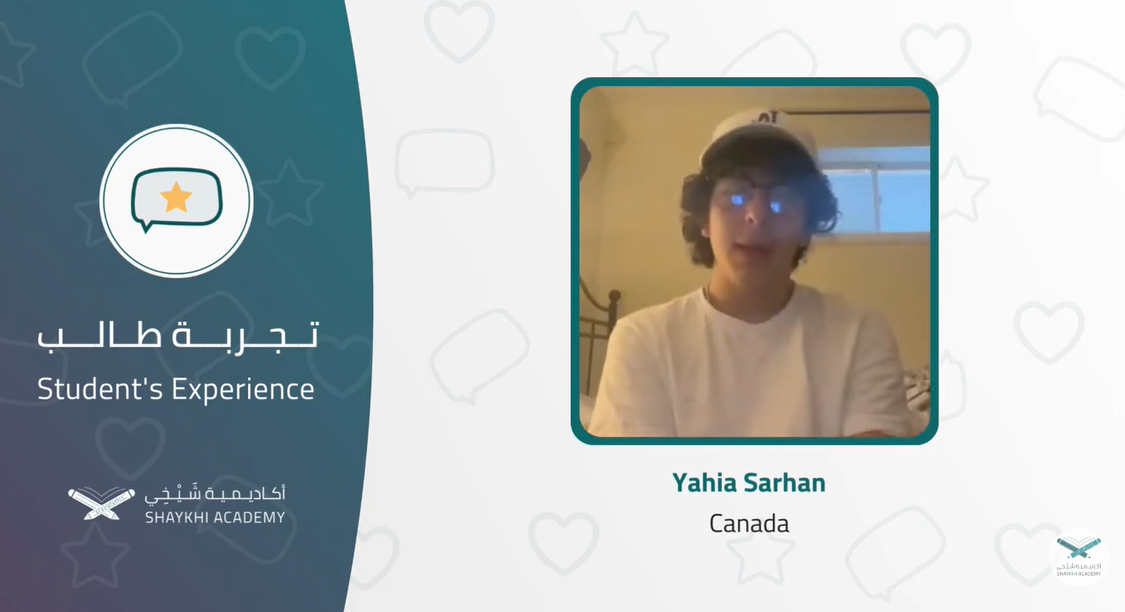
I’m Yahia Sarhan, I’m 15 years old and I’m from Canada. I’ve been a student at Shaykhi Academy since 2019, so about three or four years now. It’s been a great learning opportunity for me and I’ve learned a lot about Islamic studies, the Quran, and Arabic reading. I’d definitely recommend it to anyone who’s trying to learn.
American students gain authentic Quranic recitation skills through structured instruction, certified teachers, and flexible scheduling designed for serious learners committed to mastering Islamic knowledge.
Common questions American students ask before enrolling in The American Quran Institute's authenticated Qirat recitation program for learners nationwide.