The American Quran Institute’s Arabic classes in New York City teach Modern Standard Arabic and Quranic Arabic through structured lessons designed for real-world application. Students develop Arabic reading, Arabic writing, Arabic speaking, and Arabic listening skills through one-on-one instruction that addresses the specific challenges English speakers face when learning Arabic.
New York City’s diverse Muslim and Arab communities create practical opportunities to use Arabic beyond the classroom. Professional roles in diplomacy, international business, community outreach, and interfaith dialogue across Manhattan, Brooklyn, Queens, and the Bronx increasingly require Arabic proficiency that goes beyond basic conversational phrases.
More Details Pricing Testimonials
The American Quran Institute’s Arabic classes in New York City focus on functional Arabic language acquisition through direct instruction in Arabic grammar, vocabulary expansion, pronunciation correction, and contextual usage. Lessons cover Arabic verb conjugation patterns, noun-adjective agreement rules, sentence construction frameworks, and the distinction between formal Arabic writing and conversational Arabic speaking that students actually encounter in New York’s Arabic-speaking neighborhoods.
Students learn Arabic reading through graduated texts, Arabic writing through composition exercises with immediate correction, Arabic listening through authentic audio materials, and Arabic speaking through structured conversation practice. Classes address the specific pronunciation errors English speakers make with letters like ع, ح, ق, and the emphatic consonants that don’t exist in English phonology.
The American Quran Institute’s curriculum follows a methodical progression from foundational Arabic alphabet recognition to advanced Arabic comprehension and production skills.
New York students begin with Arabic letter recognition, distinguishing between letters that look similar but sound different (ب، ت، ث). Instruction focuses on proper articulation of sounds absent from English—the pharyngeal fricatives ع and ح, the uvular stop ق, and emphatic consonants ص، ض، ط، ظ that require tongue positioning unfamiliar to English speakers.
Lessons teach Arabic sentence structure starting with basic nominal sentences (الجملة الاسمية), then verbal sentences (الجملة الفعلية). Students learn verb conjugation across past, present, and command forms, noun-adjective gender and number agreement, and the grammatical case system (إعراب) that determines word endings in formal Arabic reading and Quranic recitation.
The American Quran Institute’s instructors teach vocabulary organized by semantic fields—family terms, food and dining, directions and transportation, religious terminology, professional vocabulary. Students learn words they’ll actually encounter in Brooklyn’s Arab commercial districts, Queens’ Yemeni restaurants, and Manhattan’s Muslim community centers, not isolated lists divorced from practical usage.
Students progress from reading voweled texts (with tashkeel) to unvoweled Arabic reading that requires grammatical knowledge to supply correct pronunciation. Arabic writing instruction covers proper letter connection in different positions, compositional structure for paragraphs and essays, and the formal register required for professional correspondence versus the simplified forms used in text messaging and social media.

Outcomes
Most Arabic texts—newspapers, books, online content—lack vowel markings. Students learn to supply correct pronunciation through grammatical pattern recognition, not memorization. This skill allows independent Arabic reading of Al Jazeera articles, Islamic texts, and social media content from Arabic-speaking friends without constant dictionary consultation or guessing.
English-trained hands struggle with Arabic's cursive requirement and right-to-left directionality. Instruction addresses common errors like disconnected letters within words, incorrect letter forms based on position (initial, medial, final, isolated), and improper spacing. Students develop muscle memory for fluent Arabic handwriting and accurate digital typing using Arabic keyboards.
English speakers initially hear ق and ك as identical, confuse ح and ه, and can't distinguish ض from ظ. The American Quran Institute's instructors use minimal pair drills (words differing by one sound) to train Arabic listening perception. Students learn to hear distinctions before reproducing them, preventing fossilized pronunciation errors that become harder to correct later.
Most adults know vocabulary but freeze when speaking. They translate mentally from English, producing grammatically incorrect Arabic or unnatural phrasing. Instruction focuses on thinking directly in Arabic through pattern practice, not translation. Students learn stock phrases for common situations, then expand them through substitution drills that build automatic production speed.
Knowing grammar rules doesn't equal using them while speaking. Students practice applying verb conjugations, gender agreement, and case endings during timed speaking exercises. This develops automatic grammatical accuracy that doesn't require conscious rule retrieval, allowing fluent Arabic conversation rather than halting, over-monitored speech production.
New York's Arabic speakers come from Egypt, Yemen, Palestine, Morocco, Syria, and other regions with distinct dialects. The American Quran Institute teaches Modern Standard Arabic as the foundation, then explains how Egyptian, Levantine, and Gulf dialects differ in pronunciation, vocabulary, and verb conjugations. This prepares students for real conversations in Brooklyn's Egyptian cafes or Queens' Yemeni community gatherings.
Why Choose us?
Individual lessons accommodate Manhattan professionals, Brooklyn parents, Queens students, and Bronx community members. Sessions adapt pacing to each learner's acquisition rate, spending extra time on pronunciation challenges or grammar concepts that need reinforcement without holding back students who grasp concepts quickly.
The American Quran Institute's tutors hold degrees in Arabic language instruction or applied linguistics. They explain grammar systematically, diagnose pronunciation errors accurately, and provide meaningful error correction. Being a native speaker doesn't automatically mean knowing how to teach Arabic to English-speaking adults effectively.
Lessons follow research-based sequencing—sounds before words, words before sentences, recognition before production. Students aren't asked to write Arabic paragraphs before mastering letter forms, or engage in conversation before learning basic verb conjugations. Each skill builds on previously mastered foundations.
Instruction prioritizes reading authentic materials, understanding spoken Arabic in community contexts, writing professional correspondence, and conversing about daily topics. Students don't spend months on classical poetry analysis if their goal is conversational fluency for community engagement or reading Quranic Arabic for religious practice.
Students in Manhattan, Brooklyn, Queens, the Bronx, or Staten Island connect from home, avoiding subway commutes to physical classroom locations. Online one-on-one instruction provides the same quality as in-person tutoring with schedule flexibility for working professionals and busy parents.
The American Quran Institute's instructors document vocabulary acquisition, grammar concept mastery, reading speed improvements, and pronunciation accuracy gains. Students receive specific feedback on errors, not vague encouragement. This data-driven approach shows exactly where proficiency is increasing and which areas need continued practice.
Students interested in Quranic recitation learn the grammatical structures and vocabulary that appear in Islamic texts. Those focused on Modern Standard Arabic for professional or academic purposes receive materials from contemporary news sources, business contexts, and formal correspondence.
Tuition remains accessible to students across income levels. The American Quran Institute doesn't inflate costs based on New York City's high cost of living while maintaining qualified instruction and structured curriculum.
Areas we serve
The American Quran Institute serves students throughout New York City—Manhattan, Brooklyn, Queens, the Bronx, Staten Island—plus learners across the United States in Los Angeles, Chicago, Houston, Philadelphia, and online students worldwide seeking qualified Arabic instruction.
Related Courses
The American Quran Institute provides Arabic instruction from beginner alphabet recognition through advanced proficiency, covering Quranic Arabic for Islamic study, Modern Standard Arabic for professional contexts, conversational Arabic skills for community engagement, and specialized Tajweed training.
The American Quran Institute's Quran Hifz for Ladies in the USA program provides structured Quran memorization training designed specifically for female students. Lessons cover Hifz techniques, retention strategies, Tajweed application during memorization, review cycles, and long-term maintenance protocols that prevent forgetting.
Explore Course
The American Quran Institute delivers Al-Azhar Quran Course in the USA, structured to reflect classical Islamic pedagogy adapted for American learners. Students engage with Quranic recitation, Tajweed mechanics, Arabic grammar foundations, and Tafsir methodology across progressive modules designed for clarity and retention.
Explore Course
The American Quran Institute's Quran classes in New York City connect learners with qualified instructors who teach Quranic recitation, Tajweed rules, Arabic reading, and Islamic studies through structured one-on-one sessions. Each Quran lesson addresses pronunciation, Makharij application, and verse comprehension, giving students clear progress markers rather than vague encouragement.
Explore CourseNew York City’s growing Arabic-speaking communities and expanding professional opportunities requiring Arabic proficiency make language acquisition both practically valuable and culturally enriching. The American Quran Institute’s structured approach develops real skills, not surface familiarity.
Testimonials
The American Quran Institute's graduates have achieved Arabic proficiency enabling professional advancement in international organizations, deeper Quran comprehension for religious practice, community leadership roles in New York's diverse Muslim populations, and academic research requiring Arabic source analysis.
I joined Shaykhi Academy to improve my Tajweed, and I noticed a steady improvement in my reading after a few weeks. The lessons are structured and easy to follow and the teachers and patient and professional. My teacher, Dr. Mahmoud explains concepts clearly and makes sure I understand before moving on. I’ve found that my pronunciation has improved during prayer and in reading Quran since starting the course. Overall my experience is very positive, and I would recommend it to others who want to improve in their Quran journey.
Asalamu Alaikum! I’m so blessed I found Shaykhi Academy. My teacher Ms. Nada is so caring and compassionate about teaching. I’ve learning and gaining lot of meaningful Islamic knowledge and mastering the Arabic Quran reading. The Service Company is very helpful, cooperative and passionated as well.
Real transformations from students who mastered the Quran with our courses
I took a class at Shaykhi Academy with Mr. Luqman, and I had a lot of fun learning with him. I even got the chance to meet him in Egypt! I learned a lot from my time with him, including Tajweed, Tahweed, Arabic reading, and Quran. I've been learning with him for about a year now. Thank you for your time.
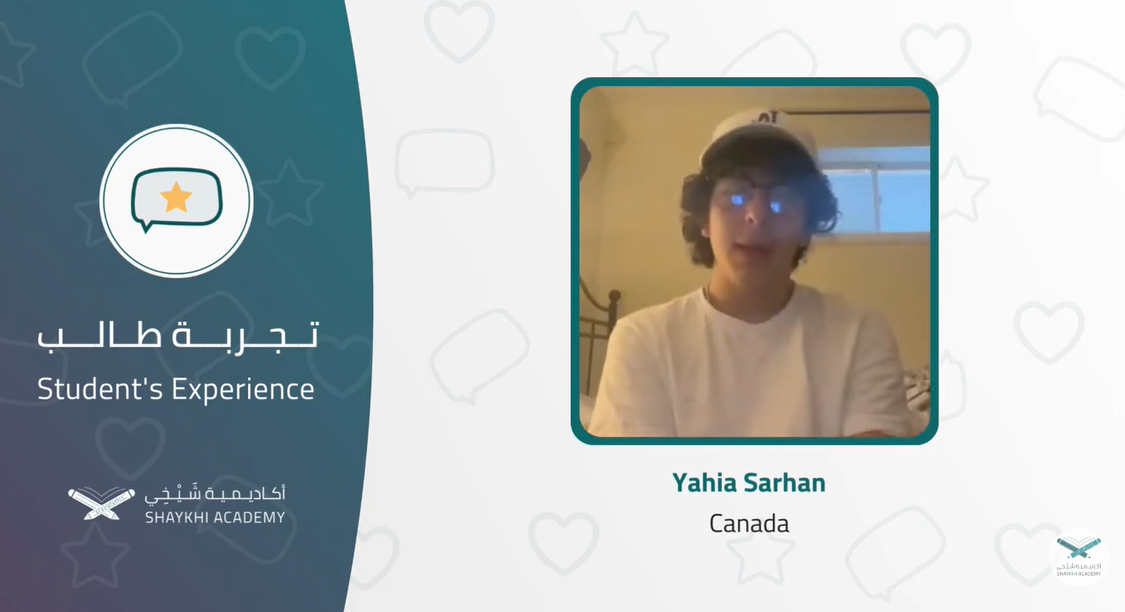
I’m Yahia Sarhan, I’m 15 years old and I’m from Canada. I’ve been a student at Shaykhi Academy since 2019, so about three or four years now. It’s been a great learning opportunity for me and I’ve learned a lot about Islamic studies, the Quran, and Arabic reading. I’d definitely recommend it to anyone who’s trying to learn.
Arabic opens professional doors, deepens religious understanding, and connects you to New York’s vibrant Arabic-speaking communities. The American Quran Institute’s one-on-one instruction provides the structured, systematic approach that produces measurable proficiency, not superficial exposure.
Common questions about The American Quran Institute's Arabic language instruction for New York City students, covering curriculum structure, scheduling flexibility, and learning outcomes.