 Quran
Quran
| Key Takeaways |
| The Arabic alphabet has 28 letters, each with up to four written forms depending on its position in a word. |
| American beginners learn the Quran alphabet fastest through systematic phonics-based methods like the Noorani Qaida. |
| Each Arabic letter is produced from a specific articulation point (makhraj) — mispronouncing it changes word meaning in the Quran. |
| Most American adults with no prior Arabic background can read basic Arabic script fluently within 8–12 weeks of consistent daily practice. |
| Online one-on-one instruction gives US-based learners immediate error correction, which self-study methods cannot replicate. |
Learning the Quran alphabet in the USA is entirely achievable for English-speaking adults, converts, and children — even with zero prior Arabic background. The key is following a structured, phonics-based sequence that teaches letter recognition, correct articulation, and connected reading as three distinct stages before you ever open the Mushaf.
This guide walks you through each stage of that process in order — from your very first exposure to Arabic letters through your first full sentences of Quranic text. Every step is designed for the realities of American learners: busy schedules, no Islamic school background, and English as your primary language of instruction.
What Is the Quran Alphabet?
The Quran alphabet consists of 28 Arabic letters, each of which changes its written form based on whether it appears at the beginning, middle, end, or in isolation within a word.
This is not the same as the Roman alphabet — Arabic is a consonantal script, meaning short vowels (harakat) are written as small diacritical marks above and below the letters rather than as full characters.
For Quranic reading specifically, these vowel markers are always present, which actually makes learning to read Quranic Arabic easier than learning standard Modern Standard Arabic — every sound is marked on the page. You are not guessing; you are decoding. That distinction matters enormously for beginners.
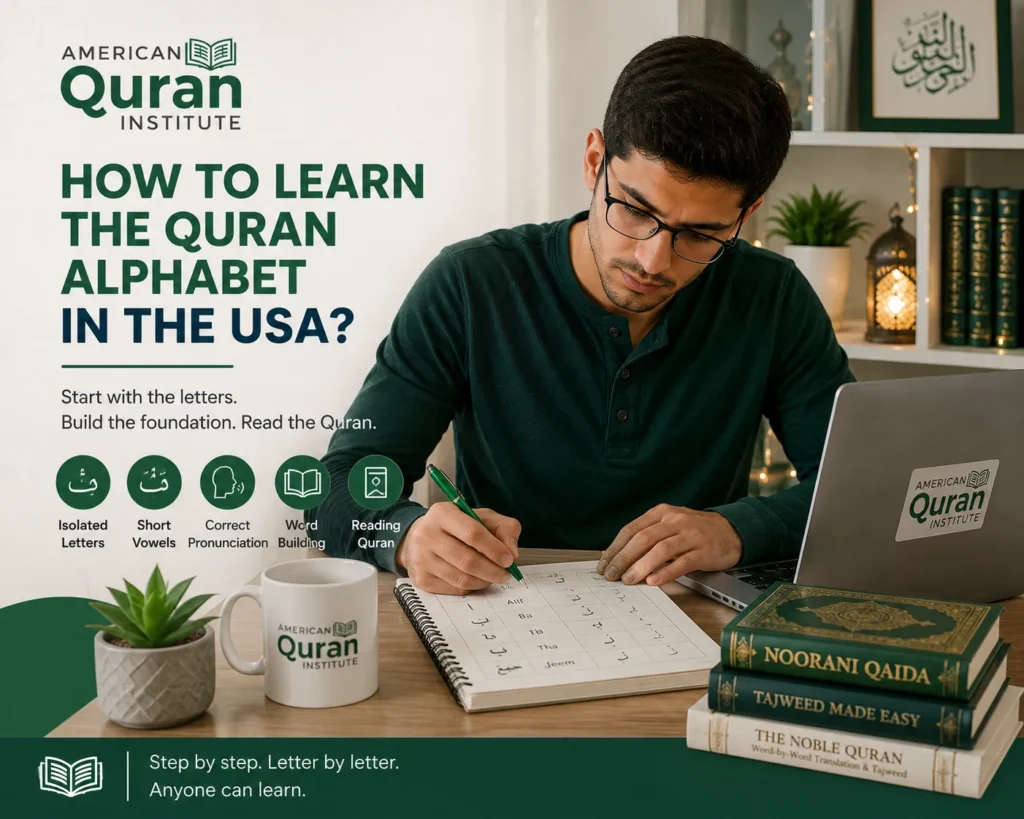
1. Learn Each Quranic Arabic Letter in Its Isolated Form
Every serious Quran alphabet curriculum — including the Noorani Qaida, the most widely used foundational text in structured Quran education — begins with isolated letter recognition. Before you connect letters or read words, you need to identify each of the 28 letters visually and name it correctly.
This step typically takes 1–2 weeks for a motivated adult learner practicing 15–20 minutes daily. Do not rush through it. In our experience at The American Quran Institute, learners who skip isolated letter mastery and move directly to connected text almost always stall within the first month — they recognize letters in the shapes they learned but fail to identify the same letters in unfamiliar positions.
Work through the letters in groups, not all at once. The traditional grouping used in the Noorani Qaida clusters visually similar letters together — for example, ب (ba), ت (ta), and ث (tha) share the same base shape and are distinguished only by the number and position of their dots.
Learning similar letters together trains your eye to spot the distinguishing features, which is the cognitive skill Quranic reading actually requires.
Shots Videos from Our Courses
Start Your Quranic Education
Join our premier online institute for structured Quranic learning tailored for students in the USA.
Book Your Free Trial2. Master the Short Vowels (Harakat) Before Moving to Words
Once you recognize the 28 letters in isolation and can approximate their articulation points, the next step is learning the vowel system. In Quranic Arabic, three short vowels are written as diacritical marks above or below the letter:
- Fathah (َ ) — the “a” sound, written as a small diagonal stroke above the letter
- Kasrah (ِ ) — the “i” sound, written as a small stroke below the letter
- Dammah (ُ ) — the “u” sound, written as a small curl above the letter
Each of these can also appear in a doubled form (tanween) at the end of words, producing the sounds “an,” “in,” and “un.” Additionally, a small circle called sukoon (ْ) indicates that a letter carries no vowel — it is silent in isolation and produces a consonant cluster with the preceding letter.
The practical reason this step comes before word-reading is simple: every letter in a Quranic text is accompanied by one of these marks. If you do not recognize them instantly, your reading pace drops to the point where your brain is processing graphic symbols rather than sounds — and you cannot build fluency from that position.
Practice by reading letter + vowel combinations in drills before you ever attempt a word. The Noorani Qaida systematizes this progression exactly.
Most American adult learners in our Noorani Qaida course in the USA can read letter-vowel combinations fluently within two to three weeks of consistent daily practice. The milestone feels small but represents genuine readiness for the next stage.
Book a FREE trial class in our Noorani Qaida classes

Read also: BEST COUNTRY TO LEARN QURAN
3. Learn the Correct Articulation Point (Makhraj) for Each Letter in the the Quran Alphabet
Recognizing a letter on the page and pronouncing it correctly are two completely separate skills. Arabic has several sounds that do not exist in English, and mispronouncing a letter in Quranic recitation is not a minor accent issue — it can alter the meaning of the word being recited.
Every Arabic letter is produced from a specific makhraj (articulation point): a location in the throat, mouth, or nasal cavity where airflow is shaped into a distinct sound.
The Arabic letter ع (ain) is produced from the middle of the throat — a sound English has no equivalent for.
The letter ح (ha) comes from the same region of the throat but with a different degree of constriction, producing the soft breathy aspirate you hear in classical recitation.
| Letter | English Approximation | Actual Makhraj | Common Beginner Error |
| ح (Ha) | None — no English equivalent | Middle of the throat | Replaced with English “h” |
| ع (Ain) | None — no English equivalent | Deep throat constriction | Replaced with glottal stop or omitted |
| ق (Qaf) | None — no English equivalent | Back of the tongue near uvula | Replaced with English “k” |
| غ (Ghain) | Like French “r” | Back of the throat (uvular) | Replaced with “g” or “r” |
| ص (Saad) | None — emphatic “s” | Front of mouth with raised back tongue | Replaced with “s” |
We consistently see this pattern with adult learners who come to us after self-study: they’ve memorized letter shapes and can name every letter correctly, but their pronunciation of ع, ح, and ق is indistinguishable.
Correcting embedded mispronunciations takes significantly longer than learning them correctly the first time. This is precisely why one-on-one instruction with immediate feedback is not optional for this step — it is the only reliable method.
The Tajweed science codifies all 28 makhaarij (plural of makhraj) into a systematic framework. Explore Tajweed course in the USA.
Start learning Tajweed with a FREE trial session

4. Learn the Long Vowels and the Madd (Elongation) System in the Quran Alphabet
Arabic distinguishes between short and long vowels, and in Quranic recitation this distinction is not optional — it is a Tajweed rule with measurable length requirements. Long vowels are formed by combining a short vowel with one of three madd letters: ا (alif), و (waw), or ي (ya).
- Fathah + alif = the long “aa” sound (held for two counts)
- Dammah + waw = the long “uu” sound (held for two counts)
- Kasrah + ya = the long “ii” sound (held for two counts)
5. Practice Letter Joining and Positional Forms in Connected Text
This is where many self-taught learners hit their first significant wall. Arabic letters connect to each other within words, and most letters change their shape depending on whether they appear at the beginning, middle, or end of a word. Six letters — ا، د، ذ، ر، ز، و — never connect to the letter following them, which affects the visual flow of the text.
| Letter | Isolated | Initial | Medial | Final |
| ب (ba) | ب | بـ | ـبـ | ـب |
| ع (ain) | ع | عـ | ـعـ | ـع |
| م (meem) | م | مـ | ـمـ | ـم |
| ن (noon) | ن | نـ | ـنـ | ـن |
The practical method for this stage is reading short Quranic words — not full verses — letter by letter and then blending them.
Start with three-letter words that use high-frequency letters: كتب, قلم, علم. Your goal is to see a connected sequence and decode it into individual letter-vowel combinations without losing track of the positional shape changes.
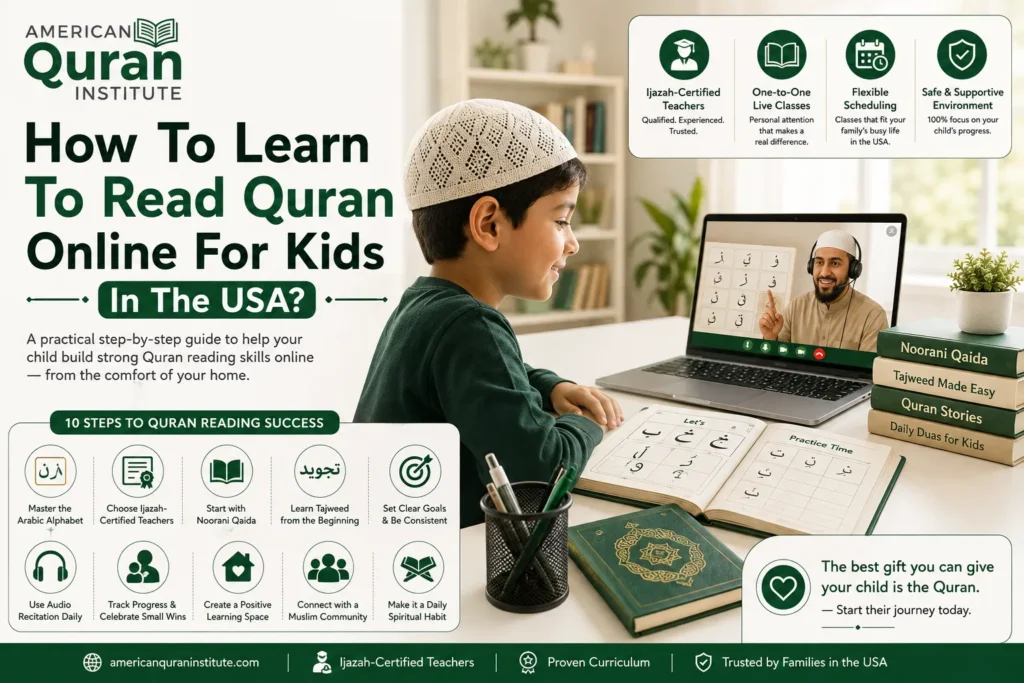
If you are a parent, the same applies to your children. Early alphabet instruction with correct articulation protects them from needing remediation later. Our Quran classes for kids in the USA gives children this foundation in an age-appropriate, structured format — and families who learn together progress faster than those who don’t.
Enroll your child in our Quran classes for kids with a FREE session

6. Read Full Words From Quranic Vocabulary
The move from individual letters to full words is its own cognitive transition. At this stage, you are no longer sounding out letter by letter — you are beginning to recognize common patterns and high-frequency Quranic words as visual units.
The most effective method here is focused Quranic vocabulary exposure. Words like الرَّحْمَٰن (the Most Gracious), الرَّحِيم (the Most Merciful), رَبّ (Lord), and الْمُسْلِمِين (the Muslims) appear dozens of times throughout the Quran. Learners who can recognize these words on sight — without decoding each letter individually — make significantly faster progress through full verses.
This is also the stage where Tajweed rules begin to apply in full. The noon sakinah (a letter noon with a sukoon) triggers different pronunciation rules depending on the letter that follows it. When followed by a ba, it produces Iqlab — the noon sound converts to a meem with nasalization.
When followed by a throat letter, the noon is pronounced clearly (Izhaar). A learner reading words in isolation will not encounter these rules yet, but awareness of them prepares you for the verse-reading stage that follows.
The American Quran Institute’s programs are designed around the reality of American life — flexible scheduling, one-on-one sessions, and instructors who understand that consistent progress matters more than speed. If you’re balancing Quran learning with a full-time job or family responsibilities, a structured program built around your schedule is far more sustainable than self-study materials alone.
Read also: LEARN QURAN BY HEART IN THE USA
7. Begin Reading Quranic Verses With Full Tajweed Application
With letter recognition, correct articulation, vowel reading, and word-level fluency in place, you are ready to read actual Quranic verses. This is where the alphabet learning that preceded it pays off — because every rule you have built is now applied to the actual text of the Quran.
Start with the short surahs of Juz Amma (the 30th part of the Quran). These surahs are short, frequently heard, and structured in ways that expose you to a wide range of Tajweed rules in small, manageable passages.
The Prophet ﷺ addressed the importance of careful recitation directly. He said:
“The one who recites the Quran skillfully will be with the noble, righteous angels, and the one who recites it and finds it difficult will have two rewards.” (Sahih Muslim 798)
This hadith is often cited as encouragement for struggling learners — and it is — but the first part is equally instructive. Skillful recitation is a specific, learnable standard. It begins with the alphabet work this guide has outlined, and it is fully achievable for American learners who follow a structured path.
For learners who want to take their recitation to the highest verifiable standard, The American Quran Institute also offers an Quran Ijazah program in the USA — certified chain transmission of Quranic recitation — for those who complete their Tajweed training at an advanced level.
Start your path to Ijazah with a FREE trial

Our Students Reviews
Start Your Quranic Education
Join our premier online institute for structured Quranic learning tailored for students in the USA.
Book Your Free TrialStart Learning the Quran Alphabet the Right Way With The American Quran Institute
Learning the Quran alphabet correctly — with proper articulation, structured vowel reading, and qualified feedback — sets the foundation for everything that follows.
Why American learners choose The American Quran Institute:
- Designed specifically for English-speaking learners — no assumed background, no skipped fundamentals
- Qualified instructors with proven teaching experience in Tajweed and foundational Arabic
- Flexible one-on-one scheduling built around full-time jobs and family life
- Structured Noorani Qaida, Tajweed, and Quran reading programs for adults, children, and families
- Welcoming environment for converts and absolute beginners
- Free trial session — no commitment required
Check out our top courses for Quran learning:
- Quran Classes for Adults
- Tajweed Classes
- Hifz Quran
- Noorani Qaida classes
- Quran classes for kids
- Hifz for Kids
- Noorani Qaida classes for kids
- Ijazah Course
Book your FREE trial session today
Conclusion
Learning the Quran alphabet is not about memorizing 28 symbols — it is about building the phonetic and visual skills that make Quranic recitation accurate and consistent. Each step in this guide builds directly on the previous one, from isolated letter recognition through full verse reading with Tajweed.
American learners have every resource they need to succeed at this. The structure exists, the instruction is available online, and the timeline is realistic — most dedicated adult learners move from zero to functional Quranic reading within three to four months.
The work is cumulative, and every correct letter you build into your practice now pays dividends through every verse you recite afterward.
Frequently Asked Questions About Learning the Quran Alphabet in the USA
How Long Does It Take to Learn the Arabic Alphabet for Quran Reading?
Most American adult learners with no prior Arabic background can recognize all 28 Arabic letters and read basic Quranic words within 3–6 weeks of consistent daily practice — roughly 20 minutes per day. Reading full verses fluently, with correct vowel marks and positional letter forms, typically requires an additional 4–6 weeks with qualified instruction.
Can I Learn the Quran Alphabet on My Own Without a Teacher?
You can memorize letter shapes independently, but correct makhraj (articulation) requires audio feedback from a qualified instructor. Mispronunciations of letters like ع, ح, and ق are extremely common in self-taught learners and become more difficult to correct the longer they are practiced. A qualified teacher catches and corrects these errors before they become embedded habits.
What Is the Noorani Qaida and Do I Need It?
The Noorani Qaida is a structured foundational text that sequences Arabic letter learning, vowel reading, letter joining, and early word reading in a phonics-based progression specifically designed for Quran learners. It is the most widely used starting curriculum in formal Quran education globally. For American beginners, it is the most reliable structured entry point to Quran alphabet learning.
Is It Too Late to Learn the Quran Alphabet as an Adult?
No. Adults who approach alphabet learning systematically — with structured materials and qualified instruction — consistently achieve functional Quranic reading fluency. The cognitive challenge is real but manageable. In our instructors’ experience, motivated adult learners often progress faster than children because they bring focused intentionality to each session that younger students are still developing.





Leave a Reply