 Quran
Quran
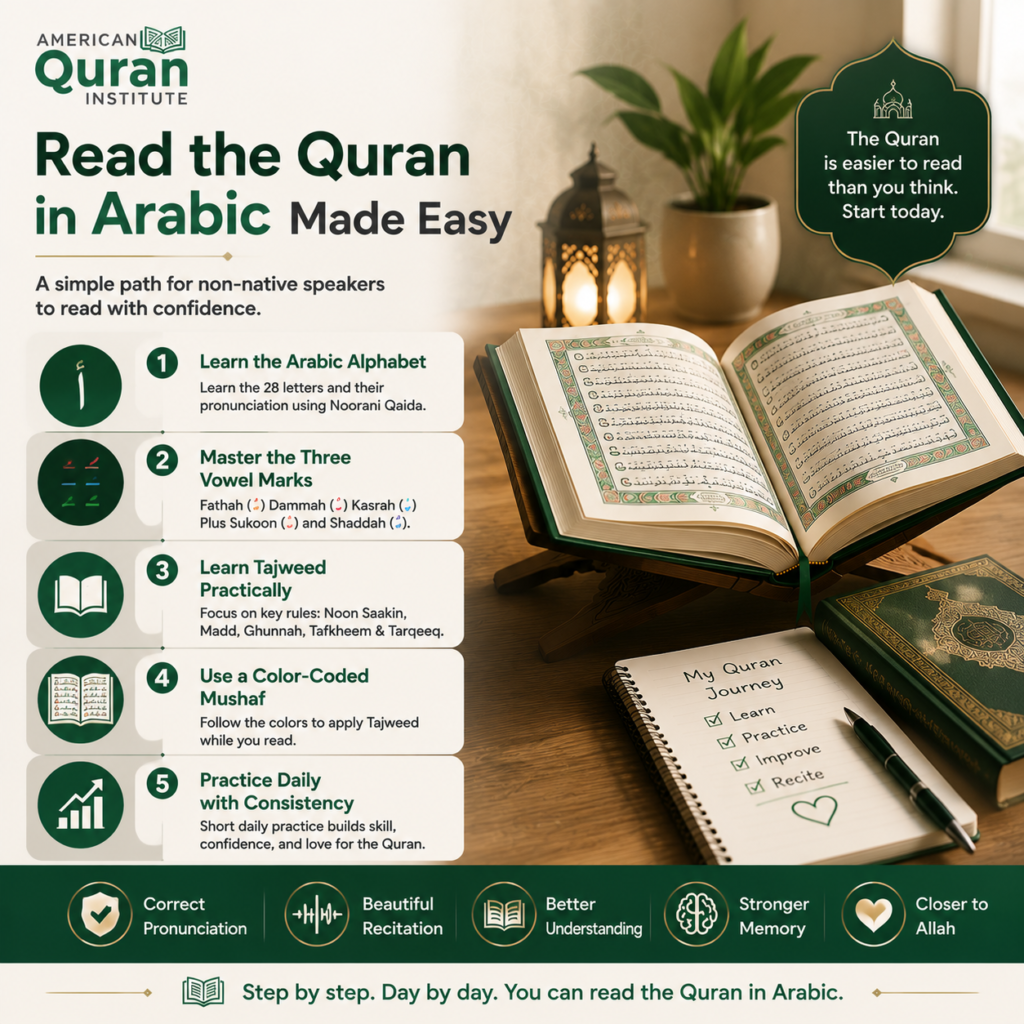
Millions of Muslims around the world want to read the Quran in Arabic — the language in which it was revealed — but feel overwhelmed before they even begin. The Arabic script looks unfamiliar, the sounds seem impossible, and the rules of Tajweed appear endless.
The good news: reading the Quran in Arabic is far more accessible than most beginners expect, especially when you follow the right sequence. Arabic Quranic reading is built on a small, learnable foundation — 28 letters, three vowel markings, and a core set of pronunciation rules — and every skilled reciter starts exactly where you are.
This is especially true for Muslims living in the United States — kids growing up in American schools, busy adults balancing work and family, Muslim women managing full schedules, and new Muslims who came to Islam without any Arabic background. No matter where you are starting from, the path is the same: structured, step-by-step, and entirely achievable.
This guide walks you through the proven sequence used by Quran teachers worldwide, with practical detail that most beginner resources leave out.
1. Start With Learning The Arabic Alphabet
Before you can read a single word of the Quran, you need to recognize the 28 Arabic letters and hear how each one sounds. This stage is not optional — skipping it leads to errors that are very hard to undo later.
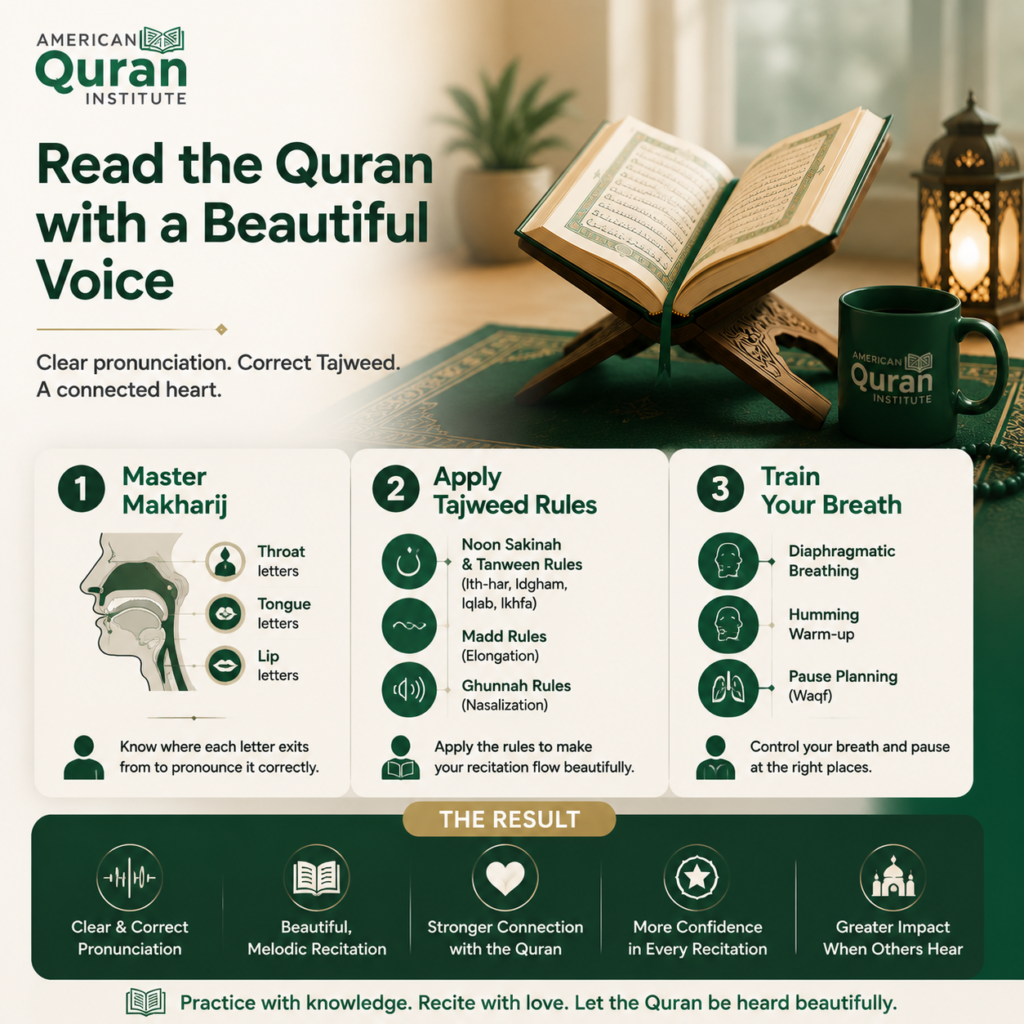
Arabic has 28 consonant letters, and each one has a fixed articulation point (makhraj) — the precise place in the mouth, throat, or lips where the sound is produced.
For example, the letter ق (Qaf) originates deep in the throat, while ب (Ba) is formed by the lips. Mixing up these points doesn’t just sound wrong — it can change the meaning of the word entirely.
The most practical starting point is the Noorani Qaida (القاعدة النورانية), a structured system designed specifically for non-native and beginner learners. It teaches each letter with all its vowel variations before moving to combinations, so you build recognition from the ground up rather than guessing through whole words.
For American kids especially, this method works because it mirrors how children learn to read in school — letter sounds before full words, building blocks before sentences. Parents who homeschool or supplement Islamic weekend school often find the Noorani Qaida slots naturally into a child’s existing learning routine.
Read also: How to Learn Quran in the USA?
2. Master the Three Vowel Marks
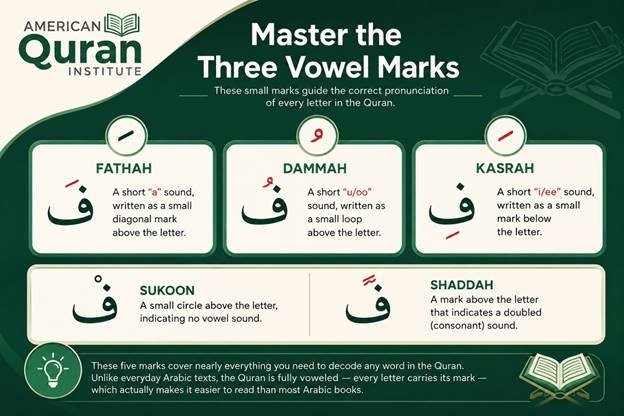
Once you can identify the letters, the next step is understanding the three short vowel marks (harakat) that tell you how to pronounce them:
- Fathah (فَ) — a short “a” sound, written as a small diagonal mark above the letter
- Dammah (فُ) — a short “u/oo” sound, written as a small loop above the letter
- Kasrah (فِ) — a short “i/ee” sound, written as a mark below the letter
There is also Sukoon (a small circle above a letter, indicating no vowel sound) and Shaddah (a doubled consonant). These five marks cover nearly everything you need to decode any word in the Quran. Unlike everyday Arabic texts, the Quran is fully voweled — every letter carries its mark — which actually makes it easier to read than most Arabic books.
A common American beginner’s mistake at this stage is reading letters in isolation without practicing them in syllables. Train your ear by listening to a teacher pronounce each letter, then repeat with your lips and tongue actively moving — silent mouthing will not build the muscle memory you need.
3. Learn Tajweed Practically, Not Theoretically
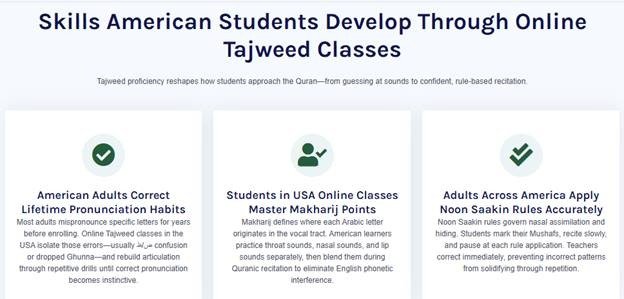
Tajweed is the science of Quranic recitation — the rules that govern how each letter is pronounced in context. Many beginners are intimidated by Tajweed because they encounter long theoretical lists before touching a single verse. The more effective approach is learning Tajweed rules while reciting, starting with the most frequently occurring rules first.
The Four Tajweed Rules That Appear Most Often
You don’t need to master all of Tajweed before you begin reading. Start with the rules you will encounter on nearly every page:
A. Noon Saakin and Tanween (النون الساكنة والتنوين)
When a noon with no vowel (نْ) or a double vowel mark (tanween) appears, four possible rules apply depending on the following letter: Ithhar (clear pronunciation), Idgham (merging), Iqlab (conversion to meem sound), or Ikhfa (hidden nasal sound). These four cases cover one of the most frequent sounds in the Quran.
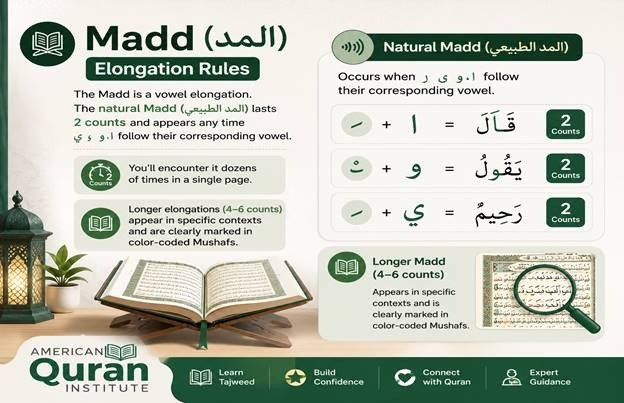
B. Madd (المد) — Elongation Rules
The Madd is a vowel elongation. The natural Madd (المد الطبيعي) lasts 2 counts and appears any time ا ، و ، ي follow their corresponding vowel. You’ll encounter it dozens of times in a single page. Longer elongations (4–6 counts) appear in specific contexts and are clearly marked in color-coded Mushafs.
C. Ghunnah (الغنة) — Nasal Sound
When noon or meem carry a Shaddah (doubling mark), you hold a nasal hum for 2 counts. This is one of the most distinctive sounds in Quranic recitation and takes about ten minutes to understand, though it takes consistent practice to make automatic.
D. Tafkheem and Tarqeeq (التفخيم والترقيق) — Heavy and Light Sounds
Certain letters are always pronounced “heavy” (with the back of the mouth raised), while others are always “light.” The letter خ (Kha) is always heavy; ي (Ya) is always light. The letter ر (Ra) and the Name of Allah (لفظ الجلالة) change between heavy and light depending on their context — a rule that surprises many beginners but follows clear, learnable patterns.
4. Use a Color-Coded Mushaf
The Tajweed Mushaf (مصحف التجويد) color-codes every Tajweed rule directly on the page. Elongations appear in one color, Ghunnah letters in another, and so on. This is not a shortcut — it’s a visual scaffold that lets you apply rules you’ve learned while reading, without having to analyze each word from scratch. As your knowledge deepens, you’ll recognize the rules by ear and won’t need the colors anymore.

5. Listen to a Certified Reciter Daily
Daily listening trains your ear to the correct sounds before your tongue tries to produce them. Scholars such as Sheikh Mahmoud Khalil Al-Husary are widely recommended for learners precisely because his recitation is deliberate and methodical — every rule is clearly audible. Sheikh Abdul Basit Abdul Samad’s tarteel recordings are another strong choice for their clarity.
Aim for 10–15 minutes of active listening daily, following along in the Mushaf. This is different from passive background listening: track each word with your finger, notice where the elongations land, and observe how pauses (waqf) work in practice.
Read also: How to Learn Quran for Kids in the USA?
For American families, this daily listening habit is easy to build into existing routines – during the school run, after Fajr, or as part of an evening wind-down before bed. Kids who hear correct recitation regularly at home absorb the sound patterns naturally, which makes formal lessons far more productive.
Read also: Quran Reading Classes in the USA
See Us in Action!
Take a look inside our virtual classrooms. Watch the clip below to see how our instructors engage with students, simplify complex rules, and create an inspiring environment for learning.
Start Your Quranic Education
Join our premier online institute for structured Quranic learning tailored for students in the USA.
Book Your Free Trial6. Find a Teacher with a Connected Chain (Isnad)
One detail most beginner articles skip: not every Quran teacher is the same. A qualified teacher should hold an Ijazah — a formal certification showing they learned from a teacher who learned from a teacher, in an unbroken chain reaching back to the Prophet ﷺ. This is not a formality. It is how the Quran has been protected from distortion for over 1,400 years.
When evaluating an online Quran teacher, ask specifically whether they hold an Ijazah in the Hafs ‘an ‘Asim recitation (the most widely used riwayah globally). A certified teacher will not only correct your pronunciation but will catch errors you cannot hear yourself.

American Quran Institute, based in the USA, connects American Muslims — children, adults, ladies, and new Muslims — with Ijazah-certified teachers who specialize in guiding English speakers from the Arabic alphabet through fluent recitation. All classes are live and online, scheduled around US time zones so there’s no need to compromise your work, school, or family commitments.
7. Practice An Organized Plan Customized for Every American Learner
The right practice sequence differs slightly depending on who you are. Here is how to approach it based on your situation.
A. For American Kids
Children learn best through repetition, short sessions, and hearing before reading. Keep daily practice to 15–20 minutes maximum. Start with letter recognition using the Noorani Qaida, then move to reading Surah Al-Fatiha — the surah every child hears in every prayer. A live teacher who knows how to keep young learners engaged makes the difference between a child who loves Quran time and one who dreads it.
B. For American Adults
Adults often feel they have left it too late. They haven’t. Adult learners actually have one significant advantage: they understand why each rule exists, which speeds up Tajweed learning considerably. The main challenge for adults is finding consistent time. Twenty minutes three to four times a week, at a fixed time, produces better results than longer irregular sessions. Online lessons that fit around a US work schedule make this genuinely manageable.
C. For Muslim Ladies in the USA
Many Muslim women in America prefer to learn with a female teacher in a comfortable, judgment-free environment. This is a completely valid and well-supported preference — female Ijazah-certified teachers are available and teach through dedicated women’s programs. Flexible scheduling around family and home responsibilities is essential, and a good online institute will offer morning, afternoon, and evening slots to accommodate this.
Book Your Free Trial Lesson of Quran Reading Classes in the USA

D. For New Muslims
Reverts to Islam often come to the Quran with zero Arabic background and a genuine urgency to read the words of Allah directly. The structured beginner sequence in this guide — letters, vowel marks, Tajweed basics, short surahs — is exactly right for new Muslims. Starting with Al-Fatiha and the short surahs of Juz ‘Amma gives you everything you need for daily prayer while you build toward reading the full Quran.
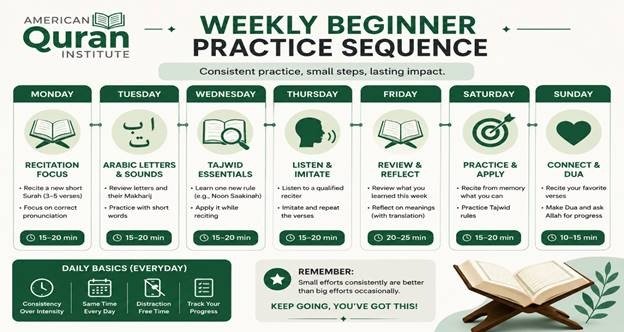
8. A Proven Practice Routine for Quran Beginners
Regardless of your background, this weekly structure works:
Week 1–2: Learn the Quran alphabet with their vowel marks using the Noorani Qaida. Do not move to full words until you can read any letter-vowel combination on sight without hesitating.
Week 3–4: Read short, fully-voweled words from Surah Al-Fatiha and the short surahs of Juz ‘Amma (the 30th part of the Quran). These chapters are short, heavily repeated in daily prayer, and contain the most common Tajweed patterns.
Week 5 onward: Add one Tajweed rule per week, applied in context while reading. Do not try to memorize all rules before reciting — this is the approach that causes most adult beginners to quit.
Daily habit: Record yourself reciting, then listen back. The gap between how you think you sound and how you actually sound is where most of your errors live. Your teacher can also review these recordings between sessions.
Experience Our Classroom Environment
Don’t just take our word for it—experience a live session for yourself! Click on the videos below to watch real snippets from our classes and see our interactive teaching methods in real-time.
Start Your Quranic Education
Join our premier online institute for structured Quranic learning tailored for students in the USA.
Book Your Free TrialStart Reading the Quran in Arabic Today
You’ve been meaning to do this. You know the reward is immense, and you know every day you wait is another day without that connection.
The only real barrier is starting without a plan — and now you have one.
At the American Quran Institute, our Ijazah-certified teachers have helped hundreds of English-speaking Muslims go from not knowing a single Arabic letter to reading the Quran with correct Tajweed. Classes are live, one-on-one, and scheduled around your time zone. Your first session is a free assessment — no commitment, no pressure.
Check out our top courses for Quran learning:
- Weekend Quran Classes
- Quran Classes for Adults
- Quran Classes for Females
- Hifz Quran
- Online Tajweed Classes
- Ijazah Course
- Quran Tafsir Course
Start Your Quranic Education
Join our premier online institute for structured Quranic learning tailored for students in the USA.
Book Your Free TrialConclusion
Reading the Quran in Arabic follows a clear, learnable sequence: master the 28 Arabic letters and their vowel marks first, then learn Tajweed rules by applying them during real recitation rather than memorizing theory in isolation.
Listen to certified reciters daily, practice with a color-coded Mushaf, and — most importantly — read regularly in front of a qualified teacher who can catch errors before they become habits.
The Arabic of the Quran is fully voweled and follows consistent phonetic rules, which makes it more accessible than everyday Arabic for beginners. Start with Surah Al-Fatiha and the short surahs of Juz ‘Amma, and you’ll cover the most common Tajweed patterns in a small amount of text.
For American Muslims — whether you’re a parent teaching your child, an adult returning to the Quran after years away, a sister looking for a comfortable learning space, or a new Muslim starting from scratch — the path is the same, and it is entirely within reach.
Progress in Quranic reading is measured in weeks, not years — for learners who follow the right sequence with proper guidance.
Frequently Asked Questions
Can I learn to read the Quran in Arabic without knowing the Arabic language?
Yes. Reading the Quran in Arabic and speaking Arabic are two separate skills. Quranic Arabic is fully voweled, phonetically consistent, and taught through its own structured system (Tajweed). Millions of Muslims worldwide — including many American Muslims — recite the Quran fluently in Arabic without speaking it conversationally, because the focus is on correct pronunciation rather than grammatical comprehension.
How long does it take to read the Quran in Arabic for beginners?
Most adult beginners can read short surahs with basic Tajweed within 3–6 months of consistent practice — typically 20–30 minutes a day with a qualified teacher. The timeline depends heavily on regularity: five sessions a week produces far faster results than one long session on weekends.
Do I need a physical Quran or can I use an app?
Both work, but they serve different purposes. A physical color-coded Tajweed Mushaf trains your eyes to track text the way you’ll read in prayer. Quran apps are excellent for listening to certified reciters and for reviewing on the go. Most serious learners use both.
Is Tajweed obligatory for reading the Quran?
Scholars of Islamic jurisprudence hold that reciting the Quran with proper Tajweed is an individual obligation (fard ‘ayn) for every Muslim who recites it. Making occasional errors while genuinely learning is excused — the Prophet ﷺ said the one who struggles to recite the Quran earns double reward. The obligation applies to deliberate, avoidable errors, which is why learning correctly from the start matters.
What does “Hafs ‘an ‘Asim” mean, and why does it matter?
Hafs ‘an ‘Asim is the most widely used recitation transmission (riwayah) of the Quran — the one printed in the vast majority of Mushafs worldwide, including in the United States. When you begin learning, start with Hafs ‘an ‘Asim so that your teacher, your Mushaf, and the recordings you listen to are all aligned. Switching between different riwayat before mastering one causes significant confusion for beginners.






Leave a Reply