The American Quran Institute operates as an online Arabic academy serving students across the United States with structured, one-on-one instruction. Lessons cover Arabic phonetics, grammar fundamentals, conversational patterns, and vocabulary building through direct interaction with qualified Arabic instructors.
American learners gain practical Arabic skills applicable in professional settings, community engagement, and interfaith dialogue. The curriculum addresses specific challenges English speakers face when acquiring Arabic pronunciation, sentence structure, and script recognition.
More Details Pricing Testimonials

The American Quran Institute’s online Arabic academy in the USA teaches Arabic reading, Arabic writing, Arabic listening, and Arabic speaking through individualized lesson plans. Students work through Arabic alphabet recognition, vowel markings, grammatical cases, verb conjugations, and sentence construction with assigned instructors.
Lessons include Arabic dictation exercises, live conversation practice, reading comprehension drills, and written composition tasks. Instructors adjust pacing based on student performance, focusing on areas where English speakers typically struggle—emphatic consonants, pharyngeal sounds, and dual forms.
The American Quran Institute’s curriculum follows a staged progression from foundational Arabic literacy through advanced grammatical application and spontaneous conversation.
Most English speakers cannot distinguish ح from ه in their first six weeks—not from lack of effort, but because English offers no equivalent contrast. Instructors isolate these sounds, drill them separately, then embed them in words students already recognize. Throat position matters more than repetition count.
Students learn nominal sentences before verbal ones. They practice subject-predicate agreement with visible case endings before moving to implicit grammatical relationships. The sequence mirrors how Arabic children acquire grammar—concrete structures first, abstract rules later when patterns are already familiar.
Adult learners often hesitate mid-sentence, searching for the perfect verb form. Instructors don’t correct immediately. They let the student finish, then revisit the verb choice afterward. Fluency builds when students stop translating internally and start thinking in Arabic sentence structures.
Students read short texts aloud, then write summaries in Arabic without translating from English. This forces them to work within their current vocabulary rather than reaching for a dictionary every sentence. Constraint accelerates fluency—students learn to communicate with what they know, not what they wish they knew.
Outcomes
Students read Arabic texts directly without needing English letter equivalents. They recognize word patterns, identify root letters, and infer meaning from context. This happens around month four for most adult learners—earlier for students with prior exposure to inflected languages.
Learners move from rehearsed dialogues to unrehearsed exchanges. They ask clarifying questions in Arabic, respond to unexpected topics, and sustain multi-turn conversations without reverting to English. Business professionals apply these skills in client meetings, community events, and interfaith discussions across American cities.
Students apply grammatical rules in real sentences rather than memorizing charts. They distinguish between definite and indefinite nouns in context, select correct verb forms for different subjects, and construct complex sentences with dependent clauses. Grammar becomes a tool for expression, not an obstacle to it.
Students compose emails, reports, and formal correspondence in Arabic. They learn register differences—how formal Arabic differs from conversational Arabic, when to use classical vocabulary versus modern terms. Lawyers, educators, and healthcare workers use these skills in their daily professional interactions across diverse American communities.
Learners identify whether spoken Arabic follows Egyptian, Levantine, or Gulf patterns. They maintain Modern Standard Arabic as their foundation while understanding dialectical variations they encounter in American mosques, businesses, and community centers. Recognition matters more than production—they don't need to speak every dialect, just comprehend them.
Students acquire vocabulary through thematic clusters rather than random lists. They learn food vocabulary while discussing recipes, medical terms during health scenarios, legal terminology through document review. Each word arrives with context, usage examples, and common collocations—making retention automatic rather than forced.
Why Choose us?
Every lesson adjusts to student progress. Instructors identify specific pronunciation errors, grammatical confusion, or vocabulary gaps, then address them immediately rather than following a rigid syllabus.
Instructors hold degrees in Arabic linguistics, Islamic studies, or language education. They've taught students from New York to Los Angeles, understanding regional American accents and how they affect Arabic pronunciation.
Lessons schedule around jobs, school, family obligations. Students in Chicago, Houston, Phoenix book sessions that fit their availability—early morning, lunch breaks, late evening.
The American Quran Institute's curriculum meets students where American life requires Arabic—business communication, healthcare interpretation, legal documentation, academic research, community leadership roles.
Students receive written evaluations every eight lessons. Instructors document which skills improved, which need more practice, and what the next four weeks should prioritize.
Pricing remains accessible without sacrificing instruction quality. Payment plans accommodate students, families, professionals managing education budgets alongside other financial responsibilities.
Instructors explain how Arabic functions in American contexts—mosques, halal businesses, interfaith events, professional settings. Students learn language that works in their actual lives, not just textbook scenarios.
Students start unable to read Arabic script and finish conducting business meetings in Arabic. Others begin with basic conversation and progress to reading classical texts independently.
Areas we serve in The USA
The American Quran Institute serves Arabic learners throughout the United States—including New York, Los Angeles, Chicago, Houston, Dallas, Phoenix—and internationally for students accessing instruction online.
Related Courses
The American Quran Institute teaches Quranic Arabic, Modern Standard Arabic, conversational Arabic, and specialized professional tracks across all proficiency levels from complete beginner to advanced fluency.
The American Quran Institute's Classical Arabic Course in the USA gives serious learners direct access to the language of the Quran, pre-Islamic poetry, and centuries of Islamic scholarship. Arabic Lessons cover Classical Arabic grammar, morphology (sarf), vocabulary patterns, and sentence analysis delivered through structured, one-on-one online sessions.
Explore Course
The American Quran Institute's Arabic Course for Beginners in the USA starts where most courses don't start, before the script, listening to letters. Lessons cover the Arabic alphabet, foundational Arabic pronunciation, Arabic reading basics, and essential Quranic Arabic vocabulary. No prior knowledge assumed. Just a consistent schedule and a clear starting point.
Explore Course
The American Quran Institute's online Arabic course in the USA equips American learners with Arabic grammar, Modern Standard Arabic conversation, and Quranic vocabulary. Students progress through structured lessons covering Arabic script mastery, sentence construction, verb conjugation patterns, and practical communication skills for real-world application.
Explore CourseAmerican students across all backgrounds, ages, and proficiency levels build real Arabic skills through structured, individualized instruction designed for measurable outcomes.
Testimonials
Graduates of The American Quran Institute's online Arabic academy have advanced professionally, engaged deeper in American Muslim communities, and achieved personal fluency goals across the United States.
I joined Shaykhi Academy to improve my Tajweed, and I noticed a steady improvement in my reading after a few weeks. The lessons are structured and easy to follow and the teachers and patient and professional. My teacher, Dr. Mahmoud explains concepts clearly and makes sure I understand before moving on. I’ve found that my pronunciation has improved during prayer and in reading Quran since starting the course. Overall my experience is very positive, and I would recommend it to others who want to improve in their Quran journey.
Asalamu Alaikum! I’m so blessed I found Shaykhi Academy. My teacher Ms. Nada is so caring and compassionate about teaching. I’ve learning and gaining lot of meaningful Islamic knowledge and mastering the Arabic Quran reading. The Service Company is very helpful, cooperative and passionated as well.
Real transformations from students who mastered the Quran with our courses
I took a class at Shaykhi Academy with Mr. Luqman, and I had a lot of fun learning with him. I even got the chance to meet him in Egypt! I learned a lot from my time with him, including Tajweed, Tahweed, Arabic reading, and Quran. I've been learning with him for about a year now. Thank you for your time.
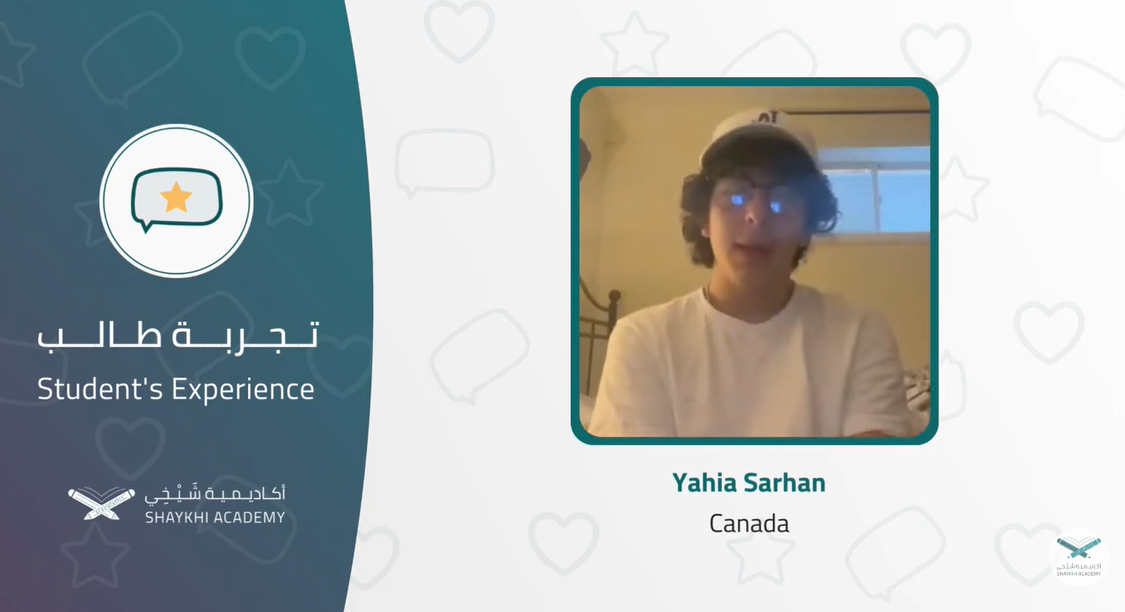
I’m Yahia Sarhan, I’m 15 years old and I’m from Canada. I’ve been a student at Shaykhi Academy since 2019, so about three or four years now. It’s been a great learning opportunity for me and I’ve learned a lot about Islamic studies, the Quran, and Arabic reading. I’d definitely recommend it to anyone who’s trying to learn.
Qualified instructors, structured curriculum, and individualized attention help American students achieve Arabic proficiency through The American Quran Institute’s online academy.
These questions address common concerns from serious learners considering The American Quran Institute's online Arabic academy programs across the United States.