 Quran
Quran

| Key Takeaways |
| Children as young as 4–5 can begin Quran learning with Arabic letter recognition through Noorani Qaida before progressing to full reading. |
| Structured online programs with qualified instructors consistently outperform self-teaching apps for building accurate Tajweed from the start. |
| Memorization should only begin after a child can read Arabic fluently — rushing Hifz before reading readiness creates long-term retention problems. |
| Short daily sessions of 15–20 minutes produce better results for children than longer, infrequent lessons spaced across the week. |
| American Muslim parents should prioritize programs built for English-speaking kids — not platforms designed for Arabic-speaking countries. |
Teaching your child to learn Quran in the USA is entirely achievable with the right structure, the right instructor, and realistic expectations about how children actually learn. The path runs through three clear stages: Arabic letter recognition, accurate Quran reading with Tajweed, and — when the child is ready — memorization.
This guide gives you a practical, step-by-step roadmap for each stage. It covers what age to start, which curriculum to use, how to find qualified instruction, and how to build habits that last — written specifically for American Muslim families navigating this without a traditional Islamic school down the street.
Step 1: Start at the Right Age With the Right Foundation
The right starting age for Quran learning is between 4 and 6 years old, beginning with Arabic letter recognition — not Quran recitation. At this stage, the goal is familiarity with Arabic script, basic sounds, and the concept of Quran as something special and worth learning.
Rushing into recitation before this foundation is solid creates confusion that takes years to undo.
Most children between 4 and 5 are ready for short, playful Arabic letter sessions — 10 to 15 minutes maximum. By age 6 to 7, they can handle structured lessons with a qualified teacher.
The key signal that a child is ready to advance is not age — it is whether they can recognize all 28 Arabic letters and their short vowel forms confidently.
Starting too early with rigid expectations is one of the most common mistakes we see from well-intentioned parents. The child who associates Quran time with pressure at age 5 is the teenager who resists it at 15.
Read also: HOW TO LEARN THE QURAN BY YOURSELF IN THE USA?
Step 2: Begin With Noorani Qaida
Noorani Qaida is the foundational curriculum every child needs before touching the Quran directly — and it works because it teaches Arabic sounds in the exact sequence needed for Quranic recitation.
It starts with individual letters, moves through vowel combinations, then introduces compound sounds, tanween, and basic Tajweed markers in a logical progression children can follow.
No app, no YouTube playlist, and no parent-led flashcard system replaces a qualified teacher guiding a child through Noorani Qaida.
The reason is pronunciation: Arabic makhaarij (articulation points) require live correction. A child who mispronounces ح as ه or ع as a simple glottal stop needs an instructor to catch and correct it immediately — not at the end of a session, and not six months later.
What Noorani Qaida Covers
| Stage | Content | Approximate Duration |
| Letters | All 28 Arabic letters, isolated and joined | 2–4 weeks |
| Vowels | Fatha, kasra, damma — short and long | 2–3 weeks |
| Tanween | Double vowel endings, nunation | 1–2 weeks |
| Compound Sounds | Mushaddad, madd, sukoon combinations | 3–5 weeks |
| Basic Tajweed Markers | Qalqalah letters, ghunnah introduction | 2–4 weeks |
Timelines vary based on session frequency and the child’s pace. Most children complete Noorani Qaida in 3 to 6 months with consistent weekly instruction.
Our Noorani Qaida for Kids program at The American Quran Institute is structured specifically for young American learners — English-speaking instruction, age-appropriate pacing, and qualified teachers who understand how children in the US actually learn.
Enroll your child in our Noorani Qaida classes for kids with a FREE session

Step 3: Move Into Quran Reading With Tajweed From Day One
Once a child completes Noorani Qaida, they are ready to begin reading directly from the Quran — starting with shorter Surahs and building upward. The transition point is clear: the child can read any Arabic combination presented to them without sounding out letters individually. Fluency, not memorization of the Qaida pages, is the signal.
Tajweed must be introduced at this stage — not deferred until later. Children who learn to read the Quran without Tajweed accuracy develop deeply embedded habits that are genuinely difficult to correct.
In our experience working with American kids who learned from apps or informal home instruction, the most consistent issue is noon sakinah and tanween rules — specifically Ikhfa and Idghaam — which get skipped or approximated and then become the child’s default for years.
The Core Tajweed Rules Children Learn at This Stage
- Noon Sakinah and Tanween rules: Izhaar, Idghaam, Ikhfa, and Iqlab — each with a distinct articulation pattern
- Meem Sakinah rules: Ikhfa Shafawi, Idghaam Shafawi, and Izhaar Shafawi
- Madd rules: Natural madd (2 counts), necessary madd, and connected madd
- Qalqalah: The echo on the five letters — ق ط ب ج د — at sukoon and waqf positions
- Laam and Raa: Tafkhim (heavy) and Tarqiq (light) pronunciation conditions
The Tajweed for Kids program at The American Quran Institute introduces Tajweed rules contextually — as the child encounters them in actual Quranic text, not as abstract theory. That is the right sequence for children.
Enroll your child in our Tajweed classes for kids with a FREE session
Read also: How to Read the Quran? A Step-by-Step Guide for American Beginners

Step 4: Build a Daily Practice Habit to Learn Quran for Kids in the USA
Consistent short sessions produce better results than long infrequent ones — and for children, this is especially true.
A child practicing Quran reading for 15 to 20 minutes every day will outpace a child doing one-hour sessions twice a week, every time.
The brain consolidates language learning during rest periods between sessions, and children’s attention spans make daily short practice the practical choice.
The most effective habit structure for school-age American Muslim children combines a weekly session with a qualified instructor and daily 15-minute review at home.
The instructor session introduces new material and corrects errors. The daily review reinforces what was introduced.
A Realistic Weekly Practice Schedule for Children
| Day | Activity | Duration |
| Instructor session day | New lesson + corrections | 30 minutes |
| Day after lesson | Repeat new material aloud | 15 minutes |
| Mid-week | Review last two lessons | 15 minutes |
| Day before next lesson | Full review of current week | 20 minutes |
| Weekend | Free recitation — Surahs child knows | 10–15 minutes |
Parents often ask how involved they need to be. The answer is: significantly, especially in the first year. A parent who listens to the child’s daily review — even without knowing Arabic — provides accountability that no app can replicate.
Shots Videos from Our Courses
Start Your Quranic Education
Join our premier online institute for structured Quranic learning tailored for students in the USA.
Book Your Free TrialStep 5: Introduce Memorization Only After Reading Is Solid
Quran memorization — Hifz — should begin only after a child reads Arabic fluently with correct Tajweed. This is the point where memorization becomes an asset rather than a shortcut.
Children who memorize before they can read fluently learn pronunciation errors alongside the text, and those errors become the memorized version.
A practical readiness benchmark: the child can open any page of Juz Amma, read any Surah they have not previously memorized, and produce recognizable Tajweed without prompting. If they can do that, they are ready to begin Hifz.
Our Kids Quran Memorization Program at The American Quran Institute structures memorization in manageable daily portions with consistent review built into every session — because new memorization without review is the most common reason children lose what they worked hard to memorize.
Start your child’s Hifz path with a FREE trial session

How Much Should a Child Memorize Per Day?
- Ages 5–7: 3 to 5 short lines per session, heavy on repetition
- Ages 8–11: Half a page or less — quality over quantity
- Ages 12+: Up to one page per session if reading fluency is strong
Review must equal or exceed new memorization time. The ratio that consistently works: one part new memorization, two parts review of previously memorized material.
Step 6: Find a Qualified Instructor — What to Look For
The most important decision in your child’s Quran education is the quality of the instructor — not the platform, not the app, and not the curriculum materials.
A qualified instructor catches errors in real time, adjusts pace to the child’s needs, and builds the relationship that keeps children engaged over years.
For American Muslim families, the most practical and consistent option in 2025 is online one-on-one instruction with a qualified teacher.
Access to certified Tajweed instructors is no longer limited by geography. The question is knowing what qualifications actually matter.
What to Look For in a Quran Teacher for Kids
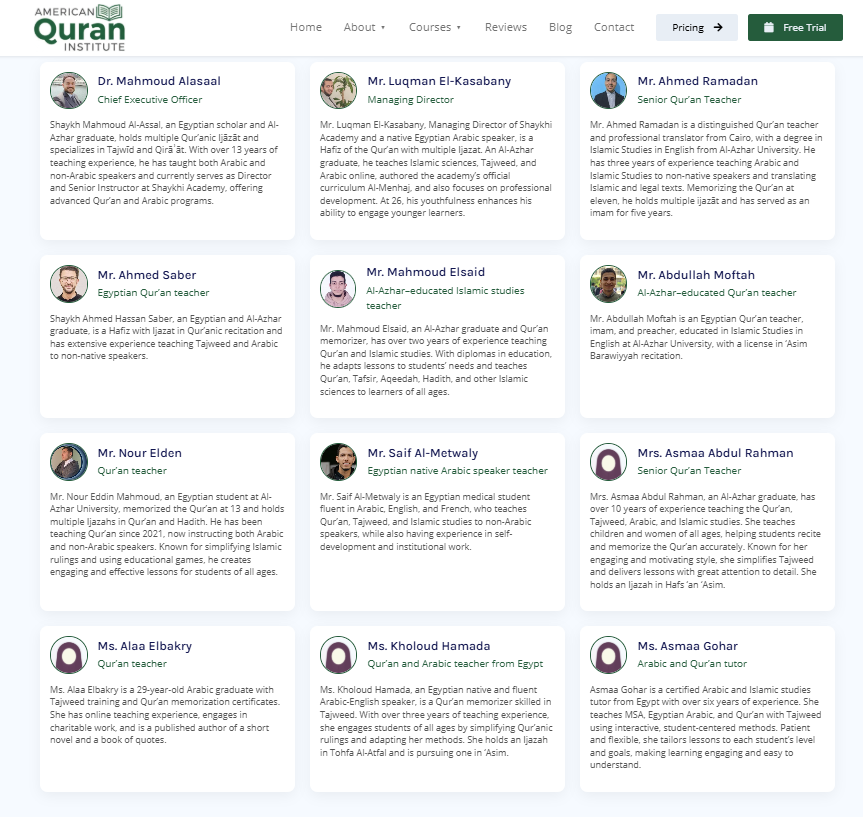
- Ijazah in Tajweed — a certified chain of transmission verifying the instructor learned from a qualified teacher themselves. This is the gold standard. Our Ijazah program gives you a sense of what that certification actually involves.
- Experience teaching children specifically — not just adult learners. The pedagogical approach is genuinely different.
- English-medium instruction — for American children, explanations in English produce faster comprehension and fewer gaps.
- Regular feedback to parents — you should know what your child covered, what errors were corrected, and what to practice at home.
Book a FREE session with one of our Ijazah-certified teachers
Step 7: Support Learning at Home Without Knowing Arabic Yourself
You do not need to know Arabic to support your child’s Quran learning — but you do need to create the right environment. The two most impactful things a parent can do are: establish a consistent time for daily review, and listen without correcting pronunciation errors you cannot identify.
Playing Quran recitation in the home — particularly from a skilled reciter using Hafs ‘an ‘Asim recitation, the standard taught in most American Islamic schools — builds phonetic familiarity passively.
Children absorb correct pronunciation through exposure in ways that are difficult to measure but consistently observable over time.
What parents should avoid: correcting their child’s Tajweed based on memory from their own childhood instruction, especially if that instruction was informal.
Well-meaning corrections of errors that are not actually errors — or missing errors that are real — undermine the instructor’s work. Leave technical corrections to the qualified teacher.
Our Students Reviews
Start Your Quranic Education
Join our premier online institute for structured Quranic learning tailored for students in the USA.
Book Your Free TrialStart Your Child’s Quran Education With Qualified Instruction at The American Quran Institute
Every child can learn Quran correctly with the right structure and the right teacher — the path is clear, and the starting point is available right now.
The American Quran Institute provides:
- Qualified instructors with Ijazah certification and experience teaching American children
- Structured curriculum from Noorani Qaida through Tajweed and Hifz
- English-medium one-on-one sessions built around your family’s schedule
- Programs designed for American Muslim families — no prior Arabic background required
- Free trial session — no commitment, no pressure
Check out our top courses for Quran learning:
- Quran Classes for Adults
- Tajweed Classes
- Hifz Quran
- Noorani Qaida classes
- Quran classes for kids
- Hifz for Kids
- Noorani Qaida classes for kids
- Ijazah Course
Book your FREE trial session today

Read Also: How to Learn Quran in the USA?
Frequently Asked Questions About Learning Quran for Kids in the USA
What Age Should a Child Start Learning Quran in the USA?
Most children are ready to begin Arabic letter recognition between ages 4 and 6 through Noorani Qaida. Structured Quran reading with Tajweed typically begins around age 6 to 7. Starting too early with rigid expectations is counterproductive — readiness signals matter more than a specific age.
Is Online Quran Learning Effective for Young Children?
Online one-on-one Quran instruction is highly effective for children when sessions are structured, the instructor is qualified, and parents support daily review at home. Group classes or self-study apps are significantly less effective because they cannot provide real-time pronunciation correction, which is the core of early Quran education.
How Long Does It Take for a Child to Finish Noorani Qaida?
Most children complete Noorani Qaida in 3 to 6 months with consistent weekly sessions and daily home review. Pace depends on session frequency, the child’s age, and how consistently they practice between lessons. Rushing through Noorani Qaida to start Quran reading earlier is a common mistake — it creates pronunciation gaps that require correction later.
Should Children Learn Tajweed Rules Before Memorizing the Quran?
Yes — Tajweed accuracy should be established before memorization begins. Children who memorize without correct Tajweed encode pronunciation errors into long-term memory. Correcting memorized text with embedded errors is significantly harder than learning it correctly the first time. Reading fluency with Tajweed is the prerequisite for effective Hifz.
How Can American Parents Support Quran Learning at Home Without Knowing Arabic?
American parents support their child’s Quran learning most effectively by maintaining a consistent daily review schedule, listening attentively without making technical corrections, and playing authentic Quran recitation in the home regularly. You do not need Arabic knowledge to provide accountability, encouragement, and a distraction-free environment for daily practice.






Leave a Reply