 Quran
Quran
| Key Takeaways |
| You can learn the Quran by yourself in the USA using structured digital resources, but qualified feedback prevents ingrained errors. |
| Start with Noorani Qaida before attempting Quran recitation — skipping foundational letter recognition creates persistent pronunciation problems. |
| Tajweed rules like ghunnah, ikhfa, and qalqalah require audio modeling; text-based self-study alone cannot develop accurate recitation mechanics. |
| American adult learners typically reach independent recitation within 6–12 months when following a daily 20–30 minute structured practice routine. |
| Online one-on-one instruction from qualified instructors combines the flexibility of self-study with the correction accuracy that solo learning cannot provide. |
The path to learn the Quran by yourself in the USA is real and accessible, even if you have no prior Arabic background. But “by yourself” works best when it includes qualified feedback at key stages — not because you can’t learn independently, but because certain foundational errors become permanent without correction.
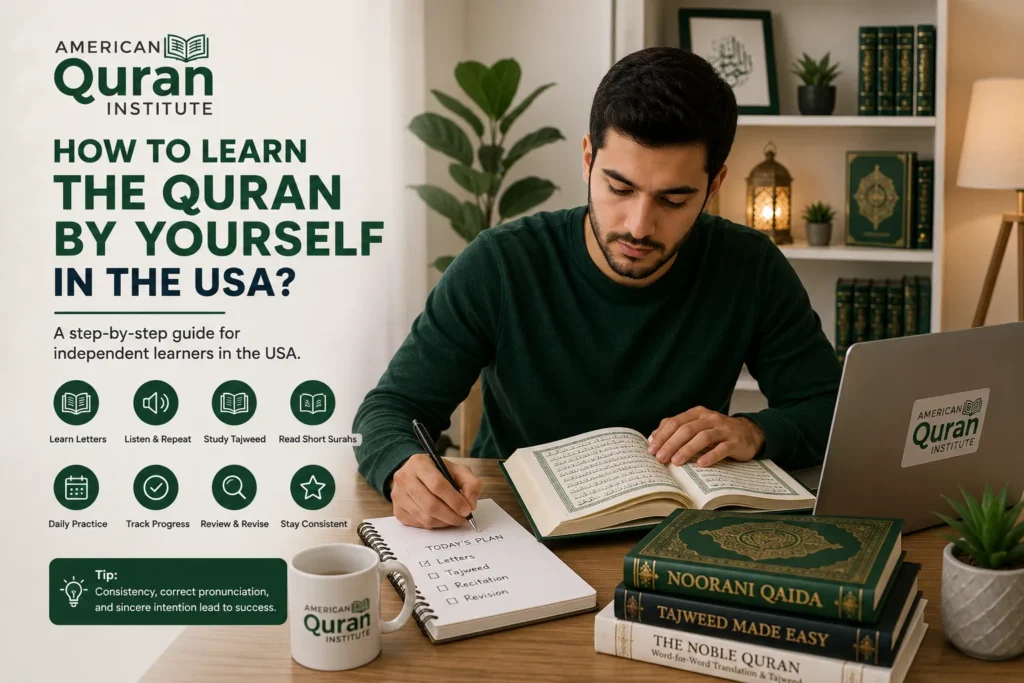
This guide gives you a precise, step-by-step progression for how to learn the Quran by yourself in the USA — from absolute zero through consistent independent recitation. Each step builds on the previous one.
Follow the sequence and you will avoid the most common mistakes that stall American learners for years.
Can You Learn the Quran by Yourself in the USA?
Yes, you can absolutely learn the Quran by yourself in the USA — the foundational skills of Arabic letter recognition, basic recitation, and Tajweed rules are all learnable through structured self-study with the right resources.
The key condition is starting with the correct sequence: letters before words, pronunciation before rules, recitation before memorization.
American learners who struggle long-term almost always skipped a foundational stage, not because they lacked capability.
Self-study in the US has real advantages. You set the schedule. You control the pace. Online Quran apps, audio recitations from masters like Sheikh Mahmoud Khalil Al-Husary, and structured curricula like the Noorani Qaida give you tools that previous generations of American converts never had.

What self-study cannot do on its own is catch the errors you don’t know you’re making — particularly in makhraj (articulation points) and sifat (letter characteristics).
This is why the most effective approach combines structured self-study with periodic qualified review rather than treating them as opposites.
Read also: How to Read the Quran? A Step-by-Step Guide for American Beginners
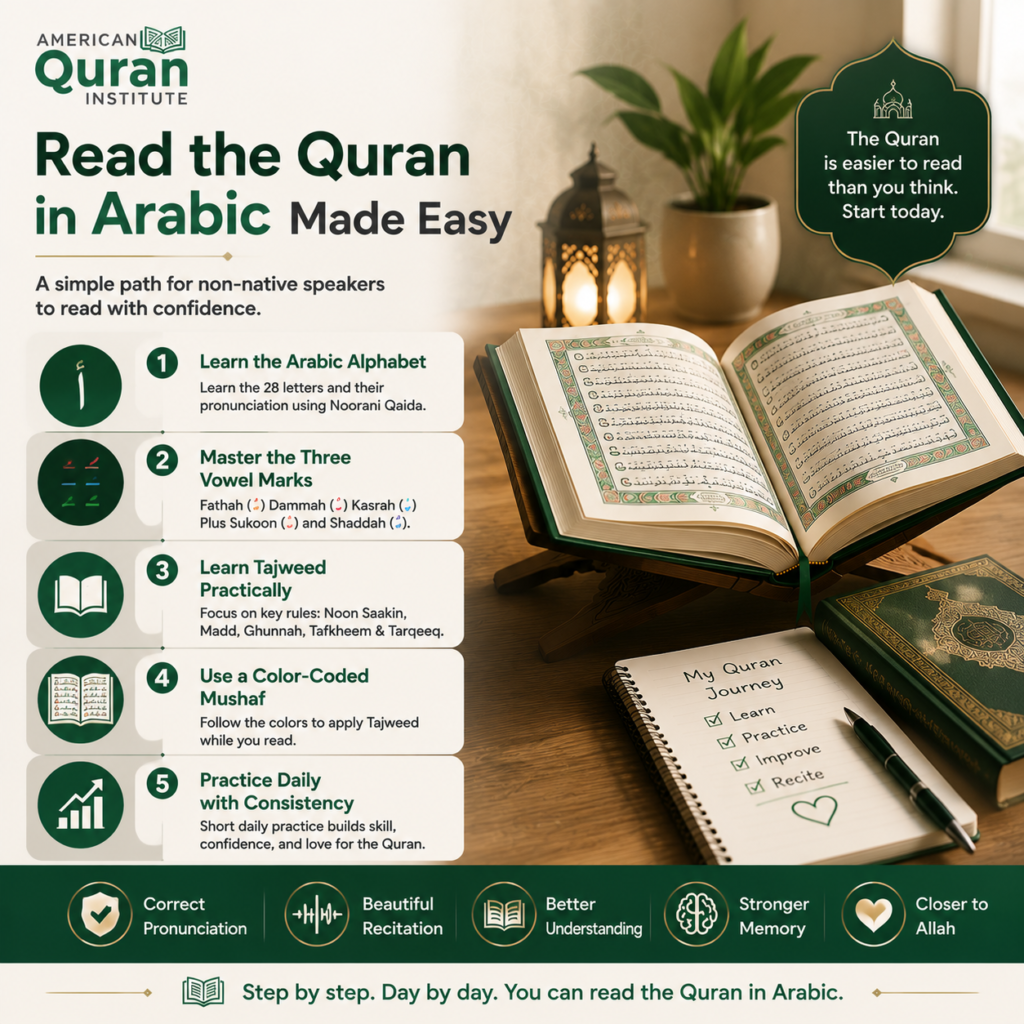
1. Learn the Arabic Alphabet Before Trying to Read the Quran
Before you open the Mushaf, spend two to four weeks on Arabic letter recognition alone. This is the step most American self-learners skip — and it is the single most common reason they plateau months later.
The Arabic alphabet has 28 letters, each with up to four positional forms depending on its placement in a word. You need to recognize all of them at sight before any recitation attempt will produce accurate results.
Tools like the Noorani Qaida course in the USA — which The American Quran Institute offers for both adults and children — are built specifically for this stage.
Book a FREE trial class in our Noorani Qaida classes

What to cover in this step:
- Recognition of all 28 letters in isolated, initial, medial, and final forms
- Basic short vowels (fatha, kasra, damma) and their effect on pronunciation
- Sukoon (absence of vowel) and shadda (gemination/doubling)
- Tanwin (nunation) — the double vowel markings that change pronunciation
Do not move to Quran recitation until you can identify any letter and its vowel without hesitation. Rushing this stage is the most predictable mistake we see from adult beginners across every background.
Read also: HOW TO LEARN THE QURAN ALPHABET IN THE USA?
Shots Videos from Our Courses
Start Your Quranic Education
Join our premier online institute for structured Quranic learning tailored for students in the USA.
Book Your Free Trial2. Master Letter Pronunciation Using Articulation Points
Once you can recognize Arabic letters, the next step is producing them correctly — and this requires understanding makhraj (articulation points), the specific physical locations in the mouth and throat from which each Arabic letter originates.
This is where audio becomes non-negotiable. You cannot learn makhraj from text alone. You need to hear a qualified reciter produce each letter and then replicate it with real-time feedback. Letters like ayn (ع), ha (ح), and qaf (ق) do not exist in English phonology.
American learners substituting familiar English sounds for these letters are not reciting Arabic — they’re approximating it, and those approximations harden quickly into habits.
Three practical resources for this stage:
- Noorani Qaida audio — produced by qualified teachers, available through structured curricula
- Sheikh Husary’s recitations on Quran Audio and verified audio platforms — model-level pronunciation
- One-on-one pronunciation sessions with a qualified instructor for feedback on your specific errors
Spend at least two weeks on makhraj before attempting connected recitation. The sifat (characteristics) of letters — qualities like hams (whisperedness), jahr (voicing), and istifal (lowness) — layer onto this foundation and can be studied alongside it.
Read also: Where Should I Start Reading the Quran? USA Student Guide
3. Begin Recitation With Short Surahs, Not the Beginning of the Quran
Most American learners open the Quran to Surah Al-Baqarah and immediately feel overwhelmed. The correct starting point is Juz Amma — the 30th section — which contains the short Surahs you already hear in prayer.
Starting with Surahs like Al-Ikhlas, Al-Falaq, Al-Nas, Al-Kawthar, and Al-Asr gives you three concrete advantages.
First, you likely already have these memorized phonetically from prayer, which gives you an immediate pronunciation reference.
Second, these Surahs are short enough that you can trace every word in the Mushaf deliberately. Third, they contain most of the fundamental Tajweed rules in concentrated form.
The Prophet ﷺ is reported to have said regarding the reciter of the Quran:
“The one who recites the Quran and is proficient in it will be with the honorable, obedient scribes.” (Sahih Muslim 798)
Proficiency here means accuracy — which is built word by word, not chapter by chapter.
Work through each Surah in this order: listen to a verified recitation, trace the text in the Mushaf while listening, then attempt recitation yourself.
Record yourself if possible — the gap between how you think you sound and how you actually sound is almost always larger than learners expect.
Read also: BEST COUNTRY TO LEARN QURAN
4. Learn Core Tajweed Rules in Practical Categories
Tajweed is not a separate subject to study after learning to recite. It is the recitation itself. The rules of Tajweed govern every letter in the Quran, and learning them in parallel with recitation — rather than before or after — is what produces lasting accuracy.
Focus on rules in order of frequency and practical impact:
| Tajweed Rule | Trigger | Application |
| Ghunnah | Noon or Meem with shadda | Nasalization held for 2 counts |
| Ikhfa | Noon sakinah before 15 specific letters | Partial nasalization without full nun sound |
| Idgham | Noon sakinah before ي ن م و ل ر | Merging without ghunnah (for ل ر) or with (for others) |
| Qalqalah | Letters ق ط ب ج د in sakin or waqf position | Echo bounce — heavier at waqf |
| Madd (elongation) | Alif, Waw, Ya after matching short vowel | 2–6 counts depending on type |
The most consistent mistake we see from adult beginners learning noon sakinah rules is conflating ikhfa and idgham — both involve the noon disappearing, but the physical execution is different.
Ikhfa is a partial nasalization held at the makhraj of the following letter. Idgham is a complete merge. These require audio demonstration to distinguish, not just a description.
Our Tajweed course in the USA at The American Quran Institute is structured specifically for English-speaking learners — no assumed background, no rushed progressions, just accurate rule-by-rule development with qualified instruction.
Start learning Tajweed with a FREE trial session

5. Build a Daily Practice Routine That Survives American Life
Consistency at a modest level outperforms intensity at an unsustainable one. American Muslim learners — especially professionals and parents — often try to start with 45–60 minute daily sessions and abandon the practice within three weeks when schedules tighten.
Twenty to thirty minutes of daily, focused Quran practice produces better long-term results than two-hour weekend sessions.
The research on skill acquisition supports this, and our instructors’ experience working with busy American adults confirms it: the learner who recites for 25 minutes every morning before work consistently outpaces the learner who sets aside Saturday afternoons.
A practical daily framework:
- 5 minutes: Revision of previously learned material — one Surah you already know, recited from memory
- 10 minutes: New recitation — working through 3–5 new lines with deliberate Tajweed attention
- 10 minutes: Focused listening — audio recitation of material you are currently learning
- 5 minutes: Written tracing — following along in the Mushaf while listening
This structure takes 30 minutes and covers all four learning modalities: auditory, visual, kinesthetic, and active production.
Students who come to us having practiced inconsistently for a year often see more progress in the first two months of structured daily practice than in the entire preceding year.
The American Quran Institute’s programs are built around the reality of American life — flexible scheduling, one-on-one sessions, and instructors who understand that consistent progress matters more than speed.
6. Add Periodic Qualified Review to Lock In Accuracy
Self-study without any qualified feedback is the point at which most American learners plateau or accumulate errors that become increasingly difficult to correct.
You do not need a full-time teacher to learn the Quran by yourself — but you do need periodic review from someone who can hear what you cannot.
The specific errors that harden without correction are almost always in makhraj and madd lengths.
A learner who has been elongating a madd lazim (6-count elongation) at 4 counts for six months has not developed bad habits — they have developed a confident wrong habit, which is harder to fix than an uncertain one.
Practical options for qualified review in the USA:
- One-on-one online sessions with certified instructors — the most effective format for targeted correction
- Quran circles at local mosques — useful for motivation but inconsistent for Tajweed accuracy without a qualified teacher present
- Recorded recitation review — sending recordings to a teacher for timestamped feedback
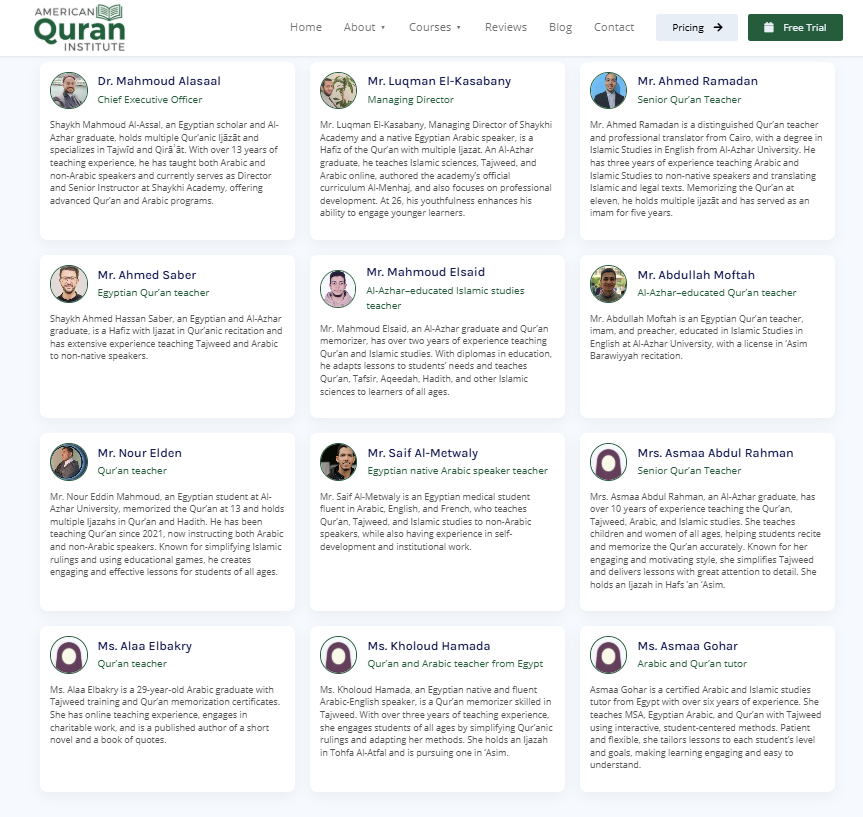
Our qualified Ijazah-certified instructors at The American Quran Institute work with learners at every stage — from absolute beginners through advanced recitation — and can identify and correct the specific errors that self-study alone cannot catch. You can start with a free trial session to experience this without any commitment.
Book a FREE session with one of our Ijazah-certified teachers
7. Begin Quran Memorization Only After Recitation Is Stable
If your goal includes Hifz (Quran memorization), do not begin memorizing until your recitation of any passage is consistently accurate with Tajweed applied.
Memorizing incorrect recitation is not memorizing the Quran — it is memorizing an error, and correcting memorized errors is significantly harder than correcting recitation errors.
The standard professional approach to memorization follows a three-part daily structure:
- New memorization (jaded): A small, accurately recited portion — 3–5 lines for most adult beginners
- Recent review: Material memorized in the past 7–14 days, recited from memory
- Old review: Previously memorized material cycled on a rotation
The portion size matters less than the accuracy threshold. Only memorize what you can already recite correctly. If a word is uncertain, clarify it before adding it to memory — not after.
For families supporting children in memorization, our Kids Quran Memorization Program in the USA provides age-appropriate structure with qualified teachers, while our adult Quran Memorization Program in the USA gives adult learners a systematic, instructor-supported path through the Quran.
Start memorizing Quran in USA with a FREE trial class

Our Students Reviews
Start Your Quranic Education
Join our premier online institute for structured Quranic learning tailored for students in the USA.
Book Your Free TrialBegin Your Quran Learning Journey With Qualified Support at The American Quran Institute
Structured self-study works — when you follow the right sequence, maintain daily consistency, and add qualified review at key stages.
The American Quran Institute is designed specifically for American Muslim learners:
- Qualified, experienced instructors who understand the English-speaking learner’s specific challenges
- Flexible one-on-one scheduling built around your life — not a fixed timetable
- Programs for every stage: from Arabic alphabet through Ijazah-level recitation
- Welcoming environment for converts, beginners, families, and children
- Consistent, structured curricula that remove guesswork from the learning process
- Free trial session available — no commitment required
Start your free trial today and build the foundation that lasts.
Check out our top courses for Quran learning:
- Quran Classes for Adults
- Tajweed Classes
- Hifz Quran
- Noorani Qaida classes
- Quran classes for kids
- Hifz for Kids
- Noorani Qaida classes for kids
- Ijazah Course
Book your FREE trial session today

Conclusion
Learning the Quran by yourself in the USA is entirely achievable — but the learners who succeed consistently are those who follow a clear sequence: letters, then pronunciation, then recitation, then rules, then memorization. Skipping stages creates the plateaus that cause most American learners to stop.
The tools available to American Muslim — qualified online instruction, verified audio from master reciters, structured curricula like the Noorani Qaida, and flexible one-on-one sessions — make structured Quran learning more accessible than it has ever been. The remaining variable is consistency.
Use the steps in this guide as your framework, add qualified review at the pronunciation and Tajweed stages, and keep your daily practice short enough to sustain. The progress will follow.
Frequently Asked Questions About Learning the Quran by Yourself in the USA
Can I Learn the Quran in English Without Knowing Arabic?
You can begin learning the Quran’s recitation without prior Arabic knowledge by starting with letter recognition and foundational pronunciation through a structured curriculum like the Noorani Qaida. Most American learners have no Arabic background and still achieve accurate recitation. Understanding the meaning requires Quranic Arabic study as a separate, parallel track.
How Long Does It Take to Learn to Recite the Quran Correctly?
Most American adult beginners reach consistent, Tajweed-applied recitation of short Surahs within three to six months of structured daily practice at 20–30 minutes per day. Full independent recitation of the entire Quran typically takes one to three years depending on prior Arabic exposure, daily practice volume, and access to qualified feedback.
What Is the Difference Between Reciting the Quran and Memorizing It?
Recitation means reading the Quran accurately from the written text with correct Tajweed applied. Memorization (Hifz) means reciting it entirely from memory without the text. Recitation accuracy must be established first — memorizing incorrect recitation is harder to correct than a recitation error because the wrong version becomes the mental default.






Leave a Reply