 Quran
Quran

| Key Takeaways |
| Adult learners in the USA can memorize the Quran by heart with consistent daily practice of 20–30 minutes minimum. |
| Starting with Juz Amma (the 30th Juz) gives American beginners manageable, prayer-relevant surahs before tackling longer portions. |
| Accurate Tajweed from the first session protects memorization quality — mispronounced ayahs are significantly harder to correct after retention. |
| A qualified online instructor provides accountability, error correction, and pacing adjustments that self-study cannot replicate reliably. |
| Daily new memorization paired with a structured revision schedule prevents the most common failure point: forgetting faster than you memorize. |
You can learn the Quran by heart in the USA — as a busy adult, a convert, or a parent starting late. What separates those who finish from those who stall is not natural ability. It is structure: a clear starting point, a daily habit, accurate pronunciation from the beginning, and someone qualified to hold you accountable.
This guide walks through every practical step in sequence — from building the right foundation before you memorize a single ayah, to maintaining what you’ve memorized years later. Each step is specific to the American Muslim context: English-speaking learners, full schedules, and no assumed Arabic background.
1. Build Your Tajweed Foundation Before You Memorize Any Ayah
Before you commit a single ayah to memory, your recitation must be accurate. Memorizing with Tajweed errors means retaining the wrong pronunciation — and unlearning a memorized pattern is far harder than learning it correctly the first time.
Tajweed is the system of phonetic and prosodic rules governing proper Quranic recitation. It governs articulation points (makhraj), letter characteristics (sifat), and rules like ghunnah (nasalization), ikhfa (concealment), and qalqalah (the echo bounce on specific letters).
For American learners with no Arabic background, the most consistent gap we see is mispronunciation of the emphatic letters — particularly dad, za, ta, and qaf — because they have no equivalent sound in English.
Students who try to memorize before addressing these sounds end up with deeply ingrained errors that resurface even years later.
A structured Tajweed course closes this gap before memorization begins. At The American Quran Institute, our Tajweed course in the USA is built specifically for English-speaking learners — no assumed background, no rushing through rules, just consistent, correct practice with a qualified instructor.
Start learning Tajweed with a FREE trial session

2. Start With Noorani Qaida if You Cannot Read Arabic Script Yet
If you cannot read Arabic script fluently, Hifz is not your first step — foundational reading is. Attempting to memorize without reading ability means relying entirely on audio imitation, which produces fragile retention and zero ability to self-correct.
Noorani Qaida is the structured primer used across traditional Quran education systems to teach Arabic letter recognition, joining, vowel marks (harakat), and basic phonetics before the learner touches the Quran text directly. It is the most widely used foundational tool for new readers, and for good reason: it isolates the building blocks before introducing the full complexity of Quranic script.
Learners who come to us after attempting to memorize through audio repetition alone almost always share the same gap: they can reproduce the sound of a surah but cannot identify where they are in the text.
That gap makes revision unreliable and correction nearly impossible without a teacher listening in real time.
Our Noorani Qaida course in the USA moves learners from zero Arabic reading ability to confident Quran reading — typically within 8–12 weeks of consistent sessions, depending on starting point and practice frequency.
Book a FREE trial class in our Noorani Qaida classes

3. Choose the Right Starting Point to Learn Quran by Heart
Most American adults learning Quran by heart should begin with Juz Amma — the 30th and final Juz of the Quran. It contains the shortest surahs, is the most frequently recited in daily prayer, and provides early memorization wins that build the habit and confidence needed for longer portions.
Here is the logical progression most qualified instructors recommend for American adult learners:
| Phase | Content | Rationale |
| Phase 1 | Juz Amma (Surah An-Nas through Al-Naba) | Short surahs, prayer-relevant, builds the memorization habit |
| Phase 2 | Juz Tabarak (29th Juz) | Slightly longer surahs, consolidates technique |
| Phase 3 | Remaining Juz from the back forward | Manageable progression with increasing length |
| Phase 4 | Al-Baqarah and longer Madinan surahs | Tackled after strong habit and revision system is in place |
Starting with Al-Baqarah — the longest surah — is a common and costly mistake. The length overwhelms learners who have not yet built a reliable memorization-and-revision system, and dropout rates at that stage are high.
The Prophet ﷺ said: “The best among you are those who learn the Quran and teach it.” (Sahih Bukhari) This hadith is frequently cited as motivation for Hifz — and rightly so.
But it applies equally to the student who memorizes 10 surahs correctly and maintains them, as to one who rushed through 30 Juz and cannot recite half of it accurately from memory.
Read also: HOW TO LEARN THE QURAN IN THE USA?
Shots Videos from Our Courses
Start Your Quranic Education
Join our premier online institute for structured Quranic learning tailored for students in the USA.
Book Your Free Trial4. Set a Daily Memorization Target You Can Actually Keep
The single most effective daily structure for Hifz is small, consistent, and non-negotiable. American adult learners with jobs and families do not need to memorize two pages per day — they need a target they will actually hit every day for years.
A realistic and sustainable daily structure looks like this:
- New memorization: 3–5 lines per day (not pages — lines)
- Recent revision: Review the past 7 days of new memorization
- Older revision: Review one older portion weekly to prevent decay
In our instructors’ experience, learners who set aggressive daily targets — half a page or more — consistently outperform their targets for the first two weeks, then collapse.
Learners who commit to 3–5 lines per day, without exception, accumulate more accurately retained material over six months than the fast starters who restart repeatedly.
The memorization itself should follow the repetition method: read one line while looking at the text, then close the Quran and repeat it from memory.
Repeat until you can say it without hesitation. Then add the next line and link them. Never move forward until what you have is solid.
5. Build a Revision System From Day One — Not After You Have Forgotten
Memorization without revision is not Hifz — it is temporary retention. The most common failure point for American adults attempting to learn Quran by heart is not the memorization itself. It is the absence of a systematic revision schedule that protects what has already been committed to memory.
The golden rule of Hifz: You must review old memorization every single day — not on the days when you remember, not on weekends, but daily.
The human memory does not preserve Quranic text the way it preserves a phone number or a story. Arabic phonetic sequences require active reinforcement at regular intervals.
A workable revision structure for adults:
- Daily: Recite the last 3–5 days of new memorization in salah (prayer) — this is the most natural and effective reinforcement tool available
- Weekly: Review the past month’s memorization in one sitting
- Monthly: Recite a full Juz from memory to a qualified listener who can catch errors
The revision load grows as memorization grows. This is why having a Quran Memorization instructor from the beginning — rather than after problems arise — saves months of corrective work.
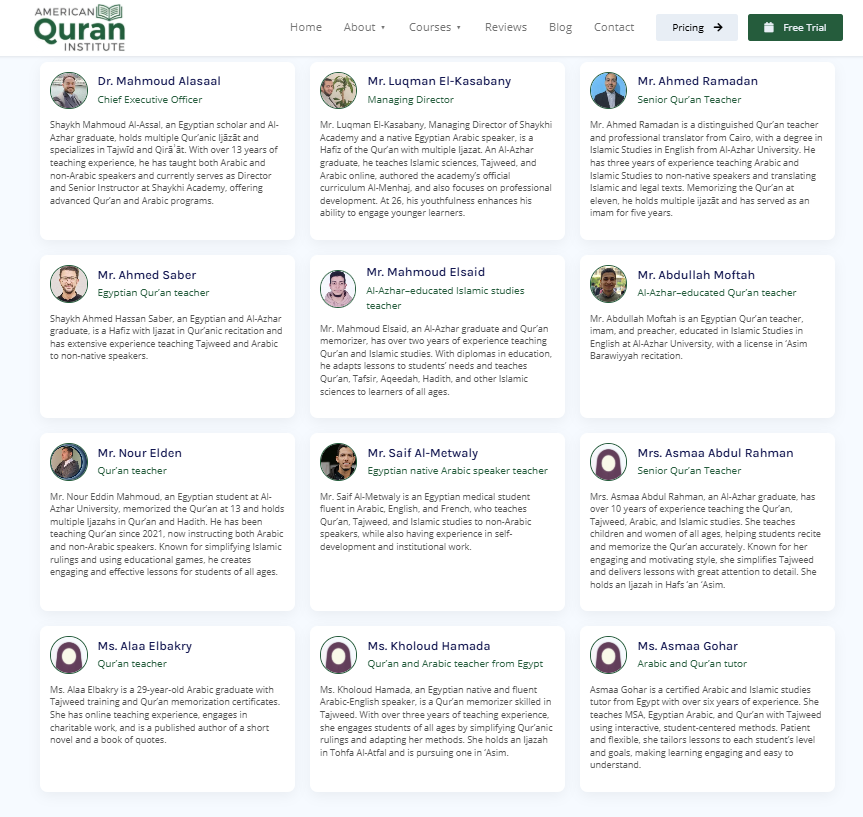
Book a FREE session with one of our Ijazah-certified teachers
Read also: HOW TO LEARN THE QURAN BY YOURSELF IN THE USA?
6. Recite to a Qualified Instructor, Not Just to Yourself
Self-assessment in Hifz is unreliable. You cannot hear your own Tajweed errors with the same precision that a trained listener can, and you cannot know what you have forgotten until you attempt to recite without the text in front of you. Both require an external, qualified listener.
A qualified Quran memorization instructor provides three things that no app, audio recording, or study group can replicate:
- Error detection in real time — catching Tajweed mistakes, skipped words, and substituted letters before they become fixed habits
- Pacing judgment — knowing when to slow a student down and when they are ready to accelerate
- Accountability — the external commitment of a scheduled session is the single most powerful habit-maintenance tool available to adult learners
At The American Quran Institute, our Quran Memorization Program in the USA gives students a structured, step-by-step path through the Quran with qualified instructors who adjust the pace to each student’s life — not the other way around.
Sessions are one-on-one and scheduled around your calendar, not a fixed cohort timetable.
Start memorizing Quran in USA with a FREE trial class

7. Use Prayer as Your Most Powerful Memorization Tool
The five daily prayers are the most underutilized memorization tool available to every Muslim attempting Hifz. They provide natural, low-pressure repetition of recently memorized surahs in a context of genuine application — which is the most effective form of retention reinforcement available.
The practical method: recite your newest memorized surah or portion in the first two rakaahs of each voluntary (nafl) prayer throughout the day.
By Isha, you have recited it five or more times in an embodied, attentive context — far more effective than sitting and repeating it mechanically from a text.
This approach also creates an immediate, functional relationship with what you are memorizing. You are not storing text in isolation — you are using it in the act of worship for which it was revealed. That connection strengthens retention in ways that pure repetition does not.
8. Protect Your Memorization With Consistent Long-Term Maintenance
Completing the memorization of a Juz or a group of surahs is not the end of the Hifz process — it is the beginning of the maintenance phase, which continues for life. American learners frequently underestimate this and discover, months after memorizing a portion, that it has degraded significantly.
A long-term maintenance structure for a Hafiz (one who has memorized the Quran) should include:
- Daily recitation: A minimum portion of memorized Quran recited from memory each day — in salah or in dedicated revision time
- Listener sessions: Monthly or quarterly recitation to a qualified instructor who can identify decay before it becomes permanent
- Dawra (full revision cycles): Periodic complete recitations of the entire memorized portion — a practice used across traditional Hifz programs to maintain integrity
The Quran is described in hadith as something that escapes quickly if not maintained: “Keep on reciting the Quran, for by Him in Whose Hand my life is, it escapes from memory faster than a camel escapes from its tying ropes.” (Sahih Bukhari) This is not a discouragement — it is a practical instruction. Maintenance is built into the nature of Hifz.
For learners who want to formalize their memorization with a chain of transmission, The American Quran Institute’s Quran Ijazah Program in the USA provides the opportunity to recite the full Quran to a certified scholar and receive a formal Ijazah — a certification connecting the student to an unbroken chain back to the Prophet ﷺ.
Start your path to Ijazah with a FREE trial

Our Students Reviews
Start Your Quranic Education
Join our premier online institute for structured Quranic learning tailored for students in the USA.
Book Your Free TrialBegin Your Quran Memorization with Structured Support from The American Quran Institute
Learning the Quran by heart in the USA is achievable — with the right structure, a qualified instructor, and a daily habit built around your real life.
The American Quran Institute offers:
- One-on-one sessions with qualified instructors — flexible scheduling around your life
- Structured curriculum from foundational reading through complete Hifz
- Programs for adults, children, and whole families
- Welcoming environment for converts and absolute beginners
- Consistent, measurable progress without pressure
- Free trial session — no commitment required
Check out our top courses for Quran learning:
- Quran Classes for Adults
- Tajweed Classes
- Hifz Quran
- Noorani Qaida classes
- Quran classes for kids
- Hifz for Kids
- Noorani Qaida classes for kids
- Ijazah Course
Book your FREE trial session today

Conclsuion
Learning Quran by heart in the USA requires a structured sequence: foundational reading and Tajweed accuracy first, a realistic daily memorization target second, and a disciplined revision system running alongside both. Each step depends on the one before it.
The learners who reach completion are not those with the most time or the strongest memory. They are those who built a sustainable system, recited consistently to a qualified instructor, and treated revision as non-negotiable from the very first week.
The American Quran Institute is here to provide that structure, those instructors, and that system — designed specifically for English-speaking American Muslims at every stage of the path.
Frequently Asked Questions About Learning Quran by Heart in the USA
How Long Does It Take to Memorize the Quran as an American Adult?
Most American adults memorizing with consistent daily practice of 20–30 minutes complete the Quran in 4–8 years. The range is wide because pace depends on daily consistency, session frequency with a qualified instructor, and the strength of the revision system. Speed matters far less than retention accuracy.
Do I Need to Know Arabic to Start Memorizing the Quran?
You do not need to understand Arabic to begin Hifz, but you must be able to read Arabic script accurately before memorizing. Learners who cannot yet read Arabic should complete a Noorani Qaida course first — typically 8–12 weeks — to build the reading foundation that makes memorization reliable and self-correctable.
Can I Learn Quran by Heart Online With a Real Instructor?
Yes. Online one-on-one Hifz instruction with a qualified teacher is fully effective and is the primary format American Muslim learners use today. The instructor hears your recitation in real time, corrects Tajweed errors immediately, and tracks your progress session by session — the same functions a classroom instructor provides.
Is It Too Late to Start Memorizing the Quran as an Adult?
No. Adults memorize the Quran successfully at every age. Adult learners bring focus, motivation, and life experience that accelerate the early stages. The adjustment required is in expectation — not speed but sustainability. A realistic daily target, maintained without exception, produces genuine Hifz at any age.







Leave a Reply