 Quran
Quran
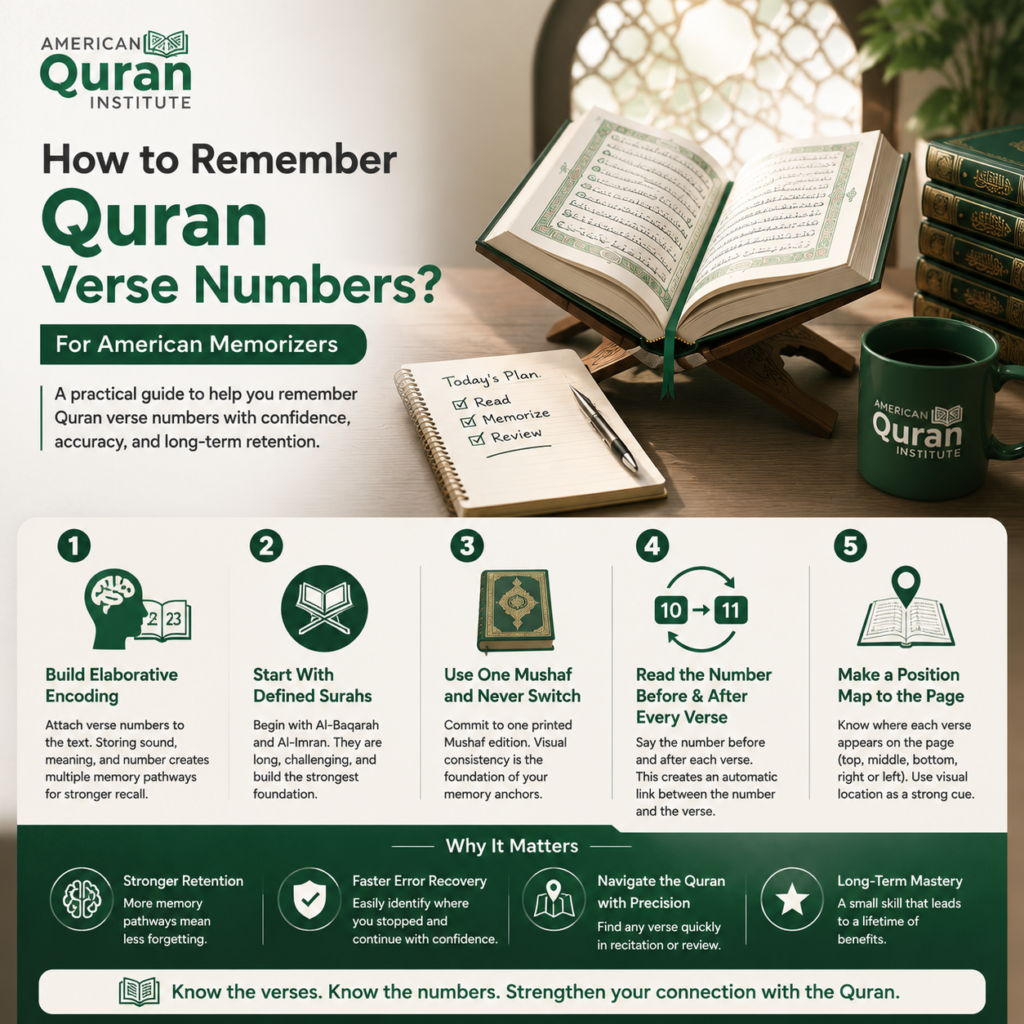
Most people who memorize the Quran know the verses — but not where they are. Ask a hafiz which verse is number 43 in Surah Al-Baqarah, and many will pause, unsure. That gap is not a failure of memorization. It is a gap in a specific, trainable skill: remembering Quran verse numbers alongside the text.
This skill is not obligatory. Scholars and Hifz teachers are clear on that point. But students who have developed it consistently report stronger overall retention, faster error-recovery during recitation, and the ability to navigate the Quran with a precision most memorizers never achieve.
Whether you are a student at an Islamic school in the US, a busy American mom fitting Hifz into a packed schedule, or an adult learner returning to the Quran after years away, this guide explains how to remember Quran verse numbers using practical, field-tested techniques — from the foundational setup to daily drills that build lasting recall.
1. Build Elaborative Encoding To Remember Quran Verse Numbers
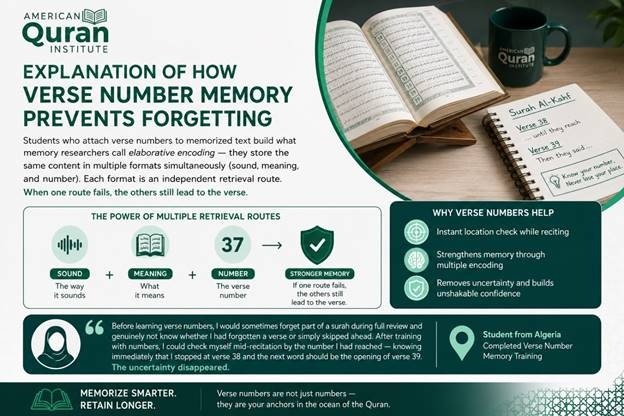
Students who attach verse numbers to memorized text build what memory researchers call elaborative encoding — they store the same content in multiple formats simultaneously (sound, meaning, and number). Each format is an independent retrieval route. When one route fails, the others still lead to the verse.
A student who went through this training described the effect precisely: before learning verse numbers, she would sometimes forget part of a surah during full review and genuinely not know whether she had forgotten a verse or simply skipped ahead.
2. Start With Defined Surahs
Verse number memorization works best when applied selectively, especially at the start. Surah Al-Baqarah and Surah Al-Imran are the highest-priority targets.
Both are long, both contain many similar-sounding passages (mutashabihat), and both are the surahs most likely to develop blind spots in long-term memorization. Scholars have noted for centuries that mastering these two chapters well is one of the most valuable things a memorizer can achieve.
Start there. Once those are stable, extend the technique to whichever surahs give you the most trouble in review.
Read also: How to Read the Quran with a Beautiful Voice? Complete Guide for American Muslims
3. Commit to a Single Printed Mushaf Edition and Never Switch
Before any technique works, one foundational step must come first: commit to a single printed Mushaf edition and never switch.
This is not a minor logistical preference. Verse number memory is anchored to visual memory — specifically, where on a page a verse sits (top, middle, bottom), which side of the opening (left page or right), and the shape of the text block around it. When you switch editions, the page layout changes, and every visual anchor you have built becomes unreliable. Students who have tried to work across multiple editions consistently report confusion and slower progress.
The Madinah Mushaf (used across much of the world) is the most common choice. Pick one edition, buy one copy, and use it exclusively – not a phone app for some sessions and a printed copy for others. Consistency in the physical artifact is the foundation everything else is built on.
Read also: LEARN QURAN BY HEART IN THE USA

4. Read the Number Before and After Every Verse
The simplest habit that delivers the most consistent results: every time you recite a verse during practice, read its number aloud before beginning and again after finishing. Do not skip this, even when it feels mechanical.
The repetition creates an automatic mental link — the number and the first word of the verse begin to surface together. After consistent practice, the number becomes the trigger for the verse, not just a label attached to it.
The reason this works is rooted in how memory encodes information. The brain retains isolated facts poorly but retains connected pairs reliably — which is why phone numbers are remembered in clusters and why a familiar melody brings back lyrics instantly.
By consistently pairing the verse number with its opening word, you are training your memory to store them as a single unit rather than two separate pieces of information.
Over time, hearing or thinking “verse five” will pull the verse itself to the surface automatically, without the effortful searching that makes recitation feel uncertain. What feels mechanical in the early days is precisely what makes retrieval effortless later.
Read also: How to Read the Quran in Arabic Easy? A Guide for Non-Native Speakers
5. Make A Position Mapping to The Page of The Mushaf
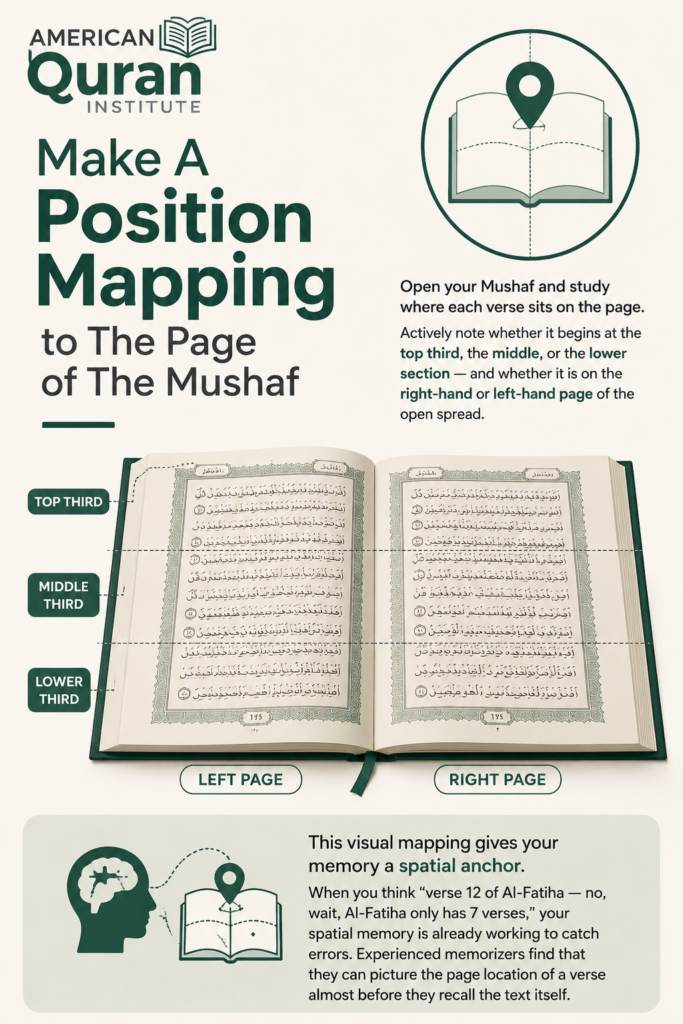
Open your Mushaf and study where each verse sits on the page. Actively note whether it begins at the top third, the middle, or the lower section — and whether it is on the right-hand or left-hand page of the open spread.
This visual mapping gives your memory a spatial anchor. When you think “verse 12 of Al-Fatiha — no, wait, Al-Fatiha only has 7 verses,” your spatial memory is already working to catch errors. Experienced memorizers find that they can picture the page location of a verse almost before they recall the text itself.
This is why traditional Islamic scholarship has always emphasized consistency in using a single Mushaf throughout the memorization process — not as a matter of preference, but as a deliberate memory strategy. Switching between different editions, apps, or printed copies disrupts the spatial map your mind has been building.
The verse that sat at the top right of a familiar page now appears mid-left in a different font, and the visual anchor is lost.
Choosing one Mushaf and staying with it from the beginning of your memorization journey is not a minor detail — it is one of the most practical decisions a memorizer can make, and one that experienced huffaz consistently identify as a factor in the accuracy and durability of what they retained.
Read also: Islamic Schools New Jersey
See Us in Action!
Take a look inside our virtual classrooms. Watch the clip below to see how our instructors engage with students, simplify complex rules, and create an inspiring environment for learning.
Start Your Quranic Education
Join our premier online institute for structured Quranic learning tailored for students in the USA.
Book Your Free Trial6. Use The Flashcard Drill
Write verse numbers on small cards — one number per card. On the reverse, write only the first word of that verse. Shuffle the deck, draw a card at random, read the number, and recite the full verse from memory before flipping to check the first word.
Run this drill in reverse too: draw a card showing a first word, and recall its verse number before flipping. This bidirectional drilling is what builds genuine recall rather than one-directional recognition.
A practical variant used by students in North Africa and Southeast Asia: cut small squares of paper, write the numbers, keep them in a pouch, and draw one at random during any idle moment in the day. Brief, frequent retrieval is far more effective than long, infrequent sessions.
7. Divide Each Surah Into Segments
Rather than memorizing every verse number from the start, map the round numbers first — the verse that falls at 10, 20, 30, 50, 100, and so on within a surah. Learn which word opens each of those landmark verses.
These anchor points divide the surah into segments you can navigate. Once the landmarks are solid, filling in the verses between them becomes significantly easier. This approach mirrors how you might see an American city — you learn the major intersections first, then the streets between them.
For Surah Al-Baqarah, for example, knowing that verse 50 begins with a specific word and verse 100 begins with another creates a structural skeleton. Individual verses slot into that skeleton rather than floating in an undifferentiated mass of 286 verses.
Book a FREE trial class in our Noorani Qaida classes

8. The Reference Table Method For Remembering Verse Numbers
Build a simple table for each surah: one column for verse number, one column for the first word of that verse. Cover one column, work down the other, and check yourself.
This table-based approach was used by classical scholars long before digital tools existed. Al-Imam al-Shaatibi noted that early Huffaz kept detailed records of verse endings (fawasil) and their positions — the table method is a continuation of that tradition adapted for modern learners.
Review the table for five minutes each morning. For American adults and ladies juggling work, family, and community commitments, five focused minutes before the day starts is realistic and, done consistently, genuinely transformative. The spaced exposure builds long-term retention without demanding large time blocks.
9. Build A Daily Practice That Actually Works
The most common mistake students make when adding verse number memory to their practice is treating it as a separate, parallel project. It is not. It is an enhancement to the Hifz work you are already doing.
A sustainable daily structure looks like this: during your regular Quran memorization classes, apply Technique 1 (number before and after each verse) to every new verse you work on. At the end of the sessions, spend five minutes on the flashcard drill for the verses you covered that day.
Once a week, test yourself on the anchor-point numbers for the surah you are currently working.
For American kids, parents can turn the weekly test into a short family activity — drawing flashcards together after Friday prayers, for example, makes the practice feel like a shared goal rather than a solo assignment.
Common Mistakes That Slow Down Verse Number Learning
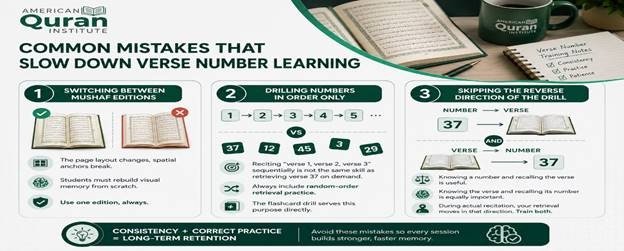
First Mistake:
Switching between Mushaf editions mid-training. The page layout changes, spatial anchors break, and students must rebuild visual memory from scratch. Use one edition, always.
Second Mistake:
Drilling numbers in order only. Reciting “verse 1, verse 2, verse 3” sequentially from memory is not the same skill as being able to retrieve verse 37 on demand. Always include random-order retrieval practice — the flashcard drill serves this purpose directly.
Third Mistake:
Skipping the reverse direction of the drill. Knowing a number and recalling the verse is useful. Knowing the verse and recalling its number is equally important — especially during actual recitation, when your retrieval moves in that direction. Train both.
Experience Our Classroom Environment
Don’t just take our word for it—experience a live session for yourself! Click on the videos below to watch real snippets from our classes and see our interactive teaching methods in real-time.
Start Your Quranic Education
Join our premier online institute for structured Quranic learning tailored for students in the USA.
Book Your Free TrialStart Your Quran Journey with Expert Guidance
Learning to remember verse numbers is significantly faster when your memorization is already solid — and both goals are more achievable with the structure of regular one-on-one instruction.
Our Quran Memorization for kids in the USA provides age-appropriate, structured instruction in English with certified teachers trained specifically to keep younger learners engaged and progressing.
At American Quran Institute, based in the United States, our teachers guide students of all ages and backgrounds through memorization and mastery techniques suited to each level — from young kids in the US taking their first steps with the Quran, to adult ladies returning to Hifz after years away, to professionals fitting structured Quran learning into a full American schedule. You do not need to figure out the sequence alone.
Enroll your Kid in the Best Online Quran Classes

Check out our top courses for Quran learning:
Start Your Quranic Education
Join our premier online institute for structured Quranic learning tailored for students in the USA.
Book Your Free TrialConclusion
Remembering Quran verse numbers is a mastery-level skill that complements and reinforces memorization of the text itself. The mechanism is straightforward: multiple memory formats (sound, meaning, number, spatial position) create multiple retrieval paths, making it far harder to truly forget a verse and far easier to recover when recall falters.
The path to this skill is methodical — one Mushaf edition, gradual verse-by-verse number attachment, anchor-point landmarks, and consistent daily drilling through tables and flashcards.
For American Muslims — whether children building their first Hifz, sisters balancing family life, or adults returning to the Quran — this skill is fully achievable with a realistic daily practice of ten to fifteen minutes built into an existing routine.
Begin with Surah Al-Baqarah, apply Technique 1 to every session starting today, and build from there.
Frequently Asked Questions
Is memorizing Quran verse numbers required?
No. Scholars and Hifz teachers are unanimous that verse number memorization is not obligatory. It is a tool of mastery and precision — one that strengthens retention and aids navigation, but not a condition of valid Hifz. Students should memorize the text accurately first and add verse numbers as an enhancement.
What is the best Mushaf edition to use for this technique?
The Madinah Mushaf is the most widely recommended because of its global prevalence and standardized page layout, and it is readily available across the United States. The key principle is consistency — whichever edition you begin with, use it exclusively throughout your training. Switching editions disrupts the visual memory anchors the technique depends on.
How long does it take to learn verse numbers for a full surah?
The timeline varies by surah length and the student’s memorization depth. For a surah already well-memorized, students practicing daily with flashcard drills and the table method typically build solid number recall for Surah Al-Baqarah’s 286 verses over two to three months of consistent, moderate daily practice.
Can my child start learning verse numbers alongside Hifz?
Children can learn verse numbers, but the technique works best after the text is memorized solidly. For kids, the flashcard pouch approach (Technique 3) is the most engaging entry point — it feels like a game rather than a drill. Start with anchor-point numbers (every 10 verses) rather than every verse, and expand from there as the child’s confidence grows.
Why do many non-Arab memorizers learn verse numbers?
Non-Arabic speakers who memorize the Quran cannot rely on language comprehension to self-correct during recitation — they do not feel the meaning drift the way a native Arabic speaker might. Verse numbers provide a structural verification system that compensates for this, allowing non-Arab memorizers to confirm their position in the text precisely.
What should I do when I forget a verse number during review?
Check the table you have built for that surah — find the anchor point nearest to where you lost the number, and work forward. Do not simply re-read the number and move on. Return it to the flashcard drill that same day so the retrieval is practiced from cold before your next session.







Leave a Reply