 Quran
Quran
Every Muslim parent in America has sat with some version of the same concern: the children are growing up in English, thriving in their schools, completely at home in American culture — and the Quran feels just out of reach. The nearest Islamic center may be 40 minutes away.
When chosen carefully, it doesn’t just replicate what a local class would offer — it often surpasses it, with one-on-one attention, a certified teacher who can hear your child’s pronunciation in real time, and a schedule built around your family’s actual day.
Evening classes do not conflict with homework or sports. Weekend programs cover the basics, but not the systematic, letter-by-letter reading skills a child actually needs. Online Quran education has changed that picture for thousands of American Muslim families.
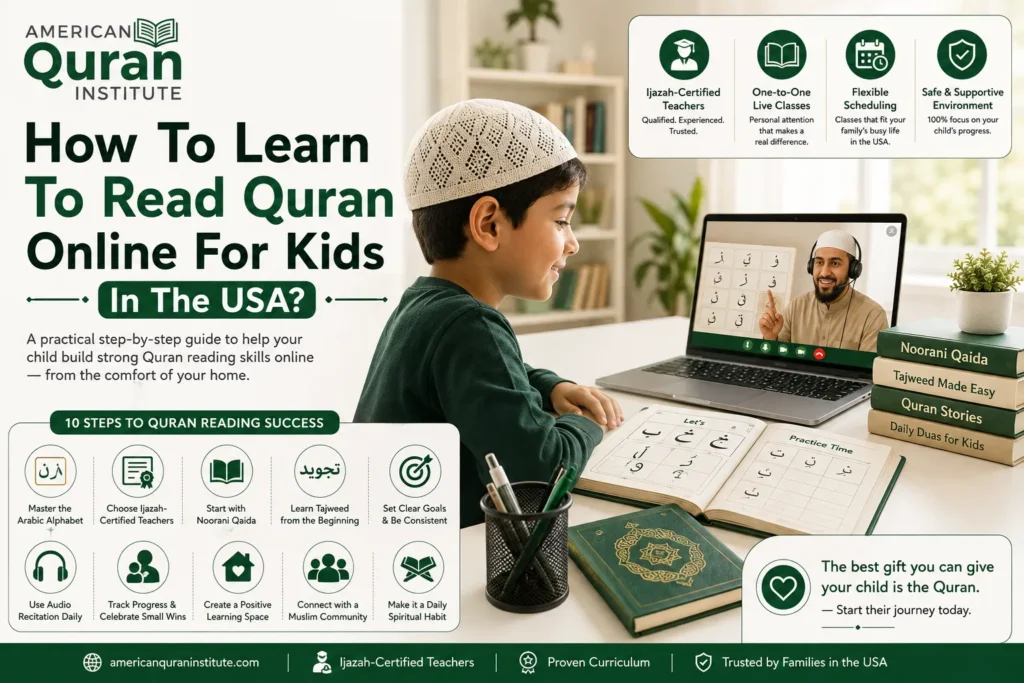
This guide walks through ten specific steps for how to learn to read Quran online for kids in the USA. These aren’t abstract recommendations, they address both, building a sequence from genuine foundation through sustainable, long-term progress.
1. To Know How To Learn To Read Quran Online For Kids In The USA They Should Master The Arabic Alphabet
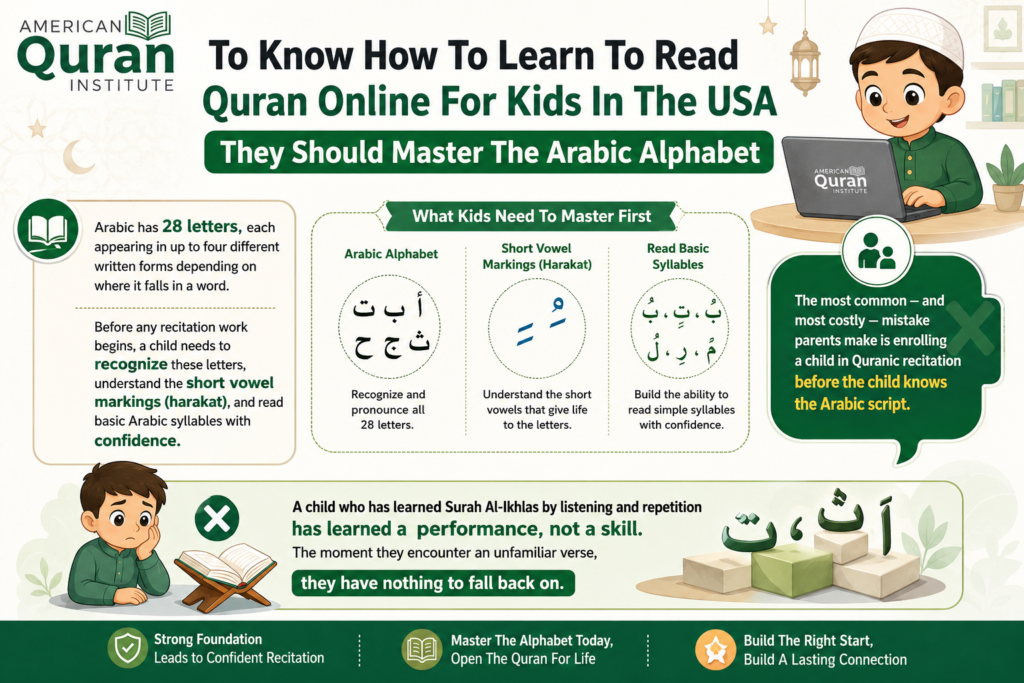
Arabic has 28 letters, each appearing in up to four different written forms depending on where it falls in a word. Before any recitation work begins, a child needs to recognize these letters, understand the short vowel markings (harakat), and read basic Arabic syllables with confidence.
The most common — and most costly — mistake parents make is enrolling a child in Quranic recitation before the child knows the Arabic script. A child who has learned Surah Al-Ikhlas by listening and repetition has learned a performance, not a skill. The moment they encounter an unfamiliar verse, they have nothing to fall back on.
If you want to understand how to learn the Quran alphabet in a way that produces lasting results — not just surface familiarity — structured foundational programs like the Noorani Qaida are where that work begins. Skipping this step doesn’t save time; it spends it twice.
Read also: How To Read The Quran As A Non-Muslim?
2. Verify That Your Teacher Holds An Ijazah Before The First Session
An Ijazah is a certified license in Quranic recitation — an authenticated document showing that the teacher’s own recitation has been tested and formally approved by a qualified scholar, in an unbroken chain that traces back to the Prophet Muhammad ﷺ. It is not a course completion certificate. It is verifiable evidence that the teacher’s knowledge has been independently validated.
For children learning online from America, this distinction carries real weight. Kids growing up outside Arabic-speaking environments are especially vulnerable to absorbing subtle mispronunciations that go unnoticed for years, particularly in emphatic consonants and throat sounds that simply don’t exist in English. An Ijazah-certified teacher recognizes these immediately and has the training to correct them.
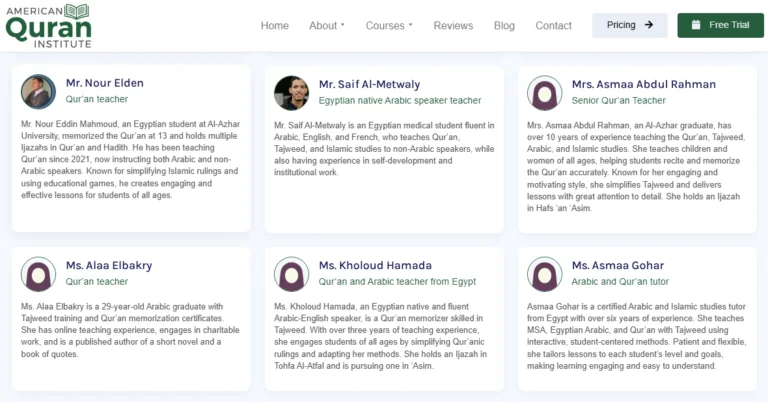
American Quran Institute, based in the USA, connects American Muslims — children, adults, ladies, and new Muslims — with Ijazah-certified teachers who specialize in guiding English speakers from the Arabic alphabet through fluent recitation.
3. Begin With The Noorani Qaida For A Structured, Step-By-Step Path
The Noorani Qaida is the most widely used Quran reading curriculum for absolute beginners in the world, and it works especially well for children who are native English speakers encountering Arabic script for the first time.
It starts with individual letters, progresses through joined-letter combinations, introduces Tajweed rules one at a time, and builds to reading actual Quranic text, all without assuming any prior knowledge.
Parents looking to understand how to read the Quran in Arabic easy from a genuine beginner’s starting point will find this approach produces steady, measurable results because it refuses to advance until each stage is solid.
Enroll Your Child in The American Quran Institute’s Noorani Qaida Course Today

4. Introduce Tajweed Rules From The First Lesson, Not As An Afterthought
The widespread belief that Tajweed is an advanced subject — something children work toward after they’ve become comfortable readers — leads to a pattern that experienced teachers recognize immediately.
Children who read letters correctly but with an English phonological accent layered over every Arabic sound. That pattern, once set, is genuinely difficult to remove.
Children who learn how to read the Quran with even one or two Tajweed rules built into their earliest lessons absorb those rules as a natural part of reading, rather than as corrections applied to an existing habit.
The elongation of a madd, the nasalization of a ghunnah — introduced early, they simply become part of what reading sounds like. Introduced late, they feel like disruptions to something that already sounds natural to the child.
Enroll Your Child in The American Quran Institute’s Tajweed Course for Kids Today
Read also: How To Make Reading Quran More Interesting In The USA?

5. Choose Live Classes For Correction Rather Than Pre-Recorded Videos
Apps and YouTube channels have a real role to play as review tools, but they cannot catch a mispronounced letter. Tajweed — the set of rules governing correct Quranic recitation — requires live audio feedback from a qualified teacher who can hear your child and correct errors before they become ingrained habits.
Live one-on-one sessions conducted over video allow a teacher to stop a student mid-syllable, model the correct articulation point (makhraj), and have the child repeat until the sound is accurate. That immediate correction loop is not replicable by any recorded content.
Children who learn primarily through apps often develop pronunciation habits that are technically consistent but fundamentally wrong — particularly with Arabic sounds that have no equivalent in English. Correcting those habits later costs far more time than getting them right from the first lesson.
Start learning Tajweed with a FREE trial session

6. Use Gamified Apps And Digital Tools Between Live Sessions
Several quality applications are designed specifically to reinforce what children learn in live sessions, using game mechanics like progress badges, letter-matching exercises, and daily streak counters to build review habits that children maintain on their own. These following points are complementary to this goal:
A. Interactive Ways To Teach Quran Reading For Kids In The USA
Getting the foundation right is the most important work. Keeping a child engaged with that foundation across months and years is the real challenge. American children are busy, easily distracted, and often tired after a full school day, so Quran learning should feel meaningful rather than like another school assignment, and should contain interactive ways to teach Quran reading for kids in the USA.
B. Make Quran Learning Interactive And Enjoyable
Long-term Quran learning becomes easier when children actively participate instead of simply listening to a teacher. Interactive activities, short lessons, encouragement, and age-appropriate challenges can keep children interested and motivated. The goal is to make Quran learning something they look forward to rather than another task they have to complete.
Read also: How To Read And Understand Quran?
See Us in Action!
Take a look inside our virtual classrooms. Watch the clip below to see how our instructors engage with students, simplify complex rules, and create an inspiring environment for learning.
Start Your Quranic Education
Join our premier online institute for structured Quranic learning tailored for students in the USA.
Book Your Free Trial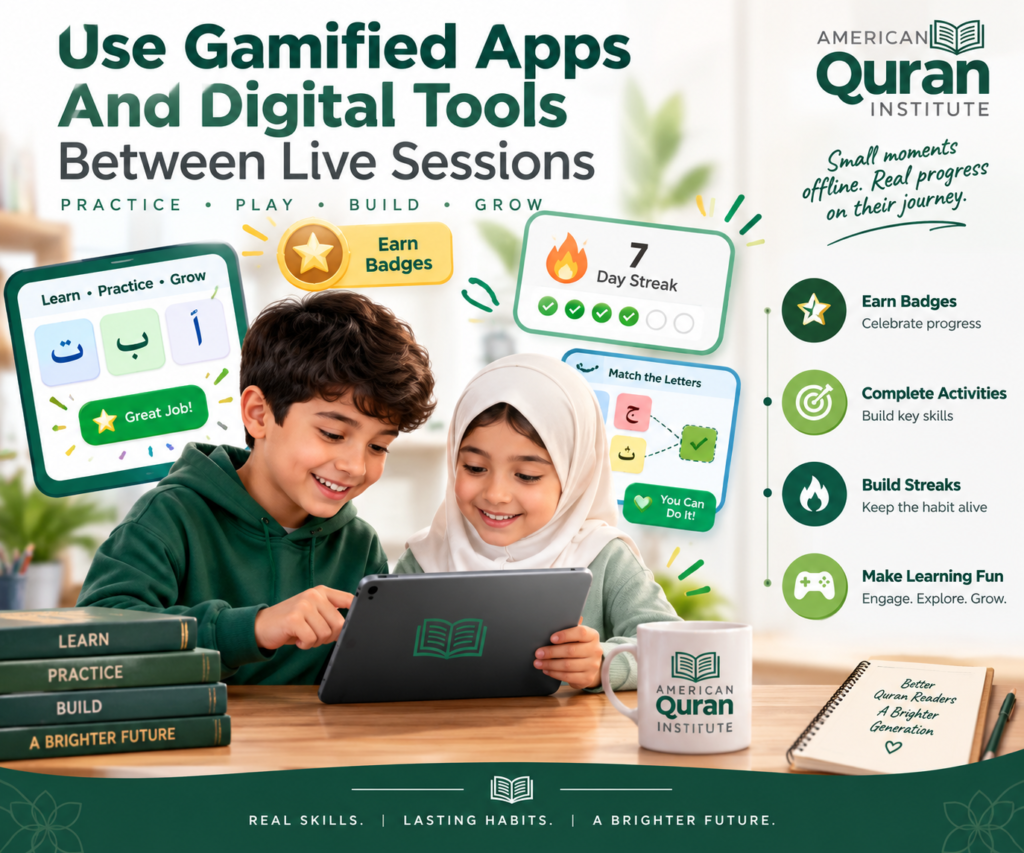
7. Bring Brief, Age-Appropriate Meaning Into Every Quran Lesson
Children retain what they understand. A 7-year-old who knows that Surah Al-Fil describes an army that came to destroy the Kaaba and was turned back by birds will carry that surah differently — and more permanently — than one who has only mastered the sounds.
Brief, concrete explanations of what a surah means, drawn from classical Tafsir and shared in plain, accessible English, transform memorization from a mechanical task into something that feels connected to real meaning.
This is where a skilled teacher earns their value in every session. Five minutes of context before a recitation exercise isn’t time away from Quran learning — it is what makes Quran learning stick.
The benefits of reciting Quran compound when children understand even a small part of what they’re reciting, and that early understanding becomes the foundation for deeper connection with the Quran as they grow older.
Book Your Free Trial Lesson of Quran Reading Classes in the USA

8. Schedule Quran Classes Around Us Time Zones And Your Child’s Natural Energy
One of the genuine advantages of working with a US-based Quran institute is avoiding the scheduling problem that affects many online programs. A teacher based abroad may be highly qualified — but if the available session slots fall at 8 p.m. Eastern after a child has been awake since 6 a.m., lesson quality suffers regardless of the teacher’s credentials.
Families researching how to learn the Quran in the USA with a schedule that genuinely fits their lives should confirm availability across Eastern, Central, Mountain, and Pacific time zones before committing to any program.
For most school-age children, the most productive session time is a mid-afternoon slot after a short rest break not immediately off the school bus, and not at the edge of bedtime when retention drops sharply.
Read also: How to Overcome The Struggling When Reading the Quran?
9. Build A Short Daily Practice Habit That Fits Around School
How to start reading the Quran daily doesn’t require an elaborate routine or a significant time commitment: after Fajr prayer, during a quiet window before homework begins, or right before bed are all times American families use successfully.
The specific time matters far less than the consistency. When Quran practice becomes as automatic as brushing teeth, children stop needing external motivation — they simply do it because it’s what they do every day.
The most consistent predictor of long-term Quran reading success is what happens between sessions, not during them. Five to ten minutes of daily review builds the kind of retention that even excellent weekly instruction cannot replicate on its own.
Begin Your Weekend Quran Education with The American Quran Institute Today

10. Set Clear Quran Learning Goals And Celebrate Each Achievement
Children who can see their own progress stay motivated; children who cannot measure it quietly disengage. A good online Quran program provides structured checkpoints not high-pressure tests, but clear benchmarks that tell both teacher and parent where the child stands and what the next concrete goal is.
Setting specific, achievable milestones; completing the Noorani Qaida, reading Juz Amma without errors, memorizing the last ten surahs from memory — gives children something real to work toward.
Marking each milestone with genuine recognition (a certificate, a family celebration, a call to a grandparent to share the news) converts an abstract achievement into a lasting memory.
Experience Our Classroom Environment
Don’t just take our word for it—experience a live session for yourself! Click on the videos below to watch real snippets from our classes and see our interactive teaching methods in real-time.
Start Your Quranic Education
Join our premier online institute for structured Quranic learning tailored for students in the USA.
Book Your Free TrialUnlock Your Spiritual Potential at The American Quran Institute
Embark on a transformative journey of faith and understanding with our structured Quran courses. Designed for all proficiency levels, our academy combines traditional recitation mastery with deep conceptual understanding. Watch the video below to see our dedicated instructors and interactive classrooms in action, and take your first step toward mastering the Quran today.
Our Quran Courses
- Quran Online Academy
- Quran Recitation Classes
- Quran Reading Classes
- Online Quran Classes for Kids
- Quran Classes for Adults
- Quran Classes for Female/Sisters
- Learn Quran Course for Beginners
- Quran Qirat Learning Course
- Quran Tafsir Course
- Noorani Qaida Course
- Noorani Qaida Course for Kids
- Weekend Quran Classes
- Intensive Quran Course
- Al-Azhar Quran Course
The powerful motivations to read Quran grow stronger when children experience firsthand the confidence that comes from genuine, measurable improvement in something their family treats as meaningful.
Check Out Our Top Courses for Quran Learning:
- Quran Classes in USA
- Noorani Qaida Course in the USA
- Online Quran Classes for Kids in the USA
- Quran Classes for Adults in the USA
- Quran Classes for Females in the USA
- Quran Ijazah Program in the USA
- Quran Memorization Course in the USA
- Quran Tafsir Course in the USA
Book your FREE trial session today
Start Your Quranic Education
Join our premier online institute for structured Quranic learning tailored for students in the USA.
Book Your Free TrialConclusion
Learning how to read the Quran online for kids in the USA is not a shortcut; it is a genuinely effective path when families approach it with the right structure. These ten steps cover the complete aspects of the educational process. They also cover the practical side, scheduling around real US family life, building consistent daily habits, and marking progress in ways that keep motivation alive across the long haul.
Families who take this seriously see results that compound over months and years. A child reading five focused lines every day will, within a year, be a confident and accurate Quranic reader.
To learn Quran for kids in the USA through a program designed for American Muslim families, with certified teachers, US-aligned scheduling, and a curriculum that meets children where they actually are, start with a free assessment at American Quran Institute.
Frequently Asked Questions
What age should my child start learning to read the Quran online?
Most children are ready for structured Quran reading instruction between ages 5 and 7, when they have sufficient attention span for 20-30 minute focused sessions. Children as young as 4 can begin with letter recognition activities and listening to short surahs, building familiarity before formal reading starts.
Does my child need to know Arabic before starting Quran classes?
No prior Arabic knowledge is required. The Noorani Qaida is specifically designed to take a complete beginner — a child who has never seen Arabic script — from the alphabet through to reading Quranic text. Many American children start from absolute zero and reach confident reading fluency within one to two years of consistent instruction.
How many sessions per week does a child need to make real progress?
Two to three live sessions per week, combined with 5-10 minutes of daily independent review at home, works well for most school-age children. Fewer than two sessions per week makes continuity difficult to maintain between lessons; more than four can lead to fatigue and resistance.
What is the difference between Tajweed and basic Quranic reading?
Basic Quranic reading means recognizing Arabic letters and vowel markings and assembling them into words correctly. Tajweed is the layer of rules governing how those words should sound — elongations, nasal resonances, letter merging, and precise articulation points.
A structured program introduces Tajweed rules progressively as reading fluency develops, so they become part of how a child reads naturally, rather than a separate subject added on afterward.
How long does it take for a child to reach Quran reading fluency?
Children attending two to three live sessions per week with consistent daily review typically complete the Noorani Qaida within 6-12 months and reach basic Quranic reading fluency within one to two years.
Can a child who speaks only English learn to read the Quran with correct pronunciation?
Absolutely. Many of the world’s most accomplished Quranic reciters come from non-Arabic speaking backgrounds — from West Africa, Southeast Asia, Turkey, and increasingly from Western Muslim communities including the United States.






Leave a Reply