 Quran

Starting a Quran class with dua can help a student approach the lesson with a sincere heart, a clear purpose, and a desire to gain beneficial knowledge. Many Muslims search for a dua before starting Quran class because they want to know what they can say before beginning their Quran lesson.
There is no single specific Prophetic dua that was prescribed exclusively for the beginning of every Quran class. However, the Sunnah contains several authentic or sound supplications asking Allah for beneficial knowledge, guidance, a humble heart, steadfastness, and the ability to worship Him properly.
These supplications can be especially meaningful for Quran students. Some are directly related to knowledge, while others ask Allah for qualities that every Quran learner needs.
1. Dua for Beneficial Knowledge
One of the most directly relevant supplications for a Quran student is the dua asking Allah for beneficial knowledge.

The Prophet ﷺ would say:
اللَّهُمَّ إِنِّي أَسْأَلُكَ عِلْمًا نَافِعًا، وَرِزْقًا طَيِّبًا، وَعَمَلًا مُتَقَبَّلًا
Allahumma inni as’aluka ‘ilman nafi‘an, wa rizqan tayyiban, wa ‘amalan mutaqabbalan.
“O Allah, I ask You for beneficial knowledge, goodly provision, and acceptable deeds.”
Why It Is Suitable Before Quran Class?
This is one of the best supplications to keep in mind before a Quran lesson because it specifically asks Allah for beneficial knowledge.
A Quran student does not simply want to memorize information. They want their learning to improve their recitation, understanding, worship, and daily life.
Although the Prophet ﷺ is reported to have said this dua after Fajr rather than specifically before a Quran class, its meaning makes it highly relevant to anyone beginning a lesson.
For students who are progressing from basic Quran reading into more accurate recitation, structured Tajweed classes for ladies can provide additional guidance in applying pronunciation and recitation rules correctly.
Read also: How to Learn Quran for Kids in the USA? – 15 Practical Tips for Parents

2. Dua for Knowledge That Benefits You
Another narration contains a supplication asking Allah to make previously learned knowledge beneficial and to teach the person knowledge that benefits them.
اللَّهُمَّ انْفَعْنِي بِمَا عَلَّمْتَنِي، وَعَلِّمْنِي مَا يَنْفَعُنِي، وَزِدْنِي عِلْمًا
Allahumma anfa‘ni bima ‘allamtani, wa ‘allimni ma yanfa‘uni, wa zidni ‘ilman.
“O Allah, benefit me by that which You have taught me, teach me that which will benefit me, and increase me in knowledge.”
Even though the narration is weak, its meaning is sound. A Quran student can ask Allah to make their learning beneficial, teach them what they need, and increase them in knowledge.
This makes the supplication relevant before a Quran class, especially when the goal is not simply to memorize verses or lessons but to gain knowledge that benefits the heart, understanding, and daily life.
For an article focused specifically on authentic Prophetic supplications, however, this dua should be clearly identified as a weakly narrated supplication rather than presented as an authentic hadith.
Read also: Free Online Quran Classes for Sisters in the USA – Learn Quran From Home
3. Dua Seeking Refuge From Knowledge That Does Not Benefit
The Sunnah also teaches Muslims to ask Allah for protection from knowledge that has no benefit.

The Prophet ﷺ said:
اللَّهُمَّ إِنِّي أَعُوذُ بِكَ مِنْ عِلْمٍ لَا يَنْفَعُ، وَمِنْ دُعَاءٍ لَا يُسْمَعُ، وَمِنْ قَلْبٍ لَا يَخْشَعُ، وَمِنْ نَفْسٍ لَا تَشْبَعُ
Allahumma inni a‘udhu bika min ‘ilmin la yanfa‘, wa min du‘a’in la yusma‘, wa min qalbin la yakhsha‘, wa min nafsin la tashba‘.
“O Allah, I seek refuge with You from knowledge that is of no benefit, from a supplication that is not heard, from a heart that does not fear You, and from a soul that is not satisfied.”
For someone preparing to begin a Quran class, this dua provides a meaningful reminder that learning should lead to benefit and positive change.
A student may learn Tajweed rules, memorize verses, or study Quranic vocabulary, but the purpose of this knowledge is not simply to collect information.
Asking Allah for beneficial knowledge helps keep the learner focused on understanding the Quran, applying what they learn, and allowing that knowledge to strengthen their faith and actions.
4. Dua for Making a Difficult Quran Lesson Easy
Quran learning can sometimes feel challenging. A student may struggle with a particular Arabic sound, find a Tajweed rule difficult, forget a verse during memorization, or need more time to understand a lesson.
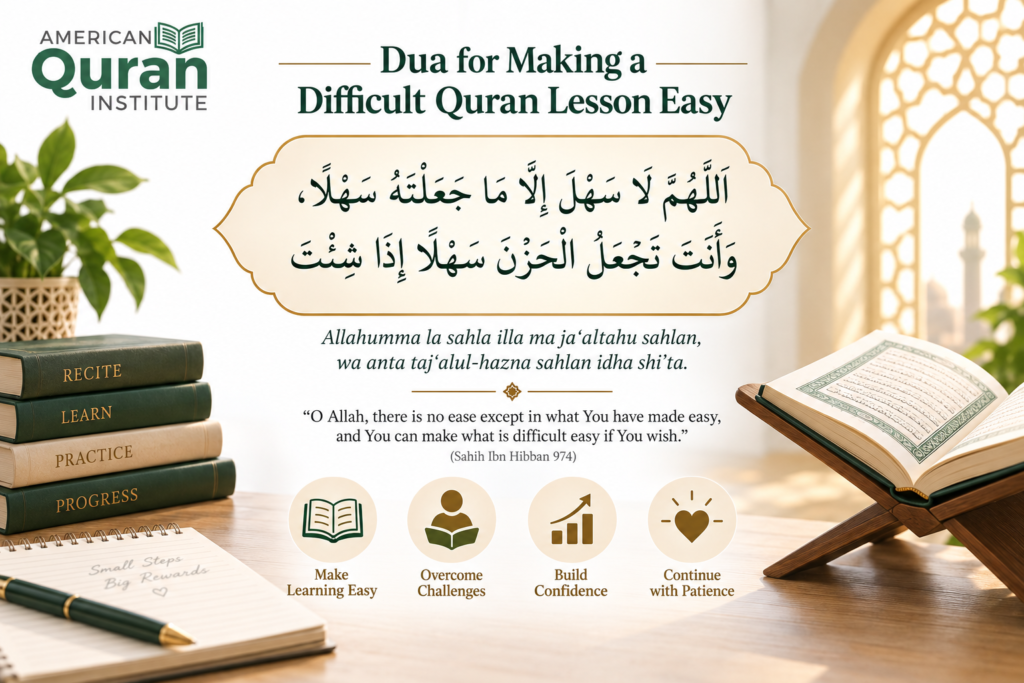
In such situations, a Muslim can turn to Allah and ask Him to make what is difficult easy.
Anas ibn Malik رضي الله عنه reported that the Prophet ﷺ said:
اللَّهُمَّ لَا سَهْلَ إِلَّا مَا جَعَلْتَهُ سَهْلًا، وَأَنْتَ تَجْعَلُ الْحَزْنَ سَهْلًا إِذَا شِئْتَ
Allahumma la sahla illa ma ja‘altahu sahlan, wa anta taj‘alul-hazna sahlan idha shi’ta.
“O Allah, there is no ease except in what You have made easy, and You can make what is difficult easy if You wish.”
The dua reminds a Quran student that ease ultimately comes from Allah, while learning still requires patience, practice, and consistent effort.
A student struggling with an Arabic letter can ask Allah for ease and then continue practicing its pronunciation with their teacher. Likewise, someone finding memorization difficult can make this dua before reviewing the verses and continue working through the passage step by step.
This makes the supplication particularly suitable for difficult moments in Quran learning. It is not specifically described in the hadith as a dua for starting a Quran class, but its general meaning makes it appropriate for a student who wants to ask Allah for help before beginning a challenging lesson.
Read also: How Long Does It Take To Learn The Quran In The USA?
See Us in Action!
Take a look inside our virtual classrooms. Watch the clip below to see how our instructors engage with students, simplify complex rules, and create an inspiring environment for learning.
Start Your Quranic Education
Join our premier online institute for structured Quranic learning tailored for students in the USA.
Book Your Free Trial5. Dua of Prophet Musa for Ease and Clear Understanding
One of the most meaningful Quranic supplications for a student is the dua of Prophet Musa .

When Allah gave Musa an important mission, he asked Him to expand his chest, make his task easier, and help him communicate clearly so that people could understand his words. Allah records his supplication in the Quran:
رَبِّ ٱشْرَحْ لِى صَدْرِى وَيَسِّرْ لِىٓ أَمْرِى وَٱحْلُلْ عُقْدَةًۭ مِّن لِّسَانِى يَفْقَهُوا۟ قَوْلِى
Rabbi ishrah li sadri, wa yassir li amri, wahlul ‘uqdatan min lisani, yafqahu qawli.
“My Lord! Uplift my heart for me, make my task easy, and remove the impediment from my tongue so people may understand my speech.”
This dua is particularly meaningful before a Quran class because learning requires an open heart, concentration, ease, and clear communication.
A student may need help understanding a new Tajweed rule, pronouncing unfamiliar Arabic sounds, memorizing a passage, or communicating with a teacher. The supplication of Musa brings these needs together by asking Allah for inner strength, ease in the task, and clarity in speech.
The dua of Musa teaches a simple principle that applies well to Quran learning: when beginning an important task, a believer can ask Allah for ease, understanding, and the ability to communicate clearly while continuing to make the necessary effort.
6. Dua for Increasing Knowledge
A Quran student should continue asking Allah for beneficial knowledge throughout their learning journey.
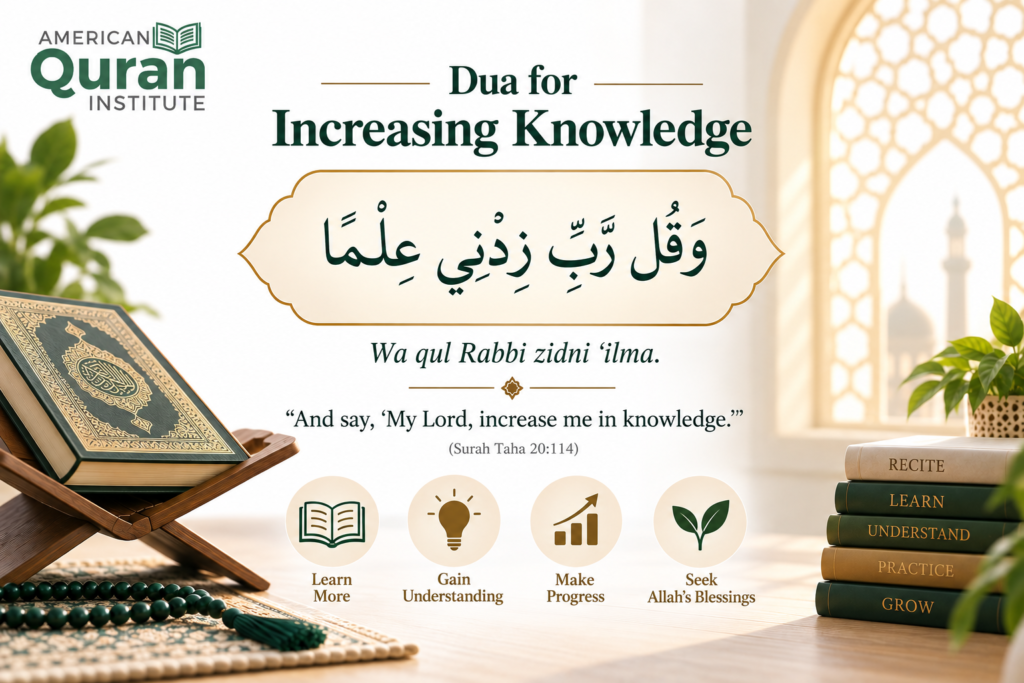
One of the shortest and most direct Quranic supplications is found in Surah Taha, where Allah says:
وَقُل رَّبِّ زِدْنِى عِلْمًا
Wa qul Rabbi zidni ‘ilma.
“And say, ‘My Lord, increase me in knowledge.’”
This concise dua is especially suitable for a Quran student because every stage of learning brings new knowledge and understanding. A beginner may ask Allah to help them learn the Arabic alphabet and read correctly, while a student studying Tajweed can ask for a deeper understanding of the rules of recitation.
Someone working on memorization can ask Allah for greater understanding and retention, while an advanced learner can ask to understand the meanings and guidance of the Quran more deeply.
The beauty of this supplication is its simplicity. “My Lord, increase me in knowledge” expresses a humble recognition that learning is an ongoing journey. Before starting a Quran class, a student can repeat this dua with the intention of seeking knowledge that brings understanding, strengthens faith, and helps them benefit from what they learn.
For learners who are still building their Quran reading foundation, a structured Quran course for beginners can complement this personal dua by providing step-by-step instruction and guidance.

Start Your Quranic Education
Join our premier online institute for structured Quranic learning tailored for students in the USA.
Book Your Free Trial7. Dua for Help in Worship
The Prophet ﷺ taught Mu‘adh ibn Jabal رضي الله عنه to say:
اللَّهُمَّ أَعِنِّي عَلَى ذِكْرِكَ، وَشُكْرِكَ، وَحُسْنِ عِبَادَتِكَ
Allahumma a‘inni ‘ala dhikrika, wa shukrika, wa husni ‘ibadatik.
“O Allah, help me to remember You, to give You thanks, and to worship You in the best manner.”
Although this dua was not specifically prescribed for the beginning of a Quran class, its meaning is closely connected to Quran learning.
A student can ask Allah to help them remember Him, appreciate the blessing of learning the Quran, and worship Him in the best manner. It also reminds the learner that Quran study is not simply an academic activity; it should strengthen their remembrance, gratitude, and worship.

For this reason, a student may make this supplication before studying the Quran as a general personal dua, while understanding that its established Prophetic context is after prayer.
The Best Dua Before Starting Quran Class
For someone looking for a dua before starting a Quran class, one of the most relevant supplications is the request for beneficial knowledge:
اللَّهُمَّ إِنِّي أَسْأَلُكَ عِلْمًا نَافِعًا
Allahumma inni as’aluka ‘ilman nafi‘an.
“O Allah, I ask You for beneficial knowledge.”
Its meaning, however, is highly relevant to Quran learning. A student can ask Allah to make the knowledge they seek beneficial and to help them gain understanding from their lesson.
Before beginning Quran recitation, a student can also follow the Quranic instruction to seek refuge in Allah from Satan:
أَعُوذُ بِاللَّهِ مِنَ الشَّيْطَانِ الرَّجِيمِ
A‘udhu billahi min ash-shaytan ir-rajeem.
“I seek refuge in Allah from Satan, the accursed.”
Together, these provide a meaningful way to begin Quran learning: ask Allah for beneficial knowledge and seek His protection before reciting His Book. Neither supplication should be described as a fixed Prophetic formula specifically prescribed for the start of a Quran class, but both have a clear and relevant connection to Quran learning.
Are These Duas Specifically for Starting Quran Class?
Not all of them The Sunnah does not establish eight specific supplications that must be recited before every Quran class.

Some of these duas ask for beneficial knowledge, guidance, steadfastness, or sincerity, so they are suitable for a Quran learner, but they should not be presented as a fixed Prophetic formula for starting a Quran class.
The specific instruction connected to Quran recitation is seeking refuge in Allah before reciting. Allah says:
فَإِذَا قَرَأْتَ الْقُرْآنَ فَاسْتَعِذْ بِاللَّهِ مِنَ الشَّيْطَانِ الرَّجِيمِ
“So when you recite the Qur’an, [first] seek refuge in Allah from Satan, the expelled [from His mercy].”
This verse directly establishes seeking refuge before Quran recitation. Other duas may be made for beneficial learning, but they should not be described as required duas for beginning every Quran lesson.
Experience Our Classroom Environment
Don’t just take our word for it—experience a live session for yourself! Click on the videos below to watch real snippets from our classes and see our interactive teaching methods in real-time.
Start Your Quranic Education
Join our premier online institute for structured Quranic learning tailored for students in the USA.
Book Your Free TrialFind the Right Support for Your Quran Learning Journey
Starting with free Quran resources can help you take the first step, but having a qualified teacher can make a real difference when you want to improve your reading, pronunciation, or Tajweed.
American Quran Institute gives Muslim sisters the opportunity to learn Quran online from home through structured lessons designed around different levels and learning goals.
Whether you are learning the Arabic letters for the first time, correcting your recitation, studying Tajweed, or working toward Quran memorization, the academy offers a guided learning environment where you can progress step by step.
This can be especially helpful for sisters in the USA who need flexible online learning that fits around work, studies, children, and family responsibilities.
Start your Quran learning journey with American Quran Institute and find a program that fits your needs.
Our Quran Courses
- Quran Online Academy
- Quran Recitation Classes
- Quran Reading Classes
- Quran Qirat Learning Course
- Quran Tafsir Course
- Noorani Qaida Course
- Noorani Qaida Course for Kids
- Weekend Quran Classes
- Intensive Quran Course
- Al-Azhar Quran Course

Conclusion
A dua before starting Quran class can help a learner begin with sincerity, humility, and the intention to seek beneficial knowledge.
While there is no single Prophetic dua specifically prescribed for every Quran class, the Sunnah and Quran provide several meaningful supplications that a student can use. The key is to distinguish between authentic texts, general personal duas, and supplications that are not specifically established for this occasion.
Along with making dua, consistent learning and practice are essential for improving Quran reading, Arabic understanding, Tajweed, and memorization. With the right guidance and a clear learning path, students can gradually build stronger Quran skills and gain more from every lesson.
Most importantly, Quran learning is a journey rather than a one-time task. A student may begin with a short dua, a few verses, or a basic lesson, then gradually develop stronger reading, understanding, and recitation skills through regular practice. Combining sincere dua with consistent effort can help make the learning journey more purposeful and beneficial.
Frequently Asked Questions
What is the dua before starting Quran class?
There is no single dua specifically prescribed for every Quran class. A particularly relevant Prophetic supplication is:
اللَّهُمَّ إِنِّي أَسْأَلُكَ عِلْمًا نَافِعًا
“O Allah, I ask You for beneficial knowledge.”
It is part of a supplication recorded in Sunan Ibn Majah 925.
What should I say before reading the Quran?
Before Quran recitation, say:
أَعُوذُ بِاللَّهِ مِنَ الشَّيْطَانِ الرَّجِيمِ
“I seek refuge in Allah from Satan, the accursed.”
This is based on Allah’s instruction in Surah An-Nahl 16:98.
Is there a dua for beneficial knowledge?
Yes. The Prophet ﷺ is reported to have said:
اللَّهُمَّ إِنِّي أَسْأَلُكَ عِلْمًا نَافِعًا
“O Allah, I ask You for beneficial knowledge.”
The longer narration is recorded in Sunan Ibn Majah 925 and is graded Sahih on Sunnah.com.
Can I make my own dua before Quran class?
Yes. You can ask Allah in your own words to help you understand the Quran, improve your recitation, remember what you learn, and benefit from the lesson. A personal dua should not be presented as a specific Prophetic supplication unless there is a reliable source for it.
Which dua is best for a Quran student?
The dua for beneficial knowledge is especially relevant because Quran learning is a form of seeking knowledge. However, there is no authentic text establishing one particular dua as the required or universally “best” dua before every Quran class.
Is “Rabbi zidni ilma” a hadith?
No. رَبِّ زِدْنِي عِلْمًا — “My Lord, increase me in knowledge” is a Quranic supplication from Surah Ta-Ha 20:114, not a Prophetic hadith. It is therefore appropriate to identify it as a Quranic dua rather than attributing it to the Prophet ﷺ.







[…] Read also: Dua Before Starting Quran Class – 7 Authentic Supplications From the Sunnah […]