 Quran
Quran
Most American Muslim families start with the same question: how long does it take to learn the Quran? A mom in Houston wants to know if her eight-year-old can read by next Ramadan. A software engineer in Seattle wonders if he can finally learn tajweed while working full time. A new Muslim in Ohio wants to know where to even begin.
The honest answer is that “learning the Quran” covers several different goals, and each one has its own timeline. Most websites blur them together or promise results in 30 days. That is marketing, not teaching.
This guide separates each goal and gives realistic ranges for an ordinary learner in the United States who starts, stays consistent, and does not quit. It also looks at what makes the American experience different: packed school calendars, weekend Islamic schools, long commutes, and the growth of live online Quran classes.
What Does “Learning the Quran” Actually Mean?
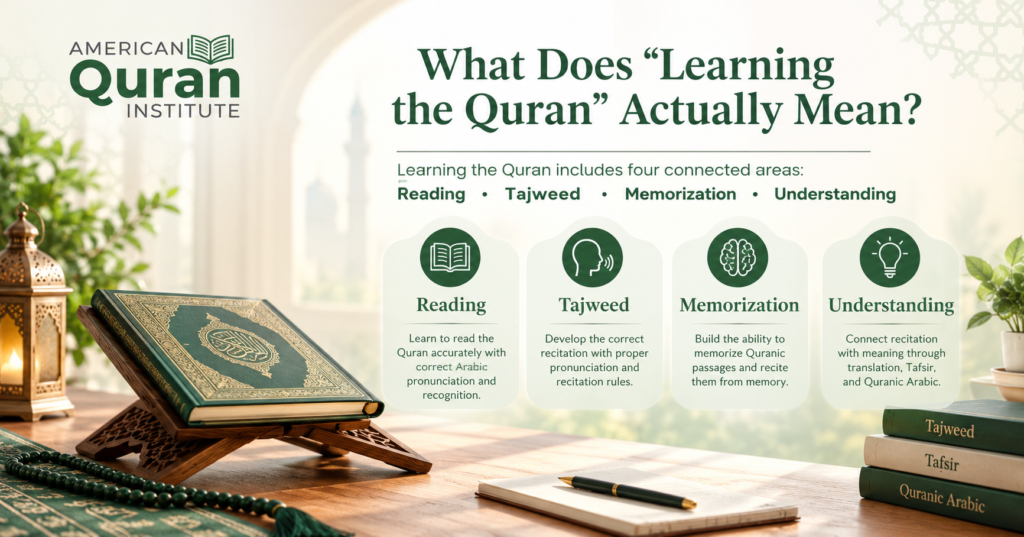
Before setting a timeline for learning the Quran, it helps to define what “learning the Quran” actually involves. For most students, Quran learning includes four connected areas: reading, Tajweed, memorization, and understanding.
1. Reading the Quran Requires Accurate Arabic Pronunciation and Recognition
This means reading the Quran directly from the Arabic Mushaf with accuracy. A beginner learns the Arabic letters, their different forms, vowel marks, joined letters, and Quranic words. Reading is a foundational skill and can be developed even before the student understands the full meaning of the verses.
2. Tajweed Develops Correct Quranic Recitation
Tajweed means learning how to pronounce Quranic letters correctly and apply the rules that govern recitation, including articulation points, letter characteristics, elongation, stopping, and other recitation rules. The goal is to recite the Quran accurately while preserving correct pronunciation and recitation principles.
3. Hifz Helps Students Memorize Quranic Passages
Hifz means memorizing the Quran so that a student can recite the memorized passages without looking at the Mushaf. Some students begin with short surahs while learning to read, while others build a stronger reading foundation before increasing their memorization.
4. Understanding the Quran Connects Recitation With Meaning
Understanding the Quran involves learning its meanings through reliable translations, Tafsir, and eventually Quranic Arabic. Reading provides the foundation, while Tajweed, memorization, and understanding can develop gradually according to the student’s age, ability, and goals.
How Long Does It Take to Learn to Read the Quran in the USA?
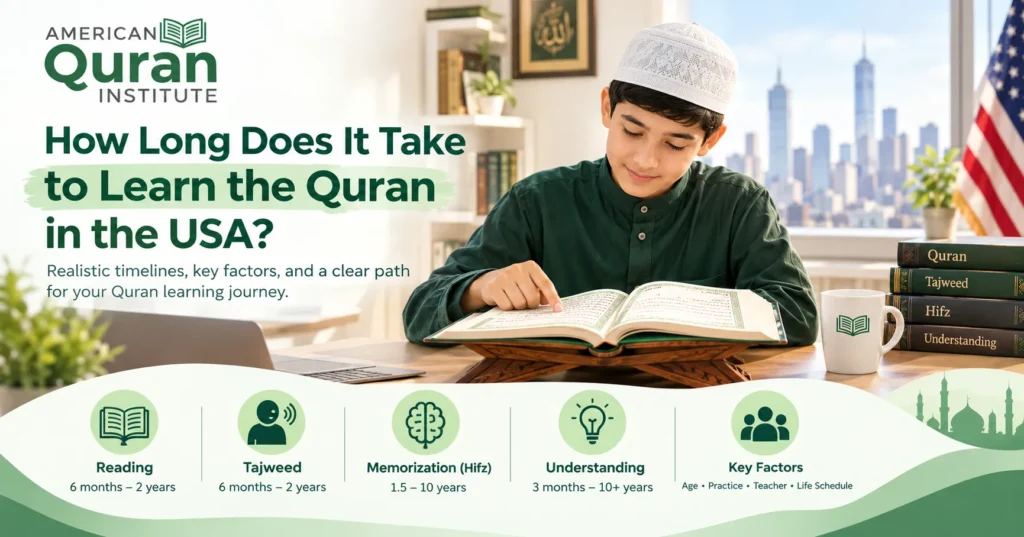
Most beginners in the USA can read short surahs from the Mushaf within 6 to 9 months, and reach fluent reading in 6 months to 2 years. The wide range comes down to age, practice frequency, teacher quality, and how much Arabic the learner hears at home.
Reading usually follows these stages:
- Letters and sounds (4 to 8 weeks). The 28 Arabic letters, their positional forms, and correct makharij (articulation points).
- Connected reading with Noorani Qaida (2 to 6 months). Vowel marks, sukun, shaddah, and joining letters. By the end, the student reads short surahs slowly but correctly.
- Fluent reading (months 6 to 24). Reading any page, even one never seen before, without stopping to decode letters.
Adults who already know the alphabet often finish Noorani Qaida in 2 to 3 months. Complete beginners, including many new Muslims and adults who grew up without Arabic exposure, typically need 6 to 9 months for the same milestone. Children ages 7 to 10 usually land in between, depending on their school load and home environment.
Complete beginners can benefit from a structured learning path that starts with Arabic letters, pronunciation, and basic Quran reading before moving into more advanced skills. Quran classes for beginners can provide this step-by-step foundation with regular guidance.

Many American kids grow up in English-only homes, so they may not hear Arabic outside the masjid. That is not a disadvantage you can’t overcome. It simply means daily listening, even a few minutes of recitation in the car on the way to school, makes a real difference.
The benchmark is not a date on the calendar. Reading is complete when the learner can open the Mushaf to any page and read without struggling.
How Long Does It Take to Learn Tajweed?
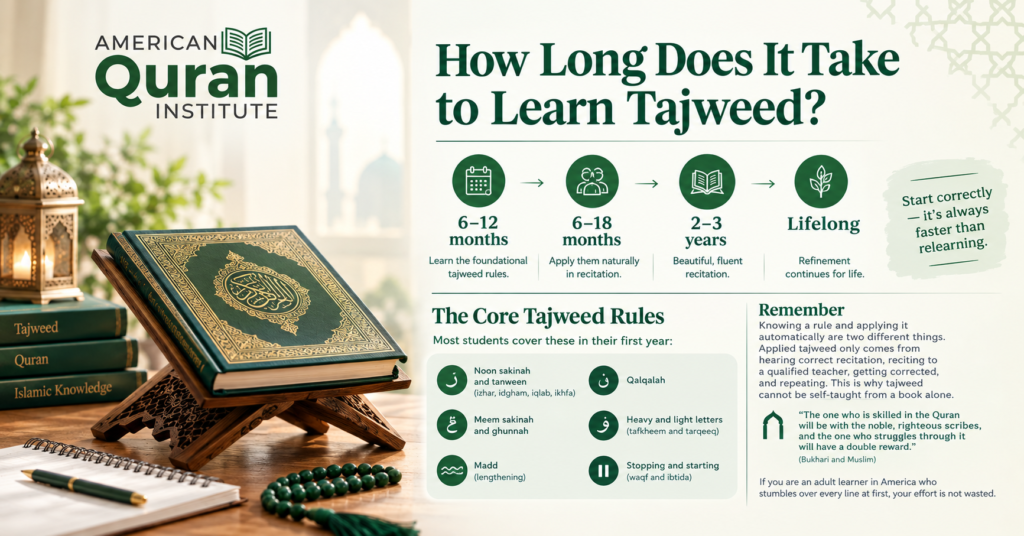
Most learners know the foundational tajweed rules within 6 to 12 months, and apply them naturally in recitation within 6 to 18 months. Beautiful, fluent recitation usually arrives around the 2 to 3 year mark, and refinement continues for life.
Many people treat tajweed as an advanced subject to start years later. That is backwards. Mispronunciations formed during the reading stage get locked in with every repetition and become very hard to undo. Starting correctly is always faster than relearning.
The core rules most students cover in their first year include:
- Noon sakinah and tanween (izhar, idgham, iqlab, ikhfa)
- Meem sakinah rules and ghunnah
- Madd (lengthening)
- Qalqalah
- Heavy and light letters (tafkheem and tarqeeq)
- The rules of stopping and starting (waqf and ibtida)
Knowing a rule and applying it automatically are two different things. Applied tajweed only comes from hearing correct recitation, reciting to a qualified teacher, getting corrected, and repeating. This is why tajweed cannot be self-taught from a book alone.
The Prophet ﷺ taught that the one who is skilled in the Quran will be with the noble, righteous scribes, and the one who struggles through it will have a double reward (Bukhari and Muslim). If you are an adult learner in America who stumbles over every line at first, your effort is not wasted.
Experience Our Classroom Environment
Don’t just take our word for it—experience a live session for yourself! Click on the videos below to watch real snippets from our classes and see our interactive teaching methods in real-time.
Start Your Quranic Education
Join our premier online institute for structured Quranic learning tailored for students in the USA.
Book Your Free TrialHow Long Does It Take to Memorize the Quran in America?
Full hifz takes most full-time students 1.5 to 3 years and most part-time students 5 to 10 years. In the USA, where nearly every child attends school and most adults work full time, the part-time path is the norm.
The Quran has 114 surahs, 6,236 ayahs, about 604 pages in the standard Madinah Mushaf, and 30 juz’. Your daily pace sets the math:
| Daily new memorization | Approximate time to finish |
| 1 page per day | About 20 months |
| Half a page per day | About 3.3 years |
| 3 ayahs per day | About 5.7 years |
These figures assume new memorization on most days. In practice, review (muraja’ah) often takes as much time as new material, or more, and it is what makes hifz last.
Hifz for American kids
A child who starts around age 6 and memorizes a little every day can realistically finish between ages 12 and 15. Juz’ ‘Amma, the 30th part and the usual starting point, takes most 7-year-olds 2 to 3 years of daily sessions. For kids in American public or private schools, a steady 30 to 60 minutes after school, plus review on weekends, fits the reality of homework, sports, and family time.
Some families choose a full-time hifz program for a year or two, then return to regular school. Others memorize steadily through elementary and middle school. Both paths work when the pace is consistent.
Hifz for adults in the USA
Adults lack a child’s effortless memory, but they bring discipline, clear motivation, and the ability to understand what they memorize. Working professionals who memorize half a page to a page most days, and protect their review time, commonly finish in 3 to 5 years. Early mornings after Fajr, before the commute, are often the most productive window.
The timeline is not the point. A child who memorizes slowly, accurately, and with understanding carries more than one who races through with weak tajweed. Hifz should be a rhythm in your home, not a race.
How Long Does It Take to Understand the Quran?
Reading a full English translation takes most people 3 to 6 months. Understanding large portions of the Quran directly in Arabic, without leaning on a translation, takes 2 to 5 years of consistent Quranic Arabic study. Deep study with classical tafsir is a lifelong journey, even for scholars.
| Level of understanding | Typical time |
| Basic, through English translation | 3 to 6 months |
| Intermediate, with simple tafsir | 1 to 3 years |
| Quranic Arabic comprehension | 2 to 5 years |
| Detailed, with classical tafsir | 3 to 10+ years |
For English-speaking Muslims in the USA, a practical approach is to learn reading and tajweed first, then add Quranic Arabic vocabulary alongside recitation. Knowing the meaning of what you memorize also makes hifz faster and more lasting.
Students who want to go beyond translation can gradually study Quran Tafsir classes to explore the meanings, context, and explanations of Quranic verses with structured guidance.

What Shapes Your Timeline as a Learner in the USA?
Several factors can affect how quickly you learn the Quran in the USA. Understanding them helps you set a realistic and sustainable pace.
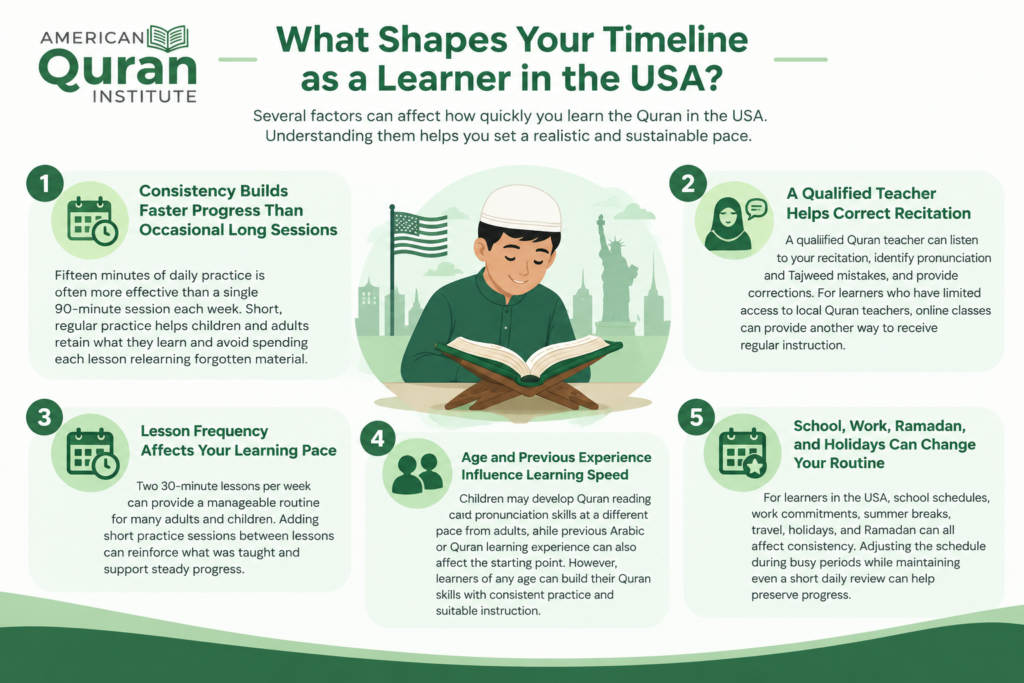
1. Consistency Builds Faster Progress Than Occasional Long Sessions
Fifteen minutes of daily practice is often more effective than a single 90-minute session each week. Short, regular practice helps children and adults retain what they learn and avoid spending each lesson relearning forgotten material.
2. A Qualified Teacher Helps Correct Recitation
A qualified Quran teacher can listen to your recitation, identify pronunciation and Tajweed mistakes, and provide corrections. For learners who have limited access to local Quran teachers, online classes can provide another way to receive regular instruction.
3. Lesson Frequency Affects Your Learning Pace
Two 30-minute lessons per week can provide a manageable routine for many adults and children. Adding short practice sessions between lessons can reinforce what was taught and support steady progress.
4. Age and Previous Experience Influence Learning Speed
Children may develop Quran reading and pronunciation skills at a different pace from adults, while previous Arabic or Quran learning experience can also affect the starting point. However, learners of any age can build their Quran skills with consistent practice and suitable instruction.
5. School, Work, Ramadan, and Holidays Can Change Your Routine
For learners in the USA, school schedules, work commitments, summer breaks, travel, holidays, and Ramadan can all affect consistency. Adjusting the schedule during busy periods while maintaining even a short daily review can help preserve progress.
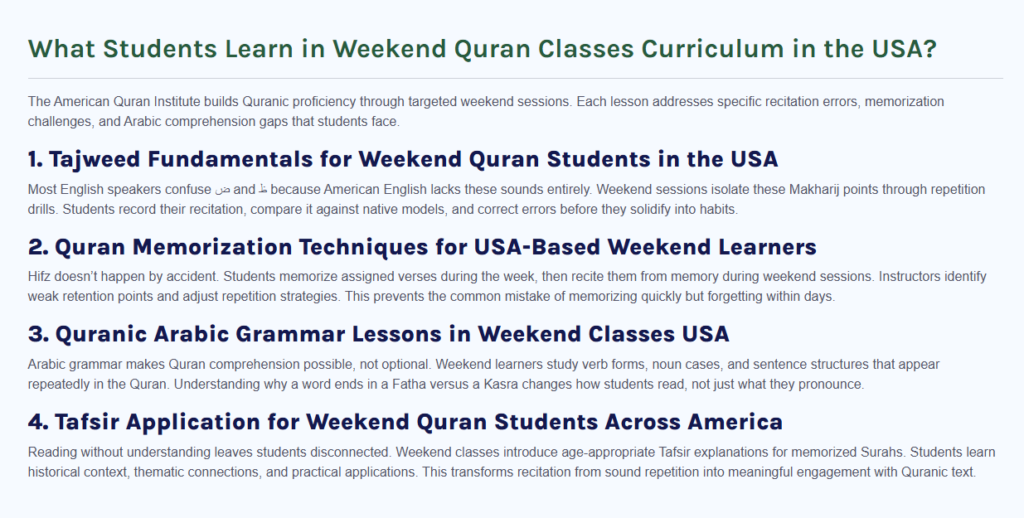
For families whose schedules are built around school and work, weekend Quran classes can also provide a structured learning option without adding weekday commitments.
Start Your Quranic Education
Join our premier online institute for structured Quranic learning tailored for students in the USA.
Book Your Free TrialA Sample Weekly Schedule for an American Family
Here is a realistic routine for a school-age child in the USA working on reading, tajweed, and early hifz. Adults can use the same structure around a workday.
| When | What | Time |
| Monday and Thursday, after school | Live lesson with a teacher | 30 min |
| Tuesday, Wednesday, Friday | Home review of the last lesson, read aloud | 15 min |
| Daily, on the drive to school | Listen to the surah being learned | 5 to 10 min |
| Saturday | Review of everything memorized so far | 20 to 30 min |
| Sunday | Weekend Islamic school or rest day | Varies |
| Once a week | Record a recitation and listen back | 5 min |
Keep the schedule simple enough to survive soccer season, exam weeks, and family trips. Two lessons you keep beat five you abandon by month two.
See Us in Action!
Take a look inside our virtual classrooms. Watch the clip below to see how our instructors engage with students, simplify complex rules, and create an inspiring environment for learning.
Start Your Quranic Education
Join our premier online institute for structured Quranic learning tailored for students in the USA.
Book Your Free TrialStart Learning the Quran With American Quran Institute
Learning the Quran becomes easier to manage when you have a clear learning path and regular guidance. American Quran Institute offers online Quran classes designed for students and families in the USA, with qualified teachers who can support learners at different levels.
Whether you are teaching a child to read the Quran, improving your Tajweed, beginning Hifz, or returning to Quran learning as an adult, structured lessons can help you build steady progress. Online classes also make it easier to fit Quran learning around school, work, and family responsibilities.
Instead of focusing only on how quickly you can finish, focus on building skills that stay with you. With regular lessons, daily practice, and guidance from a qualified teacher, you can develop a consistent Quran learning routine that fits your goals and schedule.
Start your Quran learning journey with a free trial at American Quran Institute today.
Our Quran Courses
- Quran Classes for Female/Sisters
- Learn Quran Course for Beginners
- Quran Qirat Learning Course
- Quran Tafsir Course
- Noorani Qaida Course
- Noorani Qaida Course for Kids
- Weekend Quran Classes
- Intensive Quran Course
- Al-Azhar Quran Course

Conclusion
There is no single timeline for learning the Quran in the USA. Learning to read may take several months, while developing strong Tajweed, memorizing the Quran, or understanding its meanings can take several years. Each learner progresses differently based on their starting level, age, goals, and available study time.
Consistency is one of the most important parts of making steady progress. A realistic routine that fits around school, work, family responsibilities, and daily life is easier to maintain than an intensive schedule that becomes difficult to follow.
Whether you are a beginner learning Arabic letters, an adult improving Tajweed, or a student working toward Hifz, progress comes through regular practice and qualified guidance. Set a manageable pace, keep reviewing what you learn, and give yourself enough time to build lasting Quran skills.
Frequently Asked Questions
How long does it take to learn the Quran in the USA as a complete beginner?
Most complete beginners in the USA can read short surahs within 6 to 9 months with two lessons a week and 15 minutes of daily practice. Applying tajweed naturally takes another 6 to 12 months.
Can adults in America still learn to read the Quran?
Yes. Adults, including new Muslims, learn Quran reading and tajweed every year. Consistency and a qualified teacher matter far more than age.
How long does it take to learn the Quran online?
Online learners follow the same timelines as in-person students. Many American families actually progress faster online, because lessons fit around school and work and are easier to keep consistent.
Can my child memorize the Quran while attending regular school?
Yes. Most American huffaz memorize part-time alongside school. At 30 to 60 minutes a day, a child starting around age 6 can realistically finish between ages 12 and 15.
Is Sunday school enough to learn the Quran?
Weekend Islamic school builds community and a strong foundation, but once a week is usually too little for steady progress on its own. Adding short daily practice and one or two weekday lessons makes a big difference.
How long does it take to read the entire Quran once?
Most fluent adult readers need about 20 to 30 hours to read the whole Quran. One juz’ a day finishes it in about 30 days, which is why many Muslims complete it during Ramadan.






Leave a Reply