 Quran
Quran
Have you picked up a Mushaf, looked at the Arabic script, and felt genuinely lost about where to start? You’re not alone. Millions of Muslims across the United States – kids growing up in American schools, busy adults juggling work and family, sisters managing packed schedules- want to read the Quran correctly but don’t know the right order of steps to get there.
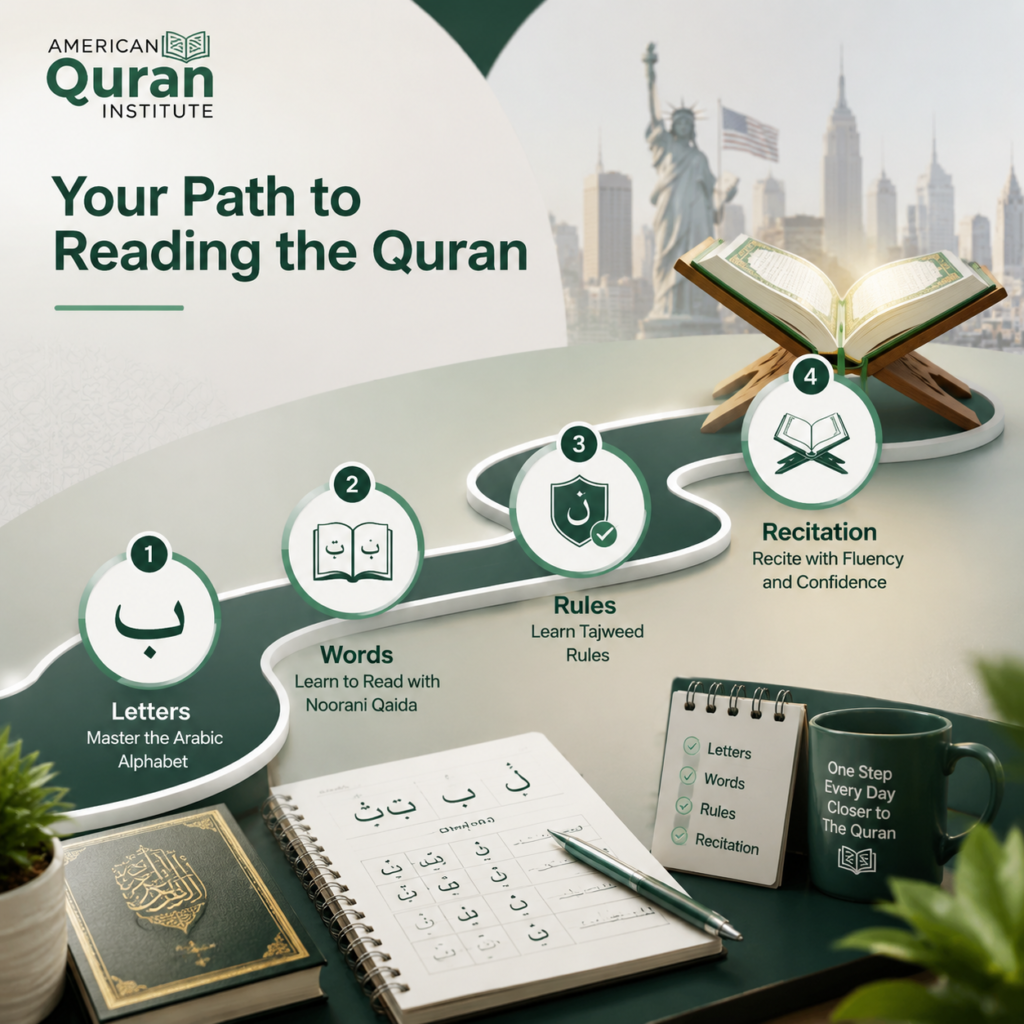
Learning how to read the Quran is not one skill; it’s four skills stacked in sequence: recognizing Arabic letters, reading connected words, applying Tajweed rules, and finally reciting fluently. Confuse the order and you stall. Follow the right sequence and most learners reach the basics of the Quran reading classes within three to six months of consistent daily practice.
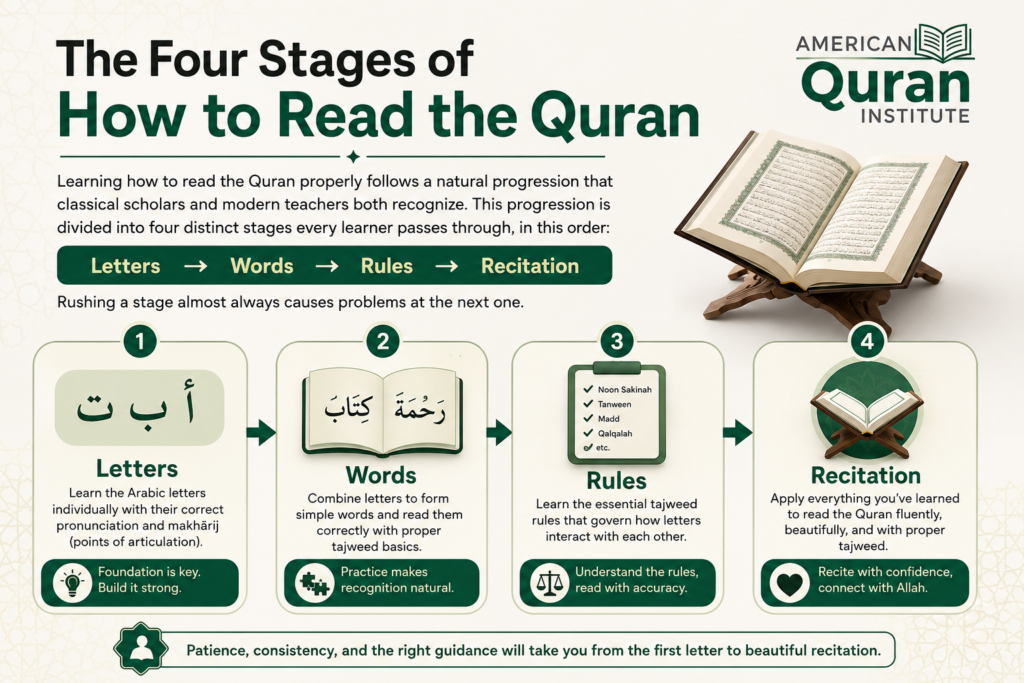
Learning how to read the Quran properly follows a natural progression that classical scholars and modern teachers both recognize. This progression is divided into four distinct stages every learner passes through, in this order: Letters → Words → Rules → Recitation. Rushing a stage almost always causes problems at the next one.
This guide gives you that sequence, plainly and completely.
1. Master the Arabic Alphabet Before Touching the Quran
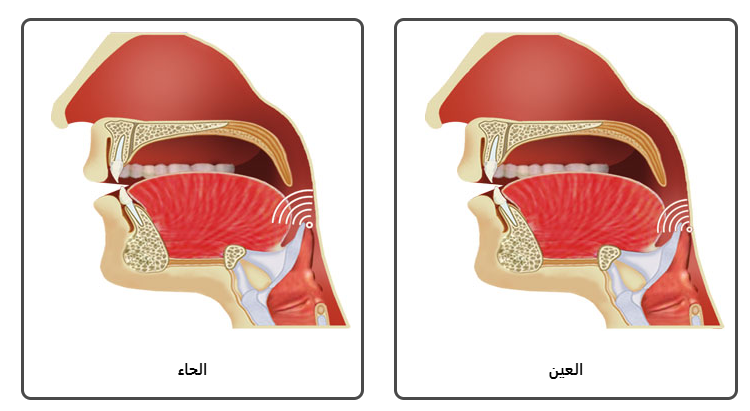
The Arabic alphabet has 28 letters, each with a specific point of articulation called a makhraj : a precise location in the mouth, throat, or lips where the sound originates. The letter ع (Ayn) is produced deep in the throat; ح (Ḥā) from the middle of the throat. These sounds don’t exist in English, which is exactly why American learners – children and adults alike – need dedicated time here before attempting Quranic text.
Arabic is also a connected script, so each letter takes a different written form depending on its position: isolated, initial, medial, or final. You must recognize all four forms of all 28 letters automatically before moving forward. Speed of letter recognition is what eventually determines reading fluency.
A critical error at this stage: learning letter names without learning their sounds. Knowing that a letter is called “Qaaf” means nothing if you can’t produce its sound from the back of the throat. Work on the sound first; the name will follow.
Read also: Where Should I Start Reading the Quran? USA Student Guide
2. Learn to Read Words Using the Noorani Qaida
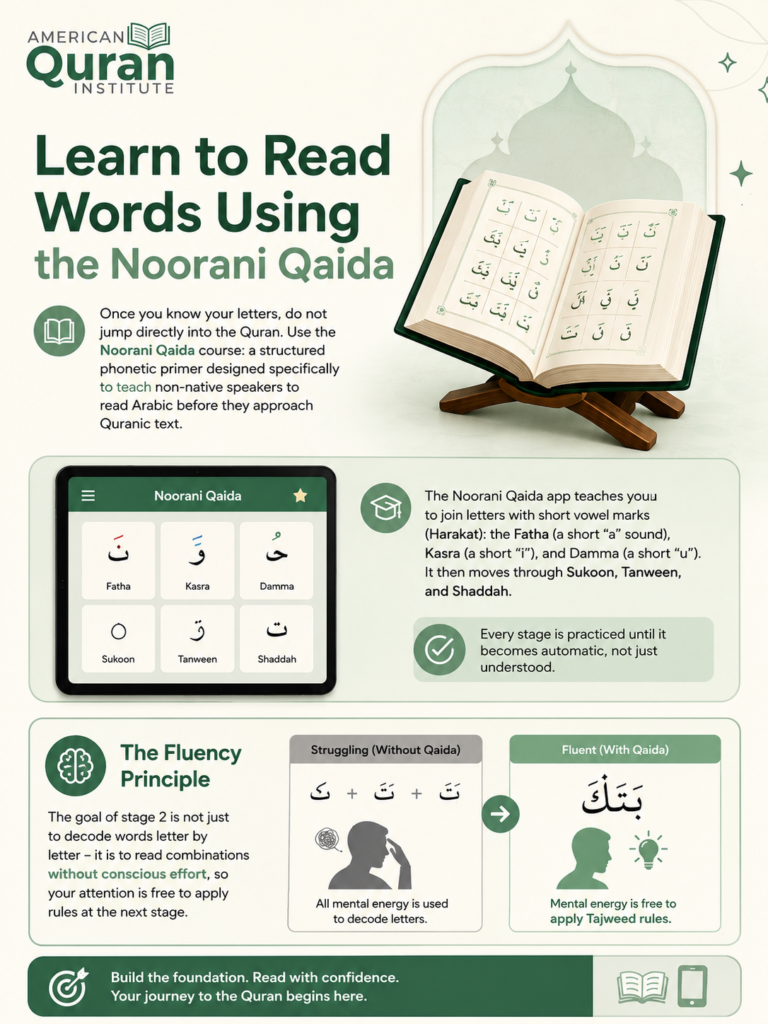
Once you know your letters, do not jump directly into the Quran. Use the Noorani Qaida course: a structured phonetic primer designed specifically to teach non-native speakers to read Arabic before they approach Quranic text.
The Noorani Qaida app teaches you to join letters with short vowel marks (Harakat): the Fatha (a short “a” sound), Kasra (a short “i”), and Damma (a short “u”). It then moves through Sukoon, Tanween, and Shaddah. Every stage is practiced until it becomes automatic, not just understood.
The fluency principle applies here: the goal of stage 2 is not just to decode words letter by letter – it is to read combinations without conscious effort, so your attention is free to apply rules at the next stage. Students who skip the Qaida and go straight to the Quran consistently struggle with Tajweed because they’re using all their mental energy just to decode letters.
Read also: How to Read the Quran Faster? A Practical Guide
Experience Our Classroom Environment
Don’t just take our word for it—experience a live session for yourself! Click on the videos below to watch real snippets from our classes and see our interactive teaching methods in real-time.
Start Your Quranic Education
Join our premier online institute for structured Quranic learning tailored for students in the USA.
Book Your Free Trial3. Learn the Core Tajweed Rules
Tajweed is the science of reciting the Quran with precision; giving each letter its right, its proper elongation, and its correct articulation. It is not optional ornamentation. The Tajweed science codifies all 28 makhaarij (plural of makhraj) into a systematic framework. Explore Tajweed course in the USA.
The Prophet Muhammad ﷺ said: “Recite the Quran in the melodious tones of the Arabs”, and classical scholars unanimously affirm that reciting with deliberate errors is impermissible.
The core rules every beginner must learn in this stage 3 are as following:
A. Rules of Noon Sakinah and Tanween
When a stationary Noon (نْ) or a Tanween ending (ً ٍ ٌ) appears in the text, one of four rules applies depending on the letter that follows:
- Izhar (Clear pronunciation): occurs when followed by the six throat letters (ء ه ع غ ح خ). The Noon is pronounced clearly with no nasalization.
- Idgham (Merging): occurs when followed by ي ن م و (with Ghunnah/nasalization) or ل ر (without Ghunnah). The Noon merges into the following letter.
- Iqlab (Substitution): occurs when followed by ب. The Noon converts to a Meem quality with Ghunnah.
- Ikhfa (Concealment): occurs when followed by any of 15 specific letters. The Noon is held between clear pronunciation and full merging, with a Ghunnah of two counts.
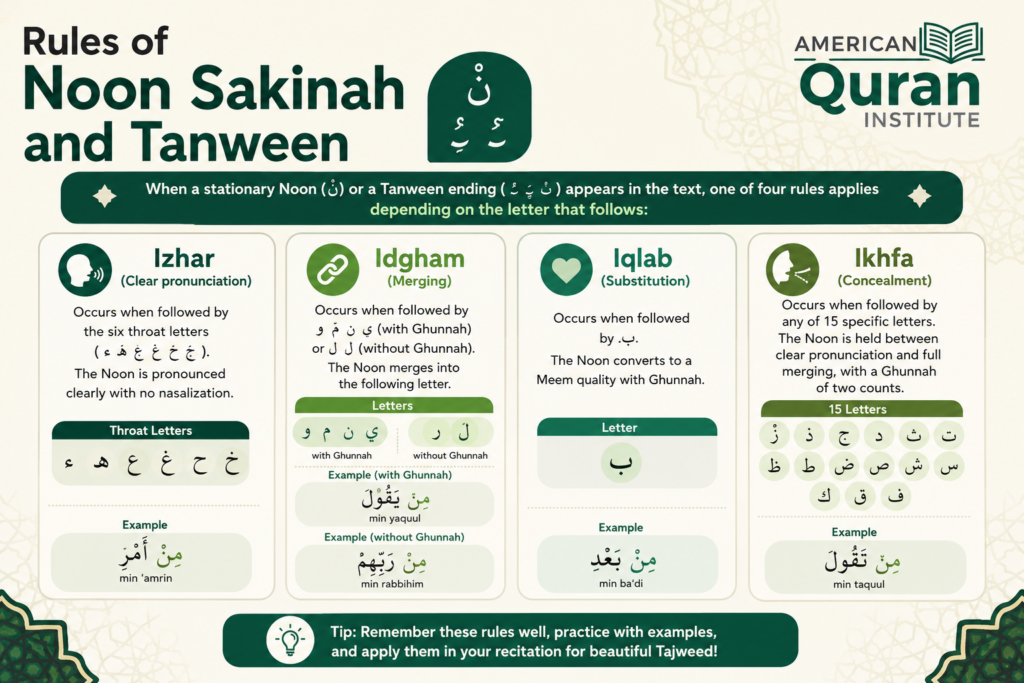
The most common error here: applying Ikhfa to every letter that doesn’t have an obvious rule, instead of learning the specific 15 Ikhfa letters. Precision matters — each rule has a defined trigger.
B. Rules of Meem Sakinah
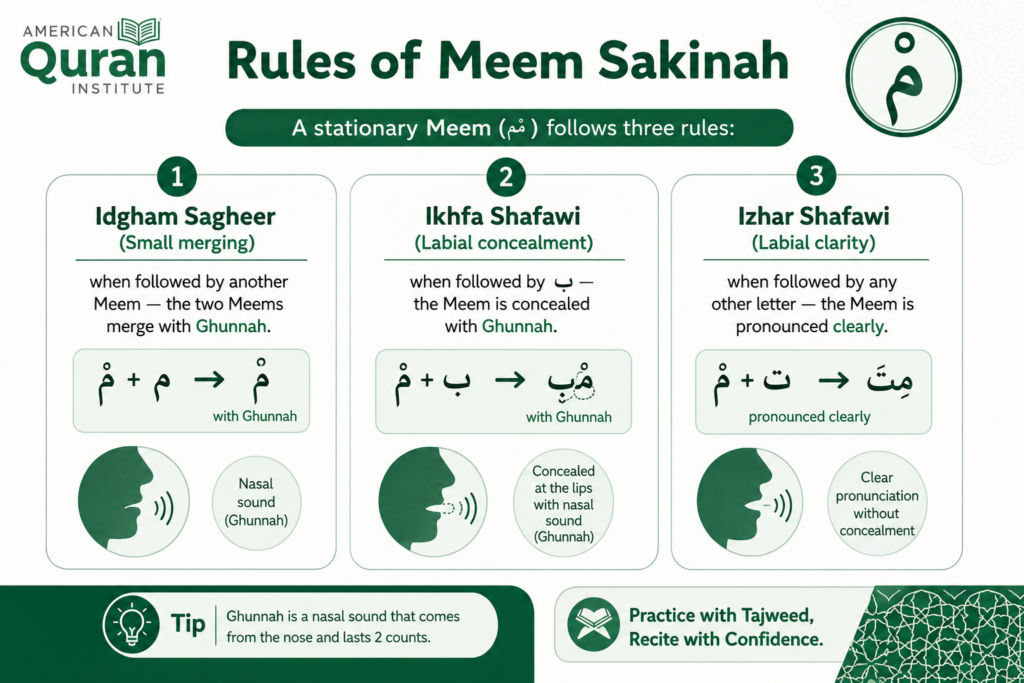
A stationary Meem (مْ) follows three rules:
- Idgham Sagheer (Small merging): when followed by another Meem — the two Meems merge with Ghunnah.
- Ikhfa Shafawi (Labial concealment): when followed by ب — the Meem is concealed with Ghunnah.
- Izhar Shafawi (Labial clarity): when followed by any other letter — the Meem is pronounced clearly.
C. Rules of Madd (Elongation)
Madd refers to elongating the voice on the three Madd letters (ا و ي). Every Madd falls into one of two categories:
- Natural Madd (Al-Madd Al-Asli): two counts of elongation, with no Hamza or Sukoon following. This is the baseline.
- Extended Madd (Al-Madd Al-Far’i): caused either by a Hamza or by a Sukoon following the Madd letter, extending the vowel to four, five, or six counts depending on the specific type. The most commonly encountered types are Al-Madd Al-Muttasil (Hamza in the same word, minimum four counts) and Al-Madd Al-‘Arid lil-Sukoon (pause-induced elongation, two to six counts permitted).
The practitioner note on Madd that most beginners miss: Madd length is measured in counts, not seconds. A count equals one movement of the finger: a rhythmic beat. Training your internal rhythm through imitation of a skilled reciter is more effective than trying to count abstractly while reading.
Enroll your child in our Tajweed course for kids with a FREE session
4. Practice Until Your Reading Becomes Fluent
Learning the rules of Quran reading is only half of the journey. The next step is transforming those rules into natural, effortless recitation through consistent practice. At this stage, your goal is to stop thinking about every individual letter or Tajweed rule and begin reading smoothly with confidence.
One of the most effective techniques is guided repetition. Choose a skilled reciter—many teachers recommend Sheikh Mahmoud Khalil Al-Husary for beginners because of his clear and measured pace. Listen to a short passage several times, then recite it aloud while following the Mushaf. Repeat the same verses over several days until your pronunciation, rhythm, and pauses become natural. Fluency is built through repetition, not speed. Focus on accuracy first, and speed will develop on its own.
Our qualified Ijazah-certified instructors at The American Quran Institute work with learners at every stage — from absolute beginners through advanced recitation — and can identify and correct the specific errors that self-study alone cannot catch. You can start with a free trial session to experience this without any commitment.
Book a FREE session with one of our Ijazah-certified teachers
5. Apply Tarteel And The Etiquette Of Reading The Quran
Before you begin a Quran recitation class, there is an etiquette of reading the Quran that scholars affirm. Performing wudu (ritual purification) before touching the Mushaf is the established scholarly position. You begin with Ta’awwudh (أعوذ بالله من الشيطان الرجيم) and Basmala (بسم الله الرحمن الرحيم) at the start of each surah, except Surah At-Tawbah. Read in a calm, measured pace – what the Quran calls tarteel (ترتيل) – moving your lips and producing the sounds audibly.

These are not peripheral habits. The Quran explicitly commands tarteel: “And recite the Quran with measured recitation” (Al-Muzzammil: 4). Reading with awareness of meaning (tadabbur) is the purpose behind the recitation, the rules are the vehicle, not the destination.

6. Build a Consistent Daily Quran Routine
Progress in Quran reading depends far more on consistency than on long study sessions. Research on skill acquisition consistently shows that short, regular practice leads to stronger long-term retention than occasional intensive study. Even fifteen to twenty minutes of focused recitation each day produces better results than several hours once a week.
Create a routine that fits naturally into your lifestyle. Read after Fajr before the day becomes busy, after Maghrib with your family, or during a quiet lunch break if you work full-time. By connecting Quran reading to an existing daily habit, it becomes easier to maintain your practice for months rather than weeks.
For kids, keep sessions to 10–15 minutes and tie them to an existing routine — right after Maghrib prayer, for example, is a natural anchor that many American Muslim families find works well. Morning Tajweed classes for ladies after Fajr are often the most protected time in the day to manage the home alongside their own learning.
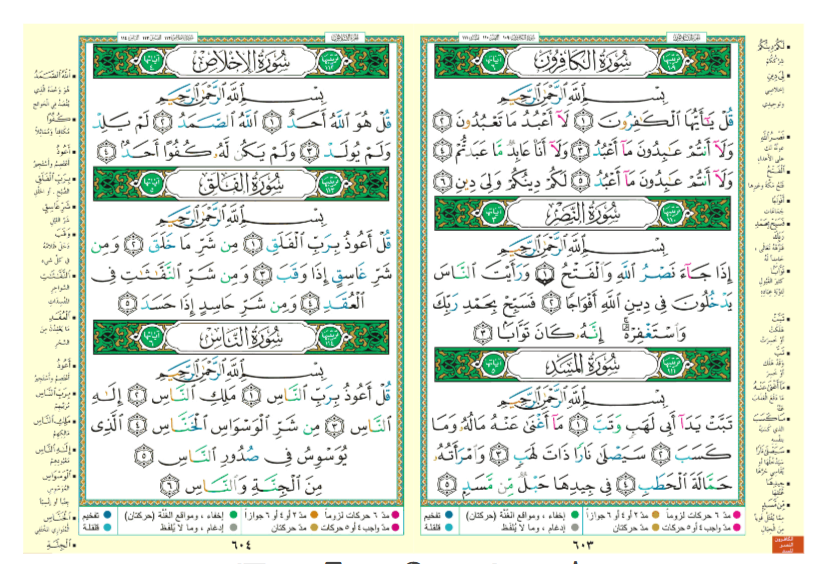
Use a color-coded Tajweed Mushaf – one where Tajweed rules are printed in distinct colors – so you can see where elongations, Ghunnahs, and special rules apply visually while you read. This bridges the gap between knowing a rule and spotting it in context.
7. Review and Reinforce What You Learn
Many beginners make the mistake of constantly moving to new lessons without reviewing previous ones. In Quran learning, progress is built through repetition and reinforcement. A learner who thoroughly reviews one page will often progress faster than someone who rushes through ten pages only to forget them a week later.
Set aside part of every study session for revision. Read yesterday’s lesson before beginning today’s, revisit previously learned Tajweed rules in different verses, and regularly return to earlier surahs. Strong review builds confidence, improves fluency, and prevents small mistakes from becoming lifelong habits.
Read also: LEARN QURAN BY HEART IN THE USA
8. Read The Quran With Understanding Alongside Recitation
Learning to read the Quran and understanding its message are two complementary goals, not competing ones. A beginner should first focus on reading the Arabic text correctly while gradually becoming familiar with its meanings through a reliable English translation and authentic Tafsir.
Even learning the meaning of a few verses each week transforms recitation into a more meaningful act of worship. As your reading becomes more fluent, your mind becomes free to reflect on the Quran’s guidance instead of concentrating solely on decoding the words.
9. Learn With a Qualified Quran Teacher
While books, videos, and mobile apps are valuable learning tools, they cannot replace the guidance of a qualified Quran teacher. An experienced instructor can identify pronunciation mistakes that learners rarely notice themselves, explain difficult Tajweed rules with clarity, and adjust lessons according to each student’s pace and ability.
For Muslims living across the United States, live online Quran classes have made high-quality instruction more accessible than ever. Whether you are a complete beginner, a busy professional, or a parent searching for structured lessons for your child, studying with a qualified teacher provides accountability, immediate feedback, and a clear path toward confident Quran recitation.
Book your FREE trial session today

10. Continue Growing Beyond Basic Quran Reading
Reading the Quran fluently is not the finish line—it is the foundation for a lifelong relationship with the Book of Allah. Once you become comfortable reading the text, continue strengthening your Tajweed, memorizing new surahs, reviewing what you have already learned, and exploring the meanings of the verses through authentic Tafsir.
Over time, you may choose to pursue higher levels of Quranic study, such as memorization (Hifz), advanced Tajweed, or even Ijazah certification under a qualified scholar. Every stage deepens your connection with the Quran and allows you to recite it with greater accuracy, understanding, and devotion. The journey of learning the Quran never truly ends; it continues throughout a believer’s life.
See Us in Action!
Take a look inside our virtual classrooms. Watch the clip below to see how our instructors engage with students, simplify complex rules, and create an inspiring environment for learning.
Start Your Quranic Education
Join our premier online institute for structured Quranic learning tailored for students in the USA.
Book Your Free TrialStart Reading the Quran the Right Way with American Quran Institute
You now have the framework. The question is whether you’ll follow it alone – or with expert guidance that cuts your learning time significantly.
The American Quran Institute, based in the United States, offers structured live online Quran reading courses designed specifically for American Muslim families. Whether you’re a parent enrolling your child, an adult who’s been meaning to learn for years, or a sister looking for a qualified female instructor in a comfortable environment — there’s a program built for you. Certified instructors provide personalized curricula, real-time pronunciation correction, and flexible scheduling that works across US time zones.
Our Quran Courses
- Quran Online Academy
- Quran Recitation Classes
- Quran Reading Classes
- Online Quran Classes for Kids
- Quran Classes for Adults
- Quran Classes for Female/Sisters
- Learn Quran Course for Beginners
- Quran Qirat Learning Course
- Quran Tafsir Course
- Noorani Qaida Course
- Noorani Qaida Course for Kids
- Weekend Quran Classes
- Intensive Quran Course
- Al-Azhar Quran Course
Start Your Quranic Education
Join our premier online institute for structured Quranic learning tailored for students in the USA.
Book Your Free TrialConclusion
Learning how to read the Quran correctly comes down to following the right sequence and not skipping stages. Master the Arabic letters first. Build word-reading fluency through the Noorani Qaida. Learn the core Tajweed rules — Noon Sakinah, Meem Sakinah, and Madd — and apply them to real verses. Then build daily recitation until the rules become automatic and the words flow with reverence.
None of this requires an Arabic-speaking background, and it doesn’t require living near an Islamic center. It requires the right structure, a qualified teacher, and the consistency of showing up every day. The Quran meets every sincere learner where they are — including in the United States.
Frequently Asked Questions
How long does it take to learn how to read the Quran?
Most non-Arabic speaking adults who study consistently for 20 minutes a day reach basic Quranic reading fluency within three to six months. The timeline depends on prior Arabic exposure, lesson frequency, and whether a teacher corrects errors in real time. Learners who study without a teacher typically take longer because mispronunciation habits go uncorrected.
Can I learn how to read the Quran without knowing Arabic?
Yes. Reading the Quran in Arabic does not require speaking Arabic. The Noorani Qaida teaches phonetic reading skills — letter sounds, vowel marks, and word combinations — without grammar or vocabulary study. Many fluent Quran readers worldwide, including throughout the US, do not speak conversational Arabic.
What is Tajweed and do beginners need it?
Tajweed is the set of rules governing correct Quranic pronunciation — letter articulation, nasalization, and vowel elongation. Beginners should learn the foundational rules (Noon Sakinah, Meem Sakinah, natural Madd) as they move into Quranic text, not before they can read connected letters. Attempting to study Tajweed rules before achieving basic reading fluency creates confusion.
Can I teach myself to read the Quran?
Yes, but only up to a point. Self-study works for the early stages — learning the Arabic alphabet and working through the Noorani Qaida with structured resources and audio from certified reciters. Once you move to actual Quranic text, a teacher becomes necessary. Makhraj and Tajweed errors are almost impossible to hear in your own recitation. Without correction, they become permanent habits that are much harder to fix later. Self-study starts you. A qualified teacher gets you there correctly.
What is the difference between reading and reciting the Quran?
Reading (Qira’ah) refers to accurately decoding Arabic text. Recitation (Tilawah) refers to reading with proper Tajweed, rhythm, and contemplation of meaning — the fuller, devotional form. Beginners should aim for accurate reading first, then refine toward proper recitation as Tajweed becomes internalized






Leave a Reply