 Quran
Quran
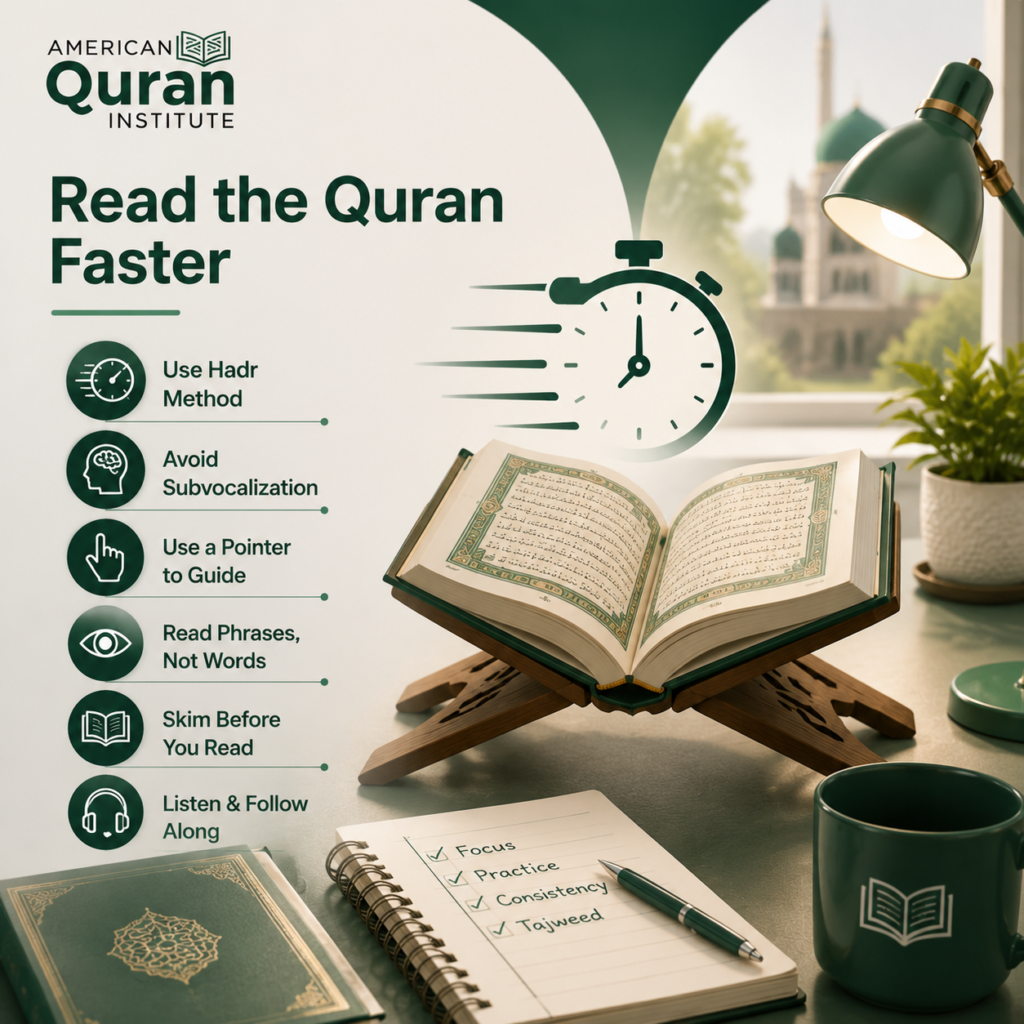
Reading the Quran faster is a goal shared by millions of Muslims across America — from busy parents in New Jersey trying to finish a Juz after Fajr, to Muslim kids in Texas juggling school and Quran lessons, to sisters who want to complete a full khatm during Ramadan without taking time off work and without sacrificing proper pronunciation or meaning. The challenge is real, and it is felt differently depending on who you are.
The good news: faster Quran reading is a learnable skill. Islamic scholarship has a dedicated name for it, and modern reading science backs the same techniques. This guide gives you both.
1. Learn The Method of Hadr in Quran Reading
Most articles on reading the Quran faster treat it like general speed reading. They’re missing something essential: Islamic recitation has its own speed framework, and it starts with Hadr.
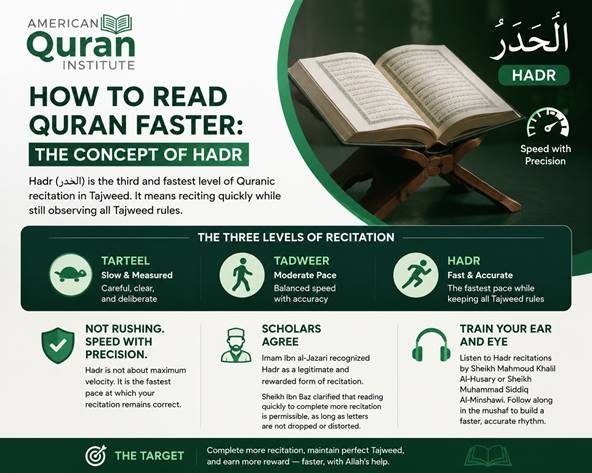
Hadr (الحَدر) is the third and fastest of the three recognized levels of Quran recitation in Tajweed — the others being Tarteel (slow and measured) and Tadweer (moderate). Hadr means reciting quickly while still observing all Tajweed rules: correct makhaarij (articulation points), proper madd lengths, accurate idghaam and ikhfaa, and clean letter pronunciation. It is not rushing carelessly — it is speed with precision.
Scholars such as Imam Ibn al-Jazari recognized Hadr as a legitimate and rewarded form of recitation. Sheikh Ibn Baz clarified that reading the Quran quickly with the intention of completing more recitation is permissible, provided the letters are not dropped or distorted. This is the target: not maximum velocity, but the fastest pace at which your recitation remains correct.
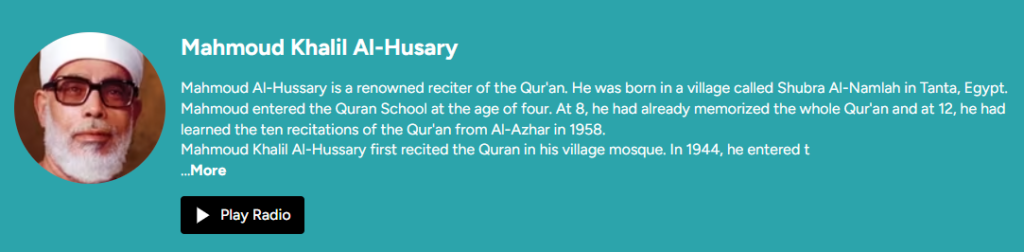
If you want a model to hear, listen to the Hadr recordings of Sheikh Mahmoud Khalil Al-Husary or Sheikh Muhammad Siddiq Al-Minshawi. Following along in the mushaf while they recite is one of the most effective ways to train your ear and eye for a faster, accurate rhythm.
Read also: How to Overcome The Struggling When Reading the Quran?
2. Learn To Avoid Subvocalization Issues
Before building speed, you need to identify what is holding you back. The most common culprit — in Quran recitation and general reading — is subvocalization: silently mouthing or mentally pronouncing every single letter and word before your eye moves forward.
Research in reading psychology confirms that untrained readers fix their eyes six to eight times per line, stopping at individual words. That constant stopping is the brake.
The Arabic-specific version of this problem is reading letter-by-letter rather than word-by-word or phrase-by-phrase. When you were first learning to read Arabic, you sounded out every letter aloud. That was correct for a beginner. But carrying that habit into advanced recitation keeps your speed permanently capped at the pace of your tongue, not your eye.
The goal is to train your eye to recognize whole words and short phrases as single visual units — the way you recognize a familiar face instantly, without analyzing each feature. When you see the word “قُلْ” or “إِنَّا”, your eye should register the meaning and sound pattern in one glance, not spell it out.
Read also: Benefits of Reciting Quran Without Understanding
3. Use a Pointer to Control Your Eye Movement
Place your finger or a pen just below the line you are reading and move it at a pace slightly faster than feels comfortable. Your eye will follow. This technique does two things: it stops your eye from jumping back to re-read words (a habit called regression), and it forces you to process groups of words rather than single letters.
A common practitioner observation: most readers who think they have a comprehension problem actually have a regression problem. They re-read words out of habit, not necessity. The pointer eliminates that reflex within days.
For younger kids, a colorful bookmark or ruler works better than a pen — it turns the pointer into a familiar school-style tool rather than something new to manage.
4. Read Phrases, Not Words
Instead of reading كلمة كلمة (word by word), train yourself to capture short Quranic phrases — often three to five words — in a single eye fixation. Many Quranic phrases are semantically complete units: “وَمَا أَرْسَلْنَاكَ”, “إِنَّ اللَّهَ عَلَى كُلِّ شَيْءٍ”. With regular practice, familiar phrases become visual anchors that your eye recognizes without decoding.
Start by reducing your eye stops from six to eight per line to three to four per line. That alone roughly doubles your speed.
For busy American adults — professionals, parents, or university students — this technique is especially practical because it reduces the mental effort required per session, making it easier to fit meaningful Quran time into a packed schedule.

5. Skim The Page/Verse Before You Recite
Before beginning a page or a passage, spend ten to fifteen seconds scanning it: read the headings of the Surah, notice where new Ayaat begin, identify any words you might hesitate on. This preview removes the element of surprise. When your eye encounters a word it has already seen, it processes it faster.
This technique — called Skimming in reading science — is directly applicable to the mushaf. Familiarity with the text’s structure reduces the cognitive load when you recite, which translates to faster, smoother reading.
Experience Our Classroom Environment
Don’t just take our word for it—experience a live session for yourself! Click on the videos below to watch real snippets from our classes and see our interactive teaching methods in real-time.
Start Your Quranic Education
Join our premier online institute for structured Quranic learning tailored for students in the USA.
Book Your Free Trial6. Listen to Hadr Recitations and Follow Along
Select a recording of Sheikh Al-Husary in his Hadr narration or Al-Minshawi’s faster recitations. Open your mushaf and follow the text while the Sheikh recites. Do not try to keep up perfectly at first — the goal is to train your internal rhythm.
After two to three sessions of listening while following, you will notice your eye begins anticipating the next phrase before you reach it. This is your reading brain adapting to a faster cadence. It is one of the fastest calibration methods available.
Children particularly benefit from this technique. A child’s ear absorbs rhythm and pronunciation patterns quickly — many kids who struggle to read faster in isolation make rapid progress once they start tracking audio recitations.
Enroll your child in our Quran classes for kids with a FREE session

7. Measure Your Speed and Set a Specific Goal
Use this formula to calculate your current reading speed:
Reading speed (words per minute) = (words per line) × (lines per page) × (pages read) ÷ (minutes spent)
A typical Quran page has between 150 and 200 words. The average reader completes one Juz (roughly 20 pages) in 60 to 90 minutes. A trained Hadr reader can complete a Juz in 20 to 30 minutes.
Measure yourself once a week. Even a 10% improvement per week compounds significantly over a month. Progress tracking is what separates deliberate practice from aimless reading.
Our Online Tajweed Classes in the USA at The American Quran Institute connect American students across time zones with Azhari teachers trained in classical recitation methods, making authentic Quranic education accessible from any state.
8. Depend on Reliable Teachers
The techniques above will carry you far — but nothing accelerates progress like reciting in front of a qualified teacher who corrects you in real time.
American Quran Institute is based in the United States and serves Muslim families across the country — kids starting their Quran journey, adults who never had the chance to learn properly, and sisters looking for a comfortable, focused learning environment with female teachers. All classes are online, one-on-one, and scheduled around your life in the US.
Read also: Quran Qirat Learning Course in the USA

9. Setting Realistic Goals for Faster Quran Reading
Hadr is a skill, not a talent. No one is born reciting quickly — just as no sprinter is born fast. Speed in recitation is the result of consistent, deliberate practice applied over weeks.
A practical framework for beginners: start by reading one Juz per day using the pointer technique and a moderate pace. Track your time. Each week, push your pointer slightly faster while maintaining correct pronunciation. Within four to six weeks, most readers see a 40 to 60% improvement in increasing Quran reading speed without any loss in accuracy.
For American Muslim kids, short daily sessions work better than long weekend sessions. Fifteen focused minutes every day after school will produce better results than a ninety-minute session on Sunday. Consistent daily exposure is what builds the visual memory for Arabic words.
For Hifz students — whether children working toward Quran memorization for kids or adults revisiting their memorized portions — Hadr practice builds the stamina to revise multiple Juz in a single sitting, which is essential for strong long-term memorization.
Do not start with Hadr on a Surah you are currently memorizing for the first time. Apply it to Surahs you already know well. Speed on a weak foundation breaks the foundation — speed on a strong one strengthens it.
See Us in Action!
Take a look inside our virtual classrooms. Watch the clip below to see how our instructors engage with students, simplify complex rules, and create an inspiring environment for learning.
Start Your Quranic Education
Join our premier online institute for structured Quranic learning tailored for students in the USA.
Book Your Free TrialStart Reciting More Quran Today
You now have a complete roadmap — from the Islamic principle of Hadr to the practical eye-movement techniques that make it possible. The gap between where you are and where you want to be is smaller than you think. It closes one session at a time.
Start today: pick one Juz you know well, use a pointer, and time yourself. That single session gives you a baseline. Everything after that is progress.
American Quran Institute is here when you are ready for a teacher. Our online classes are flexible, one-on-one, and designed for the American Muslim — whether you are a child, an adult, a revert, or a sister looking for a comfortable learning space.
Start Your Free Trial of Your Quranic Education Journey

Check out our top courses for Quran learning:
Noorani Qaida Course in the USA
Quran Ijazah Program in the USA
Start Your Quranic Education
Join our premier online institute for structured Quranic learning tailored for students in the USA.
Book Your Free TrialConclusion
Reading the Quran faster comes down to one principle: train your eye to work faster than your tongue. The concept of Hadr gives that goal Islamic grounding. Practical techniques — pointer tracking, phrase reading, skimming, and listening to fast recitations — give it a method. Regular measurement gives it direction.
For American Muslims specifically, the biggest barrier is usually not motivation — it is access to qualified guidance and a structured approach that fits into a busy American lifestyle. American Quran Institute bridges that gap with certified teachers, flexible US-friendly scheduling, and programs tailored for every age and background.
The primary keyword here is how to read the Quran faster, and the honest answer is: through daily, structured practice of Hadr, guided by a teacher who can confirm your pronunciation stays accurate as your speed increases.
Frequently Asked Questions
Does the type of mushaf (font size, page layout) affect reading speed?
Yes, significantly. The standard Madinah mushaf layout — with 15 lines per page and consistent line breaks at natural pauses — is widely considered the most speed-friendly format. Larger font sizes help beginners, while experienced readers often find medium fonts allow better phrase-level scanning.
Is Hadr recitation appropriate for use during Salah?
Scholars have differing opinions. Many permit it in voluntary prayers (Nafl) but recommend a moderate pace (Tadweer or Tarteel) in obligatory prayers (Fard), especially when praying in congregation, out of consideration for those following the Imam. The key condition in all cases remains accurate pronunciation.
Can listening to Quran recitations help me read faster?
Yes. Following along in the mushaf while listening to a Hadr recitation by readers such as Sheikh Al-Husary or Al-Minshawi trains your internal rhythm and helps your eye anticipate phrases before it reaches them. This is one of the fastest methods to recalibrate your reading pace.
Should I sacrifice comprehension for speed?
No. The goal is to reach the fastest pace at which your comprehension and pronunciation remain accurate — not to rush past meaning. For Surahs you already know well, speed and comprehension can coexist. For new or complex Surahs, slower Tarteel is still more appropriate.
How long does it typically take an adult beginner to master Hadr recitation?
This varies by individual, but most adult learners who practice consistently — around 15–30 minutes daily — begin to notice meaningful progress in 3–6 months. Reaching a confident, accurate Hadr pace with full Tajweed compliance can take 1–2 years of structured practice.






Leave a Reply