 Quran
Quran
Many Muslims in the United States — whether American-born, immigrant families, or new Muslims — ask themselves the same honest question: If I’m reading Arabic words I don’t fully understand, is there still reward in it? For Muslim kids growing up in American schools, for busy working adults in New York or Texas, for sisters managing households across the country — this question is real and deserves a direct answer. Drawn from the Quran, authentic hadith, and the rulings of major scholars, that answer is a clear yes. But the full picture is more nuanced, and more encouraging, than a simple yes or no.
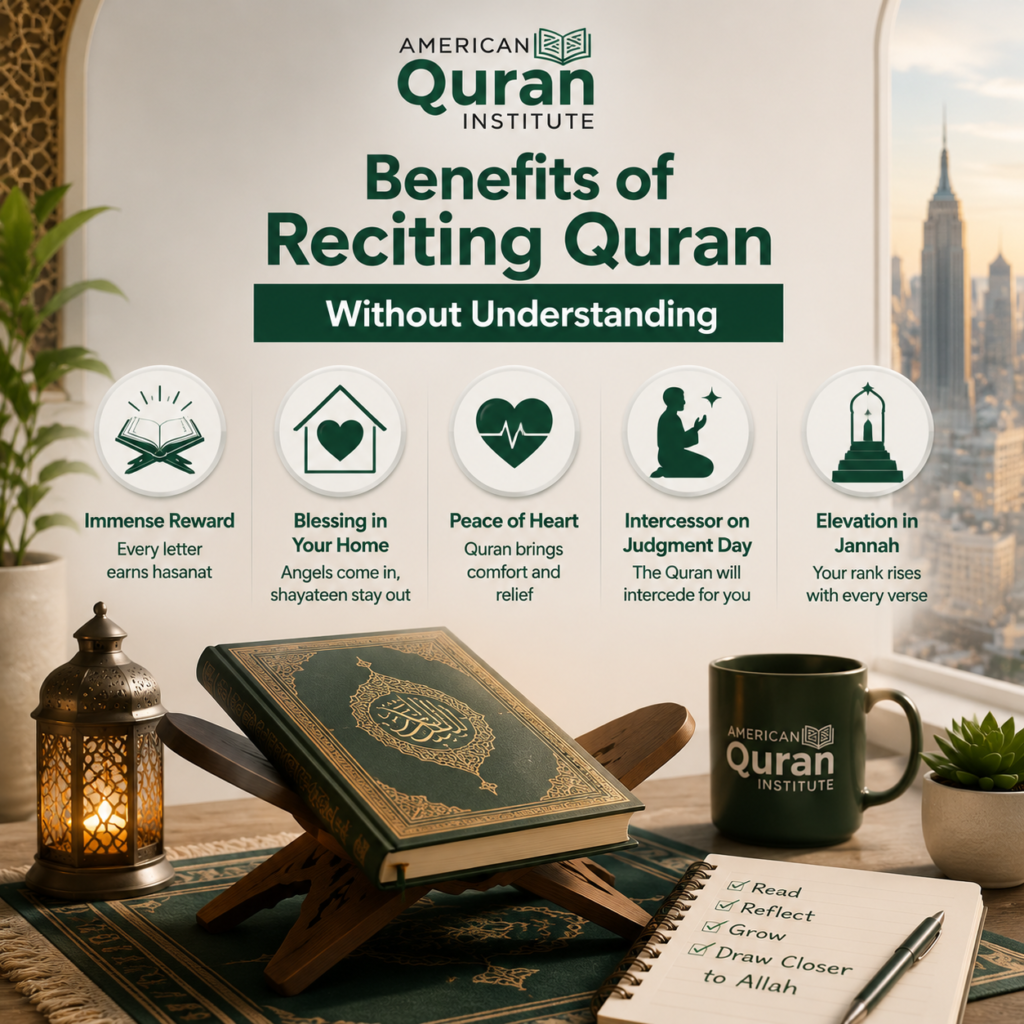
Reading Quran without understanding is not a lesser form of worship. It carries its own distinct set of benefits — some immediate, some that build over time, and some reserved for the Hereafter.
Reciting the Quran without understanding is a valid act of worship and brings reward. However, its ultimate purpose is reflection and understanding, so strive to learn its meanings alongside your recitation.
1. Immense Reward for Every Letter
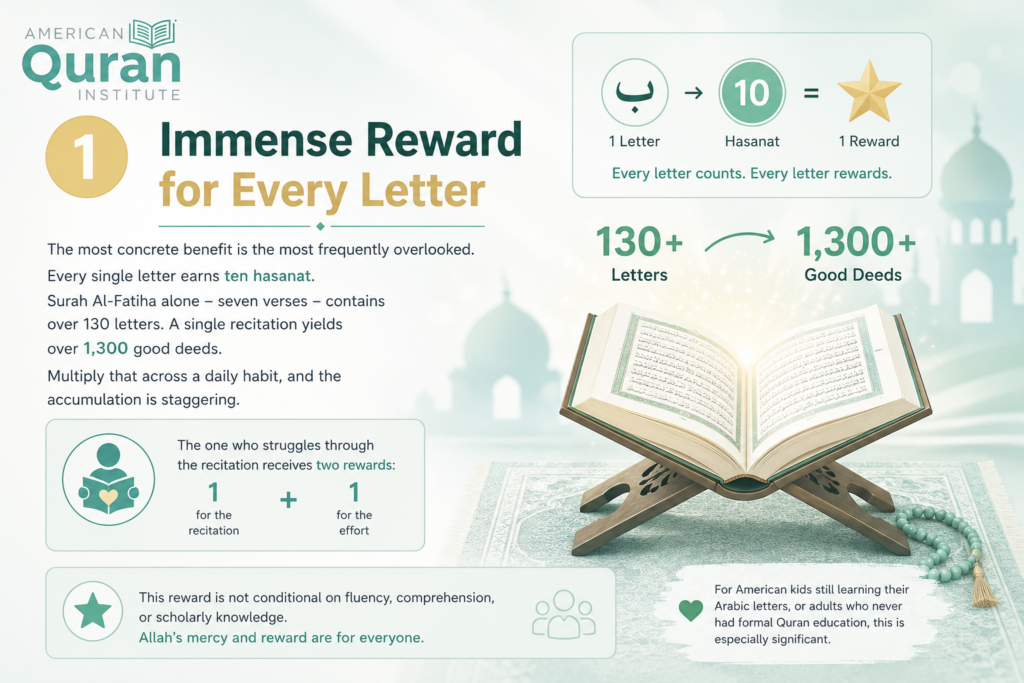
The most concrete benefit is the most frequently overlooked. Every single letter earns ten hasanat. Surah Al-Fatiha alone – seven verses – contains over 130 letters. A single recitation yields over 1,300 good deeds. Multiply that across a daily habit, and the accumulation is staggering.
This reward is not conditional on fluency, comprehension, or scholarly knowledge. The Prophet ﷺ even noted that the one who struggles through the recitation — who finds it difficult — receives two rewards: one for the recitation, and one for the effort. (Bukhari and Muslim, from Aisha RA) For American kids still learning their Arabic letters, or adults who never had formal Quran education, this is especially significant.
Read also: 11 Powerful Motivations to Read Quran
2. Reciting The Quran Gives Light, Blessing, And Protection In Your Home
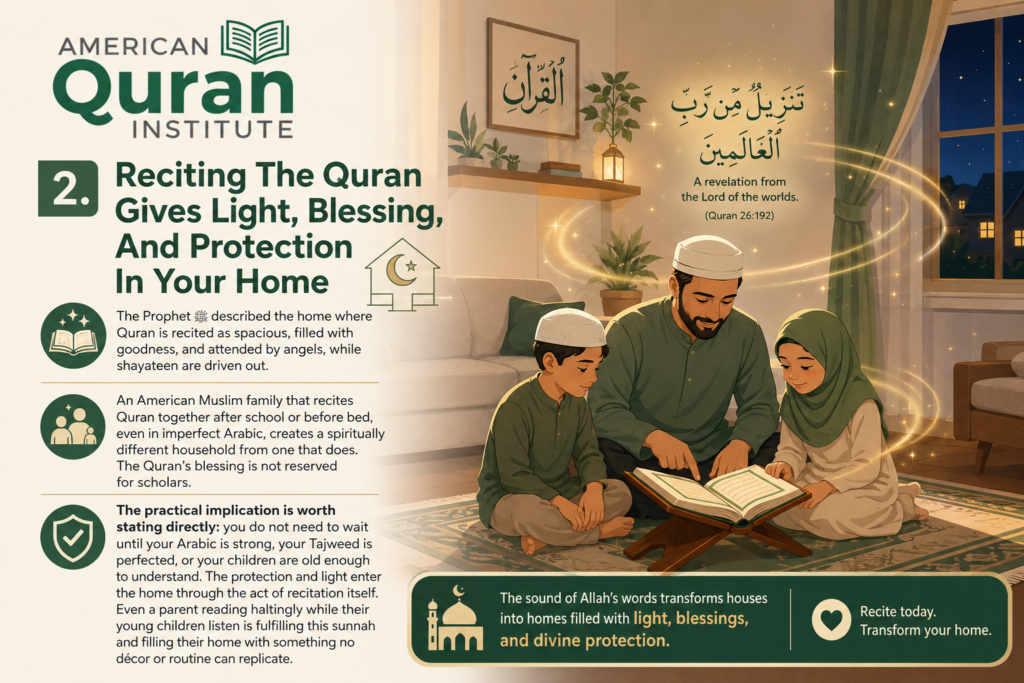
The Prophet ﷺ described the home where Quran is recited as spacious, filled with goodness, and attended by angels, while shayateen are driven out. This is a function of the Quran’s recitation — of the sound and the presence of Allah’s words — not of the listener’s ability to parse their grammar.
An American Muslim family that recites Quran together after school or before bed, even in imperfect Arabic, creates a spiritually different household from one that does not. The Quran’s blessing is not reserved for scholars.
The practical implication is worth stating directly: you do not need to wait until your Arabic is strong, your Tajweed is perfected, or your children are old enough to understand. The protection and light enter the home through the act of recitation itself. Even a parent reading haltingly while their young children listen is fulfilling this sunnah and filling their home with something no décor or routine can replicate.
3. Quran Recitation Gives You Peace of Heart and Relief from Anxiety
Of all the benefits Quran recitation brings into a Muslim’s life, perhaps none is more immediately felt than its effect on the heart, Allah says: “Verily, in the remembrance of Allah do hearts find rest.” (Ar-Ra’d: 28) Quranic recitation is the highest form of dhikr. People who recite regularly report a measurable quieting of anxiety — not as a psychological technique, but as a documented spiritual effect that scholars and practitioners alike have observed across centuries.
For Muslim adults in the US navigating busy careers, and for teenagers dealing with the pressures of American school life, this benefit is immediately practical. The calm that comes from recitation does not wait for understanding to arrive.
What makes this particularly significant is that the effect is cumulative. A single session of recitation brings immediate relief, but Muslims who build a consistent daily habit report a baseline shift — a general steadiness that carries through stressful days rather than appearing only during moments of active recitation. Ibn Al-Qayyim described the Quran as a complete remedy for the heart, and that completeness reveals itself gradually to the reader who keeps returning to it.
Experience Our Classroom Environment
Don’t just take our word for it—experience a live session for yourself! Click on the videos below to watch real snippets from our classes and see our interactive teaching methods in real-time.
Start Your Quranic Education
Join our premier online institute for structured Quranic learning tailored for students in the USA.
Book Your Free Trial4. Reading The Quran is Your Intercessor on the Day of Judgment
The Prophet ﷺ said: “Read the Quran, for it will come as an intercessor for its companions on the Day of Resurrection.” (Muslim) The word “companions” — ashabuhu — refers to those who recited it consistently, who kept it close. There is no scholarly opinion that limits this intercession to those who understood every verse.
This hadith carries a weight that should reframe how any Muslim thinks about their relationship with the Quran. Intercession on the Day of Judgment is not a minor reward — it is among the most consequential outcomes a believer can hope for. The fact that this intercession is tied to consistency of recitation, rather than to scholarly mastery or complete Quran memorization, means it is within reach of every Muslim who simply keeps the habit alive. The Quran does not ask for perfection from its companion. It asks for companionship.
Read also: How to Start Reading the Quran Daily? A Practical Guide for Americans

5. Reciting The Quran Is A Reason For Elevation in Jannah
The Prophet ﷺ said: “It will be said to the companion of the Quran: Read and ascend, recite as you used to recite in this world, for your rank will be at the last verse you recite.” (Abu Dawud, Tirmidhi) Your station in Jannah is linked to how much you recited in this life — another incentive to read consistently, regardless of where your comprehension currently stands.
This hadith has a detail that deserves close attention: the instruction in Jannah is to recite as you used to recite in this world. The habit formed here carries forward. Every verse memorized, every page read after Fajr, every surah recited in salah is not merely a present act of worship — it is a deposit that determines your standing in the next life. For the American Muslim who feels their recitation is too imperfect or too slow to matter, this hadith is a direct answer: what matters is that you recited, and how much.
Read also : Learn Quran for Beginners in the USA
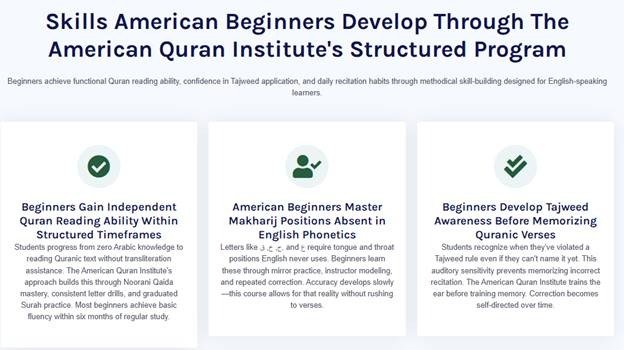
6. Building Reading Habit Opens the Door to Understanding
This is a practical benefit that competing articles rarely mention. Regular recitation — even without full understanding — builds familiarity with Quranic vocabulary, rhythm, and structure. Many American Muslims who committed to daily recitation found that words and phrases began to feel familiar before they formally studied Arabic.
This is especially true for Muslim kids in the US. Children who recite regularly at home or in Sunday school are priming their minds for comprehension later. Recitation is not separate from understanding — it is the foundation that understanding is built on.
Linguists refer to this process as passive acquisition — the way repeated exposure to a language builds an internal map of its patterns before conscious learning begins. The Quran accelerates this process because its vocabulary is concentrated and its structures repeat across surahs. A child who has recited Juz Amma consistently for two years has encountered core Quranic Arabic roots dozens of times. When they later sit in formal Arabic or Tafsir classes they are not encountering a foreign language — they are finally putting names to sounds they already know.
Start learning Tajweed with a FREE trial session
See Us in Action!
Take a look inside our virtual classrooms. Watch the clip below to see how our instructors engage with students, simplify complex rules, and create an inspiring environment for learning.
Start Your Quranic Education
Join our premier online institute for structured Quranic learning tailored for students in the USA.
Book Your Free Trial7. Reading The Quran Makes You Away of Abandonment
The Quran warns against abandoning it. Consistent recitation, even imperfect and partially understood, keeps a Muslim connected to the Book. For American Muslim families especially, where Arabic is not the home language and Islamic schools are not always accessible, this daily habit is a lifeline. It prevents the drift that comes when someone decides they will “wait until they understand it better” — and never opens it at all.
The drift is rarely dramatic. It does not usually begin with a decision to stop. It begins with a week of missing the daily reading, then a month, then a year in which the Mushaf stays on the shelf while the intention to return stays alive but untested. Scholars have noted that the Quran has a quality unlike other books: its abandonment is felt. The heart that was once steadied by recitation notices its absence, even if it cannot name what is missing. Keeping even the smallest daily portion — a single page, a single surah — is not a compromise. It is the practice that protects everything else.
And when you are ready to understand what you’re reciting — American Quran Institute, based in the USA, offers expert-taught Quranic Arabic and Tafsir courses for English-speaking Muslims at every level. Programs are available for kids, adults, and sisters, with flexible scheduling built around American time zones and daily life. Our instructors hold verified ijazah chains and teach live, online, in English.
Check out our top courses for Quran learning:
- Quran Classes for Adults
- Ijazah Course
- Noorani Qaida classes
- Quran classes for kids
- Hifz for Kids
- Tajweed Classes
- Noorani Qaida classes for kids
Book your FREE trial session today
Start Your Quranic Education
Join our premier online institute for structured Quranic learning tailored for students in the USA.
Book Your Free TrialConclusion
Recitation without understanding is not a failure. It is a beginning. It is worship that earns real reward, builds genuine connection, and prepares you for deeper engagement with the Quran’s meanings.
The scholars have been clear. The hadith is explicit. Every letter counts.
And when you are ready to understand what you’re reciting — to move from sounds to meaning — American Quran Institute offers expert-taught Quranic Arabic and Tafsir courses for English-speaking Muslims at every level. Our instructors hold verified ijazah chains and teach live, online, in English.
Frequently Asked Questions
Does Surah Al-Baqarah Criticize Reading The Quran without understanding?
No. Surah Al-Baqarah 2:78 criticizes people who distorted and falsely attributed meanings to their scripture, not sincere Muslims who recite the Quran while still learning its meaning. Scholars explain that reciting without full understanding is still rewarded, but every Muslim should gradually seek deeper knowledge through reflection and study.
What is the reward for reading the Quran daily?
Daily recitation earns thousands of hasanat, builds a consistent connection with Allah’s Book, qualifies for the Quran’s intercession on the Day of Judgment, and raises your rank in Jannah based on how much you recite. The Prophet ﷺ described the regular Quran reciter as someone whose life carries spiritual light and blessing.
Is memorizing the Quran without understanding valid?
Yes, according to scholars including the former head of Al-Azhar’s Fatwa Committee, memorization without understanding is neither haram nor wasted effort. Understanding is greatly encouraged and brings a higher reward, but the act of memorization and recitation is rewarded in its own right.
Can American kids benefit from reciting The Quran even before they learn Arabic?
Absolutely. Children who recite the Quran regularly — even before formal Arabic instruction — earn full reward for every letter, build a spiritual connection with the Book, and develop familiarity with Quranic sounds and vocabulary that makes later learning significantly easier. Starting early, even without comprehension, is strongly encouraged.





Leave a Reply