 Quran
Quran
The answer depends entirely on what you’re trying to do. A reader aiming to complete the Quran from cover to cover starts in a different place than someone memorizing for the first time and someone returning after years away starts somewhere different still.
Most articles on this topic give one universal answer. But Islamic scholarship is clear: your starting point should match your goal. Getting this right from the beginning saves you months of frustration and misaligned effort.
This article maps the correct starting point for each type of reader — whether you’re a Muslim kid growing up in the US, an adult converting to Islam, a busy American mom fitting recitation into school-run schedules, or someone who grew up hearing the Quran at the masjid but never learned to read it yourself.
1. Where Should I Start Reading the Quran?
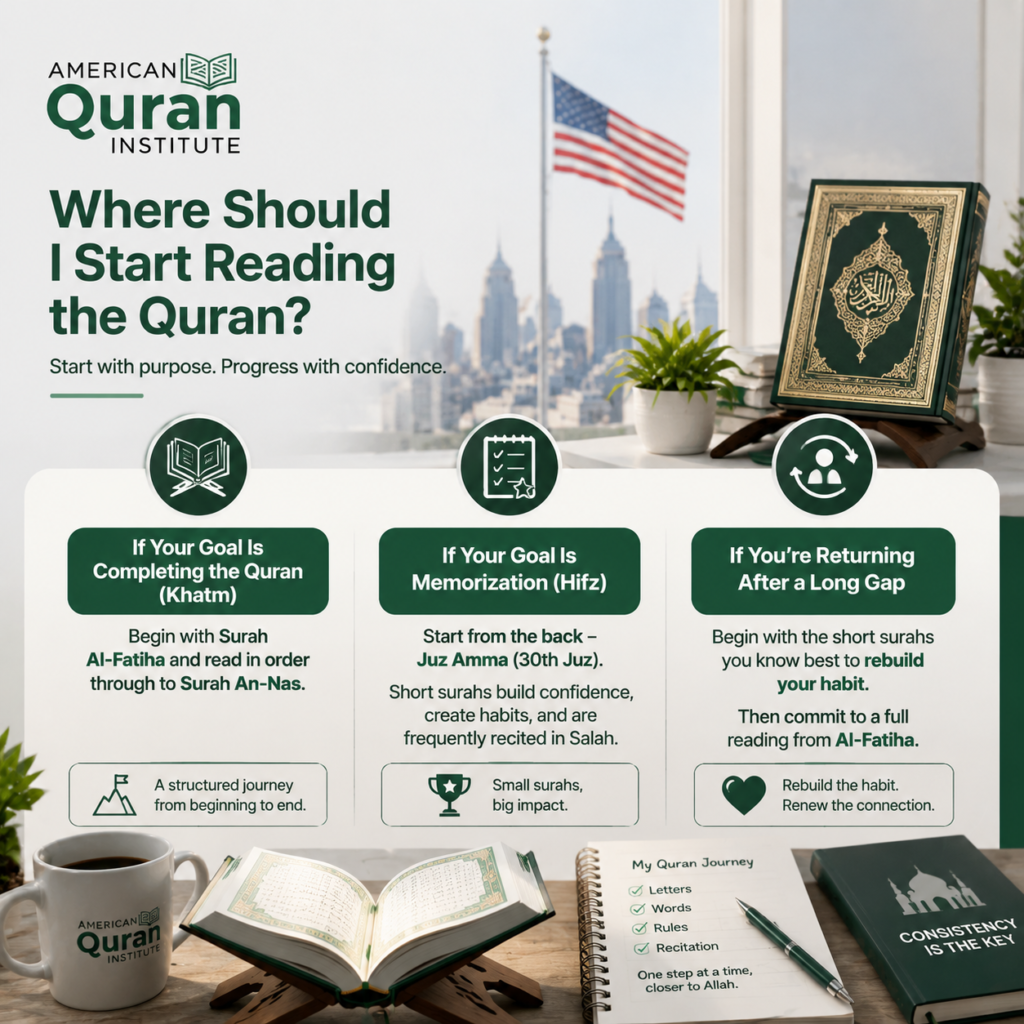
Where you should start reading the Quran depends on your goal. If you want to complete the Quran (khatm), begin with Surah Al-Fatiha and read in order until Surah An-Nas. If your goal is memorization, start with Juz Amma, where the shorter surahs help you learn the Quran, build confidence and establish a consistent routine.
If you’re returning to the Quran after a long break, begin with the short surahs you already know to rebuild your daily habit before starting a full reading from Al-Fatiha. The most important thing is not the page you begin on, but choosing a starting point that matches your purpose and helps you stay consistent.
Read also: How to Read the Quran Faster? A Practical Guide
2. Define Your Goal From Quran Reading:
The most common mistake new readers make is treating “where to start” as a question about location in the Mushaf, when it’s actually a question about purpose.
Islamic scholars consistently identify three distinct starting scenarios, each with its own guidance.

A. If Your Goal Is Completing the Quran (Khatm)
Begin with Surah Al-Fatiha and read in order through to Surah An-Nas.
This is the scholarly consensus, and it reflects how the Companions of the Prophet ﷺ structured their own recitation. A hadith recorded by Imam al-Tirmidhi describes the ideal reader as “al-hall al-murtahil” — one who journeys from the beginning of the Quran to its end, and when he arrives, sets out again. The image is deliberate: a traveler who completes one journey and immediately begins the next.
Reading in order also means you engage with the Quran as a structured revelation. The early surahs of Al-Baqarah and Al-Imran establish foundational beliefs, legal principles, and narrative context that later surahs frequently reference. Jumping out of sequence for a khatm means missing those connections.
That said, scholars including Imam Al-Suyuti in Al-Itqan fi Ulum Al-Quran confirm that maintaining order in recitation is recommended (mustahabb), not obligatory. If you have a valid reason to begin with a surah you know well, there is no sin in doing so — but the preferred practice is Al-Fatiha first.
Read also: How to Overcome The Struggling When Reading the Quran?
B. If Your Goal Is Memorization (Hifz)
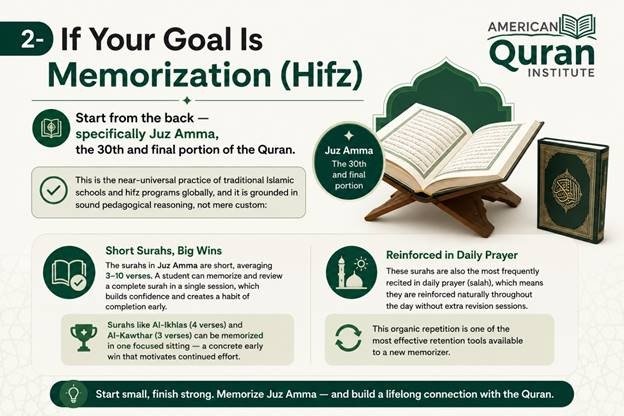
Start from the back — specifically Juz Amma, the 30th and final portion of the Quran.
This is the near-universal practice of traditional Islamic schools and hifz programs globally, and it is grounded in sound pedagogical reasoning, not mere custom:
The surahs in Juz Amma are short, averaging 3–10 verses. A student can memorize and review a complete surah in a single session, which builds confidence and creates a habit of completion early. Surahs like Al-Ikhlas (4 verses) and Al-Kawthar (3 verses) can be memorized in one focused sitting — a concrete early win that motivates continued effort.
For American Muslim kids especially, this matters. Children juggling school, homework, and extracurriculars cannot sustain multi-week memorization projects without early wins. Completing a short surah in a week — then hearing themselves recite it correctly in salah — is one of the most powerful motivators a young Quran learner can experience.
These surahs are also the most frequently recited in daily prayer (salah), which means they are reinforced naturally throughout the day without extra revision sessions. This organic repetition is one of the most effective retention tools available to a new memorizer.
Our Kids Quran Memorization Program in the USA provides age-appropriate structure with qualified teachers, and our Noorani Qaida course for kids builds foundational Quranic Arabic reading skills through structured letter recognition, vowel mastery, and sound formation.
A common mistake in Quran memorization classes is starting with Al-Baqarah — the longest surah in the Quran — before a student has developed the memorization habits and review discipline the process demands. Starting with Juz Amma lets the student build that discipline on short, manageable texts first.
C. If You’re Returning After a Long Gap
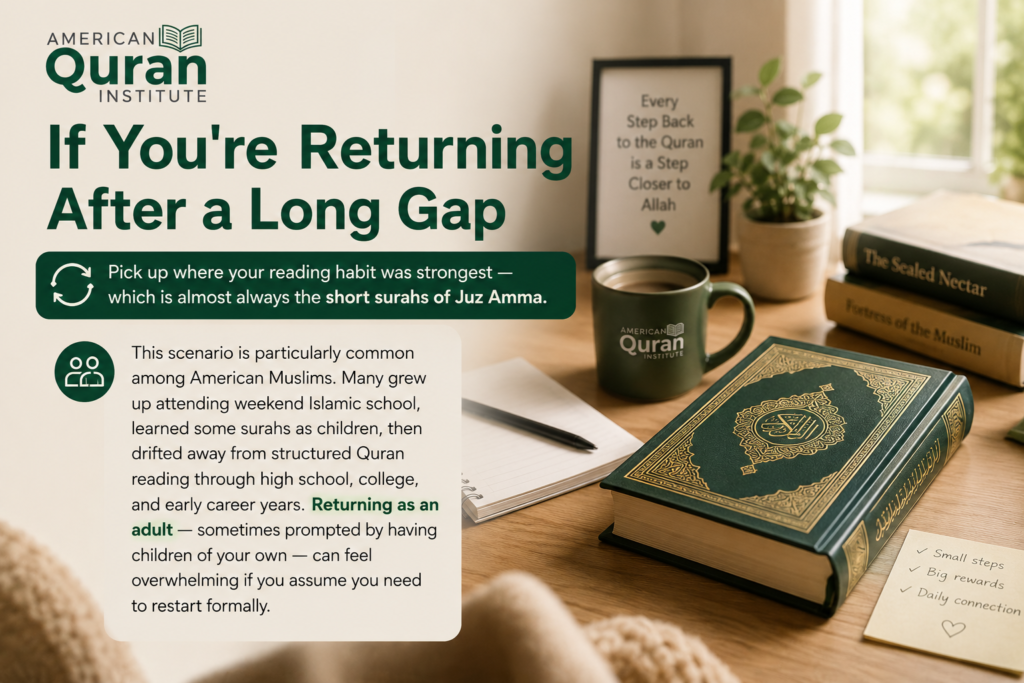
Pick up where your reading habit was strongest — which is almost always the short surahs of Juz Amma.
This scenario is particularly common among American Muslims. Many grew up attending weekend Quran classes, Islamic school, learned some surahs as children, then drifted away from structured Quran reading through high school, college, and early career years. Returning as an adult — sometimes prompted by having children of your own — can feel overwhelming if you assume you need to restart formally.
Returning readers often feel pressure to restart from Al-Fatiha and “do it properly.” Scholars including Imam Al-Nawawi in Al-Adhkar emphasize that the goal of recitation is presence of heart and reflection (tadabbur), not performance of a correct sequence. Reading what you already know with genuine attention is more rewarding than stumbling through unfamiliar text just to feel you’ve started “right.”
Once the habit is re-established — daily reading feels natural again — you can commit to a structured khatm from Al-Fatiha.
American Quran Institute’s programs work specifically with students in this situation: adults and teens across the United States who have some background but need a structured re-entry point that fits real American schedules.
Experience Our Classroom Environment
Don’t just take our word for it—experience a live session for yourself! Click on the videos below to watch real snippets from our classes and see our interactive teaching methods in real-time.
Start Your Quranic Education
Join our premier online institute for structured Quranic learning tailored for students in the USA.
Book Your Free Trial3. Know The Difference Between The Tarteel, Tadweer, and Hadr
Classical scholars of Tajweed defined three accepted speeds of Quran recitation, each valid for different contexts:
- Tarteel: Slow, measured recitation with full application of Tajweed rules — the speed described in Surah Al-Muzzammil (73:4), “recite the Quran with measured recitation”
- Tadweer: A moderate pace, applying Tajweed rules without lengthening beyond the minimum
- Hadr: A faster pace used by those who have fully mastered Tajweed and can apply rules accurately at speed
New readers should understand that Hadr is not a beginner’s mode — it is a scholar’s shortcut, available only after the rules are internalized. The common mistake of reading fast to cover more pages typically produces accumulated pronunciation errors that are far harder to correct later. Tarteel is the default for every reader who has not yet completed a formal Tajweed program.
4. Don’t Abide By Reading The Quran in Order
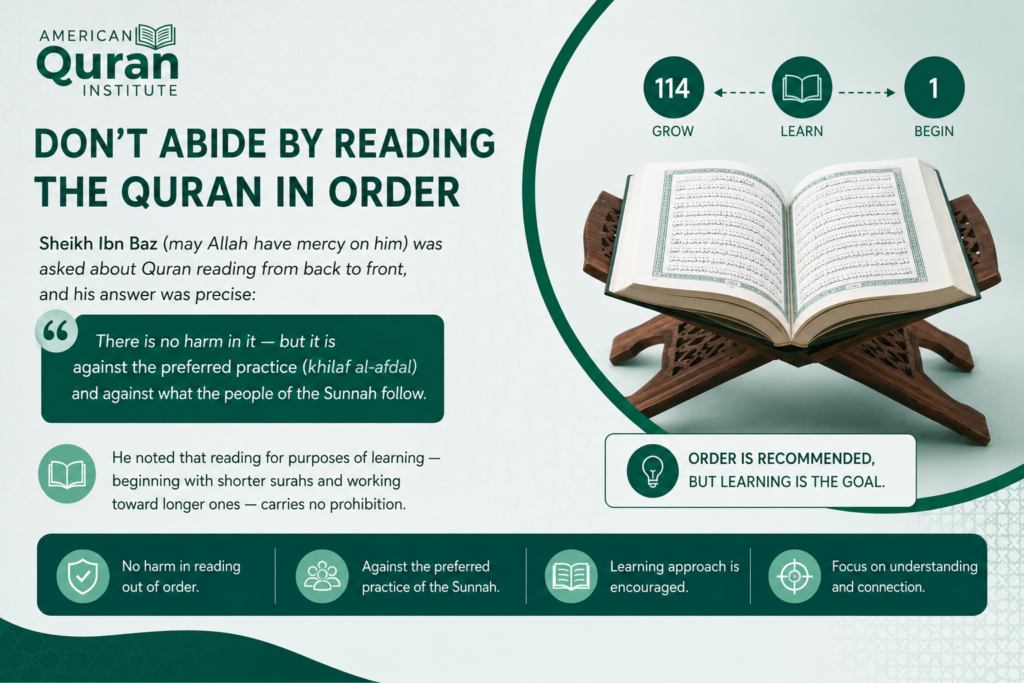
Sheikh Ibn Baz (may Allah have mercy on him) was asked about Quran reading from back to front, and his answer was precise: “There is no harm in it — but it is against the preferred practice (khilaf al-afdal) and against what the people of the Sunnah follow.” He noted that reading for purposes of learning — beginning with shorter surahs and working toward longer ones — carries no prohibition.
The scholarly position, shared across the major Sunni schools, is that reading order is a sunnah (recommended practice) when performing a complete khatm, and a non-issue when reading for reflection, prayer, or standalone recitation of individual surahs.
This matters practically: you can recite Surah Yasin on a Friday, Surah Al-Mulk before sleep, and Surah Al-Kahf each week — without this counting as disordered recitation. These are individual acts of worship, not partial khatms.
The distinction to hold in mind is: khatm reading follows order; standalone recitation follows need.
5. Balance Between The Translation of Quran and The Arabic Text
Non-Arabic speaking readers in the US frequently face a practical fork: do I read in Arabic (which I may not understand) or in an English translation (which I understand but which is not the Quran itself)?
The scholarly position is unambiguous: the Quran is the Arabic text. Translations are interpretive works — valuable tools, not the Quran itself. However, reading Arabic without comprehension and reading a translation without the Arabic are two different acts of worship with different purposes.
A workable approach for English-speaking American readers: read the Arabic aloud (even slowly, even imperfectly), then read the English meaning of the same passage immediately after. This preserves the recitation as an act of worship while building comprehension over time. Tafsir works available in English — including Ibn Kathir’s abridged translation and Maariful Quran — give the layer of contextual meaning that a bare translation cannot.
6. Set Up a Sustainable Daily Reading Habit
Knowing where to start reading the Quran is step one. Keeping the habit is what transforms a single reading session into a living relationship with the Quran.
A framework that works across all three reader types above:
A. Anchor the reading to an existing daily act.
The most consistent Quran readers attach their reading to salah — either immediately after Fajr or after Maghrib. The prayer is already happening; the Mushaf or app simply joins it. For American Muslim families, the after-school Asr or post-dinner Maghrib window often works better than Fajr for children.
B. Set a realistic minimum of reading the Quran
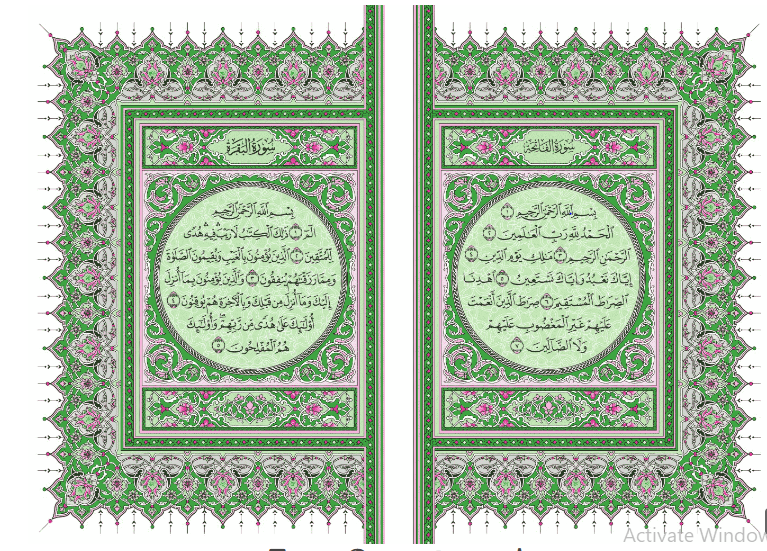
For a khatm over one month (common in Ramadan), you need one juz daily — approximately 20 pages. For a sustainable year-round habit, one page after each prayer (five pages daily) completes the Quran in roughly two months. Start with what you will actually do, not what sounds best.
Read also: LEARN QURAN BY HEART IN THE USA
C. Read from the Mushaf when possible
The scholarly majority — including Ibn Masud and Umar ibn al-Khattab according to chains authenticated by Ibn Hajar — preferred regular engagement with the physical Mushaf, even for those who had memorized the Quran. The reason is practical: it catches errors, prevents gradual drift in pronunciation, and maintains a visual connection with the text. Imam al-Nawawi’s guidance in this area is direct: “If both modes — reading from memory and from the Mushaf — produce equal khushu (presence and focus), reading from the Mushaf is preferred.” If memory reading produces more focus, that is preferred. The criterion is always the quality of attention, not the method itself.
D. Enroll with American Quran Institute
If the self-directed approach keeps stalling. Based in the United States, American Quran Institute offers one-on-one online Quran classes designed specifically for Muslim families, ladies, kids, and adult learners across America — no commute, no scheduling around a local masjid’s timetable, and no one-size-fits-all curriculum. A teacher who knows your starting level, corrects your recitation, and holds you to a realistic schedule accelerates progress in ways that apps and YouTube cannot replicate.
Start Your Quran Journey with American Quran Institute
See Us in Action!
Take a look inside our virtual classrooms. Watch the clip below to see how our instructors engage with students, simplify complex rules, and create an inspiring environment for learning.
Start Your Quranic Education
Join our premier online institute for structured Quranic learning tailored for students in the USA.
Book Your Free Trial7. Begin Reading the Quran the Right Way — with a Teacher Who Knows Where You Are
You now know where to start. The harder part is staying consistent, correcting errors before they become habits, and progressing at the pace your life actually allows.
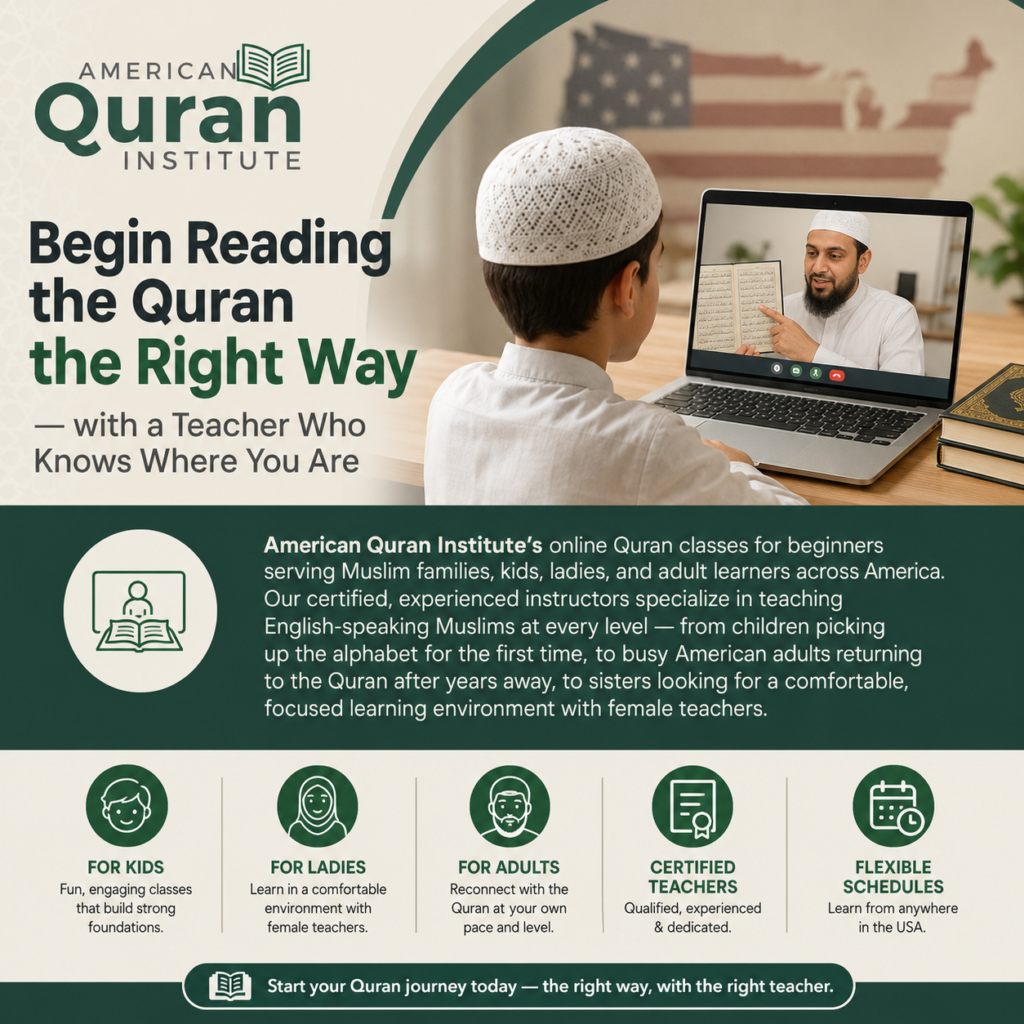
American Quran Institute’s online Quran classes for beginners serving Muslim families, kids, ladies, and adult learners across America. Our certified, experienced instructors specialize in teaching English-speaking Muslims at every level — from children picking up the alphabet for the first time, to busy American adults returning to the Quran after years away, to sisters looking for a comfortable, focused learning environment with female teachers.
Classes are live, one-on-one, and scheduled around your routine, not the other way around.
Check out our top courses for Quran learning:
Start Your Quranic Education
Join our premier online institute for structured Quranic learning tailored for students in the USA.
Book Your Free TrialConclusion
Where you start reading the Quran depends on what you’re reading for. For a complete khatm, start with Al-Fatiha and read in order — that is the preferred practice of the scholars and the Companions. For memorization, start with Juz Amma and build the discipline of completion on short, frequently-recited surahs. For a returning reader, start where your engagement is strongest, re-establish the daily habit, then commit to a structured khatm.
The criterion that runs through all of it is tadabbur — genuine reflection and presence. A reader who opens the Mushaf with a focused heart, wherever they begin, is doing more than one who rushes through pages in the right order without attention.
The goal is not to reach the last page. The goal is to travel through the Quran as al-hall al-murtahil — the journeyer who, upon arriving, sets out again.
Frequently Asked Questions
Is it okay to start reading the Quran from the middle or end?
Yes — it is permitted, though not the preferred practice for a complete khatm. Classical scholars confirm that reading order in recitation is mustahabb (recommended), not obligatory. Reading individual surahs in any order for reflection or prayer is fully acceptable and carries no restriction.
Should I start memorizing the Quran from the beginning or the end?
Start from the end — specifically Juz Amma. Short surahs like Al-Ikhlas and Al-Kawthar can be memorized in a single session, and they are reinforced daily through salah. Beginning memorization with long surahs like Al-Baqarah before developing revision discipline is one of the most common mistakes in hifz programs.
Do I need wudu (ablution) to read the Quran?
The majority scholarly position requires wudu to physically touch the Mushaf. Reading from memory or listening to recitation does not require wudu, though maintaining ritual purity is encouraged as a mark of respect for the text.
How long does it take to read the entire Quran once?
Reading at a measured pace with basic tajweed, the full Quran takes most readers between 10 and 15 hours in total. Divided into daily sessions, reading one juz (approximately 20 pages) per day completes the Quran in 30 days. Five pages daily — roughly one page after each prayer — completes it in about two months.






Leave a Reply