 Quran
Quran
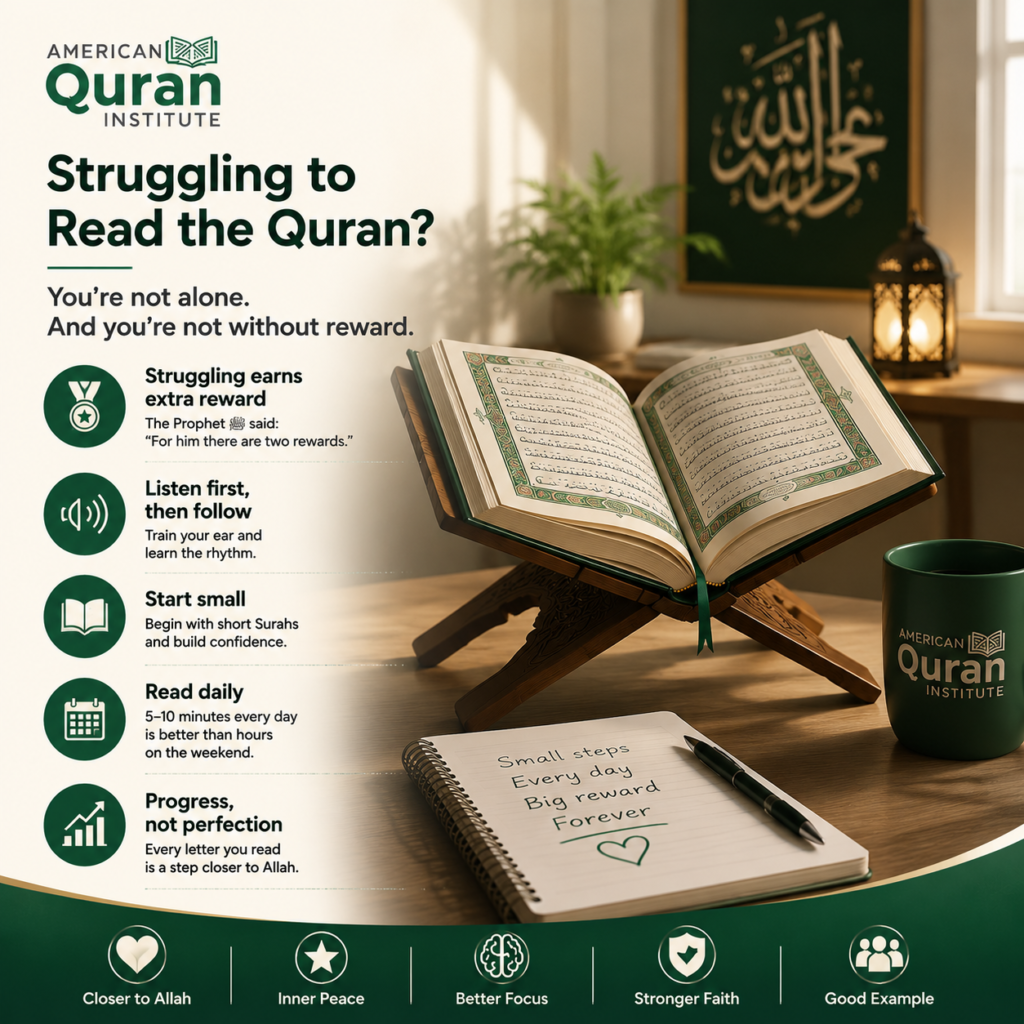
Reading the Quran feels hard — if you stumble over letters, lose your place, or feel embarrassed by how slowly you go — you are not alone, and you are not failing. This experience is especially common among Muslims living in the United States, where Arabic is not the language of daily life, Islamic schools are not always accessible, and many families are raising children without the Quran instruction they themselves never received.
Whether you’re an American Muslim adult who grew up reciting by imitation, a Muslim mother trying to teach her kids, a Muslimah who wants to read on her own, or a convert who came to Islam later in life — the struggle is real, it is shared, and Islam already has a clear answer for where you stand right now.
This article explains what the Prophet ﷺ said about those who struggle to read, why that struggle carries a specific reward, and the practical steps that actually move you forward.
The following method applies whether you’re a busy American professional squeezing in 10 minutes after Fajr, a mother reading alongside her child, a Muslimah learning independently, or a teenager in middle school who never quite caught up at Sunday school.
1. Learn The Reward Of Struggling With Quran Reading:
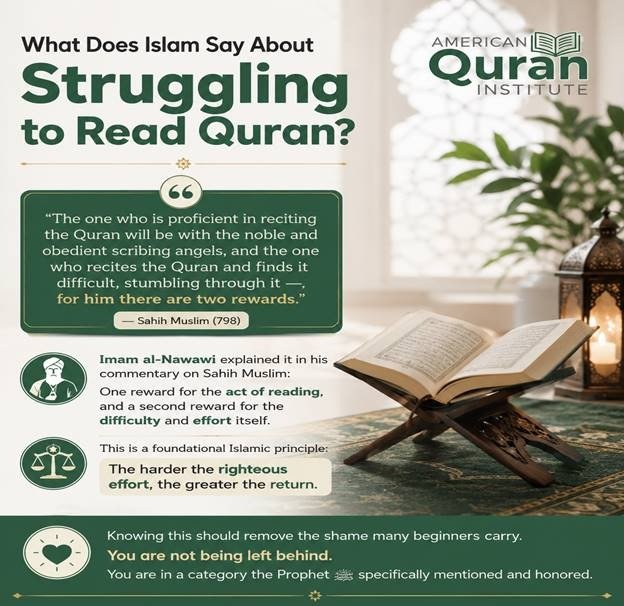
The Prophet Muhammad ﷺ addressed this question directly in authentic hadith reported by Muslim:
“The one who is proficient in reciting the Quran will be with the noble and obedient scribing angels, and the one who recites the Quran and finds it difficult, stumbling through it — for him there are two rewards.” — Sahih Muslim (798)
That phrase “two rewards” is precise. Imam al-Nawawi explained it in his commentary on Sahih Muslim: one reward for the act of reading, and a second reward for the difficulty and effort itself. The struggle is not a sign of failure — it is a condition that earns extra reward.
This is a foundational Islamic principle: the harder the righteous effort, the greater the return.
Knowing this should remove the shame many beginners carry. You are not being left behind. You are in a category the Prophet ﷺ specifically mentioned and honored.
Read also: Benefits of Reciting Quran Without Understanding
2. Learn The Root Cause of The Struggling As A Non-Native Arabic Speakers
Most people assume they struggle because they lack talent or memory. The real causes are almost always practical — and fixable. This is especially true for Muslims raised in America, where English dominates and Arabic exposure is limited to the masjid or sporadic weekend school sessions.
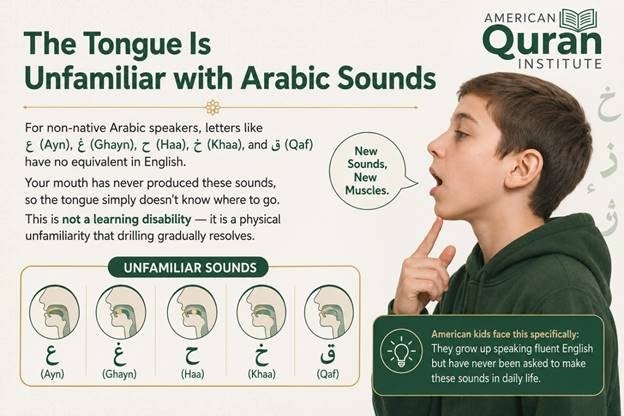
A. The Tongue Is Unfamiliar with Arabic Sounds
For non-native Arabic speakers, letters like ع (Ayn), غ (Ghayn), ح (Haa), خ (Khaa), and ق (Qaf) have no equivalent in English. Your mouth has never produced these sounds, so the tongue simply doesn’t know where to go. This is not a learning disability — it is a physical unfamiliarity that drilling gradually resolves. American kids face this specifically: they grow up speaking fluent English but have never been asked to make these sounds in daily life.
B. You Were Never Taught Systematically
Many Muslim Americans learned to recite by memorizing short surahs from a parent or imam — without ever learning to decode the Quran alphabet (Arabic letters) independently. Weekend Islamic school is often inconsistent, teachers are volunteers with varying qualifications, and the curriculum rarely reaches fluent reading. When that pattern breaks down with an unfamiliar verse, there’s no foundational system to fall back on. The gap isn’t in effort; it’s in method.
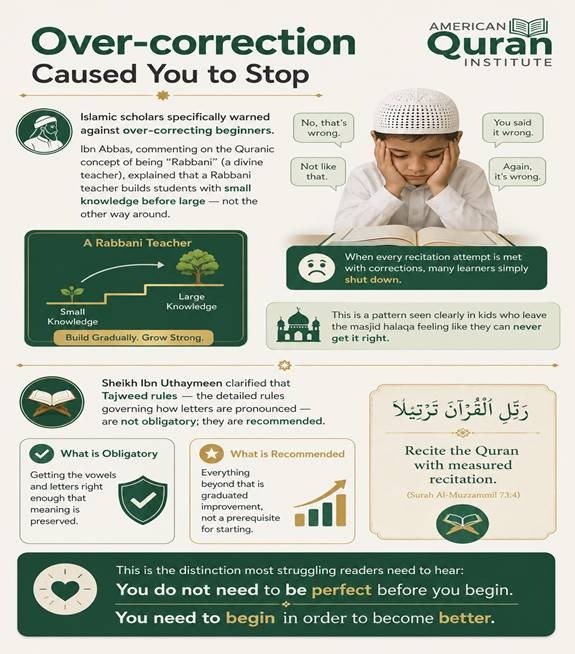
C. Over-correction Caused You to Stop
Islamic scholars specifically warned against over-correcting beginners. Ibn Abbas, commenting on the Quranic concept of being “Rabbani” (a divine teacher), explained that a Rabbani teacher builds students with small knowledge before large — not the other way around. When every attempt in Quran recitation classes is met with corrections, many learners simply shut down. This is a pattern seen clearly in kids who leave the masjid halaqa feeling like they can never get it right.
Sheikh Ibn Uthaymeen clarified that Tajweed rules — the detailed rules governing how letters are pronounced — are not obligatory; they are recommended. What is obligatory is getting the vowels and letters right enough that meaning is preserved. Everything beyond that is graduated improvement, not a prerequisite for starting.
This is the distinction most struggling readers need to hear: you do not need to be perfect before you begin. You need to begin in order to become better.
Book a FREE session with one of our Ijazah-certified teachers
See Us in Action!
Take a look inside our virtual classrooms. Watch the clip below to see how our instructors engage with students, simplify complex rules, and create an inspiring environment for learning.
Start Your Quranic Education
Join our premier online institute for structured Quranic learning tailored for students in the USA.
Book Your Free Trial3. Listen First Before Reading, Then Follow Along
Before attempting to read any passage independently, listen to a proficient reciter reading it. Apps like Ayah or the King Saud University digital Mushaf let you hear each verse and follow the text simultaneously. This trains your ear to the rhythm, the pauses, and the pronunciation before your eyes and tongue have to coordinate.
Read also: 11 Powerful Motivations to Read Quran
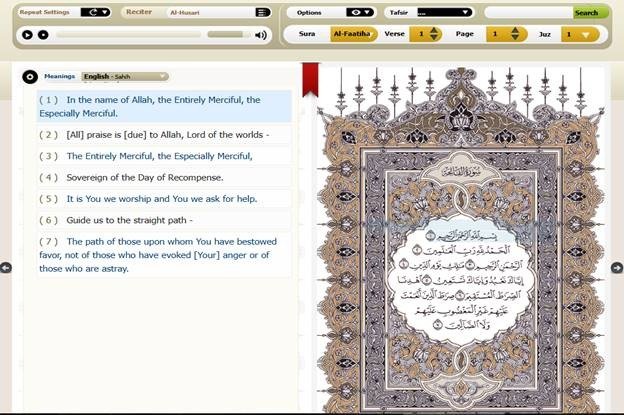
The practical effect: when you then attempt the verse yourself, you’re not processing unfamiliar sounds and unfamiliar text at the same time. You already know what it’s supposed to sound like.
4. Start with Short Surahs Only
Juz Amma — the 30th and final section of the Quran — contains the shortest surahs. Al-Ikhlas is four verses. Al-Kawthar is three. Al-Asr is three. These are the surahs most American Muslims already use in their daily Salah. Mastering them completely before moving forward builds both skill and confidence simultaneously. For kids, this is where to start every single time; don’t rush to longer surahs until the short ones are solid.
A practical rule: do not move to a new surah until you can read the current one without stopping to decipher any word.
5. Read Daily in Small Amounts
Five to ten minutes of daily Quran reading produces more progress than an hour on weekends. The science behind this is simple: daily practice keeps the neural pathways for Arabic sounds active. Weekend-only practice means you’re relearning the same sounds repeatedly without consolidating them. For American Muslim families, this means building a short daily Quran habit at home — after Fajr, before school, or after dinner — rather than relying solely on weekend Islamic school.
Sheikh Ibn Baz was asked about someone who reads incorrectly due to limited education. His answer: “He should keep reading, strive to improve, and not abandon it — because learning adds goodness upon him.” The act of continuing is itself the path.
6. Read The Meaning Of Verses Alongside Recitation
One underrated reason people struggle to stay engaged with Quran reading is that the words feel empty — sounds without meaning. Reading a clear English translation of even one or two verses before reciting them changes the experience entirely. You are no longer reading symbols; you are reading words you understand.
This is particularly powerful for American Muslims whose first language is English. A straightforward translation — like Saheeh International — is enough to give recitation its emotional weight. Children who understand what they’re reciting stay engaged far longer than those just moving their lips through unfamiliar text.
Read also : Noorani Qaida Course in the USA
7. Don’t Focus On Perfecting Your Reading In The Beginning – Make it Gradual
Sheikh Ibn Uthaymeen drew a practical line for teachers: correct errors that change the meaning first. An error in a vowel that doesn’t change the meaning can wait. An error that turns one word into another — or changes the subject of a sentence — must be corrected.
As a learner, you can apply this same filter yourself. Focus first on vowel accuracy (the harakat — fatha, kasra, damma) and correct letter sounds. Tajweed refinements like ghunnah length and specific Madd extensions come later, once the foundational reading is stable.
If you can access a teacher — even online, once or twice a week — this graduated correction happens naturally and much faster. An Ijazah-certified instructor hears errors you cannot hear yourself, because your own baseline has adjusted to what you produce. For Muslim sisters in the US who prefer learning with a female teacher, online instruction makes this completely accessible without leaving home.
8. Never Stop when it feels hard, it is An Easy Bottle Neck
The most common error in struggling Quran readers is not a pronunciation error — it’s a consistency error.
Most people try to read when motivation is high, stop when it feels hard, and restart weeks later. Each restart means relearning what was lost. This pattern is especially common in the US, where Ramadan often brings a burst of Quran reading that fades by Shawwal. The short-term discomfort of consistent daily practice — even five minutes of difficult reading — compounds over months into genuine fluency.
Scholars from Ibn Taimiyya to modern Quran educators repeat the same principle: if someone has memorized Quran in an unpolished form, they should read it as they can, not abandon it. “Whoever cannot recite it except in the manner of a non-Arab tongue — let them recite as they are able. That is better than leaving it.” (Ibn Taimiyya, Mukhtasar al-Fatawa al-Masriyya)
Daily recitation — even imperfect — is the mechanism. Everything else supports it.
Experience Our Classroom Environment
Don’t just take our word for it—experience a live session for yourself! Click on the videos below to watch real snippets from our classes and see our interactive teaching methods in real-time.
Start Your Quranic Education
Join our premier online institute for structured Quranic learning tailored for students in the USA.
Book Your Free TrialStart Reading Quran Today with Expert Guidance
If you’ve been putting off Quran reading because it feels too hard, today is the day to change that. American Quran Institute, based in the United States, offers beginner-level Quran reading courses designed for American Muslim families — kids who need a patient, structured start; adults who want to finally read independently; and sisters who prefer learning in a comfortable, female-led environment.
All sessions are live, one-on-one, and online — so whether you’re in California, Texas, New York, or anywhere across the US, qualified instructors come to you.
Check out our top courses for Quran learning:
- Quran Classes for Adults
- Tajweed Classes
- Hifz Quran
- Quran classes for kids
- Hifz for Kids
- Noorani Qaida classes for kids
- Ijazah Course
Start Your Quranic Education
Join our premier online institute for structured Quranic learning tailored for students in the USA.
Book Your Free TrialConclusion
Struggling to read Quran is one of the most honest forms of effort in Islamic worship. The Prophet ﷺ named it specifically and gave it double the reward. Islamic scholarship is clear that Tajweed perfection is not a prerequisite — it is a destination you move toward gradually.
For American Muslims in particular — raising children in English-speaking homes, managing busy schedules, and often without easy access to qualified local teachers — the path forward is consistent daily recitation, starting small with Juz Amma surahs, listening before reading, and accessing a teacher who can catch errors before they solidify. The Arabic text does not become easier by waiting. It becomes easier by reading it — again and again — until the tongue learns what the heart already wants to say.
Frequently Asked Questions
Is it haram to read Quran if you make mistakes?
No. The Prophet ﷺ explicitly stated that the one who struggles and stumbles in recitation earns two rewards — one for reading and one for the difficulty. Scholars including Sheikh Ibn Baz confirmed that making mistakes while striving to improve carries great merit. What matters is continuing to try and seeking to learn.
Do I need to learn Tajweed before I start reading Quran?
No. Tajweed rules are recommended, not obligatory. What is required is that you pronounce the letters correctly enough that meaning is not distorted. Full Tajweed mastery is a long-term goal, not a starting condition. Begin reading now and refine your recitation progressively.
How long does it take to learn to read Quran as a beginner?
Most adults with no prior Arabic reading ability can read short surahs independently within three to six months of consistent, structured practice — typically five to ten minutes daily with occasional teacher guidance. Progress depends heavily on consistency rather than session length.
Can I read Quran without a teacher?
You can begin reading on your own, but a teacher significantly speeds up progress and prevents errors from becoming habits. Incorrect pronunciation can sound correct to your own ears after enough repetition. Even one or two sessions per week with a qualified instructor catches problems that self-study cannot.
What should I start with if I can barely read Arabic?
Begin with the Arabic alphabet and short vowel sounds, then move to Noorani Qaida — a structured primer for Quran reading. Once you can sound out letters reliably, move to Juz Amma (the last section of the Quran) and work through the shortest surahs in order. A patient, child-specialized instructor makes this process far less frustrating for both parent and child.






Leave a Reply