 Quran
Quran
Most American Muslims who want to build a daily Quran reading habit face the same quiet frustration: they read for a day or two, then stop for a week. They pick it back up, then lose it again for a month. The intention is always there — the consistency never quite sticks.
The good news is that this is not a willpower problem. It is a system problem. And systems can be fixed with the right approach.
This guide explains exactly how to start reading the Quran daily — not in theory, but in the practical steps that actually build a lasting habit, starting from as little as five minutes a day. Whether you are a busy parent in Houston, a student in New York, or a new Muslim anywhere across the United States, the method works the same way.
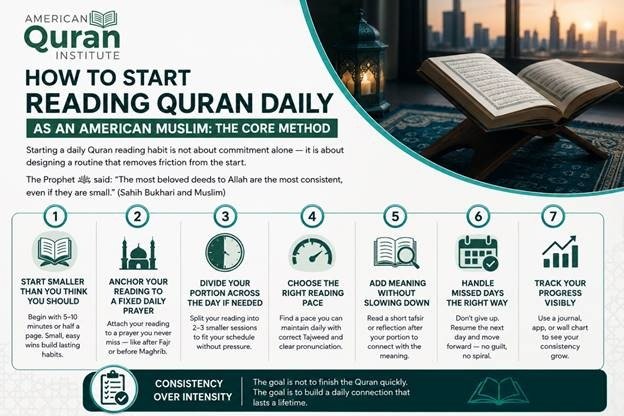
Starting a daily Quran reading habit is not about commitment alone — it is about designing a routine that removes friction from the start.
The Prophet ﷺ confirmed this when he said: “The most beloved deeds to Allah are the most consistent, even if they are small.” (Sahih Bukhari and Muslim)
That principle is the foundation of everything below.
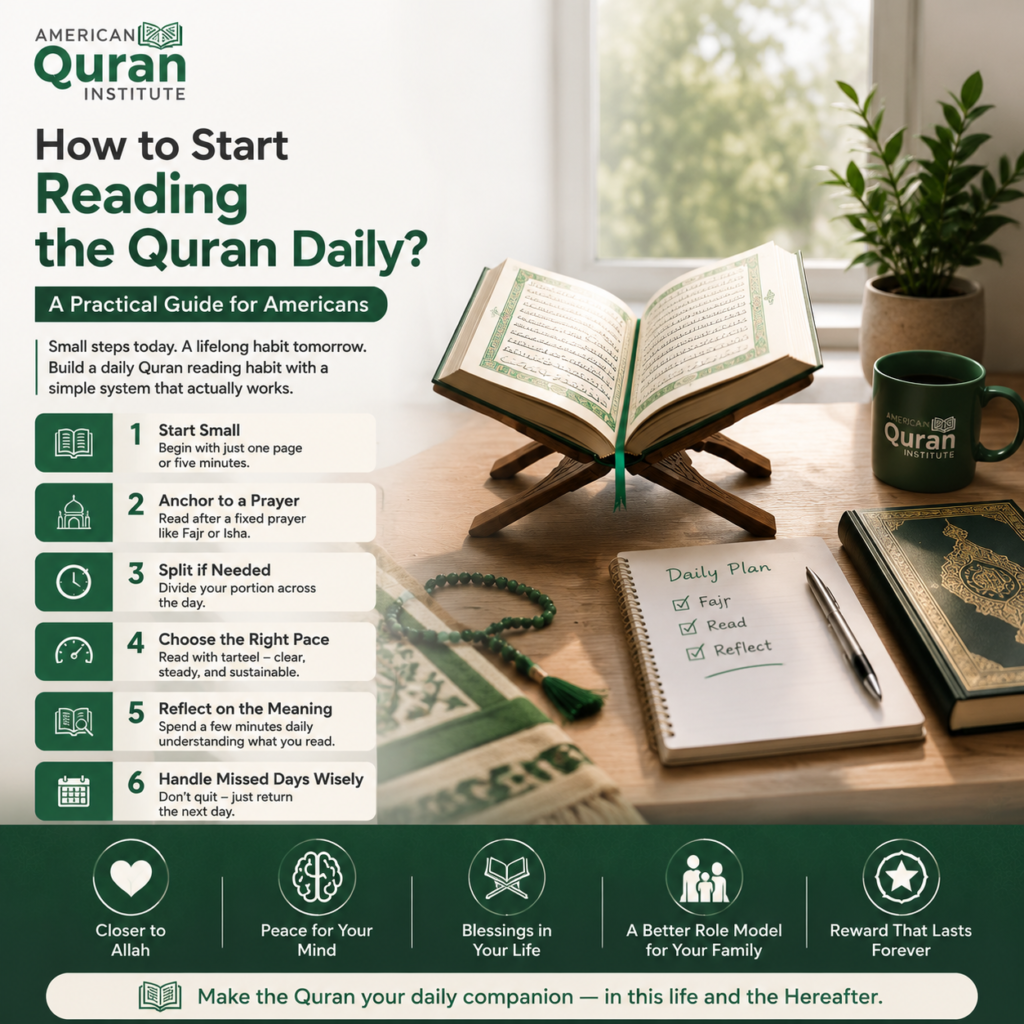
1. Start By Reading One Page of The Quran
The single most common mistake when starting a daily Quran habit is beginning with too large a commitment. Setting a goal of one Juz’ per day when you have never read daily before almost guarantees failure within two weeks.
Start with one page — or even just five minutes of reading after one prayer. That is your wird for the first two weeks. It should feel almost too easy. That is by design.
For American kids, this could mean reading just three to five verses after Maghrib prayer before dinner. For busy mothers managing a household, two pages after Fajr before the morning school run is entirely achievable. For working adults with packed American schedules, five minutes during a lunch break counts.
A small, unbroken streak builds more genuine momentum than a large goal abandoned after three days. Once the habit is established, increasing your daily portion becomes natural — not forced.
Read Also: Weekend Quran Classes in the USA

2. Anchor Your Reading to a Fixed Daily Prayer
A reading habit floats and disappears when it is not attached to something already fixed in your day. The most effective anchor is one of the five daily prayers.
After Fajr in the USA time is the strongest anchor for most people — the mind is clear, the house is quiet, and the spiritual state from prayer carries naturally into recitation. After Isha is the second strongest, especially for those with busy daytime schedules.
The practice of tying Quran reading to prayer time is not a modern productivity trick — Ibn Taymiyyah explicitly described maintaining awrad at the two ends of the day as the practice of the Prophet ﷺ and the righteous from earliest times.
Pick one prayer. Read your page immediately after making salaam, before picking up your phone or standing up. This is the highest-leverage habit decision you will make.
Experience Our Classroom Environment
Don’t just take our word for it—experience a live session for yourself! Click on the videos below to watch real snippets from our classes and see our interactive teaching methods in real-time.
Read also: How to Remember Quran Verse Numbers? – For American Memorizers
Start Your Quranic Education
Join our premier online institute for structured Quranic learning tailored for students in the USA.
Book Your Free Trial3. Divide Your Portion of The Quran Across the Day if Needed
If your life does not allow a single uninterrupted reading session — and for many American families juggling school, work, and community commitments, it often does not — divide your daily portion into two or three smaller segments spread across the day. Two pages after Fajr and two pages after Asr, for example, adds up to a half-Juz’ daily — a respectable and sustainable pace.
The key practical move: use a physical bookmark or a Quran app that saves your position automatically. You should never spend mental energy remembering where you left off — that friction is enough to break the habit.
Read also: How to Read the Quran with a Beautiful Voice? Complete Guide for American Muslims

4. Choose the Right Pace For Reading the Quran
Reading the Quran has three recognized speeds: tahqeeq (slow and deliberate), tarteel (measured and clear), and hadr (faster, fluent recitation). For a daily wird, tarteel is the right pace — it balances covering meaningful ground with proper pronunciation and some degree of reflection.
Reading at tahqeeq speed for your daily portion is impractical; it is a pace suited for teaching and intensive study, not for maintaining a daily habit. If you find yourself spending ten minutes on half a page, you are reading too slowly for a daily reading session.
Check out American Quran Institute’s top courses for Quran learning:
- Al-Azhar Quran Course in the USA
- Online Tajweed Classes in the USA
- Quran Memorization Course in the USA

5. Contemplate The Quran Meanings Without Slowing Down Your Reading
One reason many people disengage from daily Quran reading is that the text feels distant — beautiful to hear, but not personally connected to them. This is especially common among English-speaking Muslims in the United States who did not grow up with Arabic at home.
The solution is not to stop and translate every verse during your reading session, but to spend five minutes after your reading looking at the meaning of what you just read. A concise English tafsir — even a one-sentence summary of the day’s passage from an app — transforms recitation from a phonetic exercise into a living conversation with the text. For children, a parent reading a short English explanation of the passage together after recitation builds both comprehension and family connection to the Quran.
This is what the Quran itself calls tadabbur, and it is what keeps people reading year after year.

6. Handle Your Missed Days the Right Way
If you miss your wird one day, do not skip it entirely — and do not try to “catch up” by doubling the next day’s portion.
The Prophet ﷺ addressed this directly: whoever missed their nightly portion and then read it during the day, it would be recorded as though they had read it at night.” (Sahih Muslim)
The practical rule: if you miss, read your normal portion the next day and accept that one day is gone. Doubling up creates a heavier burden that makes the second day feel like punishment rather than habit — and that is what breaks streaks permanently.
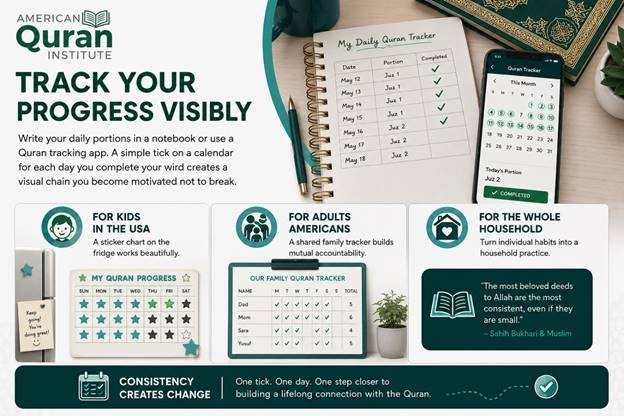
7. Track Your Progress In Reading Quran Visibly
Write your daily portions in a notebook or use a Quran tracking app. A simple tick on a calendar for each day you complete your wird creates a visual chain you become motivated not to break. For kids in the USA, a sticker chart on the fridge works beautifully. For adult Americans, a shared family tracker builds mutual accountability and turns individual habits into a household practice.
Our Quran classes for kids in the USA provide age-appropriate, structured instruction in English with certified teachers trained specifically to keep younger learners engaged and progressing.
See Us in Action!
Take a look inside our virtual classrooms. Watch the clip below to see how our instructors engage with students, simplify complex rules, and create an inspiring environment for learning.
Start Your Quranic Education
Join our premier online institute for structured Quranic learning tailored for students in the USA.
Book Your Free Trial8. Make Reading The Quran in The Best Times of The Day
When you anchor your daily Quran reading matters as much as how much you read.
After Fajr is the highest-value time for most American readers. The spiritual state from prayer is immediate, the world has not yet demanded your attention, and the mind is genuinely clearer in the early morning hours. Scholars across generations have specifically noted that reading the Quran after Fajr carries a quality of presence and focus that is harder to replicate later in the day.
After Isha, before sleep, is the second most effective time. The day’s obligations are complete, and the verses you read before sleep are among the last things your mind processes before rest – which deepens retention for those who are also working on memorization.
Splitting across prayers – for example, reading two pages after Fajr, two after Dhuhr, and two after Asr – works well for people with fragmented schedules, like parents of young children or those with demanding work hours. It requires no single long sitting and accumulates to a meaningful daily total.
The one time to avoid making your primary reading slot: the early afternoon between Dhuhr and Asr, when energy and focus are typically at their lowest.
Read also: BEST COUNTRY TO LEARN QURAN
Building a daily Quran habit is far easier — and goes far deeper — when you have a qualified teacher guiding your recitation, correcting your pronunciation, and keeping you accountable week after week.
American Quran Institute, based in the United States, offers fully online Quran classes designed specifically for the American Muslim community — kids, adults, sisters, and new Muslims alike. Whether you are a child just learning the Arabic alphabet, a busy mother looking to improve her recitation, an adult who wants to finally establish a consistent daily reading habit, or someone who has recently embraced Islam and wants to connect with the Quran for the first time — American Quran Institute has a structured, personalized program for you.
Certified instructors work with students at every level, with flexible scheduling built around American time zones and the realities of school, work, and family life. Classes are one-on-one, taught by experienced and Ijazah-certified teachers, and designed to meet you exactly where you are.
Unlock The Wisdom of The Quran At The American Quran Institute and Book your free trial today

Check out our top courses for Quran learning:
- Ijazah Course
- Quran Classes for Adults
- Hifz Quran
- Noorani Qaida classes
- Hifz for Kids
- Noorani Qaida classes for kids
Start Your Quranic Education
Join our premier online institute for structured Quranic learning tailored for students in the USA.
Book Your Free TrialConclusion
Starting to read the Quran daily comes down to one principle: make it small enough to start, and structured enough to sustain. Begin with a single page after one prayer. Anchor it to your Fajr or Isha. Divide it if your day demands it. Add meaning after you finish. Handle missed days without self-punishment.
The Companions of the Prophet ﷺ did not have more time in their days than you do. What they had was a system — a personal wird they returned to every day, whatever the circumstance. That same practice is available to every Muslim in America today, starting with as little as five minutes after your next prayer.
Frequently Asked Questions
What if I miss a day of Quran reading?
If you miss a day, simply read your normal daily portion the next day and continue. The Prophet ﷺ indicated that whoever makes up their missed Quran reading the following day receives the same reward as reading at the original time. Do not double your portion as punishment — that makes the habit feel burdensome.
Do I need to be in a state of wudu to read the Quran?
Scholars recommend being in a state of wudu when reading the Quran as an act of respect and preparation, particularly when reading from a physical Mushaf. For reading on a phone or tablet, or reciting from memory, the ruling is more flexible — but wudu enhances the state of presence and focus.
How do I stop losing my daily Quran reading habit?
Attach your reading to a fixed prayer time rather than a flexible time slot. Keep your Quran or Quran app immediately accessible in your prayer space. Start smaller than you think you need to, and track your daily completion visibly. These three elements together are what most people who successfully maintain a daily wird have in common.
Can I listen to Quran instead of reading it for my daily wird?
Listening to Quran recitation is a rewarding act of worship, but it does not substitute for reading as a daily wird in the traditional sense. Scholars recommend combining both: read your daily portion from the Mushaf, and listen to a reciter for the same passage to reinforce correct pronunciation and melody.







Leave a Reply