 Quran
Quran
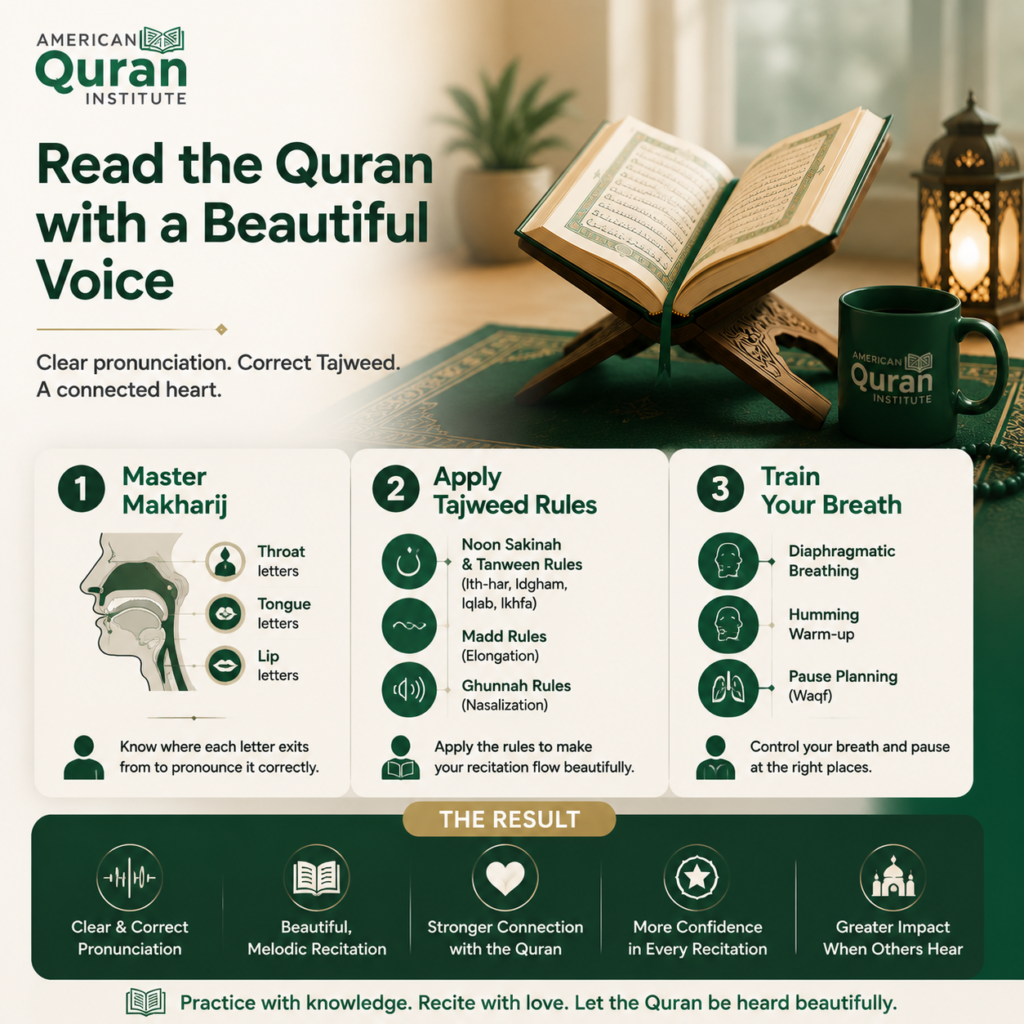
Many Muslims in the United States recite the Quran daily — yet few are taught how to make that recitation truly beautiful. Whether you’re a parent in New Jersey trying to help your child sound more confident at Sunday school, a Muslim sister in Texas who wants to improve her recitation at home, or an adult revert in California starting from scratch – the path is the same.
The difference between a flat recitation and a moving one isn’t raw talent. It’s a set of learnable skills: correct pronunciation, breath control, trained listening, and above all, a heart connected to the meaning.
This guide gives you a clear, step-by-step path to reciting the Quran with a beautiful voice — built for American Muslim families, from kids to adults, beginners to those already reciting.
1. Master Makharij to Read the Quran with a Beautiful Voice
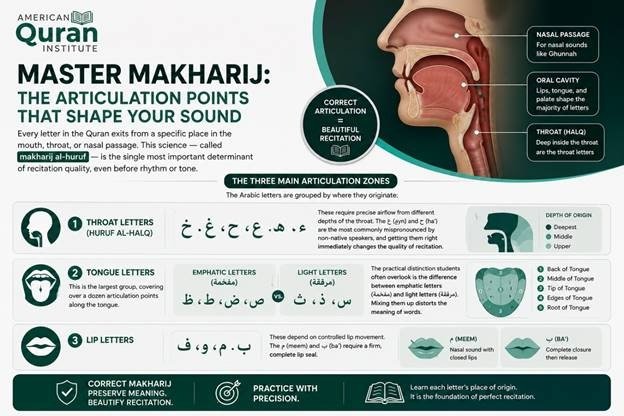
Every letter in the Quran exits from a specific place in the mouth, throat, or nasal passage. This science — called makharij al-huruf — is the single most important determinant of recitation quality, even before rhythm or tone.
A. The Three Main Articulation Zones
The Arabic letters are grouped by where they originate:
– Throat letters (huruf al-halq):
ء، ه، ع، ح، غ، خ — these require precise airflow from different depths of the throat. The ع (ayn) and ح (ha’) are the most commonly mispronounced letters among American Muslims who grew up speaking English, and getting them right immediately changes the quality of recitation.
– Tongue letters:
This is the largest group, covering over a dozen articulation points along the tongue. The practical distinction students often overlook is the difference between emphatic letters (مفخمة like ص، ض، ط، ظ) and light letters (مرققة like س، ذ، ث). Mixing them up distorts the meaning of words – a common challenge for native English speakers whose language doesn’t use these sounds.
– Lip letters:
ب، م، و، ف — these depend on controlled lip movement. The م (meem) and ب (ba’) require a firm, complete lip seal.
B. A Practical Makharij Exercise:
Take Surah Al-Fatiha and recite it one letter at a time — not one word at a time. Say each letter, identify where it exits your mouth, and only then move to the next. This exercise feels slow but rewires your pronunciation faster than any other method.
For American kids, turning this into a short daily drill after Fajr or before bed works well — five minutes is enough to build the habit.
Read also: How to Read the Quran in Arabic Easy? A Guide for Non-Native Speakers
2. Apply Tajweed Rules: The System That Preserves the Quran’s Sound
Tajweed is the formal system of rules that governs how the Quran is recited — exactly as it was revealed and taught by the Prophet ﷺ through an unbroken chain of transmission. Applying it correctly is what makes recitation sound structured, flowing, and dignified rather than choppy or arbitrary.
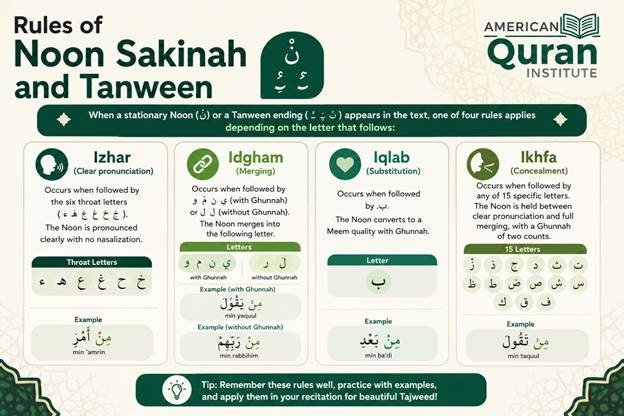
A. Rules of Noon Sakinah and Tanween
These four rules govern what happens when a nun sound appears at the end of a word or as a vowel marker:
- Ith-har (إظهار): pronounce the nun clearly before throat letters
- Idgham (إدغام): merge the nun into the following letter
- Iqlab (إقلاب): convert the nun sound to meem before ب
- Ikhfa (إخفاء): partially hide the nun with a nasal resonance
These rules create the connected, musical flow between words that distinguishes trained recitation from flat reading. For American students who learned the Quran informally — from parents, at weekend Islamic school, or through YouTube — these rules are often the missing piece that explains why their recitation doesn’t sound like the reciters they admire.
Read also: How to Learn Quran in the USA?
B. The Rules of Madd (Elongation)
The rules of madd specify how long each vowel sound is held. Natural Madd is two counts; Madd Wajib is four to five. Neglecting the madd makes recitation sound rushed and unbalanced. Applying it correctly gives recitation its measured, unhurried quality.
C. Ghunnah Rules (Nasalization)
The nasal resonance on meem and nun when they appear with a shaddah or in specific positions. Ghunnah is what gives Arabic recitation its distinctive warmth and resonance.
Read also: LEARN QURAN BY HEART IN THE USA
3. Train Your Breath While Reading The Quran
Breath control is a technical skill, not a given. Without it, long verses break awkwardly, the voice wavers, and pronunciation suffers at the end of breath phrases. Ayat Al-Kursi (2:255) is the classic test — reciting it clearly from beginning to end requires planned breath management. This is true whether you’re a ten-year-old American child trying to recite in front of the class or an adult leading Tarawih prayer.
Book your FREE trial session today

A. Diaphragmatic breathing:
Stand straight. Place one hand on your chest, the other on your belly. Inhale through your nose — only your belly hand should move. Exhale slowly through a sustained س (seen) sound.
Practice this for two minutes before any recitation session. This builds lung capacity and trains you to breathe from the diaphragm rather than the chest. Kids can make this a game — see how long they can hold the seen sound without running out of air.
B. Humming warm-up (Hamhama):
Close your mouth, keep your jaw slightly relaxed inside. Exhale through the nose while producing a low mmmm sound, then gradually raise the pitch. This loosens the vocal cords, prevents hoarseness, and opens the resonance chambers in the nose and forehead. Five minutes before reciting makes a measurable difference in vocal clarity – and takes zero equipment, which makes it easy to do before leaving for work, school, or the masjid.
C. Pause planning:
Before reading a long verse, scan it mentally and identify your waqf (stopping) points. The rule: stop only where the meaning is complete, following the pause symbols printed in the Mushaf. A misplaced pause — such as stopping mid-phrase in “iyyaka na’budu wa iyyaka nasta’een” — breaks the meaning entirely.
The American Quran Institute offers a dedicated Classical Arabic Course in the USA for adult learners, as well as a separate Noorani Qaida for Kids designed for younger students with age-appropriate pacing and instruction.

Experience Our Classroom Environment
Don’t just take our word for it—experience a live session for yourself! Click on the videos below to watch real snippets from our classes and see our interactive teaching methods in real-time.
Start Your Quranic Education
Join our premier online institute for structured Quranic learning tailored for students in the USA.
Book Your Free Trial4. Listen to Skilled Reciters and Imitate After Them
Scholars and practitioners agree: the most efficient way to improve recitation is extended, focused listening to skilled reciters followed by imitation.
The key is choosing a reciter whose natural voice register is close to yours — not the reciter you find most beautiful, but the one you can actually match. This applies equally to an American ten-year-old boy, a teenage girl, a grown man, or a woman reciting at home.
Read also: Quran Qirat Learning Course in the USA
The Recommended Listening-Imitation Method
1. Select one short surah — Surah Ad-Duha is ideal for beginners
2. Listen to your chosen reciter recite the entire surah without reading along
3. Listen again, this time following in the Mushaf
4. Recite one verse, then stop immediately and repeat it as closely as possible
5. Record your attempt and compare it to the original
Repeat this process daily for 15 minutes. Within three to four weeks, your ear trains itself to notice pitch shifts, rhythm breaks, and pronunciation differences that were previously invisible to you. American parents can make this a short after-dinner family activity — kids learn faster when they hear their parents doing the same.
Recommended Reciters by Style
- Sheikh Mahmoud Khalil Al-Husary — best for learning Tajweed rules; his recitation is slow, clear, and rule-perfect – excellent for American students and children
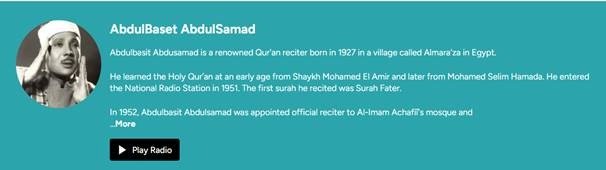
- Sheikh Abdul Basit Abd Al-Samad — known for extraordinary breath control and a naturally resonant tone
- Sheikh Mishary Rashid Al-Afasy — accessible and melodically consistent; well-suited for imitation practice by American beginners and teenagers.
- Sheikh Al-Minshawi — particularly strong in emotional depth and varied pacing.
5. Record To Yourself and Listen to Your Own Recordings
Most students avoid listening to their own recordings. This is a mistake. Self-recording is the most honest feedback available between teacher sessions.
What to Listen For in Your Own Recordings
- Are the madd sounds actually held for their correct duration, or are they slightly short?
- Do the throat letters ع and ح sound distinct, or do they blur together?
- Is the pace consistent, or does it speed up in familiar sections and slow at difficult ones?
- Does the ghunnah on meem and nun have actual nasal resonance, or is it being swallowed?
Record one surah per week. Keep the recordings. Listening to your session from six weeks ago alongside your current one shows progress you cannot feel in the moment — and this progress builds motivation to continue. For American kids, parents can make a short “recitation journal” using voice memos on the family iPad and review it together once a week.
Start learning Quran with a FREE trial class

6. Train Your Voice While Reading Quran
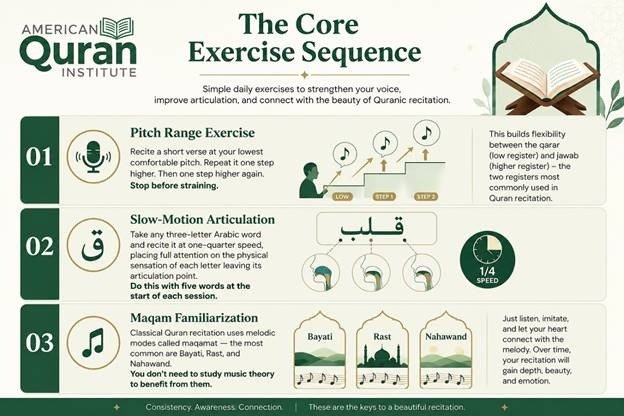
Voice quality in recitation is partly natural and partly developed. The following exercises, practiced daily for 15–20 minutes, produce measurable improvement within weeks, whether you’re a busy American professional fitting in practice during a lunch break or a stay-at-home mom reciting after the kids leave for school.The Core Exercise Sequence
A. Pitch range exercise
Recite a short verse at your lowest comfortable pitch. Repeat it one step higher. Then one step higher again. Stop before straining. This builds flexibility between the qarar (low register) and jawab (higher register) – the two registers most commonly used in Quran recitation.
B. Slow-motion articulation
Take any three-letter Arabic word and recite it at one-quarter speed, placing full attention on the physical sensation of each letter leaving its articulation point. Do this with five words at the start of each session.
C. Maqam familiarization
Classical Quran recitation uses melodic modes called maqamat — the most common are Bayati, Rast, and Nahawand. You don’t need to study music theory to benefit from them. Simply listen to the same surah recited by three different reciters and notice how the melodic contour shifts.
7. Intend With Your Recitation to Draw The Listener Closer to The Words of Allah
The Prophet ﷺ said: “Adorn the Quran with your voices” (Abu Dawud). He also praised Abu Musa Al-Ash’ari’s recitation by saying he had been given a voice like the pipes of the house of David.
This establishes clearly that seeking a beautiful voice in recitation is not vanity — it is following a prophetic example.
The concern many students carry — “am I showing off by wanting a better voice?” — has a practical resolution: the intention is to beautify the Quran, not to display the voice.
When your goal is that the listener is moved by the words of Allah, not impressed by your performance, the action is an act of worship. This is especially worth discussing with American Muslim teenagers, who may feel self-conscious about reciting in front of others and mistake that natural anxiety for insincerity.
If you notice during recitation that your attention shifts to how you sound rather than what you’re reading, this is a signal to slow down, return to the meaning of the verse, and reconnect with the purpose.
See Us in Action!
Take a look inside our virtual classrooms. Watch the clip below to see how our instructors engage with students, simplify complex rules, and create an inspiring environment for learning.
Start Your Quranic Education
Join our premier online institute for structured Quranic learning tailored for students in the USA.
Book Your Free Trial8. Start Reading Quran With The Right Foundation
Beautiful Quran recitation — known in Arabic as tajweed — is not primarily about having a naturally gifted voice. The Prophet ﷺ said: “He is not one of us who does not recite the Quran beautifully” (Bukhari). This hadith establishes beautifying recitation as an obligation, not an optional extra.
But what does “beautiful” mean in this context? Scholars define it as reciting each letter from its correct articulation point, applying the rules of Tajweed, and allowing the meaning of the verses to reflect in the tone — not performing or artificially ornamenting the voice.
The key practitioner insight most beginners miss — whether you’re a child in an American Islamic school or an adult learning on Zoom: accuracy precedes melody. A voice that is technically correct will naturally sound more beautiful than an ornate recitation full of pronunciation errors. Fix the foundation first.
Start Learning the Quran with Beautiful Recitation — Join American Quran Institute

Check out our top courses for Quran learning:
- Quran Classes for Adults
- Quran classes for kids
- Hifz for Kids
- Ijazah Course
- Tajweed Classes
- Hifz Quran
- Noorani Qaida classes
Book your FREE trial session today
Start Your Quranic Education
Join our premier online institute for structured Quranic learning tailored for students in the USA.
Book Your Free TrialConclusion
Reciting the Quran beautifully is a combination of science and sincerity. The science is Tajweed: the makharij, the rules of noon sakinah, the madd, the ghunnah. Sincerity is the intention — reciting so that the meaning reaches the heart of the listener, not to display vocal ability.
The practical path is straightforward: fix the pronunciation first, apply the Tajweed rules, train your breath daily, listen carefully to skilled reciters, record yourself weekly, and work with a qualified teacher who can hear what you cannot hear yourself. For American Muslims — whether you’re raising kids in the suburbs, leading your family in prayer, or picking up the Quran seriously for the first time as an adult, beautiful Quran recitation is not reserved for those born with a gift — it is available to anyone willing to build the skill with discipline and sincerity.
Frequently Asked Questions
Do I need a naturally beautiful voice to recite the Quran well?
No. Beautiful recitation depends primarily on correct pronunciation (makharij), proper Tajweed application, and breath control — all of which are learnable skills. A voice that is technically accurate will sound more beautiful than an ornate one with pronunciation errors. This is true for American kids, adults, and seniors alike.
How long does it take to improve Quran recitation?
With daily practice of 15–20 minutes, most students notice a clear change in their pronunciation and breath control within four to eight weeks. Full fluency with Tajweed rules typically takes six months to two years depending on starting level and consistency.
Is it permissible to use melodic modes (maqamat) in Quran recitation?
Yes, as long as the melodic pattern does not alter the pronunciation of any letter or cause incorrect elongation of sounds. The Prophet ﷺ explicitly praised beautiful, melodic recitation. The condition is that the Tajweed rules are not violated in pursuit of melody.
How often should I practice?
Daily short sessions are more effective than long irregular ones. Fifteen to twenty minutes every day — ideally after Fajr when focus is sharpest — produces better results than two hours on weekends. For school-age children in the US, a consistent after-school slot works well as it pairs with homework routines.
Can I improve without a teacher?
Self-study through recordings and self-monitoring will produce some improvement, but errors in makharij and subtle Tajweed mistakes are almost impossible to catch without an external ear. A qualified teacher accelerates progress significantly and prevents incorrect habits from becoming permanent — particularly important for American Muslims who may have spent years reciting with unnoticed errors.






Leave a Reply