 Quran
Quran
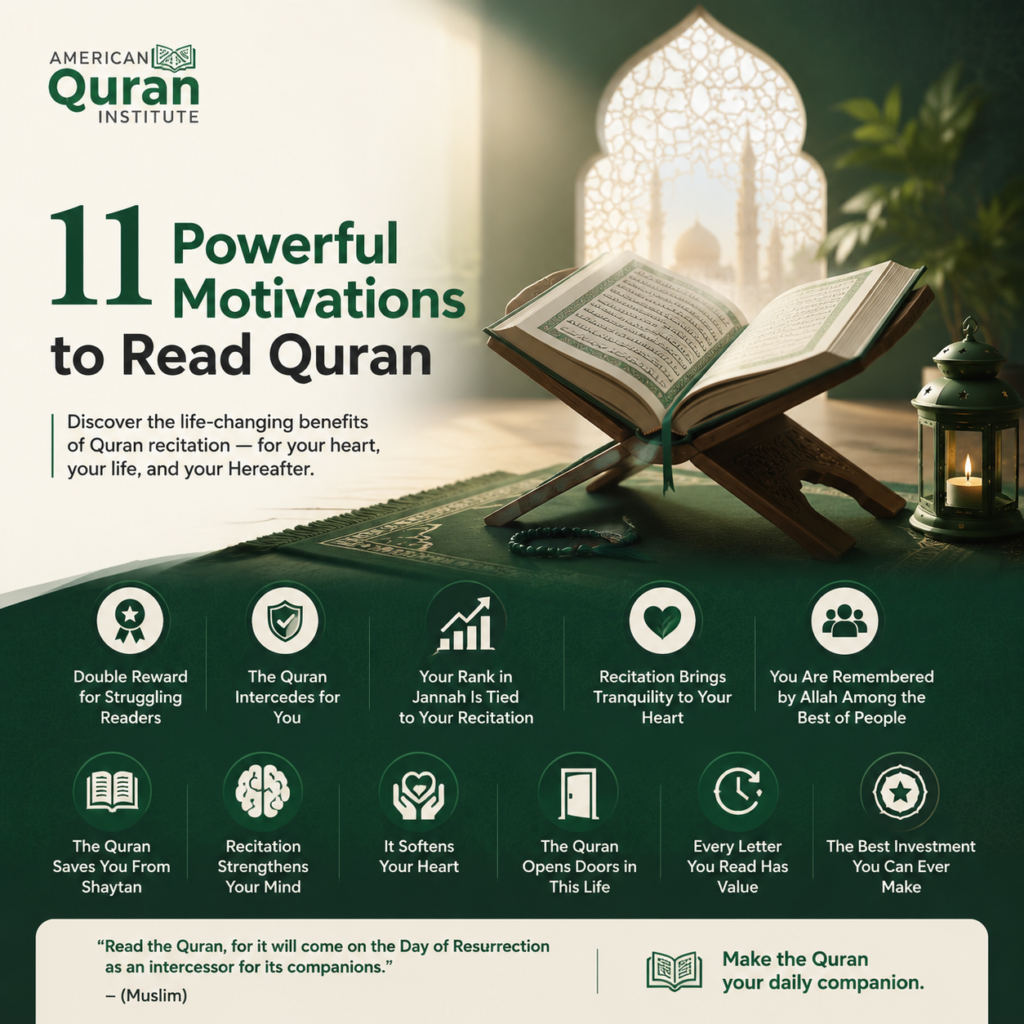
Do you open the Quran occasionally but find it hard to make recitation a daily habit? Or maybe you feel a pull toward it but can’t quite explain why it matters so much? Whether you’re a Muslim parent in Texas trying to build a family routine, a college student in New York fitting recitation between classes, or a sister in California reconnecting with her faith — you’re not alone. And the answer isn’t willpower. It’s understanding what the Quran actually does for you.
When you know what’s at stake in every session of recitation, motivation to read Quran stops being a struggle and becomes something natural.
Motivation rooted in outcomes is durable. Here are ten benefits — from authentic sources — that give your recitation real purpose.
1. The Reader Of The Quran Who Struggles Gets Double Reward
One of the most important, and least discussed, facts about Quran recitation is this: difficulty is not a disqualifier — it is an amplifier.
The Prophet ﷺ said: “The one who recites the Quran skillfully will be with the noble, righteous scribes (angels), and the one who recites it with difficulty, stammering through it, will have two rewards.” (Bukhari & Muslim)
This means a beginner who struggles through every page is earning more than they might realize. For Muslim Americans learning Arabic as a second language, this hadith is especially important. The common mistake is to delay recitation until your Arabic improves. That delay costs you a reward you could be accumulating right now.
Read also: How to Start Reading the Quran Daily? A Practical Guide for Americans
Read also: HOW TO LEARN THE QURAN ALPHABET IN THE USA?
2. The Quran Will Intercede for You on the Day of Judgment
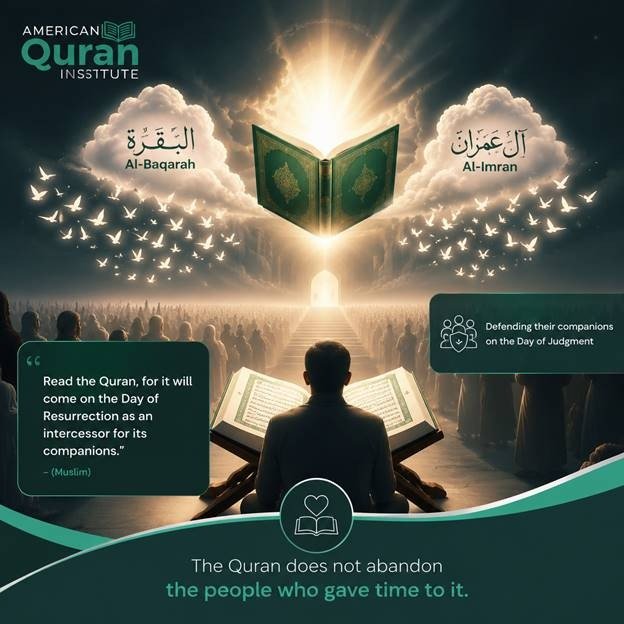
On a Day when no wealth, status, or worldly relationship will offer any protection, the Quran will rise to defend the one who kept it close in this life. The Prophet ﷺ said: “Read the Quran, for it will come on the Day of Resurrection as an intercessor for its companions.” (Muslim)
He also described Surah Al-Baqarah and Surah Al-Imran coming on that day like two clouds or flocks of birds, defending those who recited them in this life. The Quran does not abandon the people who gave time to it.
The word the Prophet ﷺ chose — companions — is not incidental. A companion is someone who stays close, who returns consistently, who does not leave the relationship only for special occasions. The hadith is not describing the scholar who mastered every verse, nor the hafiz who completed memorization in record time. It is describing the ordinary Muslim who simply kept the Quran near — who opened it after Fajr, who recited it in salah, who returned to it after periods of distance. That faithfulness is what the Quran will answer with faithfulness on the Day when no other intercession can be guaranteed.
Enroll your child in our Quran classes for kids with a FREE session
3. Your Rank in Jannah Is Tied to How Much You Recite
Among all the rewards connected to Quran recitation, this one carries a weight that is difficult to fully absorb: what you recite in this life determines where you stand in the next. It is not a vague promise of reward — it is a precise, verse-by-verse elevation. The Prophet ﷺ said: “It will be said to the companion of the Quran: Read and ascend, and recite as you used to recite in the world, for your rank will be at the last verse you recite.” (Abu Dawud, Tirmidhi)
This is a direct link between recitation in this life and your station in the next. Every additional verse you read is literally a higher floor — and that applies equally to the American child completing their first juz and the adult finishing their second khatm.
What makes this hadith especially significant is the instruction given in Jannah itself: read and ascend. The recitation does not stop at death — it continues, and it keeps lifting. But the rank you begin at is set by what you built here. Every page read after a long day, every surah recited in a quiet moment, every juz completed during Ramadan is not simply a present act of worship that ends when the session closes. It is a permanent deposit, accumulating toward a station in Jannah that no one else can occupy and nothing else can grant.
4. Recitation of The Quran Brings Tranquility — Not Metaphorically, But Physically
When a companion was reciting Surah Al-Kahf one night, a cloud descended and his horse began to bolt. He mentioned this to the Prophet ﷺ, who replied: “That was the sakinah (tranquility), which descended for the Quran.” (Bukhari & Muslim)
The Quran does not just calm anxiety as a psychological effect — classical scholars describe it as a visible mercy that descends on those who recite. For Muslim families in the USA navigating the pressures of American life — work, school, social stress — this is not a small thing. Allah says: “Verily, in the remembrance of Allah do hearts find rest.” (Ar-Ra’d: 28)
What the hadith of Usayd ibn Hudayr makes clear is that the sakinah is not waiting for the reader to reach a certain level of mastery before it descends. He was reciting alone, at night, in an ordinary setting — and the mercy came. This is the consistent pattern across the narrations: tranquility arrives in response to the act of recitation itself, not to the credentials of the one reciting. The American Muslim who opens the Mushaf after a difficult day at work, or the teenager who recites a few verses before a stressful exam, is not engaging in a symbolic gesture. They are inviting something real — a mercy that the Prophet ﷺ witnessed with his own Companions and described without qualification.
Read also: How to Remember Quran Verse Numbers? – For American Memorizers
5. You Are Remembered by Allah Among the Highest Company
There are many reasons to recite the Quran — reward, intercession, tranquility, elevation in Jannah. But this next benefit stands apart from all of them. It is not about what you receive on the Day of Judgment, or what descends upon you in this life. It is about something happening right now, in the highest realm, every time you open the Book.
The Prophet ﷺ said: “When a group of people gather in one of the houses of Allah, reciting the Book of Allah and studying it together, tranquility descends upon them, mercy covers them, angels surround them, and Allah mentions them to those who are with Him.” (Muslim)
The scale of this reward becomes clearer when you hold it against the smallness of what triggers it. Not a lifetime of scholarship. Not a complete memorization. Not a pilgrimage or a major act of worship requiring months of preparation. A group of people — any people, at any level — sitting together with the Book of Allah. The mother and her children on the living room floor after dinner. The two friends who open a Quran app together during a lunch break. The Sunday school class of seven-year-olds stumbling through Juz Amma with their teacher. Each of these gatherings, however ordinary they appear from the outside, is being noted and mentioned in the highest company that exists. There is no gathering on earth more dignified than that.
6. The Quran Is a Light in This Life and a Treasure After It
Every believer carries concerns about two things: navigating this life without going astray, and arriving in the next life with something of worth. The Quran addresses both — not as a general source of inspiration, but as a specific, named provision for each.
The Prophet ﷺ advised Abu Dharr: “Hold fast to reciting the Quran, for it is a light for you in the earth and a provision for you in the heavens.” (Ibn Hibban)
Ibn Abbas explained the worldly light this way: “Allah has guaranteed that whoever follows the Quran will not go astray in this life and will not be wretched in the next.” That is a guarantee that covers every form of confusion and loss, including the
They are carrying a working light through the darkness of this life and a stored treasure for the moment this life ends. For American Muslims raising families in an environment that pulls in every direction — where confusion about identity, values, and purpose is a daily reality — the Prophet’s ﷺ counsel to Abu Dharr is not ancient advice for a different time. It is a direct answer to the exact conditions they are navigating right now.
See Us in Action!
Take a look inside our virtual classrooms. Watch the clip below to see how our instructors engage with students, simplify complex rules, and create an inspiring environment for learning.
Start Your Quranic Education
Join our premier online institute for structured Quranic learning tailored for students in the USA.
Book Your Free Trial7. The Quran Is An Healing — For Both the Heart and the Body
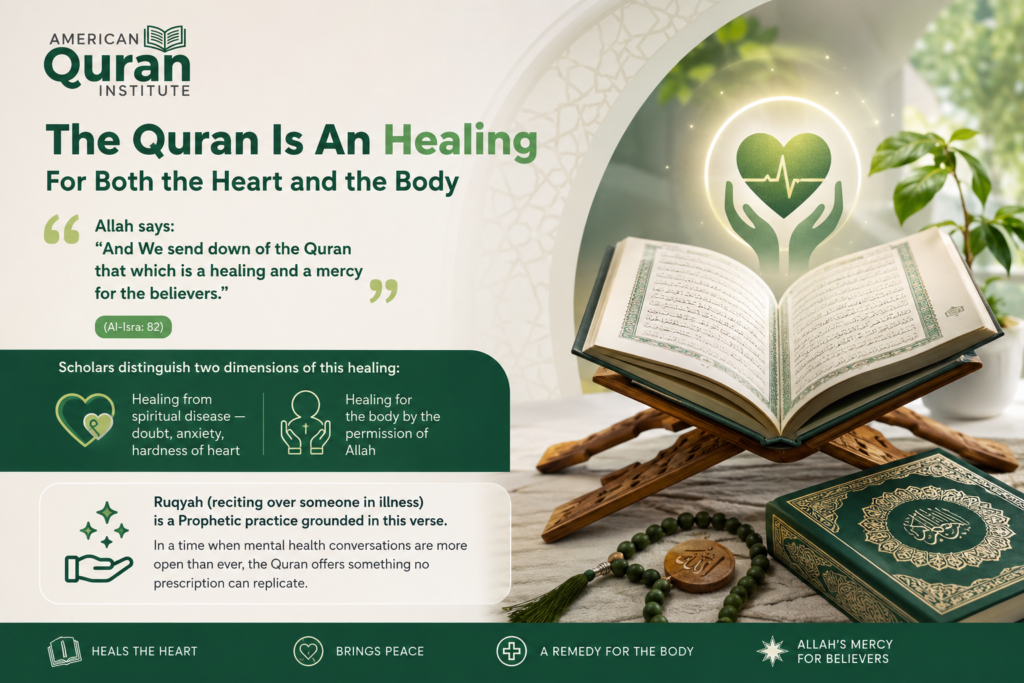
Every human being carries wounds that the world cannot fully reach — anxieties that therapy softens but does not resolve, griefs that time dulls but does not erase, doubts that logic addresses but cannot quiet. Allah did not leave His servants without a remedy for what runs deeper than medicine can treat. He named it clearly in His Book: Allah says:
“And We send down of the Quran that which is a healing and a mercy for the believers.” (Al-Isra: 82)
Scholars distinguish two dimensions of this healing: healing from spiritual disease — doubt, anxiety, hardness of heart — and healing for the body by the permission of Allah. Ruqyah (reciting over someone in illness) is a Prophetic practice grounded in this verse. In a time when mental health conversations are more open than ever, the Quran offers something no prescription can replicate.
8. Regular Recitation Protects You From Heedlessness
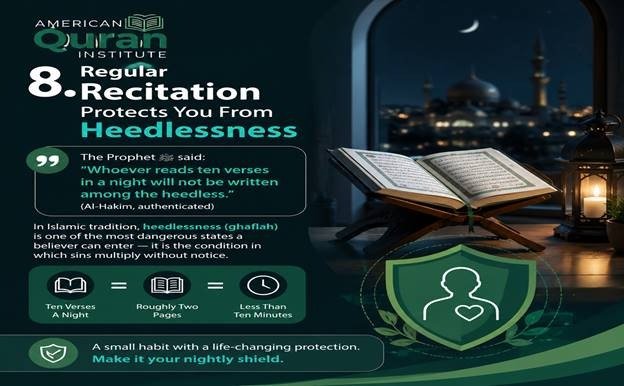
Among the quiet dangers that scholars warn about most consistently, heedlessness sits near the top — not because it announces itself, but precisely because it does not. It settles gradually, in the gaps left by busy schedules and distracted evenings, until a believer looks back and cannot identify exactly when their heart grew distant from Allah.
The Prophet ﷺ provided a specific, measurable protection against it: “Whoever reads ten verses in a night will not be written among the heedless.” (Al-Hakim, authenticated)
In Islamic tradition, heedlessness (ghaflah) is one of the most dangerous states a believer can enter — it is the condition in which sins multiply without notice. Ten verses a night is a guard against it. That is roughly two pages, less than ten minutes — achievable even on the busiest American weeknight.
For the American Muslim whose evenings are consumed by work deadlines, children’s homework, and the pull of screens, this hadith reframes the entire question of consistency. The minimum that protects you is not as far away as ghaflah wants you to believe. It is ten verses. It is tonight.
Begin Your Intensive Quran Journey in the USA Today
9. You Become Among the People of Allah
In a world that assigns belonging based on status, achievement, and social standing, Islam offers a membership that operates on an entirely different criterion. There is a group of people whom Allah has singled out, drawn close, and claimed as His own — and the qualification for joining them has nothing to do with wealth, lineage, or worldly position.
The Prophet ﷺ said: “Allah has His own people among mankind.” The companions asked who they were. He replied: “The people of the Quran — they are the people of Allah and His closest ones.” (Ibn Majah, Nasa’i)
This title — ahl Allah, the people of Allah — is not given to the wealthy, the powerful, or the famous. It is given to those who hold to His book. An American Muslim kid in middle school, an American sister balancing a full-time job, an American grandfather reading in his chair after Fajr — all of them qualify.
10. The Quran Elevates You in This World Too
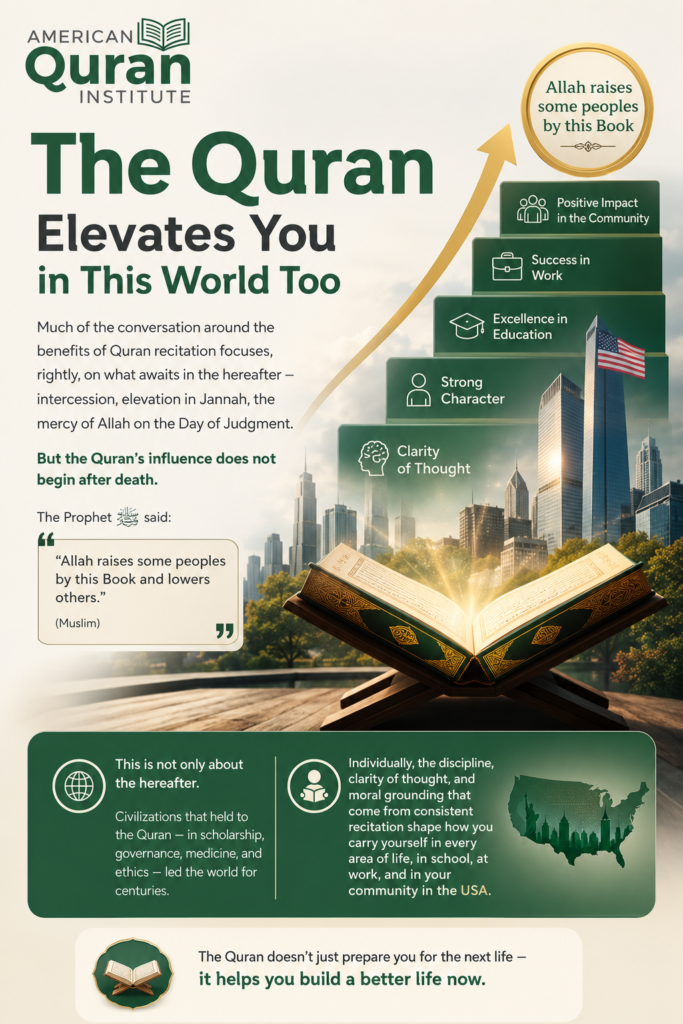
Much of the conversation around the benefits of Quran recitation focuses, rightly, on what awaits in the hereafter — intercession, elevation in Jannah, the mercy of Allah on the Day of Judgment. But the Quran’s influence does not begin after death. It reshapes the one who holds it here, in this life, in ways that are visible and measurable.
The Prophet ﷺ said: “Allah raises some peoples by this Book and lowers others.” (Muslim)
This is not only about the hereafter. Civilizations that held to the Quran — in scholarship, governance, medicine, and ethics — led the world for centuries. Individually, the discipline, clarity of thought, and moral grounding that come from consistent recitation shape how you carry yourself in every area of life, in school, at work, and in your community in the USA.
11. Every Single Letter Earns Ten Rewards
Before discussing the grandes rewards of completing a khatm, memorizing a juz, or mastering Tajweed, there is a more fundamental reward that begins at the very first sound a reader produces — one that accumulates with every single letter, regardless of the reader’s level, speed, or fluency.
The Prophet ﷺ said: “Whoever reads a letter from the Book of Allah will have a reward, and that reward will be multiplied by ten.” He then clarified: “I do not say that Alif-Lam-Meem is one letter, but Alif is a letter, Lam is a letter, and Meem is a letter.” (Tirmidhi)
Bismillah alone — nine letters — earns ninety rewards before you’ve even opened the first surah. For an American child reading their first lines of Quran, or an adult picking it up after years away, that counter starts the moment recitation begins.
Read also: Online Tajweed Classes in the USA
The Three Gates of Recitation Habit:
The scholars offer a practical framework worth naming: the Three Gates of Recitation Habit.
1. Entry Gate:
Start with the minimum viable dose. Two verses count. The Prophet ﷺ said “learning or reading two verses is better than two prize camels.” (Muslim). Lower the bar to enter the practice, not to stay there. For American kids, this might mean one short surah after school. For busy adult Americans, it means opening the Quran app during a lunch break.

2. Engagement Gate:
Read with a goal beyond completion. Before you open the Quran, ask one question: “What does Allah want from me in this passage?” Tadabbur (reflection) transforms recitation from recitation into conversation. For American ladies who lead family Quran time, this question turns a five-minute session into something everyone remembers.
Read also: Noorani Qaida Course in the USA

3. Extension Gate:
Let one session naturally open to the next. When you end on a cliffhanger – mid-story of a prophet, mid-argument in a surah – you will find yourself returning. This is why scholars recommended not always stopping at clean juz breaks.
One practical mistake many American Muslim learners make: they try to fix their Arabic before committing to daily recitation. The two should run in parallel, not in sequence. Recite daily in whatever Arabic you have, and study the language alongside it.
Experience Our Classroom Environment
Don’t just take our word for it—experience a live session for yourself! Click on the videos below to watch real snippets from our classes and see our interactive teaching methods in real-time.
Start Your Quranic Education
Join our premier online institute for structured Quranic learning tailored for students in the USA.
Book Your Free TrialReading the Quran With A Qualified Teacher
Reading the Quran alone is rewarding. Reading it with a qualified teacher — one who corrects your tajweed, answers your questions, and holds you accountable — is transformative.
At American Quran Institute, our certified instructors teach Quran recitation, tajweed, and memorization through live online sessions tailored to your level, whether you’re reading for the first time or working toward hifz.
Start Reading Quran With Proper Guidance at The American Quran Institute
Check out our top courses for Quran learning:
- Ijazah Course
- Quran Classes for Adults
- Quran classes for kids
- Hifz Quran
- Hifz for Kids
- Noorani Qaida classes for kids
Start Your Quranic Education
Join our premier online institute for structured Quranic learning tailored for students in the USA.
Book Your Free TrialConclusion
The motivation to read Quran is not something you manufacture — it grows when you understand what you are actually holding. Every letter earns ten rewards. Every session of recitation is noted by Allah and announced among the angels. The Quran will stand for you on the Day of Judgment, raise your rank in Jannah, protect you from heedlessness, and bring calm into a life that often feels the opposite.
Whether you are a parent trying to raise Quran-loving children in America, a sister rebuilding her connection to her faith, or an adult starting from scratch — the path begins the same way: with two verses, tonight.
Frequently Asked Questions
What is the best motivation to read Quran every day?
The strongest daily motivation is understanding that every letter earns ten rewards, and that those rewards are recorded whether or not you feel inspired. Pair that with a fixed time — after Fajr is the most commonly recommended — and the habit sustains itself through consistency rather than emotion.
Does it count if I read Quran without understanding Arabic?
Yes. The Prophet ﷺ explicitly said the reward is per letter, not per comprehension. A non-Arabic speaker who reads the Quran carefully earns the same letter-by-letter reward. Understanding deepens the benefit — which is a reason to study Quranic Arabic — but it does not gate the reward.
What if I struggle to read Quran fluently?
Struggling earns you double reward. The hadith in Bukhari and Muslim is explicit: the person who recites with difficulty, stumbling through the words, receives two rewards — one for the recitation and one for the effort. Difficulty is a sign you are working, not a reason to stop.
How many verses should I read each day?
The Prophet ﷺ named ten verses as enough to protect you from heedlessness. Classical scholars recommended completing the Quran once a month (one juz per day) as a sustainable baseline. Start with what you can sustain daily, then grow from there.
Is there a specific time that is best for reading Quran?
After Fajr (pre-dawn prayer) is widely considered the most blessed time, as the Quran specifically mentions this period: “Indeed, the recitation of dawn is witnessed.” (Al-Isra: 78) After Isha before sleep is the second most recommended time, particularly for those who want the last act of their day to be worship.
Can I listen to Quran instead of reading it?
Listening to a qualified reciter carries its own spiritual benefit and helps you absorb correct pronunciation. However, active recitation — moving your lips and tongue over the words — is what earns the per-letter reward described in the hadith. Listening and reciting serve different purposes and are best done together.






Leave a Reply