 Quran

Hope in the Quran is more than expecting life to become easier. It is a form of trust in Allah that remains alive even when circumstances are difficult, answers seem delayed, or a person is struggling with regret. The Quran repeatedly teaches believers not to surrender to despair. Allah’s mercy is vast, His help is near, and He is able to change circumstances in ways people cannot foresee.
For anyone searching for Quran verses about hope in Arabic, there are many powerful ayat that speak directly to hardship, fear, uncertainty, repentance, and waiting.
Some promise ease alongside difficulty, some remind us of Allah’s mercy and forgiveness, and others encourage believers to continue making dua and trusting Him when the outcome is still unclear.
Below are some of the most meaningful Quran verses about hope in Arabic, together with transliteration, English translation, and explanations of the lessons they offer.
1. Quran Verse About Never Despairing of Relief From Allah
One of the clearest Quran verses about hope in Arabic appears in the story of Prophet Ya‘qub and his sons. Despite years of grief and separation from Yusuf, Ya‘qub continued hoping in Allah’s relief.
يَا بَنِيَّ اذْهَبُوا فَتَحَسَّسُوا مِن يُوسُفَ وَأَخِيهِ وَلَا تَيْأَسُوا مِن رَّوْحِ اللَّهِ ۖ إِنَّهُ لَا يَيْأَسُ مِن رَّوْحِ اللَّهِ إِلَّا الْقَوْمُ الْكَافِرُونَ
Yaa baniyyaz haboo fatahassasoo min Yoosufa wa akheehi wa laa tai’asoo mir rawhil laahi innahoo laa yai’asu mir rawhil laahi illal qawmul kaafiroon.
“O my sons, go and find out about Joseph and his brother and despair not of relief from Allah. Indeed, no one despairs of relief from Allah except the disbelieving people.”
The circumstances surrounding this verse make its message especially powerful. Prophet Ya‘qub had endured a long separation from Yusuf, yet he did not tell his sons that all hope was lost. Instead, he told them to continue searching.
This teaches that hope in Allah can remain alive even when the solution is not yet visible. A believer can experience genuine grief while still expecting Allah’s relief and continuing to take meaningful action.
Read also: Quran Verses About Jannah in Arabic – Paradise, Eternal Reward, and Peace
2. Quran Verse About Never Losing Hope in Allah’s Mercy
One of the Quran’s most powerful messages of hope addresses people who have committed serious sins but still have the opportunity to return to Allah.

قُلْ يَا عِبَادِيَ الَّذِينَ أَسْرَفُوا عَلَىٰ أَنْفُسِهِمْ لَا تَقْنَطُوا مِنْ رَحْمَةِ اللَّهِ ۚ إِنَّ اللَّهَ يَغْفِرُ الذُّنُوبَ جَمِيعًا ۚ إِنَّهُ هُوَ الْغَفُورُ الرَّحِيمُ
Qul yaa ‘ibaadiyal lazeena asrafoo ‘alaaa anfusihim laa taqnatoo mir rahmatillaah; innal laaha yaghfiruz zunooba jamee‘aa; innahoo Huwal Ghafoorur Raheem.
“Say, ‘O My servants who have exceeded the limits against their souls! Do not lose hope in Allah’s mercy, for Allah certainly forgives all sins. He is indeed the All-Forgiving, Most Merciful.’”
This verse speaks directly to people who have wronged themselves. Instead of allowing sin to convince them that returning to Allah is pointless, they are commanded not to despair of His mercy.
At the same time, Quranic hope is not permission to continue deliberately in wrongdoing. The surrounding passage calls people toward repentance and submission. Hope therefore becomes a reason to return to Allah, reform one’s actions, and begin again.
Read also: Quran Verses About Hijab In Arabic – Modesty, Khimar, And Jilbab
3. Quran Verse About Allah Promising Ease Alongside Hardship
Some of the most comforting Quranic words for a believer facing difficulty appear in two consecutive verses of Surah Ash-Sharh.
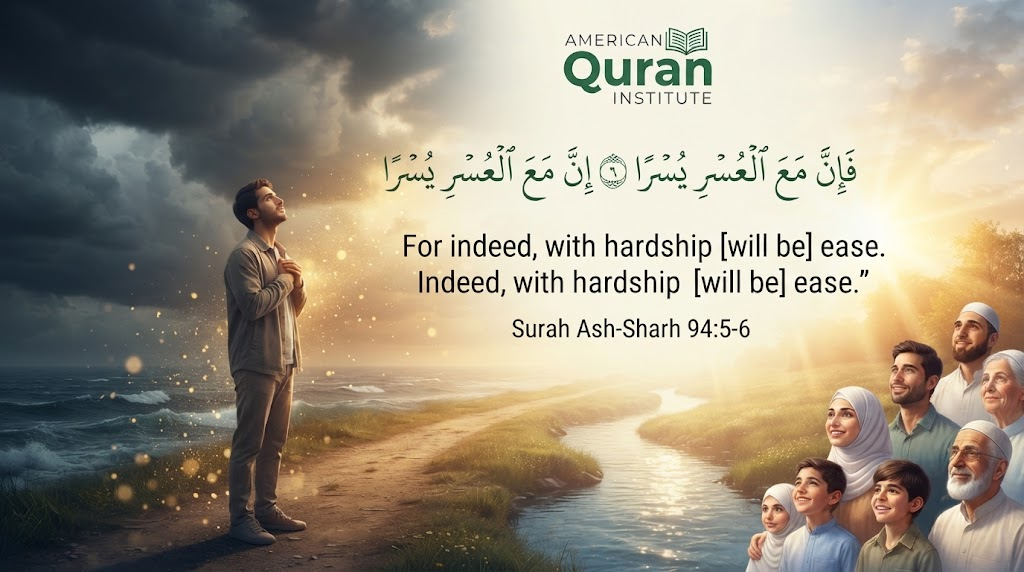
فَإِنَّ مَعَ الْعُسْرِ يُسْرًا إِنَّ مَعَ الْعُسْرِ يُسْرًا
Fa inna ma‘al ‘usri yusraa. Inna ma‘al ‘usri yusraa.
“For indeed, with hardship [will be] ease. Indeed, with hardship [will be] ease.”
The Quran does not deny the existence of hardship. Instead, it places ease alongside it and repeats the message for emphasis.
For someone experiencing financial pressure, family problems, disappointment, grief, or uncertainty, these verses provide a reason to remain patient. The difficulty being experienced now is real, but it is not the whole story.
4. Quran Verse About Allah Being Near and Responding to Dua
Hope can become difficult when a person has been making dua for a long time without seeing the answer they expected. The Quran redirects attention toward the One being called upon.
وَإِذَا سَأَلَكَ عِبَادِي عَنِّي فَإِنِّي قَرِيبٌ ۖ أُجِيبُ دَعْوَةَ الدَّاعِ إِذَا دَعَانِ
Wa izaa sa’alaka ‘ibaadee ‘annee fa innee qareebun ujeebu da‘watad daa‘i izaa da‘aani.
“And when My servants ask you concerning Me, indeed I am near. I respond to the invocation of the supplicant when he calls upon Me.”
The powerful phrase فَإِنِّي قَرِيبٌ — “Indeed I am near” gives believers reassurance during uncertainty.
Dua is not meaningless simply because an answer does not appear immediately or in the exact form a person expected. A believer continues asking Allah while trusting His wisdom regarding the timing and form of the answer.
Read also: Quran Verses About Hardship In Arabic – Patience, Trials, And Relief
5. Quran Verse About Allah’s Mercy Encompassing Everything
Few statements offer greater hope than Allah’s description of His mercy in Surah Al-A‘raf:
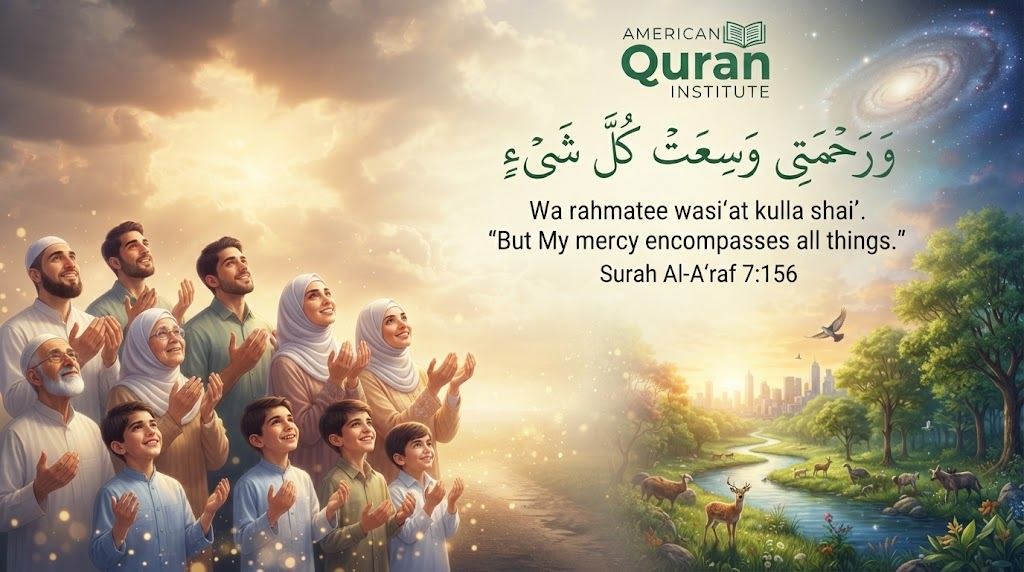
وَرَحْمَتِي وَسِعَتْ كُلَّ شَيْءٍ
Wa rahmatee wasi‘at kulla shai’.
“But My mercy encompasses all things.”
Human beings naturally focus on the size of their difficulties, failures, and mistakes.
The Quran repeatedly redirects attention toward the greatness of Allah and His mercy.
Because this is a short phrase taken from a longer verse, reading its surrounding context is especially valuable. A reliable Tafsir can help explain how this statement fits within the wider passage.
6. Quran Verses About Finding Hope Through Repentance and Allah’s Forgiveness
The Quran repeatedly connects hope with sincere repentance. A person’s past mistakes do not have to determine the direction of their future if they genuinely return to Allah.
Allah says:
وَمَن يَعْمَلْ سُوءًا أَوْ يَظْلِمْ نَفْسَهُ ثُمَّ يَسْتَغْفِرِ اللَّهَ يَجِدِ اللَّهَ غَفُورًا رَّحِيمًا
Wa mai ya‘mal sooo’an aw yazlim nafsahoo summa yastaghfiril laaha yajidil laaha Ghafoorar Raheemaa.
“And whoever does a wrong or wrongs himself but then seeks forgiveness of Allah will find Allah Forgiving and Merciful.”
The movement of the verse is important: wrongdoing is followed by seeking forgiveness, and the person finds Allah Forgiving and Merciful.
The Quran goes even further in Surah Al-Furqan:
إِلَّا مَن تَابَ وَآمَنَ وَعَمِلَ عَمَلًا صَالِحًا فَأُولَٰئِكَ يُبَدِّلُ اللَّهُ سَيِّئَاتِهِمْ حَسَنَاتٍ ۗ وَكَانَ اللَّهُ غَفُورًا رَّحِيمًا
Illaa man taaba wa aamana wa ‘amila ‘amalan saalihan fa ulaaa’ika yubaddilul laahu saiyi aatihim hasanaat; wa kaanal laahu Ghafoorar Raheemaa.
“Except for those who repent, believe and do righteous work. For them Allah will replace their evil deeds with good. And ever is Allah Forgiving and Merciful.”
Sincere repentance is therefore not simply about escaping punishment. The verse describes repentance accompanied by faith and righteous action, followed by an extraordinary promise.
Another passage reinforces the same principle:
وَإِنِّي لَغَفَّارٌ لِّمَن تَابَ وَآمَنَ وَعَمِلَ صَالِحًا ثُمَّ اهْتَدَىٰ
Wa innee la Ghaffaarul liman taaba wa aamana wa ‘amila saalihan summah tadaa.
“But indeed, I am the Perpetual Forgiver of whoever repents and believes and does righteousness and then continues in guidance.”
Together, these verses show that Quranic hope after sin is connected to tawbah, faith, righteous action, and continued guidance. The past does not have to become a permanent barrier between a believer and Allah.
See Us in Action!
Take a look inside our virtual classrooms. Watch the clip below to see how our instructors engage with students, simplify complex rules, and create an inspiring environment for learning.
Start Your Quranic Education
Join our premier online institute for structured Quranic learning tailored for students in the USA.
Book Your Free Trial7. Quran Verse About Finding Peace Through the Remembrance of Allah
Hope is not only about expecting circumstances to improve in the future. Sometimes a believer needs tranquility while the difficult situation is still happening.

الَّذِينَ آمَنُوا وَتَطْمَئِنُّ قُلُوبُهُم بِذِكْرِ اللَّهِ ۗ أَلَا بِذِكْرِ اللَّهِ تَطْمَئِنُّ الْقُلُوبُ
Allazeena aamanoo wa tatma’innu quloobuhum bizikril laah; alaa bizikril laahi tatma’innul quloob.
“Those who have believed and whose hearts are assured by the remembrance of Allah. Unquestionably, by the remembrance of Allah hearts are assured.”
This verse connects tranquility of the heart with dhikr, the remembrance of Allah.
Prayer, Quran recitation, dua, and other forms of remembrance help keep the heart connected to its Creator instead of allowing uncertainty to dominate it.
For learners who find Arabic Quran recitation difficult, stronger reading skills can make regular engagement with verses like these easier. Online Quran Reading Classes can help students improve their reading ability through structured practice.

8. Quran Verse About Not Losing Heart or Giving In to Grief as Believers
The Quran does not teach believers that faith removes every experience of sadness. Instead, it teaches them not to allow painful setbacks to destroy their commitment to Allah.
وَلَا تَهِنُوا وَلَا تَحْزَنُوا وَأَنتُمُ الْأَعْلَوْنَ إِن كُنتُم مُّؤْمِنِينَ
Wa laa tahinoo wa laa tahzanoo wa antumul a‘lawna in kuntum mu’mineen.
“So do not weaken and do not grieve, and you will be superior if you are true believers.”
This verse appears within a specific historical context and should be understood accordingly rather than reduced to a generic motivational quotation.
Yet it demonstrates an important principle: painful setbacks should not become a reason to abandon faith.
Hope does not mean never experiencing sadness. The Quran itself describes the grief of Prophets and righteous people. What it challenges is allowing grief to turn into permanent despair or spiritual defeat.
9. Quran Verses About Allah Providing a Way Out and Being Sufficient for Those Who Trust Him
Hopelessness often develops because a person cannot see a way forward. Surah At-Talaq reminds believers that Allah can create solutions and provision from places they did not expect.
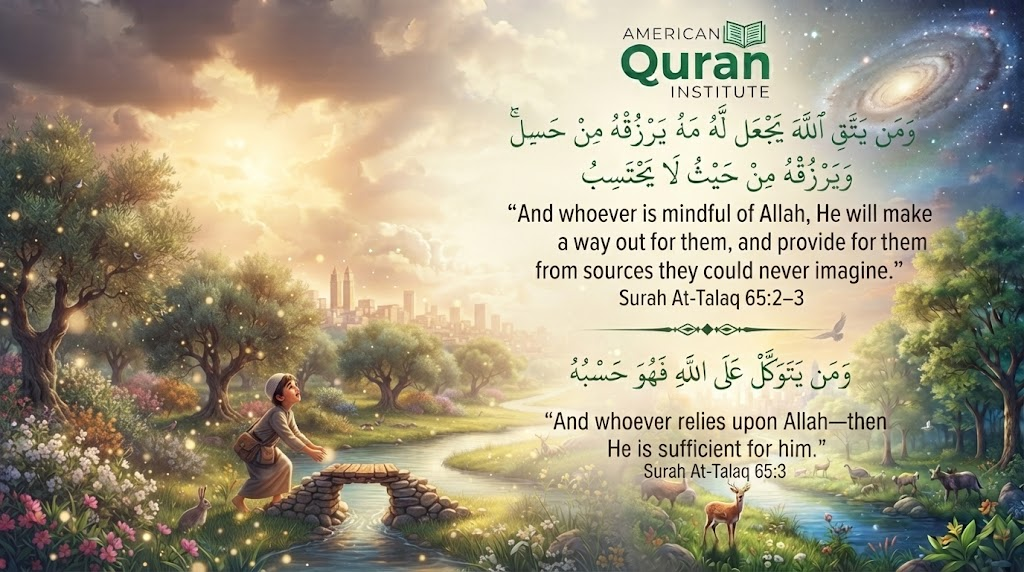
وَمَن يَتَّقِ اللَّهَ يَجْعَل لَّهُ مَخْرَجًا وَيَرْزُقْهُ مِنْ حَيْثُ لَا يَحْتَسِبُ
Wa mai yattaqil laaha yaj‘al lahoo makhrajaa. Wa yarzuqhu min haisu laa yahtasib.
“And whoever is mindful of Allah, He will make a way out for them, and provide for them from sources they could never imagine.”
Our inability to see a solution does not mean that Allah cannot provide one. Human beings see only the possibilities available to them at a particular moment, while Allah’s knowledge encompasses what they cannot see.
The same passage continues:
وَمَن يَتَوَكَّلْ عَلَى اللَّهِ فَهُوَ حَسْبُهُ
Wa mai yatawakkal ‘alal laahi fahuwa hasbuh.
“And whoever relies upon Allah—then He is sufficient for him.”
These verses connect taqwa with a way out and unexpected provision, then connect tawakkul with Allah’s sufficiency.
Tawakkul is not passive optimism. A Muslim takes responsible steps, seeks lawful solutions, and plans carefully while recognizing that the final result belongs to Allah.
10. Quran Verse About Remaining Patient Because Allah’s Promise Is True
Waiting can be one of the hardest tests of hope. Surah Ar-Rum connects patience directly with certainty in Allah’s promise.
فَاصْبِرْ إِنَّ وَعْدَ اللَّهِ حَقٌّ
Fasbir inna wa‘dal laahi haqq.
“So be patient. Indeed, the promise of Allah is truth.”
A believer may not control when circumstances change, but they can control how they respond while waiting.
Sabr is therefore not empty waiting. It is steadfastness rooted in trust that Allah’s promise is true even when the outcome has not yet appeared.
What Does the Quran Teach About Hope?
Hope in the Quran is closely connected to iman (faith), sabr (patience), tawakkul (reliance upon Allah), dua (supplication), and confidence in Allah’s mercy.
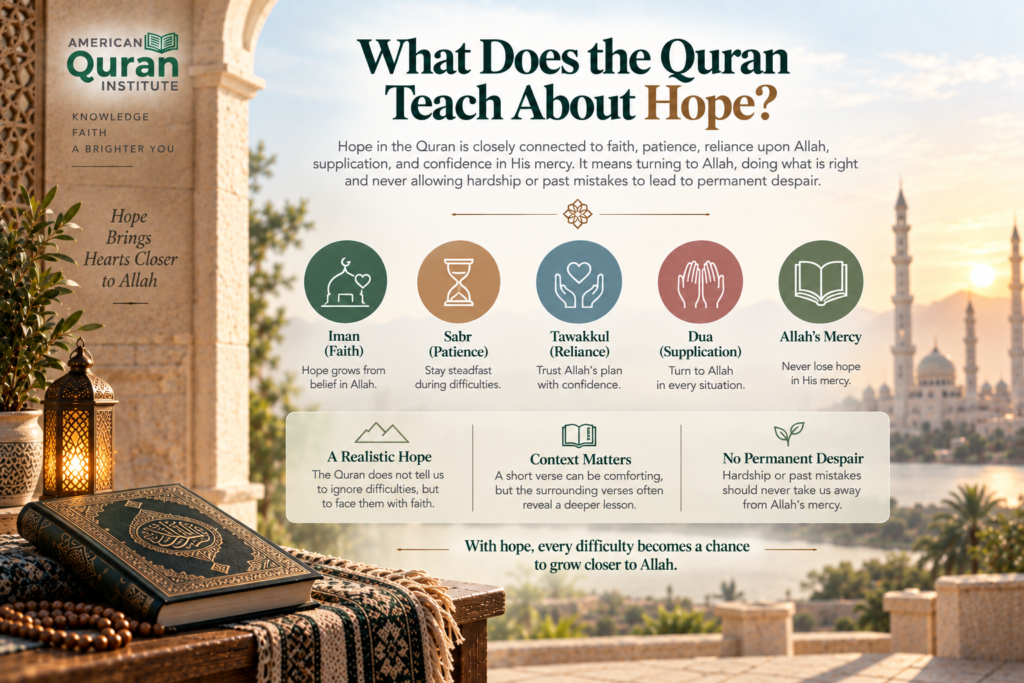
This does not mean that believers should ignore difficulties or assume every problem will disappear immediately. Quranic hope means continuing to turn toward Allah, doing what is right, and refusing to allow hardship or past mistakes to become reasons for permanent despair.
The context of each verse also matters. A short quotation may be comforting on its own, but studying the surrounding verses often reveals a deeper lesson about patience, repentance, faith, or reliance upon Allah.
Students who want to move beyond translation and understand how individual ayat connect with their Surahs can explore online Quran Tafsir classes for structured study of Quranic meanings and context.

What Do Quran Verses About Hope Teach Us?
The many Quran verses about hope in Arabic repeatedly connect hope with faith, patience, repentance, dua, and reliance upon Allah.
Hope in Allah Does Not Require Ignoring the Reality of Hardship
The Quran does not build hope by denying pain, grief, sin, uncertainty, or waiting. It acknowledges these realities while teaching believers not to allow them to become permanent despair.
True Hope Comes From Knowing Allah’s Mercy and Power
A believer hopes because Allah is Merciful, Forgiving, Near, and fully capable of changing circumstances that appear impossible from a human perspective.
- Hope Should Lead to Action Rather Than Passive Waiting: The Quran repeatedly connects hope with action. Prophet Ya‘qub told his sons to continue searching, sinners are instructed to repent, and people facing difficulty are encouraged to remain patient and continue turning toward Allah.
- Hope and Patience Work Together During Difficult Times: Hope gives a believer a reason to continue, while sabr helps them remain steadfast when relief has not yet arrived.
- Tawakkul Means Taking Responsible Action While Trusting Allah With the Result: A believer makes appropriate efforts, seeks lawful solutions, and plans responsibly while knowing that the final outcome remains with Allah.
- Hope in the Hereafter Is Greater Than Hope for Worldly Relief Alone: Not every Quranic promise means that circumstances will change exactly as we want in this life. The Quran also directs hope toward Allah’s lasting reward and the Hereafter.
How to Use Quran Verses About Hope in Daily Life?
Reading Quran verses about hope should go beyond finding temporary comfort during difficult moments. The goal is to understand these verses and turn their guidance into practical habits.
- Quran Verses About Forgiveness, Patience, and Tawakkul: Select one or two verses that closely reflect what you are experiencing. If you are struggling with regret, focus on verses about Allah’s forgiveness. If you are facing uncertainty, return to verses about tawakkul, patience, and Allah’s provision.
- Reading the Surrounding Ayat Helps You Understand Each Verse: Avoid relying only on an isolated quotation. Read the verses before and after the ayah whenever possible to understand its context, message, and connection to the surrounding passage.
- Memorizing Short Quran Verses About Hope Makes Them Easier to Recall During Difficult Moments: Memorizing shorter ayat makes it easier to recall them during moments of fear, sadness, or uncertainty. Learn the meaning alongside the Arabic and pronunciation so that you understand what you are reciting rather than memorizing the words alone.
- d. Quranic Hope Should Lead to Dua, Repentance, Patience, and Trust in Allah: Connect every verse with action. When you read about Allah answering dua, make dua. When you read about forgiveness, repent. When you read about patience, practice sabr. When you read about tawakkul, take responsible steps while entrusting the final outcome to Allah.
Students who want to develop their Quran recitation under qualified instruction can explore an online Quran Ijazah course for a structured path toward accurate recitation.

Experience Our Classroom Environment
Don’t just take our word for it—experience a live session for yourself! Click on the videos below to watch real snippets from our classes and see our interactive teaching methods in real-time.
Start Your Quranic Education
Join our premier online institute for structured Quranic learning tailored for students in the USA.
Book Your Free TrialStudying Quran Verses About Hope in Arabic Reveals Their Deeper Meaning and Context
English translations can communicate the general meaning of Quran verses about hope, but studying these ayat in Arabic and within their wider context can reveal deeper connections between concepts such as sabr, tawakkul, rahmah, tawbah, and dua.
At American Quran Institute, students can develop their Quran reading, recitation, and understanding through structured online instruction.
Learning with qualified teachers can help you move beyond isolated translations and understand how verses about hope connect with their surrounding ayat and the broader message of each Surah.
Whether you want to improve your Arabic reading, strengthen your recitation, or understand Quranic meanings more deeply, consistent study can help you build a stronger and more meaningful connection with the Quran.
Start your free trial today and begin understanding the Quran beyond translation.
Our Quran Courses
- Quran Online Academy
- Quran Recitation Classes
- Quran Reading Classes
- Quran Qirat Learning Course
- Quran Tafsir Course
- Noorani Qaida Course
- Noorani Qaida Course for Kids
- Weekend Quran Classes
- Intensive Quran Course
- Al-Azhar Quran Course

Conclusion
The Quran verses about hope in Arabic show that hardship, regret, uncertainty, and waiting should never lead a believer to permanent despair.
When life feels overwhelming, Surah Ash-Sharh reminds us that ease accompanies hardship. When past sins cause regret, Surah Az-Zumar tells us not to despair of Allah’s mercy.
When we cannot see a solution, Surah At-Talaq reminds us that Allah can create a way out from places we never expected. And when waiting becomes difficult, Surah Yusuf teaches us not to lose hope in relief from Allah.
Quranic hope is therefore not a promise that life will always unfold according to our plans. It is something deeper: confidence in Allah’s mercy, wisdom, forgiveness, provision, and power while continuing to worship Him, make sincere efforts, and remain patient.
The more we read these ayat in context, understand their meanings, and apply their guidance, the more hope becomes a lasting part of our relationship with Allah rather than simply a feeling we search for during difficult moments.
Frequently Asked Questions About Quran Verses About Hope in Arabic
What Is the Best Quran Verse About Hope?
Surah Az-Zumar 39:53 is one of the clearest verses about hope, especially for someone who regrets past sins. Allah tells those who have wronged themselves not to despair of His mercy.
Which Quran Verse Says Never Lose Hope?
Surah Yusuf 12:87 says:
وَلَا تَيْأَسُوا مِن رَّوْحِ اللَّهِ
Wa laa tai’asoo mir rawhillaah.
“Do not despair of relief from Allah.”
Surah Yusuf 12:87
What Quran Verse Gives Hope During Hard Times?
Surah Ash-Sharh 94:5–6 is one of the most comforting:
فَإِنَّ مَعَ الْعُسْرِ يُسْرًا
Fa inna ma‘al ‘usri yusraa.
“For indeed, with hardship [will be] ease.”
Surah Ash-Sharh 94:5
What Does the Quran Say About Losing Hope in Allah’s Mercy?
Surah Az-Zumar 39:53 explicitly tells people who have transgressed against themselves not to despair of Allah’s mercy and reminds them that He is the All-Forgiving, Most Merciful.
Which Quran Verse Gives Hope That Allah Will Answer Dua?
Surah Al-Baqarah 2:186 states that Allah is near and responds to the invocation of the person who calls upon Him.
What Quran Verse Gives Hope for a Better Future?
Surah At-Talaq 65:2–3 teaches that whoever has taqwa of Allah, He can make a way out and provide from unexpected sources.
What Does the Quran Say About Hope After Sin?
The Quran repeatedly connects hope after sin with sincere repentance. Surah An-Nisa 4:110, Al-Furqan 25:70, and Taha 20:82 all emphasize forgiveness for those who return to Allah and reform their actions.
Is Quranic Hope the Same as Optimism?
Not exactly. Ordinary optimism often depends on expecting circumstances to improve, while Quranic hope remains rooted in Allah even when the outcome is unknown.
How Can I Understand Quran Verses About Hope More Deeply?
Read each verse with its surrounding ayat and use reliable Tafsir to understand its context, vocabulary, and connection with broader Quranic teachings on patience, mercy, repentance, and tawakkul.







Leave a Reply