 Quran
Quran
Hardship is an unavoidable part of human life, but the Quran teaches believers that difficulty is never meaningless. Trials can test faith, develop patience, turn the heart back toward Allah, and remind us that circumstances can change even when relief seems far away.
The Quran verses about hardship in Arabic approach difficulty from several perspectives. Some verses acknowledge fear, hunger, financial struggle, loss, and personal suffering.
The Quran also teaches believers how to respond when life becomes difficult. Sabr, Salah, Dua, trust in Allah, gratitude, and sincere reliance upon Him appear repeatedly alongside verses about trials and adversity.
Below are some of the most important Quran verses about hardship in Arabic, with transliteration, English translation, direct Quran.com references, and explanations of what they teach about trials, patience, faith, and relief.
1. Quran Verses About Hardship and Allah’s Promise That Ease Accompanies Difficulty
Among the most comforting Quran verses about hardship in Arabic are two consecutive verses from Surah Ash-Sharh.
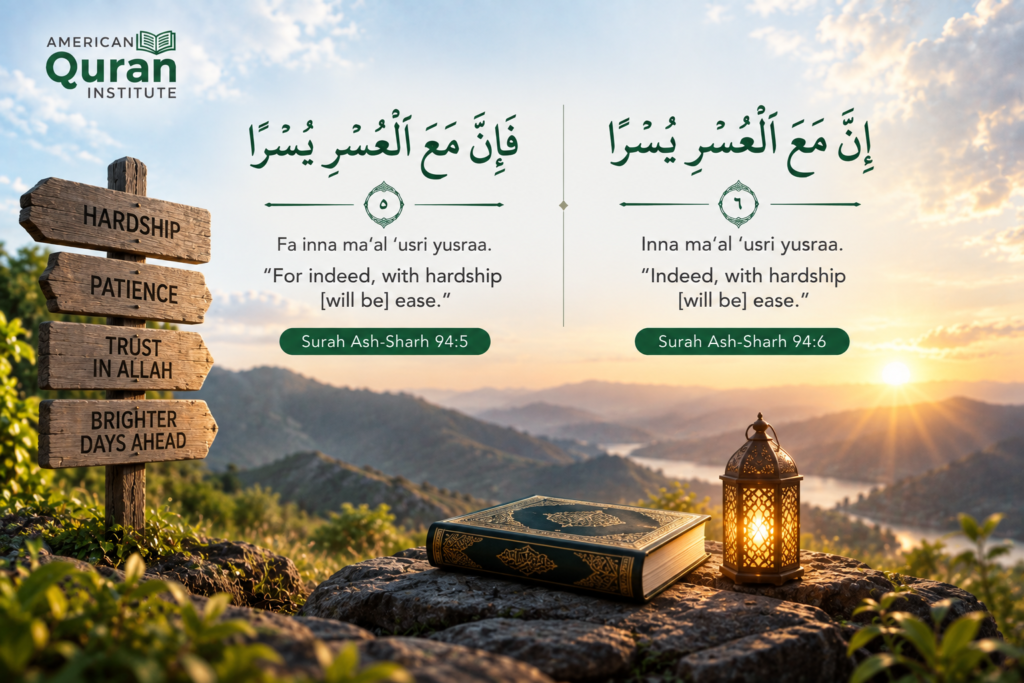
Rather than simply telling believers that difficulty eventually disappears, the verses repeatedly state that ease exists with hardship.The supplied source presents both verses with the same central promise.
فَإِنَّ مَعَ الْعُسْرِ يُسْرًا
Fa inna ma‘al ‘usri yusraa.
“For indeed, with hardship [will be] ease.”
The words الْعُسْرِ — al-‘usr and يُسْرًا — yusraa bring hardship and ease together in one short statement. The verse gives believers a reason to maintain hope even when their present circumstances remain difficult.
The promise is then immediately repeated:
إِنَّ مَعَ الْعُسْرِ يُسْرًا
Inna ma‘al ‘usri yusraa.
“Indeed, with hardship [will be] ease.”
Repeating the message strengthens its emphasis. Hardship should not convince a believer that the present difficulty is permanent or that Allah’s help is absent. These verses encourage patience, hope, and continued trust in Allah while passing through difficult circumstances.
Read also: 23 Quran Verses About Forgiveness In Arabic With English Translation
2. Quran Verse About Severe Trials Being Followed by the Nearness of Allah’s Help
The Quran does not hide how intense a trial can become. Surah Al-Baqarah describes earlier believers being touched by poverty and hardship and shaken so severely that the question arose: “When is the help of Allah?” The answer redirects the heart toward hope.
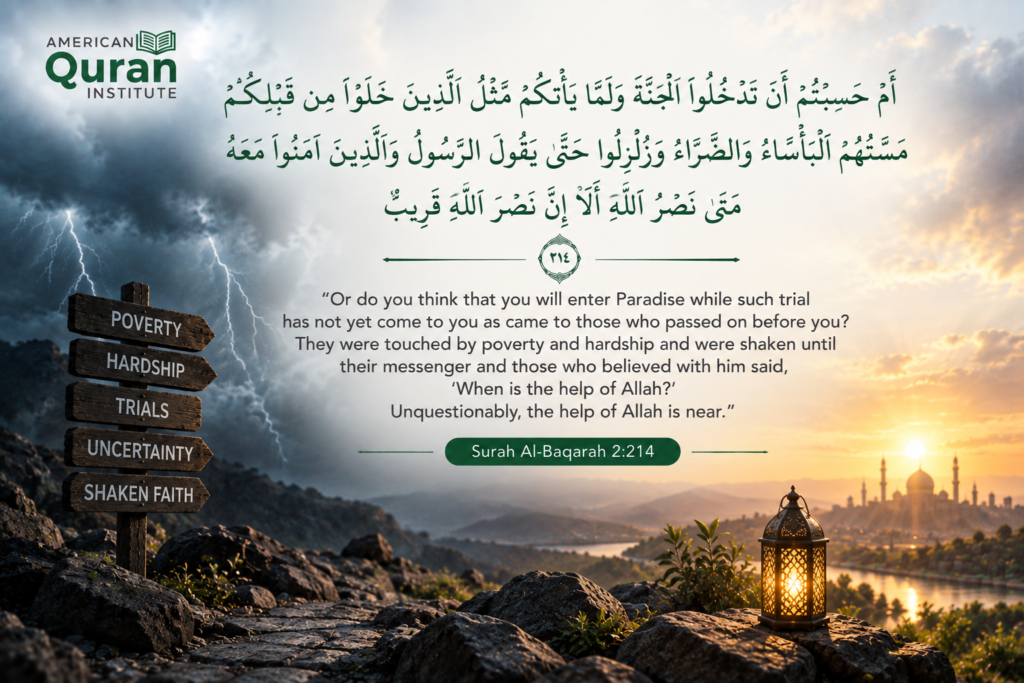
أَمْ حَسِبْتُمْ أَن تَدْخُلُوا الْجَنَّةَ وَلَمَّا يَأْتِكُم مَّثَلُ الَّذِينَ خَلَوْا مِن قَبْلِكُم ۖ مَّسَّتْهُمُ الْبَأْسَاءُ وَالضَّرَّاءُ وَزُلْزِلُوا حَتَّىٰ يَقُولَ الرَّسُولُ وَالَّذِينَ آمَنُوا مَعَهُ مَتَىٰ نَصْرُ اللَّهِ ۗ أَلَا إِنَّ نَصْرَ اللَّهِ قَرِيبٌ
Am hasibtum an tadkhulul jannata wa lammaa ya’tikum mathalul lazeena khalaw min qablikum massathumul ba’saa’u wad-darraa’u wa zulziloo hattaa yaqoolar rasoolu wallazeena aamanoo ma‘ahoo mataa nasrullaah; alaa inna nasrallaahi qareeb.
“Or do you think that you will enter Paradise while such trial has not yet come to you as came to those who passed on before you? They were touched by poverty and hardship and were shaken until their messenger and those who believed with him said, ‘When is the help of Allah?’ Unquestionably, the help of Allah is near.”
The verse acknowledges that believers can experience trials severe enough to leave them deeply shaken. Faith does not mean that difficulty will always feel easy.
Yet the verse ends by shifting attention from the intensity of the hardship to the nearness of Allah’s help: أَلَا إِنَّ نَصْرَ اللَّهِ قَرِيبٌ — “Unquestionably, the help of Allah is near.” The lesson is not to deny the pain of a trial, but to avoid allowing that pain to destroy hope in Allah.
Read also: Quran Verses About Death In Arabic – Meaning, Lessons, And Reflection
3. Quran Verses About Responding to Fear, Hunger, and Loss With Patience
Hardship can take many forms, and the Quran explicitly mentions fear, hunger, loss of wealth, loss of life, and loss of produce as forms of testing.
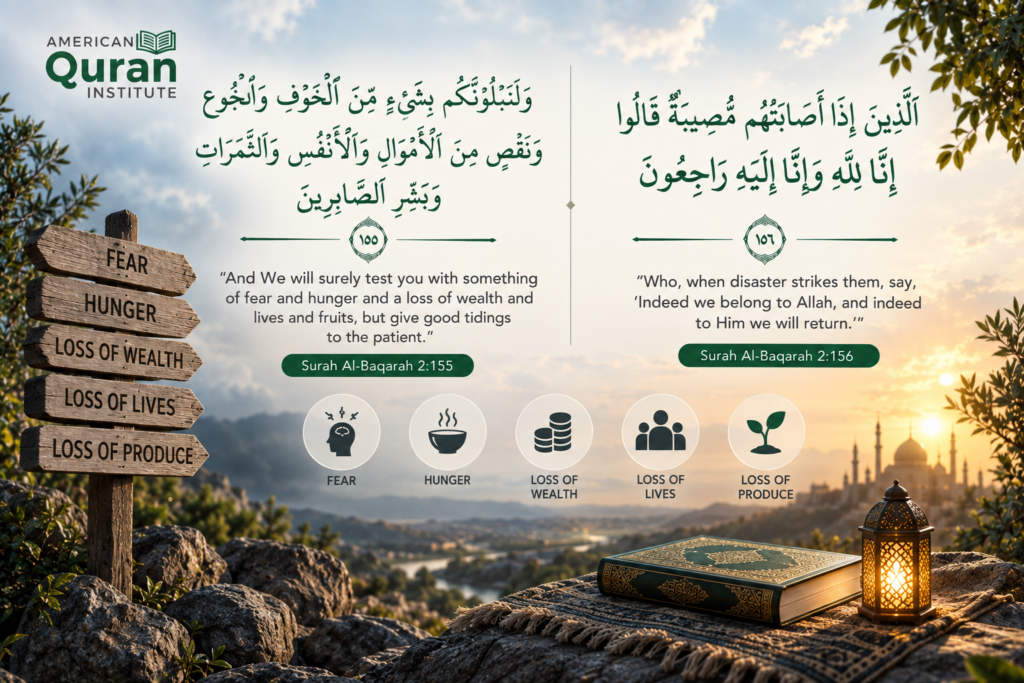
It then gives good news to those who respond with patience and awareness that they ultimately belong to Allah.
وَلَنَبْلُوَنَّكُم بِشَيْءٍ مِّنَ الْخَوْفِ وَالْجُوعِ وَنَقْصٍ مِّنَ الْأَمْوَالِ وَالْأَنفُسِ وَالثَّمَرَاتِ ۗ وَبَشِّرِ الصَّابِرِينَ
Wa lanabluwannakum bishay’im minal khawfi wal joo‘i wa naqsim minal amwaali wal anfusi wath-thamaraat; wa bashshiris saabireen.
“And We will surely test you with something of fear and hunger and a loss of wealth and lives and fruits, but give good tidings to the patient.”
The verse does not promise a life without loss. Instead, it prepares believers for the reality of testing while identifying الصَّابِرِينَ — as-sabireen, those who remain patient, as recipients of good news.
The following verse describes what they say when calamity reaches them:
الَّذِينَ إِذَا أَصَابَتْهُم مُّصِيبَةٌ قَالُوا إِنَّا لِلَّهِ وَإِنَّا إِلَيْهِ رَاجِعُونَ
Allazeena izaa asaabathum museebatun qaaloo innaa lillaahi wa innaa ilaihi raaji‘oon.
“Who, when disaster strikes them, say, ‘Indeed we belong to Allah, and indeed to Him we will return.’”
The familiar words إِنَّا لِلَّهِ وَإِنَّا إِلَيْهِ رَاجِعُونَ place hardship within a larger reality: we belong to Allah and will ultimately return to Him. They help the believer respond to loss with faith and perspective rather than viewing the hardship as the whole story.
4. Quran Verse About Allah Never Burdening a Soul Beyond Its Capacity
One of the most reassuring Quranic passages about burdens and responsibility appears at the end of Surah Al-Baqarah. The source text explicitly states that Allah does not charge a soul except within its capacity.
لَا يُكَلِّفُ اللَّهُ نَفْسًا إِلَّا وُسْعَهَا ۚ لَهَا مَا كَسَبَتْ وَعَلَيْهَا مَا اكْتَسَبَتْ ۗ رَبَّنَا لَا تُؤَاخِذْنَا إِن نَّسِينَا أَوْ أَخْطَأْنَا ۚ رَبَّنَا وَلَا تَحْمِلْ عَلَيْنَا إِصْرًا كَمَا حَمَلْتَهُ عَلَى الَّذِينَ مِن قَبْلِنَا ۚ رَبَّنَا وَلَا تُحَمِّلْنَا مَا لَا طَاقَةَ لَنَا بِهِ ۖ وَاعْفُ عَنَّا وَاغْفِرْ لَنَا وَارْحَمْنَا ۚ أَنتَ مَوْلَانَا فَانصُرْنَا عَلَى الْقَوْمِ الْكَافِرِينَ
Laa yukallifullaahu nafsan illaa wus‘ahaa; lahaa maa kasabat wa ‘alaihaa maktasabat; Rabbanaa laa tu’aakhiznaa in naseenaa aw akhta’naa; Rabbanaa wa laa tahmil ‘alainaa isran kamaa hamaltahoo ‘alal lazeena min qablinaa; Rabbanaa wa laa tuhammilnaa maa laa taaqata lanaa bih; wa‘fu ‘annaa waghfir lanaa warhamnaa; Anta mawlaanaa fansurnaa ‘alal qawmil kaafireen.
“Allah does not charge a soul except with that within its capacity. It will have the consequence of what good it has gained, and it will bear the consequence of what evil it has earned. Our Lord, do not impose blame upon us if we have forgotten or erred.
Our Lord, and lay not upon us a burden like that which You laid upon those before us. Our Lord, and burden us not with that which we have no ability to bear. And pardon us; forgive us; and have mercy upon us. You are our Protector, so give us victory over the disbelieving people.”
The opening statement is especially important: لَا يُكَلِّفُ اللَّهُ نَفْسًا إِلَّا وُسْعَهَا. In context, it speaks about Allah’s charging or obligating a soul only within its capacity. It should not be reduced to the simplistic claim that every painful experience will necessarily feel easy to endure.
The rest of the verse teaches believers to respond by turning to Allah for pardon, forgiveness, mercy, protection, and help.
4. Quran Verse About Allah Bringing Ease After Financial Hardship
Hardship can also be financial. Surah At-Talaq addresses spending according to the provision a person has actually received and closes with a direct promise of ease after hardship.
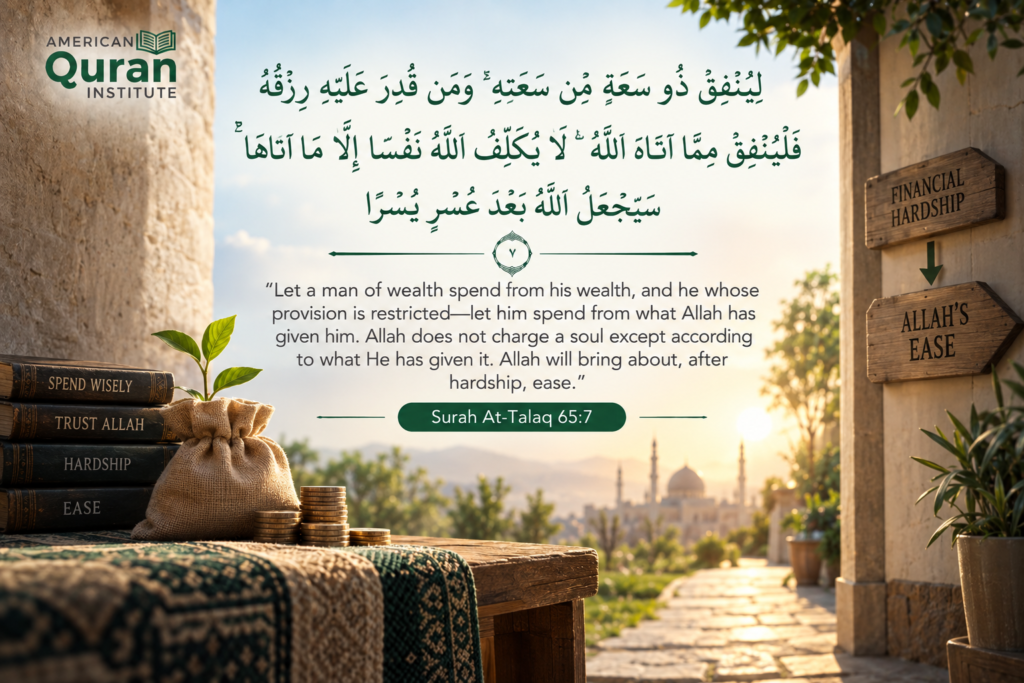
لِيُنفِقْ ذُو سَعَةٍ مِّن سَعَتِهِ ۖ وَمَن قُدِرَ عَلَيْهِ رِزْقُهُ فَلْيُنفِقْ مِمَّا آتَاهُ اللَّهُ ۚ لَا يُكَلِّفُ اللَّهُ نَفْسًا إِلَّا مَا آتَاهَا ۚ سَيَجْعَلُ اللَّهُ بَعْدَ عُسْرٍ يُسْرًا
Liyunfiq zoo sa‘atim min sa‘atih; wa man qudira ‘alaihi rizquhoo falyunfiq mimmaa aataahullaah; laa yukallifullaahu nafsan illaa maa aataahaa; sayaj‘alullaahu ba‘da ‘usrin yusraa.
“Let a man of wealth spend from his wealth, and he whose provision is restricted—let him spend from what Allah has given him. Allah does not charge a soul except according to what He has given it. Allah will bring about, after hardship, ease.”
The verse recognizes differences in financial capacity instead of demanding the same level of spending from everyone. A person whose provision is restricted is responsible according to what Allah has given them.
Its ending, سَيَجْعَلُ اللَّهُ بَعْدَ عُسْرٍ يُسْرًا — “Allah will bring about, after hardship, ease,” gives hope to those facing restricted provision without dismissing the reality of their present difficulty.
5. Quran Verse About a Mother Enduring Hardship During Pregnancy and Childbirth
Not every Quranic reference to hardship describes a spiritual crisis or punishment. Surah Al-Ahqaf uses the language of hardship when describing the physical difficulty a mother experiences in carrying and giving birth to her child.
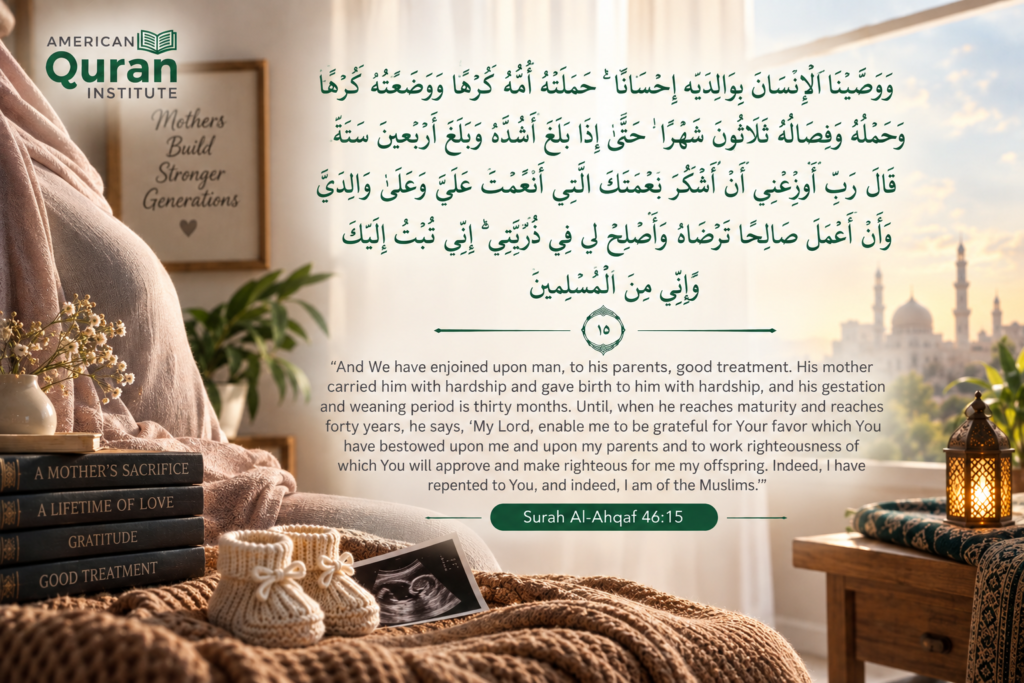
The supplied source explicitly describes both pregnancy and childbirth with كُرْهًا — kurhan, hardship.
وَوَصَّيْنَا الْإِنسَانَ بِوَالِدَيْهِ إِحْسَانًا ۖ حَمَلَتْهُ أُمُّهُ كُرْهًا وَوَضَعَتْهُ كُرْهًا ۖ وَحَمْلُهُ وَفِصَالُهُ ثَلَاثُونَ شَهْرًا ۚ حَتَّىٰ إِذَا بَلَغَ أَشُدَّهُ وَبَلَغَ أَرْبَعِينَ سَنَةً قَالَ رَبِّ أَوْزِعْنِي أَنْ أَشْكُرَ نِعْمَتَكَ الَّتِي أَنْعَمْتَ عَلَيَّ وَعَلَىٰ وَالِدَيَّ وَأَنْ أَعْمَلَ صَالِحًا تَرْضَاهُ وَأَصْلِحْ لِي فِي ذُرِّيَّتِي ۖ إِنِّي تُبْتُ إِلَيْكَ وَإِنِّي مِنَ الْمُسْلِمِينَ
Wa wassainal insaana biwaalidaihi ihsaanaa; hamalat-hu ummuhoo kurhan wa wada‘at-hu kurhaa; wa hamluhoo wa fisaaluhoo thalaathoona shahraa; hattaaa izaa balagha ashuddahoo wa balagha arba‘eena sanatan qaala Rabbi awzi‘nee an ashkura ni‘matakal latee an‘amta ‘alaiya wa ‘alaa waalidaiya wa an a‘mala saalihan tardaahu wa aslih lee fee zurriyyatee; innee tubtu ilaika wa innee minal muslimeen.
“And We have enjoined upon man, to his parents, good treatment. His mother carried him with hardship and gave birth to him with hardship, and his gestation and weaning period is thirty months. Until, when he reaches maturity and reaches forty years, he says, ‘My Lord, enable me to be grateful for Your favor which You have bestowed upon me and upon my parents and to work righteousness of which You will approve and make righteous for me my offspring. Indeed, I have repented to You, and indeed, I am of the Muslims.’”
Here, hardship becomes part of the Quran’s explanation of why parents—and especially mothers—deserve gratitude and good treatment. The verse moves from remembering a mother’s sacrifice to a mature believer asking Allah for gratitude, righteous deeds, and righteousness within the next generation.
This makes the passage especially valuable when teaching children about gratitude toward parents. Families who want young learners to develop Quran reading alongside age-appropriate understanding of Quranic values can explore Quran Classes for Kids.
Quran Verse About Human Life Naturally Involving Struggle and Hardship
The Quran gives a remarkably concise description of the human condition in Surah Al-Balad:
لَقَدْ خَلَقْنَا الْإِنسَانَ فِي كَبَدٍ
Laqad khalaqnal insaana fee kabad.
“We have certainly created man into hardship.”
The word كَبَد — kabad carries the sense of toil, struggle, and difficulty. The verse challenges the expectation that a normal human life should be entirely free from hardship.
Recognizing that struggle is part of worldly existence can change the way believers view difficult periods.
A hardship does not automatically mean that life has gone wrong or that Allah has abandoned someone. The Quran places struggle within the reality of human life itself. The supplied source likewise identifies this verse directly with human hardship.
6. Quran Verse About Trials Revealing the Sincerity of Faith
Hardship can reveal whether faith remains firm when it is tested. Surah Al-‘Ankabut makes clear that simply claiming belief does not mean a person will be left without trials.
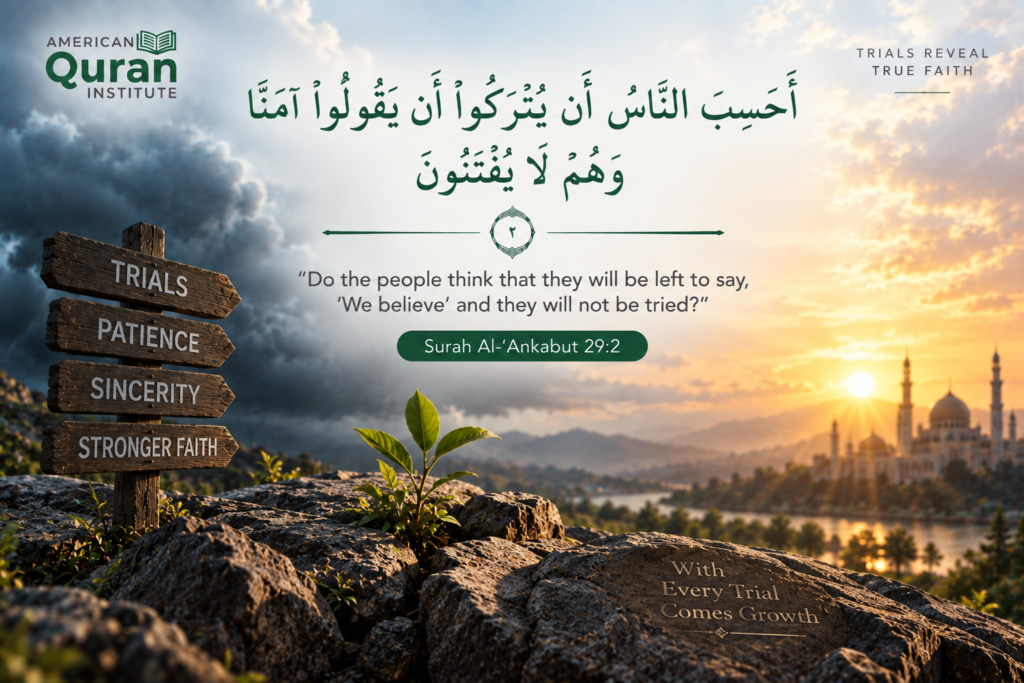
أَحَسِبَ النَّاسُ أَن يُتْرَكُوا أَن يَقُولُوا آمَنَّا وَهُمْ لَا يُفْتَنُونَ
Ahasiban naasu an yutrakoo an yaqooloo aamannaa wa hum laa yuftanoon.
“Do the people think that they will be left to say, ‘We believe’ and they will not be tried?”
The verse establishes that experiencing trials is compatible with sincere faith. Belief does not guarantee a life without difficulty.
Trials can reveal what words alone cannot: whether a person continues trusting and obeying Allah when faith requires patience, sacrifice, and perseverance.
See Us in Action!
Take a look inside our virtual classrooms. Watch the clip below to see how our instructors engage with students, simplify complex rules, and create an inspiring environment for learning.
7. Quran Verse About Allah Knowing What May Be Good for Us When We Do Not
Some difficult experiences are painful partly because we cannot see their full outcome. In its specific context of fighting being prescribed, Surah Al-Baqarah establishes a broader reminder about the limits of human judgment: a person may dislike something that contains good or love something that contains harm.
كُتِبَ عَلَيْكُمُ الْقِتَالُ وَهُوَ كُرْهٌ لَّكُمْ ۖ وَعَسَىٰ أَن تَكْرَهُوا شَيْئًا وَهُوَ خَيْرٌ لَّكُمْ ۖ وَعَسَىٰ أَن تُحِبُّوا شَيْئًا وَهُوَ شَرٌّ لَّكُمْ ۗ وَاللَّهُ يَعْلَمُ وَأَنتُمْ لَا تَعْلَمُونَ
Kutiba ‘alaikumul qitaalu wa huwa kurhun lakum; wa ‘asaa an takrahoo shai’an wa huwa khairun lakum; wa ‘asaa an tuhibboo shai’an wa huwa sharrun lakum; wallaahu ya‘lamu wa antum laa ta‘lamoon.
“Fighting has been enjoined upon you while it is hateful to you. But perhaps you hate a thing and it is good for you; and perhaps you love a thing and it is bad for you. And Allah knows, while you know not.”
The immediate context of this verse should not be ignored: it concerns fighting being prescribed. However, its closing principle reminds believers of a fundamental limitation in human perspective. We judge circumstances from what we can currently see, while Allah’s knowledge includes what we cannot see.
This can encourage humility during hardship. A believer does not need to pretend that something painful feels good, but can recognize that their present understanding is not the same as Allah’s complete knowledge.
8. Quran Verses About Hardship Turning the Heart Back Toward Allah
Several Quranic passages describe people calling sincerely upon Allah when adversity strips away their sense of independence.
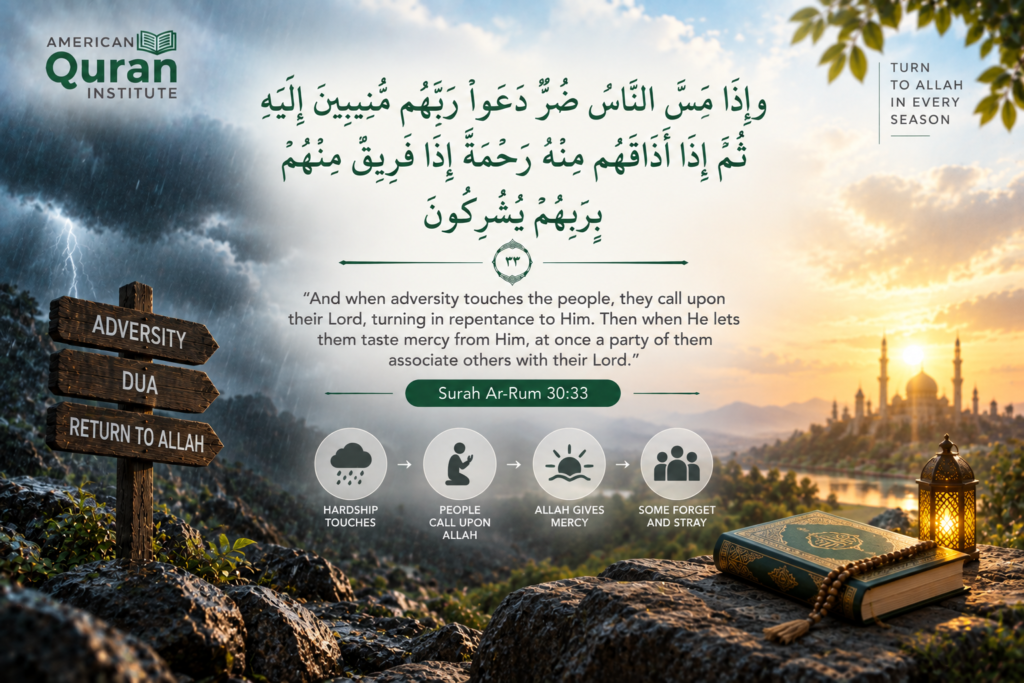
One source on hardship highlights this recurring Quranic pattern: people may turn intensely to Allah during distress, yet some forget that dependence after relief arrives.
Surah Ar-Rum states:
وَإِذَا مَسَّ النَّاسَ ضُرٌّ دَعَوْا رَبَّهُم مُّنِيبِينَ إِلَيْهِ ثُمَّ إِذَا أَذَاقَهُم مِّنْهُ رَحْمَةً إِذَا فَرِيقٌ مِّنْهُم بِرَبِّهِمْ يُشْرِكُونَ
Wa izaa massan naasa durrun da‘aw Rabbahum muneebeena ilaihi thumma izaaa azaaqahum minhu rahmatan izaa fareequm minhum bi Rabbihim yushrikoon.
“And when adversity touches the people, they call upon their Lord, turning in repentance to Him. Then when He lets them taste mercy from Him, at once a party of them associate others with their Lord.”
Hardship can make human dependence upon Allah impossible to ignore. Yet the verse also warns against making devotion temporary—turning to Allah only while desperately needing relief and then forgetting Him when circumstances improve.
The source material similarly emphasizes continuing gratitude and devotion after adversity has passed.
What Does the Quran Say About Hardship?
The Quran presents hardship as part of the test of worldly life rather than as proof that Allah has abandoned a person. Believers may experience fear, hunger, loss, financial difficulty, uncertainty, and other forms of adversity, and the Quran openly acknowledges these experiences.

At the same time, hardship is repeatedly connected with patience, prayer, reliance upon Allah, and hope.
The Quran teaches that a believer’s response to difficulty matters: trials can become occasions for turning sincerely toward Allah, recognizing our dependence upon Him, and continuing to obey Him even when circumstances are difficult.
Importantly, the Quran does not teach that every hardship should be interpreted in exactly the same way. Some passages speak about tests of faith, others describe consequences or warnings, while others establish ease within Islamic obligations or promise relief after difficulty. Understanding the context of each verse is therefore essential.
Students who want to go beyond the translation and understand the context and lessons behind these passages can explore Quran Tafsir Classes for guided study of Quranic meanings and interpretation.

What Do Quran Verses About Hardship Teach Us?
The Quran verses about hardship in Arabic do not give a single explanation for every difficult experience. Instead, they provide several principles that help believers understand trials and respond to them faithfully.
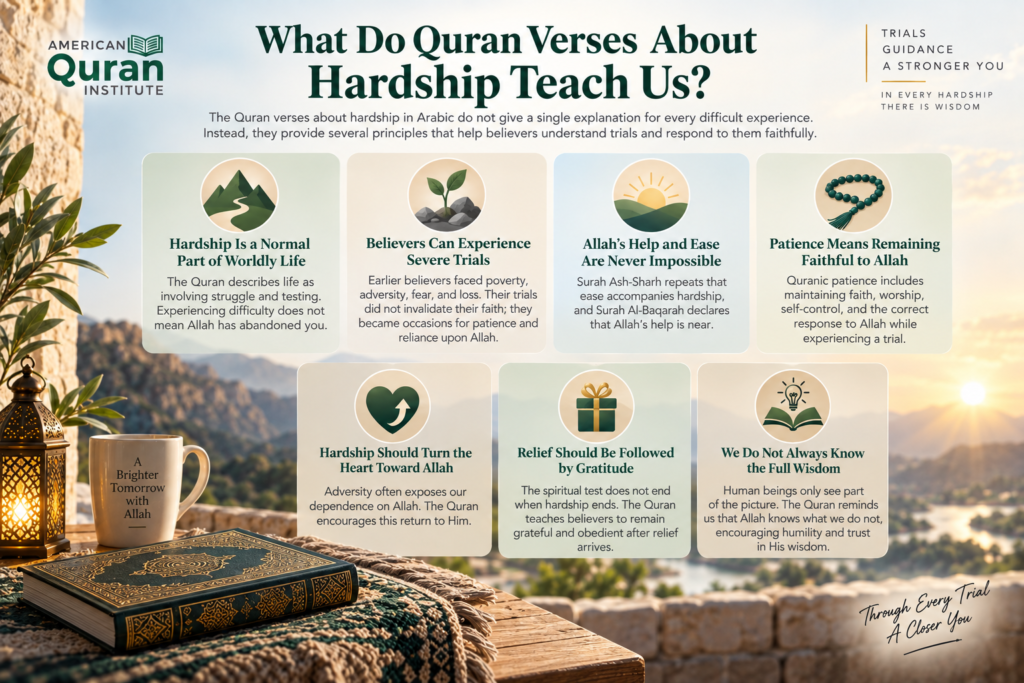
Hardship Is a Normal Part of Worldly Life Rather Than Proof of Allah’s Abandonment
The Quran openly describes human life as involving struggle and tells believers that they will face different forms of testing. Experiencing difficulty does not by itself mean that Allah has abandoned a person.
Believers Can Experience Severe Trials While Still Holding Firmly to Faith
Earlier believers experienced poverty, adversity, fear, loss, and moments in which they were deeply shaken. Their trials did not invalidate their faith; they became occasions for patience and continued reliance upon Allah.
Allah’s Help and Ease Should Never Be Considered Impossible During Hardship
Surah Ash-Sharh repeats that ease accompanies hardship, while Surah Al-Baqarah declares that Allah’s help is near. A believer can acknowledge present pain without surrendering hope for what Allah may bring next.
Patience Means Remaining Faithful to Allah While Passing Through Difficulty
Quranic patience is more than simply waiting for circumstances to improve. It includes maintaining faith, worship, self-control, and the correct response to Allah while experiencing a trial.
Hardship Should Turn the Heart Toward Allah Rather Than Away From Him
Adversity often exposes how dependent human beings are upon their Creator. The Quran encourages this return to Allah but warns against forgetting Him as soon as relief arrives.
Relief Should Be Followed by Gratitude Rather Than Forgetfulness
The spiritual test does not necessarily end when the hardship ends. The Quran also examines how people behave after relief, teaching believers to remain grateful and obedient when circumstances improve.
We Do Not Always Know the Full Wisdom Behind What We Experience
Human beings naturally judge events according to what they can see in the present. The Quran reminds believers that Allah knows what they do not, encouraging humility and trust when the full outcome of a difficult experience remains hidden.
How Can Muslims Apply Quran Verses About Hardship in Daily Life?
Reading these verses is most beneficial when their guidance affects how we respond to real difficulties.
A believer facing hardship can return regularly to Salah and Dua, practice patience without abandoning practical effort, and remember that present circumstances do not determine what Allah may bring next.
Verses about hardship can also be memorized and revisited during periods of anxiety, loss, financial pressure, family difficulty, or uncertainty.
It is equally important to study verses in context. A verse addressing religious obligations, financial hardship, motherhood, or the trials of earlier believers should not be treated as though every passage is making exactly the same point.
For learners whose weekday schedules make consistent Quran study difficult, Weekend Quran Classes can provide a more manageable way to maintain regular Quran learning while balancing work, school, or family responsibilities.

Experience Our Classroom Environment
Don’t just take our word for it—experience a live session for yourself! Click on the videos below to watch real snippets from our classes and see our interactive teaching methods in real-time.
Start Your Quranic Education
Join our premier online institute for structured Quranic learning tailored for students in the USA.
Book Your Free TrialLearning Quran Verses About Hardship in Arabic Deepens Their Meaning
English translations make the general message accessible, but reading these verses in Arabic helps learners recognize recurring Quranic vocabulary connected with difficulty and relief.
Words such as عُسْر — ‘usr (hardship or difficulty), يُسْر — yusr (ease), ضَرَّاء — darraa’ (adversity), مُصِيبَة — museebah (calamity), صَبْر — sabr (patience), and كَبَد — kabad (toil or struggle) appear within different Quranic contexts.
Recognizing these words can help students see connections between verses while also noticing important differences in how the Quran discusses tests, adversity, responsibility, and relief.
At American Quran Institute, students can develop the Arabic reading, recitation, and Quran study skills needed to engage with passages like these more confidently. Structured learning can help move beyond isolated translations toward more accurate reading and a clearer understanding of each verse in context.
Start your free trial today and experience structured Quran learning with American Quran Institute.
Our Quran Courses
- Quran Online Academy
- Quran Recitation Classes
- Quran Reading Classes
- Online Quran Classes for Kids
- Quran Classes for Adults
- Quran Classes for Female/Sisters

Conclusion
The Quran verses about hardship in Arabic acknowledge that life can include fear, loss, restricted provision, physical struggle, and severe tests of faith.
The Quran does not ask believers to pretend that these experiences are painless. Instead, it teaches them how to pass through difficulty without losing their relationship with Allah.
Some verses call believers to patience, some remind them that Allah knows what they do not, and others promise that ease accompanies or follows hardship. The Quran also warns against remembering Allah only during adversity and forgetting Him when relief arrives.
The central lesson is therefore not that believers will never experience hardship. It is that hardship does not have to separate them from faith or hope.
Through patience, prayer, gratitude, sincere reliance upon Allah, and continued righteous action, difficult periods can become moments of deeper awareness of Allah and preparation for the Hereafter.
Frequently Asked Questions
What Is the Most Famous Quran Verse About Hardship?
Surah Ash-Sharh 94:5 is among the best-known: “For indeed, with hardship [will be] ease.” The message is repeated in the following verse.
What Does the Quran Say About Hardship and Ease?
The Quran teaches that hardship and ease are not permanent opposites. Surah Ash-Sharh 94:5–6 repeatedly states that ease accompanies hardship.
Does the Quran Say Allah Will Not Burden a Soul Beyond Its Capacity?
Surah Al-Baqarah 2:286 states that Allah does not charge a soul except within its capacity.
Which Quran Verse Says Allah’s Help Is Near?
Surah Al-Baqarah 2:214 ends with the assurance: “Unquestionably, the help of Allah is near.”
What Does the Quran Say About Patience During Hardship?
Surah Al-Baqarah 2:155 gives good news to those who remain patient when facing fear, hunger, loss, and other tests.
Is Hardship Always a Punishment From Allah?
No. The Quran presents hardship in different contexts, including tests, warnings, ordinary human struggle, and specific life difficulties. Each verse should be understood in context.
What Should Muslims Say When a Calamity Happens?
Surah Al-Baqarah 2:156 teaches: إِنَّا لِلَّهِ وَإِنَّا إِلَيْهِ رَاجِعُونَ — “Indeed we belong to Allah, and indeed to Him we will return.”
Does the Quran Promise Ease After Hardship?
Yes. Surah At-Talaq 65:7 says that Allah will bring ease after hardship, while Surah Ash-Sharh 94:5–6 says that with hardship comes ease.
Why Does Allah Test Believers With Hardship?
The Quran shows that trials can test the sincerity and perseverance of faith. Surah Al-‘Ankabut 29:2 makes clear that claiming belief does not mean a person will never be tested.
How Can Quran Verses About Hardship Help During Difficult Times?
They remind believers to maintain patience, turn to Allah, continue worship, avoid despair, and remember that present circumstances are not the whole story.






Leave a Reply