 Quran
Quran
Can adults learn to read Quran in the USA after years of putting it off? That question hits home for a lot of American Muslims.
Many carry a quiet sense of guilt, a feeling that properly learning to read should have happened in childhood and that the window has somehow closed for good.
It hasn’t. Adults across the United States, in New York, Houston, Chicago, and Los Angeles, are beginning Quran study in their 30s, 40s, and 60s and making genuine, lasting progress.
The honest answer is a firm yes, and the practical path has never been clearer or more accessible than it is right now.
This guide breaks down exactly how adult Quran learning works in the USA not in abstract terms, but in the specific steps, timelines, and decisions that separate meaningful progress from frustrating stagnation.
What You Will Learn In This Article:
- Why age is not the barrier most American adults assume it is.
- The three types of adult Quran learners in America and which path fits you.
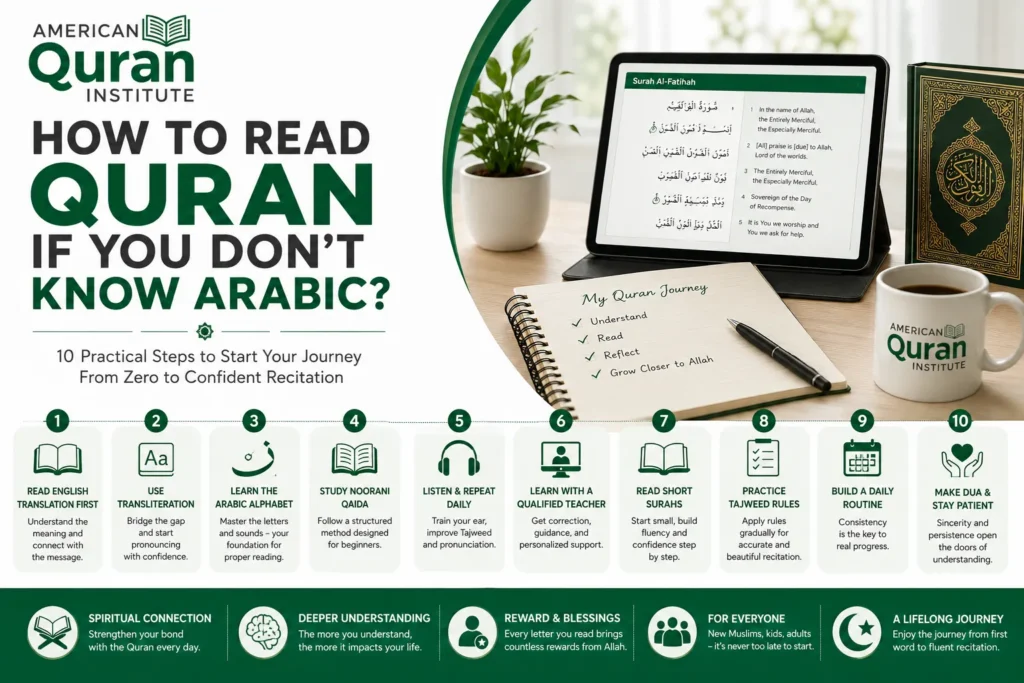
- A step-by-step roadmap from the Arabic alphabet to confident recitation.
- The most common mistakes that slow American adults down and how to avoid them.
- A realistic 12-month milestone map so you know exactly what to expect.
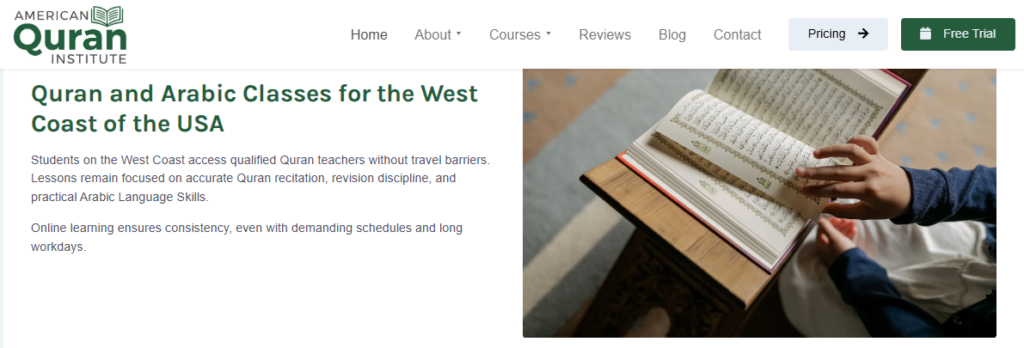
Can Adults Learn To Read Quran In The USA? The Answer Is Yes, The Odds Are In Your Favor
Yes. Adults can learn to read the Quran successfully at any age. You do not need previous Arabic knowledge or childhood Quran lessons to begin.
For adults in the USA, online Quran classes make learning more accessible through live instruction, English-language support, and schedules that can fit around work and family responsibilities.
A structured path typically begins with Arabic letters and pronunciation before progressing to connected words, Quranic verses, and Tajweed.
The key is not your age, but starting at the right level, practising consistently, and receiving correction when needed. Learning to read Quran for adults can therefore be approached as a gradual skill-building process rather than something you needed to master as a child.
Read also: Common Mistakes When Reading The Quran And How To Fix Them
Begin Quran Study With Instruction Built for Adult Learners

The Biggest Hurdle Is Finding The Right Teacher Not Age
The single most important variable in adult Quran learning is not how old you are, it is the quality and fit of your teacher.
A certified instructor who understands how English speakers process Arabic phonemes will get you reading within weeks.
Ijazah certification is the credential that matters. An Ijazah means the teacher’s recitation has been verified through a chain of transmission going back to the Prophet, peace be upon him, with no break in the line.
For an adult learner in the USA, that means every pronunciation correction you receive is grounded in 1,400 years of oral precision, not a best estimate from a digital tutorial.
Beyond certification, the most effective teachers for American adults instruct in English, have direct experience with English-speaking beginners specifically.
They know how to address the phonemic challenges that native English speakers face with Arabic sounds.
What “Learning To Read” Means For English-Speaking Adults?
Reading the Quran correctly is a specific, learnable skill — and it is distinct from speaking or understanding Arabic as a language.
At the foundational level, your goal is to decode the Arabic script: recognize letters, apply vowel marks (harakat), and follow the Tajweed rules that make your recitation valid.
Arabic has 28 letters and a fully consistent phonetic system. The Quran uses a complete diacritical notation, meaning every vowel sound is explicitly marked, nothing is left ambiguous or open to guessing.
Most adult beginners with no prior Arabic exposure reach functional reading ability within three to six months of consistent weekly sessions with a qualified teacher.
Understanding the meaning is a separate and deeply rewarding layer of study, and many American adults pursue both simultaneously. But comprehension is not a prerequisite for recitation, your first goal is simply to read correctly.
Read also: How To Concentrate While Reading Quran?
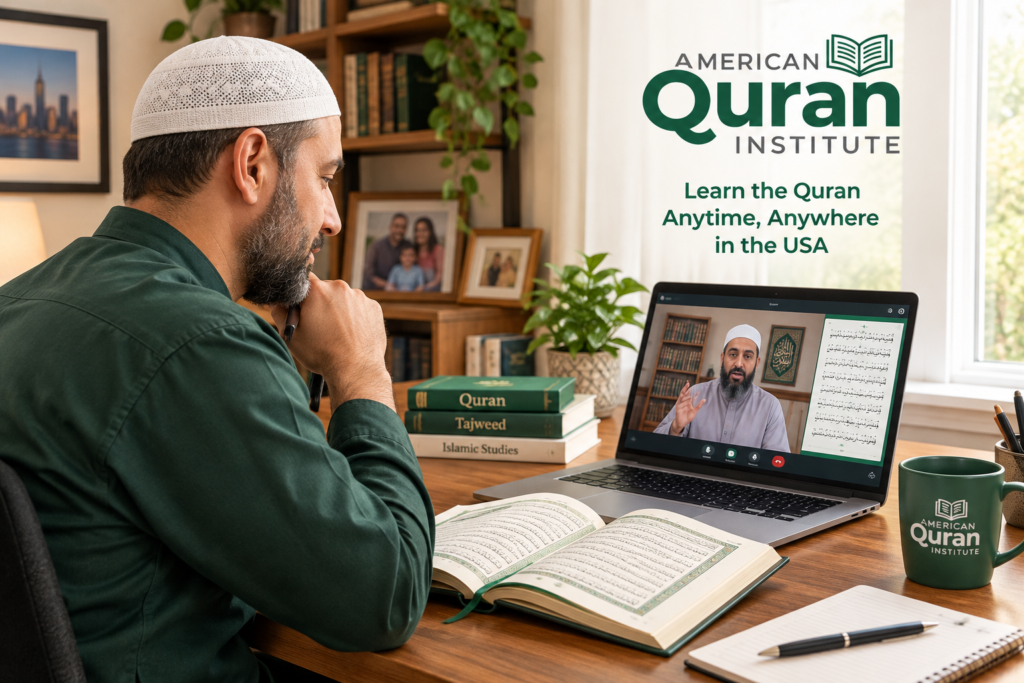
The Three Types Of Adult Quran Learners In America
Not every adult learner in the USA walks the same road, and a single one-size-fits-all method fails most of them.
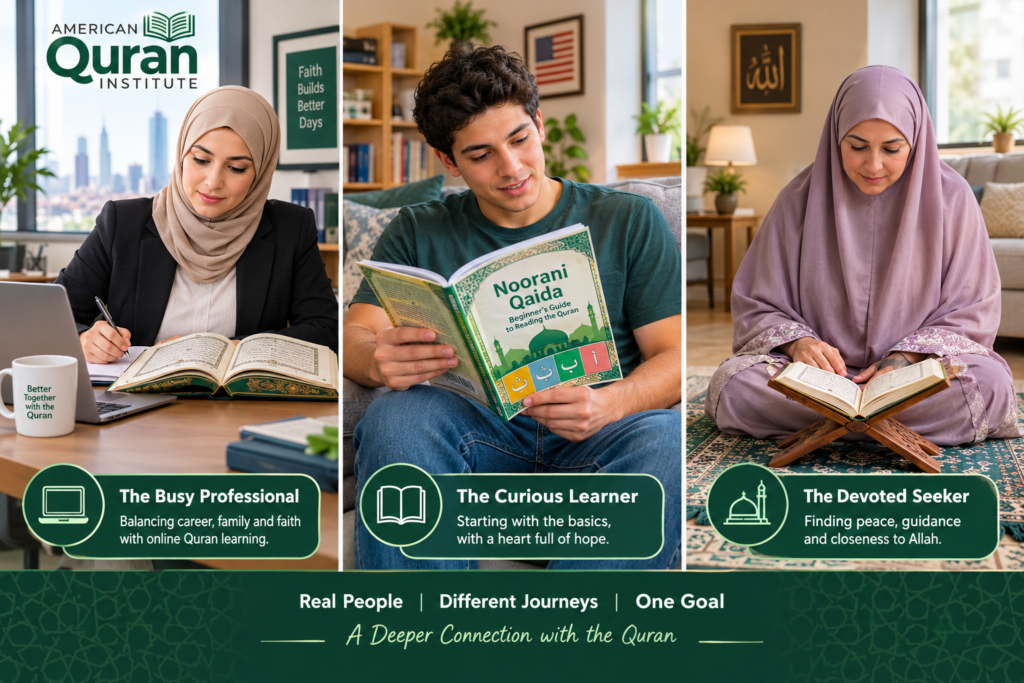
American adults come to study the Quran from different starting points, different time constraints, and different motivations and the most effective path depends on which type of learner you are.
Understanding your learner profile saves months of trial and error. It tells you which format to choose, what pace to expect, and what obstacles to plan around before they derail progress and become reasons to quit.
Read also: How To Get Better At Reading Quran In The USA?
1. The Busy Professional Where Thirty Minutes A Day Can Get You There
If you work full-time, have children, and still want to read the Quran properly, you are the majority of adult Quran students in America.
The good news is that thirty minutes of structured daily practice, two fifteen-minute sessions or one focused half-hour, is genuinely enough to build visible momentum when organized correctly.
Consistency beats volume at this stage. Short daily sessions outperform long sessions held twice a week for adult learners, because the brain needs frequent exposure to a new script to build recognition speed and retention.
A typical practice block might cover letter review, one new Tajweed rule, and fifteen minutes of reading a surah already partially known — that rhythm works.
For this learner type, how to learn the Quran in the USA with a flexible online schedule is almost always the most sustainable model, allowing weekly sessions to fit around commutes, school runs, and unpredictable professional calendars.
Explore The American Quran Institute’s Learn Quran for Beginners Course in the USA

2. The New Muslim Who Building The Foundation From The Ground Floor
A new Muslim learning to read the Quran faces a unique dual challenge: beginning a spiritual practice and a language skill at exactly the same time.
The Arabic alphabet is not a variation on a familiar writing system, it is an entirely different script, read right to left, with letters that change shape depending on their position in a word.
The most effective approach for new Muslims in the USA starts with structured, one-on-one instruction using a foundational program like the Noorani Qaida.
This method teaches letters individually, then in combination, then with vowel sounds, before introducing actual Quranic text.
Most new Muslim learners reach the point of reading directly from the Quran, slowly, with teacher guidance, within three to four months.
How to read Quran as a non-Muslim offers a practical framework that applies equally well to those who have recently accepted Islam and are building their recitation foundation from day one.
Begin Your Arabic Reading Journey with Noorani Qaida in the USA

3. The Practicing Muslim Who Never Formally Learned To Read
Many American Muslims grew up in households where the Quran was heard at prayer, recited on special occasions, and deeply revered — but never formally taught as a reading skill.
This learner often knows several surahs by sound, having absorbed them aurally over years of prayer, but cannot connect those familiar sounds to the written Arabic script.
Aural familiarity with the Quranic text provides a powerful learning scaffold: once the written script is decoded, words that were previously just sounds suddenly become recognizable letters and patterns.
A focused ten-to-twelve-week program can move this type of learner from zero reading ability to reciting Surah Al-Fatiha from the page with proper Tajweed — a milestone that often feels transformative.
How Online Classes Put A Certified Teacher In Every American Home?
A decade ago, adult Quran education in the USA was largely limited to whatever the local masjid offered, typically a group session at a fixed weekly time, with limited ability to accommodate individual pace or adult schedules.
Quality varied significantly across communities, and timing rarely aligned with American work and family rhythms. Online Quran education changed that equation permanently.
A certified teacher in Cairo or Islamabad can now hold a live, one-on-one session with a student in Boston or Dallas at any hour, via Zoom or a dedicated learning platform, with scheduling built entirely around the student’s calendar.
The teacher corrects pronunciation in real time, adjusts pace to the individual, and tracks progress session by session with no commute required on either end.
For American adults, this means the most qualified Quran teachers in the world are now as reachable as a smartphone and a reliable internet connection.
Start Your Quranic Education with Female Instructors Today at American Quran Institute
See Us in Action!
Take a look inside our virtual classrooms. Watch the clip below to see how our instructors engage with students, simplify complex rules, and create an inspiring environment for learning.
Start Your Quranic Education
Join our premier online institute for structured Quranic learning tailored for students in the USA.
Book Your Free Trial
1. What To Look For In A Quran Teacher As An Adult Learner?
The word “qualified” has a specific meaning in Quran education, and knowing what to look for before committing to any teacher or platform is worth the time.
The non-negotiable credential is Ijazah, a certification that verifies the teacher’s recitation meets the standards of a recognized chain of transmission. A teacher with Ijazah in recitation has not simply learned to read well.
Adult pronunciation correction is a different skill than teaching a child to read; a teacher experienced with both knows how to address the challenges, the letter ع (ain), the غ (ghain), the heavy ح (ha), that English phonemics never prepared the student for.
A free trial session is standard among reputable online Quran platforms. Take it every time.
Use it specifically to assess how the teacher corrects pronunciation errors — the best teachers do it immediately, specifically, and in a way that builds confidence rather than eroding it.
2. A Program Built Around The American Muslim’s Schedule
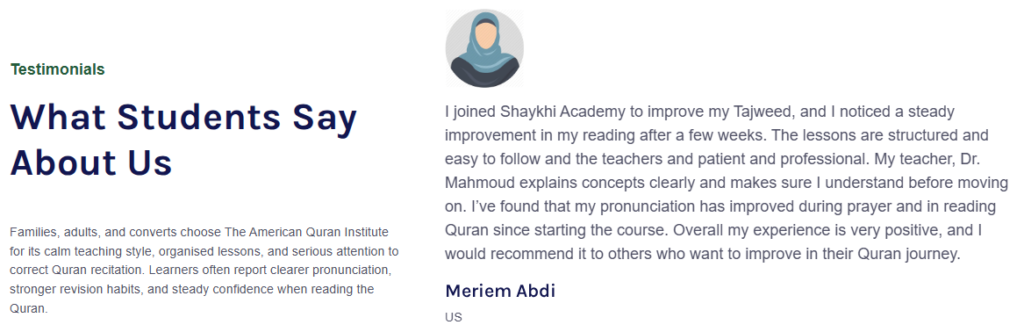
American Quran Institute, based in the USA, connects American Muslims with Ijazah-certified teachers who specialize in guiding English speakers from the Arabic alphabet through fluent recitation.
All classes are live and online, scheduled around US time zones so there’s no need to compromise your work, school, or family commitments.
The institute serves learners at every level from complete beginners who have never seen an Arabic letter to advanced students refining their Tajweed before completing a memorization goal.
For families learning together, learn to read Quran online for kids runs as a parallel track through the same platform, allowing parents and children to progress simultaneously and build a shared learning culture at home.
Many American parents find that enrolling alongside their children creates a natural accountability structure and learn Quran for kids in the USA means the whole household is working toward the same goal at the same time.
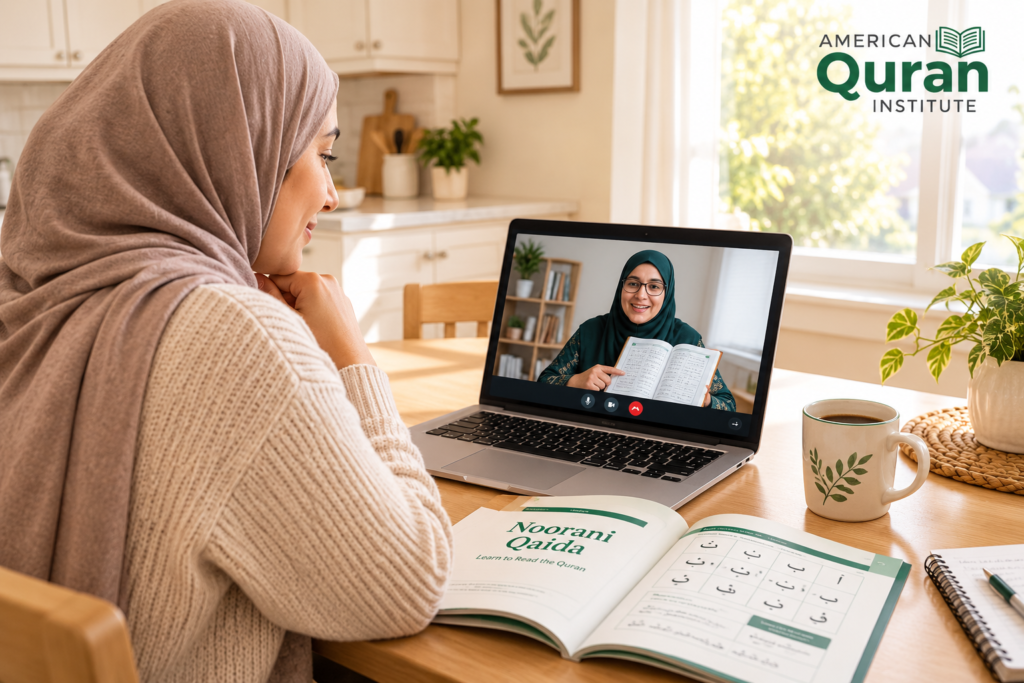
Your Roadmap From The First Letter To Fluent Recitation
The path to reading the Quran as an adult is structured, sequential, and predictable, each skill builds directly on the previous one, and every stage has a measurable outcome you can track.
Adults who understand the map in advance move faster, set better expectations, and are far less likely to quit at the first plateau.
The stages below represent the standard learning arc for an English-speaking adult in the USA starting from zero. Timelines assume weekly one-on-one instruction combined with fifteen to thirty minutes of daily independent practice.
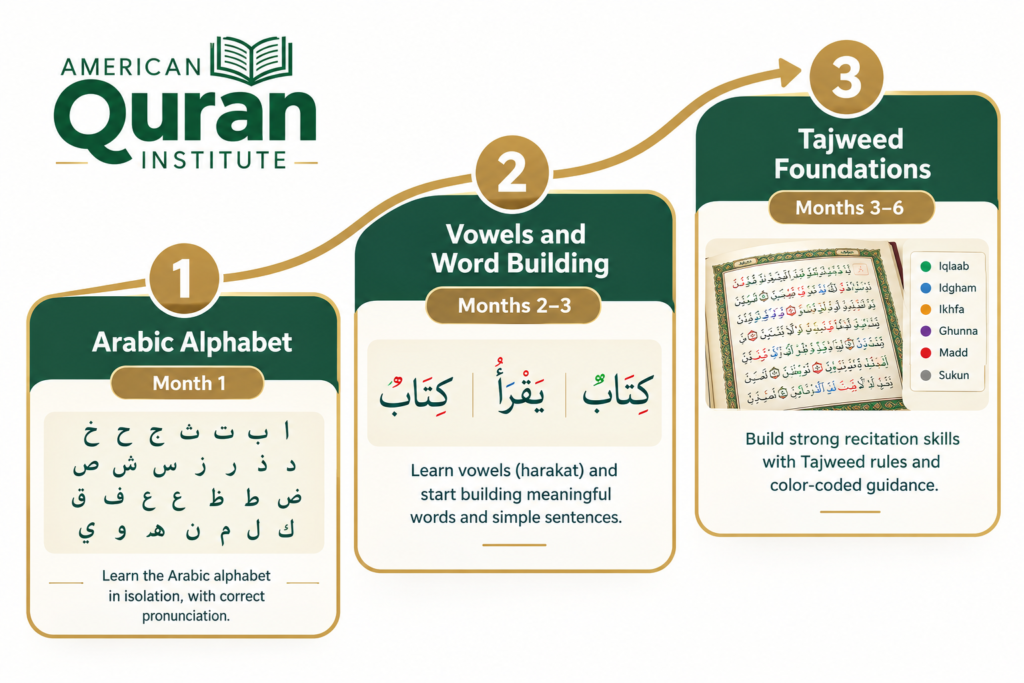
Stage One: Is Learning The Arabic Alphabet In Your First Month
The Arabic alphabet has 28 letters, most of which appear in different forms depending on where they fall in a word — at the beginning, middle, or end.
This shape-shifting can seem overwhelming on first encounter, but adult learners consistently report that letter recognition becomes intuitive within two to four weeks of regular, deliberate practice.
How to learn the Quran alphabet is the most foundational step in the entire journey, and it pays compound dividends across every stage that follows.
Once you can identify a letter reliably, patterns in the Quranic text begin to emerge, and the script that once looked like abstract decoration starts to look like something you can actually decode.
Combine visual recognition practice with handwriting. Writing each letter repeatedly anchors it in motor memory, which reinforces visual recall significantly faster than passive review or flashcard repetition alone.
Start Reading the Quran Accurately with our USA Classes
Stage Two: Vowels, Joining Letters, And Basic Sounds, And Months Two And Three
Standard Arabic is written without its short vowel sounds, but the Quran uses a complete diacritical system, the harakat, that marks every vowel explicitly.
This is one of the features that makes the Quran an ideal learning text for beginners: nothing is ambiguous, nothing is left to inference, and every sound is precisely notated.
This stage covers the three short vowels (fatha, kasra, damma), the long vowels, the sukoon, and the shadda.
It also introduces the way Arabic letters connect within words, a feature that differs substantially from English writing and requires deliberate practice to internalize and apply at reading speed.
By the end of Stage Two, a student should be able to sound out simple Quranic words slowly and accurately, with the confidence that what they are saying corresponds to the actual Arabic pronunciation of the text.
Stage Three: Tajweed Foundations Take Three To Six Months
Tajweed is the system of articulation rules that governs correct Quranic recitation. For Muslim learners, it is not optional — specific errors in Tajweed can alter meaning in ways that matter theologically.
But Tajweed is also not the overwhelming technical mountain it can appear to be from the outside, particularly for adult learners who are good at rule-based systems.
The practical entry point is the rules governing Noon Saakin (the unvoweled noon) and Tanwin (the double vowel), which cover four distinct scenarios encountered on virtually every page of the Quran.
A well-designed curriculum introduces one or two rules per session and immediately applies them to real Quranic text rather than abstract exercises.
For anyone wanting a comprehensive orientation to what Tajweed recitation involves before formal study begins, how to read Quran for beginners lays out the essentials clearly and accessible.
The Mistakes Most American Adults Make And How To Dodge Them
Most adults who struggle with Quran reading are not struggling because of age or limited ability.
They are struggling because of one or two specific, correctable errors in their approach — errors that are entirely avoidable when you know what to look for before you start.
Here are the three most common mistakes, based on what teachers and learners consistently report in adult Quran programs across the USA.
Mistake One: Skipping The Alphabet And Going Straight To Memorization
A common shortcut for adults is learning surahs by ear — repeating what they hear from audio recordings without ever connecting those sounds to written Arabic letters.
This appears to work for the first few surahs, which are already familiar from years of prayer. But it creates an invisible ceiling.
At some point, you will encounter new text you have never heard before. If you cannot read Arabic script, every new surah becomes an entirely fresh rote memorization task with no anchor to the written word and no way to self-correct.
Four to six weeks of deliberate alphabet study eliminates this problem entirely and pays back the investment across every later stage of learning.
Mistake Two: Relying On Transliteration Instead Of Arabic Script
Transliteration — writing Arabic sounds in English letters, such as “Bismillah ir-Rahman ir-Raheem” — appears to solve the script problem without the effort of learning a new alphabet.
In practice, it builds a ceiling that is lower and harder to break through than the ceiling created by skipping the alphabet.
English cannot accurately represent several Arabic sounds — the ع (ain), the غ (ghain), the ح (heavy h), the خ (kha) — so any transliteration of these letters is an approximation.
Reciting from transliteration means reciting with built-in errors that become progressively harder to unlearn.
How to read the Quran in Arabic easy offers a structured approach to reading directly from the Arabic script that makes the transition far more manageable than most beginners expect.
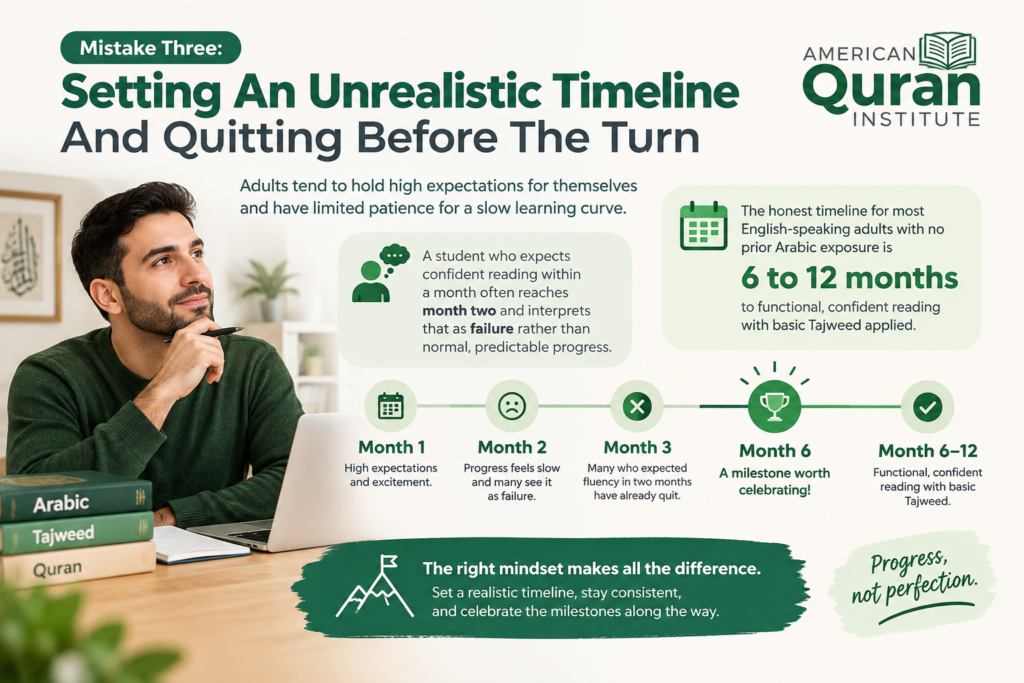
Mistake Three: Setting An Unrealistic Timeline And Quitting Before The Turn
Adults tend to hold high expectations for themselves and have limited patience for a slow learning curve.
A student who expects confident reading within a month often reaches month two and interprets that as failure rather than normal, predictable progress.
The honest timeline for most English-speaking adults with no prior Arabic exposure is six to twelve months to functional, confident reading with basic Tajweed applied.
Learners who enter with that expectation find month six to be a milestone worth celebrating. Learners who expected fluency in two months have often already quit by month three.
Motivations That Keep Adult Learners Going
The challenge for most American adults is maintaining consistent practice across the weeks and months when progress feels slow, life gets demanding, and the initial excitement fades into routine.
The learners who succeed long-term tend to draw on motivations that run deeper than a general sense of obligation.
Powerful motivations to read Quran are more durable when they are personal and specific, not a general sense of obligation but a concrete goal like understanding what you recite in Salah, or being able to read to your children.
The benefits of reciting Quran extend beyond spiritual reward to include something adult learners in America describe consistently: a daily sense of grounding and purpose that carries into the rest of the day.
A practical technique that works for most American adults is anchoring practice to a fixed existing routine, Fajr prayer, a morning coffee, the quiet before the household wakes.
How to start reading the Quran daily with a minimal, repeatable habit is more effective than waiting for an uninterrupted hour to appear in an already full schedule.
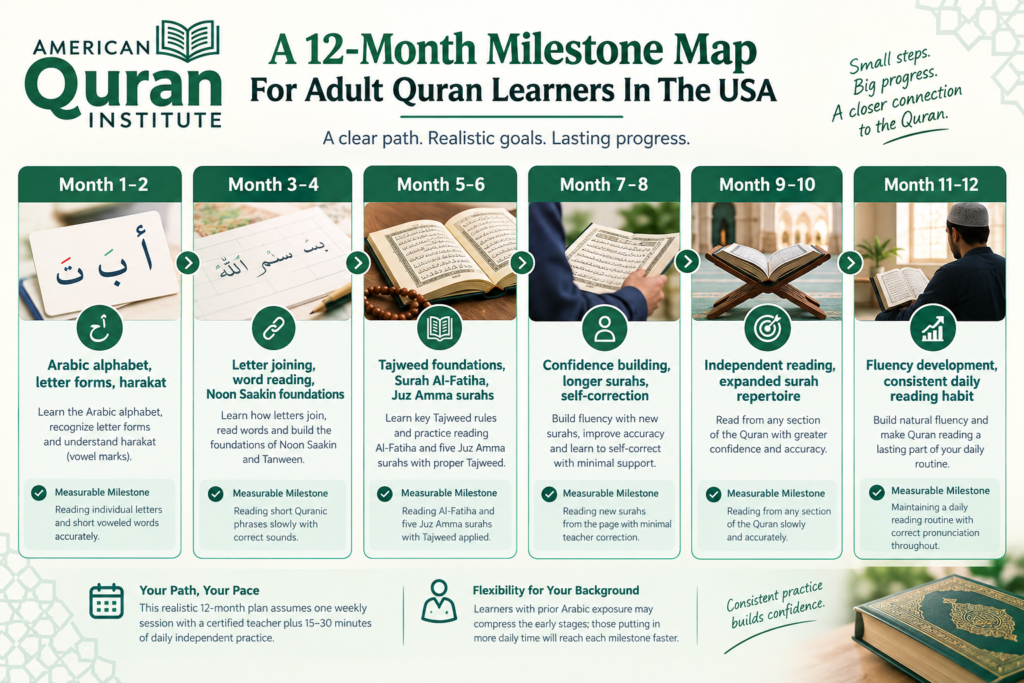
A 12-Month Milestone Map For Adult Quran Learners In The USA
Understanding what to expect at each stage removes the anxiety that derails many adult learners during the quiet middle months — after initial excitement wears off and before the satisfaction of fluency arrives.
The table below represents a realistic trajectory for an English-speaking adult starting from zero with weekly live instruction and daily independent practice.
These milestones assume one weekly session with a certified teacher plus fifteen to thirty minutes of daily practice.
Learners with prior Arabic exposure may compress the early stages; those putting in more daily time will reach each milestone faster.
| Month | Primary Focus | Measurable Milestone |
| 1–2 | Arabic alphabet, letter forms, harakat | Reading individual letters and short voweled words accurately |
| 3–4 | Letter joining, word reading, Noon Saakin foundations | Reading short Quranic phrases slowly with correct sounds |
| 5–6 | Tajweed foundations, Surah Al-Fatiha, Juz Amma surahs | Reading Al-Fatiha and five Juz Amma surahs with Tajweed applied |
| 7–8 | Confidence building, longer surahs, self-correction | Reading new surahs from the page with minimal teacher correction |
| 9–10 | Independent reading, expanded surah repertoire | Reading from any section of the Quran slowly and accurately |
| 11–12 | Fluency development, consistent daily reading habit | Maintaining a daily reading routine with correct pronunciation throughout |
The Case For Starting Today Rather Than Waiting Until You Are Ready
The most consistent reason adults in the USA delay beginning Quran study is a version of the same thought: “I’ll start when things settle down”.
The honest problem with that plan is that an American adult’s life does not settle down in a way that creates a reliably open window — the window has to be claimed deliberately, not waited for.
It is fifteen focused minutes, three or four times a week, treated as a fixed appointment rather than a flexible intention. That is what consistent progress requires — not ideal conditions, just consistent action.
How to make reading Quran more interesting? is a question that becomes much easier to answer once you have begun, because progress itself generates motivation.
How to read the Quran as an adult in the USA has never been more accessible certified teachers, English-language instruction, flexible scheduling, and a clear proven roadmap are all available right now.
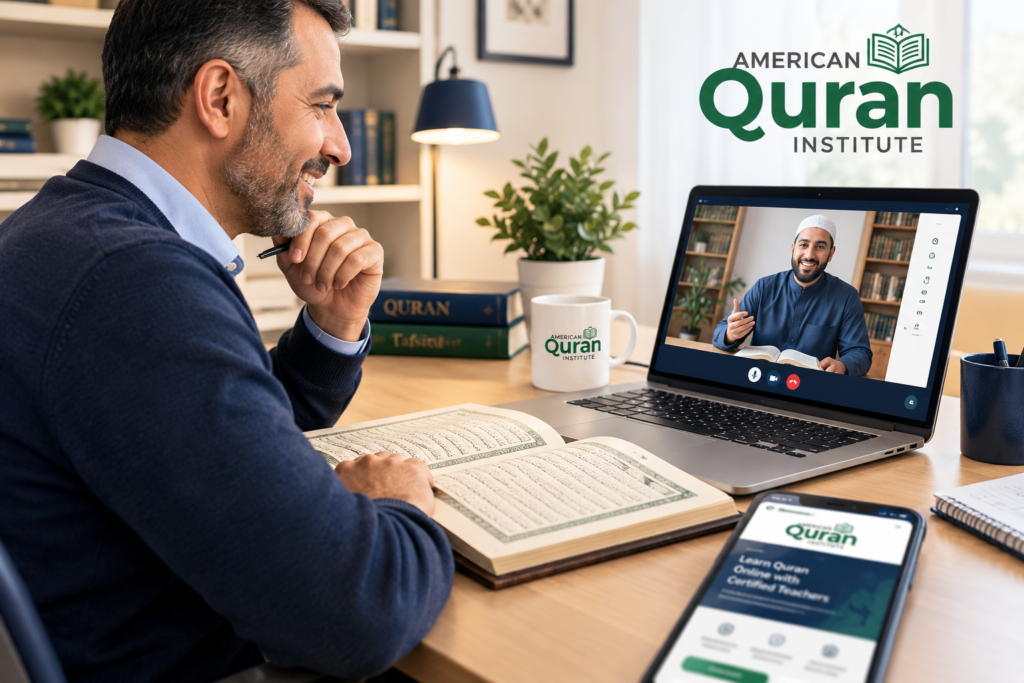
Experience Our Classroom Environment
Don’t just take our word for it—experience a live session for yourself! Click on the videos below to watch real snippets from our classes and see our interactive teaching methods in real-time.
Start Your Quranic Education
Join our premier online institute for structured Quranic learning tailored for students in the USA.
Book Your Free TrialStart Your Quran Journey With Certified Teachers Who Understand Your Life
You have the roadmap, the stages, the realistic timeline, the common mistakes to avoid, and the motivations that actually sustain this kind of long-term commitment.
The one variable that determines whether this becomes real progress or another deferred intention is the decision you make in the next few minutes.
The American Quran Institute pairs adult learners across the USA with Ijazah-certified teachers who have guided English speakers through every stage described in this article from the first Arabic letter to fluent, Tajweed-correct recitation.
Classes are live, one-on-one, and built entirely around American time zones and your personal schedule.
Our Quran Courses
- Quran Online Academy
- Quran Recitation Classes
- Quran Reading Classes
- Online Quran Classes for Kids
- Quran Classes for Adults
- Quran Classes for Female/Sisters
- Learn Quran Course for Beginners
- Quran Qirat Learning Course
- Quran Tafsir Course
- Noorani Qaida Course
- Noorani Qaida Course for Kids
- Weekend Quran Classes
- Intensive Quran Course
- Al-Azhar Quran Course
Our Memorization Courses
- Quran Memorization (Hifz) Course
- Hifz Classes for Adults
- Quran Memorization and Hifz Course for Kids
- Quran Hifz Course for Ladies
- Quran Ijazah Program
Unlock The Wisdom of The Quran At The American Quran Institute and Book your free trial today
Start Your Quranic Education
Join our premier online institute for structured Quranic learning tailored for students in the USA.
Book Your Free TrialConclusion
Can adults learn to read Quran in the USA? The answer this article arrives at is not a motivational promise; it is a practical yes, grounded in how adult learning actually works, and what thousands of American Muslims have already done.
The path is clear and sequential: Arabic alphabet, vowel system, Tajweed foundations, consistent daily practice, and a certified teacher who corrects pronunciation in real time.
The 12-month milestone map gives you the benchmarks to track. The learner typology gives you the right starting point for your specific situation. The mistakes section gives you the pitfalls to avoid before they cost you months.
Adults who begin Quran study in the USA today are learning under conditions that did not exist a generation ago, live instruction in English, scheduling built around American time zones, and certified teachers accessible from anywhere.
The geography barrier is gone. The language gap has been bridged. The scheduling conflict has a solution. The door has never been more open and it opens from your side.
Frequently Asked Questions
Is It Too Late For An Adult To Learn To Read The Quran?
It is not too late. Adults in the United States begin Quran study in their 30s, 40s, 50s, and 60s and make consistent, measurable progress.
Adults bring focus, discipline, and intrinsic motivation that often make them faster learners than younger students once the foundational skills are established. There is no biological ceiling on learning a new script or phonemic system.
How Long Does It Take An Adult To Learn To Read The Quran In The USA?
Most English-speaking adults with no prior Arabic exposure reach functional reading — reciting slowly and accurately with basic Tajweed applied, within six to twelve months of consistent weekly instruction and daily practice.
Learners with prior exposure to Arabic letters or related languages often reach functional reading in three to four months.
Do I Need To Understand Arabic Before I Can Start?
No. Reading the Quran correctly is a distinct skill from understanding Arabic as a language. Your initial goal is phonetic decoding, recognizing letters, applying vowel marks, following Tajweed rules, which does not require comprehension.
Many adult learners pursue meaning and recitation simultaneously, but understanding Arabic is not a prerequisite for beginning to read.
Can I Learn To Read The Quran Entirely Online?
Yes. Live online instruction with a certified teacher is the most common and most effective format for adult Quran learners in the USA today.
One-on-one video sessions allow real-time pronunciation correction, personalized pacing, and scheduling flexibility that in-person classes rarely match. The quality of the experience depends on the teacher’s certification and experience.
What Is Tajweed And Is It Required?
Tajweed is the system of articulation rules that govern correct Quranic recitation. For Muslim learners, it carries religious significance, specific errors can alter meaning in ways that matter theologically.
The good news is that Tajweed is taught progressively: you apply foundational rules as you learn them, session by session, rather than mastering the entire system before reading your first verse.
How Much Time Per Week Does An Adult Realistically Need For Quran Study?
One weekly live session with a certified teacher combined with fifteen to thirty minutes of daily independent practice is the standard effective investment for adult learners in the USA.
That totals roughly two to three hours per week, a sustainable commitment when scheduled with the same intentionality as any other fixed weekly appointment.





Leave a Reply