 Quran
The Quran speaks about humanity from many different angles. It describes how human beings were created, the weaknesses they struggle with, the responsibilities they carry, and the moral qualities that can raise them above selfishness, injustice, and arrogance.
For anyone searching for Quran verses about humanity in Arabic, the Quran offers a rich picture of human life. Some verses describe the origin of human creation. Others emphasize equality, justice, trust, gratitude, patience, and personal responsibility.
The Quran also acknowledges human weaknesses such as haste, despair, greed, forgetfulness, and argumentation while showing how faith and righteous action can transform those weaknesses.
Below are some of the most important Quran verses about humanity in Arabic, with transliteration, English translation, direct Quran.com references, and explanations of their lessons.
1. Quran Verses About the Creation of Human Beings From Clay
One of the clearest Quranic descriptions of human creation appears in Surah Al-Hijr. The passage connects humanity’s physical origin with Allah’s deliberate creation of Adam.
وَلَقَدْ خَلَقْنَا الْإِنسَانَ مِن صَلْصَالٍ مِّنْ حَمَإٍ مَّسْنُونٍ
Wa laqad khalaqnal insaana min salsaalim min hama’im masnoon.
“And We did certainly create man out of clay from an altered black mud.”
A few verses later, Allah says:
فَإِذَا سَوَّيْتُهُ وَنَفَخْتُ فِيهِ مِن رُّوحِي فَقَعُوا لَهُ سَاجِدِينَ
Fa izaa sawwaituhoo wa nafakhtu feehi mir roohee faqa‘oo lahoo saajideen.
“So when I have proportioned him and breathed into him of My created spirit, then fall down to him in prostration.”
These verses remind human beings of both humility and honor. Humanity has a physical origin from created material, yet Adam was also given a special place within Allah’s creation.
The passage therefore prevents two extremes: arrogance about human status and denial of the dignity Allah has granted human beings.
Read also: Quran Verses About Hope In Arabic – Mercy, Relief, And Trust In Allah
2. A Quranic Reminder to Never Despair of Allah’s Mercy
One of the strongest Quran verses about humanity and equality appears in Surah Al-Hujurat.
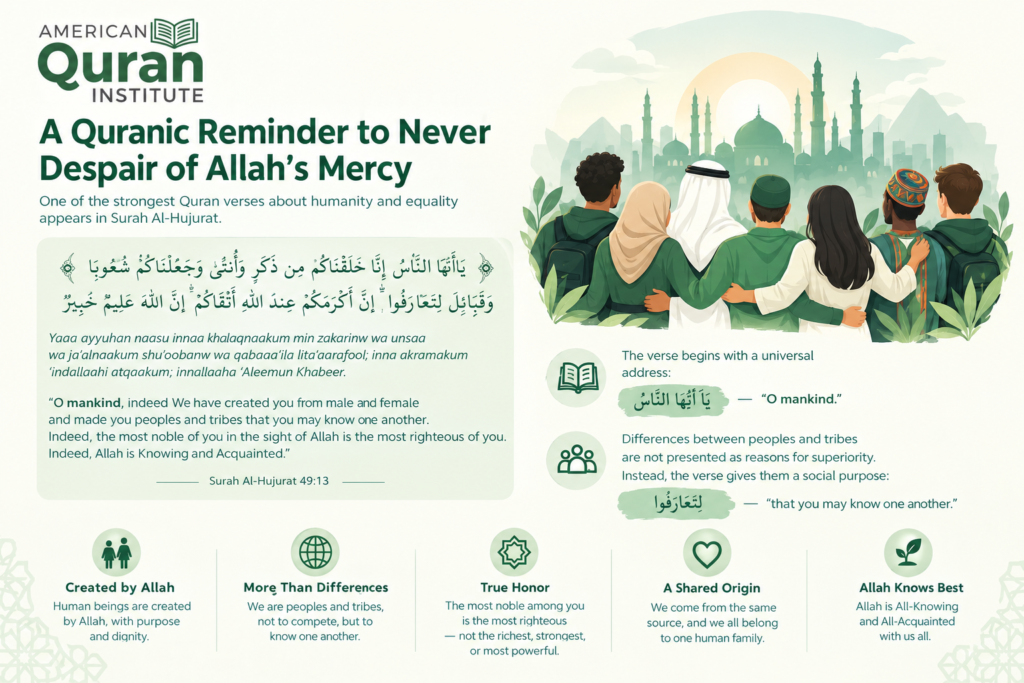
يَا أَيُّهَا النَّاسُ إِنَّا خَلَقْنَاكُم مِّن ذَكَرٍ وَأُنثَىٰ وَجَعَلْنَاكُمْ شُعُوبًا وَقَبَائِلَ لِتَعَارَفُوا ۚ إِنَّ أَكْرَمَكُمْ عِندَ اللَّهِ أَتْقَاكُمْ ۚ إِنَّ اللَّهَ عَلِيمٌ خَبِيرٌ
Yaaa ayyuhan naasu innaa khalaqnaakum min zakarinw wa unsaa wa ja‘alnaakum shu‘oobanw wa qabaaa’ila lita‘aarafool; inna akramakum ‘indallaahi atqaakum; innallaaha ‘Aleemun Khabeer.
“O mankind, indeed We have created you from male and female and made you peoples and tribes that you may know one another. Indeed, the most noble of you in the sight of Allah is the most righteous of you. Indeed, Allah is Knowing and Acquainted.”
The verse begins with a universal address: يَا أَيُّهَا النَّاسُ — “O mankind.” Differences between peoples and tribes are not presented as reasons for superiority. Instead, the verse gives them a social purpose: لِتَعَارَفُوا — “that you may know one another.” The final standard is taqwa, not ethnicity, nationality, wealth, or social position.
3. The Quran Recognizes Human Diversity as a Sign of Allah
The Quran also presents differences among people as signs of Allah rather than problems to be erased.
وَمِنْ آيَاتِهِ خَلْقُ السَّمَاوَاتِ وَالْأَرْضِ وَاخْتِلَافُ أَلْسِنَتِكُمْ وَأَلْوَانِكُمْ ۚ إِنَّ فِي ذَٰلِكَ لَآيَاتٍ لِّلْعَالِمِينَ
Wa min Aayaatihee khalqus samaawaati wal ardi wakhtilaafu alsinatikum wa alwaanikum; inna fee zaalika la Aayaatil lil ‘aalimeen.
“And of His signs is the creation of the heavens and the earth and the diversity of your languages and your colors. Indeed in that are signs for those of knowledge.”
Human diversity in language and appearance is included among Allah’s signs. The verse encourages reflection rather than prejudice. Different languages and colors are not evidence of unequal human value; they are part of the diversity built into creation.
Read also: Quran Verses About Hijab In Arabic – Modesty, Khimar, And Jilbab
4. The Quran Commands Us to Return Trusts and Judge People With Justice
Humanity in the Quran is not only about shared origin. It is also about ethical responsibility toward other people.
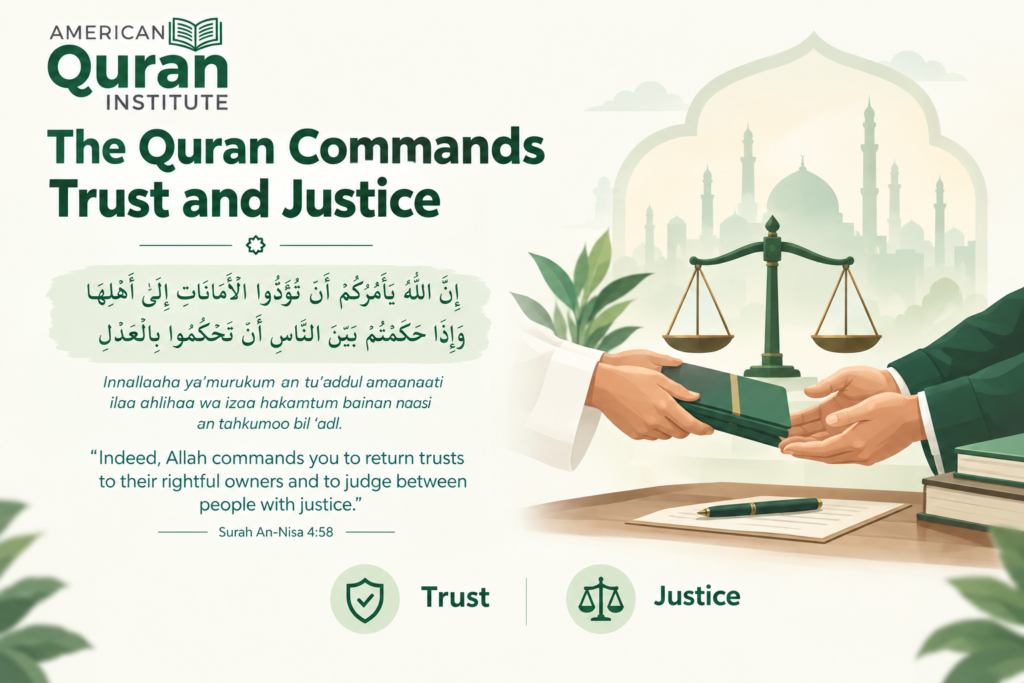
إِنَّ اللَّهَ يَأْمُرُكُمْ أَن تُؤَدُّوا الْأَمَانَاتِ إِلَىٰ أَهْلِهَا وَإِذَا حَكَمْتُم بَيْنَ النَّاسِ أَن تَحْكُمُوا بِالْعَدْلِ ۚ إِنَّ اللَّهَ نِعِمَّا يَعِظُكُم بِهِ ۗ إِنَّ اللَّهَ كَانَ سَمِيعًا بَصِيرًا
Innallaaha ya’murukum an tu’addul amaanaati ilaaa ahlihaa wa izaa hakamtum bainan naasi an tahkumoo bil ‘adl; innallaaha ni‘immaa ya‘izukum bih; innallaaha kaana Samee‘am Baseeraa.
“Indeed, Allah commands you to render trusts to whom they are due and when you judge between people to judge with justice. Excellent is that which Allah instructs you. Indeed, Allah is ever Hearing and Seeing.”
Two major principles appear together: amanah and justice. Trusts must be returned to their rightful owners, and judgment between people must be based on justice. The verse says بَيْنَ النَّاسِ — “between people,” giving the instruction a broad human dimension.
A humane society therefore requires more than good intentions. It requires honesty, fairness, responsibility, and protection of other people’s rights.
5. Quran Verses About Human Success Through Faith, Good Deeds, Truth, and Patience
Surah Al-‘Asr gives one of the most concise summaries of what saves human beings from loss.
وَالْعَصْرِ إِنَّ الْإِنسَانَ لَفِي خُسْرٍ إِلَّا الَّذِينَ آمَنُوا وَعَمِلُوا الصَّالِحَاتِ وَتَوَاصَوْا بِالْحَقِّ وَتَوَاصَوْا بِالصَّبْرِ
Wal ‘asr. Innal insaana lafee khusr. Illal lazeena aamanoo wa ‘amilus saalihaati wa tawaasaw bil haqqi wa tawaasaw bis sabr.
“By time. Indeed, mankind is in loss, except for those who have believed and done righteous deeds and advised each other to truth and advised each other to patience.”
The passage identifies four qualities that protect people from loss: faith, righteous action, commitment to truth, and patience. This gives humanity a moral direction. Human progress is not measured only by wealth, technology, or power. The Quran evaluates people according to belief, actions, truthfulness, and perseverance.
6. The Quran Acknowledges Human Weakness and Allah’s Desire to Make Things Easier
The Quran acknowledges human weakness directly rather than pretending that people possess unlimited strength.
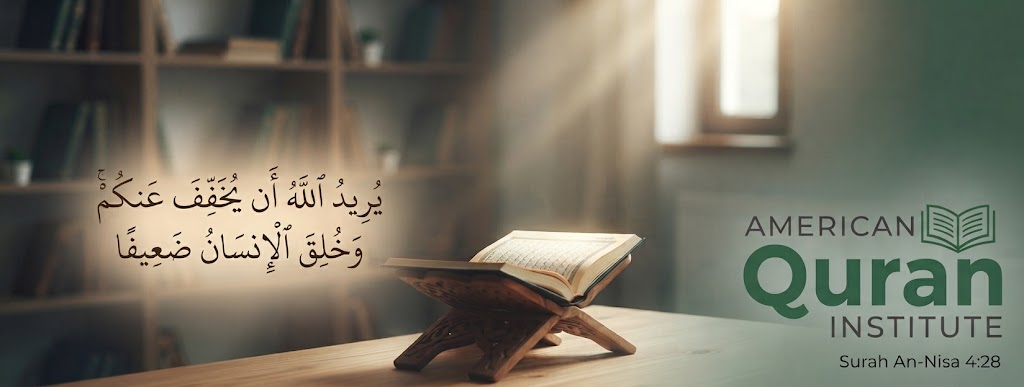
يُرِيدُ اللَّهُ أَن يُخَفِّفَ عَنكُمْ ۚ وَخُلِقَ الْإِنسَانُ ضَعِيفًا
Yureedullaahu ai yukhaffifa ‘ankum; wa khuliqal insaanu da‘eefaa.
“Allah wants to lighten for you, and mankind was created weak.”
The verse places human weakness beside Allah’s desire to make matters easier. Recognizing weakness can protect a person from arrogance. It also encourages people to seek guidance, discipline their desires, and depend upon Allah instead of imagining themselves completely self-sufficient.
Experience Our Classroom Environment
Don’t just take our word for it—experience a live session for yourself! Click on the videos below to watch real snippets from our classes and see our interactive teaching methods in real-time.
Start Your Quranic Education
Join our premier online institute for structured Quranic learning tailored for students in the USA.
Book Your Free Trial7. Quran Verses About Human Despair Being Corrected Through Patience and Good Deeds
The Quran also describes how quickly human beings can fall into despair when blessings are removed.
وَلَئِنْ أَذَقْنَا الْإِنسَانَ مِنَّا رَحْمَةً ثُمَّ نَزَعْنَاهَا مِنْهُ إِنَّهُ لَيَئُوسٌ كَفُورٌ
Wa la’in azaqnal insaana minnaa rahmatan thumma naza‘naahaa minhu innahoo laya’oosun kafoor.
“And if We give man a taste of mercy from Us and then We withdraw it from him, indeed, he is despairing and ungrateful.”
The passage later gives the corrective:
إِلَّا الَّذِينَ صَبَرُوا وَعَمِلُوا الصَّالِحَاتِ أُولَٰئِكَ لَهُم مَّغْفِرَةٌ وَأَجْرٌ كَبِيرٌ
Illal lazeena sabaroo wa ‘amilus saalihaati ulaaa’ika lahum maghfiratunw wa ajrun kabeer.
“Except for those who are patient and do righteous deeds; those will have forgiveness and great reward.”
The Quran does not merely identify despair as a human weakness. It gives an alternative response: sabr and righteous action. Hardship therefore becomes a test of how a person responds, not simply something that defines them.
The Quran Corrects Human Arrogance by Reminding Us of Our Humble Origin
The Quran repeatedly reminds people of their simple physical origin when discussing arrogance.
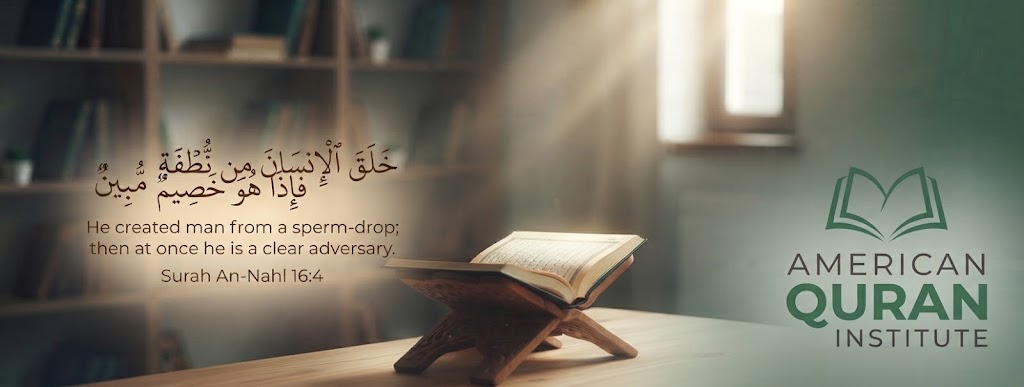
خَلَقَ الْإِنسَانَ مِن نُّطْفَةٍ فَإِذَا هُوَ خَصِيمٌ مُّبِينٌ
Khalaqal insaana min nutfatin fa izaa huwa khaseemun mubeen.
“He created man from a sperm-drop; then at once he is a clear adversary.”
The contrast is deliberate. Humanity begins from a tiny created substance, yet people may later become argumentative and arrogant. Remembering one’s origin can restore humility and prevent a person from exaggerating their own power or independence.
8. Quran Verse About Human Beings Being Naturally Hasty
Another Quranic description concerns human impatience.
وَيَدْعُ الْإِنسَانُ بِالشَّرِّ دُعَاءَهُ بِالْخَيْرِ ۖ وَكَانَ الْإِنسَانُ عَجُولًا
Wa yad‘ul insaanu bish sharri du‘aaa’ahoo bil khair; wa kaanal insaanu ‘ajoolaa.
“And man supplicates for evil as he supplicates for good, and man is ever hasty.”
Human beings do not always understand the consequences of what they desire. The verse encourages restraint and humility. Something a person urgently wants may not actually be good for them, which is one reason Islamic guidance repeatedly teaches patience and trust in Allah’s knowledge.
9. Quran Verse About People Turning to Allah During Distress and Forgetting Him After Relief
The Quran also exposes a recurring human tendency: remembering Allah intensely during crisis but turning away once safety returns.
وَإِذَا مَسَّكُمُ الضُّرُّ فِي الْبَحْرِ ضَلَّ مَن تَدْعُونَ إِلَّا إِيَّاهُ ۖ فَلَمَّا نَجَّاكُمْ إِلَى الْبَرِّ أَعْرَضْتُمْ ۚ وَكَانَ الْإِنسَانُ كَفُورًا
Wa izaa massakumud durru fil bahri dalla man tad‘oona illaaa iyyaah; falammaa najjaakum ilal barri a‘radtum; wa kaanal insaanu kafooraa.
“And when adversity touches you at sea, lost are all those you invoke except for Him. But when He delivers you to the land, you turn away. And ever is man ungrateful.”
The verse highlights dependence upon Allah during danger and human forgetfulness after relief. A healthier spiritual relationship is consistent: turning to Allah during hardship and remembering Him during ease.
10. Quran Verse About Every Person Being Accountable for Their Own Deeds
Humanity in the Quran also includes individual accountability. People cannot permanently escape responsibility by blaming others.
وَكُلَّ إِنسَانٍ أَلْزَمْنَاهُ طَائِرَهُ فِي عُنُقِهِ
Wa kulla insaanin alzamnaahu taaa’irahoo fee ‘unuqih.
“And every person We have imposed his fate upon his neck.”
The verse appears within a passage about the record and consequences of a person’s deeds. Human beings live in families and societies, but each individual remains morally accountable before Allah for their own choices.
Students who want a more traditional, structured approach to Quranic study and Islamic scholarship can explore Al-Azhar Quran Classes for guided learning rooted in established Islamic scholarship.
11. Quran Verse About Human Beings Being Created in the Best Form
The Quran does not speak only about human weakness. It also affirms the remarkable form in which humanity was created.
لَقَدْ خَلَقْنَا الْإِنسَانَ فِي أَحْسَنِ تَقْوِيمٍ
Laqad khalaqnal insaana fee ahsani taqweem.
“We have certainly created man in the best of stature.”
Human beings possess capacities for understanding, moral choice, worship, communication, creativity, and responsibility. The verse therefore balances passages about human weakness. People are vulnerable and imperfect, but they are also created with capacities that can be directed toward goodness.
What Does the Quran Say About Humanity?
The Quran presents human beings as created by Allah, morally responsible, capable of both weakness and greatness, and accountable for how they use their freedom, knowledge, wealth, and relationships.
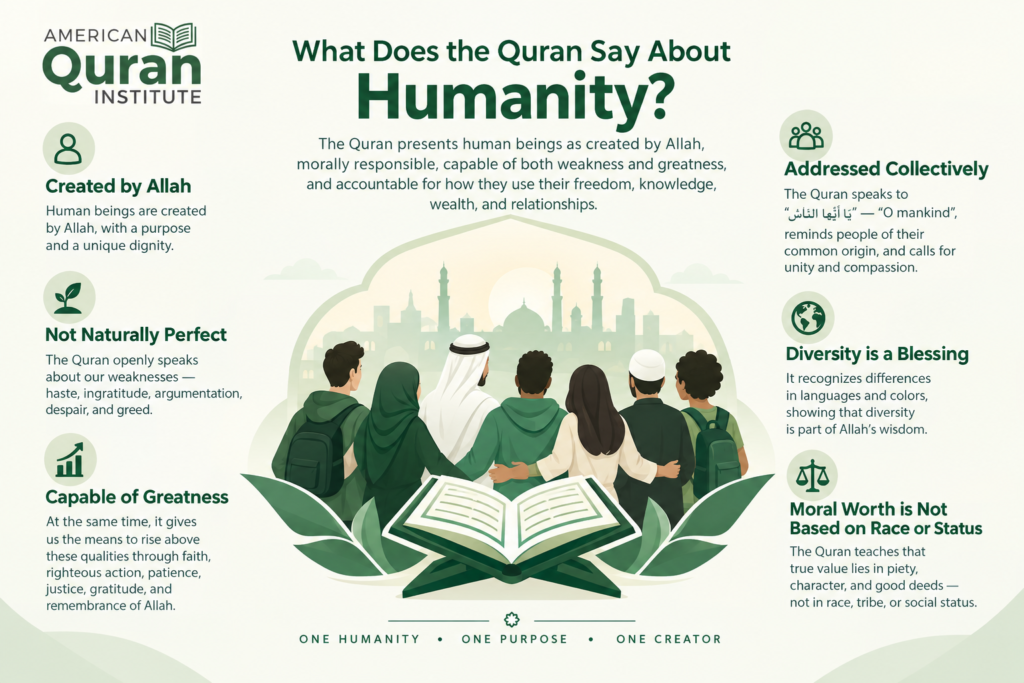
Humanity is not described as naturally perfect. The Quran openly speaks about weakness, haste, ingratitude, argumentation, despair, and greed. At the same time, it gives people the means to rise above these qualities through faith, righteous action, patience, justice, gratitude, and remembrance of Allah.
The Quran also addresses humanity collectively. It speaks to يَا أَيُّهَا النَّاسُ — “O mankind”, reminds people of their common origin, recognizes differences in languages and colors, and teaches that moral worth is not determined by race, tribe, or social status.
Students who want to build stronger Quran reading skills before studying these passages in greater depth can begin with Quran Reading Classes to strengthen Arabic reading, pronunciation, and fluency.

What Do Quran Verses About Humanity Teach Us?
The many Quran verses about humanity in Arabic present human beings as dignified but accountable, diverse but equal in origin, weak but capable of growth, and responsible for developing moral character.
- All Human Beings Share a Common Origin Regardless of Race or Tribe: Surah Al-Hujurat teaches that humanity comes from a male and female and that peoples and tribes exist to know one another, not to establish racial superiority.
- Human Worth Before Allah Is Based on Taqwa Rather Than Social Status: The Quran does not make wealth, ethnicity, language, or nationality the final measure of human worth. The standard named in Surah Al-Hujurat is righteousness and God-consciousness.
- Justice and Trustworthiness Are Essential Values for Human Society: The Quran commands people to return trusts to their rightful owners and judge between people with justice. A humane society therefore depends on fairness and responsibility.
- Human Weakness Does Not Prevent Moral and Spiritual Growth: The Quran acknowledges that people can be weak, hasty, despairing, argumentative, and ungrateful. It also teaches the practices that correct these tendencies: faith, patience, gratitude, worship, and righteous action.
- Human Diversity Is One of Allah’s Signs: Differences in languages and colors are described as signs of Allah. Diversity should lead to reflection and recognition rather than arrogance or hostility.
- Every Human Being Is Responsible for Their Own Choices: The Quran repeatedly connects humanity with personal accountability. People can influence one another, but every individual remains responsible before Allah for their own actions.
- Human Success Requires Faith, Righteous Deeds, Truth, and Patience: Surah Al-‘Asr summarizes a path out of human loss through belief, good actions, commitment to truth, and patience.
How the Quran Guides Human Weakness Toward Better Character?
The Quran does not merely identify human weaknesses; it teaches people how to overcome them and develop better character. Human limitations are acknowledged honestly, but they are always accompanied by guidance toward spiritual and moral growth.
Weakness is met with reliance on Allah, despair with patience and hope, ingratitude with gratitude, greed with generosity, and arrogance with remembrance of humanity’s humble origin. Haste is disciplined through patience, while anxiety is eased through prayer and trust in Allah.
This is a recurring theme in Quran verses about humanity in Arabic: the Quran recognizes human nature as it is while showing that negative qualities do not have to define who a person becomes.
For students who are beginning their Quran journey and want to develop the reading foundation needed to study passages like these directly in Arabic, Quran Classes for Beginners can provide step-by-step instruction in Arabic letters, pronunciation, Quran reading, and basic recitation.
See Us in Action!
Take a look inside our virtual classrooms. Watch the clip below to see how our instructors engage with students, simplify complex rules, and create an inspiring environment for learning.
Start Your Quranic Education
Join our premier online institute for structured Quranic learning tailored for students in the USA.
Book Your Free TrialUnderstand the Quran’s View of Human Nature With American Quran Institute
English translation can communicate the general message of Quran verses about humanity, but reading them in Arabic helps students recognize repeated concepts such as insan, nas, taqwa, adl, amanah, sabr, and shukr.
At American Quran Institute, students can strengthen Quran reading, recitation, and understanding through structured instruction.
Learning the Quran more directly in Arabic can help students move beyond isolated translations and see how the Quran connects human creation, weakness, responsibility, justice, gratitude, and spiritual growth.
Whether you are starting with basic Arabic reading or developing a deeper understanding of Quranic meanings, consistent study can help you engage with these verses more confidently.
Start your free trial today and build a stronger understanding of the Quran’s message about humanity.
Our Quran Courses
- Quran Classes for Female/Sisters
- Learn Quran Course for Beginners
- Quran Qirat Learning Course
- Quran Tafsir Course
- Noorani Qaida Course
- Noorani Qaida Course for Kids
- Weekend Quran Classes
- Intensive Quran Course
- Al-Azhar Quran Course

Conclusion
The Quran verses about humanity in Arabic present a balanced view of human beings. Humanity is honored through creation, knowledge, moral responsibility, and the ability to choose good.
At the same time, people are reminded of weaknesses such as haste, ingratitude, despair, greed, and arrogance.
The Quran does not leave these weaknesses without guidance. It directs human beings toward justice, trustworthiness, patience, gratitude, generosity, worship, and awareness of Allah.
It also teaches that humanity shares a common origin, that diversity in language and color is one of Allah’s signs, and that true honor is based on taqwa rather than race, wealth, or social position.
The Quranic picture of humanity is therefore neither idealistic nor hopeless. It recognizes human weakness while showing that faith and righteous action can transform character and raise people toward greater justice, responsibility, and spiritual maturity.
Frequently Asked Questions About Quran Verses About Humanity in Arabic
What Does the Quran Say About Humanity?
The Quran describes humanity as created by Allah, morally responsible, naturally weak in some areas, and capable of developing through faith, righteous action, patience, justice, and gratitude.
Which Quran Verse Talks About Human Equality?
Surah Al-Hujurat 49:13 teaches that all people were created from a male and female and made into peoples and tribes to know one another. It states that the most honored before Allah are those with the most taqwa.
What Does the Quran Say About Human Weakness?
Surah An-Nisa 4:28 says that mankind was created weak. Other verses discuss haste, anxiety, despair, ingratitude, and greed.
What Does the Quran Say About Human Nature?
The Quran presents human nature as containing both weaknesses and positive capacities. People can be hasty, ungrateful, or anxious, but they can also grow through worship, patience, gratitude, knowledge, and righteous action.
Does the Quran Teach Personal Responsibility?
Yes. Several verses emphasize that human beings are responsible for their own deeds and will be accountable before Allah.
How Can I Understand Quran Verses About Humanity More Deeply?
Read each verse with its surrounding passage, study key Arabic terms, and use reliable Tafsir to understand context and interpretation. Structured Quran study can also help connect individual verses with the Quran’s broader teachings about human nature, justice, morality, and responsibility.




Leave a Reply