 Quran
Quran
Most American Muslims who want to read the Quran face the same obstacle: they may have memorized surahs phonetically from childhood, but they cannot read the Arabic text on their own. That gap is not a language problem, it is a foundation problem.
The Noorani Qaida is the curriculum built to close it, lesson by lesson, until the letters and their rules become automatic. For US residents, the practical barrier to learning it has largely disappeared.
Live classes with certified teachers, scheduling built around American time zones, and structured curricula that match traditional Islamic school standards.
Many families begin by asking how to learn to read Quran by yourself in the USA? The honest answer is that self-study takes you only so far before a qualified teacher becomes essential. This guide gives you nine concrete steps so you know exactly what to do, in what order, and why each step matters.
1. Understand What the Curriculum Actually Covers
Many learners sign up for Noorani Qaida classes without a clear picture of what the program is actually teaching them. That confusion slows progress from the very first session.
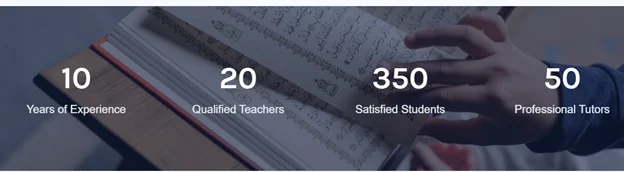
The Noorani Qaida is a phonics-based primer developed by Sheikh Noor Muhammad Haqqani in Punjab, India. Its purpose is focused: to teach Quranic Arabic letters, their shapes, vowel sounds, and essential tajweed rules before a student ever attempts to read from the Quran itself.
It is the step that makes the next step possible, not a separate subject, but a direct preparation. The curriculum contains 17 progressive lessons, each one building on the one before it.
There is no lesson that can be skipped without creating gaps that surface later, often in the middle of Quran recitation, when they are harder to address.
Understanding how to read the Quran in a lasting, correct way starts with these 17 lessons, before the mushaf is ever opened.
Read also: How To Learn Quran Reading With Tajweed For Beginners In The USA?
2. Find A Certified Teacher to Determine Everything
The Noorani Qaida works as well as the person delivering it. This is where most self-starters make their first mistake: they find a YouTube playlist and assume that is sufficient.
A qualified Noorani Qaida teacher should hold an Ijazah — a formal Islamic credential documenting an unbroken chain of transmission from teacher to teacher, going back to the Prophet ﷺ.
For American learners, credentials are only half the question. A teacher based overseas who operates during their local morning hours cannot realistically serve a family in California or Illinois.
Look specifically for teachers who schedule around US Eastern, Central, Mountain, and Pacific time zones. A program built for how to learn the Quran in the USA treats scheduling as a core feature, not an afterthought.
American Quran Institute, based in the USA, connects American Muslims — children, adults, ladies, and new Muslims — with Ijazah-certified teachers who specialize in guiding English speakers from the Arabic alphabet through fluent recitation.
Begin Your Al-Azhar Quran Course Journey in the USA

3. Build A Practice Routine That Holds Up Against Real American Life
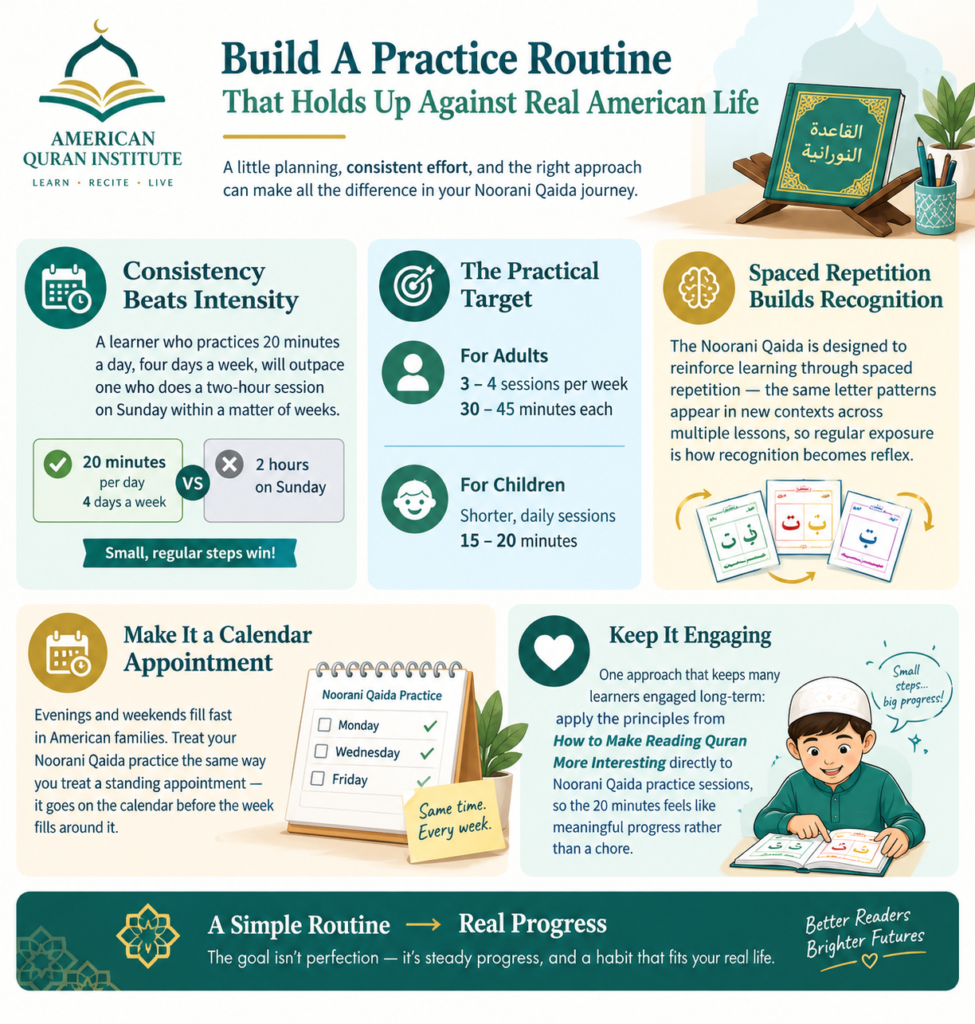
Consistency beats intensity every time. A learner who practices 20 minutes a day, four days a week, will outpace one who does a two-hour session on Sunday within a matter of weeks.
The practical target for an adult learner is three to four sessions per week, each lasting 30 to 45 minutes. Children do better with shorter, daily sessions of 15 to 20 minutes.
The Noorani Qaida is designed to reinforce learning through spaced repetition — the same letter patterns appear in new contexts across multiple lessons, so regular exposure is how recognition becomes reflex.
The challenge for American families is that evenings and weekends fill fast. Treat your Noorani Qaida practice the same way you treat a standing appointment — it goes on the calendar before the week fills around it.
One approach that keeps many learners engaged long-term: applying the principles from how to make reading Quran more interesting directly to Noorani Qaida practice sessions, so the 20 minutes feels like meaningful progress rather than a chore.
Read also: How To Learn Quran Reading With Tajweed Juz 30?
4. Work Through All 17 Lessons Of Noorani Qaida In Order
The most common error adults make in online Noorani Qaida classes is trying to accelerate by jumping ahead.
Experienced teachers recognize this pattern immediately: the resulting errors are predictable, they appear at specific points, and they take longer to unlearn than they would have taken to prevent.
The 17 lessons fall into three distinct stages, each with a different goal and a different skill being built.
Read also: How To Learn Quran Recitation In The USA?
A. Beginner Stage: Letters, Shapes, And Basic Vowels
The first lessons cover the 29 Arabic letters in their isolated forms, then in their connected forms as they appear at the beginning, middle, and end of words.
After letters come the three short vowels (fatha, kasra, damma) and their long equivalents, followed by compound letter combinations.
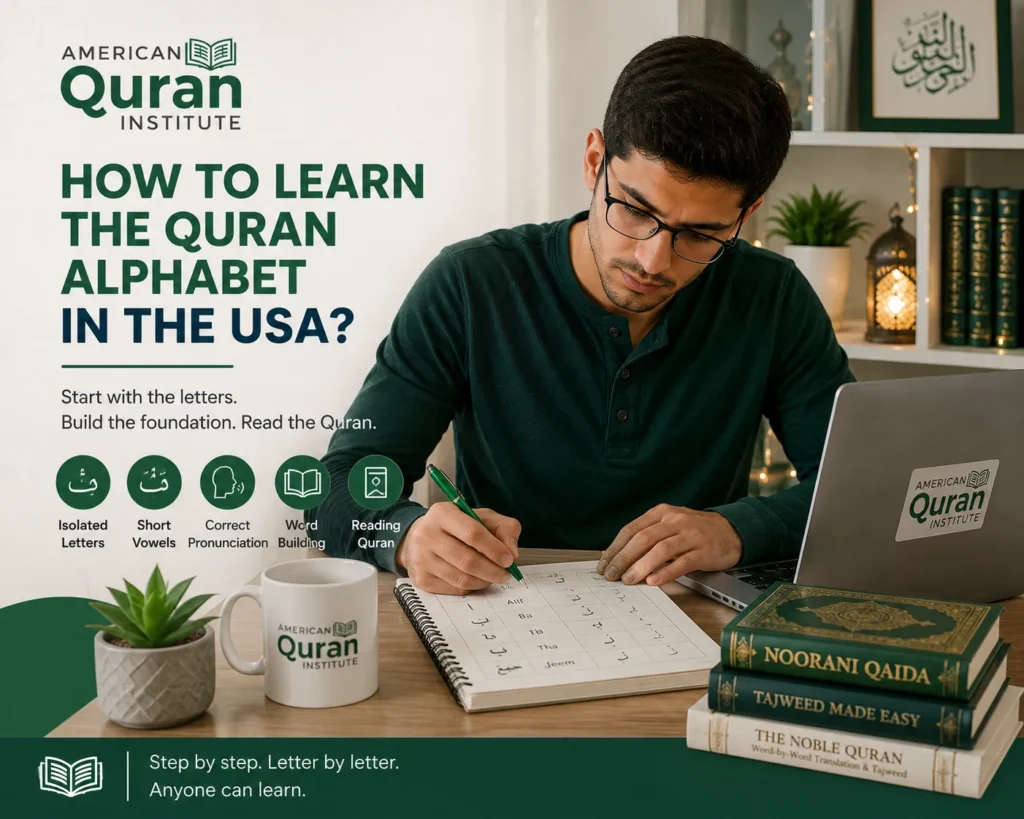
This stage is the direct answer to how to learn the Quran alphabet: one letter at a time, with the teacher confirming correct pronunciation at each step before advancing.
Students who complete this stage can sound out short Quranic words correctly and independently, even before they understand the meaning.
Enroll Your Kid in the Best Online Quran Classes
B. Intermediate Stage: Sukoon, Shadda, Madd, And Tanween
The middle lessons introduce the rules that change how letters behave in combination.
Sukoon (the resting consonant), shadda (a doubled letter sound), madd (elongated vowels of specific lengths), and tanween (the “n” sound added to word endings) are the building blocks of fluent Quranic pronunciation.
The rules interact with each other in ways that require real-time correction from a trained ear.
The difference between a correct and incorrect sukoon is audible only to someone who knows what to listen for — and catching it in the moment is what prevents it from hardening into a habit.
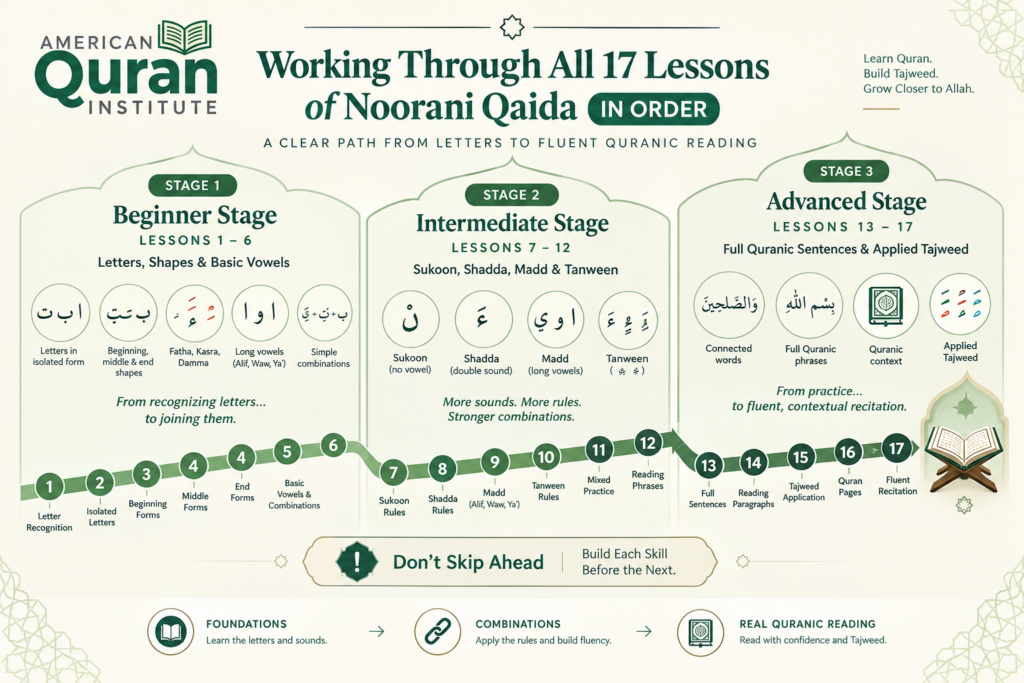
C. Advanced Stage: Full Quranic Sentences And Applied Tajweed
The final lessons bridge the Noorani Qaida directly to Quran recitation. Students read short Quranic phrases and surahs using all of the rules they have learned, applying them in context rather than in isolated drills.
Finishing this stage means a student can open any copy of the Quran and read from it — not yet fluently, but correctly and independently. That transition is the entire purpose of the curriculum.
See Us in Action!
Take a look inside our virtual classrooms. Watch the clip below to see how our instructors engage with students, simplify complex rules, and create an inspiring environment for learning.
Start Your Quranic Education
Join our premier online institute for structured Quranic learning tailored for students in the USA.
Book Your Free Trial5. Use Free Tools To Reinforce Your Classes
There are genuinely useful free resources for Noorani Qaida learners, and there are ones that create false confidence by simulating progress without actually delivering it.
YouTube playlists from certified teachers can reinforce what you covered in your live session.
Listening to correct pronunciation between classes helps cement the sounds in memory before the next session.
The noorani qaida master reading the Quran pdf is a widely circulated reference that many teachers use as their classroom text — having a copy available means you can follow along during class and review exercises independently.
They model correct pronunciation, but they cannot hear you mispronounce a letter and catch it in real time.
For learning to read Quran for adults, this distinction matters more than for children — adults who have been mispronouncing Arabic letter sounds for years need active correction, not passive repetition, or they reinforce errors rather than eliminate them.
A common misconception is that enough self-study eventually gets you there. The detailed look at how to learn the Quran by yourself covers the methods and their limits clearly — and the consistent conclusion is that self-study works best as a supplement to live instruction, not as a replacement for it.
Book your first free class today
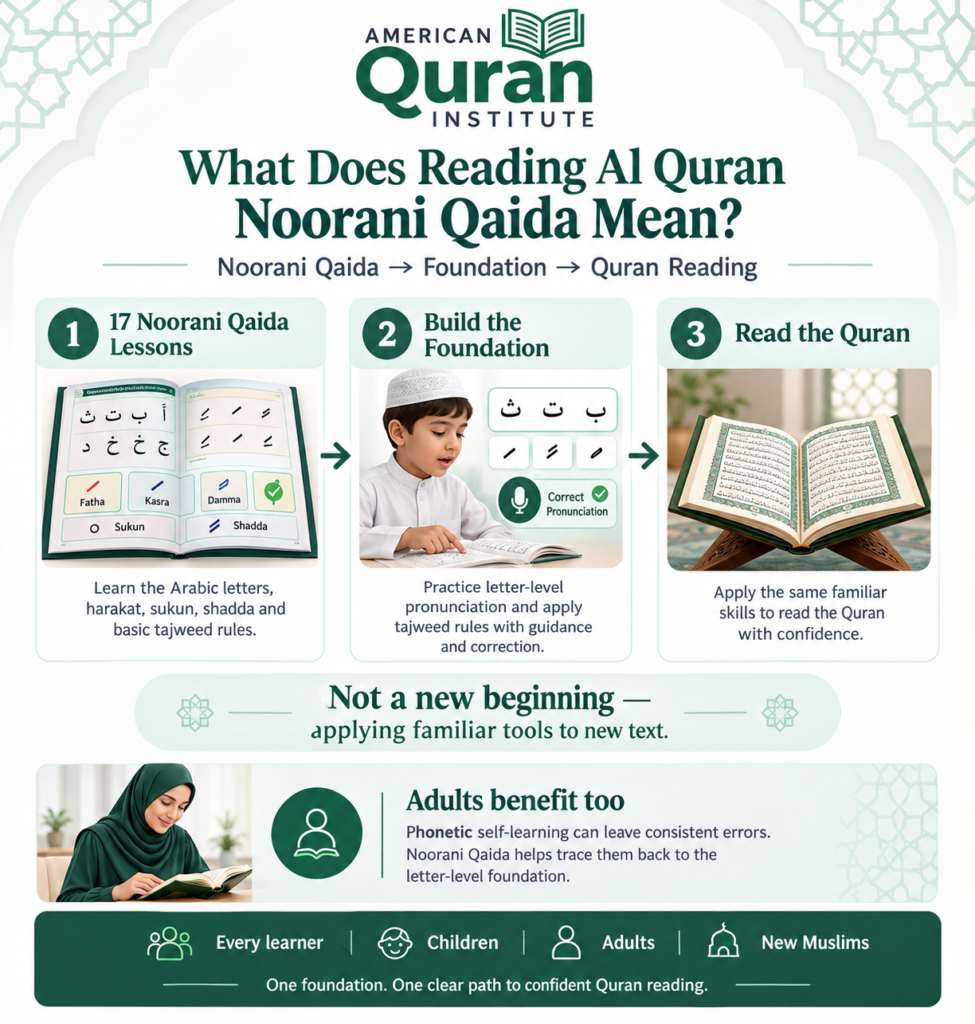
6. Understand What “Reading Al Quran Noorani Qaida” Means in Practical Terms
The phrase reading al Quran noorani qaida describes the relationship between the two: the Noorani Qaida is not a parallel study track — it is the direct preparation that makes Quran reading possible in the first place.
When a student finishes all 17 lessons, the move to the Quran is not a leap into new territory. Every tajweed rule they will encounter in the Quran has already appeared in the Noorani Qaida in its simplified, teachable form.
The transition is designed to feel like applying familiar tools to new text, not starting from scratch.
This is why the Noorani Qaida is recommended for every type of learner — not only young children.
Adults who bypassed it and taught themselves phonetically often find that their recitation contains specific, consistent errors that trace directly back to gaps in their letter-level foundation.
The guide on how to read Quran for beginners addresses exactly this: why foundational training is not optional even for adults who can already produce some Arabic sounds from memory.
Not sure where to begin? The American Quran Institute offers free trial classes with Ijazah-certified teachers across all US time zones — for adults, kids, sisters, and new Muslims. One session is enough to find out which level is right for you.
7. Track Your Progress Lesson by Lesson Before You Move Forward
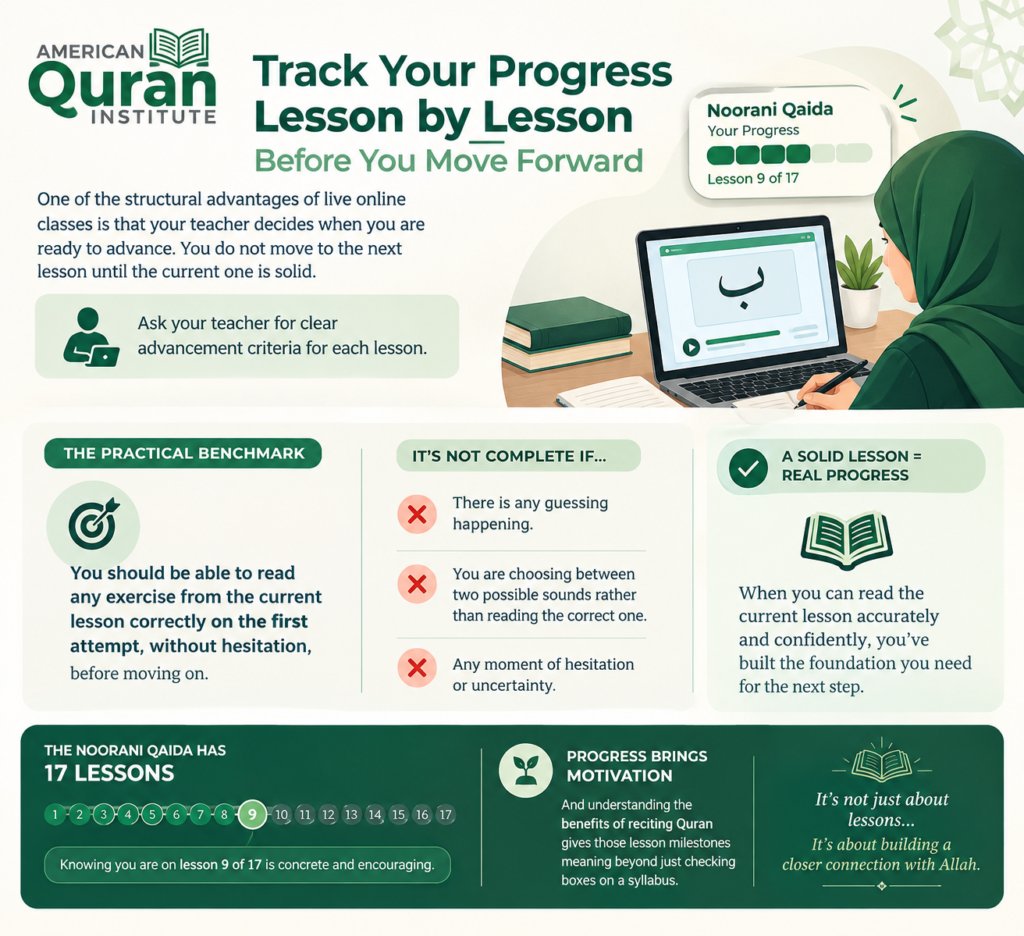
One of the structural advantages of live online classes is that your teacher decides when you are ready to advance. You do not move to the next lesson until the current one is solid. Ask your teacher for clear advancement criteria for each lesson.
A practical benchmark: you should be able to read any exercise from the current lesson correctly on the first attempt, without hesitation, before moving on.
If there is any guessing happening, any moment where you are choosing between two possible sounds rather than reading the correct one, the lesson is not complete.
Progress tracking matters for motivation as much as it does for accuracy. The Noorani Qaida has 17 lessons. Knowing you are on lesson 9 of 17 is concrete and encouraging.
Understanding the benefits of reciting Quran gives those lesson milestones meaning beyond just checking boxes on a syllabus.
8. Choose The Online Class Format That Matches How You Actually Learn
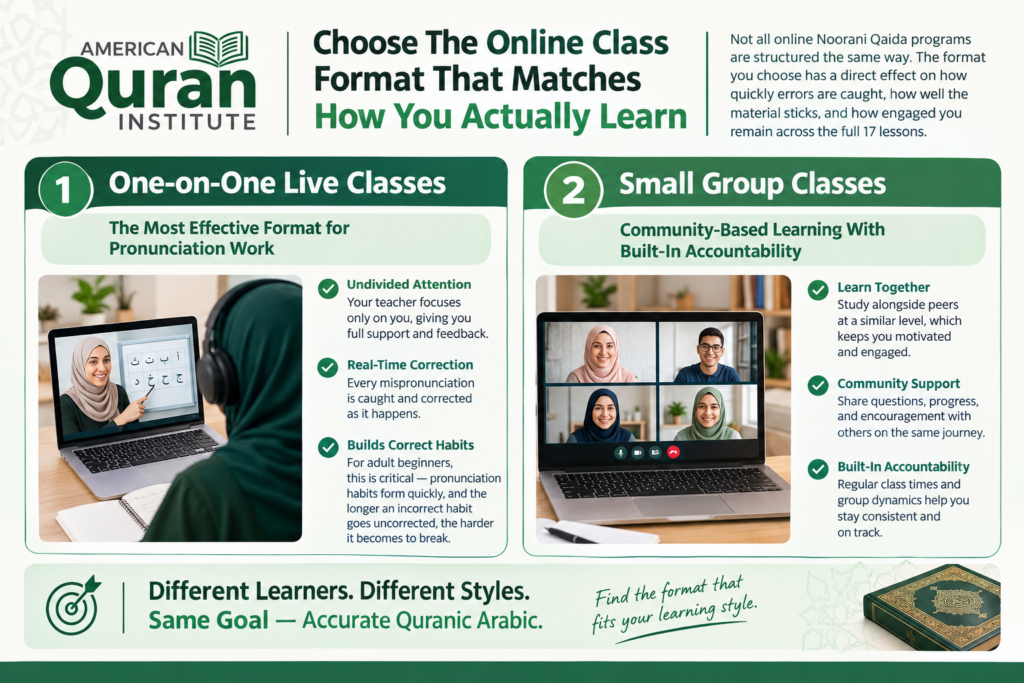
Not all online Noorani Qaida programs are structured the same way. The format you choose has a direct effect on how quickly errors are caught, how well the material sticks, and how engaged you remain across the full 17 lessons.
A. One-on-One Live Classes: The Most Effective Format for Pronunciation Work
Individual sessions give your teacher their undivided attention for the entire class. Every mispronunciation is caught and corrected in real time.
For adult beginners learning Quranic Arabic sounds for the first time, this is critical — pronunciation habits form quickly, and the longer an incorrect habit goes uncorrected, the harder it becomes to break.
One-on-one sessions via Zoom also allow the teacher to adjust pace around your specific needs. If a concept in lesson 6 requires an extra session to fully internalize, the class slows down for you without affecting anyone else.
This format is most recommended for anyone learning how to read the Quran in Arabic easy from a complete-beginner starting point, especially in the early lessons where letter shapes and short vowel sounds are being established for the first time.
B. Small Group Classes: Community-Based Learning With Built-In Accountability
Some learners progress faster when they study alongside peers at a similar level. Small group classes — typically two to five students — provide that community element without removing individual attention entirely.
They are generally more affordable than one-on-one sessions, and the social dynamic often increases attendance and engagement for younger learners.
The practical trade-off is that correction time is divided among students. Group classes work well once the beginner stage is complete and a student is reinforcing intermediate concepts rather than establishing them from scratch.
For parents specifically searching for learn to read Quran online for kids programs, small group formats often increase energy and alertness for children between ages 6 and 12.
Start The Journey of Quran Ijazah Program at American Quran Institute
9. Plan Your Timeline Around Realistic Expectations
The first question every new learner asks is how long this will take. The answer depends on three variables: the learner’s age, session frequency, and prior exposure to Arabic sounds.
Children ages 4 to 7 with daily 15-minute sessions typically complete the Noorani Qaida in four to six months. Children ages 8 to 12 attending three sessions per week generally finish in three to four months.
Adult beginners with no Arabic background, attending three sessions per week of 30 to 45 minutes each, typically complete the curriculum in two to five months.
During difficult stretches many long-term learners say that returning to their powerful motivations to read Quran is what keeps them from stopping at lesson 10. Keeping the end goal visible makes the intermediate lessons feel purposeful rather than mechanical.
The habit of how to start reading the Quran daily does not begin after you finish the Noorani Qaida — it begins during it.
Students who build a daily reading practice during the curriculum phase arrive at the Quran already conditioned for consistency, which is the variable that determines long-term progress more than any other.
Experience Our Classroom Environment
Don’t just take our word for it—experience a live session for yourself! Click on the videos below to watch real snippets from our classes and see our interactive teaching methods in real-time.
Start Your Quranic Education
Join our premier online institute for structured Quranic learning tailored for students in the USA.
Book Your Free TrialStart Learning Noorani Qaida Today Where Your Quran Reading Begins Here
The Noorani Qaida is where fluent Quranic recitation begins. Every letter you learn correctly, every rule you internalize, and every lesson you complete moves you one step closer to reading the Quran with real confidence and accuracy.
The American Quran Institute pairs you with an Ijazah-certified teacher who has guided American Muslim families through every stage of this curriculum from the very first Arabic letter through fluid, confident recitation.
Classes are live, one-on-one, and built around US schedules so that learning fits around your life, not the other way around.
Book your first free class today and begin at the foundation and build confidence step by step.
Our Memorization Courses
- Quran Memorization (Hifz) Course
- Hifz Classes for Adults
- Quran Memorization and Hifz Course for Kids
- Quran Hifz Course for Ladies
- Quran Ijazah Program
Our Tajweed Courses
Start Your Quranic Education
Join our premier online institute for structured Quranic learning tailored for students in the USA.
Book Your Free TrialConclusion
The Noorani Qaida is not a shortcut to the Quran — it is the only correct starting point. Its 17 lessons systematically build letter recognition, vowel fluency, and foundational tajweed skills that make independent Quranic reading possible.
For American Muslims, the practical question has always been access: finding a qualified, Ijazah-certified teacher who is available across US time zones, teaches fluently in English, and fits into a schedule built around work, school, and family.
That access now exists in a way it did not even a decade ago. Live online classes have made it possible to pursue the Noorani Qaida with the rigor of a traditional Islamic school — from home, on your terms.
The nine steps in this guide give you a complete framework: understand the curriculum before you start, find a teacher with the right credentials and the right schedule, follow all 17 lessons in order, practice consistently between sessions, use free tools as supplements rather than substitutes, track your advancement before moving forward.
Frequently Asked Questions
What is the Noorani Qaida, and why is it taught before the Quran?
The Noorani Qaida is a phonics-based Quranic primer developed by Sheikh Noor Muhammad Haqqani. It teaches Quranic Arabic letters, vowel sounds, and foundational tajweed rules in a structured, progressive sequence before a student reads from the Quran itself.
Starting directly with the Quran, without this preparation, leads to pronunciation errors that become embedded habits and those habits are significantly harder to correct later.
How long does it take to complete the Noorani Qaida online?
Completion time depends on age and how frequently a student practices. Children ages 4 to 7 with daily short sessions typically finish in four to six months. Adults attending three sessions per week generally complete the curriculum in two to five months. Consistent practice between live classes is the single biggest factor determining how quickly a student moves through the 17 lessons.
Do I need any prior knowledge of Arabic to start the Noorani Qaida?
No prior knowledge of Arabic — spoken or written — is required. The Noorani Qaida begins with the Arabic alphabet from the very first lesson and is designed specifically for complete beginners. It is the correct starting point for children and adults alike, regardless of background.
Is the Noorani Qaida appropriate for non-Muslims who want to learn to read the Quran?
Yes. How to read Quran as a non-Muslim is a question many people ask, and the Noorani Qaida is the same recommended starting point regardless of faith background. The curriculum teaches Quranic Arabic reading — it is open to anyone who wants to learn it.
What is the difference between the Noorani Qaida and a formal tajweed course?
The Noorani Qaida introduces the tajweed rules that govern basic recitation, integrated into the letter and vowel lessons from the beginning. A dedicated tajweed course goes considerably deeper covering precise articulation points, advanced rules of elongation, and the full system of recitation for students who can already read the Quran fluently and independently.
Why can’t I just use videos and PDFs to learn the Noorani Qaida on my own?
Videos and PDFs model correct pronunciation but cannot hear yours. Learning from recorded material alone means your errors go uncaught and become part of your recitation pattern. A live teacher hears exactly what you are producing and corrects it in the moment — which is the mechanism through which accurate pronunciation is actually learned.





Leave a Reply