 Quran
Quran
Learning the Quran is a journey that combines sincere effort, regular practice, understanding, and reliance upon Allah. Many students search for a dua for learning Quran because they want to ask Allah to increase their knowledge, strengthen their memory, help them understand His Book, and keep the Quran firmly in their hearts.
There is no single supplication that must be recited exclusively when beginning to learn the Quran. However, the Quran itself contains beautiful supplications for seeking knowledge, guidance, steadfastness, and ease. There are also reported supplications related to memorizing the Quran that can be mentioned with appropriate attribution.
The following duas can help a student build a meaningful spiritual routine alongside regular Quran study and memorization.
1. Dua for Increasing Knowledge from the Quran
One of the most direct Quranic supplications for anyone seeking knowledge is found in Surah Taha. Allah says:
“وَقُل رَّبِّ زِدْنِي عِلْمًا”
“Wa qul rabbi zidni ‘ilma.“
“And say, ‘My Lord, increase me in knowledge.’Surah Taha 20:114
This supplication appears in Surah Taha 20:114. The verse comes in the context of the Prophet ﷺ receiving revelation and being instructed not to rush ahead of it, followed by the command to ask Allah for an increase in knowledge.
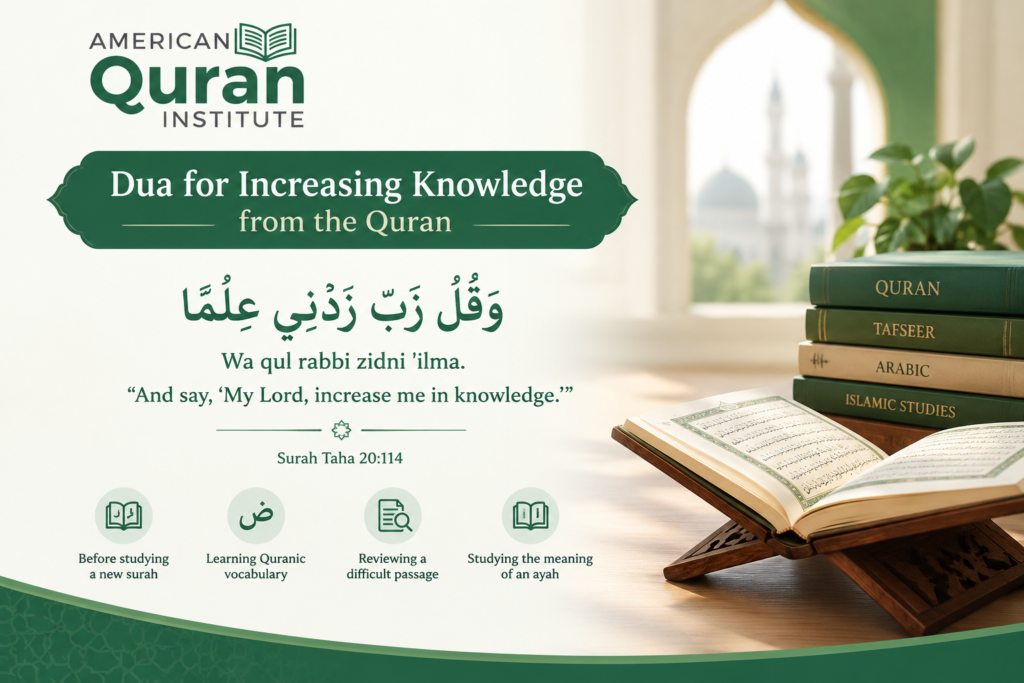
For a Quran student, this short dua has a broad and meaningful application. It can be said before studying a new surah, learning Quranic vocabulary, reviewing a difficult passage, or studying the meaning of an ayah.
It also reminds the student that knowledge is ultimately a gift from Allah. A person may study consistently and use every available learning method, while still asking Allah to grant beneficial understanding.
2. Dua for Understanding and Ease When Studying the Quran
When Prophet Musa عليه السلام was preparing to speak to Pharaoh, he turned to Allah with a supplication asking for an open heart, ease in his task, and clarity in speech.
رَبِّ ٱشْرَحْ لِي صَدْرِي وَيَسِّرْ لِيٓ أَمْرِي وَٱحْلُلْ عُقْدَةً مِّن لِّسَانِي يَفْقَهُواْ قَوْلِي
“Rabbi ishrah li sadri, wa yassir li amri, wahlul ‘uqdatan min lisani, yafqahu qawli.“
“My Lord! Uplift my heart for me, make my task easy, and remove the impediment from my tongue so people may understand my speech.” Surah Taha 20:25–28.
Although the original context concerns Prophet Musa عليه السلام, its wording provides a meaningful dua for anyone facing difficulty with a beneficial task. A Quran student may reflect on these meanings when struggling with pronunciation, recitation, understanding, or communicating what they have learned.
For beginners especially, learning Arabic letters, sounds, Makharij, and connected words can initially feel difficult. A structured Noorani Qaida course can help students build these foundational reading skills step by step. Asking Allah for ease can accompany the practical process of learning and repetition.

3. Dua for Remaining Steadfast After Receiving Guidance
Quran learning is not only about collecting information. A Muslim also asks Allah to keep the heart firm upon guidance.
Allah records the supplication of the believers:
“رَبَّنَا لَا تُزِغْ قُلُوبَنَا بَعْدَ إِذْ هَدَيْتَنَا وَهَبْ لَنَا مِن لَّدُنكَ رَحْمَةً ۚ إِنَّكَ أَنتَ ٱلْوَهَّابُ”
“Rabbana la tuzigh qulubana ba’da idh hadaytana wa hab lana min ladunka rahmah, innaka antal-Wahhab.“
“Our Lord! Do not let our hearts deviate after You have guided us. Grant us Your mercy. You are indeed the Giver of all bounties.”
Surah Ali ‘Imran 3:8.This dua is especially meaningful for a Quran student because learning the Quran is intended to influence the heart and actions, not merely increase the amount of information a person can recall.
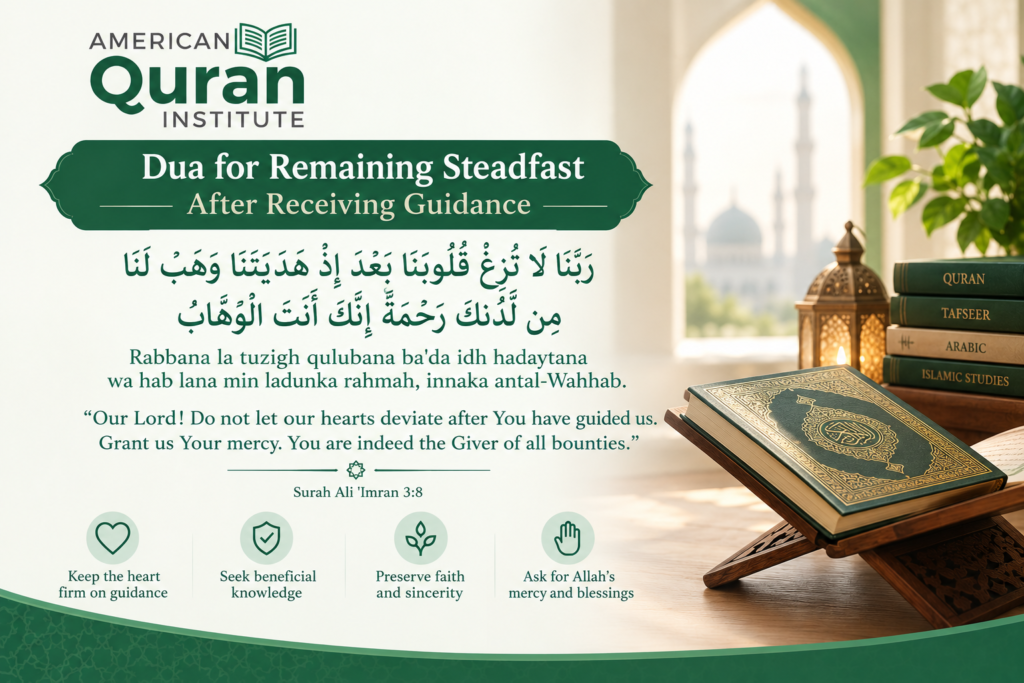
A student can therefore ask Allah for beneficial knowledge while also asking Him to preserve faith, sincerity, and steadfastness.
4. Dua for Guidance Toward What Is Right
Another Quranic supplication appears in Surah Al-Kahf:
“عَسَىٰٓ أَن يَهْدِيَنِ رَبِّي لِأَقْرَبَ مِنْ هَٰذَا رَشَدًا”
‘Asa an yahdiyani Rabbi li-aqraba min hadha rashada.“
“I trust my Lord will guide me to what is more right than this.”Surah Al-Kahf 18:24
The wording appears in Surah Al-Kahf 18:24, within a broader passage that also reminds believers to remember Allah. A Quran student can reflect on this meaning when seeking sound understanding and asking Allah to guide them toward what is correct.
This is particularly relevant when studying verses whose meanings require explanation. Rather than relying only on personal assumptions, students can ask Allah for guidance and seek explanations through reliable Quran Tafsir classes and qualified teachers.

Experience Our Classroom Environment
Don’t just take our word for it—experience a live session for yourself! Click on the videos below to watch real snippets from our classes and see our interactive teaching methods in real-time.
Start Your Quranic Education
Join our premier online institute for structured Quranic learning tailored for students in the USA.
Book Your Free Trial5. Dua for Memorizing the Quran and Keeping It Firm in the Heart
For students pursuing Hifz, memorization involves more than learning a passage once. It requires repeated recitation, revision, correction, and continued review.
A reported narration attributed to Ali رضي الله عنه describes a supplication connected with asking Allah to establish the Quran in the heart. The report describes Ali رضي الله عنه complaining about the Quran slipping from his memory and then receiving words through which he could ask Allah for help.
The reported supplication includes:
اللَّهُمَّ ارْحَمْنِي بِتَرْكِ مَعَاصِيكَ أَبَدًا مَا أَبْقَيْتَنِي، فَارْحَمْنِي بِتَرْكِ مَا لَا يَعْنِينِي، وَارْزُقْنِي حُسْنَ النَّظَرِ فِيمَا يُرْضِيكَ عَنِّي، وَأَلْزِمْ قَلْبِي حِفْظَ كِتَابِكَ كَمَا عَلَّمْتَنِي، وَأَنْ أَتْلُوَهُ عَلَى” النَّحْوِ الَّذِي يُرْضِيكَ مِنِّي.”
“اللَّهُمَّ نَوِّرْ بِكِتَابِكَ بَصَرِي، وَأَطْلِقْ بِهِ لِسَانِي، وَاشْرَحْ بِهِ صَدْرِي، وَاسْتَعْمِلْ بِهِ بَدَنِي، وَأَعِنِّي عَلَيْهِ إِنَّهُ لَا يُعِينُ عَلَيْهِ إِلَّا أَنْتَ.”
“O Allah, have mercy on me by helping me leave disobedience as long as You keep me alive. Have mercy on me by helping me leave what does not concern me. Grant me sound consideration of what pleases You. Keep the memorization of Your Book firmly in my heart as You have taught me, and enable me to recite it in the manner that pleases You. O Allah, enlighten my sight through Your Book, release my tongue through it, expand my chest through it, put my body to work through it, and help me with it, for none can help me with it except You.” Jami` at-Tirmidhi 3570
This report should be presented with appropriate qualification rather than being described simply as an authenticated Prophetic hadith. The source cited in the supplied material attributes the report to Ali رضي الله عنه and references Da’a’im al-Islam, volume 2, page 137.
6. Personal Dua for Memorizing and Understanding the Quran
A student may also make a personal dua asking Allah to combine memorization with understanding and action.
“اللَّهُمَّ إِنِّي أَسْأَلُكَ أَنْ تَرْزُقَنِي حِفْظَ الْقُرْآنِ، وَفَهْمَ الْقُرْآنِ، وَالْعَمَلَ بِالْقُرْآنِ، اللَّهُمَّ إِنِّي أَسْأَلُكَ أَنْ تَجْعَلَنِي مِنْ أَهْلِ الْقُرْآنِ وَخَاصَّتِكَ، وَأَنْ تُقَرِّبَنِي إِلَيْكَ، وَتَرْضَى عَنِّي.”
“Allahumma inni as’aluka an tarzuqani hifdha al-Qur’an, wa fahma al-Qur’an, wal-‘amala bil-Qur’an. Allahumma inni as’aluka an taj’alani min ahlil-Qur’an wa khasstika, wa an tuqarribani ilayka, wa tarda ‘anni.”
“O Allah, I ask You to bless me with memorization of the Quran, understanding of the Quran, and acting upon the Quran. O Allah, I ask You to make me among the people of the Quran, bring me closer to You, and be pleased with me.” Hisn al-Muslim 62
This wording can be used as a personal dua for learning Quran. It should not be presented as a specific Prophetic supplication unless a reliable source establishes that attribution.

This distinction allows students to make sincere personal requests without confusing their own wording with established Sunnah.
7. Dua for Keeping the Quran in the Heart and Home
A person may also ask Allah to maintain a lasting relationship with the Quran:
“اللَّهُمَّ لَا تَقْطَعِ الْقُرْآنَ مِنْ قُلُوبِنَا وَلَا مِنْ بُيُوتِنَا، وَاجْعَلْهُ مِيرَاثًا لَنَا فِي أَوْلَادِنَا مِنْ بَعْدِنَا.”
Allahumma la taqta’ al-Qur’ana min qulubina wa la min buyutina, waj’alhu mirathan lana fi awladina min ba’dina.
“O Allah, do not remove the Quran from our hearts or our homes, and make it an inheritance for our children after us.”
This is best treated as a general personal supplication, not as a dua established from the Prophet ﷺ. Its meaning reflects a valuable goal for Quran learning: that the Quran should remain part of a person’s daily life and, where possible, become part of the family’s learning environment as well.
What Should a Student Ask Allah for When Learning the Quran?
A Quran student does not need to limit their dua to memorization alone. The learning journey involves several connected goals. A student can ask Allah for:
- Knowledge, so that new lessons become beneficial.
- Understanding, so that memorized words are connected to meaning.
- Ease, when pronunciation, reading, or memorization feels difficult.
- Strong memory, while recognizing that memorization still requires repetition.
- Steadfastness, so that Quran study becomes consistent.
- Guidance, so that learning leads to sound understanding and practice.
- Sincerity, so that learning is done for Allah.
- Correct recitation, especially when studying Tajweed.
- Beneficial action, so that Quranic learning influences daily life.
This broader approach helps prevent Quran learning from becoming only a memorization exercise. Students who want to develop a consistent Hifz routine can also follow a structured Quran memorization course alongside regular revision and practice.

Start Your Quranic Education
Join our premier online institute for structured Quranic learning tailored for students in the USA.
Book Your Free TrialIs There a Specific Dua for Learning the Quran?
There is no single authentic Prophetic supplication that is specifically prescribed for every Quran student to recite before every lesson.
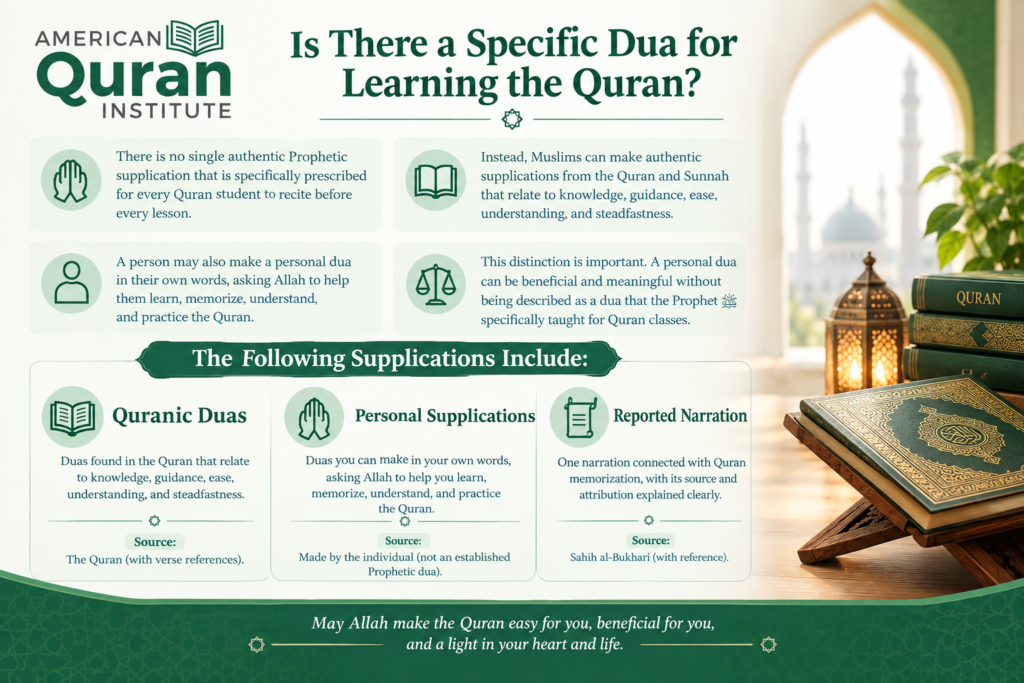
Instead, Muslims can make authentic supplications from the Quran and Sunnah that relate to knowledge, guidance, ease, understanding, and steadfastness. A person may also make a personal dua in their own words, asking Allah to help them learn, memorize, understand, and practice the Quran.
This distinction is important. A personal dua can be beneficial and meaningful without being described as a dua that the Prophet ﷺ specifically taught for Quran classes.
The following supplications therefore include Quranic duas, personal supplications, and one reported narration connected with Quran memorization, with their sources and attribution explained clearly.
Does Dua Help With Quran Memorization?
A Muslim may ask Allah to help with memorization, understanding, concentration, and retention. However, making dua does not remove the need for practical effort.
Quran memorization normally requires repeated exposure to the same verses, accurate recitation, frequent revision, and correction when mistakes occur.
A student may therefore combine spiritual and practical steps:
- Make sincere dua before studying.
- Listen carefully to the passage.
- Read the verses repeatedly.
- Memorize a manageable amount.
- Recite without looking at the Mushaf.
- Correct mistakes with a qualified teacher.
- Review older portions regularly.
- Continue making dua for steadfastness and consistency.
This approach is especially useful for beginners because progress does not depend on memorizing a large amount at once.
A Simple Quran Learning Routine
A consistent Quran learning routine does not need to be complicated. The goal is to create a manageable pattern that combines dua, focused study, revision, and gradual progress.
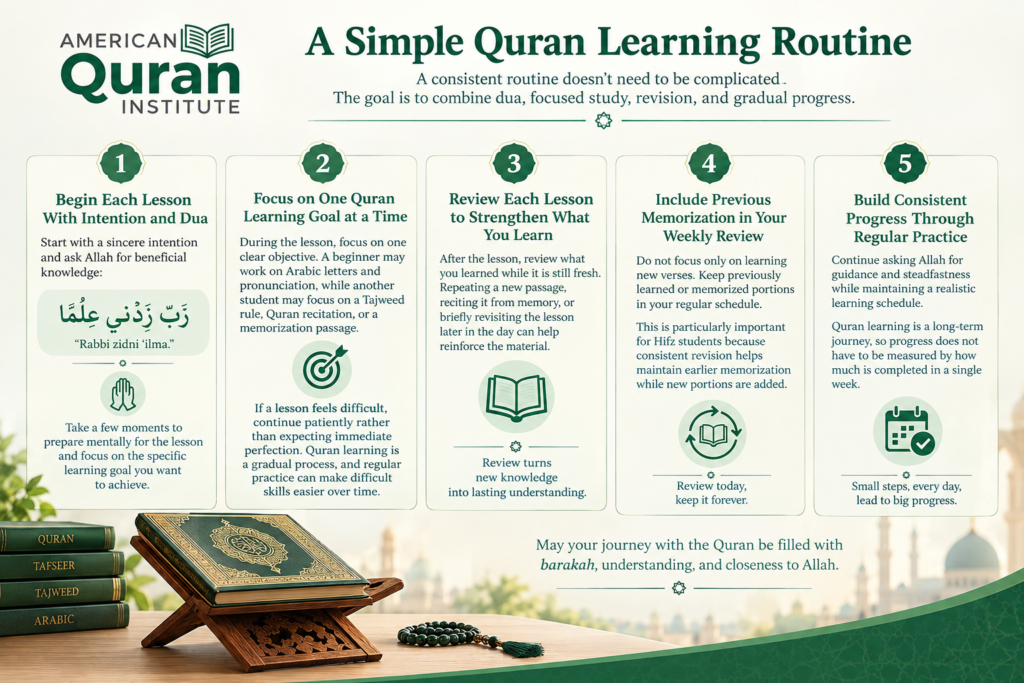
1. Begin Each Lesson With Intention and Dua
Start with a sincere intention and ask Allah for beneficial knowledge:
“رَّبِّ زِدْنِي عِلْمًا”
Take a few moments to prepare mentally for the lesson and focus on the specific learning goal you want to achieve.
2. Focus on One Quran Learning Goal at a Time
During the lesson, focus on one clear objective. A beginner may work on Arabic letters and pronunciation, while another student may focus on a Tajweed rule, Quran recitation, or a memorization passage.
If a lesson feels difficult, continue patiently rather than expecting immediate perfection. Quran learning is a gradual process, and regular practice can make difficult skills easier over time.
3. Review Each Lesson to Strengthen What You Learn
After the lesson, review what you learned while it is still fresh. Repeating a new passage, reciting it from memory, or briefly revisiting the lesson later in the day can help reinforce the material.
4. Include Previous Memorization in Your Weekly Review
Do not focus only on learning new verses. Keep previously learned or memorized portions in your regular schedule. This is particularly important for Hifz students because consistent revision helps maintain earlier memorization while new portions are added.
5. Build Consistent Progress Through Regular Practice
Continue asking Allah for guidance and steadfastness while maintaining a realistic learning schedule. Quran learning is a long-term journey, so progress does not have to be measured by how much is completed in a single week.
A consistent routine, even when the daily amount is small, can help build a lasting connection with the Quran.
See Us in Action!
Take a look inside our virtual classrooms. Watch the clip below to see how our instructors engage with students, simplify complex rules, and create an inspiring environment for learning.
Start Your Quranic Education
Join our premier online institute for structured Quranic learning tailored for students in the USA.
Book Your Free TrialStart Learning the Quran with American Quran Institute
Dua opens the door, and structured learning walks you through it. Choose one dua for learning Quran from this list, recite it before every session, and pair it with consistent practice under a qualified teacher.
At American Quran Institute, you can learn the Quran online with certified teachers, whether you are beginning to read, perfecting your Tajweed, or memorizing the Quran by heart. Let your dua be sincere, your method sound, and your teacher qualified, and the Quran will settle in your heart, in sha’ Allah.
Start your Quran learning journey today with a free trial at American Quran Institute.
Our Quran Courses
- Quran Online Academy
- Quran Recitation Classes
- Quran Reading Classes
- Online Quran Classes for Kids
- Quran Classes for Adults
- Quran Classes for Female/Sisters
- Learn Quran Course for Beginners
- Quran Qirat Learning Course
- Quran Tafsir Course

Conclusion
A dua for learning Quran can help a student approach the Quran with sincerity, patience, and reliance upon Allah. Whether the goal is to gain knowledge, improve understanding, memorize verses, strengthen recitation, or remain steadfast in learning, the Quran and Sunnah provide meaningful supplications that can become part of a regular learning routine.
At the same time, dua should be accompanied by consistent effort. Regular recitation, revision, Tajweed practice, understanding the meanings, and learning from a qualified teacher all play an important role in building a lasting relationship with the Quran. Even small, consistent steps can help a student continue progressing without becoming overwhelmed.
Ask Allah for beneficial knowledge, ease, guidance, and steadfastness, then take the practical steps needed to keep learning. With sincere dua, patient practice, and reliable guidance, Quran learning can become a meaningful part of daily life and a lasting source of guidance, in sha’ Allah.
Frequently Asked Questions
What is the best dua for learning Quran?
“Rabbi zidni ‘ilma” (رَّبِّ زِدْنِى عِلْمًا) is the best known because it comes from the Quran itself. It is short, authentic, and easy to repeat before every lesson. Surah Taha 20:114.
What is the dua to learn Quran by heart?
A common choice is “Allahumma inni as’aluka an tarzuqani hifdhal-Qur’an, wa fahmal-Qur’an, wal-‘amala bil-Qur’an.” Many students also recite the words taught to Ali, asking Allah to “make my heart hold fast to Your Book.”
Is the dua for memorizing Quran taught to Ali authentic?
Scholars disagree. Al-Hakim graded it sahih, while al-Albani judged it fabricated, and Sunnah.com lists it as da’if. The special prayer is not an established Sunnah, but its words carry sound meanings and can be said as general dua. Jami’ at-Tirmidhi 3570.
Can I make dua for learning Quran in English?
Yes. Outside the prayer you can make dua in any language, and Allah understands every tongue. Learning the Arabic wording over time adds to the reward and the connection.
Can parents make dua for their children to memorize the Quran?
Yes. The Prophet ﷺ counted a parent’s dua among the supplications that are answered:
ثَلاَثُ دَعَوَاتٍ مُسْتَجَابَاتٌ لاَ شَكَّ فِيهِنَّ دَعْوَةُ الْوَالِدِ وَدَعْوَةُ الْمُسَافِرِ وَدَعْوَةُ الْمَظْلُومِ
“Three supplications are answered, with no doubt about them: the supplication of a parent, the supplication of a traveler, and the supplication of one who has been wronged.” Sunan Abi Dawud 1536
So a parent’s dua for a child’s Hifz is among the most hopeful of all. “Allahumma la taqta’il-Qur’ana min qulubina wa la min buyutina” is a beautiful dua for the whole family.







Leave a Reply