 Quran
Justice is one of the clearest moral principles repeated throughout the Quran. Allah commands believers to judge fairly, speak truthfully, protect people’s rights, fulfill trusts, and refuse to let personal interests, family ties, wealth, poverty, or even hatred influence what is right.
The Quran verses about justice in Arabic show that justice is not limited to courts or rulers. It applies to testimony, family relationships, financial dealings, conflict resolution, speech, business transactions, and everyday treatment of other people.
The Quran uses several important Arabic terms connected with justice, especially الْعَدْل — al-‘adl and الْقِسْط — al-qist. Both appear in verses that call Muslims to fairness, balance, and impartial judgment.
Below are some of the most important Quran verses about justice in Arabic, with transliteration, English translation, Quran.com references, and explanations of what each verse teaches.
1. Quran Verse About Allah Commanding Justice, Excellence, and Good Conduct
One of the clearest and most comprehensive Quran verses about justice appears in Surah An-Nahl.
إِنَّ اللَّهَ يَأْمُرُ بِالْعَدْلِ وَالْإِحْسَانِ وَإِيتَاءِ ذِي الْقُرْبَىٰ وَيَنْهَىٰ عَنِ الْفَحْشَاءِ وَالْمُنكَرِ وَالْبَغْيِ
Innal laaha ya’muru bil ‘adli wal ihsaani wa eetaaa’i zil qurbaa wa yanhaa ‘anil fahshaaa’i wal munkari wal baghy.
“Indeed, Allah commands justice and good conduct and giving to relatives and forbids immorality and bad conduct and oppression.”
The verse places justice — al-‘adl alongside ihsan, or excellence and good conduct.
Justice establishes what is right and fair, while ihsan encourages believers to go beyond minimum fairness through kindness, generosity, and good character.
The same verse also forbids baghy, oppression and transgression. Justice in the Quran is therefore both positive and protective: believers are told to establish fairness and avoid abuse.
2. Quran Verse About Returning Trusts and Judging Between People Fairly
Justice in the Quran is closely connected with responsibility and trust.
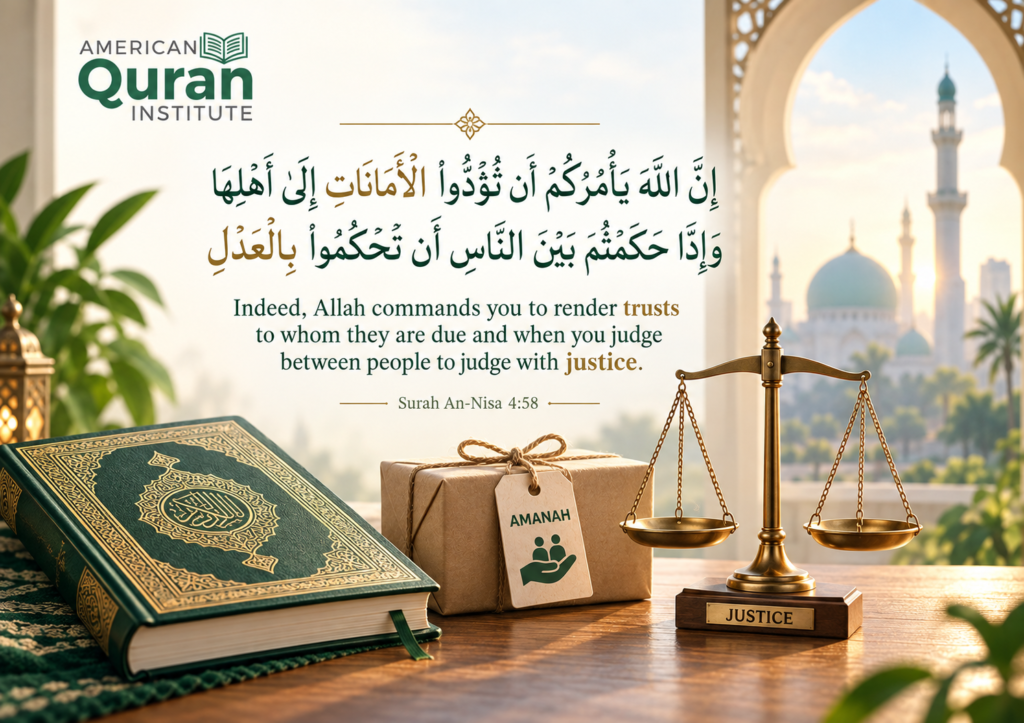
إِنَّ اللَّهَ يَأْمُرُكُمْ أَن تُؤَدُّوا الْأَمَانَاتِ إِلَىٰ أَهْلِهَا وَإِذَا حَكَمْتُم بَيْنَ النَّاسِ أَن تَحْكُمُوا بِالْعَدْلِ
Innal laaha ya’murukum an tu’addul amaanaati ilaaa ahlihaa wa izaa hakamtum bainan naasi an tahkumoo bil ‘adl.
“Indeed, Allah commands you to render trusts to whom they are due and when you judge between people to judge with justice.”
The verse links two essential principles: amanah and justice. A person who is given a responsibility must fulfill it properly, and anyone who judges between people must do so fairly. The wording says بَيْنَ النَّاسِ — “between people,” making the command broad rather than limited to one group.
Read also: Quran Verses About Humanity In Arabic
3. Quran Verse About Standing Firm for Justice Even Against Yourself or Your Family
One of the strongest Quranic commands concerning impartiality appears in Surah An-Nisa.
يَا أَيُّهَا الَّذِينَ آمَنُوا كُونُوا قَوَّامِينَ بِالْقِسْطِ شُهَدَاءَ لِلَّهِ وَلَوْ عَلَىٰ أَنفُسِكُمْ أَوِ الْوَالِدَيْنِ وَالْأَقْرَبِينَ
Yaa ayyuhal lazeena aamanoo koonoo qawwaameena bil qisti shuhadaaa’a lillaahi wa law ‘alaa anfusikum awil waalidaini wal aqrabeen.
“O you who have believed, be persistently standing firm in justice, witnesses for Allah, even if it be against yourselves or parents and relatives.”
Justice is tested most seriously when telling the truth may disadvantage someone close to us. This verse removes several common excuses for bias. A believer is not allowed to distort justice simply to protect themselves, their parents, or their relatives. The full verse also warns against allowing wealth, poverty, or personal desire to influence judgment.
Read also: Quran Verses About Hope In Arabic – Mercy, Relief, And Trust In Allah
4. Quran Verse About Allah Loving Those Who Judge With Justice
The Quran not only commands justice; it also describes just people as loved by Allah.
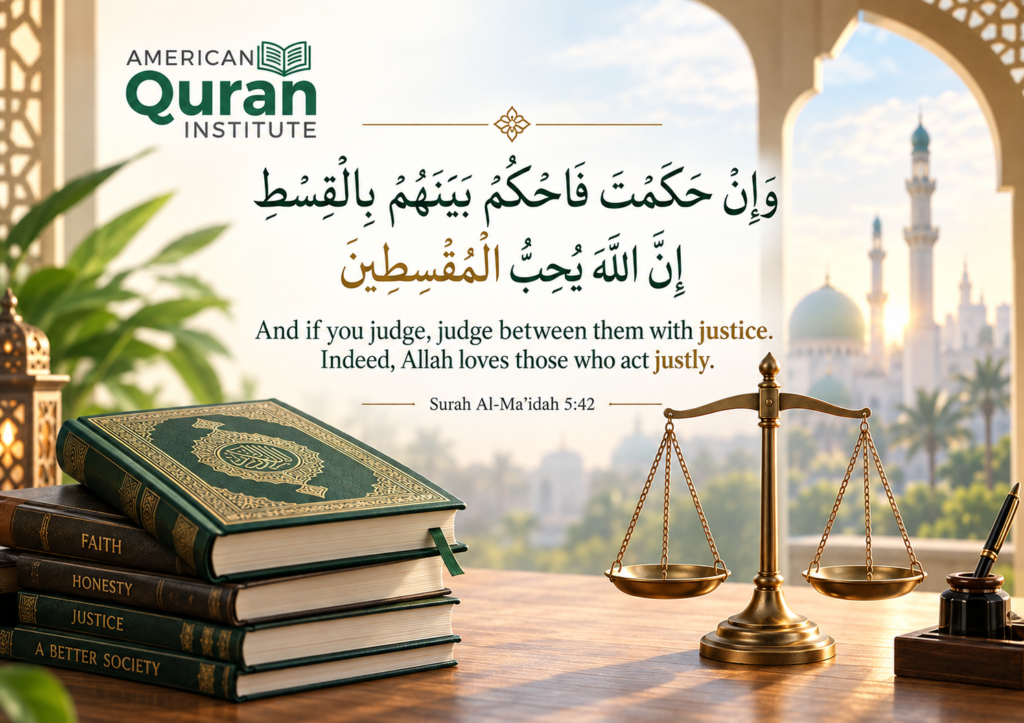
وَإِنْ حَكَمْتَ فَاحْكُم بَيْنَهُم بِالْقِسْطِ ۚ إِنَّ اللَّهَ يُحِبُّ الْمُقْسِطِينَ
Wa in hakamta fahkum bainahum bil qist; innal laaha yuhibbul muqsiteen.
“And if you judge, judge between them with justice. Indeed, Allah loves those who act justly.”
The key word is الْمُقْسِطِينَ — al-muqsiteen, those who act with justice. This verse gives justice a spiritual dimension. Fair judgment is not only socially beneficial; it is an action beloved to Allah.
5. Quran Verse About Being Fair in Speech Even When Relatives Are Involved
Justice in the Quran also applies to what people say.
وَإِذَا قُلْتُمْ فَاعْدِلُوا وَلَوْ كَانَ ذَا قُرْبَىٰ
Wa izaa qultum fa‘diloo wa law kaana zaa qurbaa.
“And when you speak, be just, even if it concerns a near relative.”
This command is especially relevant to testimony, accusation, disagreement, and reporting what happened. Family loyalty must not turn into distortion of the truth.
The wider verse also connects fair speech with protecting the property of orphans, giving correct measure and weight, and fulfilling Allah’s covenant. Justice therefore covers both words and actions.
6. Quran Verse About Allah’s Word Being Perfect in Truth and Justice
Justice is not only something Allah commands human beings to practice. The Quran also describes Allah’s own word with justice.
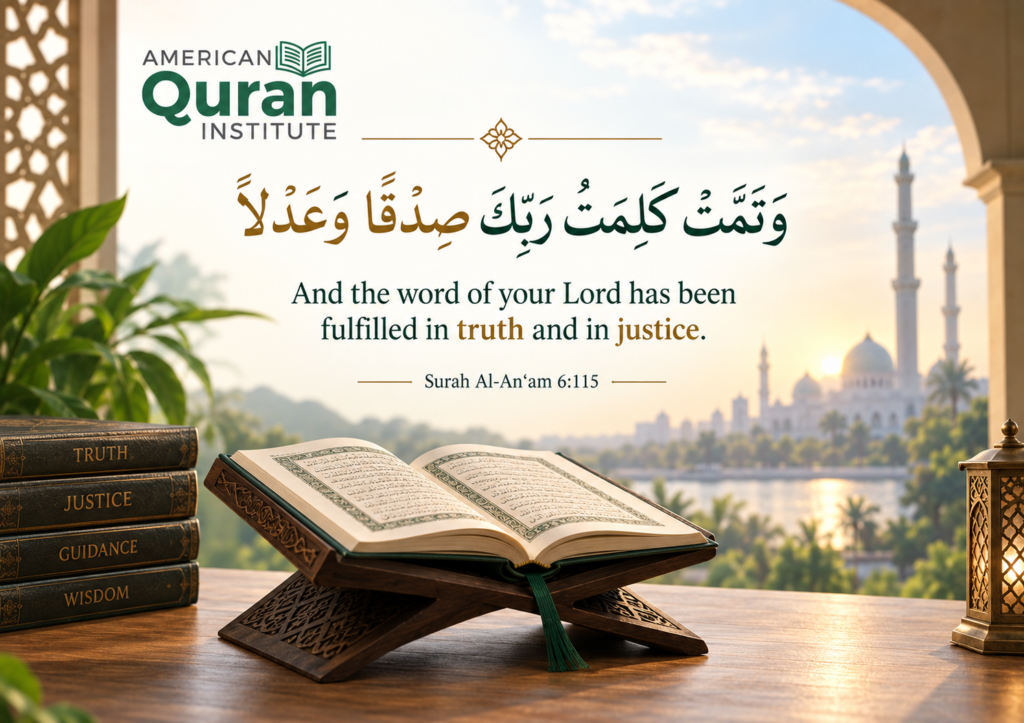
وَتَمَّتْ كَلِمَتُ رَبِّكَ صِدْقًا وَعَدْلًا
Wa tammat Kalimatu Rabbika sidqan wa ‘adlaa.
“And the word of your Lord has been fulfilled in truth and in justice.”
The two qualities appear together: sidq, truth, and ‘adl, justice. This shows that Quranic justice is inseparable from truth. Fairness cannot be built on falsehood, manipulation, or distorted information.
Experience Our Classroom Environment
Don’t just take our word for it—experience a live session for yourself! Click on the videos below to watch real snippets from our classes and see our interactive teaching methods in real-time.
Start Your Quranic Education
Join our premier online institute for structured Quranic learning tailored for students in the USA.
Book Your Free Trial7. Quran Verse About Documenting Financial Agreements With Justice and Fairness
The longest verse in the Quran contains detailed instructions about financial transactions and documentation.
وَلْيَكْتُب بَّيْنَكُمْ كَاتِبٌ بِالْعَدْلِ
Walyaktub bainakum kaatibum bil ‘adl.
“And let a scribe write it between you in justice.”
The verse concerns debts and financial agreements, instructing believers to document obligations clearly and fairly. It also gives attention to witnesses, accurate recording, protecting weaker parties, and reducing future disputes.
This demonstrates that Quranic justice is practical. It applies to contracts, evidence, debt, documentation, and economic relationships—not only abstract moral ideas.
8. Quran Verse About Giving Full Measure and Not Depriving People of Their Rights
Justice also appears in the Quran in the context of trade and economic behavior.
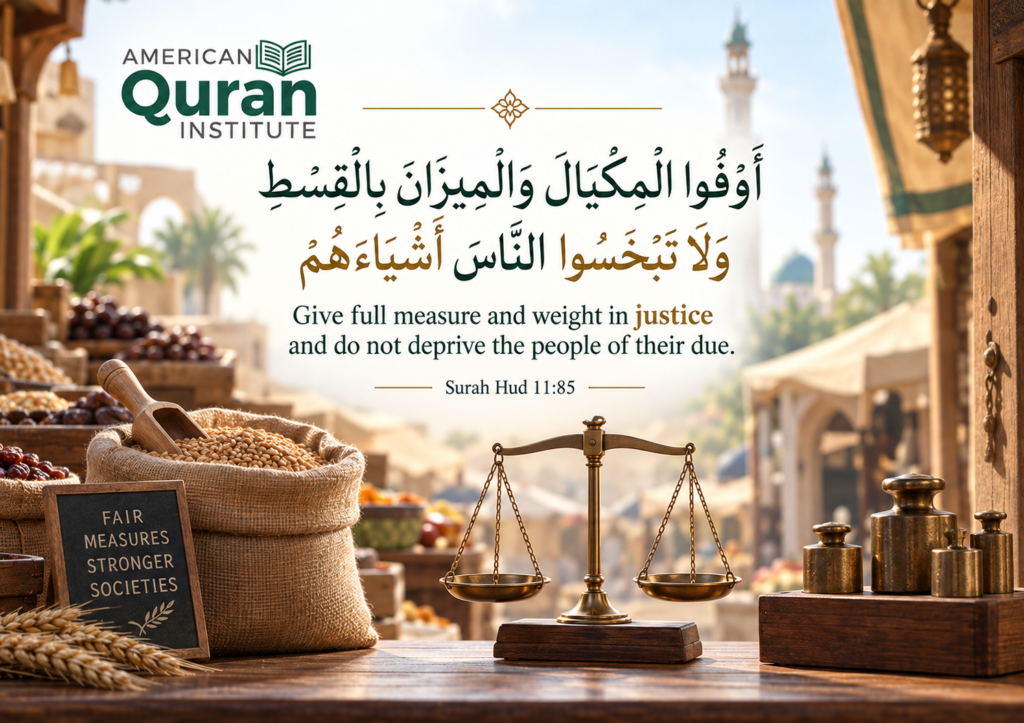
أَوْفُوا الْمِكْيَالَ وَالْمِيزَانَ بِالْقِسْطِ وَلَا تَبْخَسُوا النَّاسَ أَشْيَاءَهُمْ
Awful mikyaala wal meezaana bil qisti wa laa tabkhasun naasa ashyaaa’ahum.
“Give full measure and weight in justice and do not deprive the people of their due.”
Fair dealing means giving people exactly what they are entitled to. Cheating in weight, value, measurement, wages, quality, or payment is therefore incompatible with Quranic justice.
The principle extends naturally beyond physical marketplaces to any transaction where one person could take unfair advantage of another.
9. Quran Verse About Justice in Marriage When More Than One Wife Is Involved
The Quran makes justice a condition when discussing plural marriage.
فَإِنْ خِفْتُمْ أَلَّا تَعْدِلُوا فَوَاحِدَةً
Fa in khiftum allaa ta‘diloo fawaahidah.
“But if you fear that you will not be just, then marry only one.”
The verse places justice at the center of responsibility in plural marriage. It does not treat fairness as optional. If a man fears that he cannot fulfill the required justice, the verse directs him toward one wife.
Surah An-Nisa later adds that complete equality of emotional feeling cannot be achieved, while warning against total inclination toward one wife in a way that leaves another neglected.
10. Quran Verse About Reconciling Between Believers With Justice and Fairness
Justice is also essential when repairing conflict.

فَإِن فَاءَتْ فَأَصْلِحُوا بَيْنَهُمَا بِالْعَدْلِ وَأَقْسِطُوا ۖ إِنَّ اللَّهَ يُحِبُّ الْمُقْسِطِينَ
Fa in faaa’at fa aslihoo bainahumaa bil ‘adli wa aqsitoo; innal laaha yuhibbul muqsiteen.
“If it returns, then make settlement between them in justice and act justly. Indeed, Allah loves those who act justly.”
Reconciliation does not simply mean ending a disagreement as quickly as possible The resolution itself must be fair. This means restoring peace without ignoring wrongdoing, favoring one side unfairly, or allowing personal relationships to distort the outcome.
11. Quran Verse About Practicing Justice Even With Those Who Differ From You
The Quran presents justice as a principle that extends beyond people who share the same views or background.
وَأُمِرْتُ لِأَعْدِلَ بَيْنَكُمُ
Wa umirtu li a‘dila bainakum.
“And I have been commanded to do justice among you.”
The larger passage speaks within a context of religious disagreement while still emphasizing uprightness and justice This shows that disagreement does not remove moral responsibility. Muslims are still required to act fairly toward others, even where beliefs or positions differ.
Women who want to deepen their Quran reading and understanding in a structured environment can also explore Quran Classes for Females with guided instruction suited to different learning levels.

12. Quran Verse About Communities Guided by Truth and Upholding Justice
Justice is not presented only as an individual quality. It can also define a community.
وَمِمَّنْ خَلَقْنَا أُمَّةٌ يَهْدُونَ بِالْحَقِّ وَبِهِ يَعْدِلُونَ
Wa mimman khalaqnaaa ummatuny yahdoona bil haqqi wa bihee ya‘diloon.
“And among those We created is a community which guides by truth and thereby establishes justice.”
The verse connects two ideas: truth and justice A community cannot establish real justice if it is disconnected from truth, and truth should lead to fair treatment rather than remaining only theoretical knowledge.
13. Quran Verse About Commanding Justice as Part of the Straight Path
Surah An-Nahl presents a comparison between someone who contributes no good and someone who commands justice.
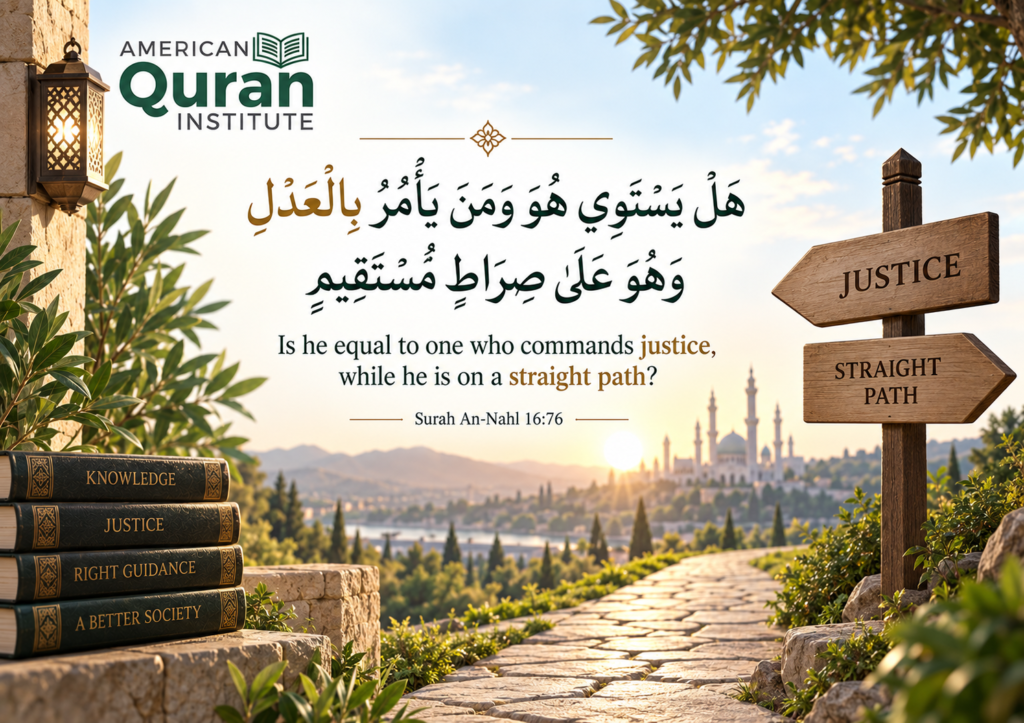
هَلْ يَسْتَوِي هُوَ وَمَن يَأْمُرُ بِالْعَدْلِ وَهُوَ عَلَىٰ صِرَاطٍ مُّسْتَقِيمٍ
Hal yastawee huwa wa man ya’muru bil ‘adli wa huwa ‘alaa siraatim mustaqeem.
“Is he equal to one who commands justice, while he is on a straight path?”
The verse links commanding justice with being upon a straight path. Justice is therefore not presented as separate from religious guidance. It is part of living according to that guidance.
14. Quran Verse About Justice in Witnesses and Legal Testimony
The Quran repeatedly emphasizes the importance of trustworthy witnesses.
وَأَشْهِدُوا ذَوَيْ عَدْلٍ مِّنكُمْ وَأَقِيمُوا الشَّهَادَةَ لِلَّهِ
Wa ash-hidoo zaway ‘adlin minkum wa aqeemush shahaadata lillaah.
“And bring to witness two just men from among you and establish the testimony for Allah.”
Justice in testimony means more than technically giving evidence. Witnesses must be trustworthy, fair, and conscious that testimony is ultimately given before Allah. This makes honesty in legal and personal disputes a spiritual responsibility.
What Does the Quran Say About Justice?
The Quran presents justice as a religious obligation rather than simply a social preference.
Believers are commanded to remain fair even when justice goes against their own interests, their relatives, or people they dislike. They are also instructed to protect trusts, deal honestly in financial matters, give truthful testimony, and reconcile conflicts fairly.
The Quran therefore treats justice as something that must shape both personal character and public life.
Students who want to read these verses with stronger Arabic pronunciation and fluency can explore Quran Qiraat Classes to develop greater accuracy and confidence in Quran recitation.
What Do Quran Verses About Justice Teach Us?
The many Quran verses about justice in Arabic show that fairness must remain consistent even when personal interests, emotions, relationships, or social pressures make it difficult.
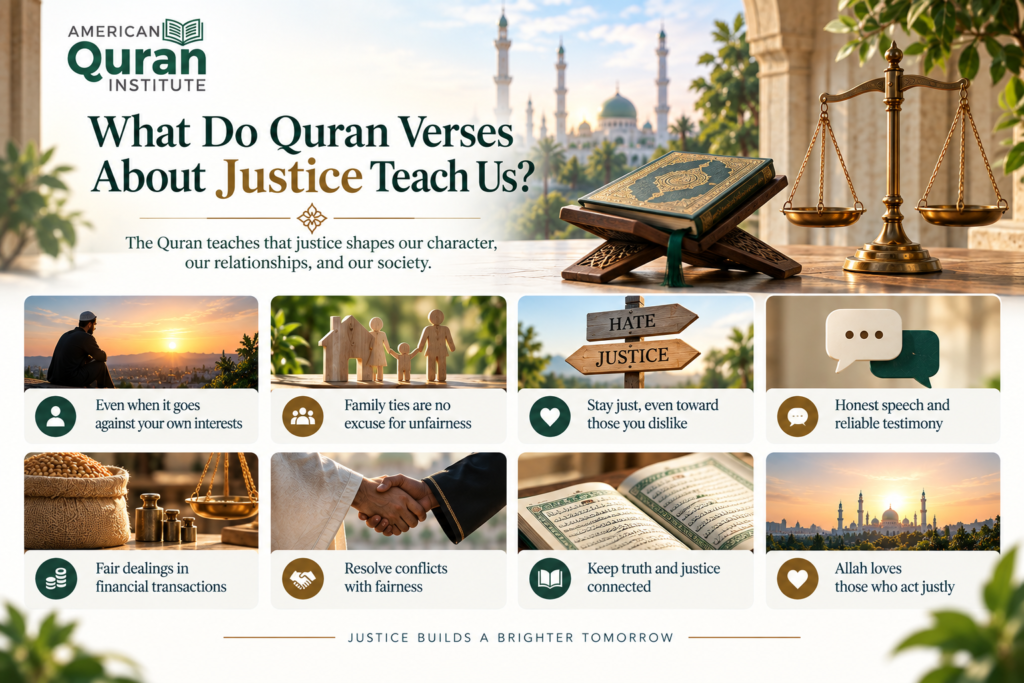
- Justice Must Be Upheld Even When It Goes Against Your Own Interests: Surah An-Nisa 4:135 commands believers to stand firmly for justice even when truthful testimony may work against themselves.
- Family Relationships Must Never Become an Excuse for Unfairness: The Quran specifically mentions parents and relatives when warning believers against biased testimony and unfair speech.
- Hatred of Other People Does Not Give Permission to Treat Them Unjustly: Surah Al-Ma’idah 5:8 commands believers to remain just even toward people they dislike and connects justice directly with taqwa.
- Justice Includes Honest Speech and Reliable Testimony:Fairness is not limited to decisions made by judges. It also applies to what people say, report, witness, and claim about one another.
- Financial Transactions Must Protect the Rights of Everyone Involved: The Quran discusses accurate documentation, witnesses, fair measurement, and protection against deprivation in commercial dealings.
- Justice Is Required When Resolving Conflict: Reconciliation must itself be fair. Ending a dispute without correcting injustice does not fulfill the Quranic command to reconcile bil-‘adl.
- Justice and Truth Must Remain Connected: Several Quranic passages place truth and justice together. Fairness cannot be maintained through lies, concealment, or manipulation.
- Allah Loves Those Who Act Justly: The Quran repeatedly uses the expression إِنَّ اللَّهَ يُحِبُّ الْمُقْسِطِينَ — “Indeed, Allah loves those who act justly.” This gives justice both a social purpose and a spiritual reward.
How to Apply Quranic Justice in Daily Life?
Justice becomes meaningful when it influences ordinary decisions rather than remaining only an abstract principle.
- Speak Fairly Even When the Truth Does Not Benefit You: Avoid changing a story, hiding information, or exaggerating simply because doing so protects your own interests.
- Do Not Defend Wrongdoing Simply Because the Person Is Close to You: Family, friendship, or loyalty should not become excuses for supporting unfair behavior.
- Give People Their Full Financial Rights: Pay debts, wages, contracts, and agreed amounts honestly. Do not use another person’s weakness or lack of information to gain an unfair advantage.
- Do Not Allow Anger to Control Your Judgment: A disagreement may justify setting boundaries, but it does not justify lying, cheating, or denying someone what is rightfully theirs.
- Listen to Both Sides Before Reaching a Judgment: Fairness requires enough information to understand a dispute rather than immediately siding with the person you know or prefer.
- Protect the Rights of People With Less Power: Many Quranic commands concerning justice appear around vulnerable people, including orphans and those who may struggle to defend their own interests.
These practical dimensions are easier to understand when verses are studied with their surrounding context and classical interpretation. Students interested in deeper traditional study can explore Al-Azhar Quran Classes for structured Quranic learning.

See Us in Action!
Take a look inside our virtual classrooms. Watch the clip below to see how our instructors engage with students, simplify complex rules, and create an inspiring environment for learning.
Start Your Quranic Education
Join our premier online institute for structured Quranic learning tailored for students in the USA.
Book Your Free TrialUnderstand the Quran’s Teachings on Justice Through Arabic With American Quran Institute
English translations communicate the general meaning of these verses, but studying Quran verses about justice in Arabic makes repeated Quranic terms easier to recognize.
Words such as ‘adl, qist, muqsiteen, haqq, amanah, and zulm reveal how justice appears across different areas of life, from personal speech and family relationships to financial agreements and public judgment.
At American Quran Institute, students can strengthen their Quran reading, recitation, and understanding through structured online study.
Learning directly from the Arabic text can help students see how individual commands about justice connect with broader Quranic principles of truth, responsibility, taqwa, and protection of people’s rights.
Start your free trial today and develop a deeper understanding of Quranic guidance on justice and fairness.
Our Quran Courses
- Quran Online Academy
- Quran Qirat Learning Course
- Quran Tafsir Course
- Noorani Qaida Course
- Noorani Qaida Course for Kids
- Weekend Quran Classes
- Intensive Quran Course
- Al-Azhar Quran Course

Conclusion
The Quran verses about justice in Arabic show that justice is one of the central ethical principles of Islam.
The Quran commands believers to judge fairly, return trusts, speak truthfully, protect financial rights, reconcile conflicts justly, and refuse to let hatred or personal relationships influence what is right.
Perhaps the most demanding lesson is that justice must remain consistent. A Muslim is expected to be fair when the truth benefits them and when it does not, when dealing with someone they love and someone they dislike, and when justice is easy as well as when it requires personal sacrifice.
Quranic justice is therefore not only a legal concept. It is a form of worship, moral discipline, social responsibility, and taqwa.
Frequently Asked Questions About Quran Verses About Justice in Arabic
What Is the Main Quran Verse About Justice?
Surah An-Nahl 16:90 is one of the clearest verses because it states directly that Allah commands justice and ihsan while forbidding wrongdoing and oppression.
Which Quran Verse Says to Be Just Even Against Yourself?
Surah An-Nisa 4:135 commands believers to stand firmly for justice even when testimony is against themselves, their parents, or relatives.
Which Quran Verse Says to Be Just Toward People You Dislike?
Surah Al-Ma’idah 5:8 says not to let hatred of a people prevent you from being just and states that justice is closer to taqwa.
Does the Quran Mention Justice in Financial Transactions?
Yes. Surah Al-Baqarah 2:282 instructs believers to document debts fairly, while other verses command full measure and weight and forbid depriving people of what is due to them.
Does Allah Love People Who Are Just?
Yes. Several Quran verses state that Allah loves al-muqsiteen, those who act justly.
What Is the Difference Between ‘Adl and Qist?
Both terms are associated with justice and fairness. ‘Adl commonly emphasizes fairness, balance, and impartiality, while qist frequently appears in contexts of equitable judgment and dealing fairly with others.
What Does the Quran Say About Justice During Conflict?
Surah Al-Hujurat 49:9 commands believers to reconcile conflicting groups with justice and fairness.
How Can I Understand Quran Verses About Justice More Deeply?
Read each verse with its surrounding passage, study recurring Arabic terms such as ‘adl and qist, and consult reliable Tafsir to understand how each command applies within its context.






Leave a Reply