 Quran
What does the Prophet ﷺ say makes someone among the best of Muslims? The answer isn’t wealth, lineage, or status. It’s one short statement: the best of you are those who learn the Quran and teach it.
This hadith in Sahih al-Bukhari has shaped Islamic education for over fourteen centuries. It still decides how families plan their children’s learning and how adults pick back up after years away from the Mushaf.
This article covers what the hadith means word by word and what it asks of you in practice. It then summarizes the importance of learning and teaching the Quran and walks through seven other authentic hadiths about learning the Quran, with a short lesson from each.
At the American Quran Institute, this hadith is the starting point for how we teach students of every age.
What you’ll learn in this article:
- The exact wording, source, and meaning of the hadith “the best of you are those who learn Quran and teach it”
- Why learning and teaching come as a pair, and what counts as “teaching” for an ordinary Muslim.
- A short summary of the importance of learning and teaching Quran.
- Seven other hadiths about learning the Quran, each with its practical lesson.
- Common mistakes learners make, and a simple framework for putting the hadith into practice.
The Best Of You Are Those Who Learn Quran And Teach It: Text, Source, And Meaning
The hadith comes from Uthman ibn Affan (may Allah be pleased with him) and is recorded in Sahih al-Bukhari (5027). Below are its wording, the story connected to it, and what each part tells a learner today.
The Exact Wording Of The Hadith
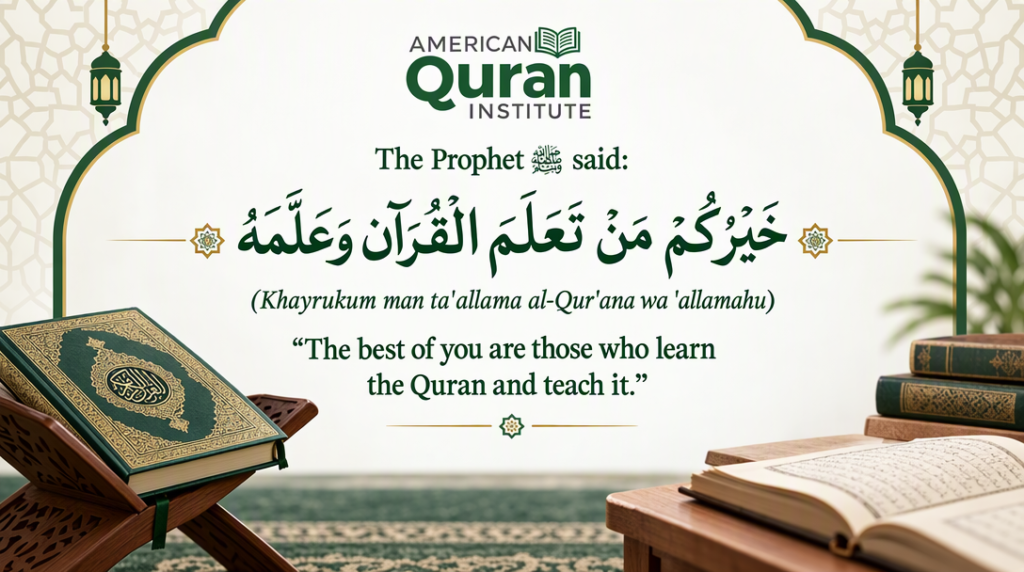
The Prophet ﷺ said:
“خَيْرُكُمْ مَنْ تَعَلَّمَ الْقُرْآنَ وَعَلَّمَهُ”
(Khayrukum man ta’allama al-Qur’ana wa ‘allamahu)
“The best of you are those who learn the Quran and teach it.”
A related narration in Bukhari (5028) uses afdalukum, “the most excellent of you.” The word khayrukum is a superlative. It doesn’t say “among the good.” It places Quran learners and teachers at the top of the community.
The two Arabic verbs, ta’allama (to learn) and ‘allama (to teach), come from the same root and are joined by “and.” Islam treats them as one cycle: you learn so that you can pass the Quran on, and teaching it well requires that you first learned it correctly.
Some narrations in Musnad Ahmad use “or,” and scholars took this to mean that each half carries virtue on its own, while doing both brings the full reward.
Who lived this hadith first?
The narrator who passed this hadith on from Uthman, Abu Abdur-Rahman al-Sulami, taught the Quran in the mosque of Kufa from Uthman’s caliphate until the time of al-Hajjaj, a span of decades. Explaining why he stayed in that seat for so long, he said:
“That is what made me sit in this seat” (Bukhari 5027). The hadith was a plan he followed for most of his life, and he didn’t treat it as a slogan.
What Does “Learn” And “Teach” Include In This Hadith?
Many readers assume the hadith applies only to full-time scholars or certified teachers. Classical scholars read it more broadly, and that wider reading is what makes it apply to everyone.
What counts as “learning the Quran”?
Learning the Quran covers several levels: reading the Arabic letters, reciting with correct Tajweed, memorizing (Hifz), understanding meanings through Tafsir, and acting on what you learned. A beginner learning Surah Al-Fatiha correctly is inside this hadith, and so is a student finishing Ijazah.
What counts as “teaching the Quran”?
Teaching includes formal instruction, but it also covers a parent correcting a child’s Al-Fatiha, a sibling reviewing a surah with a younger brother, or an imam leading prayer.
The Prophet ﷺ said,
“Convey from me, even if it is one verse” (Bukhari 3461).
One condition comes with it: teach only what you have learned correctly yourself. Passing on a mispronunciation spreads the mistake.
The Learn–Live–Pass On Cycle: Applying The Hadith In Practice
Knowing that the best of you are those who learn the Quran and teach it is the easy part; living it daily is where most learners stall.
To turn the hadith into action rather than admiration, the American Quran Institute uses a simple three-stage framework we call the Learn–Live–Pass On cycle.
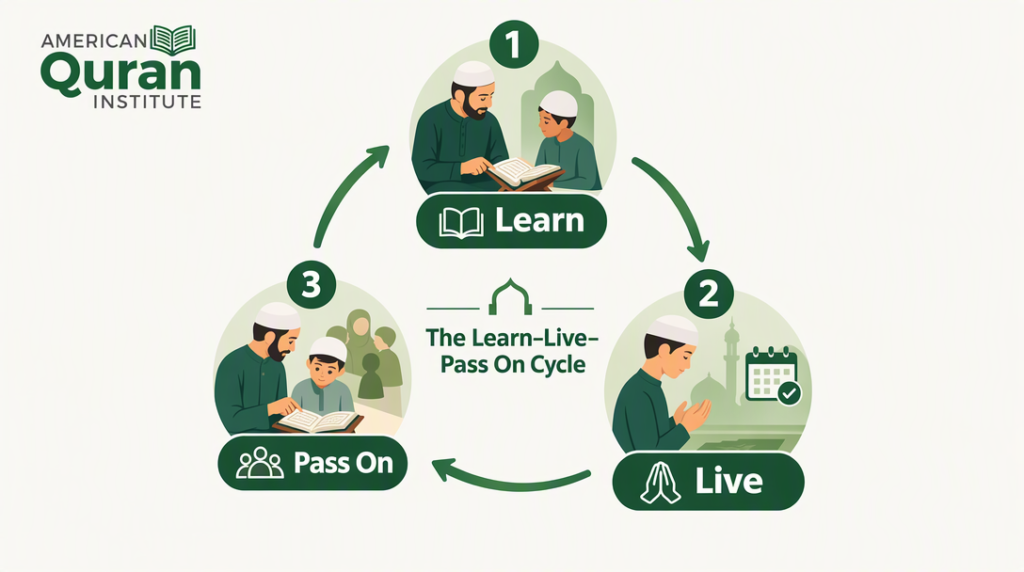
Stage 1: Learn it correctly
Start with accurate pronunciation under a qualified teacher before you try to cover a lot of material. Letters are best corrected through hearing and repetition, which is how the Quran has been passed on, person to person, since the Prophet ﷺ. This is why live one-on-one feedback matters more than self-study apps alone.
Stage 2: Live by it
Recite what you learned in your daily prayers, review it on a fixed schedule, and reflect on its meaning. A memorized surah you never recite in Salah fades, and a surah you recite every day stays.
Stage 3: Pass it on
Teach one thing you have mastered within a week of learning it, even to one family member. Explaining a verse or correcting someone’s recitation also shows you where your own gaps are, so teaching makes your learning stick.
If you want help with the first stage, the American Quran Institute offers structured online Quran classes where every recitation is corrected live, so what you later pass on is accurate.
Experience Our Classroom Environment
Don’t just take our word for it—experience a live session for yourself! Click on the videos below to watch real snippets from our classes and see our interactive teaching methods in real-time.
Start Your Quranic Education
Join our premier online institute for structured Quranic learning tailored for students in the USA.
Book Your Free TrialRead also: 11 Powerful Motivations to Read Quran
The Importance Of Learning And Teaching Quran
The importance of learning and teaching the Quran comes down to four points that every Muslim should know.
- Learning The Quran Is A Religious Duty For Every Muslim: At its minimum level, learning the Quran is required of everyone. Every Muslim must learn enough to pray, starting with Al-Fatiha, which is recited in every unit of Salah. Memorizing the whole Quran is a communal obligation (fard kifayah): if enough Muslims carry it, the rest are excused.
- Teaching The Quran Earns Reward That Continues After Death: Teaching the Quran is beneficial knowledge, one of the three deeds whose reward continues after death (Muslim 1631). Every time your student recites what you taught, you share in the reward without reducing theirs.
- The Quran Is The Foundation Of All Islamic Knowledge: Fiqh, Tafsir, and Aqeedah all build on the Quran. A Muslim who reads and understands it learns every other Islamic subject faster and more deeply.
- Quran Learning Protects The Identity Of Families And Communities:Communities that teach the Quran to the next generation keep their identity. Muslim families living as a minority, including in the United States, depend on structured home and online learning more than families in Muslim-majority countries do.
7 Other Hadiths About Learning The Quran And Their Lessons
The hadith “the best of you are those who learn the Quran and teach it” doesn’t stand alone. These seven authentic hadiths about learning the Quran add to its meaning, and each one ends with the lesson it teaches.
a. Gatherings For Learning The Quran Receive Tranquility And Mercy
The Prophet ﷺ said:
“that whenever people gather in a house of Allah to recite His Book and study it together, “tranquility descends upon them, mercy covers them, the angels surround them, and Allah mentions them to those with Him” (Muslim 2699).
Lesson: learning with others isn’t just a convenient setup. It’s a gathering Allah describes with special honor, so a regular class with a teacher and fellow students earns rewards that studying alone doesn’t.
b. Every Letter You Recite Earns Ten Rewards
The Prophet ﷺ said:
“Whoever reads a letter from the Book of Allah will have a reward, and that reward is multiplied by ten. I do not say Alif-Lam-Mim is one letter; rather Alif is a letter, Lam is a letter, and Mim is a letter” (Tirmidhi 2910).
Lesson: reward is counted per letter, not per page or per minute. A slow beginner is still earning, so there’s no reason to wait until you’re “good enough” to start.
c. The Struggling Reciter Receives A Double Reward
The Prophet ﷺ said:
“The one who is proficient in the Quran will be with the noble, righteous scribes (angels), and the one who recites it and stumbles over it, finding it difficult, will have two rewards” (Bukhari 4937).
Lesson: difficulty isn’t failure. The adult beginner and the non-Arabic speaker earn one reward for reciting and another for the effort, and fluency earns the company of the angels. Both are worth working toward.
4. Allah raises people through this Book
Umar ibn al-Khattab once asked why a freed slave, Ibn Abza, had been appointed governor of Makkah.
He was told that Ibn Abza was a reciter of the Quran who knew the laws of inheritance. Umar replied that the Prophet ﷺ said:
“Allah raises some people by this Book and lowers others by it” (Muslim 817).
Lesson: knowledge of the Quran raised a man above the social status he was born with. The Quran can lift your standing in this world as well as the next, depending on whether you act on it or neglect it.
e. The believer who recites the Quran is like a citron
The Prophet ﷺ said:
that the believer who recites the Quran is like a citron (utrujjah): its taste is good and its scent is good. The believer who doesn’t recite is like a date, sweet but without scent (Bukhari 5020).
Lesson: the Quran adds a “fragrance” that others notice. Recitation shapes your character in a way that benefits the people around you, which ties straight back to teaching.
f. The Quran will intercede for its companions
The Prophet ﷺ said:
“Recite the Quran, for it will come on the Day of Resurrection as an intercessor for its companions” (Muslim 804).
Lesson: the word ashab (companions) describes a lasting relationship, not an occasional reading. Steady daily recitation, even a small amount, is what makes you the Quran’s companion.
g. Keep reviewing, or the Quran will slip away
The Prophet ﷺ said:
“Keep reviewing the Quran, for by the One in whose Hand is my soul, it escapes faster than a camel escapes from its tying rope” (Bukhari 5033).
Lesson: learning doesn’t end once you’ve memorized a passage. A revision schedule protects what you learned, and a student who keeps adding new material without reviewing the old will lose both.
Read also: How To Improve Recitation Of The Quran In The USA?
Common Mistakes When Trying To Live This Hadith
Teachers see the same mistakes again and again. Knowing them in advance saves months of wasted effort.
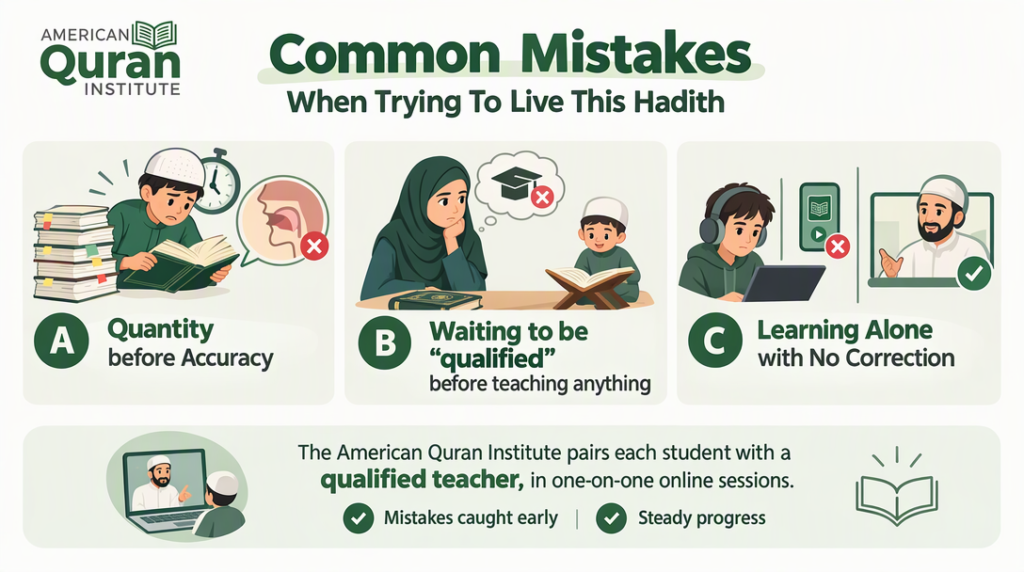
- Chasing quantity before accuracy: Students often rush to memorize many pages while their makharij (articulation points) are still wrong. Fixing a mistake after it’s memorized takes much longer than learning the letter correctly at the start.
- Waiting to be “qualified” before teaching anything: Some learners never pass anything on because they don’t feel like scholars. Teaching a child one surah you’ve mastered is still teaching, as long as you stay within what you know accurately.
- Learning alone with no correction: Apps and audio help with listening, but they can’t hear your recitation and correct it. The Quran has always been passed on through a teacher who listens and corrects.
The American Quran Institute pairs each student with a qualified teacher in one-on-one online sessions, so mistakes are caught early and progress stays steady.
See Us in Action!
Take a look inside our virtual classrooms. Watch the clip below to see how our instructors engage with students, simplify complex rules, and create an inspiring environment for learning.
Start Your Quranic Education
Join our premier online institute for structured Quranic learning tailored for students in the USA.
Book Your Free TrialStart Learning The Quran Today And Join The Best Of The Ummah
The Prophet ﷺ said the best of you are those who learn Quran and teach it, and the first step to joining them is a single lesson.
Whether you’re an adult starting over, a parent planning your child’s Quran education, or a student working toward Hifz, the American Quran Institute builds a plan around your level, your schedule, and your goal.
You’ll learn correct recitation from a qualified teacher, review on a set schedule, and get to the point where you can confidently pass the Quran on to your family.
Our Islamic Studies Courses:
- Islamic Studies Courses
- Islamic Studies Courses for Kids
- Islamic Studies Courses for Adults
- Islamic Studies Courses for Female
Conclusion
The hadith “the best of you are those who learn the Quran and teach it” sets out a clear standard: a Muslim’s worth is measured by their relationship with the Book of Allah.
Learning and teaching go together. Learning means correct recitation, understanding, and practice, and teaching ranges from formal classes to correcting a child at home.
The seven hadiths above fill in the details. Group learning brings mercy, every letter earns reward, struggling earns double, the Quran intercedes for its companions and raises them, and steady review protects what you learned. The takeaway is simple: learn one thing correctly, live by it, and pass it on.
FAQs About The Best Of You Are Those Who Learn Quran And Teach It
These answers cover the questions readers most often ask about this hadith and about learning and teaching the Quran in general.
1. Where is the hadith “the best of you are those who learn Quran and teach it” recorded?
The hadith is recorded in Sahih al-Bukhari (5027), narrated by Uthman ibn Affan. It also appears in Jami’ at-Tirmidhi and Sunan Abi Dawud, and scholars agree that it is authentic.
2. Do I have to teach the Quran to be among “the best of you”?
No, learning the Quran carries virtue on its own, and some narrations say “learns or teaches.” The highest rank, though, combines both. Even teaching one surah to a family member counts.
3. Can I teach the Quran if I am still a beginner?
Yes, you can teach what you have already mastered correctly, even if it’s a single surah. Avoid teaching anything you aren’t sure how to pronounce, and keep learning under a qualified teacher.
4. Is learning the Quran obligatory for every Muslim?
Yes, at the minimum level. Every Muslim must learn enough of the Quran to pray, including Surah Al-Fatiha. Memorizing the entire Quran is a communal obligation that is fulfilled when enough Muslims carry it.
5. What is the reward for teaching someone the Quran?
Teaching the Quran is beneficial knowledge whose reward continues after death (Muslim 1631). Every time your student recites what you taught them, you share in the reward.
6. Can adults who never learned the Quran start now?
Yes, and the Prophet ﷺ promised a double reward to the one who recites with difficulty (Bukhari 4937). Adults usually progress steadily when they study with live correction and a fixed schedule.



Leave a Reply