 Quran
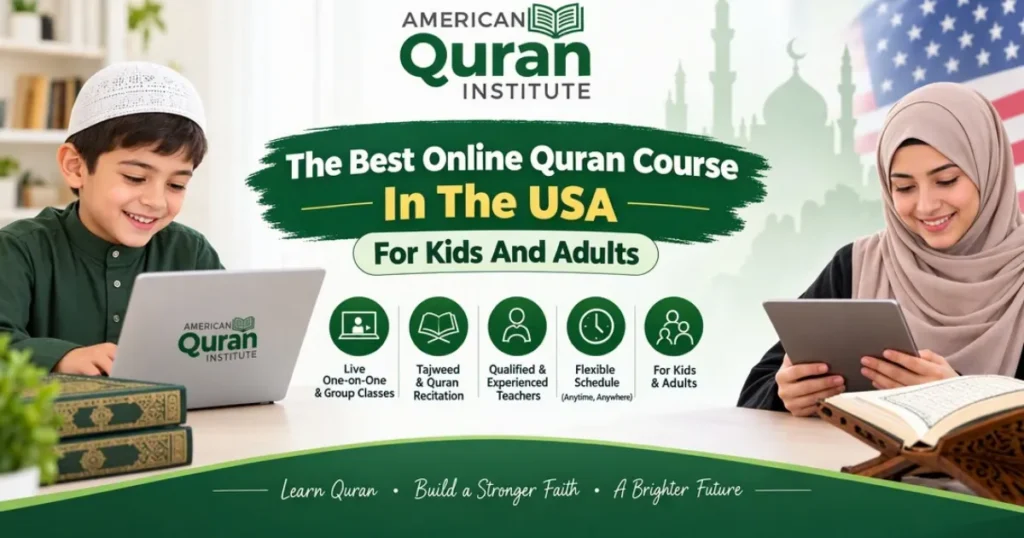
How do you pick the best online Quran course in the USA when dozens of academies say the same thing: certified tutors, flexible hours, a free trial? For most Muslim families in America, the hard part isn’t finding a class.
The hard part is finding one that will actually fix a child’s pronunciation, keep an adult going after a long workday, and still be on the calendar six months later.
Below, you’ll find the best online Quran courses in the USA from the American Quran Institute, split into courses for kids and courses for adults. After the list, this guide covers what makes a course work, how to plan classes around US time zones, and the mistakes that quietly stall progress.
A. Best online Quran courses in the USA for kids
Children learn the Quran best in short, live one-on-one lessons with plenty of repetition and a teacher who can hold their attention through a screen. These six courses take a child from the first Arabic letter to correct recitation and memorization, at a pace set by their age and level.
1. Online Quran Classes for Kids
Online Quran Classes for Kids is the American Quran Institute’s main program for children, taught in live one-on-one sessions by qualified Azhari teachers who hold Ijazah certification and have experience teaching young learners.
Most children start between ages 4 and 7, when they can focus for about 30 minutes. Lessons cover the 28 Arabic letters, makharij, Tajweed basics such as ghunnah, qalqalah, and madd, short surah memorization, and basic Islamic etiquette. Short activity breaks about every 10 minutes keep attention fresh.
Parents can sit nearby during lessons and receive regular updates on pronunciation, memorization, and Tajweed. With consistent lessons, most children reach basic Quran reading within 6 to 12 months.
2. Noorani Qaida Course for Kids
The Noorani Qaida Course for Kids teaches children to read Quranic Arabic from zero, with no prior Arabic exposure needed. It works best for ages 4 to 12, though teachers enroll younger or older children based on readiness.
The course moves through four stages: alphabet recognition and sounds, harakat (fatha, kasra, damma), letter joining from two- to three-letter words, and finally tanween, sukoon, and shaddah. Teachers give extra drilling to sounds English doesn’t have, such as ع, ح, and ق.
Three to four sessions a week are recommended, and most children finish in 6 to 12 months. A child moves forward only after mastering the current stage, then continues to Tajweed, Hifz, or Quranic Arabic.
3. Quran Reading Classes
Quran Reading Classes build fluent reading straight from the Mushaf, without transliteration. Children can enroll from age five, and the course also suits adults who need to refine their reading.
Students read aloud in every session and get corrected immediately. The four stages run from letter sounds to vowel mastery, connected reading, and finally independent reading of full pages. Basic Tajweed is built into the reading, while memorization is kept as a separate track.
Between lessons, families get email support with audio examples and practice tasks, plus weekly progress updates. Students typically read short surahs within about three months and reach full fluency in 6 to 12 months.
4. Tajweed Course for Kids
The Tajweed Course for Kids teaches children to recite every letter correctly. Children as young as five can join once they recognize Arabic letters.
Rules follow a set order: articulation points first, then noon sakinah and tanween (izhar, idgham, iqlab, ikhfa), then madd types held for two, four, or six counts, then minor and major qalqalah. Teachers correct tongue placement and vowel length live, and use call-and-response, verse-repetition games, and rhythm exercises to keep lessons engaging.
The goal is for children to apply the rules to verses they haven’t memorized, not only to familiar surahs. Most children build solid Tajweed fundamentals in 6 to 12 months.
5. Quran Memorization and Hifz Course for Kids
The Quran Memorization and Hifz Course for Kids is a one-on-one Hifz program with sessions of 30 to 45 minutes. Most children begin between ages 4 and 8, after learning basic letter recognition.
Each new verse is repeated 10 to 15 times in class and broken into phrases along natural breath points. Yesterday’s portion is always reviewed before new material, with weekly consolidation reviews and monthly cumulative tests to protect what’s already memorized.
Pace usually ranges from half a page to two pages a week, depending on age and practice at home. Parents receive weekly summaries of verses memorized and review performance, and children can message their teacher between lessons.
B. Best online Quran courses in the USA for adults
Adult learners rarely start from the same point. Some have never read Arabic, some read but want to fix their Tajweed, and others want to memorize, understand, or earn an Ijazah. These ten courses cover each goal and fit around full-time work.
1. Quran Classes for Adults
Quran Classes for Adults are private one-on-one sessions over Zoom, built for working professionals and parents. No prior Arabic or Quran study is needed.
The path runs from letter pronunciation and Noorani Qaida to surah recitation with Tajweed, memorization in short segments with review cycles, and Tafsir with word-by-word meanings. Teachers hold Ijazah certification and have experience with adult learners.
The course recommends about 15 minutes of daily practice over occasional long sessions. Most adults reach basic Tajweed-correct recitation within 6 to 12 months, enough to recite with confidence in family prayers.
2. Learn Quran Course for Beginners
The Learn Quran Course for Beginners is for adults with no Quran or Arabic background, and learners over 40 are explicitly welcome. Teachers specialize in students starting from zero and are trained in the pronunciation problems English speakers face.
The course has four stages: the 28 letters in isolated and connected forms, Noorani Qaida fundamentals, basic Tajweed (noon sakinah, qalqalah, idgham), and short surahs from Al-Fatiha through Juz Amma. Rules are learned by listening and imitating before learning the terminology.
Students record themselves weekly and take weekly assessments, and foundational gaps are fixed before moving on. Most beginners reach basic reading ability within six months.
3. Noorani Qaida Course
The Noorani Qaida Course gives adults the same solid foundation children get: all 28 letters in every position, harakat, sukoon, shaddah, tanween, and madd held for two, four, or six counts.
It’s also the right course for adults who already read but carry old errors. Makharij drills focus on sounds absent from English, such as ع, ح, ق, ص, ض, ط, and ظ, and teachers correct them in real time.
Students advance only after showing mastery of each stage. Most learners finish in three to six months and are ready to read simple verses and start Tajweed.
4. Quran Recitation Classes
Quran Recitation Classes suit adults relearning pronunciation and anyone who wants to recite with rhythm and correct stops. A trial session assesses your current level first.
The sequence is sounds first, rules second, application third: articulation across 17 makharij points, Tajweed rules within recitation, verse recitation with correct stopping points, and listening training using several Qaris to sharpen your ear for errors.
Students recite assigned verses daily under teacher supervision. Slot options include East Coast mornings, West Coast evenings, evening classes, and weekend-only sessions.
5. Tajweed Course for Adults
The Tajweed Course for Adults is taught by native Arabic speakers who hold an Ijazah in Quran recitation and have experience teaching English-speaking adults. It’s built for adults returning to the Quran or who missed Quran training as children.
Topics include makharij and sifaat, noon and meem sakinah rules, ghunnah timing, all madd types, and waqf (stopping) rules. Students learn to tell apart letters English speakers often confuse, such as ح and ه, ص and س, and ض and ظ.
Live lessons come with recordings to review between classes. Basic proficiency typically takes 6 to 12 months, and advanced mastery 18 to 24 months, enough to lead prayer, including Taraweeh, with confidence. Sisters can also choose the Tajweed Course for Ladies.
6. Hifz Classes for Adults
Hifz Classes for Adults are designed for adults with unpredictable work hours, and daytime availability isn’t required. Lessons are structured one-on-one sessions at an individual pace.
Instead of rote repetition alone, adults memorize through meaning, thematic verse groups, and word roots, and pick up basic Quranic grammar along the way. Tajweed is corrected before a verse is memorized, so mistakes aren’t locked in.
Most adults spend 30 to 60 minutes a day on new memorization and review. Spaced repetition and a personal review calendar keep older portions strong. Some adults memorize a page a week, others go slower, and both are fine.
7. Quran Classes for Female/Sisters
Quran Classes for Female/Sisters offer female-only instruction for women and girls, and all instructors in this program are female. Teachers hold Ijazah certification in Quran recitation.
The path moves from makharij to Noorani Qaida, then Tajweed one rule at a time, with Hifz added once Tajweed accuracy is solid. Sisters who want a focused track can also join the Quran Hifz Course for Ladies.
Sessions run early morning, midday, and late evening across all four US time zones, with documented feedback after every lesson. Most adult women reach basic reading proficiency in six to nine months.
8. Quran Tafsir Course
The Quran Tafsir Course is for students who already read Quranic Arabic fluently and know basic grammar. Readiness is checked in a consultation before placement.
Four modules cover classical grammar applied to exegesis (i’rab), occasions of revelation (asbab al-nuzul), comparative Tafsir methods, and thematic study of concepts such as justice and patience across surahs. Students study the works of Ibn Kathir, Al-Tabari, Al-Zamakhshari, and Al-Razi within a mainstream Sunni approach.
Lessons are private and discussion-based, with all materials provided. Graduates keep lifetime access to course materials and consultation.
9. Quran Qirat Learning Course
The Quran Qirat Learning Course teaches the recognized modes of Quranic recitation. Basic Tajweed is recommended first, and each student’s level is assessed at enrollment.
The course opens with Hafs and Warsh foundations and moves on to other narrations and their differences in vowels, consonants, and rules. Students are advised to master Hafs first before adding Warsh or other styles. Instructors hold Ijazahs in multiple recitation styles with authenticated chains (sanad).
Lessons are one-on-one, with recordings available between sessions and regular evaluations. Students receive traditional certification once they master a style.
10. Quran Ijazah Program
The Quran Ijazah Program leads to a formal certificate with a documented sanad, which authorizes the graduate to teach Quranic recitation. Foundational Tajweed is required first, and students without it complete preparatory Tajweed courses.
Students can pursue a full Quran Ijazah or a portion-based one, mainly in Hafs ‘an ‘Asim. Training moves from makharij accuracy to Tajweed in connected recitation, Hifz training with random testing, and a final readiness stage over several sessions.
The final exam is a recitation to the instructor by video, assessed for pronunciation, Tajweed, and fluency. The program has certified students from teenagers to retirees.
See Us in Action!
Take a look inside our virtual classrooms. Watch the clip below to see how our instructors engage with students, simplify complex rules, and create an inspiring environment for learning.
Start Your Quranic Education
Join our premier online institute for structured Quranic learning tailored for students in the USA.
Book Your Free TrialWhat Makes The Best Online Quran Course In The USA?
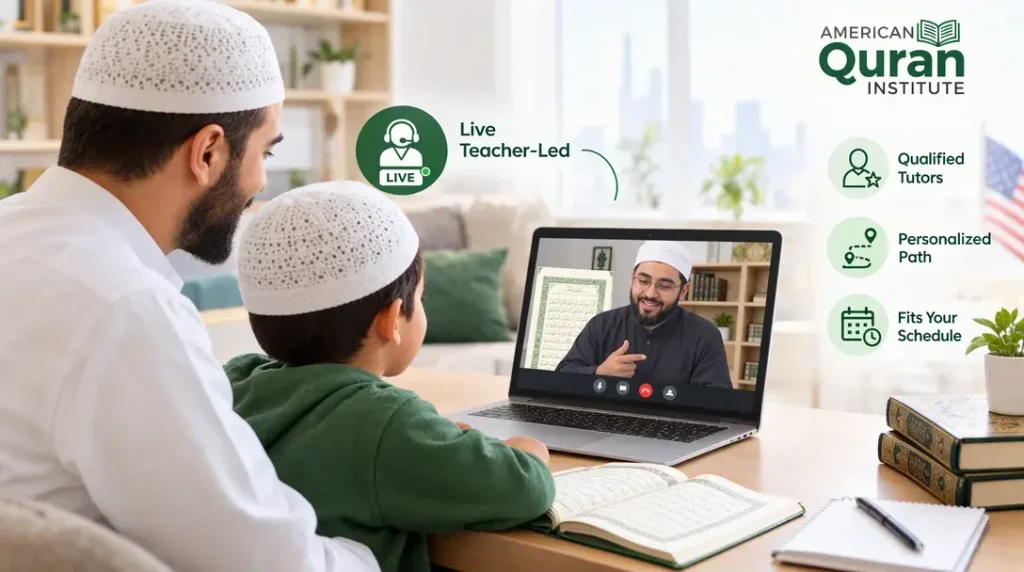
The best online Quran course in the USA is a live, teacher-led program. A qualified tutor listens to every recitation, corrects mistakes on the spot, and moves the student through a set path that fits their age, level, and schedule. Recorded videos and self-paced apps can help with practice, but they can’t hear your recitation, so they can’t replace a teacher.
Three things decide whether a program works: who teaches, how the lessons are structured, and whether the schedule holds up in an American week.
A. Live one-on-one correction from a qualified teacher
Quran recitation is learned by listening and being corrected. In Arabic this is called talaqqi, receiving the recitation directly from a teacher. A one-on-one class means the tutor hears every letter you read. In a group of eight, a student might read aloud for only a few minutes.
Look for teachers trained in Tajweed, ideally holding an Ijazah with a connected chain of transmission (sanad), who can also explain rules clearly in English.
At the American Quran Institute, lessons are live and personal, so the teacher’s attention stays on one student’s recitation.
B. A structured path from first letters to fluent recitation
A strong program never drops a beginner straight into the Mushaf. The usual order is:
- Noorani Qaida: Arabic letters, their exit points (makharij), short vowels, joining letters.
- Quran reading: reading short surahs smoothly.
- Tajweed: rules such as ghunnah, madd, idgham, and qalqalah, practised on real verses.
- Hifz: memorization with a plan for new lessons, recent revision, and long-term review.
- Understanding: translation, Tafseer, and Quranic Arabic.
A course that tells you where you are on this path, and what comes next, is easier to stay with than one that just runs “a class.”
C. Scheduling that fits US school and work hours
Online Quran classes in the USA have to work around school, homework, sports, and full-time jobs. The best academies offer evening and weekend slots in your own time zone, and a clear policy for rescheduling missed classes.
Read also: How To Get Better At Reading Quran In The USA?
How Do You Choose The Best Online Quran Course In The Usa? The 5-Point Class Check
Most comparison articles give a long list of features. A faster way is to run any academy through five questions. We call it the CLASS check:
- Correction: Does the teacher stop and fix mistakes live, or just let the student read on?
- Level plan: Did they assess the student’s level and explain the next steps?
- Availability: Are slots offered in your local time zone, with a clear makeup-class policy?
- Session format: Is it one-on-one, and can you choose a male or female teacher?
- Signals of progress: Will you get regular feedback or reports you can check?
If an academy fails two or more of these, keep looking, whatever the price.
How should you plan online Quran classes across USA time zones?
A practical rule is to book the class at the same time on the same days each week, in the slot where the student is least tired. Consistency predicts progress far more than the length of any single lesson.
Suggested slots by time zone and learner:
- East Coast (ET), kids: right after school, before homework drains attention.
- Central and Mountain (CT/MT), adults: early morning before work, or after dinner.
- West Coast (PT): weekend mornings work well for families learning together.
- Hifz students in any zone: short, frequent sessions beat one long weekly class, because memorization depends on daily review.
Common Mistakes That Slow Quran Learning Online
Avoiding these mistakes saves months:
- Choosing on price alone: A cheap class with no real correction costs more in lost time.
- Skipping Noorani Qaida: Adults often rush to the Mushaf and carry pronunciation errors for years.
- Group classes for Tajweed correction: Rules can be taught in groups, but correction needs one-on-one time.
- Memorizing without revision: Hifz without a manzil plan fades quickly.
- No practice between classes: Ten minutes of daily recitation keeps each lesson from starting over.
Read also: How To Concentrate While Reading Quran?
What Affects The Cost Of The Best Online Quran Course In The Usa?
Prices for online Quran classes in the USA depend on how often you meet, how long each class runs, the course type (Hifz and Ijazah tracks need more teacher time), and the teacher’s qualifications.
One-on-one lessons usually cost more than group classes but deliver far more corrections per minute.
When comparing affordable Quran classes online, compare value, not the sticker price. Ask how much of each class the student spends reciting and how progress is measured. For current plans, contact the American Quran Institute directly.
Experience Our Classroom Environment
Don’t just take our word for it—experience a live session for yourself! Click on the videos below to watch real snippets from our classes and see our interactive teaching methods in real-time.
Start Your Quranic Education
Join our premier online institute for structured Quranic learning tailored for students in the USA.
Book Your Free TrialStart Your Quran Journey Today with the American Quran Institute
Every week you put off starting is a week of habits, good or bad, setting in. Whether your child is meeting Arabic letters for the first time or you want to recite in salah with confidence, the American Quran Institute gives you live one-on-one lessons, a clear path from Qaida to Hifz, and class times that fit your American schedule.
Choose your level, pick a time in your time zone, and take your first lesson from home this week.
Our Quran Courses:
- Quran Recitation Classes
- Quran Reading Classes
- Online Quran Classes for Kids
- Quran Classes for Adults
- Quran Classes for Female/Sisters
- Learn Quran Course for Beginners
Conclusion
The best online Quran course in the USA comes down to three things: live correction from a qualified teacher, a clear path from Noorani Qaida to Tajweed and Hifz, and a schedule that survives a busy American week.
Run every academy through the CLASS check, use the trial lesson to test real correction, and stay consistent with your class days.
Do that, and online Quran classes become a lasting part of your family’s routine. With the American Quran Institute, kids and adults across the USA can learn the Quran from home, at their level and in their time zone.
FAQs About The Best Online Quran Course In The Usa
Parents and adult learners in America tend to ask the same questions before enrolling. Here are short, direct answers to the most common ones about online Quran classes, teachers, and schedules.
1. What is the best online Quran course in the USA for beginners?
The best online Quran course in the USA for beginners starts with Noorani Qaida in live one-on-one classes. The student learns Arabic letters, sounds, and reading rules before moving on to Quran reading and Tajweed.
2. Can my child learn the Quran online without knowing Arabic?
Yes, children can learn the Quran online without speaking Arabic. Beginner Quran classes teach letters and pronunciation from zero, and teachers explain everything in English.
3. Are online Quran classes as effective as local classes?
Online Quran classes are as effective as local classes when they’re live and one-on-one. The teacher hears every recitation and corrects mistakes immediately, often with more individual attention than a crowded masjid class.
4. Are female Quran teachers available for online classes?
Yes, many online Quran academies, including the American Quran Institute, offer female Quran teachers for women and girls. Confirm availability in your preferred time slot before enrolling.
5. How long does it take to learn Tajweed online?
How long it takes to learn Tajweed online depends on your starting level, how often you have class, and how much you practise daily. Students who already read Arabic and practise every day usually progress much faster than those who only recite during class.
6. Can adults with full-time jobs take online Quran classes in the USA?
Yes, adults with full-time jobs can take online Quran classes in the USA by booking early-morning, evening, or weekend slots in their own time zone. One-on-one lessons let them learn at their own pace.




Leave a Reply