 Quran
Kindness in the Quran is closely connected with ihsan, mercy, generosity, good speech, patience, forgiveness, and treating other people well.
The Quran verses about kindness in Arabic show that kindness is not limited to one type of relationship. The Quran teaches Muslims to show ihsan toward parents, relatives, neighbors, orphans, people in need, spouses, and the wider community.
The Arabic word إِحْسَان — ihsan carries a broader meaning than simple kindness. It includes doing what is good, acting with excellence, treating people beautifully, and worshipping Allah with sincerity and awareness.
Below are some of the most meaningful Quran verses about kindness in Arabic, with transliteration, English translation, direct Quran.com references, and explanations of what each verse teaches.
1. Quran Verse About Allah Commanding Justice and Kindness
One of the clearest Quran verses about kindness appears in Surah An-Nahl.
إِنَّ اللَّهَ يَأْمُرُ بِالْعَدْلِ وَالْإِحْسَانِ وَإِيتَاءِ ذِي الْقُرْبَىٰ
Innal laaha ya’muru bil ‘adli wal ihsaani wa eetaaa’i zil qurbaa.
“Indeed, Allah commands justice and good conduct and giving to relatives.”
The verse places ihsan directly beside justice. Justice ensures that people receive what they are entitled to, while ihsan encourages believers to go further through generosity, mercy, patience, and good treatment. Kindness in the Quran is therefore not merely an emotional feeling. It is something expressed through real actions.
2. Quran Verse About Allah Loving Those Who Practice Ihsan
The Quran directly connects kindness and excellence with Allah’s love.
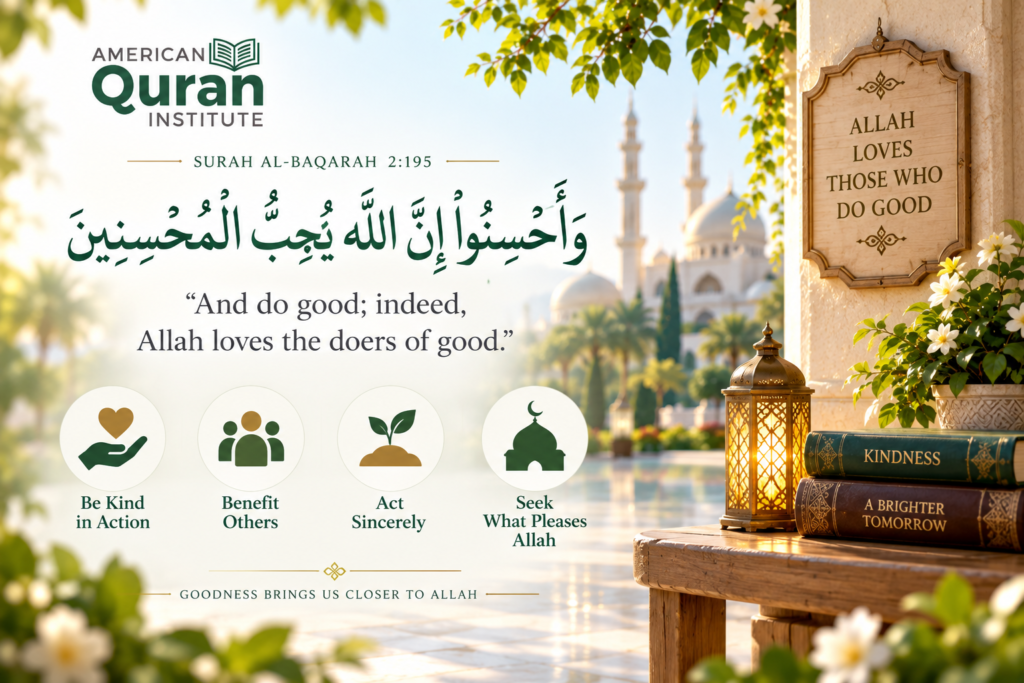
وَأَحْسِنُوا إِنَّ اللَّهَ يُحِبُّ الْمُحْسِنِينَ
Wa ahsinoo innal laaha yuhibbul muhsineen.
“And do good; indeed, Allah loves the doers of good.”
The command وَأَحْسِنُوا — “do good” is broad.
It includes behaving well, acting sincerely, and doing what benefits others in a manner pleasing to Allah. The promise that Allah loves the muhsineen gives kindness a deeper spiritual meaning. Ihsan is not only beneficial to other people; it is also a quality that draws a believer closer to Allah.
Read also: Quran Verses About Justice In Arabic – Fairness, Truth, And Equality
3. Quran Verse About Kindness to Parents, Relatives, Orphans, and the Poor
The Quran repeatedly connects worship of Allah with good treatment of people.
وَاعْبُدُوا اللَّهَ وَلَا تُشْرِكُوا بِهِ شَيْئًا ۖ وَبِالْوَالِدَيْنِ إِحْسَانًا وَبِذِي الْقُرْبَىٰ وَالْيَتَامَىٰ وَالْمَسَاكِينِ
Wa‘budul laaha wa laa tushrikoo bihee shai’aw wa bil waalidaini ihsaanaw wa bizil qurbaa wal yataamaa wal masaakeen.
“Worship Allah and associate nothing with Him, and to parents do good, and to relatives, orphans, and the needy.”
The order is important. After commanding worship of Allah alone, the verse immediately turns to the treatment of people. Parents are mentioned first, followed by relatives, orphans, and those in need. Kindness therefore begins with the relationships and responsibilities closest to us before extending outward.
4. Quran Verse About Speaking to Others With Kindness and Good Words
Kindness in the Quran also includes the way we speak.
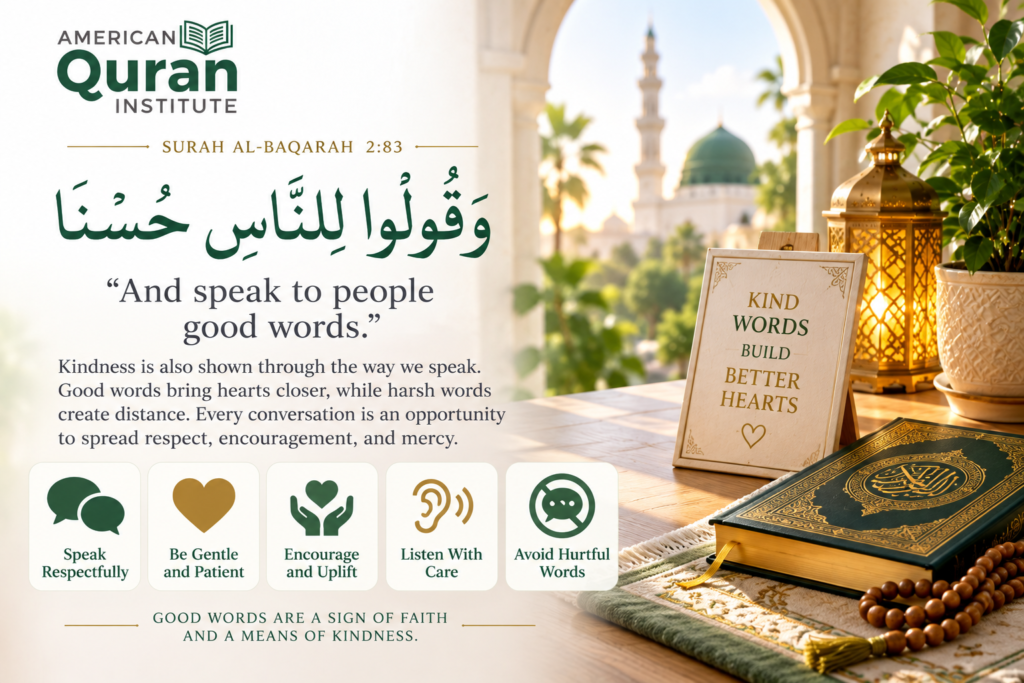
وَقُولُوا لِلنَّاسِ حُسْنًا
Wa qooloo linnaasi husnaa.
“And speak to people good words.”
This short instruction has wide application Kindness is not only shown through money or physical help. It also appears in respectful speech, gentle correction, encouragement, patience, and avoiding unnecessarily hurtful words.
The same verse also connects kind speech with worship, care for parents, relatives, orphans, and the poor.
Read also: Quran Verses About Humanity In Arabic
5. Quran Verse About Showing Kindness to Parents as They Grow Older
Surah Al-Isra gives one of the most detailed Quranic instructions about kindness toward parents.
وَقَضَىٰ رَبُّكَ أَلَّا تَعْبُدُوا إِلَّا إِيَّاهُ وَبِالْوَالِدَيْنِ إِحْسَانًا
Wa qadaa Rabbuka allaa ta‘budooo illaaa iyyaahu wa bil waalidaini ihsaanaa.
“And your Lord has decreed that you worship none but Him, and that you show kindness to parents.”
The verse continues by addressing the situation when one or both parents reach old age. It tells believers not even to say “uff” to them, not to rebuke them, and to speak to them with honorable words. Kindness to parents therefore includes patience, respect, emotional restraint, and gentle speech, especially when caring for them becomes more demanding.
6. Quran Verse About Showing Kindness to Parents and Honoring a Mother’s Sacrifice
Surah Al-Ahqaf also emphasizes good treatment of parents.

وَوَصَّيْنَا الْإِنسَانَ بِوَالِدَيْهِ إِحْسَانًا ۖ حَمَلَتْهُ أُمُّهُ كُرْهًا وَوَضَعَتْهُ كُرْهًا
Wa wassainal insaana biwaalidaihi ihsaanan hamalathu ummuhoo kurhanw wa wada‘athu kurhaa.
“And We have enjoined upon man kindness to his parents. His mother carried him with hardship and gave birth to him with hardship.”
The verse connects ihsan to parents with recognition of sacrifice. It specifically reminds people of the hardship their mothers experienced during pregnancy and childbirth.
Gratitude toward parents is therefore not abstract. The Quran encourages believers to remember the care and sacrifice they received and respond with respect and kindness.
7. Quran Verse About Kindness and Goodness Being Rewarded With Goodness
One of the shortest and most memorable verses about ihsan appears in Surah Ar-Rahman.
هَلْ جَزَاءُ الْإِحْسَانِ إِلَّا الْإِحْسَانُ
Hal jazaaa’ul ihsaani illal ihsaan.
“Is the reward for good anything but good?”
The verse appears within a passage describing the rewards prepared for the righteous. Its wording expresses a powerful Quranic principle: goodness is not wasted. Acts of sincere ihsan may sometimes go unnoticed by people, but they are never unnoticed by Allah.
See Us in Action!
Take a look inside our virtual classrooms. Watch the clip below to see how our instructors engage with students, simplify complex rules, and create an inspiring environment for learning.
Start Your Quranic Education
Join our premier online institute for structured Quranic learning tailored for students in the USA.
Book Your Free Trial8. Quran Verse About Allah’s Mercy Being Near to Those Who Practice Kindness and Ihsan
Kindness and mercy are closely connected in the Quran.
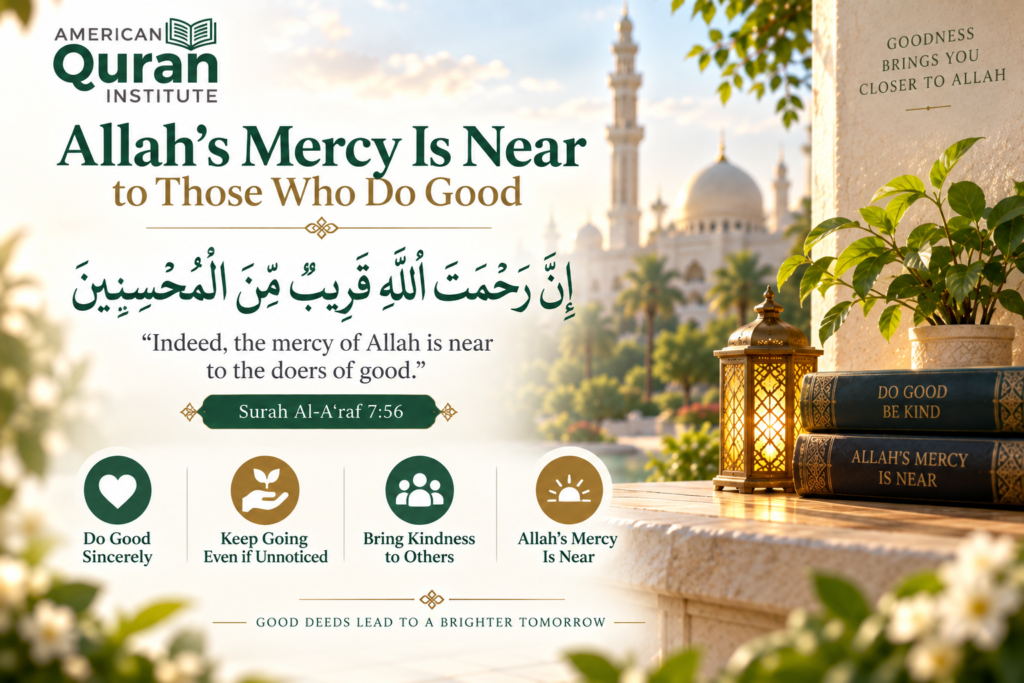
إِنَّ رَحْمَتَ اللَّهِ قَرِيبٌ مِّنَ الْمُحْسِنِينَ
Inna rahmatal laahi qareebum minal muhsineen.
“Indeed, the mercy of Allah is near to the doers of good.”
The verse gives the muhsineen a beautiful promise: Allah’s mercy is near. This encourages believers to continue doing good even when results are not immediate or appreciation from others is absent. Ihsan is ultimately practiced for Allah, not simply for recognition from people.
9. Quran Verse About Allah Preserving the Reward of Those Who Do Good
The Quran repeatedly reassures believers that good deeds are not lost.
إِنَّ اللَّهَ لَا يُضِيعُ أَجْرَ الْمُحْسِنِينَ
Innal laaha laa yudee‘u ajral muhsineen.
“Indeed, Allah does not allow the reward of the doers of good to be lost.”
A person may act kindly without receiving gratitude, repayment, or recognition from others. The Quran redirects the believer’s attention toward Allah. No sincere act of ihsan disappears from His knowledge or reward.
10. Quran Verse About Patience and Ihsan in the Story of Yusuf
The story of Prophet Yusuf gives a powerful example of patience, taqwa, and excellence during difficulty.
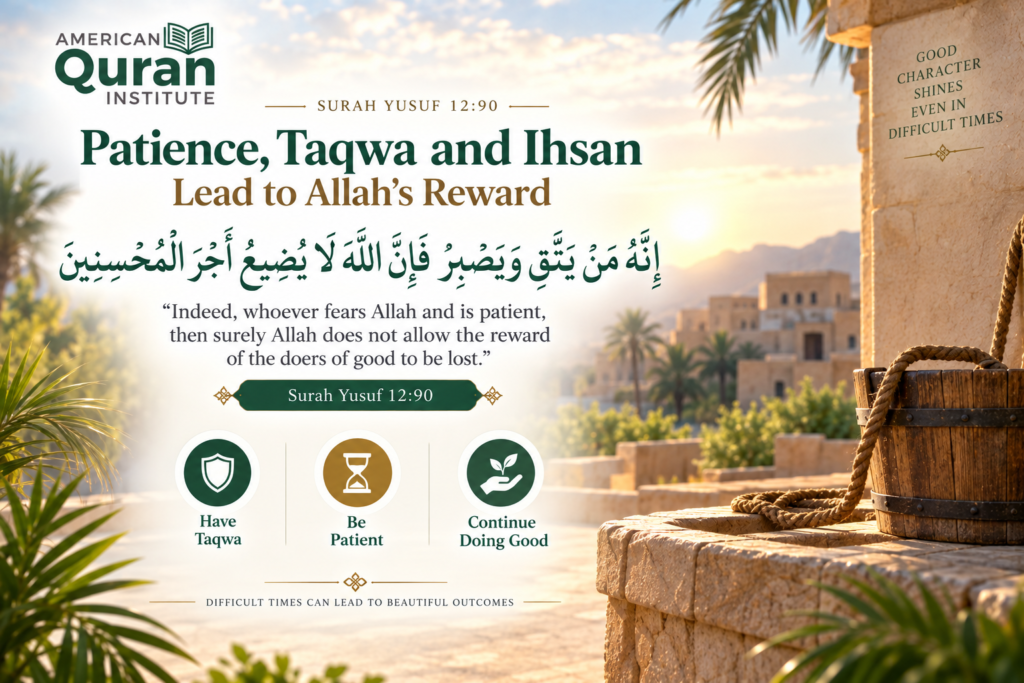
إِنَّهُ مَن يَتَّقِ وَيَصْبِرْ فَإِنَّ اللَّهَ لَا يُضِيعُ أَجْرَ الْمُحْسِنِينَ
Innahoo mai yattaqi wa yasbir fa innal laaha laa yudee‘u ajral muhsineen.
“Indeed, whoever fears Allah and is patient, then surely Allah does not allow the reward of the doers of good to be lost.”
The verse connects three ideas: taqwa, patience, and ihsan.
Yusuf’s story shows that good character matters most when circumstances make it difficult to maintain. Kindness and excellence are therefore not limited to easy situations. They can include remaining patient, refusing wrongdoing, and continuing to obey Allah when facing injustice or hardship.
11. Quran Verse About Allah Being With Those Who Practice Ihsan
The Quran also promises divine guidance and support to those who strive sincerely.
وَالَّذِينَ جَاهَدُوا فِينَا لَنَهْدِيَنَّهُمْ سُبُلَنَا ۚ وَإِنَّ اللَّهَ لَمَعَ الْمُحْسِنِينَ
Wallazeena jaahadoo feenaa lanahdiyannahum subulanaa; wa innal laaha lama‘al muhsineen.
“And those who strive for Us—We will surely guide them to Our ways. And indeed, Allah is with the doers of good.”
Ihsan is connected here with sincere effort. A believer does not simply wait to become better. They strive against bad habits, selfishness, anger, and other weaknesses while seeking Allah’s guidance.
The promise إِنَّ اللَّهَ لَمَعَ الْمُحْسِنِينَ — “Allah is with the doers of good” gives encouragement to continue. Students who want to recite verses like these accurately can strengthen pronunciation and Quran reading through Quran Tajweed Classes.
12. Quran Verse About Those Who Do Good Receiving the Best Reward
Surah Yunus connects ihsan with the highest reward.
لِلَّذِينَ أَحْسَنُوا الْحُسْنَىٰ وَزِيَادَةٌ
Lillazeena ahsanul husnaa wa ziyaadah.
“For those who have done good is the best reward—and more.”
The verse then describes them as people of Paradise who will remain there eternally. This shows that ihsan is not merely an earthly moral quality. It has consequences in the Hereafter.
The people who choose goodness, sincerity, and excellence are promised a reward far greater than anything they may sacrifice in this life.
13. Quran Verse About Allah Rewarding Good Work Without Losing Any of It
The Quran makes clear that excellent deeds are fully recognized.

إِنَّا لَا نُضِيعُ أَجْرَ مَنْ أَحْسَنَ عَمَلًا
Innaa laa nudee‘u ajra man ahsana ‘amalaa.
“Indeed, We do not allow to be lost the reward of anyone who does well in deeds.”
The expression أَحْسَنَ عَمَلًا — “does well in deeds” emphasizes quality as well as action. Ihsan encourages believers not merely to perform good deeds mechanically, but to perform them sincerely and carefully.
14. Quran Verse About Following Forgiveness With Fairness and Kind Treatment
The Quran also uses ihsan in the context of resolving serious wrongdoing.
فَمَنْ عُفِيَ لَهُ مِنْ أَخِيهِ شَيْءٌ فَاتِّبَاعٌ بِالْمَعْرُوفِ وَأَدَاءٌ إِلَيْهِ بِإِحْسَانٍ
Faman ‘ufiya lahoo min akheehi shai’un fattibaa‘um bil ma‘roofi wa adaaa’un ilaihi bi ihsaan.
“But whoever is pardoned something by his brother, then there should be a suitable follow-up and payment to him with good conduct.”
The verse shows that where pardon or settlement occurs, it should be handled respectfully and fairly. Ihsan therefore includes avoiding further aggression after a dispute has been resolved.
15. Quran Verse About Jannah Being the Reward for Those Who Practice Ihsan
The Quran repeatedly connects the muhsineen with Jannah.

فَأَثَابَهُمُ اللَّهُ بِمَا قَالُوا جَنَّاتٍ تَجْرِي مِن تَحْتِهَا الْأَنْهَارُ خَالِدِينَ فِيهَا ۚ وَذَٰلِكَ جَزَاءُ الْمُحْسِنِينَ
Fa asaabahumul laahu bimaa qaaloo jannaatin tajree min tahtihal anhaaru khaalideena feehaa; wa zaalika jazaaa’ul muhsineen.
“So Allah rewarded them for what they said with gardens beneath which rivers flow, wherein they abide eternally. And that is the reward of the doers of good.”
Jannah is repeatedly presented as the lasting reward for faith, sincerity, and righteous action. The verse also reinforces a central theme throughout the Quran: ihsan is never separated from belief and obedience to Allah.
What Does the Quran Say About Kindness?
The Quran presents kindness as an essential part of righteous character and a practical expression of faith. It is not limited to being polite or gentle; Quranic kindness includes doing good to others, showing mercy, giving generously, speaking well, helping those in need, and treating people with fairness and compassion.
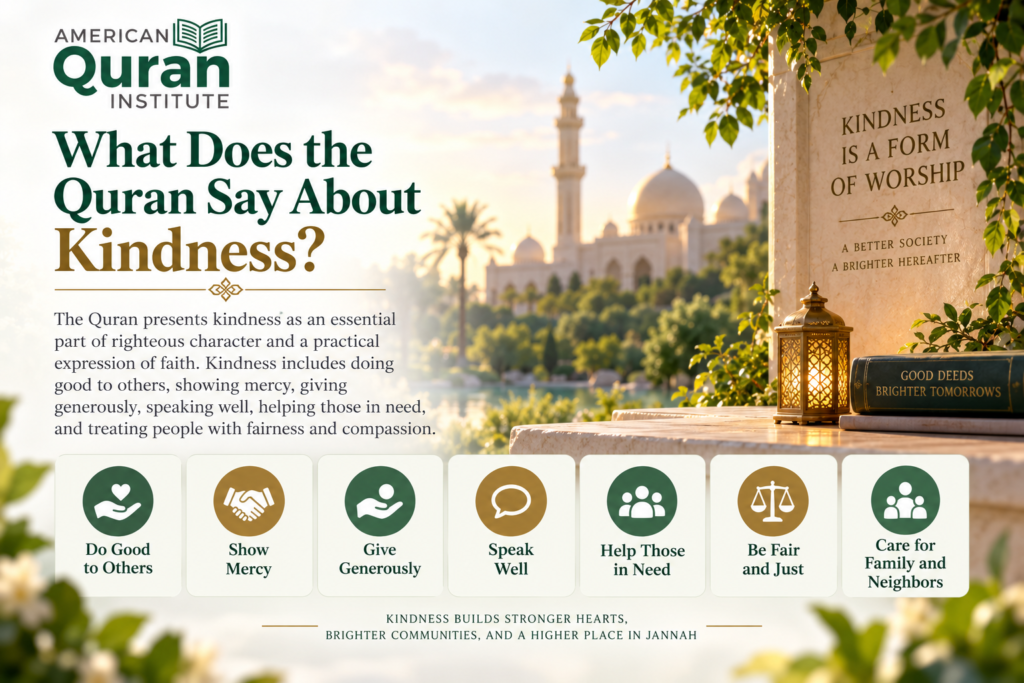
Kindness appears alongside justice, worship, generosity, family responsibility, patience, and taqwa. In many verses, those who practice ihsan are called المُحْسِنِينَ — al-muhsineen, meaning people who do good and act with excellence.
Ihsan encourages a believer to go beyond simply avoiding wrongdoing and to actively choose what is good and beneficial.
The Quran also connects ihsan with Allah’s love, mercy, guidance, forgiveness, and reward. This makes kindness more than a social virtue; it becomes an act of worship and a quality that shapes how Muslims interact with parents, relatives, neighbors, people in need, and society as a whole.
Students who want to understand these Quranic concepts beyond translation can explore Quran Tafsir Classes to study how verses about kindness, mercy, and good character fit within their wider context.
What Do Quran Verses About Kindness Teach Us?
The Quran verses about kindness in Arabic show that ihsan should influence worship, speech, family relationships, financial behavior, patience, and treatment of others.
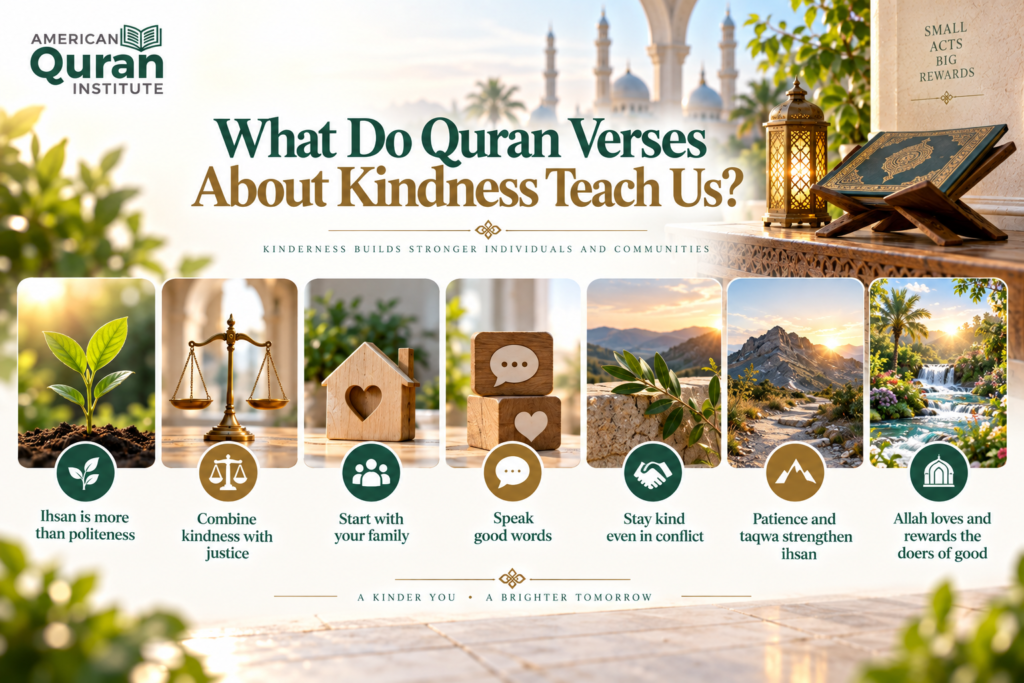
- Kindness in the Quran Goes Beyond Being Polite: Ihsan means doing what is good with sincerity and excellence. It includes behavior, worship, relationships, generosity, and character.
- Allah Commands Kindness Alongside Justice: Surah An-Nahl 16:90 places ihsan beside justice, showing that believers should not only avoid wrongdoing but also actively pursue goodness.
- Kindness Begins With the People Closest to Us: The Quran repeatedly emphasizes ihsan toward parents, relatives, orphans, neighbors, and people in need.
- Kind Speech Is Part of Quranic Kindness: The instruction “speak to people good words” shows that everyday speech is one of the simplest ways to practice kindness.
- Kindness Should Continue Even During Conflict or Separation: The Quran commands ihsan even when relationships are strained, including during divorce and dispute resolution.
- Patience and Taqwa Help a Believer Maintain Ihsan During Hardship: The story of Yusuf shows that excellence in character is especially meaningful when a person has been tested or treated unfairly.
- Allah Loves and Rewards the Muhsineen: Many verses explicitly state that Allah loves the doers of good, does not waste their reward, and has prepared lasting blessings for them.
How to Practice Quranic Kindness in Daily Life?
The Quran turns kindness into practical behavior rather than leaving it as a general ideal.
- Speak to People in a Respectful and Constructive Way: Avoid insulting, mocking, or humiliating others. Kind words may be simple, but they can have a lasting effect.
- Treat Your Parents With Patience and Honor: Kindness to parents includes gentle speech, respect, service, and patience, particularly as they grow older.
- Help People Who Are Vulnerable or in Need: The Quran repeatedly mentions orphans, the poor, travelers, relatives, and others who may need support.
- Continue Acting Well When Relationships Become Difficult: Ihsan is especially important during disagreements, separation, and moments when anger makes good treatment harder.
- Do Good Without Depending on Recognition From People: The Quran promises that Allah does not waste the reward of the muhsineen. Good deeds remain valuable even when no one else notices them.
- Connect Kindness With Worship and Sincerity: Quranic ihsan begins with the relationship between the believer and Allah. Prayer, istighfar, taqwa, and sincere worship help strengthen good character toward other people.
For learners who want to memorize verses about ihsan and other important Quranic themes, Quran Memorization Classes can provide structured repetition, revision, and teacher guidance.

Experience Our Classroom Environment
Don’t just take our word for it—experience a live session for yourself! Click on the videos below to watch real snippets from our classes and see our interactive teaching methods in real-time.
Start Your Quranic Education
Join our premier online institute for structured Quranic learning tailored for students in the USA.
Book Your Free TrialDeepen Your Understanding of Quranic Kindness and Ihsan With American Quran Institute
English translations often use words such as kindness, goodness, excellence, or good conduct for ihsan, but no single English word captures every Quranic use of the term.
Reading Quran verses about kindness in Arabic helps students recognize recurring words such as ihsan, muhsineen, husna, ma‘ruf, rahmah, and birr and understand how they connect across different Surahs.
At American Quran Institute, students can strengthen Quran reading, Tajweed, memorization, and understanding through structured online instruction. Learning directly from the Arabic text can make verses about kindness and character more meaningful and easier to apply.
Start your free trial today and build a stronger connection with the Quran and its teachings on ihsan.
Our Quran Courses
- Learn Quran Course for Beginners
- Quran Qirat Learning Course
- Quran Tafsir Course
- Noorani Qaida Course
- Noorani Qaida Course for Kids
- Weekend Quran Classes
- Intensive Quran Course
- Al-Azhar Quran Course

Conclusion
The Quran verses about kindness in Arabic show that kindness is much more than polite behavior. The Quran connects ihsan with worship, justice, mercy, patience, family responsibility, generosity, good speech, and excellence in character.
Believers are instructed to treat parents kindly, speak good words to people, support those in need, act fairly during conflict, and continue doing good even when relationships become difficult.
The Quran also repeatedly promises that Allah loves the muhsineen, guides them, brings His mercy near to them, and never allows their reward to be lost. Kindness in Islam is therefore both a way of treating people and a way of living before Allah.
Frequently Asked Questions About Quran Verses About Kindness in Arabic
What Does Ihsan Mean in the Quran?
Ihsan refers to goodness, excellence, and doing what is right in the best manner. It applies to worship, character, relationships, and treatment of others.
Which Quran Verse Talks About Kindness to Parents?
Surah Al-Isra 17:23 commands believers to worship Allah alone and show ihsan to their parents.
What Does the Quran Say About Speaking Kindly?
Surah Al-Baqarah 2:83 says وَقُولُوا لِلنَّاسِ حُسْنًا — “Speak to people good words.”
Does the Quran Teach Kindness During Divorce?
Yes. Surah Al-Baqarah 2:229 instructs Muslims either to retain a wife appropriately or release her with ihsan.
What Reward Does the Quran Promise for Ihsan?
The Quran connects ihsan with Allah’s love, mercy, guidance, reward, and Paradise.
What Are Some Qualities of the Muhsineen?
The Quran describes the muhsineen as people who worship Allah sincerely, seek forgiveness, remain patient, practice taqwa, spend on those in need, and continue doing good.
How Can I Understand Quran Verses About Kindness More Deeply?
Read the surrounding verses, study the different meanings of ihsan in Arabic, and consult reliable Tafsir to understand how kindness connects with worship, justice, family relationships, and good character.






[…] Read also: Quran Verses About Kindness In Arabic – Ihsan, Mercy, And Good Character […]