 Learn Arabic
The importance of Arabic language in Quran begins with a simple fact: Arabic is the language Allah chose for His final revelation.
The Quran was revealed, preserved, recited, and transmitted in Arabic, which means its vocabulary, grammar, expressions, sounds, and rhetorical structure are all connected to understanding its message.
Allah says:
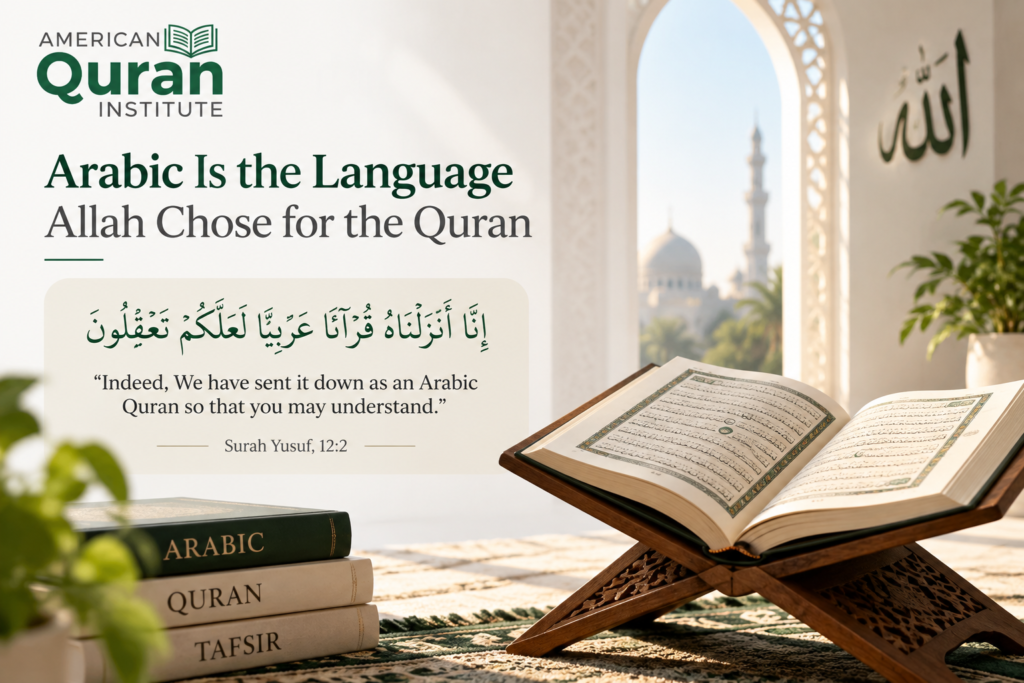
إِنَّا أَنزَلْنَاهُ قُرْآنًا عَرَبِيًّا لَّعَلَّكُمْ تَعْقِلُونَ
“Indeed, We have sent it down as an Arabic Quran so that you may understand.”
This connection between Arabic and understanding appears repeatedly in the Quran. Allah also describes His revelation as an Arabic Quran in Surah Taha (20:113) and Surah Fussilat (41:3).
Translations make the meanings of the Quran accessible to Muslims around the world, but they remain explanations of the Arabic original. They cannot always carry every shade of meaning contained in a Quranic word or reproduce its grammatical, rhetorical, and phonetic qualities.
Understanding the importance of Arabic, therefore, helps explain not only why the Quran was revealed in Arabic, but also why knowledge of the language can transform the way Muslims understand, recite, reflect upon, and live by the Quran.
1. Arabic Is the Language Allah Chose for the Quran
The strongest evidence for the importance of Arabic language in Quran comes from the Quran itself.
Allah does not merely tell us that the Quran was revealed; He specifically draws attention to the language in which it was revealed and connects its Arabic form with understanding.
Allah says:
إِنَّا أَنزَلْنَاهُ قُرْآنًا عَرَبِيًّا لَّعَلَّكُمْ تَعْقِلُونَ
“Indeed, We have sent it down as an Arabic Quran so that you may understand.”
The verse establishes a direct relationship between the Quran being revealed in Arabic and the purpose of understanding its message. The expression لَّعَلَّكُمْ تَعْقِلُونَ draws attention to comprehension, showing why the language of revelation matters when studying the Quran.
This does not mean that only Arabic speakers can benefit from the Quran. Reliable translations and Tafsir make its guidance accessible to Muslims everywhere.
Rather, the verse explains why Arabic occupies a unique position: it is the language of the revealed text itself, while translations communicate its meanings in another language.
Read also: Can Adults Learn To Read Quran In The USA?
2. Arabic Gives Access to the Original Meaning of the Quran
One of the greatest aspects of the importance of Arabic language in Quran is direct access to its wording.
When you read a translation, the translator has already made linguistic decisions for you. They have considered an Arabic word or expression and selected an English equivalent they believe communicates its meaning in that particular context.
That translation may be accurate and useful, but the reader receives the meaning through another person’s linguistic choices.
Understanding Arabic reduces that distance.
You begin recognizing the words Allah uses, the relationships between them, and the way meanings develop from one Ayah to another.
This does not make Tafsir or scholarly interpretation unnecessary. Rather, Arabic gives students a stronger foundation for understanding why scholars interpret Quranic passages as they do.
Structured Quran classes for kids can help younger Muslims establish correct reading and pronunciation while they gradually begin connecting Quranic Arabic with meaning.

3. Quranic Arabic Carries Meanings That Translation Cannot Fully Express
Arabic is particularly important because Quranic words can contain layers of meaning that are difficult to represent with a single English equivalent.
A clear example is: تقوى — Taqwa
It may be translated as piety, fear of Allah, righteousness, or God-consciousness.
Yet each translation captures only part of the concept.
Taqwa carries the sense of awareness of Allah that leads a person to guard themselves against what displeases Him and live with reverence and righteousness.
The same challenge appears with many central Quranic concepts:
- رحمة — Rahmah: mercy
- توكل — Tawakkul: reliance upon Allah
- إحسان — Ihsan: excellence and beautiful conduct
- صبر — Sabr: patience and steadfastness
- هدى — Huda: guidance
- مغفرة — Maghfirah: forgiveness
An English translation can communicate their general meanings, but Arabic allows the learner to understand how those meanings operate in their original Quranic setting.
The more Quranic Arabic a person understands, the more these terms become complete concepts rather than translated vocabulary.
Read also: Common Mistakes When Reading The Quran And How To Fix Them
See Us in Action!
Take a look inside our virtual classrooms. Watch the clip below to see how our instructors engage with students, simplify complex rules, and create an inspiring environment for learning.
Start Your Quranic Education
Join our premier online institute for structured Quranic learning tailored for students in the USA.
Book Your Free Trial4. Arabic Grammar Protects the Precise Meaning of Quranic Verses
Understanding individual vocabulary is only one part of understanding the Quran. Arabic grammar determines how those words relate to one another.
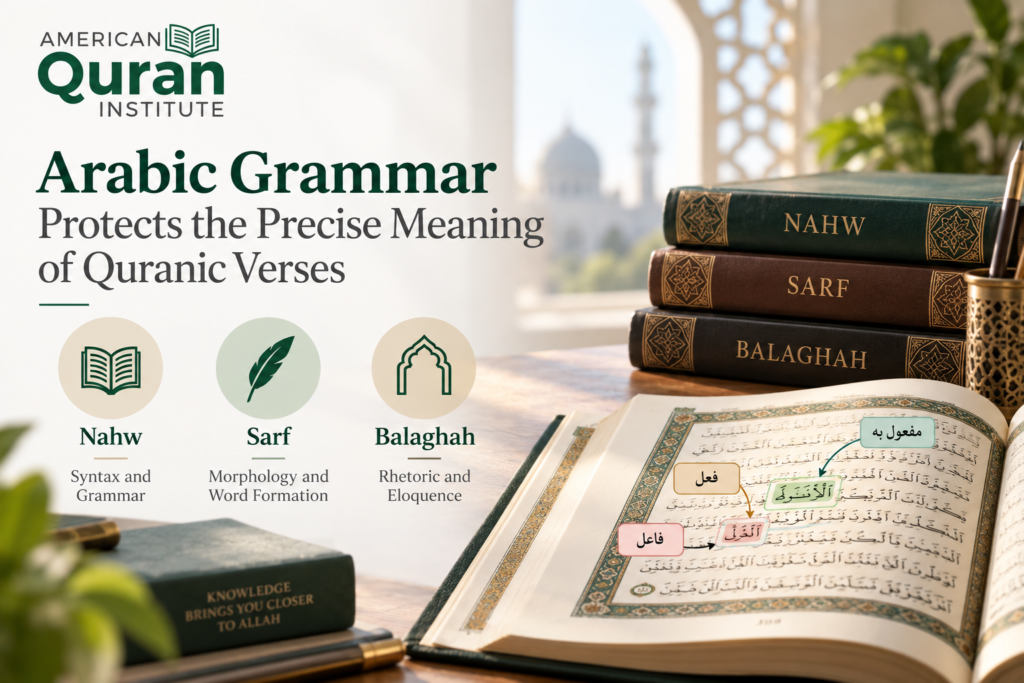
Changes in word endings, pronouns, verb patterns, sentence structures, and particles can affect meaning.
This explains why the classical Islamic tradition gave such importance to Arabic sciences such as:
- Nahw — syntax and grammar
- Sarf — morphology and word formation
- Balaghah — rhetoric and eloquence
For the ordinary Muslim, mastering these sciences is not required simply to benefit from the Quran.
For advanced Quranic interpretation, however, they become extremely important.
A scholar studying a verse may examine why one grammatical form was used rather than another, why a particular word appears before another word, or why a certain verb form was chosen.
These linguistic details can reveal dimensions that disappear when the verse is rendered into another language.
Read also: How To Concentrate While Reading Quran?
5. Arabic Reveals the Depth of Quranic Word Roots
Another important characteristic of Arabic is its root-based structure Many Arabic words develop from a common root and retain relationships in meaning.
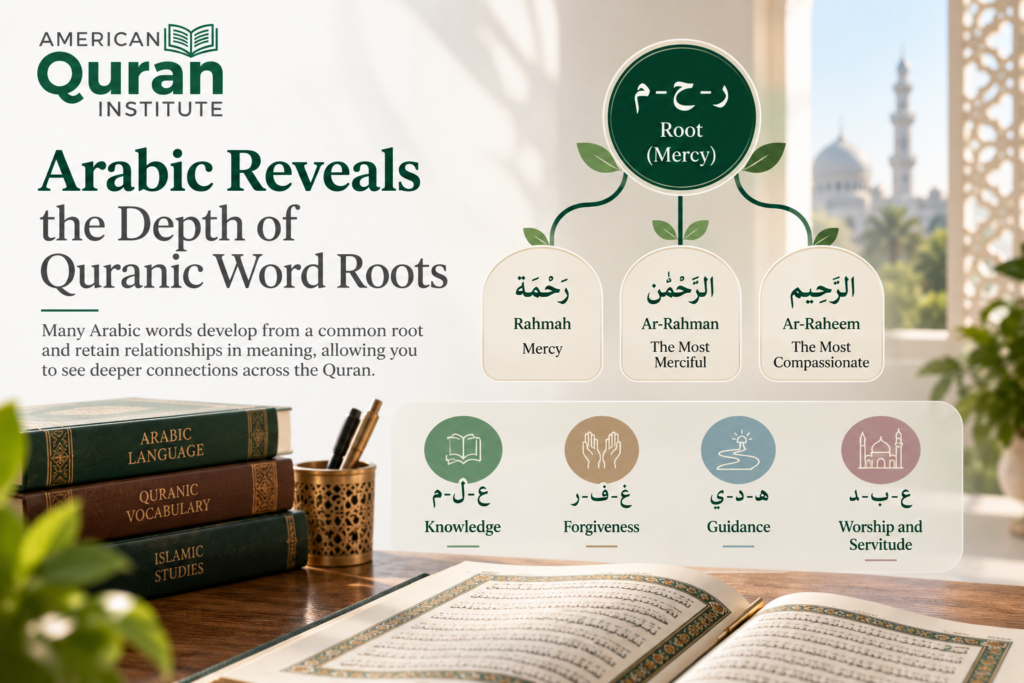
Consider the root: ر-ح-م
From it come words such as:
رَحْمَة — Rahmah
الرَّحْمَٰن — Ar-Rahman
الرَّحِيم — Ar-Raheem
This relationship allows a student of Arabic to see connections between words that may appear unrelated once translated into English.
The same occurs with roots connected to:
ع-ل-م — knowledge
غ-ف-ر — forgiveness
ه-د-ي — guidance
ع-ب-د — worship and servitude
As Muslims become familiar with these roots, they begin recognizing relationships across different verses and Surahs.
This is one reason Quranic vocabulary becomes increasingly meaningful as Arabic knowledge develops: one word can unlock an entire family of related expressions.
6. Arabic Preserves the Eloquence and Linguistic Beauty of the Quran
The Quran communicates through more than dictionary definitions Its message is also carried through rhetorical structure, emphasis, word order, repetition, contrast, imagery, and sound.
These qualities form an important part of Quranic Balaghah, or rhetoric A translator may successfully communicate the general message of an Ayah but still be unable to reproduce its exact linguistic effect.
Word order provides a simple example Arabic allows words to be moved within a sentence for purposes such as emphasis and restriction. English may require those words to be rearranged into a conventional sentence, causing some of the original emphasis to become less visible.
This is why studying Quranic Arabic often reveals details that were present in familiar verses all along but were difficult to see through translation.
7. Arabic Is Essential for Understanding the Quran’s Linguistic Miracle
The Quran’s linguistic excellence is an important aspect of its I’jaz, or inimitability.
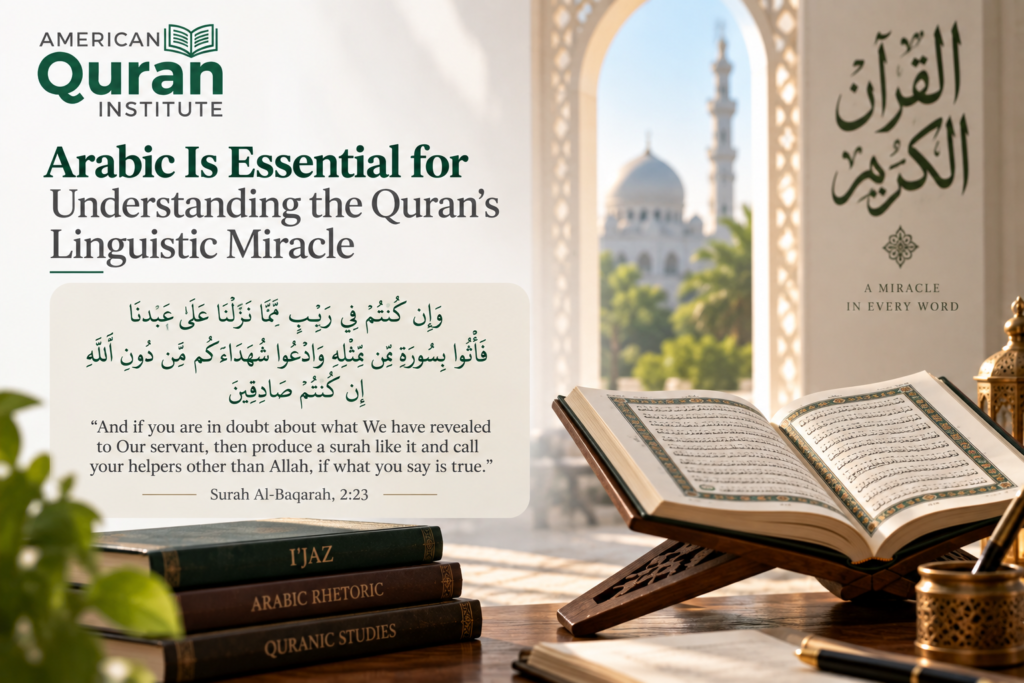
Allah challenges those who doubt the Quran to produce something comparable to it:
وَإِن كُنتُمْ فِي رَيْبٍ مِّمَّا نَزَّلْنَا عَلَىٰ عَبْدِنَا فَأْتُوا بِسُورَةٍ مِّن مِّثْلِهِ وَادْعُوا شُهَدَاءَكُم مِّن دُونِ اللَّهِ إِن كُنتُمْ صَادِقِينَ
“And if you are in doubt about what We have revealed to Our servant, then produce a surah like it and call your helpers other than Allah, if what you say is true.”
The challenge concerns the Quran in its revealed Arabic form Its precision, rhetorical composition, sound, vocabulary, and arrangement cannot simply be recreated in English or another language.
A translation can communicate the meaning of the challenge, but the linguistic object of that challenge remains the Arabic Quran.
Therefore, understanding the linguistic dimension of Quranic I’jaz requires at least some engagement with Arabic.
8. Arabic Helps Muslims Understand Why Quran Translations Differ
Open several reputable English translations of the same Ayah and you may find different wording.
Often, the difference exists because the original Arabic allows a richness that cannot be reproduced through a single English expression.
One translator may choose a more literal rendering. Another may prioritize contextual meaning. A third may add explanatory wording to make the intended meaning clearer.
This does not automatically mean one translation is correct and another is wrong It demonstrates the limitations inherent in translation.
Arabic allows students to return to the original expression and then use Tafsir and scholarly explanation to understand why different translators made different choices.
Translations are therefore extremely valuable tools, but they work best when understood as guides to the meaning of the original Arabic Quran.
9. Arabic Makes Tafsir More Meaningful
The relationship between Arabic and Tafsir is particularly important Classical scholars interpreting the Quran examined much more than the apparent translation of individual words.
Their analysis included:
- Word roots
- Grammar
- Morphology
- Sentence structure
- Classical Arabic usage
- Rhetorical devices
- Context
- Related Quranic expressions
This means that a reader using an English Tafsir can benefit from a scholar’s conclusions, but someone with Arabic knowledge can increasingly understand the linguistic reasoning behind those conclusions.
As a student progresses into advanced Quranic studies, Arabic becomes more important because so much of the classical Tafsir tradition was written in Arabic.
It gives the learner access not only to translated conclusions but also to the arguments, explanations, and linguistic evidence used by scholars.
10. Arabic Connects Quranic Words Directly to Salah
The importance of Arabic language in Quran is not limited to academic study. Muslims experience it every day through Salah.
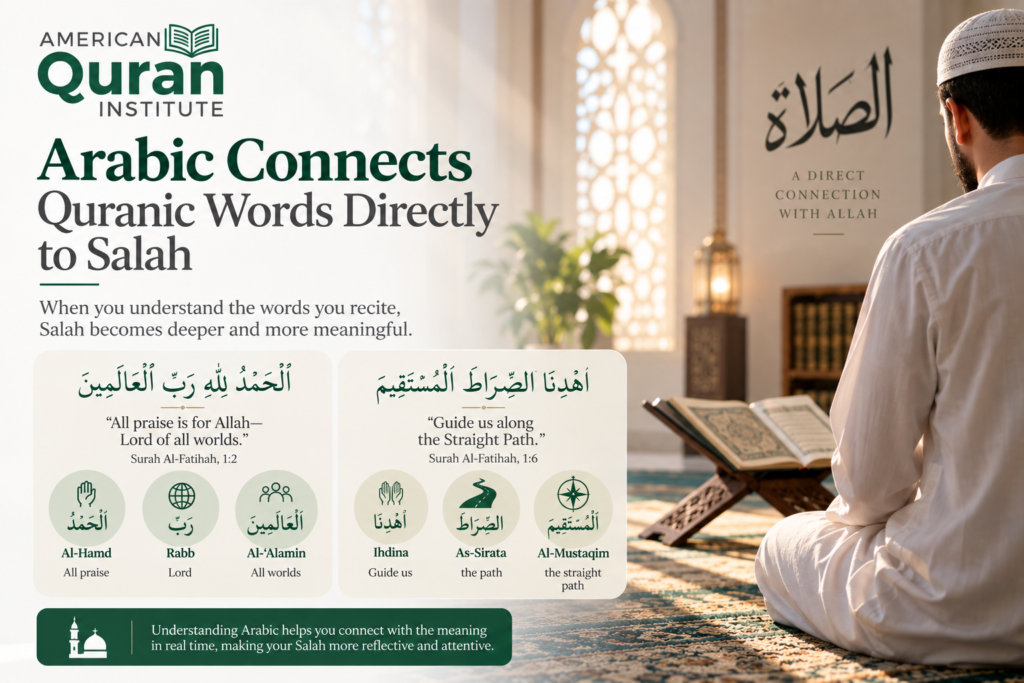
Surah Al-Fatihah is recited repeatedly in the five daily prayers.
Consider:
الْحَمْدُ لِلَّهِ رَبِّ الْعَالَمِينَ
A Muslim can memorize and recite this Ayah correctly without speaking Arabic.
But when the worshipper understands words such as:
Al-Hamd — الحمد
Rabb — رب
Al-‘Alamin — العالمين
the experience changes.
The reciter understands the praise being offered to Allah while saying the words.
The same happens with:
اهْدِنَا الصِّرَاطَ الْمُسْتَقِيمَ
Understanding Arabic makes it possible to connect the act of recitation with its meaning in real time.
This can support reflection and attentiveness during prayer rather than leaving the Quranic verses as memorized sounds whose meaning is accessed only afterward.
11. Arabic Helps Muslims Think Through Quranic Concepts
Language influences how concepts are understood When Muslims learn Quranic Arabic, terms such as Taqwa, Tawakkul, Sabr, Rahmah, Ihsan, and Hidayah gradually stop requiring an immediate English substitute.
The learner begins understanding them within their Quranic framework This is important because the Quran establishes an entire vocabulary through which Muslims understand faith, worship, morality, human behavior, and their relationship with Allah.
Learning that vocabulary can therefore shape the way a Muslim thinks about the Quran’s message.
This is one of the deepest benefits of understanding the Quran’s language.
12. Arabic Connects the Meaning and Sound of the Quran
The Quran was not only preserved as written text. It has also been transmitted through recitation Arabic pronunciation therefore matters.
Every Arabic letter has a specific articulation point and characteristics. Sounds such as:
ع، ح، خ، غ، ق، ص، ض
cannot be represented perfectly by English transliteration Tajweed preserves these sounds and teaches Muslims how to recite Quranic Arabic correctly.
This is where language and oral transmission meet: understanding Arabic reveals more of the meaning, while correct Tajweed preserves the way the Quran is pronounced.
Students who progress beyond basic reading and want to perfect their recitation under qualified supervision can pursue more advanced study through an Online Quran Ijazah Course, where accurate recitation and direct teacher correction become central to the learning process.

13. Arabic Gives Muslims Directer Access to the Sunnah and Islamic Scholarship
The importance of Arabic extends naturally beyond the Quran because the Prophet Muhammad ﷺ spoke Arabic and the major collections of Hadith were preserved in Arabic.
The same is true of much of the classical literature of:
- Tafsir
- Hadith
- Fiqh
- Aqeedah
- Seerah
- Usul al-Fiqh
This matters for Quran study because Tafsir does not exist in isolation. Scholars explain Quranic verses through other verses, Hadith, statements of the Companions, Arabic language, and other Islamic sciences.
A strong Arabic foundation therefore gives advanced learners access to a much broader body of material through which the Quran has traditionally been studied and understood.
14. Arabic Has an Important Place in Preserving Correct Islamic Understanding
Precise language becomes especially important when dealing with matters of belief and Islamic law.
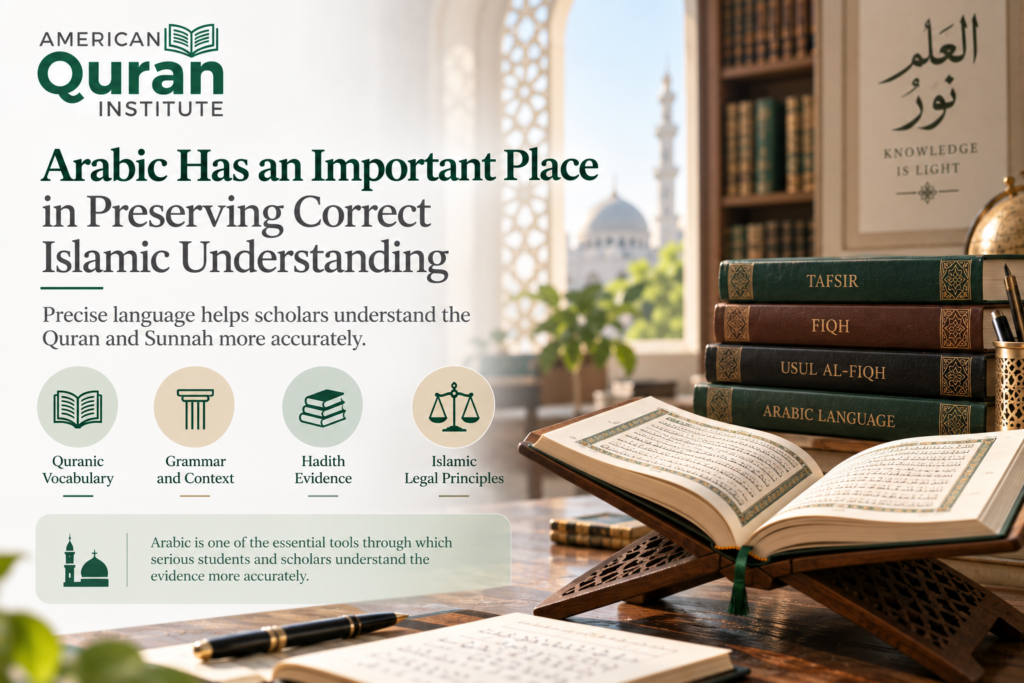
A Quranic word cannot always be removed from its Arabic context, assigned a single English definition, and then used to establish a theological or legal conclusion.
Qualified scholars examine vocabulary, grammar, context, other Quranic verses, Hadith, and established principles of interpretation.
Arabic is therefore not a license to interpret the Quran independently after learning some vocabulary.
Rather, it is one of the essential tools through which serious students and scholars understand the evidence more accurately The deeper the level of interpretation, the greater the level of Arabic knowledge required.
15. Arabic Helps Preserve the Quran Across Generations
Muslims live across the world and speak thousands of languages, yet they recite the same Quran in Arabic The language provides a remarkable continuity.
A child learning Al-Fatihah in the United States is learning the same Arabic verses recited by Muslims in Egypt, Indonesia, Nigeria, Pakistan, or any other part of the world.
Translations may vary according to language and translator. The Arabic Quran does not change with them.
Teaching children the Quran’s Arabic from an early age therefore helps maintain this direct relationship with revelation across generations.
16. Arabic Can Make Quran Memorization More Meaningful
Understanding Arabic also changes how Quran memorization works A learner who does not understand the language may initially memorize verses primarily through sound and repetition.
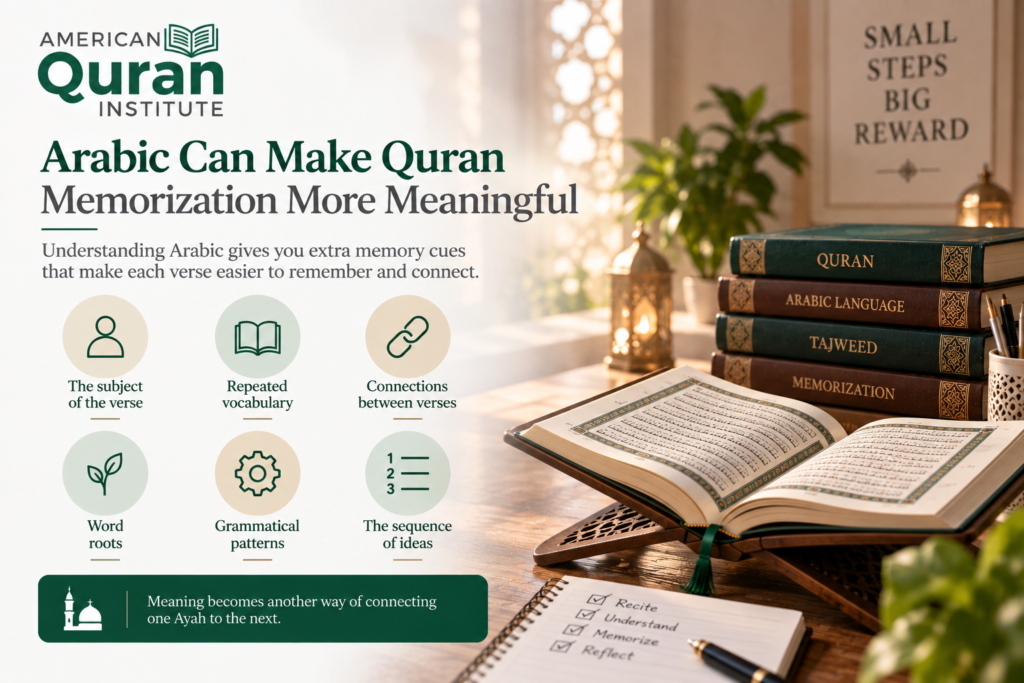
A learner who understands some Arabic has additional memory cues.
They can recognize:
- The subject of the verse
- Repeated vocabulary
- Connections between verses
- Word roots
- Grammatical patterns
- The sequence of ideas
Meaning therefore becomes another way of connecting one Ayah to the next This does not replace repetition or regular revision in Hifz, but it can make memorization more conscious and help the student recognize the structure of what is being memorized.
How Much Arabic Does a Muslim Need to Understand the Quran?
Recognizing the importance of Arabic does not mean every Muslim must become an Arabic linguist There are different levels of need.
A Muslim can begin by learning enough Arabic to correctly recite what is required in Salah and understand commonly recited verses and supplications.
From there, the learner may gradually study:
- Common Quranic vocabulary
- Frequently occurring roots
- Basic grammar
- Morphology
- Quranic expressions
Students who want to pursue advanced Tafsir, Fiqh, Hadith, or other Islamic sciences require a much deeper command of Arabic.
This reflects a distinction emphasized by scholars: every Muslim benefits from the Arabic needed for personal worship and understanding, while the Muslim community also needs scholars who master Arabic deeply enough to preserve, teach, and interpret the Islamic sciences.
Experience Our Classroom Environment
Don’t just take our word for it—experience a live session for yourself! Click on the videos below to watch real snippets from our classes and see our interactive teaching methods in real-time.
Start Your Quranic Education
Join our premier online institute for structured Quranic learning tailored for students in the USA.
Book Your Free TrialLearn the Language of the Quran with The American Quran Institute
Understanding why Arabic matters is only the beginning; the next step is building the language skills that help you engage with the Quran more directly.
At The American Quran Institute, students can develop Arabic alongside their Quranic studies through structured learning designed to strengthen reading, pronunciation, vocabulary, grammar, and Quran comprehension.
Whether you are starting with the Arabic alphabet or want to progress toward deeper study of Quranic Arabic, Tajweed, or Tafsir, the academy offers guided learning for different ages and levels.
Instead of relying entirely on translation, you can gradually begin recognizing the words, patterns, and meanings you encounter in the Quran itself and build a stronger, more informed connection with the Book of Allah.

Start Your Quranic Education
Join our premier online institute for structured Quranic learning tailored for students in the USA.
Book Your Free TrialConclusion
The importance of Arabic language in Quran comes first from the fact that Arabic is the language in which Allah revealed His final Book. Its vocabulary, grammar, rhetorical structure, and expressions are all part of the Quranic text, which is why no translation can reproduce every dimension of the original with complete precision.
This does not mean that Muslims must become fluent in Arabic before they can understand or benefit from the Quran. Reliable translations and Tafsir remain valuable resources, particularly for non-Arabic speakers.
However, even a growing knowledge of Quranic vocabulary and commonly recited verses can help a Muslim move from relying entirely on translation toward recognizing the meanings of Allah’s words more directly.
For students who pursue Tafsir and the Islamic sciences, Arabic becomes even more important because it provides access to the linguistic details of the Quran and the scholarly tradition built around its interpretation.
Frequently Asked Questions
What is the importance of Arabic language in Quran?
Arabic is important because it is the original language of the Quran. Its vocabulary, grammar, rhetoric, word roots, and sound contribute to Quranic meaning in ways that translations cannot always reproduce completely.
Why was the Quran revealed in Arabic?
The Quran repeatedly states that Allah revealed it as an Arabic Quran, including in Quran 12:2, 20:113, and 41:3. Arabic was also the language of Prophet Muhammad ﷺ and the people to whom the Quran was first directly addressed.
Why is Arabic important for understanding the Quran?
Arabic allows readers to engage with the Quran’s original vocabulary and grammatical structures. It also helps them understand word roots, rhetorical features, and the linguistic evidence discussed in Tafsir.
Can you understand the Quran without knowing Arabic?
Yes. Reliable translations and Tafsir allow non-Arabic speakers to understand and benefit greatly from the Quran. However, Arabic provides access to linguistic details and layers of meaning that cannot always be fully conveyed through translation.
Is a Quran translation considered the Quran itself?
A translation communicates the meanings of the Quran in another language. The original Quranic text is the Arabic revelation, while translations involve human decisions about how those meanings should be expressed.
Why do different Quran translations use different words?
Arabic words and expressions can carry several shades of meaning. Translators may prioritize different aspects of those meanings or use different English structures to communicate the same Arabic passage.
Related Articles
Learn Arabic






Leave a Reply