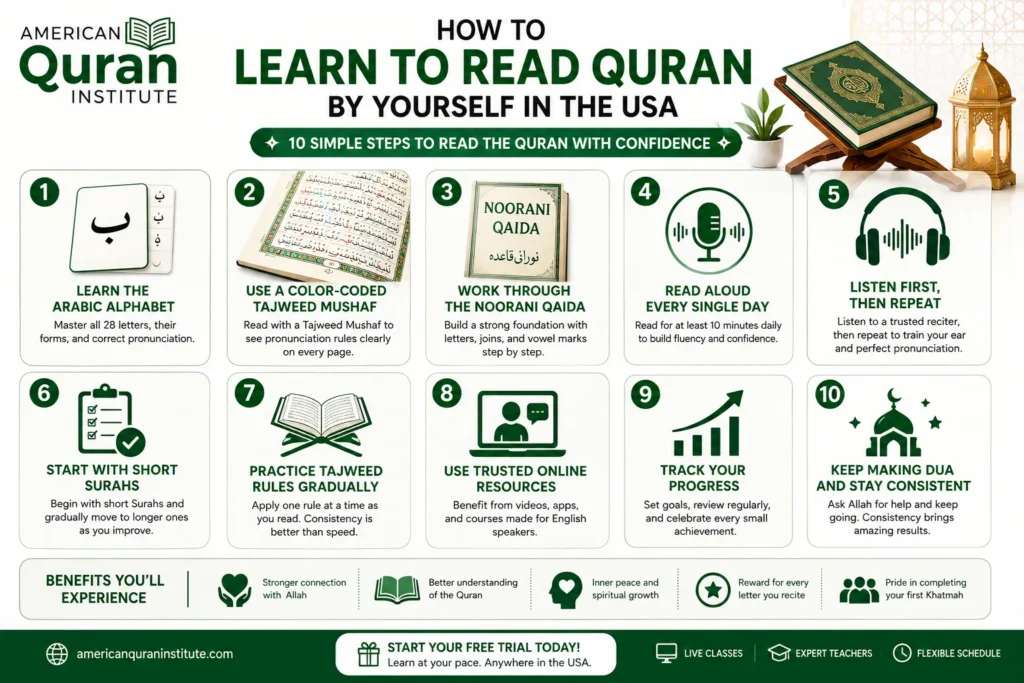
 Learn Arabic
The Quran is a universal message, followed and recited by Muslims from almost every language and culture. Yet its original text is entirely Arabic. This naturally raises an important question: why is the Quran in Arabic if its guidance is meant for all humanity?
The answer begins with Prophet Muhammad ﷺ and the people who first received the revelation, but it goes beyond the language they spoke.
Arabic became the language through which the Quran’s exact words, meanings, rhetorical expression, and linguistic challenge were revealed and preserved.
In this article, we will explore why Allah revealed the Quran in Arabic, what the Quran itself says about its language, why translations cannot fully replace the original Arabic text, and how a revelation in one language can still carry a message for people of every nation and language.
1. The Quran Was Revealed in Arabic So Prophet Muhammad ﷺ Could Clearly Convey It to His People
One of the clearest reasons the Quran was revealed in Arabic is that Prophet Muhammad ﷺ was sent to an Arabic-speaking people.
The revelation came in the language they already understood, allowing its guidance, commands, warnings, and teachings to reach them clearly and directly.
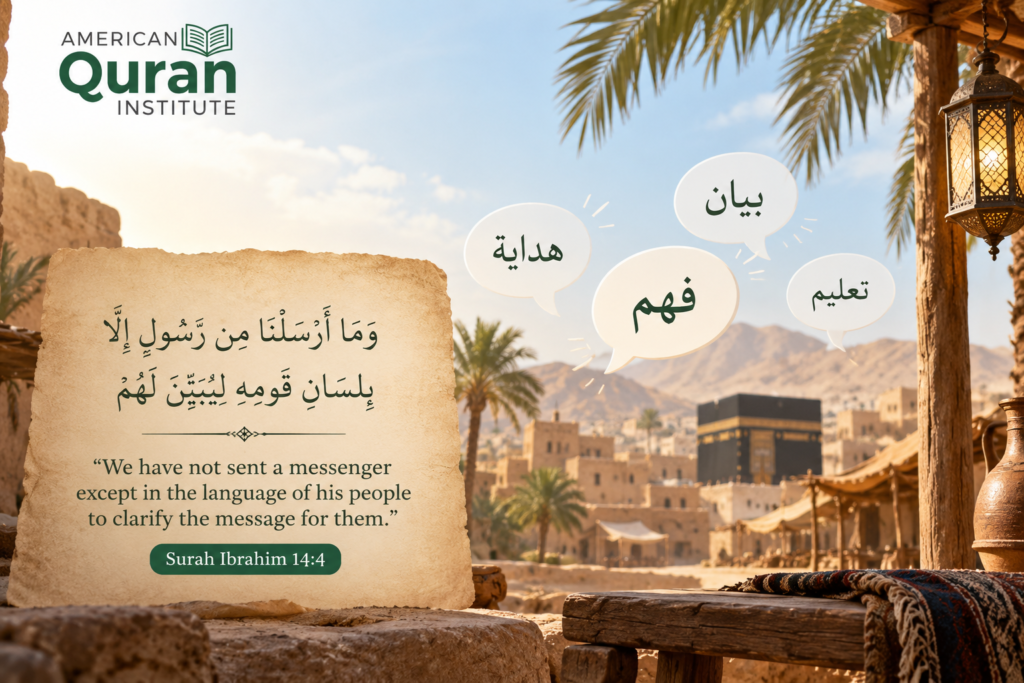
Allah explains that this was the general pattern with His messengers:
وَمَا أَرْسَلْنَا مِن رَّسُولٍ إِلَّا بِلِسَانِ قَوْمِهِ لِيُبَيِّنَ لَهُمْ
Wa maa arsalnaa mir rasoolin illaa bilisaani qawmihee liyubayyina lahum.
“We have not sent a messenger except in the language of his people to clarify ˹the message˺ for them.”
The key phrase is لِيُبَيِّنَ لَهُمْ — “to clarify the message for them.” A messenger needed to communicate Allah’s revelation in a language his first audience could understand without a linguistic barrier.
Prophet Muhammad ﷺ spoke Arabic, and the people who first heard his message were primarily Arabic speakers.
Revealing the Quran in their language enabled them to hear its teachings directly, understand its meanings, and respond to its guidance.
This gives us a clear answer to why the Quran is in Arabic: it was revealed in the language of Prophet Muhammad ﷺ and his first audience so that Allah’s message could be communicated to them with clarity.
Read also: The Importance of Arabic Language in Quran
2. The Quran Was Revealed in Arabic So Its First Audience Could Understand It Without Translation
The Quran itself explains why revealing its message in a foreign language would not have suited its first audience.
Had the revelation been non-Arabic, the Arabic-speaking people who first received it could have questioned why Allah’s message was not made clear in their own language.
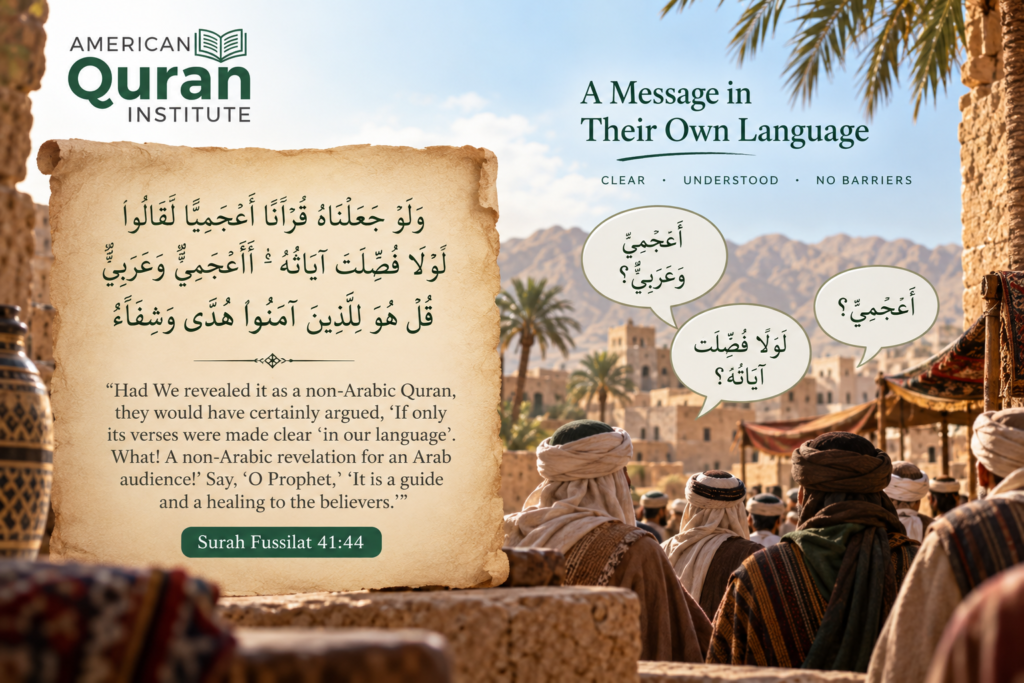
Allah says:
وَلَوْ جَعَلْنَاهُ قُرْآنًا أَعْجَمِيًّا لَّقَالُوا لَوْلَا فُصِّلَتْ آيَاتُهُ ۖ أَأَعْجَمِيٌّ وَعَرَبِيٌّ ۗ قُلْ هُوَ لِلَّذِينَ آمَنُوا هُدًى وَشِفَاءٌ
Wa law ja‘alnaahu Qur’aanan a‘jamiyyan laqaaloo lawlaa fussilat aayaatuhu; a-a‘jamiyyun wa ‘Arabiyyun; qul huwa lillazeena aamanoo hudan wa shifaa’.
“Had We revealed it as a non-Arabic Quran, they would have certainly argued, ‘If only its verses were made clear ˹in our language˺. What! A non-Arabic revelation for an Arab audience!’ Say, ˹O Prophet,˺ ‘It is a guide and a healing to the believers.’”
This verse shows that language was not meant to stand between the first listeners and the revelation. The Quran came to them in Arabic, allowing them to hear its teachings, understand its warnings and guidance, and consider its message directly.
In this way, revealing the Quran in Arabic removed the excuse that its first audience could not understand what was being communicated to them.
Read also: Can Adults Learn To Read Quran In The USA?
See Us in Action!
Take a look inside our virtual classrooms. Watch the clip below to see how our instructors engage with students, simplify complex rules, and create an inspiring environment for learning.
Start Your Quranic Education
Join our premier online institute for structured Quranic learning tailored for students in the USA.
Book Your Free Trial3. Arabic Allows the Quran to Express Precise
Another reason becomes apparent when we examine the Quran’s language itself. Arabic uses a rich system of word roots, morphology, grammatical endings, particles, and sentence structures that can give a single expression several closely connected shades of meaning.
This does not require claiming that other languages lack richness or complexity. Rather, the important point is that the Quran was revealed through the specific linguistic features of Arabic, and those features form part of how its meanings are expressed.
Consider the opening praise in Surah Al-Fatihah:
الْحَمْدُ لِلَّهِ رَبِّ الْعَالَمِينَ
Alhamdu lillaahi Rabbil ‘aalameen.
“All praise is for Allah—Lord of all worlds.”
The English translation communicates the central meaning, but expressions such as الْحَمْدُ لِلَّهِ contain grammatical and rhetorical nuances that often require further explanation in another language.
This occurs throughout the Quran. A particular word form may add emphasis, a grammatical construction may shape the meaning, and a short Arabic expression may require several words or even a sentence to explain fully in translation.
For this reason, translations can communicate and explain the meanings of the Quran, but they cannot reproduce every linguistic feature and nuance of its original Arabic wording.
For students who want to begin engaging with that original wording rather than relying entirely on transliteration, Quran Reading Classes can help build the foundation for reading Quranic Arabic correctly.
Read also: Common Mistakes When Reading The Quran And How To Fix Them

4. The Quran Was Revealed in Arabic So Its First Audience Could Recognize Its Linguistic Miracle
The Quran’s Arabic wording was itself central to the challenge presented to those who doubted its divine origin. Its first listeners understood Arabic directly, which meant they could encounter its language as it was revealed rather than through a translation.
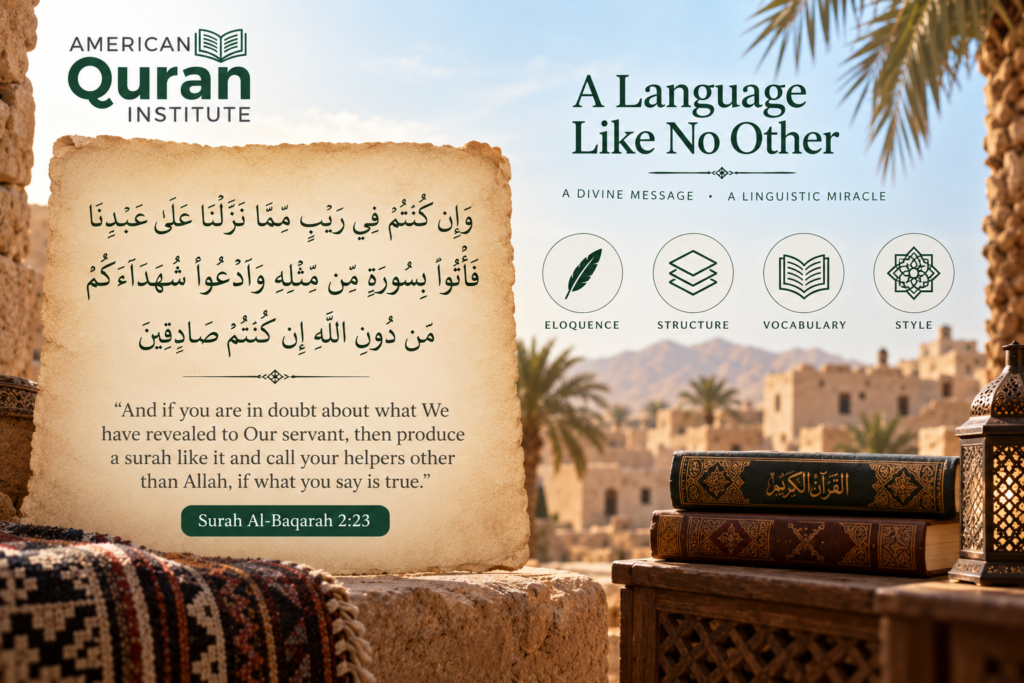
Allah says:
وَإِن كُنتُمْ فِي رَيْبٍ مِّمَّا نَزَّلْنَا عَلَىٰ عَبْدِنَا فَأْتُوا بِسُورَةٍ مِّن مِّثْلِهِ وَادْعُوا شُهَدَاءَكُم مِّن دُونِ اللَّهِ إِن كُنتُمْ صَادِقِينَ
Wa in kuntum fee raibim mimmaa nazzalnaa ‘alaa ‘abdinaa fa’too bisooratim mim mithlihee wad‘oo shuhadaa’akum min doonil laahi in kuntum saadiqeen.
“And if you are in doubt about what We have revealed to Our servant, then produce a surah like it and call your helpers other than Allah, if what you say is true.”
The challenge was presented in the same language understood by the people who first heard it.
They were able to assess its vocabulary, structure, eloquence, rhetorical force, and style directly. If the revelation had first reached them through translation, they would not have been evaluating the actual linguistic form of the Quran.
This is why the Quran’s linguistic I’jaz, or inimitability, is connected to its Arabic wording.
Translations can explain what an Ayah means, but the linguistic challenge concerns the Quran as it was revealed.
5. The Quran Was Revealed in Arabic, but Its Message Is for All Humanity
A common question behind why the Quran is in Arabic is: If Islam is for everyone, why was its final revelation given in the language of one people?
The answer is that the language of revelation does not determine the limits of its audience. The Quran was revealed in Arabic, but Prophet Muhammad ﷺ was sent with its message to all humanity.
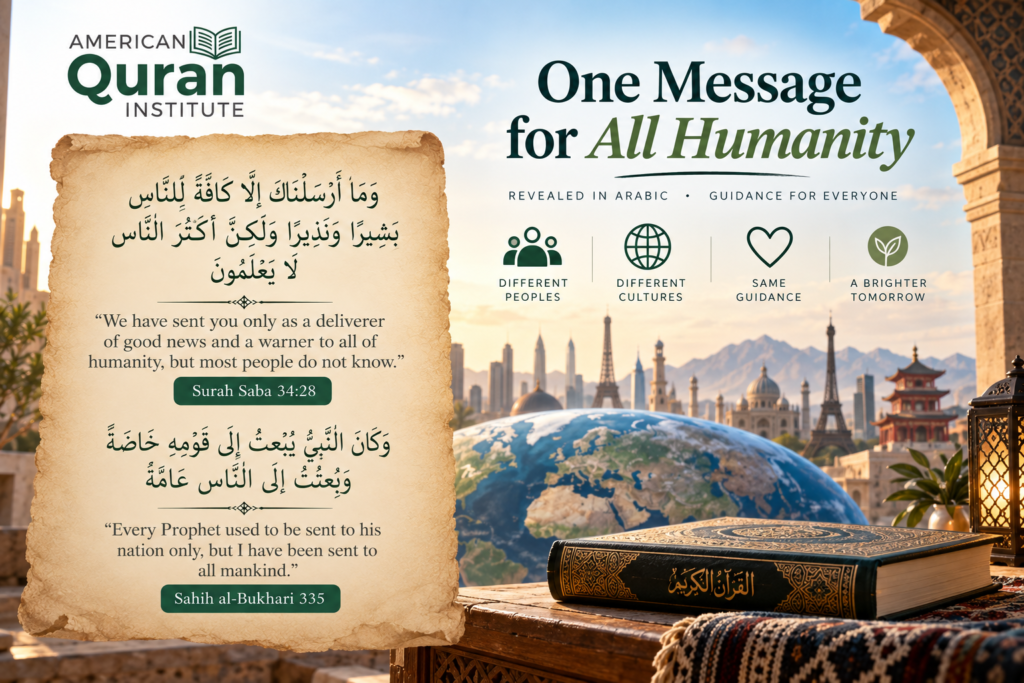
Allah says about Prophet Muhammad ﷺ:
وَمَا أَرْسَلْنَاكَ إِلَّا كَافَّةً لِّلنَّاسِ بَشِيرًا وَنَذِيرًا وَلَٰكِنَّ أَكْثَرَ النَّاسِ لَا يَعْلَمُونَ
Wa maa arsalnaaka illaa kaaaffatal linnaasi basheeranw wa nazeeranw wa laakinna aksaran naasi laa ya‘lamoon.
“We have sent you ˹O Prophet˺ only as a deliverer of good news and a warner to all of humanity, but most people do not know.”
The Arabic language of the Quran therefore does not limit its audience to Arabs.
The Prophet ﷺ also explained the universal nature of his mission when comparing it with the missions of earlier prophets:
وَكَانَ النَّبِيُّ يُبْعَثُ إِلَى قَوْمِهِ خَاصَّةً وَبُعِثْتُ إِلَى النَّاسِ عَامَّةً
Wa kaanan-nabiyyu yub‘athu ilaa qawmihee khaassatan wa bu‘ithtu ilan-naasi ‘aammah.
“Every Prophet used to be sent to his nation only, but I have been sent to all mankind.”
The Prophet ﷺ introduces an important distinction here. Earlier prophets were sent specifically to their own peoples, whereas his mission extended to humanity generally.
This shows that Arabic was the language of revelation, not a restriction on who could receive its guidance.
The Quran could first be delivered clearly in one language and then have its teachings explained to other peoples in their own languages That is exactly what happened as Islam spread beyond Arabia.
Programs such as Weekend Quran Classes can continue that process today by helping Muslim families maintain regular engagement with Quran reading and Islamic learning even when Arabic is not their first language.

Is the Quran Written in Arabic?
Yes. The Quran was originally revealed in Arabic, and its original text remains in Arabic today. Translations help readers understand its meanings in other languages, but the Quranic text itself is the Arabic revelation.
The Quran explicitly describes itself as Arabic:
إِنَّا أَنزَلْنَاهُ قُرْآنًا عَرَبِيًّا لَّعَلَّكُمْ تَعْقِلُونَ
Innaa anzalnaahu Qur’aanan ‘Arabiyyan la‘allakum ta‘qiloon.
“Indeed, We have sent it down as an Arabic Quran so that you may understand.”
Notice that the verse does not simply say that the Quran was later written in Arabic. It says that Allah sent it down as an Arabic Quran. This means Arabic is part of the original form in which the revelation was delivered.
So, while the meanings of the Quran can be translated into many languages, the original Quranic text is Arabic.
Is the Quran Only in Arabic?
Yes, the original Quran is in Arabic, but its meanings can be translated into other languages so that people around the world can understand its guidance.
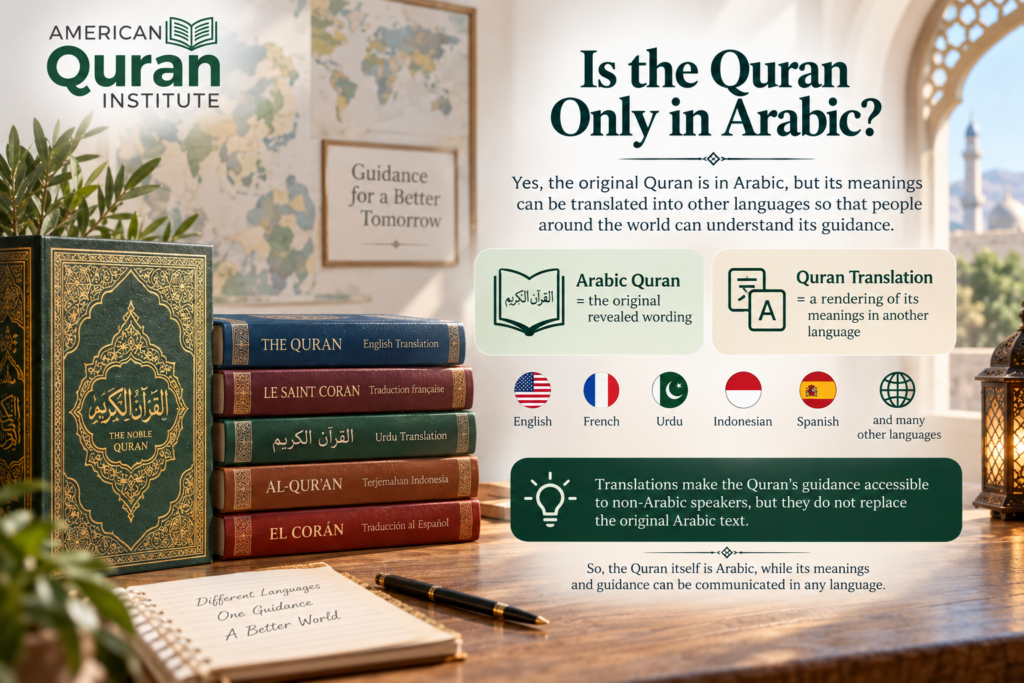
Translations are available in English, French, Urdu, Indonesian, Spanish, and many other languages. They make the Quran’s guidance accessible to non-Arabic speakers, but they do not replace the original Arabic text.
This is also why two English translations may use different words for the same Ayah. Each translator makes linguistic choices when expressing the meaning, while both translations refer back to the same original Arabic verse.
So, the Quran itself is Arabic, while its meanings and guidance can be communicated in any language.
Why Wasn’t the Quran Revealed in Every Language?
The Quran did not need to be revealed separately in every language for its message to reach all humanity.
It was first revealed in the language of Prophet Muhammad ﷺ and the people he was directly addressing, so they could understand Allah’s message clearly.
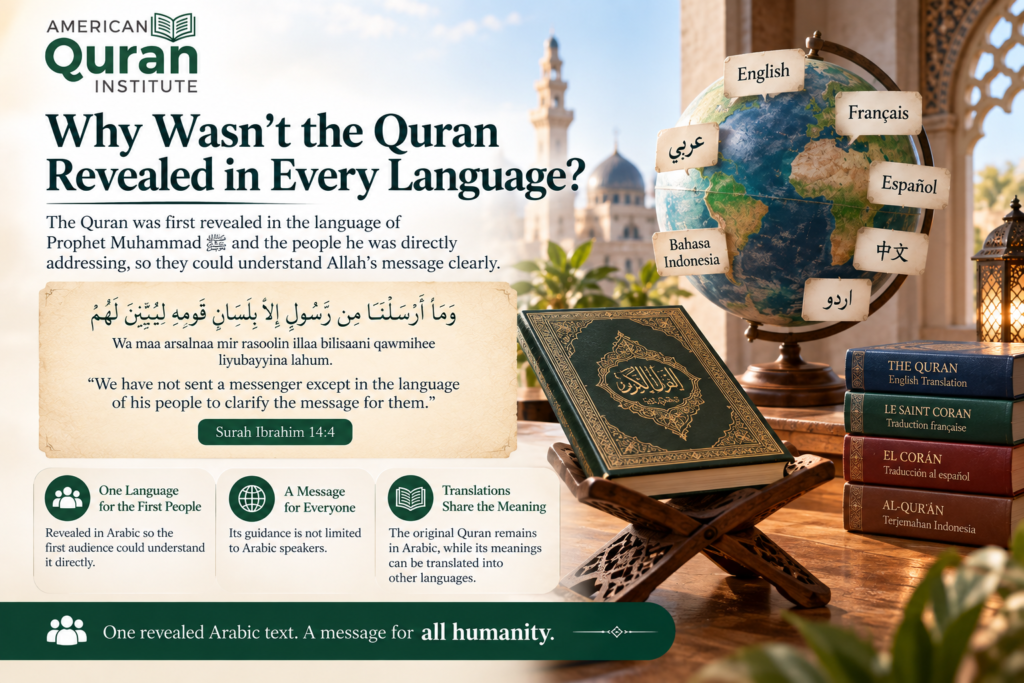
Allah explains this principle:
وَمَا أَرْسَلْنَا مِن رَّسُولٍ إِلَّا بِلِسَانِ قَوْمِهِ لِيُبَيِّنَ لَهُمْ
Wa maa arsalnaa mir rasoolin illaa bilisaani qawmihee liyubayyina lahum.
“We have not sent a messenger except in the language of his people to clarify ˹the message˺ for them.”
Prophet Muhammad ﷺ first delivered the Quran among Arabic-speaking people, so Arabic allowed them to receive and understand the revelation directly without a language barrier.
However, being revealed in one language does not mean its guidance is limited to speakers of that language.
The original Quran remains in Arabic, while its meanings can be translated and explained in other languages for people throughout the world.
So, the Quran did not require separate original versions in every language to be universal. It has one revealed Arabic text and a message that can be communicated to people of every language and nation.
Experience Our Classroom Environment
Don’t just take our word for it—experience a live session for yourself! Click on the videos below to watch real snippets from our classes and see our interactive teaching methods in real-time.
Start Your Quranic Education
Join our premier online institute for structured Quranic learning tailored for students in the USA.
Book Your Free TrialTake the Next Step Toward Understanding the Quran
Knowing why the Quran was revealed in Arabic is one thing; learning how to engage with that Arabic for yourself is the next step. Even a basic ability to read Quranic Arabic can help you recognize familiar words, follow recitation more closely, and better appreciate the verses you study.
The American Quran Institute provides structured Quran learning for students at different levels. You can begin by strengthening your Quran reading and recitation, then gradually move toward understanding verses and studying Tafsir as your knowledge develops.
Wherever you are starting from, guided learning can help you build a more direct and consistent relationship with the Quran.
Our Quran Courses
- Quran Online Academy
- Quran Recitation Classes
- Quran Reading Classes
- Online Quran Classes for Kids
- Quran Classes for Adults
- Quran Classes for Female/Sisters
- Learn Quran Course for Beginners
- Quran Qirat Learning Course
- Quran Tafsir Course
- Noorani Qaida Course
- Noorani Qaida Course for Kids
- Weekend Quran Classes
- Intensive Quran Course
- Al-Azhar Quran Course
Our Memorization Courses
- Quran Memorization (Hifz) Course
- Hifz Classes for Adults
- Quran Memorization and Hifz Course for Kids
- Quran Hifz Course for Ladies
- Quran Ijazah Program
Start Your Quranic Education
Join our premier online institute for structured Quranic learning tailored for students in the USA.
Book Your Free TrialConclusion
Understanding why the Quran is in Arabic becomes easier when we separate the language of revelation from the audience of its message.
The Quran was revealed in Arabic so that Prophet Muhammad ﷺ could communicate it clearly to its first listeners, and that same Arabic wording has remained the foundation through which the revelation is recited, studied, and understood.
Its original language also preserves features that translations cannot fully reproduce, from precise word choices and grammatical nuances to rhetorical expression and linguistic inimitability.
Translations therefore play an essential role in making the Quran’s meanings accessible, while the Arabic text remains the original reference.
Yet none of this makes the Quran a message for Arabs alone. Its revelation began in a particular language and place, but its guidance was never confined to them.
The Quran is Arabic in its revealed words, universal in its message, and accessible in meaning to people of every language.
FAQs About Why the Quran Is in Arabic
1. What Language Was the Quran Originally Revealed In?
The Quran was originally revealed in Arabic to Prophet Muhammad ﷺ. Its Arabic wording is the original revealed text, while translations communicate its meanings in other languages.
2. Do You Have to Know Arabic to Understand the Quran?
No. You can begin understanding the Quran through reliable translations and Tafsir in your own language. However, learning Quranic Arabic can provide more direct access to vocabulary, grammatical nuances, and rhetorical features that translations may not fully convey.
3. Can the Quran Be Translated Into Other Languages?
Yes. The meanings of the Quran can be translated into any language to help people understand its guidance. However, a translation is considered a rendering of the Quran’s meanings rather than a replacement for the original Arabic text.
4. Is Arabic a Holy Language in Islam?
Arabic has a special importance in Islam because it is the language of the Quran and is used in key acts of worship. Its significance is closely connected to revelation, although Islam’s message is not limited to Arabic-speaking people.
5. Why Do Quran Translations Use Different Words for the Same Verse?
Translation requires linguistic and interpretive choices. A single Arabic word or grammatical structure may carry nuances that do not have one exact equivalent in another language. As a result, translators may choose different wording while attempting to communicate the meaning of the same Arabic Ayah.
6. Can Non-Arabic Speakers Learn the Quran?
Absolutely. Muslims do not need to be native Arabic speakers to learn the Quran. Beginners can start with Arabic letters, pronunciation, and Quran reading while using translations and Tafsir to understand the meanings. Their Arabic knowledge can then develop gradually alongside their Quran study.





Leave a Reply