 Learn Arabic
You don’t have to wait for the perfect class, the right city, or a schedule that lines up with local mosque programs. Thousands of American Muslims have taught themselves to read the Quran starting from zero. What they had in common was not talent; it was a clear method and the consistency to follow it through.
If you’ve been searching for how to learn to read Quran by yourself in the USA, the answer is yes. Arabic script is unfamiliar to English speakers, and the sounds the Quran requires are unlike anything in English phonology. Without a clear structure, most self-learners make fast early progress, then hit a wall they can’t diagnose on their own. This guide is built to prevent that wall from forming.
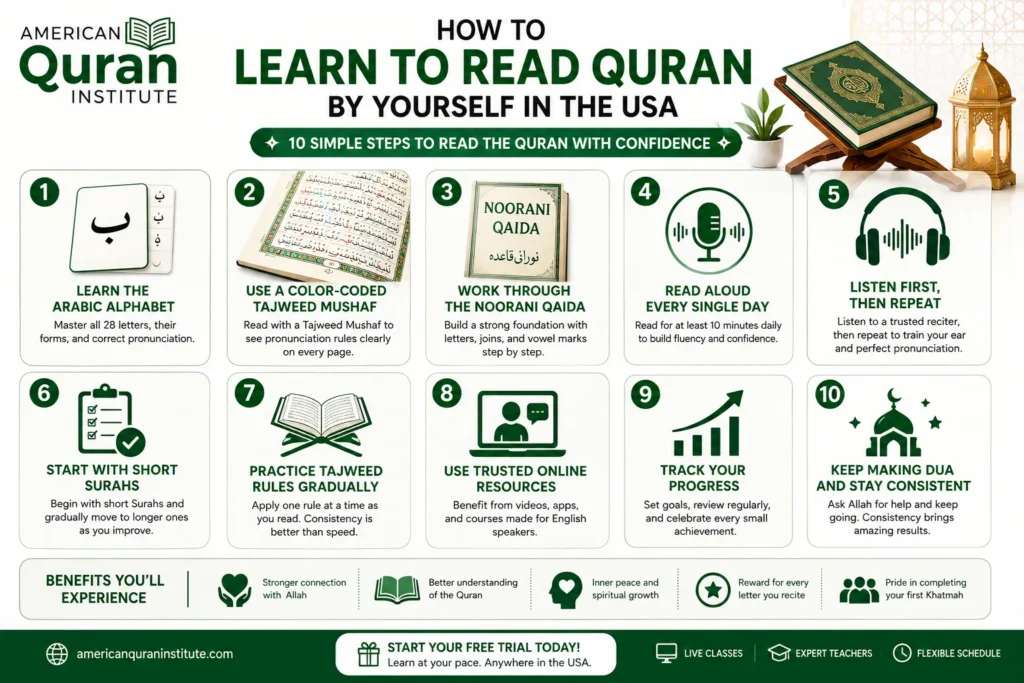
Below you’ll find a 10-step roadmap drawn from the methods that Quran educators have used with English-speaking communities for decades. Follow the steps in order, and you’ll move from not recognizing a single Arabic letter to reading Quranic text with correct pronunciation, all from your home, anywhere in the United States, on your own schedule.
1. The Arabic Alphabet Is Your Key To Know How To Learn To Read Quran By Yourself In The USA
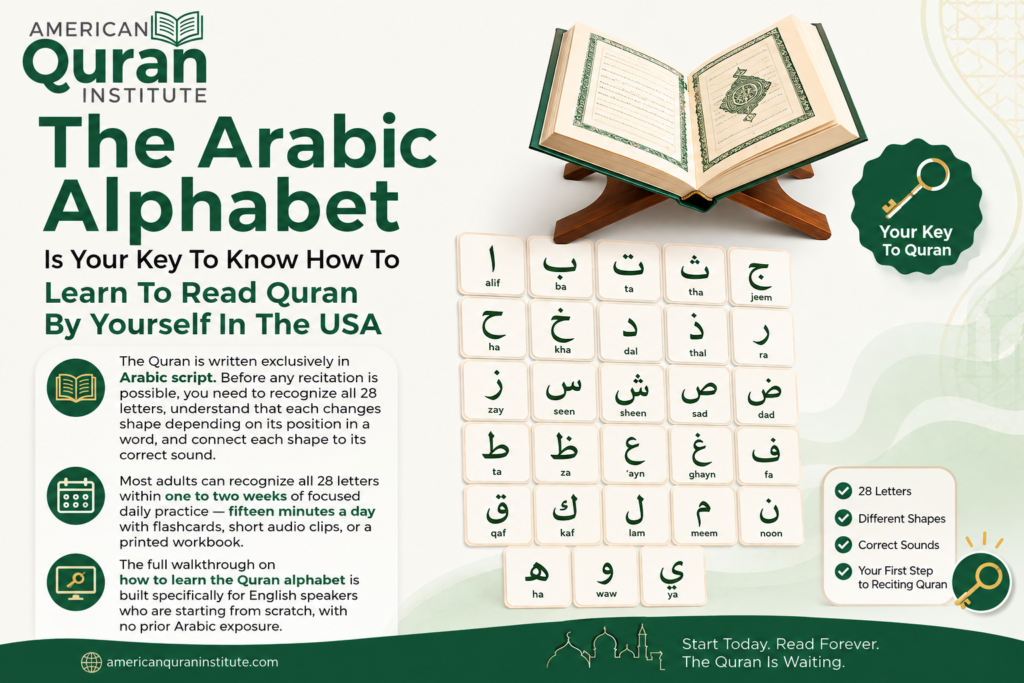
The Quran is written exclusively in Arabic script. Before any recitation is possible, you need to recognize all 28 letters, understand that each changes shape depending on its position in a word, and connect each shape to its correct sound.
Most adults can recognize all 28 letters within one to two weeks of focused daily practice — fifteen minutes a day with flashcards, short audio clips, or a printed workbook. The full walkthrough on how to learn the Quran alphabet is built specifically for English speakers who are starting from scratch, with no prior Arabic exposure.
2. Use A Color-Coded Tajweed Mushaf
A Tajweed Mushaf color-codes the Quran’s pronunciation rules directly on the page. Elongated vowels appear in one color, nasal sounds in another, specific merging rules in a third.
You do not need to memorize every rule first — the colors make the rules visible as you read, so you absorb them through practice rather than through abstract study.
This is among the most underused tools for Americans learning independently. It is available at most Islamic bookstores and online. Pair it with audio of the same passage from a trusted reciter, and you hear and see the rules simultaneously — which is dramatically more effective than either approach alone.
3. Work Through The Noorani Qaida
The Noorani Qaida is a foundational primer that has been the standard starting point for Quran learners across generations. It teaches how Arabic letters join together, how vowel marks (fatha, damma, kasra) change pronunciation, and how to produce the specific sounds the Quran requires — all in a graduated, structured sequence.
Think of it this way: you learn to read before you read a novel. The Qaida is the reading curriculum for Quranic Arabic. Free versions exist as PDFs, apps, and YouTube playlists. Working through it at a modest daily pace takes four to eight weeks — and every hour invested here prevents ten hours of error-correction later.
Master Arabic Reading Foundations Through Noorani Qaida in the USA

4. Read Aloud Every Single Day Even For Ten Minutes
Daily oral practice is the one habit that separates learners who advance steadily from those who plateau. Reading silently has its place, but reading aloud forces your mouth to physically produce Arabic sounds — and Tajweed happens in the mouth, not on the page.
Pick a minimum you can keep without exception: ten minutes every day outperforms sixty minutes three times a week, because consistency is what builds pronunciation muscle memory. For strategies on embedding this into a demanding American schedule, how to start reading the Quran daily covers the specific habit structures that have worked for Muslims juggling jobs, families, and commutes.
Start Reading the Quran with The American Quran Institute’s USA Classes

5. Let Your Ear Do The Heavy Lifting First
Classical Tajweed scholarship has always emphasized hearing before speaking. Your ear needs to recognize correct pronunciation before your mouth can produce it reliably.
Choose one respected reciter whose style suits you — Sheikh Al-Husary for precision, Sheikh Al-Minshawi for a measured instructional style — and listen to short passages on repeat before attempting to recite them yourself.
Fifteen minutes of focused, intentional listening does more for your pronunciation than an hour of reading alone. The benefits of reciting Quran extend beyond the spiritual: active listening builds your ability to self-monitor your own reading, which is the core mechanism of steady independent progress.
Master Quran Recitation Through The American Quran Institute’s USA-Based Classes

6. Record Your Recitation And Listen Back Without Flinching
Your ear catches mistakes your eye misses. After reading a passage aloud, record it on your phone and listen back. Identify where elongations were too short, where pronunciation was loose, where a rule you thought you had applied was actually dropped.
Most self-learners record once, feel uncomfortable with what they hear, and never do it again. The learners who improve consistently are the ones who make it a weekly habit — not a one-time exercise. Treat the recording the way a coach treats game footage: useful precisely because it is honest.
If you want to know how to read the Quran with genuine accuracy, this feedback loop is the closest thing to a teacher’s correction you’ll get when working independently.
Book your FREE trial session today

7. Learn Tajweed Rules One At A Time
Tajweed has a reputation for being overwhelming because most learners try to absorb the entire system before they’ve developed any feel for the text. The effective method is one rule per week, applied immediately to the Quranic passages you are already reading.
A practical four-week sequence for beginners:
- Week 1 — Natural elongation (Madd Tabiee): the standard two-count vowel extension
- Week 2 — Noon Saakinah: Idhar, Idgham, Iqlaab, and Ikhfa in context
- Week 3 — Meem Saakinah and its three rulings
- Week 4 — Qalqalah: the slight echo-bounce on its six letters
Apply each rule in actual Quranic text that week, not as an abstract concept memorized separately from the reading itself.
See Us in Action!
Take a look inside our virtual classrooms. Watch the clip below to see how our instructors engage with students, simplify complex rules, and create an inspiring environment for learning.
Start Your Quranic Education
Join our premier online institute for structured Quranic learning tailored for students in the USA.
Book Your Free Trial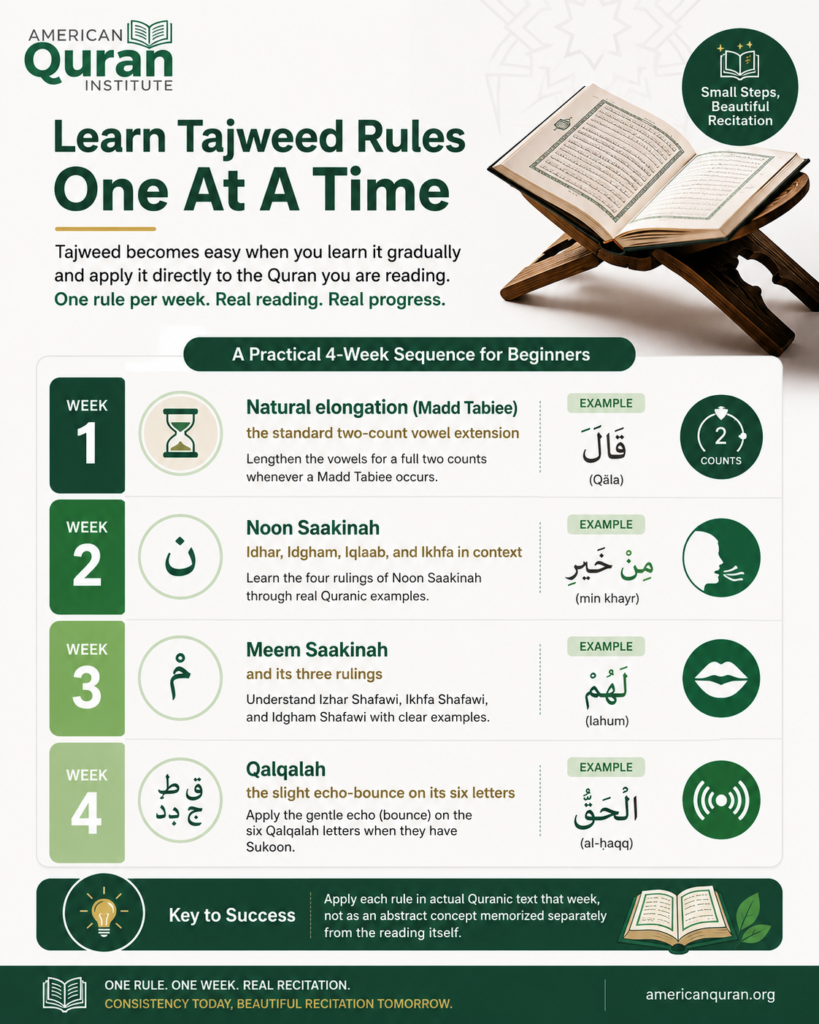
8. Start With Juz Amma And Build From There
Juz Amma — the 30th and final section of the Quran — contains the shortest surahs, the most commonly recited passages in Salah, and the most accessible Arabic for new readers. This is not a shortcut; it is the standard starting point recommended by Quran educators across Muslim communities worldwide.
Begin with Surah Al-Fatiha, then work from An-Nas backward through the short surahs. Read each slowly, correctly, and repeatedly until it feels natural before moving forward.
For a full map of the progression from first reading to sustained independent recitation with practical benchmarks along the way, how to read Quran for beginners is the clearest guide available for English-speaking Americans at the starting line.
Begin Quran Memorization Training With Qualified Hifz Instructors

9. Accountability Helps You Stay Consistent With Quran Reading
Self-study does not mean going it entirely alone. Accountability partners, local mosque reading groups, or online Quran circles at the same level all serve the same function: they create a reason to show up consistently and offer ears other than your own.
This matters especially for Americans whose nearest Islamic center may be a significant drive away, or whose schedule doesn’t align with weekend halaqas.
When the practice starts to feel repetitive or your motivation dips, how to make reading Quran more interesting offers practical approaches used by learners who have kept their practice alive through demanding seasons of life.
10. Know When Self-Study Needs A Teacher
Self-teaching is effective for building the foundations. But it has a ceiling: certain pronunciation errors are not audible to the untrained ear, and a learner who has drilled a wrong pronunciation for months may not know it until a qualified teacher points it out.
The practical benchmark is readiness for Salah. When you genuinely cannot tell whether your recitation of a surah is correct — or when you are preparing a child and need their reading formally verified — that is when an Ijazah-certified teacher becomes essential.
For a broader picture of teacher-led programs available across the country, the guide on how to learn the Quran by yourself draws the line clearly between what independent study can build and what requires guided instruction.
How To Improve Quran Recitation Once You’ve Hit Your Stride
Reaching the point where you can read Quranic text is a genuine milestone — but many learners then discover a second plateau. They can decode the words, yet their recitation feels flat, hesitant, or rough in specific sounds.
This phase calls for different strategies: the goal shifts from learning to read to reading with confidence, accuracy, and the correct vocal expression.
The three approaches below address the most common recitation difficulties faced by American self-learners who have completed the beginner phase and want to move their recitation from functional to fluent.
A. Mirror The Best Reciters You Can Find
Choose one reciter you genuinely admire, listen to three to five ayaat on repeat until you can hear the passage clearly in your mind, then recite the same passage immediately afterward. Record it. Compare.
This is not about copying someone’s voice — it is about building an internal standard that your ear then applies to your own reading. Self-learners who plateau often lack this internal benchmark; they read without a reference point for what correct pronunciation sounds like.
Active, structured imitation builds that reference model, and it is also the fastest route to greater fluency overall. Learners who listen before they recite tend to discover how to read the Quran faster compared to those who read silently first and develop speed without an accuracy model.
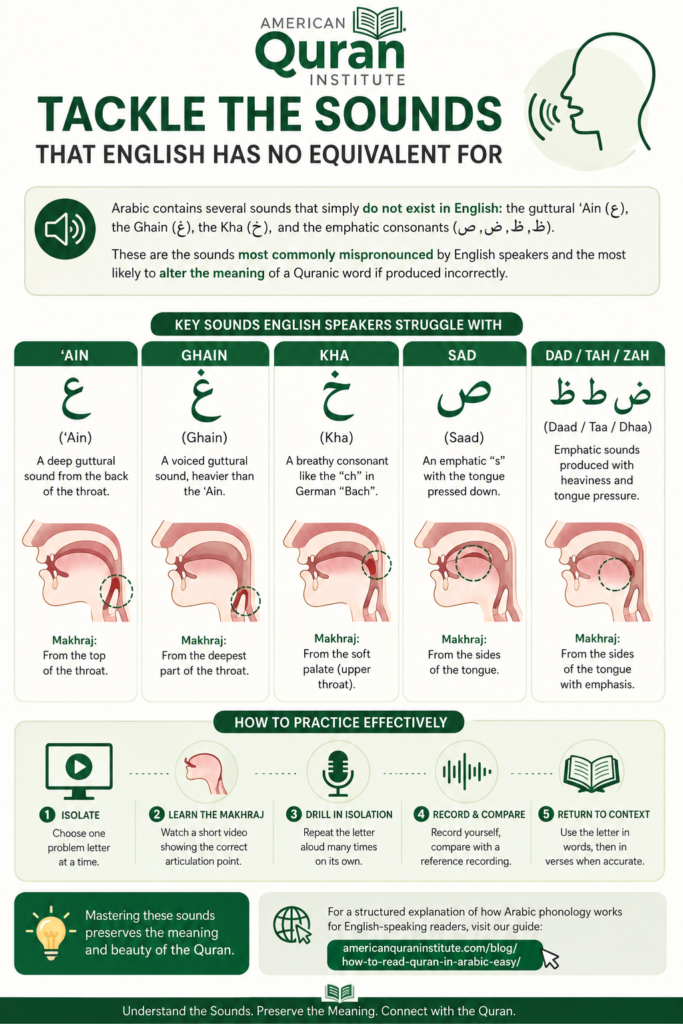
B. Tackle the Sounds That English Has No Equivalent For
Arabic contains several sounds that simply do not exist in English: the guttural ‘Ain (ع), the Ghain (غ), the Kha (خ), and the emphatic consonants (ص, ض, ط, ظ). These are the sounds most commonly mispronounced by English speakers and the most likely to alter the meaning of a Quranic word if produced incorrectly.
Isolate each problem letter, find a short video of its articulation point (makhraj), and drill it alone before returning it to a full surah. Record the letter in isolation, compare it to a reference recording, and return to context only when the isolated sound is accurate.
For a structured explanation of how Arabic phonology works for English-speaking readers, the resource on how to read the Quran in Arabic easy breaks down the Arabic sound system in plain terms accessible to American learners at any level.
Build A Weekly Quran Review Schedule
Consistent reviewers maintain and build their reading level; inconsistent ones lose ground they have worked hard to gain. A simple structure works: two or three days per week on new passages, two days reviewing material you have already covered.
Write down which surahs you’ve read, rate your confidence in each, and return to the lowest-rated ones before advancing.
During stretches where motivation is low — and they will come — returning to powerful motivations to read Quran can reconnect you to the reasons you started, which is often more useful in a difficult week than any technique or tool.
Read also: How to Read the Quran with a Beautiful Voice? Complete Guide for American Muslims
Who Can Learn — and Who Can Teach You in the USA
Learning to read the Quran is not limited by age, background, or starting point. Adults who have never seen Arabic script, children preparing to read for Salah, new Muslims connecting with the Quran in their first language, and anyone approaching the text out of sincere curiosity can all begin from Step 1 of the roadmap above.
American Quran Institute, based in the USA, connects American Muslims with Ijazah-certified teachers who specialize in guiding English speakers from the Arabic alphabet through fluent recitation. All classes are live and online, scheduled around US time zones so there’s no need to compromise your work, school, or family commitments.
For families whose children are beginning this journey, learn Quran for kids in the USA covers the age-appropriate pathways and the methods that work best for young learners at different stages.
And for those researching structured programs across the country, the guide on how to learn the Quran in the USA covers the full range of options from local halaqas to certified online instruction.

Experience Our Classroom Environment
Don’t just take our word for it—experience a live session for yourself! Click on the videos below to watch real snippets from our classes and see our interactive teaching methods in real-time.
Start Your Quranic Education
Join our premier online institute for structured Quranic learning tailored for students in the USA.
Book Your Free TrialStart Your Quran Journey with American Quran Institute Today
Self-study builds the foundation. But reading the Quran with verified Tajweed and a sound recitation requires a qualified teacher at some point in the journey. American Quran Institute offers live, one-on-one online classes taught by Ijazah-certified instructors who work exclusively with English speakers across every US time zone.
Whether you are starting from the Arabic alphabet or refining a recitation you have built independently, our teachers meet you where you are — and take you where the Quran calls you to be.
Check Out Our Top Courses for Quran Learning:
- Quran Classes in USA
- Noorani Qaida Course in the USA
- Online Quran Classes for Kids in the USA
- Online Tajweed Classes in the USA
- Quran Classes for Adults in the USA
- Quran Classes for Females in the USA
- Quran Ijazah Program in the USA
- Quran Memorization Course in the USA
- Quran Tafsir Course in the USA
- Tajweed Course for Kids in the USA
Book your free trial class today and find out what consistent, expert-guided Quran learning actually feels like.
Start Your Quranic Education
Join our premier online institute for structured Quranic learning tailored for students in the USA.
Book Your Free TrialConclusion
Learning how to read the Quran by yourself in the USA is a journey that begins with a single letter and builds, step by step, into confident and accurate recitation. The path is clear: start with the Arabic alphabet, complete the Noorani Qaida, use a color-coded Tajweed Mushaf, train your ear before your tongue, and read aloud every single day without exception.
Tajweed rules learned one at a time stick better than a system absorbed all at once. Recording yourself and listening back catches the errors that no amount of silent reading will reveal. Starting with Juz Amma gives you short, achievable milestones that build genuine momentum.
And knowing when to bring in a qualified teacher — rather than hoping wrong pronunciations will self-correct — is what separates learners who reach fluency from those who remain permanently stuck at beginner level.
Your location in the United States is not a barrier to reading the Quran. It is simply the starting point for the road ahead.
Frequently Asked Questions
How long does it take to learn to read the Quran by yourself in the USA?
Most committed adult learners can read short surahs correctly within three to four months of consistent daily practice, starting from zero Arabic knowledge. The alphabet takes one to two weeks. The Noorani Qaida takes four to eight weeks.
Can I learn to read the Quran without knowing Arabic grammar?
Yes. Reading the Quran and studying Arabic grammar are two separate skills. Quranic reading means pronouncing the text correctly with proper Tajweed — it does not require conversational Arabic or knowledge of nahw and sarf. Many fluent Quran reciters have limited spoken Arabic, and many native Arabic speakers have technically poor recitation.
Is it permissible for non-Muslims to read the Quran?
Non-Muslims can read and study the Quran. Mainstream Islamic scholarly opinion permits non-Muslim readers to handle and read the Quran, particularly for the purpose of understanding or sincere study. For a fuller discussion of both the permissions and the appropriate etiquette, how to read the Quran as a non-Muslim addresses this question with clarity and respect for the reader’s context.
At what age should children in the USA begin learning to read the Quran?
Most Quran educators recommend introducing Arabic letters between ages four and six, and beginning structured Quran reading between ages six and eight. The right moment depends more on the individual child’s readiness than on a fixed age.
For families looking for structured programs with qualified instructors, learn to read Quran online for kids covers age-appropriate approaches and what a quality program for young learners should include.
What is the most common mistake American self-learners make?
The most common — and most costly — mistake is skipping the Noorani Qaida and going straight to Quranic text. The second most common is reading silently rather than aloud, which means Tajweed errors go unheard for months. The third is failing to listen to a master reciter before attempting a passage — which means reading without a model to measure against.
Do I need a teacher, or can self-study take me all the way?
Self-study is genuinely effective for building the foundations — the alphabet, the Qaida, the basic Tajweed rules. Most learners, however, reach a point where their recitation contains errors they cannot hear on their own, because those errors have become habitual.





Leave a Reply