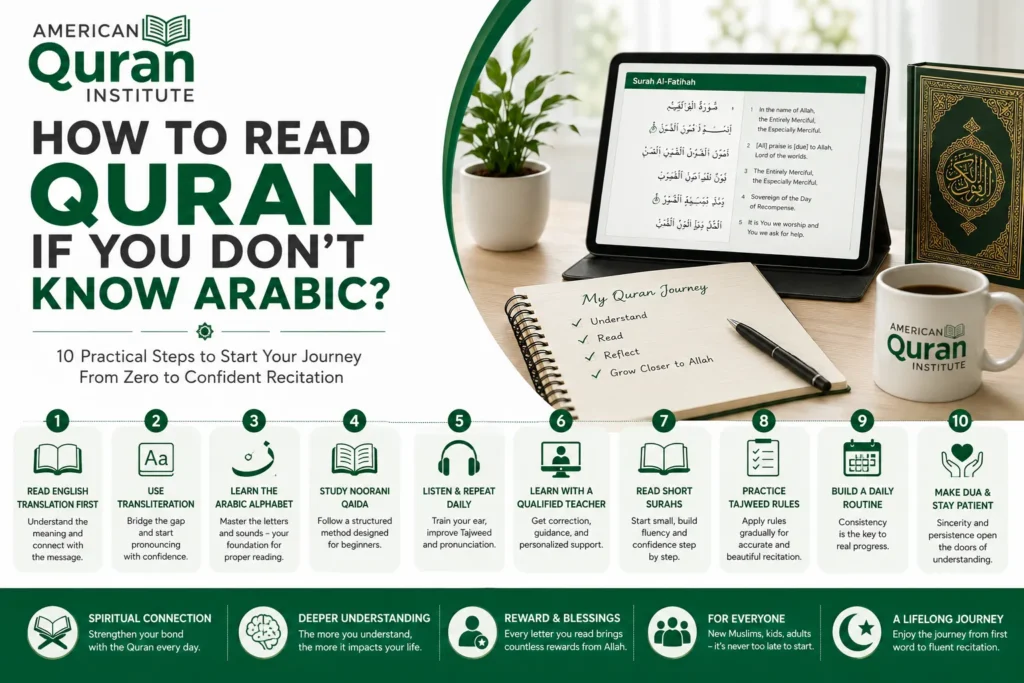
 Quran
Maybe you were raised Muslim in Texas but never learned to read Arabic. Maybe you took your Shahada in California and the Mushaf still looks like a wall of unfamiliar script.
Either way, the question is the same: how do you learn the Quran in English in the USA, without a local teacher and with a full-time schedule?
You can do it. Thousands of English-speaking Muslims learn every year through live online lessons taught in English, with tutors who teach in American time zones (EST, CST, MST, PST).
What you need is a clear order of steps, the right expectations, and a teacher who can correct your mistakes as you make them.
This guide covers what “learning the Quran in English” actually means, what kind of Arabic to study, how long it takes, which free resources are worth using, and how American Quran Institute structures lessons for English-speaking learners across the country.
To learn Quran in English in the USA, enroll in a live online program where an English-speaking teacher takes you through four skills in order: reading the Arabic script, reciting it correctly with Tajweed, understanding the meaning through translation and Tafsir, and memorizing at your own pace.
The steps below are the order that works for most English speakers. Each one builds on the skill before it.
Step 1: Decide what “learning the Quran” means for you
“Learning the Quran” can mean five different goals. Pick your main one before you book a single class, because the goal decides the course:
- Reading from zero: the Arabic alphabet and Noorani Qaida.
- Correct recitation: Tajweed rules applied while you read.
- Understanding: translation, Tafsir, and Quranic Arabic vocabulary.
- Memorization (Hifz): short surahs first, then whole Juz’.
- Kids’ foundations: reading, short surahs, and Islamic manners.
A common mistake is mixing all five in week one. Pick a main goal plus one side goal (for example, reading plus the meaning of the surahs you pray with) and add more as you progress.
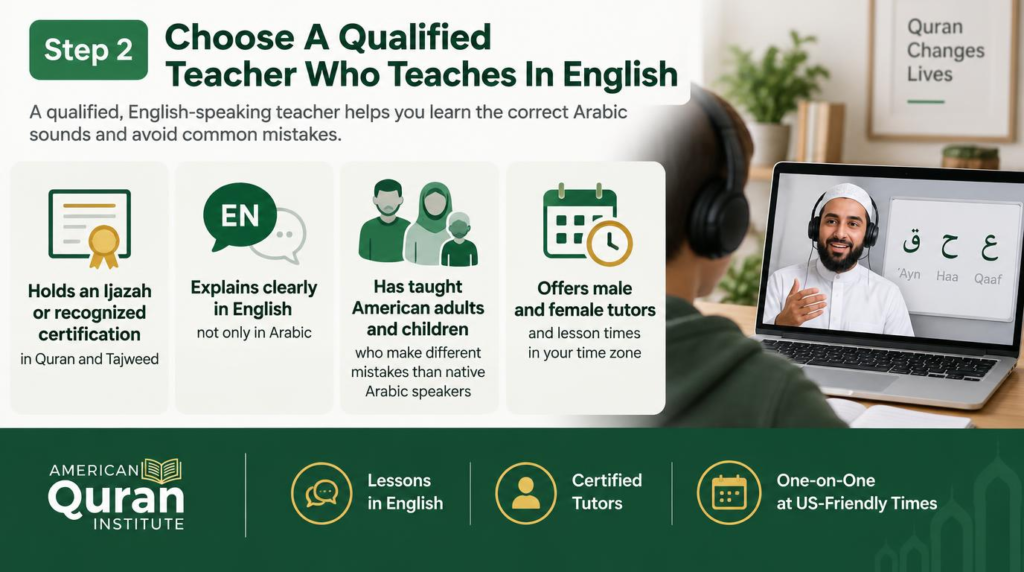
Step 2: Choose A Qualified Teacher Who Teaches In English
A teacher is the one part you can’t replace with an app. You can’t reliably hear your own mistakes in Arabic sounds like ع, ح, or ق, and an English ear tends to flatten them into English sounds. Before you enroll, check that the teacher:
- Holds an Ijazah or a recognized certification in Quran and Tajweed
- Explains clearly in English, not only in Arabic
- Has taught American adults and children, who make different mistakes than native Arabic speakers
- Offers male and female tutors and lesson times in your time zone
At American Quran Institute, every lesson is taught in English by certified tutors, one-on-one, at times that fit US schedules.
Step 3: Start At Your Real Level
If you can’t read Arabic yet, start with the letters, their shapes, and short vowels (Noorani Qaida). If you can already sound out words, a short assessment shows where your reading breaks down, for example with long vowels, sukoon, or joined letters.
Starting too high is the most expensive mistake. Learners who skip the Qaida often spend months later unlearning wrong pronunciation. Our Quran Reading Classes begin wherever your assessment places you, not at page one by default.
Read also: Why Is the Quran in Arabic?
Step 4: Learn Tajweed While You Read
Tajweed is the set of rules for pronouncing the Quran as it was revealed: where each letter comes from in the mouth (makharij), how long to hold vowels (madd), and how letters change next to each other (such as idgham and ikhfa).
Learn the rules gradually inside real recitation rather than from a long list. A practical order is makharij first, then noon saakin and tanween rules, then madd.
That covers most of the corrections a beginner gets. When you’re ready to polish your recitation, our Quran Recitation Classes focus on exactly this.
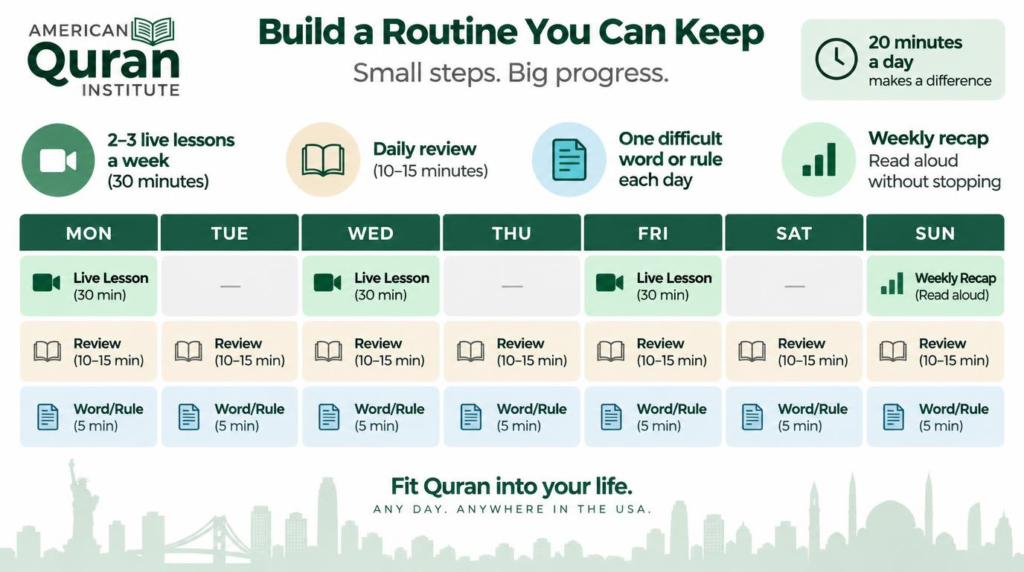
Step 5: Build A Routine You Can Keep
Consistency matters more than intensity. Twenty focused minutes a day will move you further than one long session on Sunday. A schedule that works for many working adults and families in the USA:
- Two or three live 30-minute lessons a week, on weekday evenings or weekend mornings.
- 10–15 minutes of daily review, reading the same lines your teacher corrected.
- One difficult word or rule practiced on its own each day.
- A weekly recap where you read your lesson aloud without stopping.
Can We Learn The Quran In English?
Yes, with one distinction. You can learn about the Quran and understand its meaning in English, and you can learn to read and recite the Arabic Quran with instruction given entirely in English.
An English translation, however, isn’t the Quran itself. It’s a human rendering of its meaning. That distinction has practical consequences, which the next two sections explain.
Can English Speakers Easily Understand The Quran?
English speakers can understand the core message of the Quran through a good translation. The basics of belief, worship, ethics, and the stories of the prophets come through clearly. What gets lost is depth: wordplay, rhythm, and terms with no single English equivalent.
Words like taqwa (God-consciousness and careful avoidance of displeasing Allah), sabr (patient perseverance), and ihsan (excellence in worship and conduct) each need a sentence to explain in English. Keep a small glossary of these terms. It’s one of the fastest ways to deepen your understanding.
Do you have to learn Arabic to understand the Quran?
You don’t need Arabic to understand the Quran’s general meaning, but you do need Arabic to recite it in Salah. Prayer is performed with the Arabic text. That’s why most English speakers learn to read Arabic and understand through English at the same time.
Learning some Quranic Arabic over time pays off a lot. The same roots and high-frequency words appear across the Quran, so every word you learn shows up again, and you start recognizing meaning directly while you pray.
What Is The Best Way To Understand The Quran?
The best way to understand the Quran combines four layers: a reliable English translation, a short Tafsir for verses that need context, the reason a verse was revealed (asbab al-nuzul) where relevant, and a teacher to answer your questions.
1. Choose one reliable English translation
Stick to one main translation so the terminology stays consistent. Widely used options include Saheeh International (close to the Arabic), The Clear Quran by Dr. Mustafa Khattab (modern, accessible English), and M.A.S. Abdel Haleem’s translation (fluent prose).
Avoid archaic, poetic translations as a beginner. They can hide plain instructions.
2. Use Tafsir only where you need it
Tafsir is a scholarly explanation of the Quran’s meaning, context, and rulings. You don’t need it for every verse. Reach for it when a verse seems unclear, involves law, or refers to a historical event. A concise Tafsir such as Tafsir As-Sa’di (available in English) is a good fit for beginners.
3. The Read–Understand–Retain framework
A simple way to plan your studies is to treat them as three tracks running in parallel, each with its own weekly time:
- Read: Arabic script and Tajweed with your teacher.
- Understand: translation and Tafsir of the exact passages you’re reading.
- Retain: memorizing short surahs you already understand.
Most learners put all their time into one track. Linking them, so you read, understand, and memorize the same passage, makes each one easier. That’s how lessons at the American Quran Institute are organized for adult learners.
See Us in Action!
Take a look inside our virtual classrooms. Watch the clip below to see how our instructors engage with students, simplify complex rules, and create an inspiring environment for learning.
Start Your Quranic Education
Join our premier online institute for structured Quranic learning tailored for students in the USA.
Book Your Free TrialWhat Type Of Arabic Should I Learn For The Quran?
Learn Quranic Arabic: the Classical Arabic (Fus’ha) the Quran was revealed in, studied through the Quran’s own vocabulary and grammar.
Modern Standard Arabic (MSA) is useful but not required, and spoken dialects (Egyptian, Levantine, Gulf) won’t help much with the Quran.
Classical vs. MSA vs. Quranic Arabic
The word “Arabic” covers several forms of the language, and they aren’t equally useful for studying the Quran. Classical Arabic is the language of the revelation itself. MSA is its modern descendant, and dialects are what people speak day to day. The table below compares them so you can put your study time where it matters most.
| Type | What it is | Useful for the Quran? |
| Classical Arabic (Fus’ha) | The formal Arabic of the Quran, Hadith, and early scholarship | Yes, it’s the source language |
| Quranic Arabic | Classical Arabic taught through Quranic vocabulary and grammar | Best fit for understanding the Quran |
| Modern Standard Arabic (MSA) | The modern formal Arabic of news and books | Partly: shares grammar, but vocabulary differs |
| Dialects (Egyptian, Levantine, etc.) | Everyday spoken Arabic | Little direct help |
How to study Arabic for the Quran?
Study Arabic for the Quran in this order: first reading fluency, then the most frequent Quranic words, then basic grammar (Nahw and Sarf), and finally the 3-letter root system. Roots unlock whole word families. For example, k-t-b gives kitab (book), kataba (he wrote), and maktub (written).
Begin with the surahs you already pray with, especially Al-Fatiha and Juz’ Amma. You’ll learn vocabulary you use five times a day, which is the fastest way to start understanding your own Salah.
How To Learn The Quran For Beginners In English?
Beginners learn the Quran in English by starting with the Arabic alphabet in short, frequent lessons with an English-speaking teacher, then moving to joined words, short surahs, and basic Tajweed. Expect noticeable progress in the first few weeks if you review daily.
A typical first session is a short level check, an introduction to a few letters and their sounds, and practice saying them back while the teacher corrects you live. You leave with a small, specific task, such as reviewing five letters each day, not a chapter to read.
How can children learn the Quran in English?
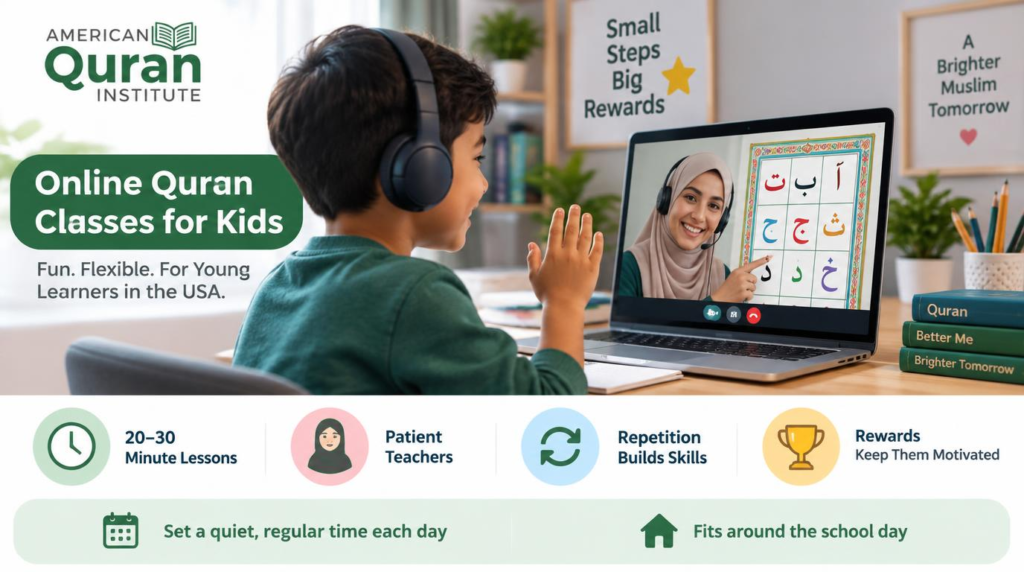
Children learn best in short, lively sessions of 20–30 minutes with a patient teacher, repetition, and visible rewards. Parents help most by setting a quiet, regular slot, ideally the same time each day.
Our Online Quran Classes for Kids are designed for young learners in the USA, with lessons that fit around the school day.
Can you learn the Quran in English for free?
Yes, you can start for free, but free resources work best as a supplement, not as your only teacher. These are reliable and free:
- Quran.com: Arabic text, several English translations, and audio from well-known reciters.
- Quranic Arabic Corpus: word-by-word grammar and root analysis.
- Tanzil.net: accurate Arabic text with translations.
- Free Noorani Qaida PDFs and reputable recitation channels for listening practice.
The limitation is feedback. A video can’t hear you. Without correction, self-taught learners usually lock in pronunciation errors that take far longer to fix later than to learn correctly the first time. Free material also comes without structure, so it’s easy to bounce between topics without finishing anything.
The practical middle ground is low-cost live lessons plus free tools for review. At American Quran Institute, you get a structured English-language course and live correction, with flexible packages so you pay only for the lessons your schedule allows.
Read also: The Importance of Arabic Language in Quran
How To Engage With The Quran While You’re Still Studying?
Engage with the Quran now by reading its meaning in English, listening to recitation daily, and reflecting on a few verses at a time. You don’t need fluent Arabic to build a daily relationship with the Quran.
The 15-minute daily reflection routine
- Listen to 3–5 verses recited while following the Arabic text with your eyes.
- Read the English translation of the same verses slowly.
- Ask yourself: what does this teach me about Allah, what does it ask of me, and how does it apply to my day?
- Write one line in a journal: the verse reference, its main idea, and one action you’ll take today.
Doing a small amount every day is the goal. Weekly journal reviews turn reading into habits you can actually see.
Should I start memorizing even if I don’t understand?
Yes, you can start memorizing before you fully understand. Muslims have long memorized the Quran from childhood, and reciting it carries reward in itself. But for adults, memorization sticks better when you know roughly what each verse says.
A useful rule: read the translation of a short surah before you memorize it. It takes two minutes and makes recall noticeably easier. This is why we pair Hifz with meaning at the American Quran Institute.
How Long Does It Take An English Speaker To Learn The Quran?
There’s no single timeline. It depends on your starting point, your goal, and how often you practice. As a rough guide for an adult English speaker with two to three lessons a week plus daily review:
- Reading Arabic letters and simple words: a few weeks to a few months.
- Reading the Quran with basic Tajweed: often within the first year.
- Understanding common Quranic vocabulary: steady progress over one to two years.
- Full memorization (Hifz): several years part-time, depending on daily hours.
The biggest factor is daily review. Learners who review between lessons consistently progress faster than those who only practice the night before class.
Common mistakes that slow English speakers down:
- Learning only from apps or videos with no one correcting pronunciation.
- Reading transliteration long-term instead of moving to the Arabic script.
- Choosing a lesson time you can’t keep, then missing weeks.
- Studying Tajweed rules as a list instead of applying them while reading.
- Memorizing without ever revising old surahs.
Experience Our Classroom Environment
Don’t just take our word for it—experience a live session for yourself! Click on the videos below to watch real snippets from our classes and see our interactive teaching methods in real-time.
Start Your Quranic Education
Join our premier online institute for structured Quranic learning tailored for students in the USA.
Book Your Free TrialStart Learning The Quran In English With American Quran Institute Today
You don’t need to live near a mosque or an Arabic-speaking teacher to read, understand, and memorize the Book of Allah. American Quran Institute brings certified, English-speaking tutors to your screen in one-on-one lessons scheduled around your time zone, whether you’re starting from the alphabet, fixing your Tajweed, or enrolling your kids.
Our Quran Courses:
- Quran Online Academy
- Quran Recitation Classes
- Quran Reading Classes
- Online Quran Classes for Kids
- Quran Classes for Adults
- Quran Classes for Female/Sisters
- Learn Quran Course for Beginners
- Quran Qirat Learning Course
- Quran Tafsir Course
Conclusion
To learn the Quran in English in the USA, set a clear goal, find an English-speaking certified teacher, start at your real level, learn Tajweed while you read, and protect a short daily routine.
Use a reliable translation and short Tafsir to understand the meaning, and study Quranic Arabic step by step so meaning starts reaching you directly.
The takeaway: read, understand, and memorize the same passages, and practice a little every day. If you’d like a structured path with live correction, American Quran Institute is ready to guide you from your first letter to your first full surah.
Frequently Asked Questions About Learning The Quran In English
These are the questions English-speaking learners in the USA ask most often before they start. Each answer is short and direct, so you can find what you need quickly.
1. How can an English speaker learn the Quran?
An English speaker learns the Quran by taking live lessons taught in English: first the Arabic alphabet, then reading with Tajweed, then understanding through translation and Tafsir. Daily review between lessons is what turns progress into fluency.
2. Can I learn the Quran online in English?
Yes, you can learn the Quran online in English through one-on-one video lessons with certified tutors who explain everything in English. American Quran Institute offers reading, recitation, memorization, and kids’ programs in US time zones.
3. Do I need to know Arabic to pray if I learn the Quran in English?
Yes. Salah is recited in Arabic, so you need to read or memorize at least Al-Fatiha and a few short surahs in Arabic. Your English understanding helps you know what you’re saying while you pray.
4. What’s the difference between Quran reading and Quran recitation classes?
Reading classes teach you to read the Arabic text accurately from the Mushaf. Recitation classes refine how you read, focusing on Tajweed, fluency, and correct pronunciation. Most learners take reading first, then recitation.
5. How do I learn the Quran as a complete beginner in English?
Complete beginners start with Noorani Qaida, the Arabic letters and short vowels, taught in English in short, frequent lessons. Once you can join letters into words, you move to short surahs and basic Tajweed.
6. Is transliteration enough to learn the Quran?
No. Transliteration helps for the first few days, but it can’t represent several Arabic sounds accurately. Move to the Arabic script as early as possible so your recitation is correct.





Leave a Reply