 Quran
Quran
Forgiveness is one of the most comforting themes in the Quran. Allah repeatedly reminds people that making mistakes does not close the door to His mercy. Instead, He calls them to return through sincere repentance, seek His forgiveness, reform their actions, and never despair of His mercy.
The Quran presents forgiveness as a balance between hope and responsibility. Muslims are encouraged to seek Allah’s forgiveness through istighfar and sincere tawbah, but forgiveness should never become an excuse to knowingly continue in sin.
Forgiveness also extends to how Muslims treat others. Just as believers hope for Allah’s pardon, the Quran encourages them to restrain anger, overlook faults, and forgive those who have wronged them.
Below are some of the most important Quran verses about forgiveness, presented with the original Arabic, transliteration, English translation, direct Quran.com references, and a brief explanation of the lesson each verse teaches.
1. Quran Verse About Never Despairing of Allah’s Mercy
One of the most powerful Quran verses about forgiveness in Arabic is found in Surah Az-Zumar.
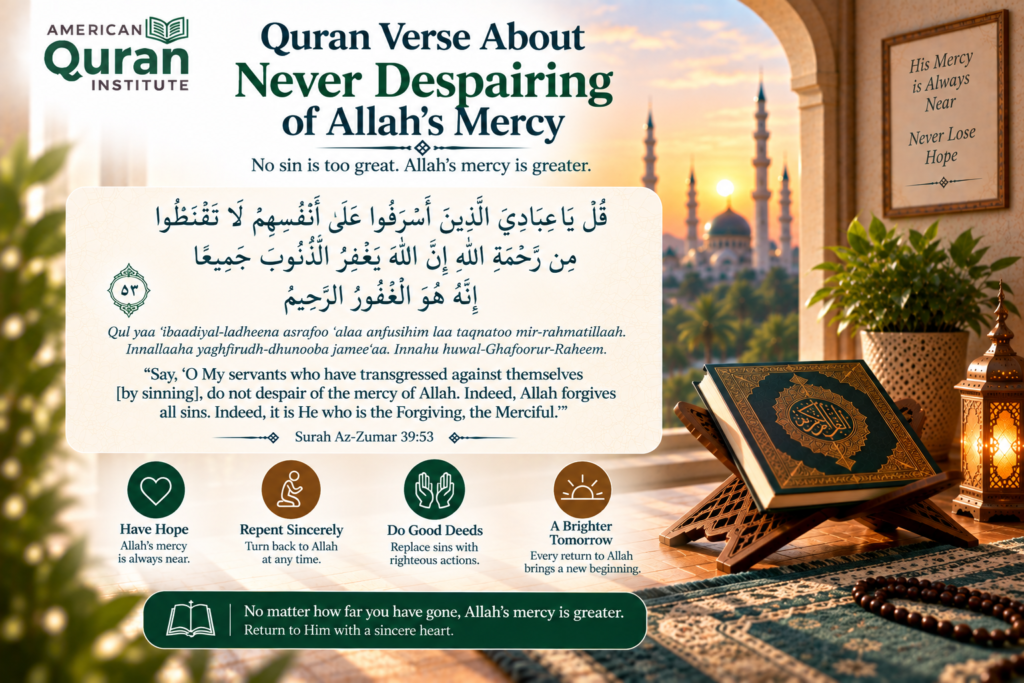
Allah directly addresses people who have committed many sins and tells them not to lose hope.
قُلْ يَا عِبَادِيَ الَّذِينَ أَسْرَفُوا عَلَىٰ أَنفُسِهِمْ لَا تَقْنَطُوا مِن رَّحْمَةِ اللَّهِ ۚ إِنَّ اللَّهَ يَغْفِرُ الذُّنُوبَ جَمِيعًا ۚ إِنَّهُ هُوَ الْغَفُورُ الرَّحِيمُ
Qul yaa ‘ibaadiyal-ladheena asrafoo ‘alaa anfusihim laa taqnatoo mir-rahmatillaah. Innallaaha yaghfirudh-dhunooba jamee‘aa. Innahu huwal-Ghafoorur-Raheem.
“Say, ‘O My servants who have transgressed against themselves [by sinning], do not despair of the mercy of Allah. Indeed, Allah forgives all sins. Indeed, it is He who is the Forgiving, the Merciful.’”
The phrase لَا تَقْنَطُوا مِن رَّحْمَةِ اللَّهِ — “Do not despair of the mercy of Allah” is the heart of this verse. It speaks directly to the person who thinks they have gone too far.
The lesson is not that sin is insignificant. Rather, it is that sincere repentance should never be abandoned because of hopelessness.
For women who want to improve the accuracy of the Arabic they recite during regular worship, online Tajweed classes for ladies can provide guided practice in pronunciation and Tajweed rules.
2. Quran Verse About Seeking Allah’s Forgiveness After Sin
The Quran gives a remarkably direct promise to anyone who has done wrong and then sincerely turns back to Allah.
وَمَن يَعْمَلْ سُوءًا أَوْ يَظْلِمْ نَفْسَهُ ثُمَّ يَسْتَغْفِرِ اللَّهَ يَجِدِ اللَّهَ غَفُورًا رَّحِيمًا
Wa man ya‘mal sooo’an aw yazlim nafsahoo thumma yastaghfirillaaha yajidillaaha Ghafooran Raheemaa.
“And whoever does a wrong or wrongs himself but then seeks forgiveness of Allah will find Allah Forgiving and Merciful.”
The structure of this verse is deeply hopeful. A person may have already committed a wrong, yet the verse directs them toward istighfar, seeking Allah’s forgiveness.
It does not say that the sinner is permanently defined by the mistake. It points immediately toward the possibility of returning to Allah.
3. Quran Verse About Allah Forgiving Those Who Repent and Reform
Forgiveness in the Quran is strongly connected with sincere repentance and righteous change.
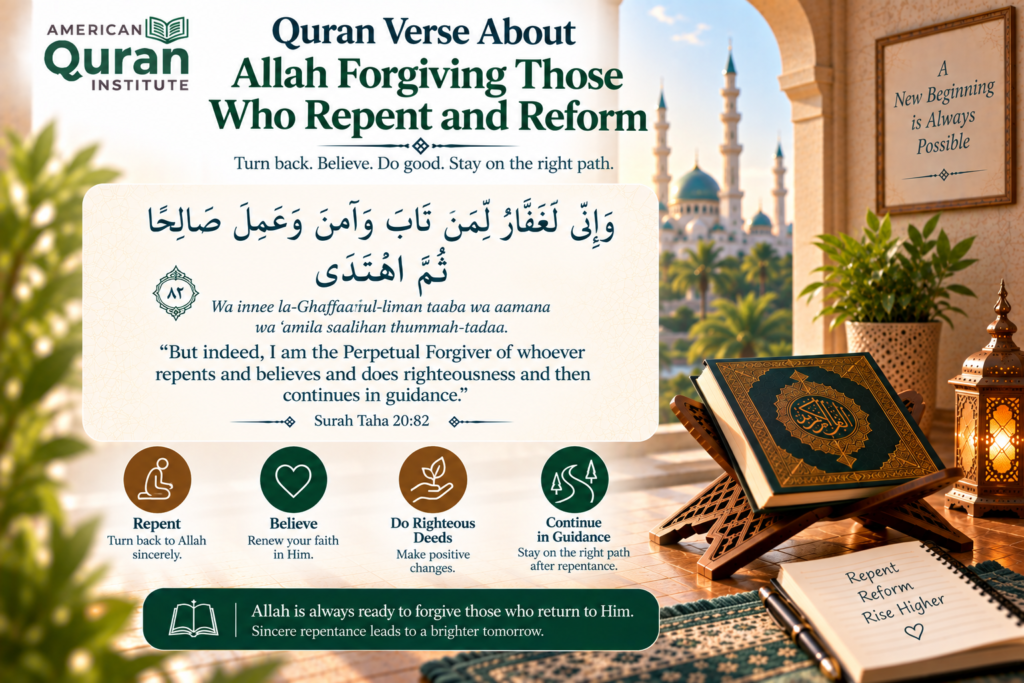
وَإِنِّي لَغَفَّارٌ لِّمَن تَابَ وَآمَنَ وَعَمِلَ صَالِحًا ثُمَّ اهْتَدَىٰ
Wa innee la-Ghaffaarul-liman taaba wa aamana wa ‘amila saalihan thummah-tadaa.
“But indeed, I am the Perpetual Forgiver of whoever repents and believes and does righteousness and then continues in guidance.”
The verse does not describe repentance as words alone. It connects forgiveness with four ideas: repentance, faith, righteous action, and continuing upon guidance.
This gives a fuller picture of tawbah: turning back to Allah should lead to a changed direction.
4. Quran Verse About Allah Accepting Repentance and Pardoning Sins
Another verse directly describes Allah as the One who accepts repentance from His servants.
وَهُوَ الَّذِي يَقْبَلُ التَّوْبَةَ عَنْ عِبَادِهِ وَيَعْفُو عَنِ السَّيِّئَاتِ وَيَعْلَمُ مَا تَفْعَلُونَ
Wa huwal-ladhee yaqbalut-tawbata ‘an ‘ibaadihee wa ya‘foo ‘anis-sayyi’aati wa ya‘lamu maa taf‘aloon.
“And it is He who accepts repentance from His servants and pardons misdeeds, and He knows what you do.”
This verse combines two concepts: التَّوْبَة — tawbah, returning to Allah in repentance, and الْعَفْو — al-‘afw, pardon.
Allah knows what His servants have done, yet He also opens the path of repentance and pardon. That combination helps the believer understand that forgiveness is an act of mercy from the One who knows their sins completely.
5. Quran Verse About Hastening Toward Allah’s Forgiveness
The Quran does not encourage believers to postpone repentance. Instead, it uses the language of urgency.
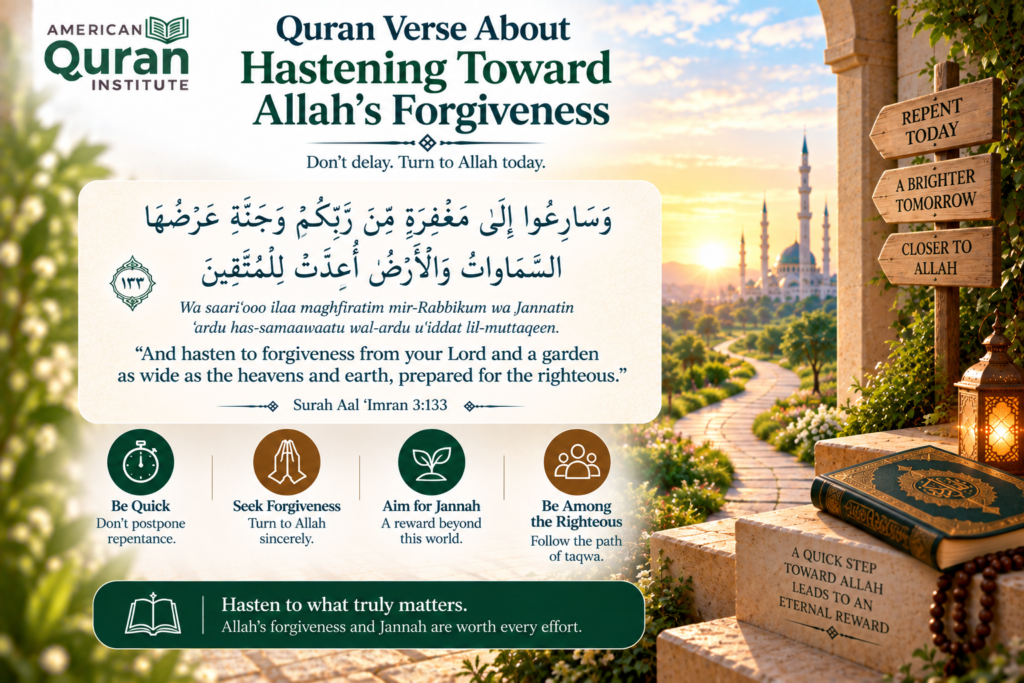
وَسَارِعُوا إِلَىٰ مَغْفِرَةٍ مِّن رَّبِّكُمْ وَجَنَّةٍ عَرْضُهَا السَّمَاوَاتُ وَالْأَرْضُ أُعِدَّتْ لِلْمُتَّقِينَ
Wa saari‘ooo ilaa maghfiratim mir-Rabbikum wa Jannatin ‘ardu has-samaawaatu wal-ardu u‘iddat lil-muttaqeen.
“And hasten to forgiveness from your Lord and a garden as wide as the heavens and earth, prepared for the righteous.”
The verb سَارِعُوا — saari‘oo means to hasten or hurry. The verse therefore teaches that forgiveness should be actively pursued, not treated as something to deal with later.
A believer does not know how much time remains, so repentance should not be delayed.
6. Quran Verse About Remembering Allah and Seeking Forgiveness After Sin
The Quran gives an important description of righteous believers: they are not necessarily people who never make mistakes. Rather, when they fall into sin, they remember Allah and return to Him.
وَالَّذِينَ إِذَا فَعَلُوا فَاحِشَةً أَوْ ظَلَمُوا أَنفُسَهُمْ ذَكَرُوا اللَّهَ فَاسْتَغْفَرُوا لِذُنُوبِهِمْ وَمَن يَغْفِرُ الذُّنُوبَ إِلَّا اللَّهُ وَلَمْ يُصِرُّوا عَلَىٰ مَا فَعَلُوا وَهُمْ يَعْلَمُونَ
Walladheena idhaa fa‘aloo faahishatan aw zalamooo anfusahum dhakarullaaha fastaghfaroo lidhunoobihim wa man yaghfirudh-dhunooba illallaahu wa lam yusirroo ‘alaa maa fa‘aloo wa hum ya‘lamoon.
“And those who, when they commit an immorality or wrong themselves, remember Allah and seek forgiveness for their sins—and who can forgive sins except Allah?—and [who] do not persist in what they have done while they know.”
The final part of the verse is essential: وَلَمْ يُصِرُّوا عَلَىٰ مَا فَعَلُوا — “and they do not persist in what they have done.”
Seeking forgiveness is therefore connected to a sincere desire to stop knowingly continuing in the same wrongdoing.
7. Quran Verse About Forgiveness and the Reward of Paradise
The next verse explains the reward awaiting those who repent and seek Allah’s forgiveness.
أُولَٰئِكَ جَزَاؤُهُم مَّغْفِرَةٌ مِّن رَّبِّهِمْ وَجَنَّاتٌ تَجْرِي مِن تَحْتِهَا الْأَنْهَارُ خَالِدِينَ فِيهَا ۚ وَنِعْمَ أَجْرُ الْعَامِلِينَ
Ulaaa’ika jazaaa’uhum maghfiratum mir-Rabbihim wa Jannaatun tajree min tahtihal-anhaaru khaalideena feehaa; wa ni‘ma ajrul-‘aamileen.
“Those—their reward is forgiveness from their Lord and gardens beneath which rivers flow, wherein they will abide eternally; and excellent is the reward of the righteous workers.”
The reward is not limited to having sins erased. Allah connects maghfirah, forgiveness, with everlasting Paradise. This is a recurring Quranic pattern: divine forgiveness is often followed by mercy, reward, or entry into Jannah.
8. Quran Verse About Repentance Turning Bad Deeds Into Good Deeds
One of the most extraordinary promises concerning forgiveness appears in Surah Al-Furqan. Allah describes more than simply removing sins.
إِلَّا مَن تَابَ وَآمَنَ وَعَمِلَ عَمَلًا صَالِحًا فَأُولَٰئِكَ يُبَدِّلُ اللَّهُ سَيِّئَاتِهِمْ حَسَنَاتٍ ۗ وَكَانَ اللَّهُ غَفُورًا رَّحِيمًا
Illaa man taaba wa aamana wa ‘amila ‘amalan saalihan fa-ulaaa’ika yubaddilullaahu sayyi’aatihim hasanaat; wa kaanallaahu Ghafooran Raheemaa.
“Except for those who repent, believe and do righteous work. For them Allah will replace their evil deeds with good. And ever is Allah Forgiving and Merciful.”
The key word is يُبَدِّلُ — yubaddilu, meaning “He replaces.” Sincere repentance does not only involve regret over the past. It can become the beginning of transformation.
The verse connects tawbah with renewed faith and righteous action, showing that repentance should reshape the direction of a person’s life.
9. Quran Verse About Allah Loving Those Who Repent
The Quran goes beyond saying that Allah accepts repentance. It says that He loves those who repeatedly turn back to Him.
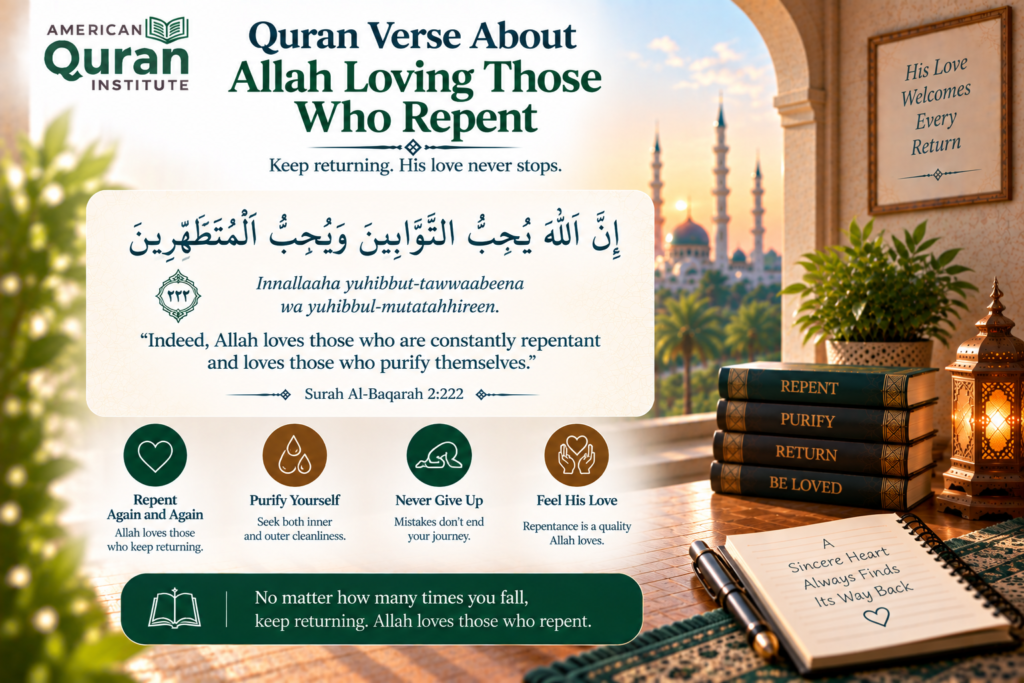
إِنَّ اللَّهَ يُحِبُّ التَّوَّابِينَ وَيُحِبُّ الْمُتَطَهِّرِينَ
Innallaaha yuhibbut-tawwaabeena wa yuhibbul-mutatahhireen.
“Indeed, Allah loves those who are constantly repentant and loves those who purify themselves.”
The word التَّوَّابِينَ — at-tawwaabeen refers to people who repeatedly return in repentance.
Human beings may make mistakes more than once, but the Quran encourages them to keep returning sincerely rather than giving up. Repentance is therefore not merely tolerated; it is described as a quality Allah loves.
10. Quran Verse and Dua Asking Allah for Forgiveness and Mercy
Some of the most useful Quran verses about forgiveness in Arabic are themselves duas that Muslims can recite. Allah teaches this short supplication in Surah Al-Mu’minun:
وَقُل رَّبِّ اغْفِرْ وَارْحَمْ وَأَنتَ خَيْرُ الرَّاحِمِينَ
Wa qur-Rabbighfir warham wa Anta khayrur-raahimeen.
“And say, ‘My Lord, forgive and have mercy, and You are the best of the merciful.’”
This dua combines two requests: اغْفِرْ — forgive, and ارْحَمْ — have mercy.
It is short enough to memorize easily, yet it expresses two of the believer’s greatest needs: forgiveness for what has passed and mercy for what lies ahead. Learners who still find reading verses like this difficult can strengthen their fluency through structured Quran reading classes before moving into deeper study of their meanings.

11. The Dua of Adam and Hawwa for Allah’s Forgiveness
The Quran records the repentance of Adam and his wife after they wronged themselves. Their response was not to blame others or justify the mistake. They turned to Allah.
قَالَا رَبَّنَا ظَلَمْنَا أَنفُسَنَا وَإِن لَّمْ تَغْفِرْ لَنَا وَتَرْحَمْنَا لَنَكُونَنَّ مِنَ الْخَاسِرِينَ
Qaalaa Rabbanaa zalamnaaa anfusanaa wa il-lam taghfir lanaa wa tarhamnaa lanakoonanna minal-khaasireen.
“They said, ‘Our Lord, we have wronged ourselves, and if You do not forgive us and have mercy upon us, we will surely be among the losers.’”
This is one of the clearest Quranic models of repentance. They acknowledge the wrong directly: ظَلَمْنَا أَنفُسَنَا — “We have wronged ourselves.”
Then they seek both forgiveness and mercy. The verse teaches believers that genuine repentance begins with honesty before Allah.
12. Quranic Dua for Pardon, Forgiveness, and Mercy
The final verse of Surah Al-Baqarah includes a comprehensive dua.
وَاعْفُ عَنَّا وَاغْفِرْ لَنَا وَارْحَمْنَا ۚ أَنتَ مَوْلَانَا
Wa‘fu ‘annaa waghfir lanaa warhamnaa; Anta Mawlaanaa.
“And pardon us; and forgive us; and have mercy upon us. You are our Protector.”
Three requests appear together:
- وَاعْفُ عَنَّا — pardon us
- وَاغْفِرْ لَنَا — forgive us
- وَارْحَمْنَا — have mercy upon us
This combination shows the depth of the believer’s dependence on Allah. We ask not merely for punishment to be avoided, but for pardon, forgiveness, and mercy together.
13. Allah Praises Those Who Seek His Forgiveness Before Dawn
The Quran praises believers who seek Allah’s forgiveness during the quiet hours before dawn.
الصَّابِرِينَ وَالصَّادِقِينَ وَالْقَانِتِينَ وَالْمُنفِقِينَ وَالْمُسْتَغْفِرِينَ بِالْأَسْحَارِ
As-saabireena was-saadiqeena wal-qaaniteena wal-munfiqeena wal-mustaghfireena bil-ashaar.
“The patient, the truthful, the devoutly obedient, those who spend, and those who seek forgiveness before dawn.”
The word الْمُسْتَغْفِرِينَ — al-mustaghfireen means those actively seeking forgiveness. The verse specifically mentions الْأَسْحَار — al-ashaar, the late part of the night before dawn.
This shows that istighfar is not only an emergency response after major mistakes. It can become a regular act of worship.
14. Quran Verse About Seeking Forgiveness From Allah
Some Quranic commands are beautifully simple.
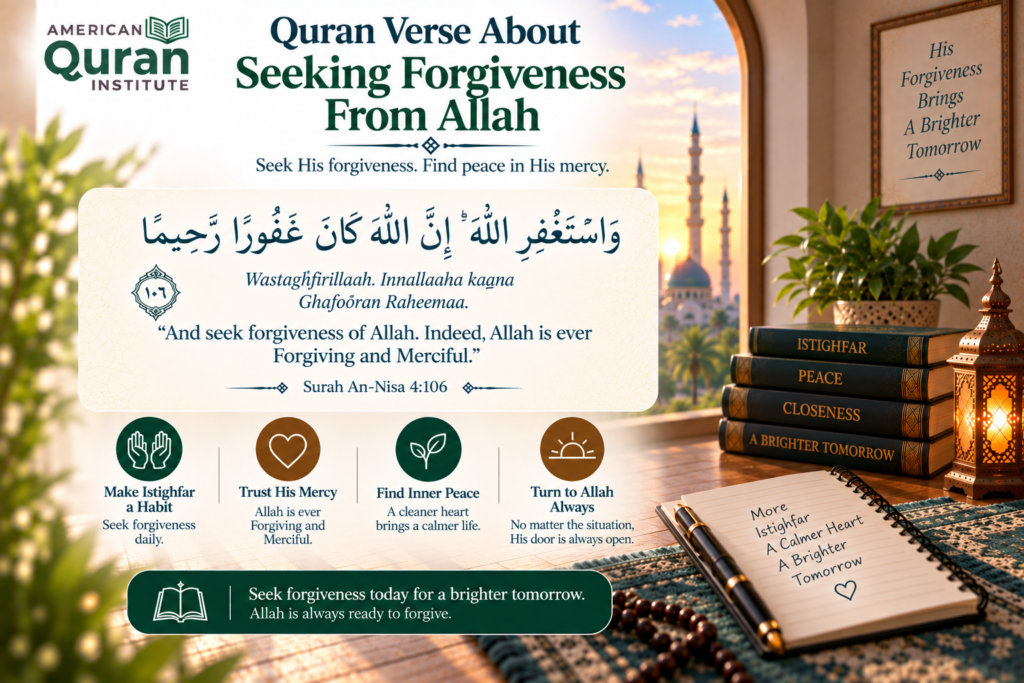
وَاسْتَغْفِرِ اللَّهَ ۖ إِنَّ اللَّهَ كَانَ غَفُورًا رَّحِيمًا
Wastaghfirillaah. Innallaaha kaana Ghafooran Raheemaa.
“And seek forgiveness of Allah. Indeed, Allah is ever Forgiving and Merciful.”
This short ayah contains both a command and a reason: seek forgiveness because Allah is Ghafoor, Forgiving, and Raheem, Merciful.
It encourages Muslims to make istighfar a natural part of their worship rather than something they remember only when overwhelmed by guilt.
Experience Our Classroom Environment
Don’t just take our word for it—experience a live session for yourself! Click on the videos below to watch real snippets from our classes and see our interactive teaching methods in real-time.
Start Your Quranic Education
Join our premier online institute for structured Quranic learning tailored for students in the USA.
Book Your Free Trial15. Prophet Nuh’s Call to Seek Allah’s Forgiveness
Prophet Nuh called his people to seek forgiveness from Allah.
فَقُلْتُ اسْتَغْفِرُوا رَبَّكُمْ إِنَّهُ كَانَ غَفَّارًا
Faqultustaghfiroo Rabbakum innahoo kaana Ghaffaaraa.
“And said, ‘Ask forgiveness of your Lord. Indeed, He is ever a Perpetual Forgiver.’”
Here Allah is described as غَفَّارًا — Ghaffaar, a form that emphasizes abundant and repeated forgiveness.
The verse encourages believers not to think of istighfar as a one-time action. Seeking Allah’s forgiveness can become part of daily remembrance and worship.
16. Quran Verse About Repentance and Reform
The Quran repeatedly connects repentance with correcting one’s behavior.
فَمَن تَابَ مِن بَعْدِ ظُلْمِهِ وَأَصْلَحَ فَإِنَّ اللَّهَ يَتُوبُ عَلَيْهِ ۗ إِنَّ اللَّهَ غَفُورٌ رَّحِيمٌ
Faman taaba mim-ba‘di zulmihee wa aslaha fa-innallaaha yatoobu ‘alayh. Innallaaha Ghafoorur-Raheem.
“But whoever repents after his wrongdoing and reforms, indeed, Allah will turn to him in forgiveness. Indeed, Allah is Forgiving and Merciful.”
The word وَأَصْلَحَ — wa aslaha, “and reforms,” is important.
Repentance involves more than saying Astaghfirullah. When possible, a person should repair what has been damaged and change the behavior that led to the wrong. This is why sincere tawbah has a practical dimension.
17. Allah Promises Forgiveness and a Great Reward for Faith and Good Deeds
Forgiveness is frequently connected with faith and good deeds.
وَعَدَ اللَّهُ الَّذِينَ آمَنُوا وَعَمِلُوا الصَّالِحَاتِ لَهُم مَّغْفِرَةٌ وَأَجْرٌ عَظِيمٌ
Wa‘adallaahul-ladheena aamanoo wa ‘amilus-saalihaati lahum maghfiratun wa ajrun ‘azeem.
“Allah has promised those who believe and do righteous deeds that for them there is forgiveness and a great reward.”
The verse connects three ideas clearly: faith, righteous action, and forgiveness.
It shows that the Quranic path is not merely to regret the past but also to build a better future through good deeds.
18. Quran Verse About Forgiving Others and Receiving Allah’s Forgiveness
The Quran does not limit forgiveness to the relationship between a person and Allah. It also commands believers to pardon others.
وَلْيَعْفُوا وَلْيَصْفَحُوا ۗ أَلَا تُحِبُّونَ أَن يَغْفِرَ اللَّهُ لَكُمْ ۗ وَاللَّهُ غَفُورٌ رَّحِيمٌ
Wal-ya‘foo wal-yasfahoo. Alaa tuhibboona an yaghfirallaahu lakum. Wallaahu Ghafoorur-Raheem.
“Let them pardon and overlook. Would you not love for Allah to forgive you? And Allah is Forgiving and Merciful.”
The verse uses a powerful question: “Would you not love for Allah to forgive you?”
It connects our desire for divine forgiveness with our willingness to pardon other people. Forgiving someone does not mean pretending that harm never happened, but it can mean releasing the desire for revenge and choosing a higher response for Allah’s sake.
19. Quran Verse About Restraining Anger and Forgiving Others
Surah Aal ‘Imran describes several characteristics of righteous people. Among them is the ability to control anger and forgive.
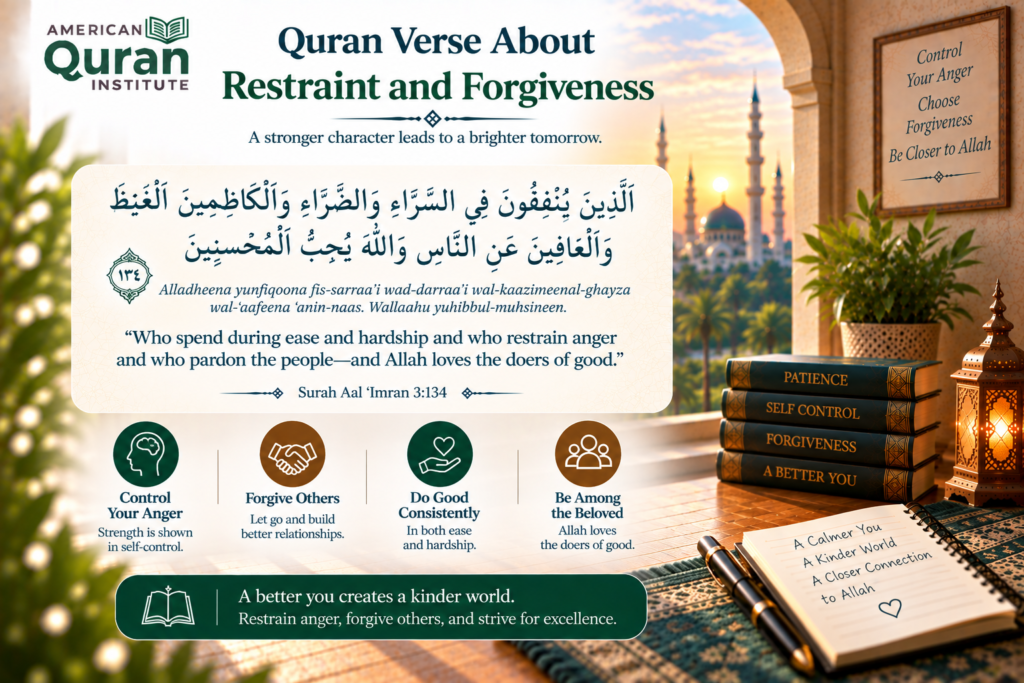
الَّذِينَ يُنفِقُونَ فِي السَّرَّاءِ وَالضَّرَّاءِ وَالْكَاظِمِينَ الْغَيْظَ وَالْعَافِينَ عَنِ النَّاسِ ۗ وَاللَّهُ يُحِبُّ الْمُحْسِنِينَ
Alladheena yunfiqoona fis-sarraaa’i wad-darraaa’i wal-kaazimeenal-ghayza wal-‘aafeena ‘anin-naas. Wallaahu yuhibbul-muhsineen.
“Who spend during ease and hardship and who restrain anger and who pardon the people—and Allah loves the doers of good.”
The verse first mentions restraining anger, then moves to pardoning people. Feeling angry is not the same as acting destructively because of anger.
The Quran praises those who control that emotion and then choose forgiveness, placing this behavior among the qualities of al-muhsineen, the doers of excellence.
20. Quran Verse About Pardoning the Wrongdoing of Others
Another verse encourages people to pardon wrongs while reminding them that Allah Himself is Pardoning and Powerful.
إِن تُبْدُوا خَيْرًا أَوْ تُخْفُوهُ أَوْ تَعْفُوا عَن سُوءٍ فَإِنَّ اللَّهَ كَانَ عَفُوًّا قَدِيرًا
In tubdoo khayran aw tukhfoohu aw ta‘foo ‘an sooo’in fa-innallaaha kaana ‘Afuwwan Qadeeraa.
“If you show good or conceal it or pardon an offense—indeed, Allah is ever Pardoning and Powerful.”
The verse links human pardon with one of Allah’s names and attributes: Al-‘Afuww, the Pardoning.
It teaches that the ability to forgive when one has the power to respond differently can be a form of spiritual strength.
21. Kind Speech and Forgiveness Are Better Than Charity Followed by Harm
Forgiveness also appears in Quranic guidance about how people should treat others after helping them.
قَوْلٌ مَّعْرُوفٌ وَمَغْفِرَةٌ خَيْرٌ مِّن صَدَقَةٍ يَتْبَعُهَا أَذًى ۗ وَاللَّهُ غَنِيٌّ حَلِيمٌ
Qawlum ma‘roofun wa maghfiratun khayrum min sadaqatin yatba‘uhaaa adhaa. Wallaahu Ghaniyyun Haleem.
“Kind speech and forgiveness are better than charity followed by injury. And Allah is Free of need and Forbearing.”
The verse shows that good treatment and forgiveness may be more valuable than financial charity followed by humiliation or harm. It is a reminder that Islamic ethics are not measured only by visible actions. The way we speak to and treat people also matters.
Teaching children Quran verses about forgiveness can help them understand concepts such as repentance, mercy, and pardoning others from an early age. Alongside learning these meanings, structured Quran classes for kids can help young learners develop their reading, recitation, and understanding of the Quran.

22. A Quranic Dua for Forgiveness and Steadfastness
The Quran preserves several duas of believers who sought forgiveness during times of difficulty.
رَبَّنَا اغْفِرْ لَنَا ذُنُوبَنَا وَإِسْرَافَنَا فِي أَمْرِنَا وَثَبِّتْ أَقْدَامَنَا
Rabbanaghfir lanaa dhunoobanaa wa israafanaa feee amrinaa wa thabbit aqdaamanaa.
“Our Lord, forgive us our sins and the excess committed in our affairs and plant firmly our feet.”
This dua combines humility with determination. The believers acknowledge both sins and excesses, then ask Allah for firmness. It is an excellent reminder that forgiveness should be followed by a stronger effort to remain steadfast.
23. Quranic Dua for Forgiveness and a Righteous Ending
Another Quranic dua connects forgiveness with the believer’s final destination.
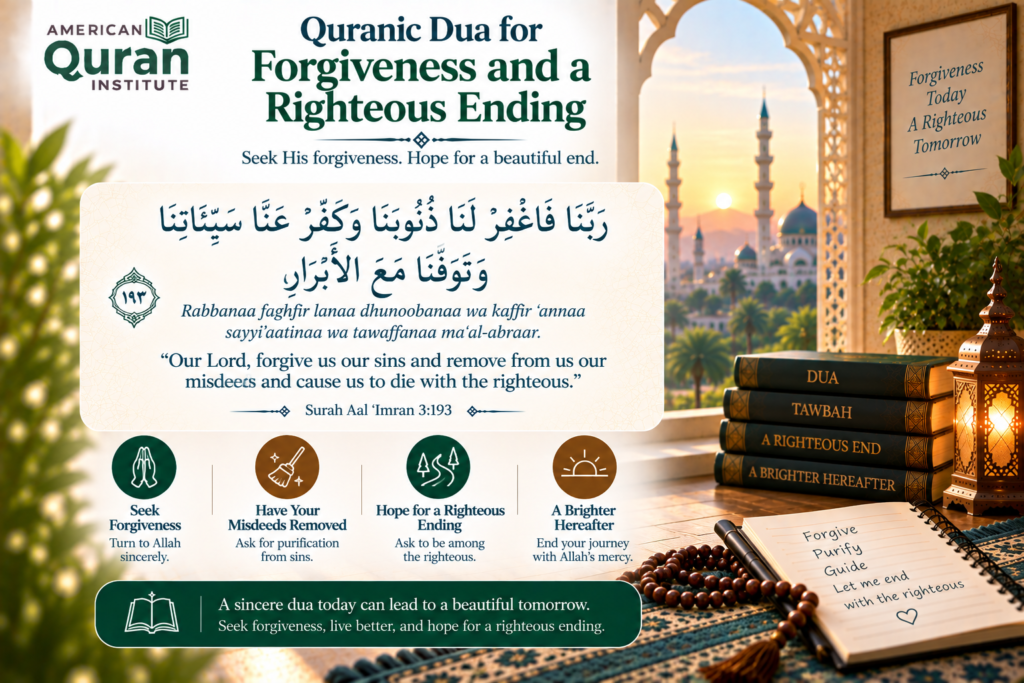
رَبَّنَا فَاغْفِرْ لَنَا ذُنُوبَنَا وَكَفِّرْ عَنَّا سَيِّئَاتِنَا وَتَوَفَّنَا مَعَ الْأَبْرَارِ
Rabbanaa faghfir lanaa dhunoobanaa wa kaffir ‘annaa sayyi’aatinaa wa tawaffanaa ma‘al-abraar.
“Our Lord, forgive us our sins and remove from us our misdeeds and cause us to die with the righteous.”
The dua asks for three things: forgiveness of sins, removal of bad deeds, and a righteous ending. This reminds us that seeking forgiveness is connected not only to the past but also to how we hope to complete our lives.
What Is the Difference Between Maghfirah, Istighfar, Tawbah, and ‘Afw?
Several Arabic terms related to forgiveness appear throughout the Quran.
- Maghfirah — مَغْفِرَة: means forgiveness. It is connected to the Arabic root غ-ف-ر, which carries the meaning of covering or shielding. When Muslims ask Allah for maghfirah, they are asking Him to forgive their sins and protect them from their consequences.
- Istighfar — اسْتِغْفَار: means actively seeking Allah’s forgiveness. The familiar phrase أَسْتَغْفِرُ اللَّه — Astaghfirullah means “I seek Allah’s forgiveness.”
- Tawbah — تَوْبَة: means returning to Allah after sin True repentance includes recognizing the wrong, regretting it, leaving it, and sincerely intending not to return to it.
- ‘Afw — عَفْو: carries the meaning of pardon or overlooking The Quran uses it when discussing both Allah’s pardon and human beings forgiving one another.
Understanding these words helps students appreciate why English translations sometimes use “forgive,” “pardon,” and “repentance” in slightly different contexts.
What Do Quran Verses About Forgiveness Teach Us?
The Quran verses about forgiveness in Arabic repeatedly emphasize several important lessons about Allah’s mercy, sincere repentance, seeking forgiveness, and forgiving others.
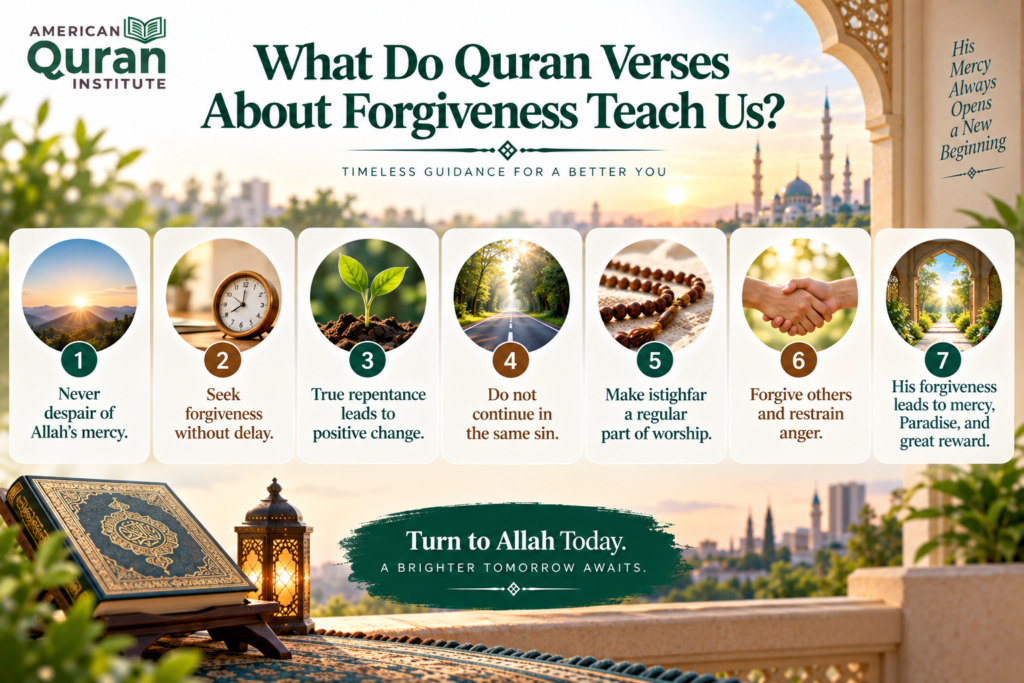
- Never Despair of Allah’s Mercy, No Matter How Great the Sin: Even someone who has committed serious sins should never assume that repentance is useless or that Allah’s forgiveness is beyond reach.
- Seek Allah’s Forgiveness Without Delaying Repentance: The Quran encourages believers to hasten toward forgiveness rather than knowingly postponing repentance.
- Sincere Tawbah Requires Repentance and Positive Change: True repentance is not limited to asking for forgiveness. The Quran often connects tawbah with reform, renewed faith, and righteous action.
- Do Not Continue Knowingly in the Same Sin After Seeking Forgiveness: A believer may fall into error, but the Quran praises those who remember Allah, seek His forgiveness, and do not deliberately persist in wrongdoing.
- Make Istighfar a Regular Part of Your Worship: Seeking forgiveness is not only for moments after committing a major sin. The Quran presents istighfar as an ongoing act of worship, including during the quiet hours before dawn.
- Forgive Others and Restrain Anger to Seek Allah’s Pleasure: The Quran connects forgiveness with the way believers treat other people, praising those who control their anger, pardon others, and choose forgiveness over revenge.
- Allah’s Forgiveness Can Lead to Mercy, Paradise, and Great Reward: Forgiveness in the Quran goes far beyond the removal of sin. It is connected with Allah’s mercy and love, entry into Paradise, great reward, and even the transformation of bad deeds into good deeds after sincere repentance.
See Us in Action!
Take a look inside our virtual classrooms. Watch the clip below to see how our instructors engage with students, simplify complex rules, and create an inspiring environment for learning.
Start Your Quranic Education
Join our premier online institute for structured Quranic learning tailored for students in the USA.
Book Your Free TrialLearn Quran Verses About Forgiveness in Arabic
Reading these verses in English gives access to their general meaning, but reading them in Arabic helps students recognize the repeated Quranic vocabulary of repentance, mercy, and forgiveness.
Words such as غَفُور — Ghafoor, غَفَّار — Ghaffaar, مَغْفِرَة — maghfirah, اسْتَغْفِرُوا — seek forgiveness, and تُوبُوا — repent appear throughout the Quran.
At American Quran Institute, students can build stronger Quran reading, pronunciation, Tajweed, and understanding through structured instruction with qualified teachers.
Studying passages like these directly in Arabic can help students move beyond reading isolated translations and begin recognizing the language and patterns of the Quran itself.
Start your free trial with American Quran Institute today
Our Arabic Courses
- Arabic Classes for Adults
- Arabic Classes for Ladies
- Fusha Arabic Course
- Business Arabic Course
- Al Azhar Arabic Course
- Madinah Arabic Course

Conclusion
The quran verses about forgiveness in arabic present a message of hope without removing responsibility.
Allah tells those who have sinned not to despair of His mercy. He promises forgiveness to those who seek Him sincerely, accepts repentance, loves those who repeatedly return to Him, and can even replace evil deeds with good deeds for those who repent, believe, and reform.
The Quran also teaches that forgiveness should influence the way believers treat one another. Those who seek Allah’s pardon are encouraged to pardon others, restrain anger, and respond to hurt with a higher level of character.
Forgiveness in Islam is therefore not only about erasing the past It is about returning to Allah, changing direction, repairing what can be repaired, performing righteous deeds, and developing a heart that seeks mercy while also showing mercy.
Frequently Asked Questions
What Is the Most Powerful Quran Verse About Forgiveness?
One of the most frequently cited is Surah Az-Zumar 39:53, where Allah tells those who have transgressed against themselves not to despair of His mercy and states that He forgives all sins.
What Does “Allah Forgives All Sins” Mean?
Surah Az-Zumar 39:53 teaches that no sin should make a person despair of sincere repentance. A person who sincerely turns back to Allah should continue to hope in His forgiveness and mercy.
What Is the Arabic Word for Forgiveness in the Quran?
One common word is مَغْفِرَة — maghfirah, meaning forgiveness. Related forms include Ghafoor, Ghaffaar, and yaghfiru, all deriving from the Arabic root غ-ف-ر.
What Does Istighfar Mean?
Istighfar — استغفار means seeking forgiveness from Allah. The phrase Astaghfirullah — أستغفر الله means “I seek forgiveness from Allah.”
What Is Tawbah in Islam?
Tawbah means turning back to Allah after sin. Quranic verses connect sincere repentance with leaving wrongdoing, reforming one’s actions, strengthening faith, and doing righteous deeds.
What Does the Quran Say About Forgiving Others?
Surah An-Nur 24:22 tells believers to pardon and overlook, then asks, “Would you not love for Allah to forgive you?” Surah Aal ‘Imran 3:134 also praises those who restrain anger and pardon people.
Does the Quran Encourage Daily Istighfar?
Yes. The Quran repeatedly commands believers to seek forgiveness and praises those who do so regularly, including those who seek forgiveness before dawn in Surah Aal ‘Imran 3:17.






Leave a Reply