 Quran

For Muslim parents in the United States, teaching children the Quran can sometimes feel challenging. School schedules, extracurricular activities, family responsibilities, and the distance from local Islamic centers can make it difficult to maintain a consistent Quran learning routine.
So, how can parents make Quran learning easier, more engaging, and more consistent?
The answer is not simply to increase the number of lessons. Children learn differently at different ages, and the right approach should combine short lessons, repetition, Arabic reading foundations, age-appropriate instruction, and consistent parental support.
For families looking for how to learn Quran for kids in the USA, online learning can also make Quran education more accessible. A child can learn from home while parents choose lesson times that work around school and family schedules.
The Arabic Learning Centre provides online Arabic and Quran-related learning opportunities for international students, including children, with instruction designed to accommodate different learning levels and time zones.
In this guide, we will explore 15 practical ways to help children learn the Quran successfully in the USA, from building an early connection with the Quran to choosing the right online learning environment.
1. Build Familiarity With the Quran Through Listening
Young children can become familiar with Quranic sounds before they begin formal memorization.

Parents can play short Surahs such as Al-Fatihah, Al-Ikhlas, Al-Falaq, and An-Nas during calm moments at home. For families in the USA, this can easily become part of an existing routine:
- During breakfast
- On the way to school
- After returning home
- Before bedtime
- During quiet family time
At this stage, the purpose is familiarity rather than testing the child. Avoid turning every listening session into a memorization exercise. Let the child hear the Quran naturally and develop a positive association with its sound.
For children who later develop a strong interest in Quran recitation, learning different recognized methods of recitation can become part of their advanced Quran journey through Quran Qirat classes.
Read also: Free Online Quran Classes for Sisters in the USA – Learn Quran From Home

2. Choose the Right Starting Point for Your Child’s Age
There is no single age at which every child should begin formal Quran instruction. Some children may be ready for structured Arabic reading earlier, while others need more time to develop attention, pronunciation, and learning habits.
For younger children, parents can begin with:
- Listening
- Short Surahs
- Repetition
- Arabic letters
- Simple pronunciation practice
As the child becomes more comfortable, lessons can gradually introduce Quran reading, Tajweed, and memorization. The important point is to match the learning method to the child’s developmental stage rather than comparing one child with another.
Read also: Free Online Quran Classes for Kids in the USA – A Complete Guide for Parents
3. Build Strong Arabic Reading Skills Before Memorization
One of the most important steps in learning Quran for kids is learning how Arabic letters sound and connect.
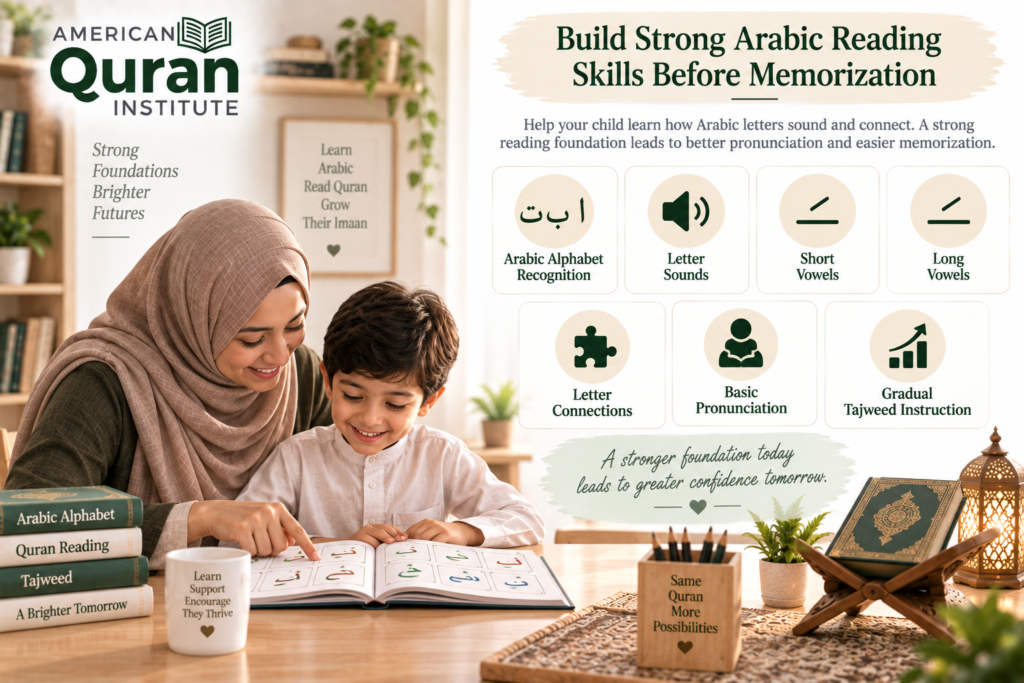
A child who memorizes verses without understanding how the letters are pronounced may later develop pronunciation habits that are difficult to correct.
This is why parents should give attention to:
- Arabic alphabet recognition
- Letter sounds
- Short vowels
- Long vowels
- Letter connections
- Basic pronunciation
- Gradual Tajweed instruction
For families whose children primarily speak English, this foundation can be especially useful because Arabic may not be part of their daily environment. Learning Arabic alongside Quran education can therefore support the child’s confidence when reading Arabic text.
Read also: Dua for Learning Quran – 7 Powerful Supplications for Memorization
4. Keep Quran Lessons Short and Focused
Long Quran lessons can be difficult for young children, especially after a full day at an American school. A child may already have spent several hours listening, reading, writing, and completing schoolwork, so adding a lengthy Quran session afterward may create unnecessary resistance.
Instead, parents can keep Quran lessons short, focused, and appropriate for the child’s age and attention span.
Recommended lesson duration:
- 10–15 minutes: Younger children and beginners
- 15–25 minutes: Children who can maintain attention for longer periods
The exact duration should depend on the child’s age, ability, and learning level. A short, successful lesson is often more useful than a long session that ends with frustration.
5. Create a Consistent Quran Routine Around the USA School Calendar
Maintaining a regular Quran routine can be challenging for Muslim families in the USA. Children often have busy schedules filled with school, homework, extracurricular activities, and family commitments.
Common Schedule Challenges for Children
A child’s weekly schedule may include:
- Elementary or middle school classes
- Homework and school projects
- Sports and clubs
- Weekend activities
- Family commitments
- School holidays and breaks
Rather than trying to find a large amount of free time, parents can build Quran learning into the child’s existing routine.
Create a Simple Weekly Quran Schedule
A predictable schedule can help children know when it is time for Quran learning, practice, and review.
| Day | Quran Activity |
| Monday–Thursday | Quran lesson or daily practice |
| Friday | Review previously learned material |
| Saturday | Listening and family recitation |
| Sunday | Light revision or rest |
The schedule does not need to be identical for every family. Parents can adjust lesson days and practice times according to the child’s school timetable, activities, and learning level.
The goal is consistency, not a perfect schedule. A simple routine that a child can follow regularly is more sustainable than an intensive schedule that becomes difficult to maintain.
Read also: How Long Does It Take To Learn The Quran In The USA?
6. Create a Consistent Quran Routine Around School
For families living far from a mosque, Islamic center, or qualified Quran teacher, online learning can provide another option.

This is particularly useful in the USA because Muslim families live across different states, cities, and communities. Online lessons can allow children to learn from home without spending additional time driving to and from a class.
Parents can also look for schedules that fit their local time zone, whether the family lives on the East Coast, Central Time, Mountain Time, or West Coast.
The Arabic Learning Centre offers online instruction for international learners and provides scheduling designed to accommodate families across different time zones.
7. Combine Quran Education With Arabic Learning
Children do not necessarily need to become fluent Arabic speakers before learning to read the Quran.
However, developing Arabic skills can complement Quran learning.
For example, children can gradually learn:
- Arabic letters
- Basic vocabulary
- Simple phrases
- Reading skills
- Pronunciation
- Everyday Arabic expressions
Fusha Arabic can help children become more comfortable with formal Arabic vocabulary and structures, while Quran learning focuses on reading and engaging with the Quranic text.
Experience Our Classroom Environment
Don’t just take our word for it—experience a live session for yourself! Click on the videos below to watch real snippets from our classes and see our interactive teaching methods in real-time.
Start Your Quranic Education
Join our premier online institute for structured Quranic learning tailored for students in the USA.
Book Your Free Trial8. Use Repetition to Build Strong Memorization
Children usually need repeated exposure before a new Surah becomes familiar. Instead of asking a child to memorize a large passage at once, divide the material into smaller sections.
A simple approach is:
- The teacher reads the verse.
- The child listens carefully.
- The child repeats the verse.
- The teacher corrects pronunciation.
- The child repeats it again.
- The previous verse is reviewed before introducing new material.
Parents can then review the same passage later in the day.
As children become more confident, families may also consider a structured Quran memorization program that provides a gradual approach to memorizing and reviewing the Quran.

9. Begin Memorization With Short Surahs
Short Surahs can give children achievable goals Beginning with shorter passages allows children to experience success before moving toward longer Surahs.

Parents can create a simple progression such as:
- Al-Fatihah
- Al-Ikhlas
- Al-Falaq
- An-Nas
- Al-Kawthar
- Al-Asr
- Al-Nasr
The exact sequence can be adjusted according to the child’s level and teacher’s plan. The important thing is to make sure the child understands that memorization is a gradual process.
10. Make Quran Learning Interactive and Engaging
Children learn differently from adults A lesson that consists entirely of listening to a teacher speak may not hold a young child’s attention for long Interactive activities can make lessons more engaging.
Depending on the child’s age, teachers and parents can use:
- Flashcards
- Arabic letter games
- Matching activities
- Repetition games
- Visual progress charts
- Quran stories
- Short quizzes
- Recitation challenges
The Arabic Learning Centre’s children’s Arabic program uses visual learning aids, repetition, stories, games, and interactive exercises to support young learners. These techniques can also help children who are more comfortable learning through activities rather than traditional instruction.
11. Develop Arabic Speaking Skills Alongside Quran Learning
For children growing up in the USA, Arabic may not be the language they use at school or with most friends.
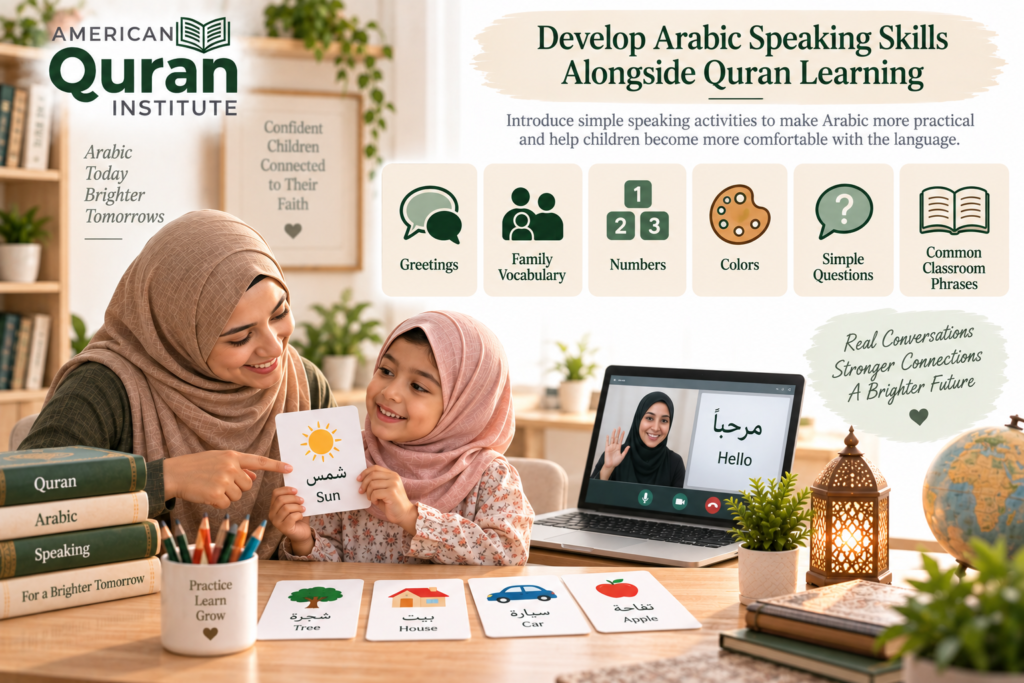
This can make Arabic feel like a separate subject One way to make Arabic more practical is to introduce simple speaking activities alongside Quran learning.
For example, children can learn everyday expressions such as:
- Greetings
- Family vocabulary
- Numbers
- Colors
- Simple questions
- Common classroom phrases
This does not replace Quran instruction, but it can help children become more comfortable hearing and producing Arabic sounds.
12. Teach Children the Meaning of Simple Surahs
Memorization becomes more meaningful when children understand what they are learning Parents do not need to give young children complicated explanations Instead, explain the central message of a Surah in simple English.
For example, after learning a short Surah, parents can ask:
- What is this Surah talking about?
- What did we learn from it?
- Is there something we can practice today?
- Which word did you recognize?
This turns Quran learning into more than memorization. For older children, parents can gradually introduce more detailed explanations and Quranic vocabulary.
13. Create a Dedicated Quran Learning Space at Home
A dedicated space can help children recognize that Quran time is different from homework or entertainment It does not need to be an entire room.
A small area can include:
- A Quran
- Arabic reading materials
- A notebook
- A pencil
- A tablet or computer for online lessons
- A small progress chart
For American families using online classes, having the same learning space each day can also make it easier to transition from schoolwork to Quran learning. Try to keep the space quiet and free from unnecessary distractions.
14. Choose an Online Teacher Who Understands Children
The teacher can have a major influence on whether a child enjoys Quran learning.

When comparing online programs, parents should consider the following factors:
- Choose a Teacher With Experience Teaching Children: Look for instructors who have experience working with children and beginners.
- Make Sure the Teacher Provides Pronunciation Correction: Quran learning requires careful attention to Arabic pronunciation. Children should have opportunities to recite and receive corrections.
- Select a Teaching Method That Matches the Child’s Age: A teaching method suitable for a teenager may not work for a five-year-old. The teacher should adapt the lesson style to the child’s age, attention span, and learning level.
- Choose Lesson Times That Fit Your Family’s Schedule: US families may need lesson times that work around school, weekends, and different time zones.
- Look for Clear Communication With Parents: Parents benefit from knowing what their child learned, how they are progressing, and what should be practiced between lessons.
The Arabic Learning Centre describes its instructors as experienced in teaching learners of different ages and backgrounds, and its teacher team includes Quran instructors with Quranic recitation and Tajweed experience.
As children progress beyond basic reading and memorization, some families may eventually explore more advanced Quran study, including Ijazah programs for learners who are ready for a more formal level of Quranic study.

Start Your Quranic Education
Join our premier online institute for structured Quranic learning tailored for students in the USA.
Book Your Free Trial15. Introduce Arabic to Kindergarten and Young Learners
For very young children, traditional Quran memorization may not be the only useful starting point. A child can first become comfortable with Arabic sounds, letters, and basic vocabulary.
Build an Arabic Foundation Before Formal Quran Learning
This approach can be especially useful for families in the USA whose children may have little exposure to Arabic outside the home. An age-appropriate Arabic foundation can make later Quran reading easier by helping children become familiar with the language and its sounds.
Introduce Arabic Through Age-Appropriate Kindergarten Lessons
The objective is not to rush children into advanced Arabic. It is to give them a comfortable introduction to Arabic sounds, letters, and basic vocabulary before gradually progressing to more structured learning.
Why Should Kids in the USA Start Learning the Quran Early?
Learning the Quran during childhood is about more than memorizing Surahs. It can help children develop a lasting relationship with Quranic recitation while building familiarity with Arabic sounds and Islamic values.
For Muslim families living in the USA, starting early can also help children maintain a connection with their Islamic identity while growing up in an English-speaking environment.
Here are some of the main reasons parents prioritize Quran learning for their children:
- Developing a connection with the Quran: Regular exposure makes Quran recitation a familiar part of the child’s routine.
- Building Arabic pronunciation skills: Children can gradually learn how Arabic letters and sounds are produced.
- Supporting memorization: Short, consistent practice can make memorization more manageable.
- Teaching Islamic values: Quranic stories and verses can provide opportunities to discuss honesty, patience, kindness, and responsibility.
- Creating a lifelong habit: Children who become accustomed to regular Quran practice may find it easier to continue as they grow older.
The goal should not be to make children memorize as much as possible in the shortest amount of time. Instead, parents should focus on creating a positive and sustainable learning routine.
A Simple Weekly Quran Plan for Kids in the USA
Parents can make Quran learning easier for children by following a simple weekly routine. The schedule does not need to be long or demanding; consistent, age-appropriate practice is usually more helpful than long study sessions.
| Day | Quran Learning Activity |
| Monday | Learn a new verse or a short passage. |
| Tuesday | Review the new material and practice correct pronunciation. |
| Wednesday | Revise previously learned verses and introduce the next part. |
| Thursday | Recite the complete passage independently, without assistance. |
| Friday | Focus on weekly revision and strengthen any difficult verses. |
| Saturday | Listen to the Surahs and practice recitation with a parent. |
| Sunday | Have a light review session or take a rest day. |
This routine should remain flexible and be adjusted according to the child’s age, school workload, attention span, and learning speed. Younger children may need shorter sessions, while older children who have more experience with Quran reading and memorization may be ready for longer practice.
Families can also adapt the routine during Ramadan, summer vacation, and school breaks, when children may have more time for Quran practice. The main goal is to create a consistent routine that keeps Quran learning manageable, positive, and sustainable throughout the week.
How Parents Can Keep Kids Motivated to Learn Quran?
Motivation can change from week to week. One day a child may be excited about learning a new Surah. Another day, they may prefer to play or relax after school.
Parents can support motivation by:
- Praising effort rather than perfection.
- Celebrating completed Surahs.
- Using small rewards.
- Allowing the child to choose between two practice activities.
- Listening to the child’s favorite Qari.
- Reviewing familiar Surahs when the child is tired.
- Avoiding comparisons with siblings or classmates.
- Keeping lessons positive and manageable.
The purpose of encouragement is to help the child develop a lasting relationship with the Quran rather than associating Quran time with pressure.
Common Mistakes Parents Should Avoid
Parents play an important role in shaping a child’s Quran learning experience. Avoiding a few common mistakes can help children learn at a comfortable pace while building accurate reading and recitation habits.
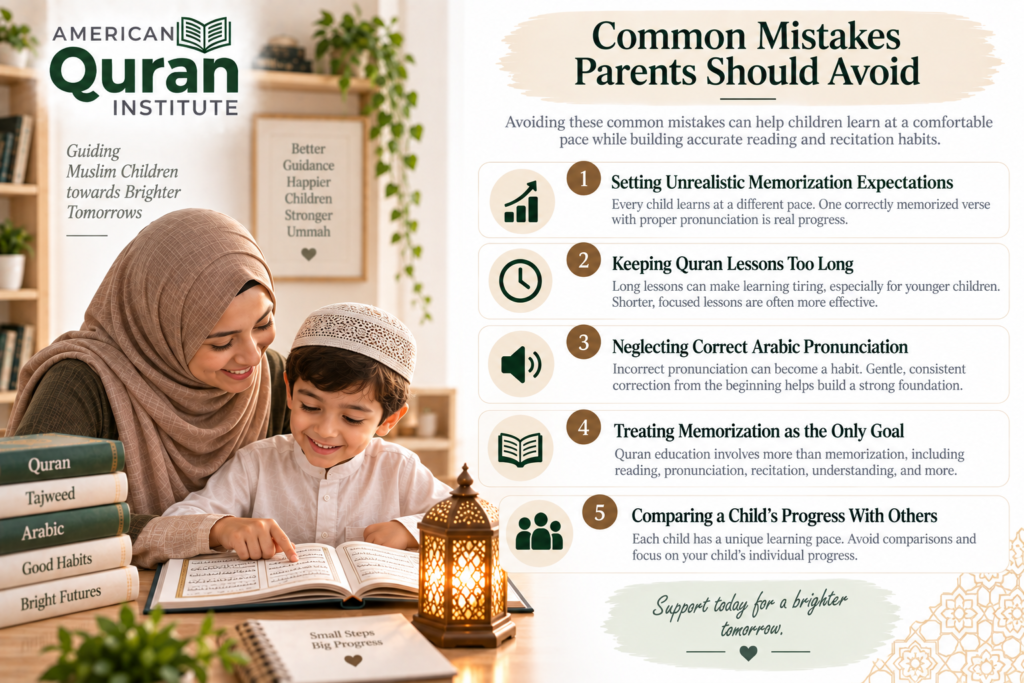
1. Setting Unrealistic Memorization Expectations
Every child learns at a different pace. A child who correctly memorizes one verse with proper pronunciation may be making better progress than a child who memorizes an entire page but struggles to recite it accurately.
2. Keeping Quran Lessons Too Long
Long lessons can make Quran learning feel tiring or frustrating, especially for younger children. If a child is consistently exhausted or losing focus by the end of a session, it may be better to shorten the lesson and focus on consistent, high-quality practice.
3. Neglecting Correct Arabic Pronunciation
Correct Arabic pronunciation should be developed from the beginning. When children repeatedly pronounce letters or words incorrectly without correction, these mistakes can become difficult habits to change later. Gentle, consistent correction helps children build a stronger foundation for Quran reading and recitation.
4. Treating Memorization as the Only Quran Learning Goal
Quran education involves more than memorizing verses. Children can gradually develop several skills, including Arabic reading, pronunciation, recitation, understanding, and memorization. A balanced approach allows children to build these skills together.
5. Comparing a Child’s Progress With Other Children
Siblings and other children may have very different learning speeds, attention spans, and strengths. Comparing them can create unnecessary pressure and reduce their enjoyment of learning. Parents should instead focus on each child’s individual progress and encourage steady improvement over time.
Why Arabic Matters When Learning Quran for Kids?
Quran learning and Arabic learning are related, but they are not exactly the same thing A child can learn Quranic reading without becoming fluent in conversational Arabic. However, Arabic education can give children additional tools for understanding the language they encounter in the Quran.
For example, learning Arabic can help children become familiar with:
- Arabic vocabulary
- Word patterns
- Pronunciation
- Sentence structures
- Common expressions
- Reading Arabic text
For families who want to build this foundation from an early age, combining Quran education with an age-appropriate Arabic program can create a more complete language-learning experience.
See Us in Action!
Take a look inside our virtual classrooms. Watch the clip below to see how our instructors engage with students, simplify complex rules, and create an inspiring environment for learning.
Start Your Quranic Education
Join our premier online institute for structured Quranic learning tailored for students in the USA.
Book Your Free TrialGive Your Child a Structured Quran Learning Path
For parents looking for a more consistent approach to Quran education, having a qualified teacher and a structured learning plan can make the process easier to maintain.
American Quran Institute offers online Quran classes for children, allowing families in the USA to support their children’s Quran learning from home without adding regular travel to their already busy schedules.
Children can learn according to their level and progress gradually through Quran reading, pronunciation, Tajweed, memorization, and other areas of Quran education. Online learning also gives parents the opportunity to choose a program that fits their child’s age, schedule, and learning needs.
Explore American Quran Institute and help your child build a consistent and meaningful Quran learning routine.
Our Quran Courses
- Online Quran Classes for Kids
- Quran Classes for Adults
- Quran Classes for Female/Sisters
- Learn Quran Course for Beginners
- Quran Qirat Learning Course
- Quran Tafsir Course
- Noorani Qaida Course
- Noorani Qaida Course for Kids
- Weekend Quran Classes
- Intensive Quran Course
- Al-Azhar Quran Course

Conclusion
Helping children learn the Quran in the USA does not require a complicated or intensive schedule. What matters most is creating a consistent learning routine that matches the child’s age, attention span, school commitments, and learning pace.
Short lessons, regular revision, correct Arabic pronunciation, and positive encouragement can gradually help children build stronger Quran reading and recitation skills.
Parents should also remember that Quran learning is a gradual journey. Children do not need to memorize large amounts quickly to make meaningful progress.
By combining reading, recitation, understanding, and gradual memorization in a supportive environment, families can help children develop a lasting and positive connection with the Quran.
FAQs About How to Learn Quran for Kids in the USA
What is the best age to start learning Quran for kids?
There is no single age that works for every child. Young children can begin with listening and familiarity, while formal Arabic reading and Quran instruction can be introduced when the child is ready to focus and learn letter sounds.
Can kids in the USA learn Quran online?
Yes. Online learning can be a practical option for families who want Quran education from home, particularly when local options are limited or when family schedules make commuting difficult.
Does my child need to speak Arabic to learn the Quran?
No. A child can learn to read and recite Quranic Arabic without being fluent in conversational Arabic. However, learning Arabic alongside Quran study can help children become more familiar with Arabic vocabulary and structures.
How long should a child’s Quran lesson be?
The appropriate lesson length depends on the child’s age and attention span. Younger children generally benefit from shorter, focused sessions rather than long lessons.
How can I help my child memorize Quran?
Use repetition, start with manageable passages, review previously memorized material, and keep the learning environment positive. Parents can also listen to the child’s recitation regularly and communicate with the teacher about progress.
Is online Quran learning suitable for children who do not speak Arabic?
Yes. Children from English-speaking families can learn Quranic reading and pronunciation through structured instruction. The Arabic Learning Centre also offers Arabic programs for learners who want to develop broader Arabic skills alongside their Quran studies.







Leave a Reply