 Quran
For Muslim families in the USA, helping children build a strong connection with the Quran can be challenging when school, homework, sports, family responsibilities, and limited access to local Quran teachers compete for their time.
Free online Quran classes and learning resources can make Quran education more accessible by allowing children to learn from home without the cost or travel involved in traditional lessons.
However, finding a free resource is only the first step. Parents also need to consider whether the lessons match their child’s age and reading level, provide accurate pronunciation guidance, follow a clear learning progression, and offer enough practice to build lasting skills.
In this guide, we explore what children can learn through free online Quran classes, how to choose suitable resources, how often children should practice, and when structured teacher-led instruction may become more beneficial.
1. American Quran Institute: Free Live Trial Quran Class for Kids
Apps and videos are a great start, but they can’t hear your child read. A free trial class with American Quran Institute gives your child a real one-on-one lesson with a teacher who is used to working with English-speaking kids.
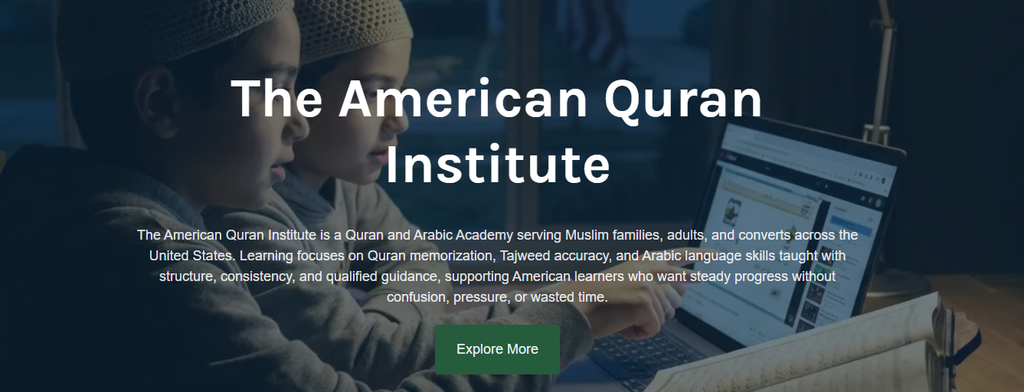
During the trial, you can expect the teacher to:
- Listen to your child read and assess their level, even if they’re just starting with the alphabet
- Correct pronunciation and Makharij gently, as mistakes happen
- Keep the lesson short, interactive, and suited to your child’s age
- Share a clear plan for what your child should learn next
You’re welcome to sit in on the lesson, and class times can be set around school, homework, and activities in your U.S. time zone.
2. Noorani Qaida – Learn Quran: Free Arabic Alphabet App for Kids
Before a child can read the Quran, they need the letters. This free app is built for Muslim kids meeting the Arabic alphabet for the first time, which makes it a good first step for children growing up in English-speaking homes.
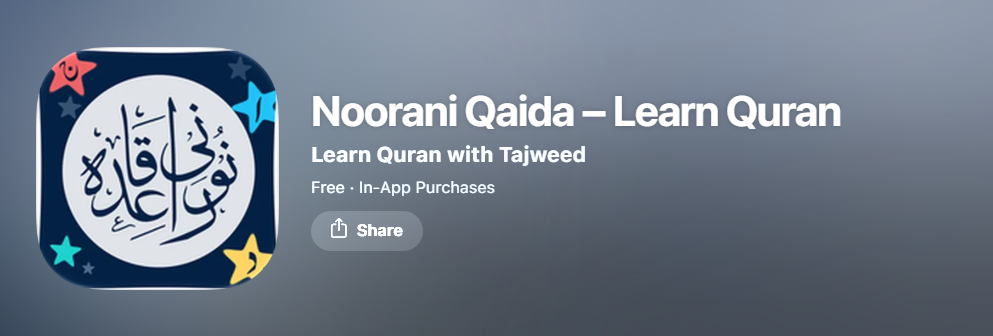
It follows the Noorani Qaida order from easy to hard. The first chapter introduces all the Arabic letters, the next brings in common Quranic words, and later chapters focus on phonics so your child hears how each letter and word should sound. There’s also an instruction section that guides kids toward the precise pronunciation of each letter.
Ten minutes after school is enough to work through a lesson, and it’s a natural companion to what your child’s teacher covers in class. Since the app can’t hear your child read, it works best alongside a teacher who can correct their pronunciation.
3. Kahf Kids: Free Quran Reader Inside a Kid-Safe App
Kahf Kids solves a problem every parent knows: your child opens a Quran app, and two minutes later they’re on YouTube. Its Quran reader sits inside a parental-control app, so Quran time stays separate from the rest of the device.
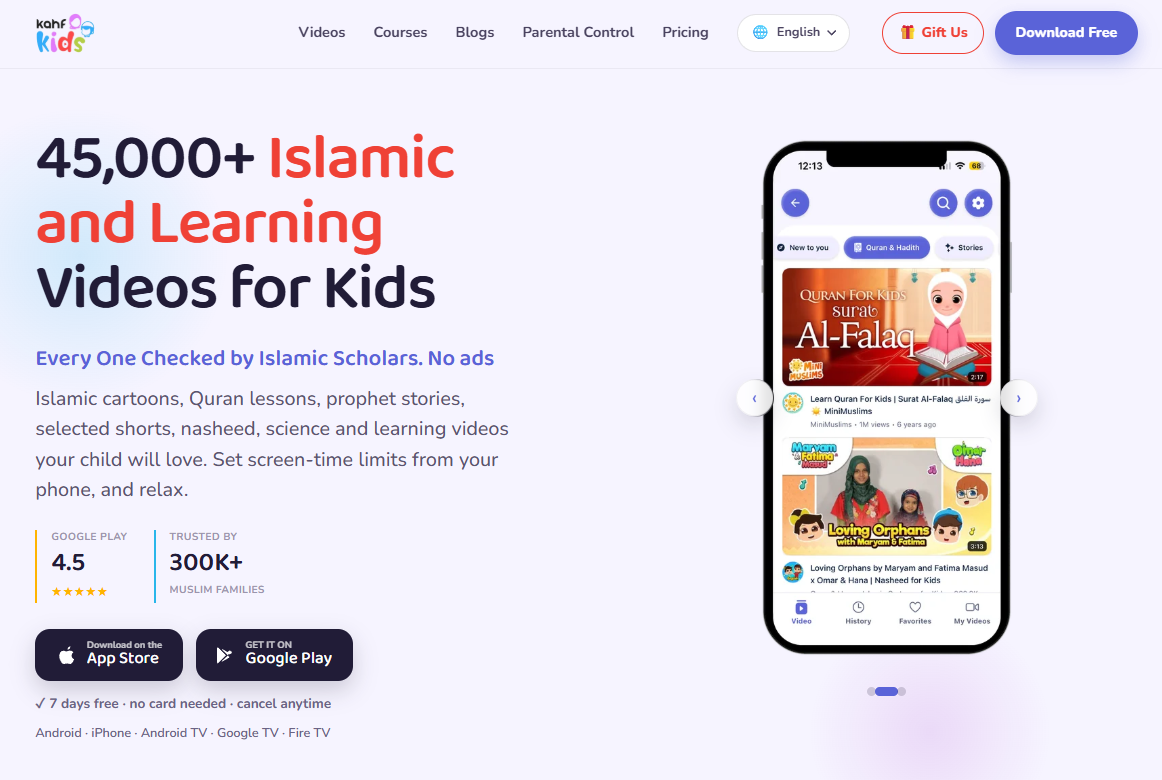
The Quran reader itself is free and includes:
- Color-coded Tajweed, with both Indo-Pak and Uthmani fonts so the page matches what your child sees at the mosque
- Adjustable verse repeat and loop for memorization
- Recitations from well-known reciters, with translations
- Navigation by Surah, Juz, or page, plus bookmarks to pick up where they left off
It doesn’t listen to and correct your child’s recitation, so it works best alongside a live teacher.
4. Memorize Quran Word by Word for Kids: Free Short-Surah App With English and Transliteration
Made by Osratouna, this free app is a good fit for kids in the USA who speak English at home. It focuses on the last Hizb of the Quran, the short Surahs most children memorize first, and lets your child choose between practicing verse by verse or word by word.
After each recitation there’s a short pause so your child can repeat what they heard. Every word comes with an English translation and transliteration, so they understand what they’re memorizing and can follow the pronunciation even before they read Arabic fluently. The word being recited lights up in red, which helps younger kids keep their place.
Your child can tap any verse or word to hear it again, and a repeat button makes it easy to stay on a tricky word until it sounds right. The iPhone version is free with optional in-app purchases, while the Android version is free with ads, so you may want to sit with younger children while they use it.
5. Juz’ Amma for Kids: Free App for Memorizing Short Surahs
Juz’ Amma is usually the first part of the Quran children memorize, and this app is built around exactly that.
Sheikh Muhammad Siddiq Al-Minshawi recites each verse, then a group of children repeats it, so your child hears both the correct recitation and how a young voice says it back. A few things make it handy for Hifz practice at home:
- Each verse can be repeated as many times as your child needs
- Simple navigation between verses and Surahs
- A short explanation of each verse
- Cartoon visuals that keep younger kids engaged
6. SurahKids: Learn What Juz’ Amma Means, Word by Word
Many kids in the USA can recite Surahs they don’t understand. SurahKids focuses on meaning, helping children connect the words they memorize with what those words actually say.
Children work through Juz’ Amma Surah by Surah, using word-by-word flashcards that show the Arabic, the transliteration, and a simple English meaning, with audio for every word. Short quizzes and a “next ayah” game help the meanings stick, and stars and daily streaks keep kids coming back.
The app has no ads and puts a parental gate in front of any purchase or outside link, so younger children can use it safely. It’s a newer app, so it’s a nice companion to the memorization apps above rather than a replacement for them.
Why Parents in the USA Look for Free Online Quran Classes for Kids?
Muslim families across the USA have different levels of access to Quran education. Some children live near mosques, Islamic centers, and weekend schools, while others have limited access to qualified Quran teachers in their local communities.

Even when local classes are available, busy American family schedules can make regular attendance difficult. Parents may need to balance school, work, homework, transportation, sports, and other activities. Online Quran classes allow children to learn from home without adding travel time to the family’s routine.
For families living far from Islamic centers, online learning can also provide access to teachers who specialize in Quran reading, Tajweed, Hifz, or teaching English-speaking children. Free online lessons and resources can be a practical way for parents to introduce Quran learning before choosing a more structured program.
Read also: Best Online Quran Learning Platforms in the USA – Top 10 Options for Students and Families
Are Free Online Quran Classes for Kids in the USA Really Available?
Yes. Children in the USA can find free Quran learning resources online, but parents should check what “free” actually includes. Some platforms offer free recorded lessons, Arabic alphabet resources, Tajweed explanations, worksheets, or Quran recitation materials, while others provide only a free trial lesson before enrollment in a paid program.
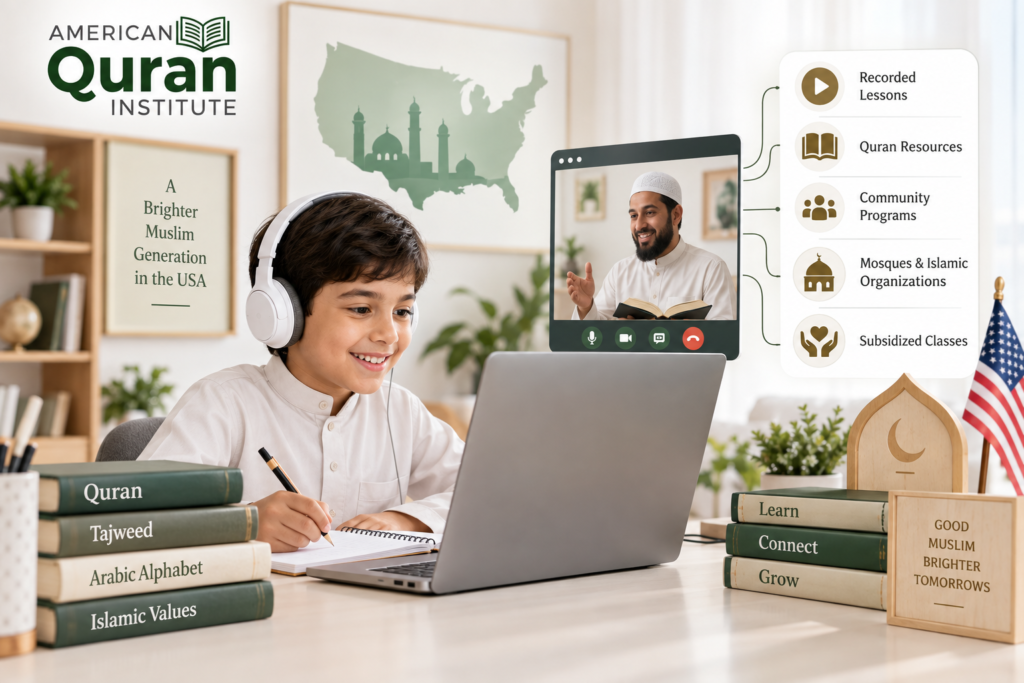
Mosques, Islamic organizations, community initiatives, and charitable programs may also offer free or subsidized Quran classes for eligible families. Availability can vary based on location, funding, age, teacher availability, and class capacity.
Before choosing a free option, parents should check:
- Whether the entire course is free or only a trial.
- Whether lessons are live or recorded.
- Whether classes are individual or group-based.
- Whether Tajweed and recitation correction are included.
- Whether there are eligibility or location requirements.
- Whether the schedule works with the family’s U.S. time zone.
- Whether parents can monitor their child’s lessons.
Checking these details helps families find a Quran learning option that fits their child’s needs, schedule, and learning level.
Read also: Dua Before Starting Quran Class – 7 Authentic Supplications From the Sunnah
What Can Kids Learn Through Free Online Quran Classes?
A good Quran program should match the child’s current reading level. Beginners may need to start with Arabic letters and sounds, while children who already read Arabic can focus on Tajweed, fluency, memorization, or pronunciation correction.
Arabic Letters and Quranic Reading Basics
Children who are new to Arabic need to recognize each letter, learn its sound, and understand how letters change when connected at the beginning, middle, or end of a word. For children growing up in the USA and primarily using English at school and home, gradual practice can make Arabic reading more familiar and comfortable.
For complete beginners, a structured Noorani Qaida course can provide a step-by-step foundation for learning Arabic letters, vowel signs, pronunciation, and basic Quran reading before moving to longer Quranic passages.

Start Your Quranic Education
Join our premier online institute for structured Quranic learning tailored for students in the USA.
Book Your Free TrialAccurate Arabic Pronunciation and Makharij
Learning a letter is not enough; children also need to pronounce it correctly. Makharij refers to the articulation points of Arabic letters, including sounds that may not have direct equivalents in English. A live teacher can listen to the child’s recitation, identify pronunciation problems, and provide immediate correction.
Harakat and Basic Quran Reading
After learning the letters, children can practice Fatha, Kasra, and Damma, followed by Sukoon, Shaddah, Tanween, long vowels, and connected words. Building these skills gradually helps children read Quranic words and phrases more accurately before moving to longer Surahs.
Tajweed and Quran Recitation
As children’s reading improves, they can gradually learn essential Tajweed rules, including:
- Makharij and letter characteristics
- Noon Sakinah and Tanween
- Meem Sakinah
- Ghunnah
- Qalqalah
- Madd
- Tafkheem and Tarqeeq
- Basic stopping and starting rules
For young learners, practical repetition is often more effective than lengthy theoretical explanations. Children can hear the correct recitation, imitate it, receive correction, and gradually apply Tajweed rules while reading the Quran.
Read also: Dua for Learning Quran – 7 Powerful Supplications for Memorization
Can Kids Memorize the Quran Through Free Online Classes?
Yes, children can use free online Quran resources to support memorization, especially through reliable recitation recordings and consistent review. However, effective Hifz requires more than repeatedly listening to a Surah.
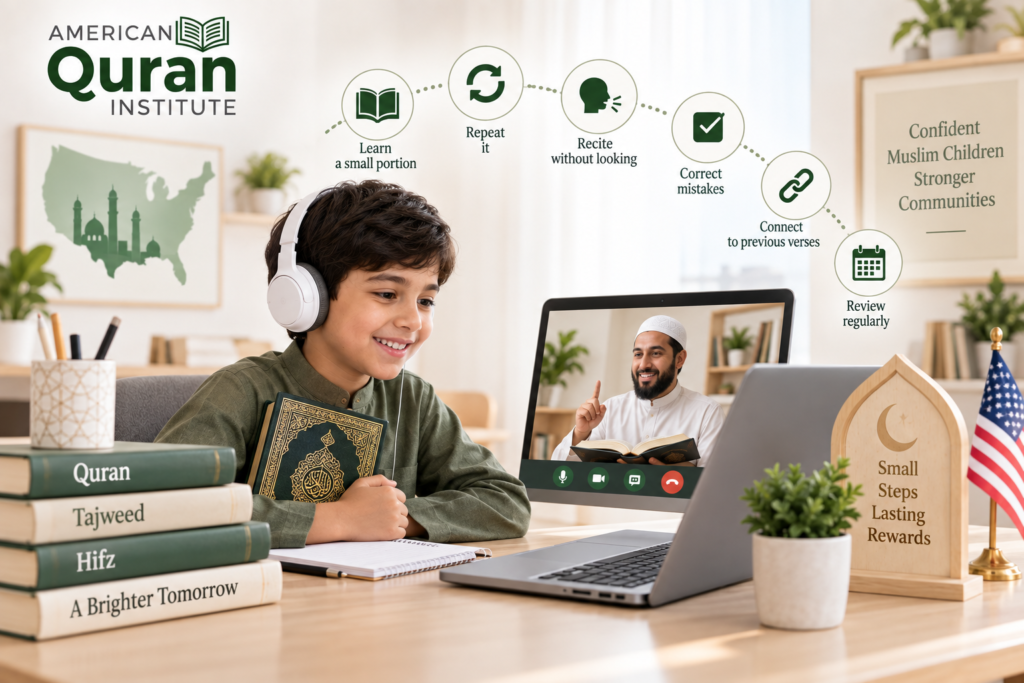
A simple routine can include learning a small portion, repeating it, reciting it without looking, correcting mistakes, connecting it to previous verses, and reviewing older portions regularly.
For children in the USA, keeping the daily amount realistic is especially useful during busy school weeks filled with homework, projects, sports, and other activities. Memorizing a small amount accurately and retaining it is more valuable than rushing through large sections.
When a live Quran teacher is available, regular correction can also help ensure that children memorize the verses with accurate pronunciation and recitation.
Read also: How Long Does It Take To Learn The Quran In The USA?
Benefits of Online Quran Learning for Children in the USA
Online Quran learning can offer practical benefits for children and parents in the USA, especially when lessons are organized around the family’s schedule and the child’s learning level.
Learn Quran From Home
Children can learn from a familiar home environment without regular travel to a mosque, madrasa, or Islamic center. This can save time for parents who are balancing work, school pickups, homework, sports, younger siblings, and other family responsibilities.
Access Teachers Beyond the Local Community
Online learning allows families to connect with Quran teachers beyond their immediate area. Parents may find teachers who specialize in Quran reading, Tajweed, Arabic, Hifz, or teaching children in English-speaking environments.
Flexible Scheduling Across U.S. Time Zones
Families should check the teacher’s or academy’s time zone before choosing a class. A schedule that works for a family in the Eastern Time Zone may not suit a child in the Central, Mountain, or Pacific Time Zone. A consistent class time that fits around school, homework, sports, dinner, and bedtime can help children build a regular Quran learning habit.
Parents Can Follow Their Child’s Progress
Online lessons also make it easier for parents to stay involved. They can understand what the child is learning, notice areas that need more practice, and help with short daily reviews. Parents do not need to teach the Quran themselves; maintaining a consistent routine and supporting the child’s practice can be enough to reinforce the teacher’s work.
Experience Our Classroom Environment
Don’t just take our word for it—experience a live session for yourself! Click on the videos below to watch real snippets from our classes and see our interactive teaching methods in real-time.
Start Your Quranic Education
Join our premier online institute for structured Quranic learning tailored for students in the USA.
Book Your Free TrialHow to Choose Free Online Quran Classes for Your Child?
Free does not always mean suitable. Parents should check the teacher, curriculum, lesson format, and safety measures before making a program part of their child’s regular Quran learning routine.
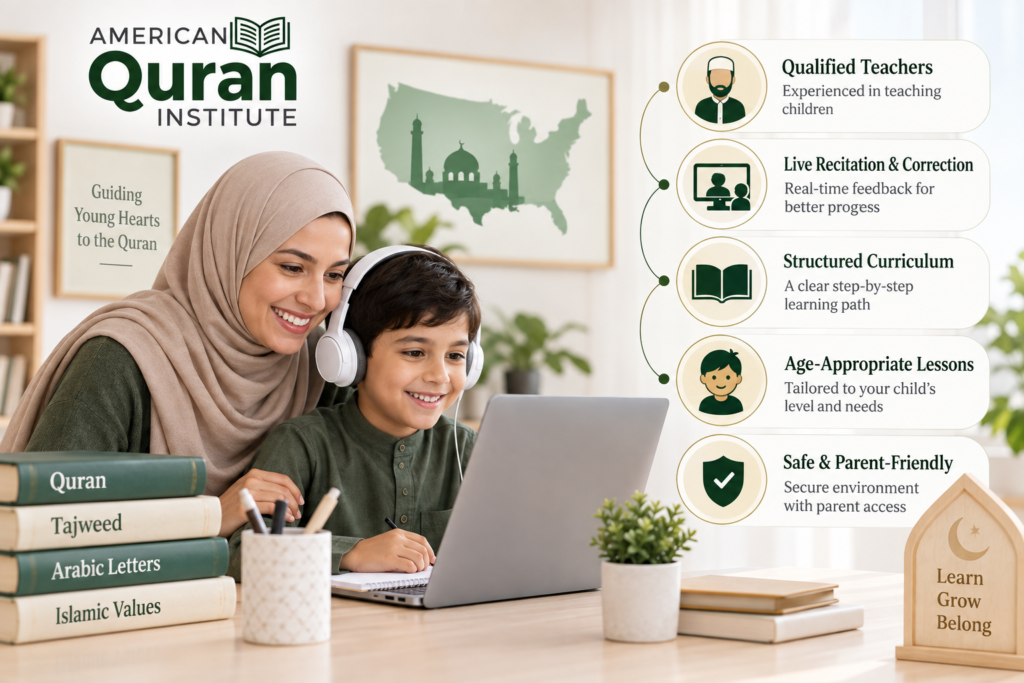
- Choose Qualified Teachers With Experience Teaching Children: Look for teachers with both Quranic qualifications and experience working with young learners. Teaching children requires patience, clear explanations, suitable pacing, and the ability to keep lessons engaging, especially for English-speaking children.
- Prioritize Live Quran Recitation and Correction: Children learning Quran reading or Tajweed need to recite aloud and receive direct feedback. Live correction helps teachers identify pronunciation and reading mistakes before they become repeated habits.
- Follow a Clear Quran Learning Progression: A structured program should move gradually from Arabic letters → sounds and Makharij → Harakat → joined letters → words → short Quranic passages → basic Tajweed → fluent recitation. This gives children a clear learning path and helps parents understand their progress.
- Match the Lesson to the Child’s Age and Level: Younger children usually benefit from shorter lessons, repetition, visual activities, and simple goals. Older children may be ready for longer recitation practice, more detailed Tajweed, and memorization targets. The lesson should match the child’s ability rather than follow one format for every age.
- Check Child Safety and Parent Access: Parents should know how lessons are conducted, how teachers communicate with children, whether parents can observe sessions, and whether classes are recorded. It is also important to understand the video platform being used and any child-safeguarding measures provided.
Parents who want to make Quran memorization a family learning goal can also explore structured memorization programs for adults, such as Quran memorization classes for adults, while helping their children develop their own age-appropriate memorization routine.

How Many Quran Classes Should a Child Take Each Week?
Consistency is usually more helpful than occasional intensive study. The ideal frequency depends on the child’s age, learning level, and goal.
Beginners may benefit from frequent short sessions to practice Arabic letters and reading. Children learning Tajweed need regular recitation and correction, while Hifz students need consistent memorization and revision to support retention.
For families in the USA, Quran practice can be fitted around school, homework, sports, and weekend activities. Shorter sessions may work well after school, while longer revision can be scheduled on weekends.
Parents can also reinforce lessons at home with 10–15 minutes of focused daily practice between formal classes.
How Parents Can Help Kids Stay Interested in Online Quran Classes?
Children are more likely to stay consistent when Quran learning feels manageable rather than stressful. Parents can support this by creating a quiet learning space, reducing distractions, keeping practice sessions short, and praising genuine progress.
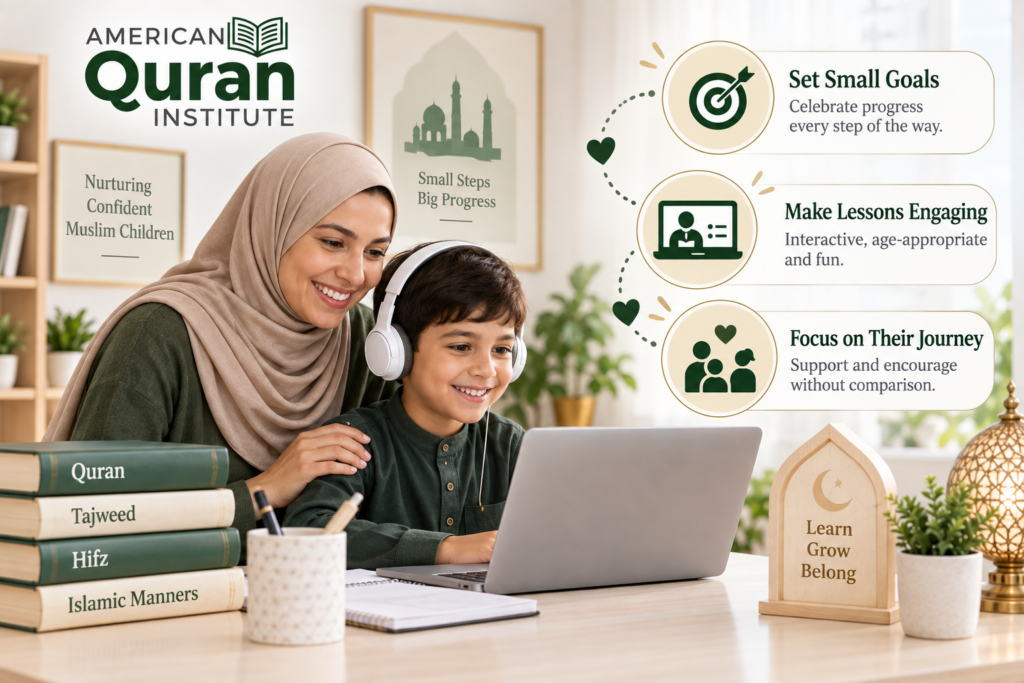
- Set Small and Achievable Quran Learning Goals: Clear goals help children see their progress. A beginner might focus on recognizing five letters, reading one line independently, correcting a difficult sound, or memorizing one short verse accurately.
- Keep Online Lessons Interactive and Age-Appropriate:Teachers can maintain children’s attention through repetition, visual materials, interactive activities, quizzes, storytelling, and small rewards when appropriate. Activities should match the child’s age and learning level.
- Support Progress Without Comparing Children: Every child develops reading, pronunciation, memory, and confidence at a different pace. Parents should focus on the child’s individual improvement rather than comparing their Quran progress with siblings or other children.
When Should You Consider Structured Quran Classes?
Free resources can be very helpful, especially during the early exploration stage or as supplementary practice.
However, structured teacher-led lessons become particularly valuable when your child:
- Repeatedly struggles with Arabic pronunciation.
- Cannot identify their own recitation mistakes.
- Needs individualized Tajweed correction.
- Is beginning a serious Hifz program.
- Lacks consistency with self-study.
- Has reached a plateau despite regular practice.
- Needs a curriculum appropriate to their current level.
Parents can also use a free trial, when available, to evaluate a teacher before committing to regular lessons.
During the trial, pay attention to how much the child actually participates, whether the teacher corrects mistakes clearly, how comfortable the child feels, whether instructions are easy for the child to understand, and whether the lesson has an obvious structure.
For U.S. families, it is also worth confirming that regular lesson times remain practical during the school year and are clearly stated in the correct time zone.
Parents may also look for teachers with recognized Islamic educational backgrounds. For example, programs that include Al-Azhar Quran education can be relevant for families who want their children to learn Quran with guidance connected to a well-established Islamic educational tradition.

See Us in Action!
Take a look inside our virtual classrooms. Watch the clip below to see how our instructors engage with students, simplify complex rules, and create an inspiring environment for learning.
Start Your Quranic Education
Join our premier online institute for structured Quranic learning tailored for students in the USA.
Book Your Free TrialGive Your Child the Guidance to Build Strong Quran Skills
Free Quran resources can help children get started, but regular teacher-led instruction can make a significant difference when a child needs pronunciation correction, Tajweed guidance, or a clear learning path. A structured class also gives parents a better way to follow their child’s progress while keeping Quran learning consistent alongside school and other activities.
American Quran Institute provides online Quran learning for students and families who want guided instruction from home. For parents in the USA, this can be a practical next step when free resources are no longer enough and a child needs regular lessons, teacher feedback, and a structured approach to Quran reading and recitation.
Explore American Quran Institute and help your child take the next step in their Quran learning journey.
Our Quran Courses
- Quran Qirat Learning Course
- Quran Tafsir Course
- Noorani Qaida Course
- Noorani Qaida Course for Kids
- Weekend Quran Classes
- Intensive Quran Course
- Al-Azhar Quran Course

Conclusion
Free online Quran classes can be a valuable starting point for children, especially for families in the USA looking for flexible and accessible ways to introduce Quran learning at home. Children can use free resources to practice Arabic letters, Quran reading, Tajweed, recitation, and memorization while building a regular learning routine around school and family life.
However, successful Quran learning depends on more than having access to free lessons. Children need age-appropriate instruction, accurate pronunciation, regular practice, clear progress, and encouragement along the way.
Parents can begin with free resources and gradually move toward structured teacher-led classes when their child needs more personalized correction, consistent guidance, or a clear learning path.
The goal is not simply to complete lessons, but to help children develop accurate Quran reading skills and a lasting relationship with the Quran. With the right balance of quality resources, regular practice, and parental support, online Quran learning can become a meaningful part of a child’s daily routine.
Frequently Asked Questions About Free Online Quran Classes for Kids in the USA
Are There Really Free Online Quran Classes for Kids in the USA?
Yes. Families can find free Quran resources, sponsored programs, community initiatives, and academies offering free trial lessons. However, parents should verify whether a program is completely free or whether only introductory lessons are offered without charge.
What Can My Child Learn in Free Online Quran Classes?
Depending on the program and the child’s level, lessons may cover Arabic letters, Harakat, basic reading, Quran recitation, Tajweed, Makharij, short Surahs, memorization, and Islamic etiquette.
Are Free Quran Classes Suitable for Complete Beginners?
Yes, provided the program starts with appropriate foundations A complete beginner should generally learn Arabic letters, sounds, vowels, and joined forms before being expected to read complete Quranic passages independently.
Can My Child Learn Tajweed Online for Free?
Free videos and educational materials can introduce Tajweed rules and provide useful demonstrations.
However, applying Tajweed accurately often requires live feedback because a recording cannot hear and correct your child’s individual pronunciation.
Are Online Quran Classes Effective for Children?
They can be effective when lessons are age-appropriate, interactive, consistent, and supported by regular practice.
Live correction is especially useful for Quran recitation because the teacher can identify pronunciation mistakes as they happen.
How Long Should a Quran Class Be for a Child?
Young children generally benefit from shorter, focused sessions, while older children can often manage longer lessons.
The appropriate length depends on age, attention span, learning level, and whether the lesson involves reading, Tajweed, memorization, or several activities.






Leave a Reply