 Quran
Quran
You’ve been praying for years, reciting Al-Fatiha from memory without being entirely sure your pronunciation is correct. Or you’ve just taken your Shahada and can’t read a single letter of Arabic yet. Or you grew up in a Muslim household in the USA where the Quran was respected deeply but never formally taught. Each situation is more common than you think — and each has the same solution.
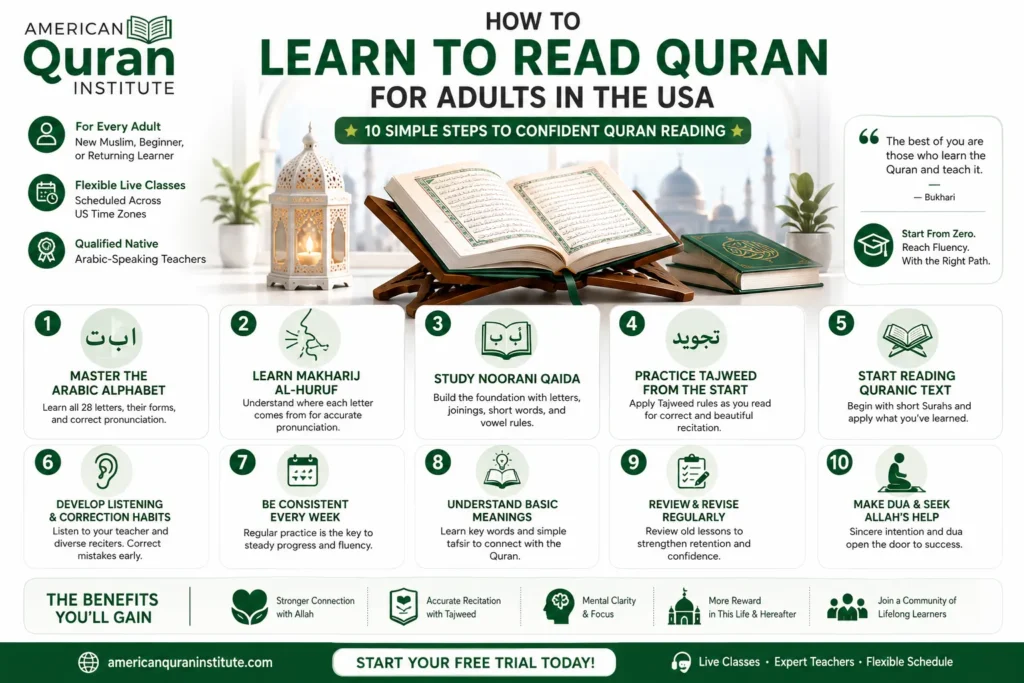
How to learn to read Quran for adults in the USA is not a distant goal reserved for scholars or children who started early. It’s a learnable skill with a clear sequence, increasingly accessible through live online instruction scheduled around US time zones. Adults who follow the right steps and stay consistent typically reach basic Quranic reading fluency within three to five months.
This guide covers every step of that process. Whether you are a lifelong Muslim returning to a practice you never fully developed, a new convert starting from scratch, or someone exploring this tradition for the first time, these ten steps reflect the methodology that qualified Quran teachers use with English-speaking adult learners across America.
For those approaching the Quran from outside the Islamic tradition, how to read the Quran as a non-Muslim offers helpful context before diving into the mechanics below.
Start Your Free Trial Now in Quran Classes for Adults in the USA at American Quran Institute
1. Learning Quran Reading In The USA Starts From Letting Them Master The Arabic Alphabet First
Learning to read Quran for adults, building a strong foundation in Arabic is the essential first step. Mastering letter recognition and correct pronunciation makes it much easier to progress to reading words, applying Tajweed, and eventually reciting Quranic verses with confidence.
A. Build Automatic Recognition Of All 28 Arabic Letters
Arabic has 28 letters, each appearing in up to four different forms depending on its position in a word. Before touching a Quranic verse, you need to recognize every letter instantly in all its forms — the same automatic recognition you have for English letters when reading this sentence. A learner who hesitates at letters cannot apply Tajweed rules at the same time; they are too busy decoding.
Letter recognition to automaticity typically takes two to four weeks of daily practice with a teacher. Sessions at this stage are short and focused: learn the letter, learn its multiple forms, produce the sound correctly, and move to the next.
B. Understanding Makharij Al-Huruf; Where Letters Come From
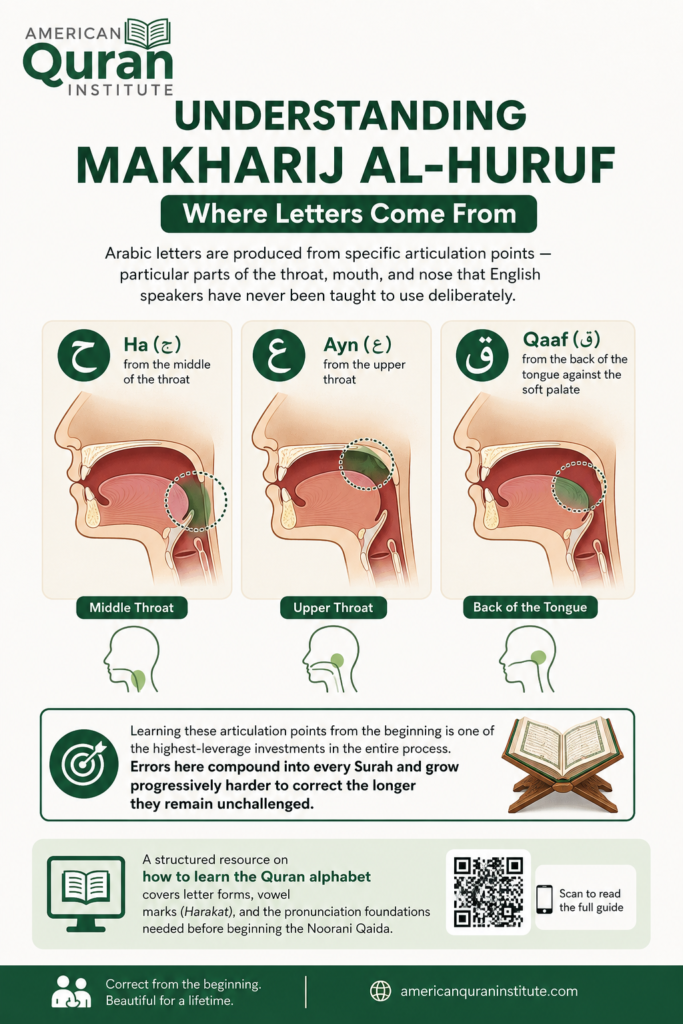
Arabic letters are produced from specific articulation points — particular parts of the throat, mouth, and nose that English speakers have never been taught to use deliberately. The ح (Ha) comes from the middle of the throat; the ع (Ayn) from the upper throat; the ق (Qaaf) from the back of the tongue against the soft palate.
Learning these articulation points from the beginning is one of the highest-leverage investments in the entire process. Errors here compound into every Surah and grow progressively harder to correct the longer they remain unchallenged.
A structured resource on how to learn the Quran alphabet covers letter forms, vowel marks (Harakat), and the pronunciation foundations needed before beginning the Noorani Qaida.
2. Work Through The Noorani Qaida To Build The Foundation
The Noorani Qaida is the structured primer used by Quran teachers worldwide for one simple reason: it works. It progresses from isolated letters to joined combinations, to short words, to Quranic-style text — all before the student encounters an actual verse. Think of it as a flight simulator: you practice the precise movements in a controlled environment before flying the real aircraft.
For adults in the USA studying three sessions per week, the Noorani Qaida typically takes four to eight weeks to complete. Do not rush this phase. Finishing it correctly — every letter combination read without hesitation, every vowel mark applied cleanly — is worth far more than racing into Surahs on an unstable foundation.
How to read the Quran in Arabic easy covers the practical mechanics of Arabic reading that the Noorani Qaida teaches — a useful overview of what you are working toward and why the sequence of each stage matters.
Master Arabic Reading Foundations Through Noorani Qaida in the USA

3. Don’t Put The Cart Before The Horse, Begin Tajweed Right Away
A persistent misconception among adult learners is that Tajweed is advanced material for experienced reciters. It is not. Tajweed governs every word in the Quran from Al-Fatiha onward. The practical approach is to introduce rules as they naturally appear in what you are reading, so each rule is immediately grounded in real Quranic text rather than memorized in abstract isolation.
Beginning Tajweed alongside your reading — not after it — changes the entire trajectory of your progress. Rules anchored to real text are retained far better than rules studied separately, and errors caught early never become ingrained habits.
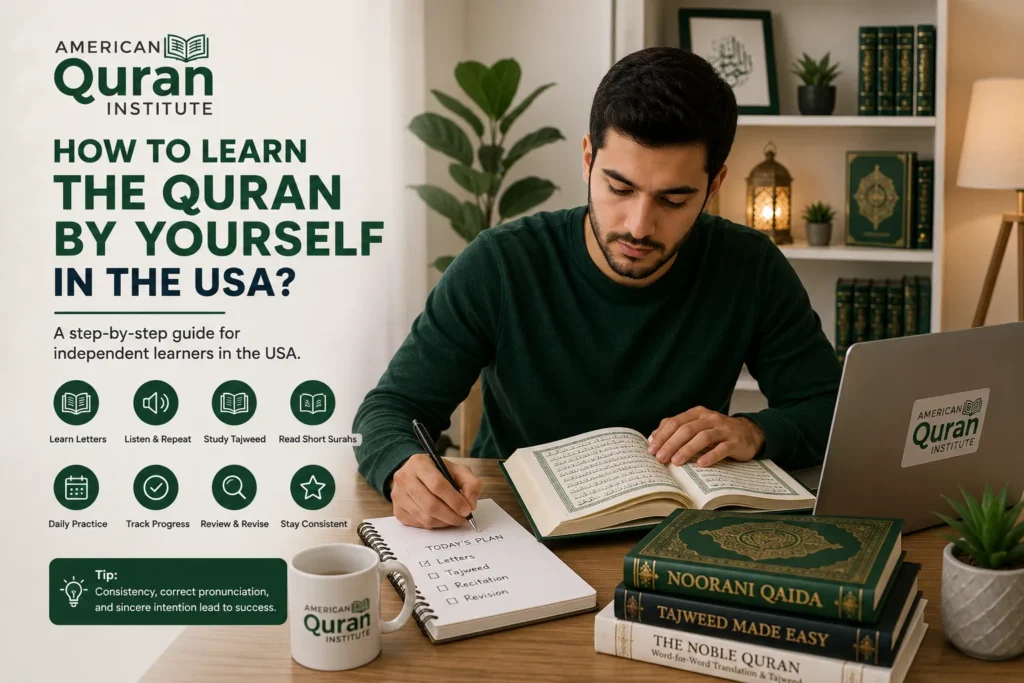
Read also: How To Learn To Read Quran By Yourself In The USA?
See Us in Action!
Take a look inside our virtual classrooms. Watch the clip below to see how our instructors engage with students, simplify complex rules, and create an inspiring environment for learning.
Start Your Quranic Education
Join our premier online institute for structured Quranic learning tailored for students in the USA.
Book Your Free TrialA. The Core Tajweed Rules Is Necessary To Every Beginner
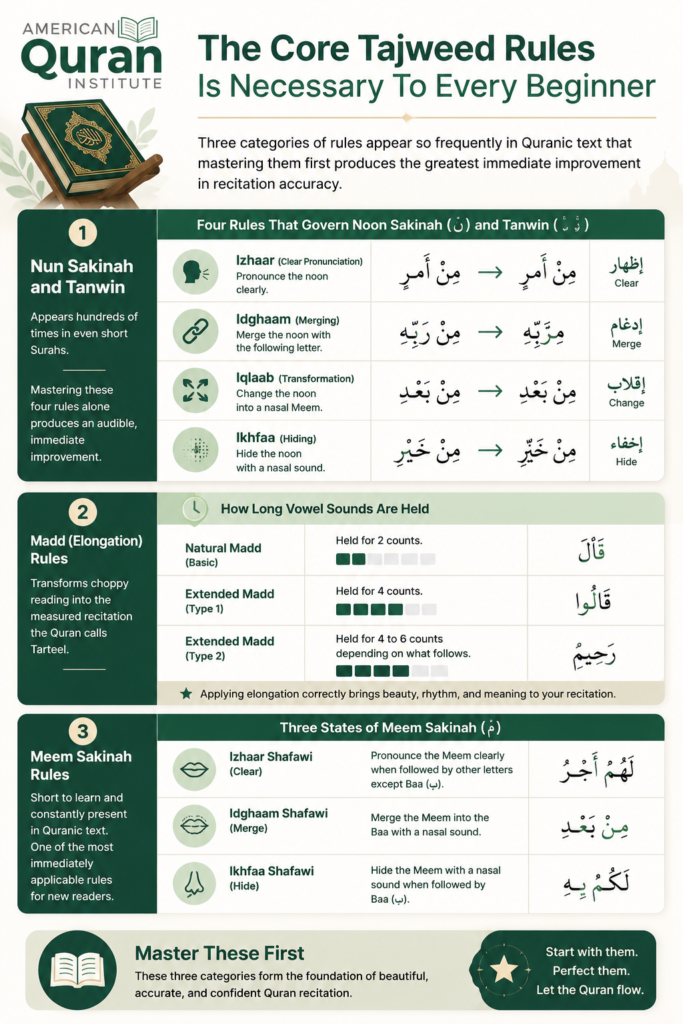
Three categories of rules appear so frequently in Quranic text that mastering them first produces the greatest immediate improvement in recitation accuracy.
Nun Sakinah and Tanwin — covering Izhaar (clear pronunciation), Idghaam (merging with the following letter), Iqlaab (transformation to a nasal M), and Ikhfaa (partial hiding with resonance) — appear hundreds of times in even short Surahs. Mastering these four rules alone produces an audible, immediate improvement.
Madd (elongation) rules govern how long vowel sounds are held. The natural Madd is two counts; extended types reach four to six depending on what follows. Applying elongation correctly transforms choppy letter-by-letter reading into the measured recitation the Quran calls Tarteel.
Meem Sakinah covers the three states of a silent M depending on the following letter. Short to learn and constantly present in Quranic text, it is one of the most immediately applicable rules for new readers.
B. Why Correct Pronunciation Is Not Just A Stylistic Choice?
A letter produced from the wrong articulation point can change a word’s meaning. The Arabic script is precise in a way that English orthography is not — the difference between ق and ك, or between ع and أ, is not an accent variation.
These are different sounds producing different words. Classical scholars categorized the practical application of Tajweed as individually obligatory on every Muslim who recites, precisely because accuracy protects the meaning of what is being said in prayer and recitation.
Enroll With Expert Female Tajweed Instructors With A FREE Trial

4. Find A Qualified Teacher You Can Count On
No app, no recording, and no video tutorial can do what a qualified teacher does in real time: hear your pronunciation and correct it before the wrong pattern sets in. The Islamic tradition’s insistence on voice-to-voice Quran transmission is not ceremonial — it is the mechanism by which accuracy moves from one generation to the next.
American Quran Institute, based in the USA, connects American Muslims — children, adults, ladies, and new Muslims — with Ijazah-certified teachers who specialize in guiding English speakers from the Arabic alphabet through fluent recitation. All classes are live and online, scheduled around US time zones so there’s no need to compromise your work, school, or family commitments.
An Ijazah is not a certificate from a weekend course. It is an authorization granted through an unbroken teacher-to-student chain reaching back to the Prophet ﷺ. A teacher with Ijazah has been examined on their recitation and found accurate — that standard is what they pass on to you.
For learners who want to maximize practice time between sessions, how to learn the Quran by yourself outlines self-study strategies that complement — rather than replace — live teacher instruction.
5. Choose An Online Program That Fits The American Schedule
The biggest barrier to Quran study for adults in the USA is not motivation or resources — it is time. Full-time work, commuting, family obligations, and the general pace of American daily life leave little room for fixed weekly commitments at a physical location. Live online instruction removes exactly this friction.
Flexible scheduling means a session at 6am before work is as accessible as one at 9pm after the kids are in bed. If your work involves travel, your classes travel with you. If your week gets disrupted, sessions can be rescheduled rather than simply missed.
Adults seeking a comprehensive picture of their options will find how to learn the Quran in the USA a useful guide — covering programs, platforms, and what to look for in a quality online learning environment designed for American Muslim adults.
Start Weekend Quran Classes and Build Lifelong Quranic Skills

6. Read Short Surahs Every Day
Once the Noorani Qaida is complete and Tajweed instruction has begun, start reading short Surahs from Juz Amma (the 30th section of the Quran) every day. Do not wait until you feel fully prepared — fluency comes from reading, not from preparing to read.
Most adults already know several of these Surahs from prayer; reading them from the Mushaf rather than reciting from memory trains the eye to follow Arabic connected script, reinforces letter recognition, and applies Tajweed rules to real Quranic text immediately.
Fifteen to twenty consistent minutes daily accomplishes more over three months than an hour-long session once a week. At this stage, regularity is the variable that decides everything.
For strategies to keep your practice sessions active and engaged rather than mechanical, how to make reading Quran more interesting offers practical techniques that work specifically for adult learners in a self-directed reading context.
Start Your Quran Reading Classes with a native-trained instructors at American Quran Institute

7. Use A Tajweed Mushaf To Self-Correct Between Sessions
A color-coded Tajweed Mushaf marks every Tajweed rule visually — elongation in one color, Ikhfaa in another, Ghunnah in another. This visual system allows independent practice between teacher sessions without needing to hold every rule in simultaneous mental recall.
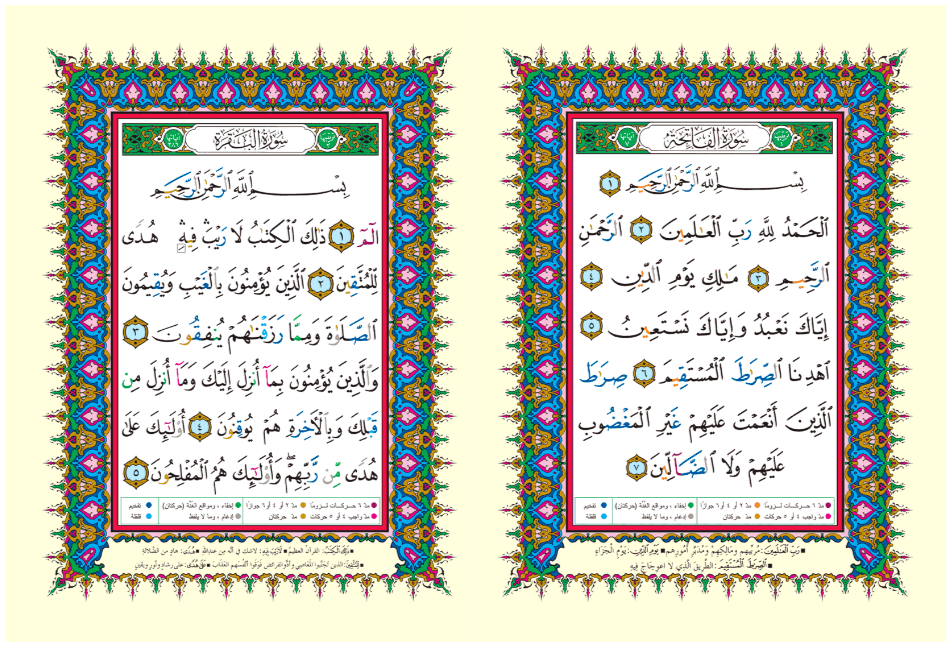
For adults who meet their teacher two or three times per week, the Tajweed Mushaf is the most practical bridge tool available. Every independent reading session becomes a live application exercise, and you arrive at each teacher session having already practiced the relevant rules actively rather than hearing them for the first time.
The broader benefits of reciting Quran,improved focus, spiritual clarity, and a deepening connection to the text, make this daily practice worth the initial discipline. Adult learners who establish a consistent reading habit consistently report tangible effects within the first few months of regular recitation.
8. Record Your Recitation And Listen Back Honestly
Record yourself reading three to five verses, then listen back. This step is skipped by most learners and is among the highest-leverage habits you can build. The gap between how you think you sound and how you actually sound is where most pronunciation errors live — and most people are genuinely surprised the first time they hear themselves.
Listening to your own recording reveals whether your elongation is consistent, whether your Ghunnah is too clipped, and whether you are rushing past the measured pace of Tarteel. Share the recording with your teacher and ask for specific, targeted feedback. This turns independent practice into evaluable data and accelerates progress in a way that unreviewed practice cannot.
Once accuracy is solid and you want to build speed without sacrificing precision, how to read the Quran faster covers the pacing techniques that help fluent readers move efficiently while keeping correct Tajweed intact.
Master Quran Recitation Through The American Quran Institute’s USA-Based Classes

9. Build A Daily Quran Reading Habit
Life in the USA is structured in a way that makes inconsistent practice easy and consistent practice requires deliberate design. The solution is habit architecture: anchoring Quran reading to an existing part of your daily routine rather than carving out entirely new time. The strongest anchor points tend to be immediately after Fajr, during a lunch break, or right after Isha.
A dedicated guide on how to start reading the Quran daily walks through habit design in detail, helping you identify the right anchor point and build protection around it for when life gets demanding.
Every adult learner hits periods where progress feels invisible and the habit starts to slip. The most effective reset is not adding more pressure — it is reconnecting with the reasons you began.
Powerful motivations to read Quran covers the spiritual, cognitive, and communal reasons adult learners across the USA return to their Quran education. Returning to these motivations during difficult stretches consistently restores the forward momentum that sustained practice requires.
10. Set Specific Goals And Measure Your Progress Along The Way
“I want to read the Quran better” is a wish. “I want to read Surah Al-Baqarah with correct Tajweed by the end of six months, working through five verses per teacher session three times per week” is a goal you can plan backward from, track weekly, and adjust when life intervenes.
Ask your teacher for explicit benchmarks: what does completing this level look like, where are the most common errors at this stage, and what comes next? Adult learners who track which Surahs they can read fluently, which rules they have applied correctly, and where errors still cluster make measurably faster progress than those who track nothing.
The progress itself becomes its own motivation and that compounding momentum is what separates learners who reach fluency from those who plateau.
American Quran Institute offers free trial classes for adults beginning this journey. Live instruction, Ijazah-certified teachers, English-language delivery, and US time zone scheduling — designed for exactly the life you are living.
Explore The American Quran Institute’s Al-Azhar Quran Course in the USA

Experience Our Classroom Environment
Don’t just take our word for it—experience a live session for yourself! Click on the videos below to watch real snippets from our classes and see our interactive teaching methods in real-time.
Start Your Quranic Education
Join our premier online institute for structured Quranic learning tailored for students in the USA.
Book Your Free TrialStart Your Quran Journey Now Is The Right Time
Learning to read the Quran as an adult in the USA is achievable on the schedule you already have. The ten steps in this guide are not a shortcut — they are the method. Following them in sequence, with a qualified teacher and consistent daily practice, is what produces the result.
American Quran Institute specializes in working with English-speaking American adults, and their families, through every stage of this journey. Live online classes. Ijazah-certified instruction. Flexible US-timezone scheduling. Teaching built specifically for adults who are starting fresh and want to get it right from day one.
Check Out Our Top Courses for Quran Learning:
- Quran Classes in USA
- Online Quran Classes for Kids in the USA
- Quran Classes for Females in the USA
- Quran Ijazah Program in the USA
- Quran Memorization Course in the USA
- Tajweed Course for Kids in the USA
Book your free trial class today and find out what consistent, expert-guided Quran learning actually feels like.

Start Your Quranic Education
Join our premier online institute for structured Quranic learning tailored for students in the USA.
Book Your Free TrialConclusion
The ten steps in this guide map the exact journey from the Arabic alphabet to fluent Quranic recitation for adult learners in the USA. They are not a collection of tips — they are a sequence. Adults who follow this sequence, stay consistent, and invest in qualified teacher-led instruction reach their reading goals.
Begin with the alphabet and make letter recognition automatic. Move through the Noorani Qaida without rushing. Start Tajweed from lesson one. Find a teacher with Ijazah who delivers instruction in English and schedules around your life. Read Juz Amma daily.
Use a Tajweed Mushaf between sessions to self-correct between teacher meetings. Record yourself reading and listen back critically — your ear will catch errors your eyes miss. Build the habit into an existing daily routine so it holds under real American schedules. Set measurable goals — one surah per month, one Tajweed rule per week — and track them.
Learning how to read the Quran for adults in the USA is not fast, but it is entirely achievable. Adults who commit to this sequence reach clean, confident recitation. The difference is not talent — it is structure.
Frequently Asked Questions
How long does it take an adult to learn to read the Quran in the USA?
Most adults with no prior Arabic background reach basic reading fluency in six to twelve months with consistent daily practice and a qualified teacher. Full Tajweed-accurate recitation typically takes one to two years. Speed depends on session frequency, daily practice time, and whether instruction begins with proper letter pronunciation from the start.
Do I need to understand Arabic to learn to read the Quran?
No. Reading the Quran and understanding Arabic are two separate skills. Reading is about recognizing letters, applying vowel marks, and reciting with correct Tajweed rules. Comprehension requires grammar and vocabulary study. Most adult beginners in the USA learn to read correctly before studying meaning, and many never pursue full Arabic comprehension — correct recitation is a complete, independent goal.
Is it too late to start learning the Quran as an adult?
It is not too late. Adults learn differently than children — they bring stronger focus, clearer motivation, and better self-discipline — but they typically need more repetition to build automatic letter recognition. The Noorani Qaida method was designed to work for adult beginners, and online instruction has removed the scheduling barriers that previously made adult Quran learning difficult in the USA.
What is the difference between a Tajweed teacher and a regular Quran teacher?
A Tajweed teacher has studied the rules of Quranic recitation systematically and can correct pronunciation at the level of individual sounds. A regular Quran teacher may guide you through reading but lack the precision to fix deeply embedded errors. For adult learners starting from zero, the distinction matters: errors learned early calcify quickly, and a Tajweed-trained teacher prevents the rework that slows progress later.
Can I learn to read the Quran entirely online if I live in the USA?
Yes. Online Quran instruction is fully functional for adult learners. Live one-on-one sessions over video allow a teacher to hear your recitation in real time, correct errors immediately, and track progress across lessons — the same instructional model as in-person study.





Leave a Reply