 Quran

Yes, a woman can continue learning about the Quran during menstruation. She can listen to Quran recitation, study Tafsir and Tajweed, review meanings and translations, attend Quran lessons, and continue many parts of her Islamic education.
The question becomes more detailed when learning involves verbally reciting Quran or touching a physical Mushaf. Muslim jurists have differed over recitation during menstruation.
The Hanafi and Shafi‘i schools, along with the relied-upon Hanbali position, generally restrict Quran recitation with the intention of tilawah until menstruation ends. The Maliki school permits a menstruating woman to recite, with important details concerning the end of her menstrual period.
Because of this scholarly difference, a woman does not have to completely disconnect from Quran learning during her period. She can continue studying in ways that agree with the scholarly position she follows and, when necessary, ask a trusted scholar about her individual situation.
Can I Learn Quran While on My Period?
Yes. If you are asking, “Can I learn Quran while on my period?”, menstruation does not mean that all Quranic education must stop.

There are many parts of Quran learning that do not require directly touching a printed Mushaf or, according to the more cautious scholarly opinion, verbally reciting Quran.
A student can continue listening to her teacher, studying Tajweed principles, learning the meaning of verses, reading Tafsir, reviewing vocabulary, and strengthening her understanding of Quranic themes.
This distinction is especially useful for women who attend regular Quran classes. Instead of abandoning a course for several days every month, the lesson can temporarily focus more heavily on listening, comprehension, theory, correction, and review.
For example, studying the meaning and context of revelation can continue through a structured Quran Tafsir Course, even on days when a student chooses not to verbally recite according to the scholarly opinion she follows.
Read also: 10 Best Times To Learn Quran For Better Focus And Progress

Why Is There a Difference of Opinion About Reciting Quran During Menstruation?
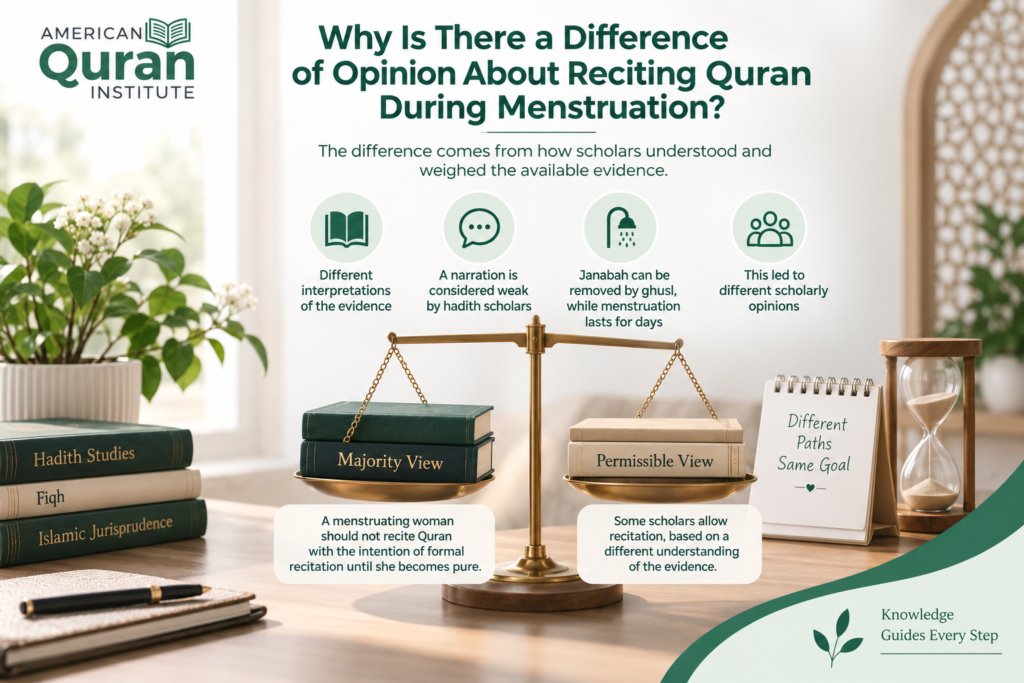
The difference arises because scholars evaluated the available evidence in different ways. The majority of jurists traditionally held that a menstruating woman should not recite Quran with the intention of formal Quranic recitation until she becomes pure. They compared menstruation in certain respects to janabah, or major ritual impurity.
One narration commonly discussed in this subject states:
لَا تَقْرَإِ الْحَائِضُ وَلَا الْجُنُبُ شَيْئًا مِنَ الْقُرْآنِ
“The menstruating woman and the person in a state of Janabah should not recite anything from the Quran.”
However, hadith scholars have regarded this particular narration as weak. This weakness is one reason why other jurists did not consider it sufficient to establish a general prohibition.
Scholars who permit recitation also point out an important difference between menstruation and janabah: a person in janabah can perform ghusl and remove the state immediately, while menstruation lasts for a number of days and cannot simply be ended by the woman herself.
As a result, Islamic scholarship contains more than one recognized opinion on this matter.
Read also: Quran Verses About Kindness In Arabic – Ihsan, Mercy, And Good Character
What Do the Four Schools Say About Reading Quran During a Period?
Understanding the four Sunni schools helps explain why Muslim women may receive different answers to the same question.
1. Hanafi School
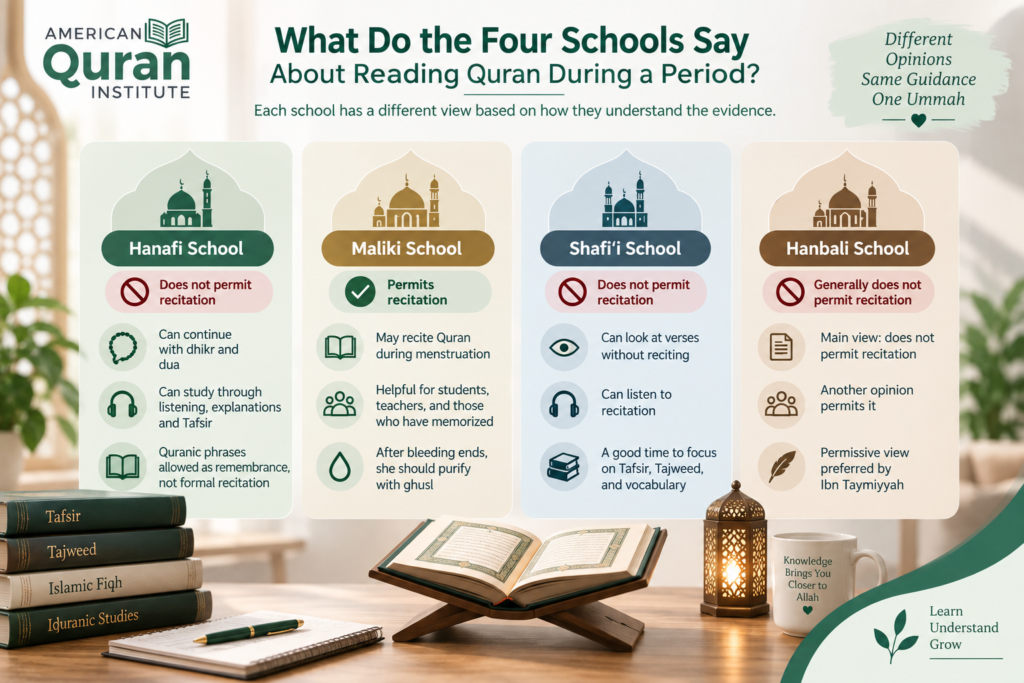
The Hanafi position generally does not permit a menstruating woman to recite Quran with the intention of Quranic recitation.
However, this does not prevent her from remembering Allah. She may continue with dhikr, tasbih, tahlil, tahmid, and supplications.
Quranic phrases may also be said when they are being used as established forms of remembrance or dua rather than with the intention of formal Quran recitation.
A Hanafi student can therefore continue studying through listening, explanations, translations, Tafsir, and Tajweed theory without necessarily pausing her entire Quran course.
2. Maliki School
The Maliki school is more permissive concerning Quran recitation during menstruation.
According to the Maliki position, a woman may recite Quran while she is menstruating. This is particularly significant for students, teachers, and women who have memorized Quran and are concerned that a long interruption may weaken their memorization.
There is an important detail: once the menstrual bleeding has ended, the Maliki ruling changes because she is then able to perform ghusl. She should therefore purify herself before continuing in situations where purification has become possible.
This opinion is also one reason some contemporary fatwa institutions allow women who need to study, teach, or protect their memorization to follow the Maliki position.
3. Shafi‘i School
The Shafi‘i school generally does not permit Quran recitation during menstruation when it is intended as tilawah.
A woman can still look at Quranic verses without verbally reciting them, remember them internally, listen to recitation, make permissible forms of dhikr, and continue studying Quranic subjects.
For a student following this position, a menstrual period can therefore become a useful time to focus on Tafsir, Tajweed rules, Quranic vocabulary, listening practice, and correction of previous mistakes.
4. Hanbali School
The relied-upon Hanbali position also generally restricts Quran recitation during menstruation.
However, another opinion has been reported within Hanbali scholarship permitting it. The permissive view was also preferred by scholars including Ibn Taymiyyah.
This illustrates why a woman may hear respected scholars give different answers without either side necessarily ignoring Islamic scholarship.
See Us in Action!
Take a look inside our virtual classrooms. Watch the clip below to see how our instructors engage with students, simplify complex rules, and create an inspiring environment for learning.
Start Your Quranic Education
Join our premier online institute for structured Quranic learning tailored for students in the USA.
Book Your Free TrialCan We Learn Quran During Periods Without Reciting?
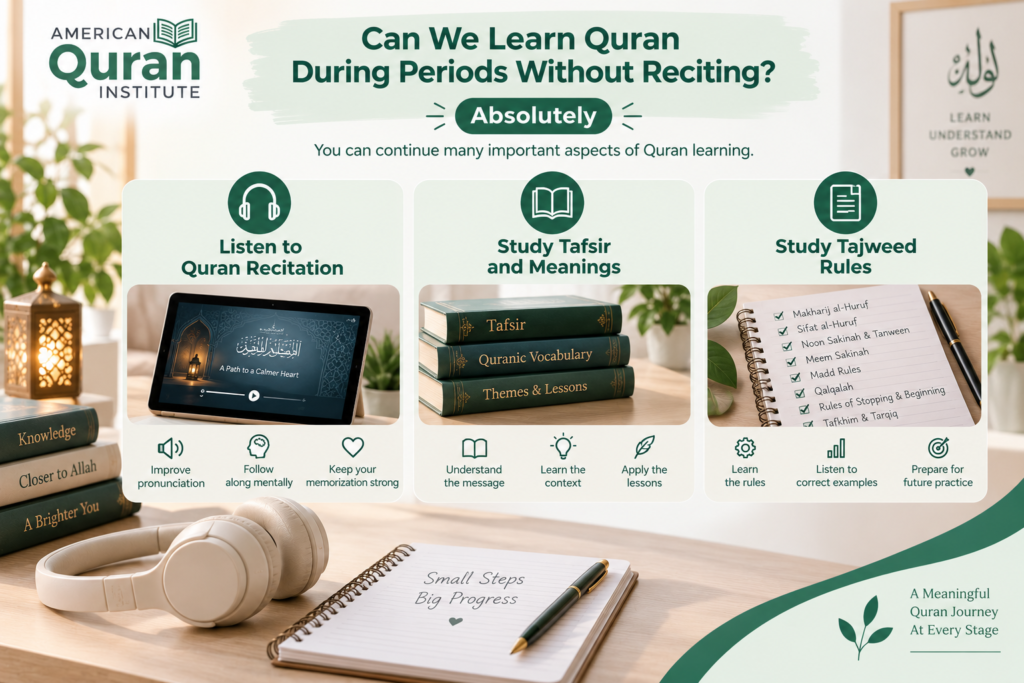
Absolutely. Quran learning is much broader than verbal recitation. A woman can continue developing several important skills during menstruation. In fact, these days can be deliberately incorporated into a monthly learning plan rather than treated as lost study time.
1. Women Can Listen to Quran Recitation During Menstruation
Listening to the Quran is permissible during menstruation. Students can listen carefully to a qualified reciter or teacher and focus on pronunciation, pauses, elongations, rhythm, and articulation.
Listening is particularly valuable for Hifz students because repeated exposure helps keep previously memorized passages familiar. A student who follows the stricter position on verbal recitation can listen to a verse and mentally follow it without pronouncing it aloud.
2. Women Can Study Tafsir and Quranic Meanings During Their Period
Menstruation does not prevent a woman from learning what the Quran means. She can study the background of a Surah, vocabulary, themes, reasons for revelation, scholarly explanations, lessons, and practical applications.
This can create a more balanced Quran-learning routine in which recitation is combined with understanding rather than focusing on pronunciation alone.
3. Women Can Study Tajweed Rules During Menstruation
A woman can continue studying the theoretical rules of Tajweed during her menstrual period. This includes:
- Makharij al-Huruf
- Sifat al-Huruf
- Noon Sakinah and Tanween
- Meem Sakinah
- Madd rules
- Qalqalah
- Rules of stopping and beginning
- Tafkhim and Tarqiq
If she follows a scholarly position that permits recitation during menstruation, she may also practice these rules through recitation.
If she follows the more cautious position, she can study the rules theoretically, listen to correct examples, identify common mistakes, and prepare exercises to practice once her period ends.
Can You Continue Quran Classes During Your Period?
Yes. There is no reason for a woman to automatically cancel Quran lessons simply because she is menstruating.

The exact activities during the lesson can be adjusted according to the fiqh opinion she follows.
For example, a lesson may involve:
- Listening to the teacher’s recitation
- Studying Tajweed rules
- Identifying pronunciation mistakes
- Reviewing memorization mentally
- Studying translations
- Learning Tafsir
- Discussing Quranic vocabulary
- Reviewing the structure of a Surah
- Studying Qira’at theory
Students following the Maliki or another recognized permissive opinion may also continue reciting.
For learners working through an accelerated curriculum, the Intensive Quran Course can similarly remain structured around consistent study, with the lesson content adapted when necessary rather than abandoning progress for several days each month.

Can I Memorize Quran During My Period?
Yes, you can continue memorizing and reviewing the Quran during your period, but whether you recite the verses aloud depends on the scholarly opinion you follow.
According to the Maliki position and other scholars who permit Quran recitation during menstruation, a woman may recite for learning, memorization, and revision. This can be especially important for a Hafizah, Quran teacher, or Hifz student who fears losing previously memorized verses during a monthly break.
If you follow the stricter opinion that avoids verbal Quran recitation during menstruation, you can still maintain your Hifz by listening repeatedly to memorized passages, mentally reviewing the sequence of verses, studying their meanings, and using previous recordings to identify weak areas.
So, your period does not have to become a complete break from Quran memorization. You can continue your Hifz routine while adapting the method to the scholarly position you follow.
Can a Woman Listen to Quran During Her Period?
Yes. Listening to Quran during menstruation is permissible This is one of the easiest ways to remain closely connected to Quranic study regardless of which opinion a woman follows concerning verbal recitation.
Listening can also serve a practical educational purpose. A student can compare different reciters, focus on articulation, recognize Tajweed rules, follow a teacher’s correction, or repeatedly listen to a Surah she is memorizing.
For advanced students studying different authenticated recitation traditions, listening becomes even more important. The American Quran Institute’s Quran Qirat Learning Course focuses on authenticated Qira’at, pronunciation differences, articulation, and recitation patterns, making careful listening an essential part of the learning process.

Can I Read Quran From My Phone While on My Period?
Yes, you can use a phone or tablet to access the Quran during your period. A digital device is generally not treated like a physical Mushaf because the Quranic text appears temporarily on the screen and the device has many other functions.
This means you can use your phone to listen to Quran recitation, study Tafsir and translations, review Tajweed rules, and follow Quran lessons without directly handling a physical Mushaf.
As for reciting Quran aloud from the phone, scholars differ. The Maliki position and other scholars permit Quran recitation during menstruation, including for learning, memorization, and revision.
The more cautious opinion avoids verbal recitation until menstruation ends. So, using the phone itself is generally permissible, while reciting the verses aloud depends on the scholarly opinion you follow.
Can a Woman Touch the Physical Mushaf During Her Period?
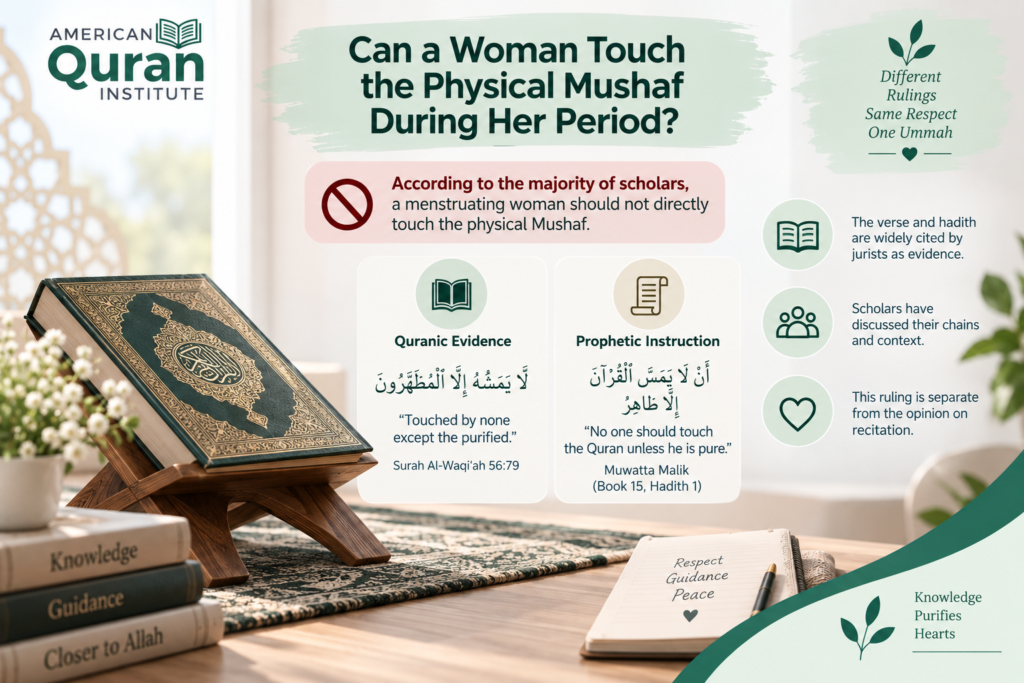
According to the majority of scholars, a menstruating woman should not directly touch the physical Mushaf. This ruling is separate from the scholarly disagreement about whether she may verbally recite the Quran.
Among the Quranic evidence discussed by scholars is Allah’s statement:
لَّا يَمَسُّهُ إِلَّا ٱلْمُطَهَّرُونَ
“Touched by none except the purified.”
The immediate context of the verse has been interpreted by many scholars as referring to the purified angels and the protected record, while jurists have also discussed the verse as part of the evidence concerning purity and touching the Mushaf.
Scholars also cite the instruction contained in the letter sent by the Prophet ﷺ to ‘Amr ibn Hazm:
أَنْ لَا يَمَسَّ الْقُرْآنَ إِلَّا طَاهِرٌ
“No one should touch the Quran unless he is pure.”
This report has been transmitted through different routes, and hadith scholars have discussed its chains; for example, Bulugh al-Maram notes that Malik transmitted it as mursal and records discussion concerning its chain. Nevertheless, it has been widely cited by jurists in rulings on touching the Mushaf.
Therefore, touching a printed Mushaf and reciting the Quran are two separate fiqh issues. Even scholars who permit Quran recitation during menstruation may place different conditions on directly handling the physical Mushaf.
Can You Read the Mushaf With Gloves or a Barrier?
According to some scholars, a menstruating woman may handle the Mushaf through a separate barrier, such as clean gloves or a cloth, without touching it directly. This can be useful for students and teachers who need access to a physical copy during Quran lessons.
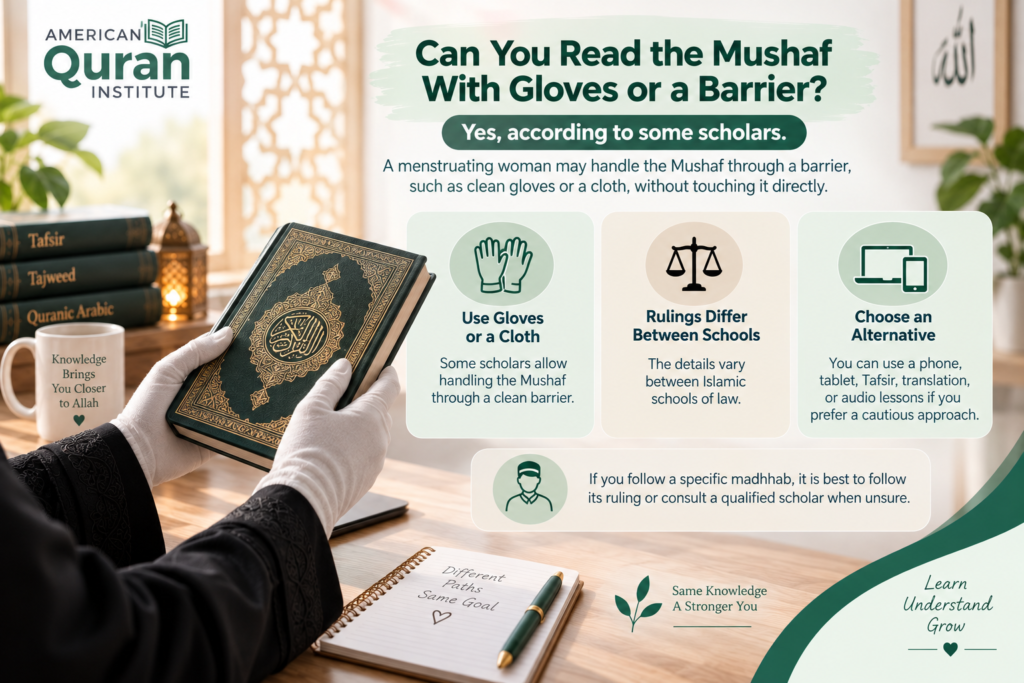
However, the details differ between schools of Islamic law. A woman who prefers the more cautious approach can use a phone, tablet, Tafsir book, translation, or audio lesson instead of handling the physical Mushaf.
If you follow a particular madhhab, it is best to follow its specific ruling on handling the Mushaf during menstruation or consult a qualified scholar when unsure.
How to Continue Your Quran Study Routine During Your Period?
You do not need to stop your Quran study routine during your period; you can simply adjust the activities you focus on. If you follow the opinion that permits recitation, you may continue your regular study while observing the relevant rulings on handling the physical Mushaf.
If you follow the more cautious opinion, use these days for listening to Quran, studying Tafsir and Tajweed theory, reading translations, learning vocabulary, reviewing mistakes, and planning your memorization.
A Hifz student, for example, can listen repeatedly to previously memorized portions, while a beginner can focus on recognizing Tajweed rules. More advanced students can study Quranic vocabulary, meanings, and different authenticated Qira’at.
The goal is to maintain a consistent connection with Quran learning while following the fiqh position you trust.
What Happens When the Period Ends?
Once menstruation has completely ended, a woman performs ghusl and can return to the acts of worship that require ritual purity. At this point, the restrictions specifically connected to menstruation no longer apply, and she can resume her usual Quran routine.
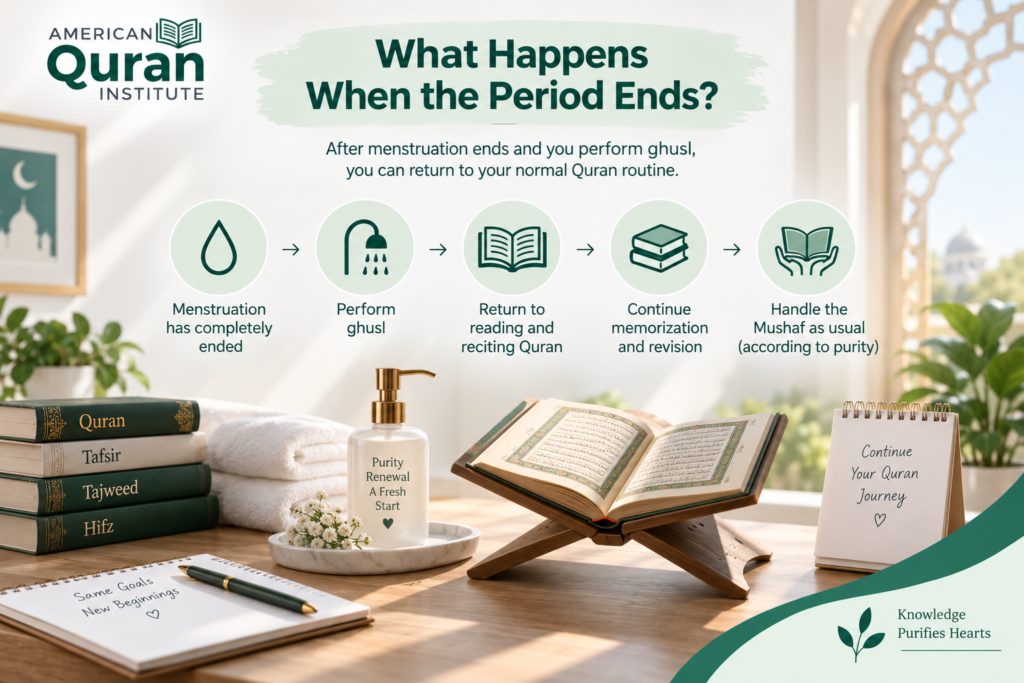
It is important to distinguish between the actual end of menstruation and a temporary pause or reduction in bleeding. A woman should rely on the recognized signs by which she normally knows that her period has finished before performing ghusl.
After purification, she can return to reading and reciting the Quran normally, continue her memorization and revision, and handle the physical Mushaf according to the usual rules of purity.
For Quran students, this is also a good time to return to any recitation exercises that were postponed during menstruation. Listening, Tafsir, Tajweed study, and other learning completed during the period can now be combined again with direct recitation and regular Mushaf practice.
Experience Our Classroom Environment
Don’t just take our word for it—experience a live session for yourself! Click on the videos below to watch real snippets from our classes and see our interactive teaching methods in real-time.
Start Your Quranic Education
Join our premier online institute for structured Quranic learning tailored for students in the USA.
Book Your Free TrialContinue Learning the Quran With American Quran Institute
Menstruation may temporarily change how a Muslim woman studies the Quran, but it does not have to interrupt her learning. Listening, studying meanings, reviewing Tajweed, and maintaining previous memorization can all help keep Quran learning consistent throughout the month.
At American Quran Institute, students can continue developing their Quran knowledge with structured guidance from qualified teachers. Lessons can be adapted to different learning needs and circumstances, helping women maintain steady progress without treating menstruation as a complete break from Quran study.
With American Quran Institute, you can build a consistent learning routine, strengthen your understanding of the Quran, and continue progressing with confidence throughout every stage of your learning journey.
Start your free trial with American Quran Institute today and take the next step in your Quran learning journey.
Our Quran Courses
- Quran Online Academy
- Quran Recitation Classes
- Quran Reading Classes
- Online Quran Classes for Kids
- Quran Classes for Adults
- Quran Classes for Female/Sisters
- Learn Quran Course for Beginners
- Al-Azhar Quran Course

Conclusion
So, can we learn Quran during periods? Yes. Menstruation does not prevent a woman from learning the Quran. She can listen to recitation, study Tajweed, explore Tafsir, learn Quranic meanings, attend classes, and maintain her connection with Quranic knowledge.
The main scholarly disagreement concerns verbal Quran recitation during menstruation. The majority of classical jurists generally prohibit recitation with the intention of tilawah, while the Maliki school and a number of other scholars permit it. This permissive position is particularly relevant to women studying, teaching, memorizing, or fearing that they may forget Quran.
Directly touching the physical Mushaf is a separate matter, and the majority of jurists prohibit it during menstruation. Phones, digital devices, Tafsir materials, and other learning methods offer practical alternatives.
Rather than treating a period as a complete interruption, a woman can adjust her Quran routine according to the scholarly position she follows and continue developing her knowledge throughout the month.
Frequently Asked Questions
Can we learn Quran during periods?
Yes. Women can continue learning Quran during menstruation through listening, Tafsir, Tajweed theory, translations, vocabulary study, and Quran classes. Whether she verbally recites depends on the scholarly opinion she follows.
Can I learn Quran while on my period?
Yes. You can study Quranic meanings, listen to recitation, learn Tajweed rules, review lessons, and attend classes while on your period. The main difference of opinion concerns verbal recitation rather than Quran education as a whole.
Can I recite Quran from memory during my period?
Scholars differ. The Hanafi and Shafi‘i schools and the relied-upon Hanbali position generally prohibit recitation during menstruation, while the Maliki school and other scholars permit it. Women should follow reliable scholarship or the madhhab they normally observe.
Can I read Quran on my phone during my period?
You may handle a phone or tablet containing Quran because a multipurpose digital device is generally not treated as a physical Mushaf. Whether you verbally recite the displayed verses still depends on the scholarly position you follow concerning Quran recitation during menstruation.
Can I listen to Quran during menstruation?
Yes. A menstruating woman may listen to Quran recitation. It is also a useful way to maintain Hifz, improve pronunciation, recognize Tajweed rules, and stay connected to Quranic study.
Can I study Tafsir during my period?
Yes. Studying Tafsir is an excellent way to continue Quran learning during menstruation. You can study meanings, explanations, vocabulary, context, and lessons from Quranic verses.







Leave a Reply