 Quran

Finding the best time to learn Quran can make your daily study easier, more focused, and more consistent. While you can read, study, and revise the Quran throughout the day, some times naturally provide a quieter environment and a fresher mind.
For many learners, the time after Fajr is one of the strongest choices, especially for memorization and learning new material. However, not everyone has the same schedule or energy levels. A student may concentrate best early in the morning, while a busy parent or working adult may learn more effectively at night.
The real goal is therefore not simply to find a “perfect hour,” but to choose a time when you can concentrate, avoid distractions, and return to the Quran consistently.
1. After Fajr Prayer – The Best Time to Learn Quran
For many students, after Fajr is the best time to learn Quran, particularly when studying something new. After a full night of rest, the mind is usually fresher, while the early morning environment tends to have fewer distractions than the rest of the day.

This makes the post-Fajr period particularly useful for Quran memorization, practicing new verses, improving pronunciation, or studying a new Tajweed rule. Instead of using this valuable period for a long session, even a focused 20–30 minutes can become the foundation of a consistent Quran routine.
The early morning also has a special place in Islam. The Prophet ﷺ made du’a for blessing in the early part of the day:
اللَّهُمَّ بَارِكْ لأُمَّتِي فِي بُكُورِهَا
“O Allah, bless my nation in their early mornings.”
You do not need to turn the post-Fajr period into a long study session. A focused 20–30 minutes every morning can be more manageable than an occasional session lasting several hours.
If you are memorizing Quran, consider reserving this period primarily for new Hifz and moving most of your revision to another part of the day.
If you are starting completely from scratch, following structured Quran classes for beginners can also help you decide what to practice during each study session instead of trying to learn reading, pronunciation, and Tajweed randomly.
Read also: Quran Verses About Kindness In Arabic – Ihsan, Mercy, And Good Character

2. Before Fajr – A Quiet Time for Deep Quran Study
The period before Fajr can be an excellent alternative for people who enjoy waking early and find complete silence helpful for concentration. At this time, household activity is usually minimal, phone notifications are less frequent, and the responsibilities of the new day have not yet begun.
Because interruptions are limited, this period can be useful for material that requires careful attention. You might work on a difficult page of memorization, repeat similar ayat that you frequently confuse, study Quranic vocabulary, or listen closely to a qualified reciter before practicing the passage yourself.
It can also be a suitable time for slower, reflective Quran study. Instead of trying to complete a large amount, you can concentrate on a smaller passage, correct pronunciation mistakes, and pay closer attention to what you are reading.
However, studying before Fajr should fit naturally into a healthy daily routine. If waking extremely early means you are constantly sleep-deprived, your concentration may eventually suffer. The purpose of choosing this time is to benefit from quietness and mental presence—not simply to study at the earliest possible hour.
3. Early Morning Before Work or School
You may like the idea of morning Quran learning but find that the period immediately after Fajr does not fit your responsibilities. In that case, the early morning before work, university, or school can still be a highly practical study window.
At this stage of the day, you may still have more mental energy than you will after several hours of work or study. It is also easier to protect a fixed morning routine than to depend on finding an unpredictable free period later.
For example, you could dedicate 20 minutes before leaving home to Quran reading. One day might focus on fluency, another on Tajweed, and another on memorization. Beginners who are not yet comfortable reading Arabic can instead use this period to work systematically through letter recognition, Harakat, Sukoon, Shaddah, and connected words. A structured Noorani Qaida course can provide this foundation before the learner moves into independent Quranic reading.

Try to avoid filling this period with unnecessary digital activity before you begin. Checking emails, scrolling through social media, or reading messages can quickly turn a planned Quran session into a rushed five-minute review.
Read also: Quran Verses About Justice In Arabic – Fairness, Truth, And Equality
4. Mid-Morning – A Good Time for Kids and Flexible Learners
Mid-morning is particularly useful for learners who have flexible schedules, including homeschoolers, younger children, weekend students, and adults who work later in the day.
For children, the earliest part of the morning is not automatically the most effective learning period. Some children need time to wake fully, eat breakfast, and become mentally active before they can concentrate on Arabic letters, pronunciation, Tajweed, or memorization.
A mid-morning Quran session can therefore provide a useful balance. The child is awake and active, but the tiredness that may appear later in the afternoon has not yet developed.
The session should still match the child’s age and attention span. Younger learners may benefit from shorter activities such as recognizing letters, joining Arabic sounds, repeating several Quranic words, or memorizing one short passage. Older children can gradually handle longer reading and memorization sessions.
Mid-morning is also valuable for adults with flexible schedules. If you work from home, study part-time, or have a day off, this period can provide enough energy for a longer Quran lesson without requiring an extremely early start.
5. After Dhuhr – A Useful Midday Quran Break
After Dhuhr can turn the middle of the day into a useful opportunity to reconnect with the Quran. For students and working adults, it can function as a mental break from tasks that have occupied the morning.

This period may not be ideal for intensive new memorization if you normally experience an afternoon energy drop. Instead, use it strategically for lighter learning activities that still contribute to your progress.
You could read several pages aloud, review a Tajweed rule, listen to a passage while following the Mushaf, revise Quranic vocabulary, or prepare the verses you will study with your teacher later.
If you are working on Hifz, Dhuhr can also be used for a quick recall test. Close the Mushaf and attempt to recite the verses memorized earlier. When you identify a weak transition or forgotten phrase, mark it for focused revision instead of repeating the entire section unnecessarily.
This approach makes Quran learning part of your day without requiring every session to be intensive. Not every encounter with the Quran needs to involve learning something new; strengthening existing knowledge is equally important.
Experience Our Classroom Environment
Don’t just take our word for it—experience a live session for yourself! Click on the videos below to watch real snippets from our classes and see our interactive teaching methods in real-time.
Start Your Quranic Education
Join our premier online institute for structured Quranic learning tailored for students in the USA.
Book Your Free Trial6. After Asr – One of the Best Times for Quran Revision
After Asr can be one of the most practical times for Muraja’ah, especially if you use the morning for new Quran learning.

By this stage of the day, you may have already spent several hours working, studying, or managing responsibilities. Rather than forcing your mind to memorize a demanding new passage, you can use the session to test and strengthen material you have already encountered.
Suppose you memorized five ayat after Fajr. After Asr, close the Mushaf and attempt to recite them independently. Pay particular attention to where you hesitate, repeat words unnecessarily, confuse similar ayat, or need to look at the page Then focus your repetitions on those weak areas.
This is more useful than simply reading the same passage from the Mushaf again and assuming that recognition means memorization. Being able to continue without visual prompts gives you a clearer picture of what has actually become stable.
You can therefore create a simple daily pattern:
- Morning: Learn or memorize new Quran material.
- After Asr: Test and revise it.
- Later: Perform a final light review if necessary.
After Asr can also be used for Tajweed practice, especially if your morning lesson introduced a new rule. Return to the verses and try to identify and apply the rule without relying heavily on your notes.
7. Between Maghrib and Isha – A Practical Time for Families
The period between Maghrib and Isha can be an especially convenient Quran learning time for families.
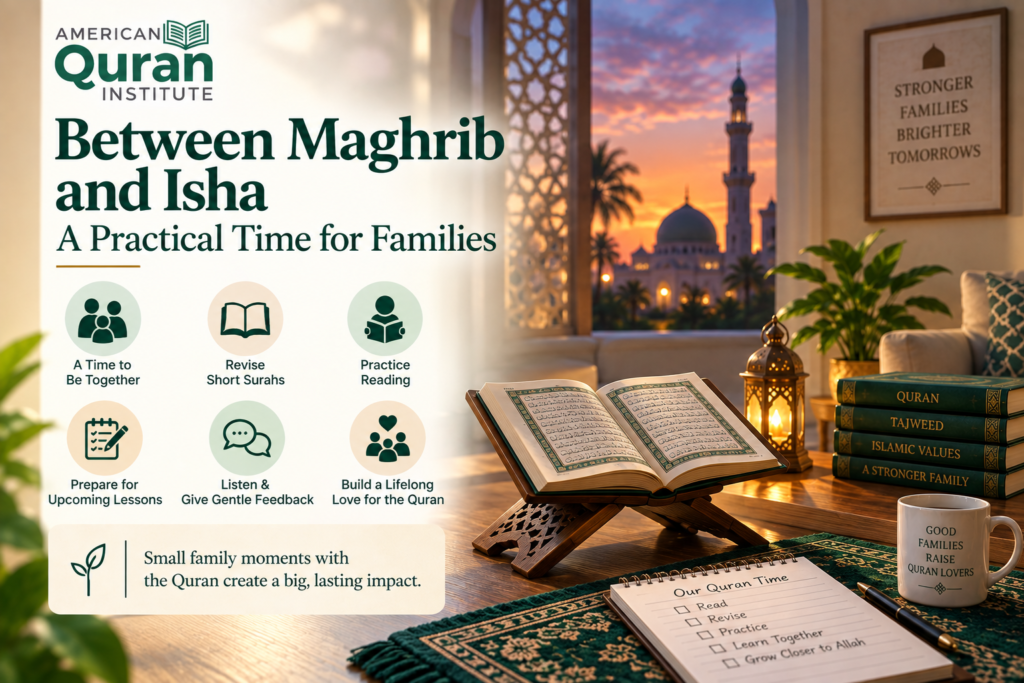
Many children are home by this point, daytime work is beginning to slow down, and the two prayers naturally create a defined period that can be associated with Quran study.
Parents can use this time for a short family Quran routine rather than treating learning as something that only happens during formal classes. One child might revise a short surah, another could practice reading from the Mushaf, while a parent listens and gently corrects obvious mistakes.
For children enrolled in Quran classes, this period can also be used to prepare for the next lesson. Instead of arriving at class without reviewing, they can spend a few minutes practicing the assigned passage beforehand.
Adults can benefit from the same routine. If mornings are dominated by work or childcare, the period after Maghrib may be the first predictable opportunity for uninterrupted learning.
The key is not to make the family session unnecessarily long. A short routine repeated regularly is easier to sustain than turning every evening into a demanding study program.
8. After Isha – A Good Time for Quiet Quran Learning
After Isha is often one of the most realistic options for adults whose daytime schedules are full.
Work has finished, children may be preparing for sleep, and there are usually fewer responsibilities waiting to be completed. For some learners, this is the first point in the day when they can sit with the Quran without watching the clock.
The period can work well for an online Quran lesson because you may be able to give your teacher uninterrupted attention. It can also be used for recitation practice, Quranic Arabic, or systematic Tajweed study.
If correct recitation is your main goal, structured online Tajweed classes can help you move beyond simply knowing the rules by practicing Makharij, pronunciation, and Tajweed application with direct correction.

If you want to memorize new material after Isha, pay attention to your level of mental fatigue. Some people remain highly focused at night, while others find that they need many more repetitions than they would in the morning.
In that situation, use the night session for preparation instead. Read tomorrow’s passage several times, listen to its correct recitation, identify unfamiliar words, and practice difficult pronunciations. When you return to it with a fresher mind the next day, the passage will already feel familiar.
9. Before Going to Sleep – Best for Light Quran Review
The period immediately before sleep is better suited to light Quran revision than to an intense learning session.

By this stage of the day, your mind may already be tired from work, study, family responsibilities, and other activities. Trying to memorize a difficult new page can therefore become frustrating and require unnecessary repetition.
Instead, return briefly to material you have already studied. You might recite the ayat memorized that morning, listen once more to a passage from a reliable reciter, review several difficult words, or repeat the transition between two verses that you struggled with earlier.
If you are studying Tajweed, quickly revisit one rule and identify examples of it in the passage you practiced that day. If you are still learning to read Quran, repeat several words that previously caused hesitation.
The session does not need to last long. Even 5–10 minutes can serve as a final review of the day’s work. This also creates a useful distinction in your Quran schedule: your strongest concentration period is used for learning, while smaller periods throughout the day are used to reinforce what you learned.
10. Your Most Focused Time – The Best Personal Time to Learn Quran
Although early morning is highly recommended, the best time to learn Quran for you must also be realistic.
People have different responsibilities, sleep schedules, energy patterns, and family circumstances. A parent caring for a newborn, a student attending early classes, and someone working night shifts cannot be expected to follow exactly the same Quran schedule.
Ask yourself three simple questions:
- When is my mind most alert?
- When am I least likely to be interrupted?
- What time can I realistically protect every day?
Try your chosen period for a week. Pay attention to how easily you concentrate, how much you retain, and whether you can maintain the routine without constantly skipping sessions.
If Fajr works, make it your main learning period. If another time consistently gives you stronger concentration and greater commitment, use it. A consistent Quran session at a realistic time is better than repeatedly missing a schedule simply because it sounds ideal.
What Is the Best Time to Learn Quran for Memorization?
For many learners, after Fajr is the best time to memorize Quran because the mind has rested and daily distractions have not yet accumulated A practical approach is to separate new Hifz from revision.

Use your freshest period for new ayat, then return to those ayat later in the day for Muraja’ah. For example, you could memorize after Fajr, review after Asr, and perform a final light recitation before sleeping.
Do not focus only on how many new verses you can memorize. Retaining yesterday’s verses is just as important as adding today’s portion.
If your Fajr schedule is genuinely unsuitable, choose another quiet period when you are mentally fresh and can maintain the routine consistently.
What Is the Best Time for Kids to Learn Quran?
The best time for children to learn Quran depends on their age, school schedule, sleep, and individual concentration patterns.

Some children learn effectively after Fajr, while others are more attentive during mid-morning, particularly on weekends or when homeschooling. After Maghrib may also be practical for families who want to study together.
Parents should pay more attention to the child’s focus than to the clock. If a child becomes restless after 15 minutes, extending the lesson to 45 minutes simply because that was the planned duration may not produce better learning. Short, regular, positive sessions can help children develop a healthier long-term relationship with Quran learning.
How Long Should You Spend Learning Quran Each Day?
There is no single daily duration that suits every learner A beginner may start with 15–20 focused minutes, while a student working on Hifz, Tajweed, or Quranic Arabic may need longer sessions.
What matters is that the amount remains manageable enough to repeat consistently.
A simple daily structure could be:
- 20–30 minutes: New Quran learning or memorization
- 15–20 minutes: Revision later in the day
- 5–10 minutes: Light review or listening
You do not have to begin with a demanding schedule. Start with a duration you can maintain, then increase it gradually when the habit becomes stable.
See Us in Action!
Take a look inside our virtual classrooms. Watch the clip below to see how our instructors engage with students, simplify complex rules, and create an inspiring environment for learning.
Start Your Quranic Education
Join our premier online institute for structured Quranic learning tailored for students in the USA.
Book Your Free TrialStart Learning Quran With American Quran Institute
Finding the right time is only one part of making steady progress with the Quran. You also need a clear learning path, regular practice, and correction so that mistakes do not become permanent habits.
American Quran Institute can help you turn the time available in your schedule into structured Quran learning. Instead of wondering what to study next or whether you are practicing correctly, you can learn with guidance suited to your current level and goals.
Whether you want to improve Quran reading, work on Tajweed, strengthen memorization, or develop a more consistent learning routine, structured instruction can help you use each study session more effectively.
Our Quran Courses
- Quran Online Academy
- Quran Recitation Classes
- Quran Reading Classes
- Online Quran Classes for Kids
- Quran Classes for Adults
- Noorani Qaida Course
- Noorani Qaida Course for Kids
- Weekend Quran Classes
- Intensive Quran Course
- Al-Azhar Quran Course

Conclusion
The best time to learn Quran is the time when you can study with focus, consistency, and enough energy to benefit from each session.
For many learners, after Fajr is an excellent choice for new learning and memorization, while periods such as after Asr, Maghrib, or before sleep can be used effectively for revision and reinforcement.
What matters most is building a routine that fits your life and allows you to return to the Quran every day. You do not need a perfect schedule or long study sessions to make progress. A short, focused period practiced consistently can gradually improve your reading, Tajweed, memorization, and confidence.
Start with the time that feels most realistic, protect it from distractions, and adjust your routine as you discover when you learn best. With patience and regular practice, Quran learning can become a natural and lasting part of your day.
FAQs About the Best Time to Learn Quran
What is the best time to learn Quran?
After Fajr is one of the best times to learn Quran because the mind is generally fresh and the early morning tends to have fewer distractions. However, the best personal time is one that allows you to concentrate and study consistently.
Is Fajr the best time to learn Quran?
Fajr is an excellent time for Quran learning, particularly for new memorization. The quiet environment and fresh mind can make reading, repetition, and memorization easier. If Fajr is not practical, choose another time when you can maintain strong focus.
Is it better to learn Quran in the morning or at night?
Morning is often better for learning or memorizing new material, while nighttime can be excellent for quiet study and revision. Your personal concentration and daily schedule should ultimately determine which period works better.
Can I learn Quran after Asr?
Yes. Quran learning and recitation are not prohibited after Asr. This period can be particularly useful for reviewing verses memorized earlier in the day.
Is it good to learn Quran before sleeping?
Yes, especially for light revision. You can recite recently memorized verses, listen to a passage again, or review mistakes before sleeping rather than beginning a long and demanding new lesson.
What is the best time for children to learn Quran?
After Fajr or mid-morning can work well for many children, while some families prefer the period between Maghrib and Isha. The best choice is when the child is rested, attentive, and able to participate without feeling exhausted.
How many minutes should I learn Quran every day?
Beginners can start with around 15–20 focused minutes and gradually increase their study time. Learners working on memorization may benefit from separating new Hifz and revision into two daily sessions. Consistency matters more than simply making each session longer.







[…] Read also: 10 Best Times To Learn Quran For Better Focus And Progress […]