 Quran
Quran
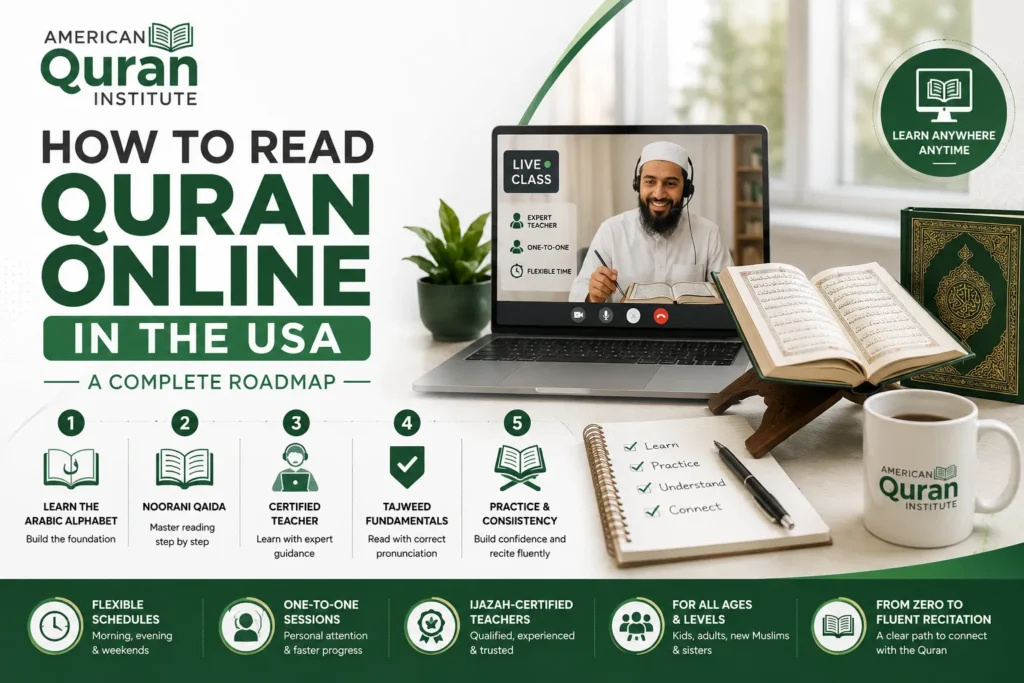
Every year, thousands of Americans pick up the Quran for the first time. Converts beginning a new chapter of faith. Born Muslims who grew up speaking English and never received formal instruction. Parents determined to give their children what they never had. Adults who simply never had the opportunity to start.
The question is almost always the same: how to read Quran for beginners — and where to start reading the Quran?
The honest answer is that Quran reading basics are learnable skills. Not a talent. Not something reserved for those who grew up in Arabic-speaking households. What it requires is a clear sequence of steps, the right habits, and a method that addresses the specific challenges English speakers face.
This article covers how to read the Quran from absolute zero, designed specifically for people in the United States who are starting fresh or who started before but never built a solid foundation.
Start Our Quran Classes for Adults with a FREE trial class

1. Learn The Arabic Alphabet First To Can Read The Quran
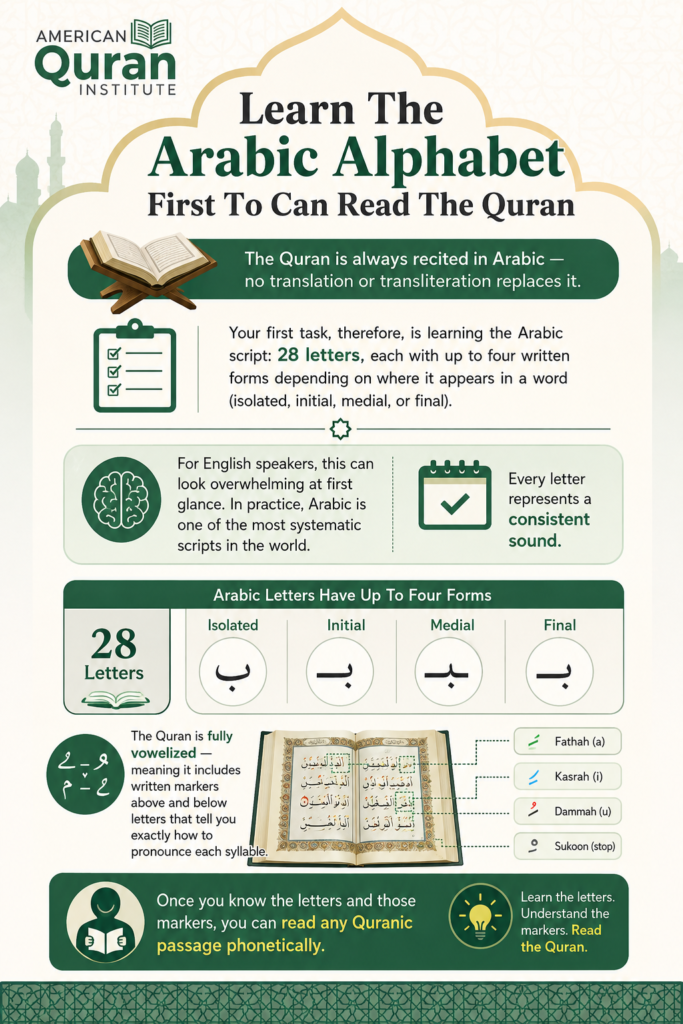
The Quran is always recited in Arabic — no translation or transliteration replaces it. Your first task, therefore, is learning the Arabic script: 28 letters, each with up to four written forms depending on where it appears in a word (isolated, initial, medial, or final).
For English speakers, this can look overwhelming at first glance. In practice, Arabic is one of the most systematic scripts in the world. Every letter represents a consistent sound, and the Quran is fully vowelized — meaning it includes written markers above and below letters that tell you exactly how to pronounce each syllable. Once you know the letters and those markers, you can read any Quranic passage phonetically.
The real challenge is not the script itself but the sounds. Arabic contains several consonants that simply do not exist in English: the ع (a voiced sound produced deep in the throat), the ح (a breathy exhale from the chest), the ق (a “k” produced at the back of the throat), and the خ (similar to the “ch” in Scottish loch). These require deliberate physical training — your mouth and throat must learn new positions — not just letter memorization.
If you have been looking for guidance on how to learn the Quran alphabet, the most widely used and universally recommended starting resource is the Noorani Qaida, covered in the next step.
Read also: How To Read The Quran In English In The USA? 10 Steps To Get Started
2. Complete Studying The Noorani Qaida Before Opening The Quran
This is the single most skipped step among self-taught beginners, and it is the primary reason so many people struggle for months without making real progress.
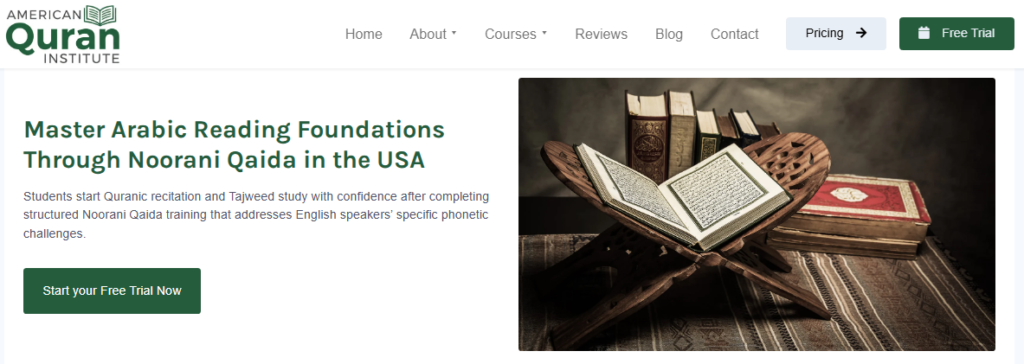
The Noorani Qaida is a teaching primer used across the Muslim world for well over a century. It was designed specifically to bring a complete beginner — someone who knows nothing about Arabic — through letter recognition, pronunciation, vowel marks, syllable formation, and basic reading rules in a carefully ordered sequence.
A student who finishes the Noorani Qaida can read any vowelized Arabic text. A student who skips it and opens the Quran directly will hit an obstacle on nearly every line. The Noorani Qaida is the phonics stage for Arabic Quranic reading. Most beginners finish it in four to twelve weeks with regular practice — and every hour spent here saves hours of error-correction later.
For those researching how to learn the Quran by yourself: self-study is genuinely possible and many people make meaningful progress independently. That said, the Noorani Qaida stage especially benefits from a teacher who can hear your pronunciation in real time.
3. Master The Vowel Marks (Harakat) Of Arabic Language
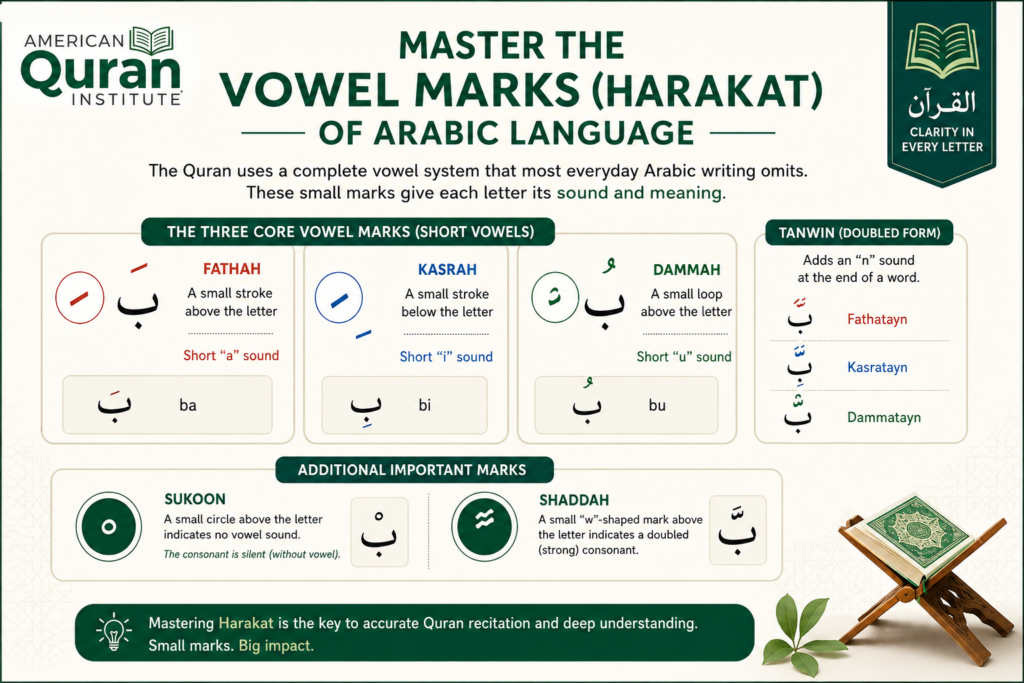
The Quran uses a complete vowel system that most everyday Arabic writing omits. These short vowel marks — harakat — appear as small symbols above and below letters and specify exactly how each consonant is pronounced.
The three core marks are the fathah (a small stroke above the letter, producing a short “a” sound), the kasrah (a small stroke below, producing a short “i” sound), and the dammah (a small loop above, producing a short “u” sound).
Each has a doubled form called tanwin, which adds an “n” sound at the end of a word. Additional marks include the sukoon (indicating a vowel-less consonant) and the shaddah (indicating a doubled consonant).
Many beginners find that once the harakat system clicks, the question of how to read the Quran in Arabic easy stops feeling unreachable. The vowel marks remove guesswork entirely and turn reading into a decoding process you can approach step by step.
Read also: How To Read Quran Online For Free In The USA?
4. Begin With Surah Al-Fatiha And The Short Surahs Of Juz Amma
Where should someone start reading the Quran? The answer depends on your goal. For completing a full recitation (khatm), the traditional practice is to begin at Surah Al-Fatiha and continue in order through An-Nas, following the arrangement of the Mushaf as compiled by the Companions.
For beginners building reading skills from scratch, starting at Juz Amma — the 30th and final section — is far more practical. The surahs here are short, rhythmically clear, and built on vocabulary that appears repeatedly throughout the Quran.
More importantly, these are the surahs every Muslim recites in daily prayer. Surah Al-Fatiha, Al-Ikhlas, Al-Falaq, An-Nas, and Al-Kawthar are not abstract practice material — they are words you will say in every salah for the rest of your life.
A practical observation from Quran teachers: two weeks spent exclusively on Al-Fatiha — reading it correctly, listening to it recited well, understanding its meaning — builds more genuine foundation than rushing through three unfamiliar longer chapters.
Begin Your Quranic Journey with The American Quran Institute with a FREE Trial session

5. Always Begin Recitation With The Isti’aadhah And Bismillah
Before reading the Quran, say: A’udhu billahi min ash-shaytaan ir-rajeem — “I seek refuge in Allah from the accursed Satan.” Allah commands this directly in Surah An-Nahl (16:98). Before beginning each surah (with the exception of At-Tawbah), say: Bismillah ir-rahman ir-raheem — “In the name of Allah, the Most Gracious, the Most Merciful.”
For a beginner, these phrases carry both spiritual and practical weight. They mark the transition into recitation as an intentional act of worship rather than a reading exercise. Teachers consistently observe that students who establish this habit from their very first session arrive at each recitation with noticeably better focus and less distraction.
Build this habit on day one. It should become as automatic as picking up the Mushaf itself.
Read also: BEST COUNTRY TO LEARN QURAN
See Us in Action!
Take a look inside our virtual classrooms. Watch the clip below to see how our instructors engage with students, simplify complex rules, and create an inspiring environment for learning.
Start Your Quranic Education
Join our premier online institute for structured Quranic learning tailored for students in the USA.
Book Your Free Trial6. Learn Essential Tajweed Rules For Accurate Recitation
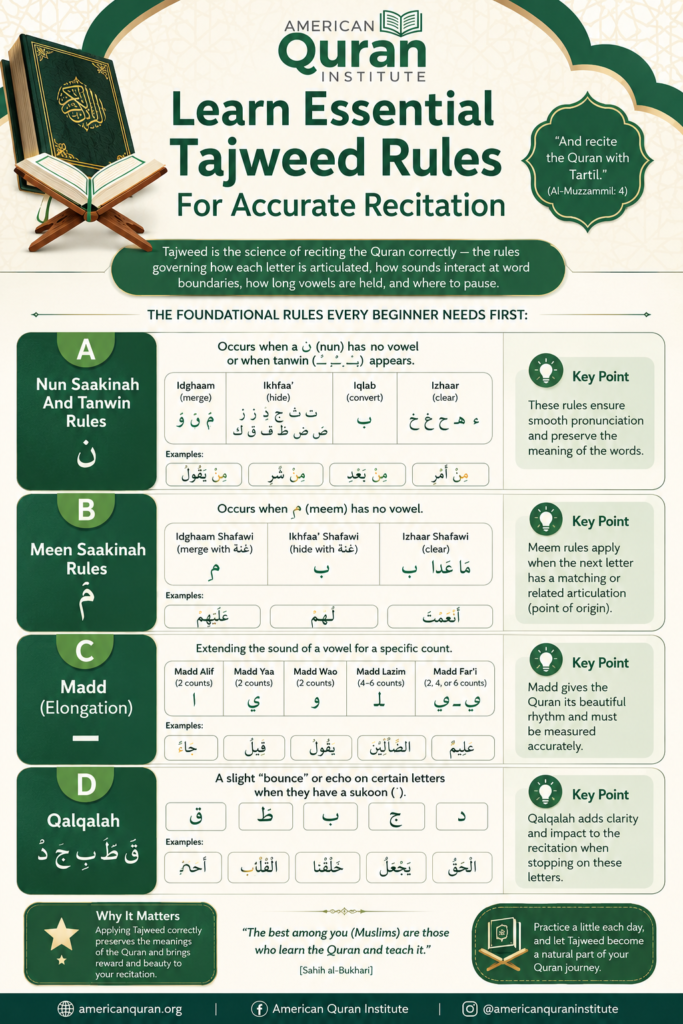
Tajweed is the science of reciting the Quran correctly — the rules governing how each letter is articulated, how sounds interact at word boundaries, how long vowels are held, and where to pause. Scholars of Islamic law have classified applying tajweed correctly as individually obligatory (fard ‘ayn) for every reciting Muslim, based on Allah’s command: “And recite the Quran with measured recitation” (Al-Muzzammil 73:4).
For beginners, the word “tajweed” can feel intimidating. In practice, every time you correctly produce a letter from its proper place of articulation (makhraj), you are already applying tajweed. Formal tajweed study names and systematizes what accurate readers do naturally. The foundational rules every beginner needs first:
A. Nun Saakinah And Tanwin Rules
A vowel-less nun (نْ) or a tanwin takes four forms depending on the following letter — idh-har (clear pronunciation before throat letters), idgham (merging into the following letter), iqlab (converting to a nasal meem sound before ب), and ikhfa (a hidden nasal sound before fifteen remaining letters). These rules govern a substantial portion of every Quranic page.
B. Meem Saakinah Rules
A vowel-less meem follows similar principles — ikhfa shafawi (hidden before ب), idgham shafawi (merging before another مeem), and idh-har shafawi (clear before all other letters).
C. Madd (Elongation)
Vowels before hamzah or sukoon are stretched for two, four, or six beat-counts depending on context. The difference is audible and shapes the rhythm of every verse.
D. Qalqalah
The five letters ق ط ب ج د produce a slight echo when vowel-less, most noticeably at the end of a verse. You hear this clearly in Surah Al-Ikhlas.
Do not attempt to memorize all tajweed theory before reading. The most effective approach is learning each rule and immediately applying it in an actual surah, returning to review in the following session. Theory without application does not transfer into recitation.
Read also: How to Remember Quran Verse Numbers? – For American Memorizers
7. Listen To Proficient Quran Reciters Every Single Day
Of every habit in this guide, consistent daily listening is the most underused and highest-leverage practice for beginners. Most people skip it entirely and wonder why their progress stalls.
The brain builds pronunciation models the same way children acquire their first language — through massive, repeated exposure to correct input. When you listen to skilled reciters daily, your ear calibrates to what correct Quranic Arabic sounds like. That internal model then guides your own recitation.
Two reciters are particularly valuable for beginners. Sheikh Mahmoud Khalil Al-Husary recorded a deliberate, classroom-paced recitation in which every letter receives its full weight with no vocal ornamentation — ideal for learning. Sheikh Muhammad Siddiq Al-Minshawi offers exceptional clarity of articulation with a warmth that many beginners find immediately accessible. Both are free and widely available online.
Read also: How To Read Quran Online In The USA? A Complete Roadmap

Listen with the text in front of you whenever possible, following along word by word. This simultaneous listening-and-tracking practice outperforms either activity alone.
Start memorizing Quran in USA with a FREE trial class

8. Build A Consistent Daily Quran Reading Practice
Fifteen minutes every day produces better results than two hours once a week. This is not a motivational slogan — it reflects how skill acquisition actually works. The brain consolidates phonological patterns during sleep, which means frequent short sessions (each followed by sleep consolidation) build faster and more durably than infrequent long ones.
For Americans navigating work schedules, school pickups, and family commitments, this is genuinely good news. You do not need to find a large block of time. You need to find fifteen minutes.
The most reliable method for establishing that habit is anchoring it to something you already do consistently. If you pray Fajr, read for ten minutes immediately after. If you commute by train, that window already exists. If you have a morning coffee routine, replace five minutes of phone browsing with five minutes of recitation.
Knowing how to start reading the Quran daily matters less than the mechanics of protecting the habit once started: a consistent trigger, a fixed time, and a simple streak tracker. Mark each reading day on a calendar. Missing one day is a slip. Missing three is a pattern. The streak makes skipping feel more costly than continuing.
Book your FREE trial session today

9. Read The Quran Aloud Every Time
Quran recitation is a vocal act. The Prophet ﷺ recited aloud. The Companions recited aloud. Islamic scholarly tradition consistently recommends reading with an audible voice — even a whisper when privacy requires it — over silent mental reading.
Reading aloud serves two distinct functions for beginners. First, it builds muscle memory. The tongue, lips, and throat learn correct positions through physical repetition, the same way musicians train finger placement through repeated practice.
Second, it lets you hear your own mistakes. What seems correct internally often reveals an error when you hear it externally. This is especially true for the guttural letters (ع، ح، خ، غ، ق) that English speakers are most prone to softening.
Begin each session by reading previously covered material before advancing to new text. This five-minute warm-up review consolidates what you learned in previous sessions and activates the correct pronunciation before you encounter unfamiliar words. Move your lips deliberately. Do not race through difficult letters to reach the next word.
10. Find A Qualified Quran Teacher With Ijazah
Every step in this guide becomes significantly more effective under qualified instruction. The Islamic tradition has always transmitted the Quran through direct teacher-to-student recitation for a reason that is fundamentally practical: Quranic Arabic contains sounds and subtleties that no text, app, or pre-recorded video can fully transmit.
A teacher who hears your recitation can identify a mispronounced ع or an incorrectly applied madd that you genuinely cannot detect yourself, because your ear has spent decades normalized to English phonetics.
An Ijazah-certified teacher holds certification through an unbroken chain of transmission tracing back to the Prophet ﷺ. That is not a formality — it means their own recitation has been verified to meet the exacting standards of the tradition. They do not just know the rules; they recite correctly themselves.
American Quran Institute, based in the USA, connects American Muslims — children, adults, ladies, and new Muslims — with Ijazah-certified teachers who specialize in guiding English speakers from the Arabic alphabet through fluent recitation.
Experience Our Classroom Environment
Don’t just take our word for it—experience a live session for yourself! Click on the videos below to watch real snippets from our classes and see our interactive teaching methods in real-time.
Start Your Quranic Education
Join our premier online institute for structured Quranic learning tailored for students in the USA.
Book Your Free TrialBegin Your Quran Journey with the Right Foundation
American Quran Institute offers live, one-on-one Quran classes built for English speakers across the United States. Whether you are starting from the very first letter or correcting years of self-taught habits, certified teachers guide you at your pace — scheduled around your US time zone, your work, and your family.
Parents searching for learn Quran for kids in the USA will find that the Institute’s children’s program uses age-appropriate pacing and teaching methods developed specifically for young English-speaking learners, making the learning process engaging rather than daunting.
Check Out Our Top Courses for Quran Learning:
- Quran Classes in USA
- Noorani Qaida Course in the USA
- Online Quran Classes for Kids in the USA
- Online Tajweed Classes in the USA
- Quran Classes for Adults in the USA
- Quran Classes for Females in the USA
- Quran Ijazah Program in the USA
- Quran Memorization Course in the USA
- Quran Tafsir Course in the USA
- Tajweed Course for Kids in the USA
Book your FREE trial session today

Start Your Quranic Education
Join our premier online institute for structured Quranic learning tailored for students in the USA.
Book Your Free TrialConclusion
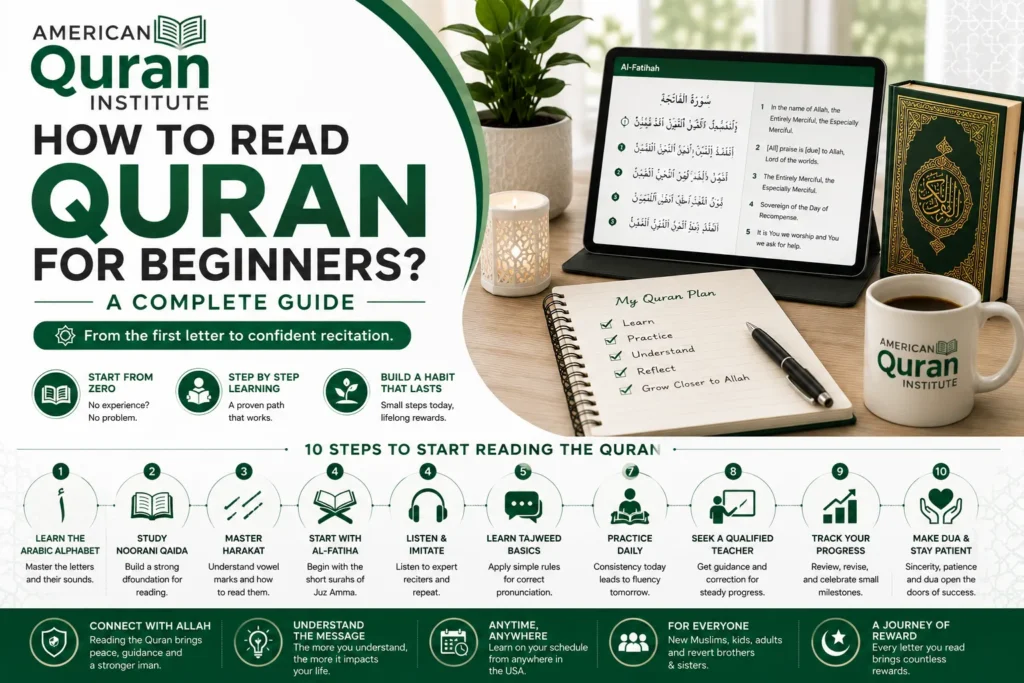
Learning how to start reading Quran for beginners follows a clear, ordered sequence: the Arabic alphabet, the Noorani Qaida, vowel marks, short surahs, the etiquette of recitation, tajweed rules, daily listening, consistent practice, vocal recitation, and qualified instruction.
These ten steps do not require exceptional ability. They require the right sequence, the right daily habits, and — critically — a teacher who understands where English speakers specifically struggle.
None of the obstacles in this process are unique to you. Thousands of American Muslims have completed this journey before: adults who started at fifty, converts who knew nothing about Arabic four months earlier, children who now recite fluently. The deciding factor in every case was not talent — it was starting right and not skipping the foundational steps because they seemed basic.
The most important decision you can make today is to begin — with step one, with fifteen minutes, with a qualified teacher — and to trust the process. The foundation is everything. Build it correctly the first time.
Frequently Asked Questions
Do I need to learn Arabic to read the Quran?
You do not need to understand Arabic conversationally — you need to learn the Arabic script and its sounds. The Quran is fully vowelized, meaning every word carries written marks showing you exactly how to pronounce it. A beginner can learn to read phonetically without fluent comprehension, though pairing recitation practice with basic translation study is strongly recommended from the start.
Where should a complete beginner start reading the Quran?
For building reading skills and daily-prayer vocabulary, start with Surah Al-Fatiha followed by the short surahs of Juz Amma — the 30th section at the back of the Quran. For completing the Quran in full recitation sequence, start from Al-Fatiha and follow the Mushaf in order through An-Nas.
How long does it take to learn to read the Quran from scratch?
With consistent daily practice of fifteen to thirty minutes and a qualified teacher, most beginners can read basic Quranic text within three to six months. Fluent, accurate recitation with correct tajweed typically develops over one to two years of regular study. Consistency matters far more than the length of individual sessions.
Can I learn to read the Quran through online classes?
Yes, and live online instruction is particularly effective for pronunciation development. One-on-one classes with an Ijazah-certified teacher over video allow real-time correction that pre-recorded video or apps cannot provide. American Quran Institute offers this format specifically — live classes with certified teachers built around US time zones.
Is it required to have wudu (ablution) to read the Quran?
Scholars agree that reciting the Quran from memory or from a screen without physically touching the printed Mushaf is permissible without wudu. Touching the physical Mushaf requires ritual purity according to the majority scholarly opinion. Beginners learning from a digital copy or app are not required to have wudu for recitation, though maintaining ritual purity is recommended as an act of reverence toward Allah’s words.
What is the first surah a beginner should memorize?
Surah Al-Fatiha is the essential starting point. It is recited in every unit of every obligatory prayer — which means you will hear it and say it multiple times every single day. That daily repetition is the most powerful memorization reinforcement available to any beginner. After Al-Fatiha, the natural progression is Al-Ikhlas, Al-Falaq, and An-Nas.





Leave a Reply