 Quran

If you are trying to figure out how to learn Quran quickly in the USA, you probably do not need another complicated study plan. You need a clear routine that works around your actual day—work, college, school, family responsibilities, and everything else competing for your attention.
The good news is that learning the Quran faster does not mean spending several hours studying every day. It means using your available time more effectively. A focused 20 or 30 minutes every day can take you further than an occasional two-hour session followed by several days without practice.
Whether you are starting from basic Arabic reading, improving your recitation, learning Tajweed, or beginning Hifz, the following steps will show you how to learn the Quran fast and easy without sacrificing correct pronunciation or long-term retention.
Step 1: Decide Exactly What You Want to Learn
Before trying to learn faster, define what “learning Quran” means for you Do you want to read Arabic without assistance? Improve your pronunciation? Apply Tajweed correctly? Memorize short Surahs? Complete Hifz? Or eventually study advanced recitation and Qiraat?

These goals require different learning methods For example, a beginner who struggles to recognize Arabic letters should not start with an intensive memorization target.
Build reading accuracy first. Likewise, someone who already reads fluently but repeatedly makes Tajweed mistakes needs correction rather than more basic reading practice.
Write down one measurable goal for the next four weeks. It could be reading one page without assistance, memorizing a short Surah accurately, or correcting a specific group of Tajweed mistakes.
Once your destination is clear, learning becomes much faster because you stop spending time on material that does not match your current level.
Read also: Can I Learn Quran Without Wudu? – A Clear Guide For Quran Students
Step 2: Choose a Daily Quran Time That Fits Your Life in the USA
One of the biggest mistakes learners make is waiting until they “have time” for Quran. For Muslims living in the United States, schedules can vary considerably.

A university student in New York may have a completely different routine from a parent working full-time in Texas or a professional living in California.
Instead of searching for one perfect universal time, choose a period you can realistically protect every day.
Early morning around Fajr can work particularly well because there are usually fewer interruptions. If that is difficult because of your work or school schedule, choose another consistent period, such as after Maghrib, after Isha, or before going to bed.
A simple routine could be:
- 20–30 minutes for your main Quran lesson.
- 10 minutes later in the day for repetition.
- 10–15 minutes in the evening for revision.
The important point is consistency. Short, regular sessions are generally much easier to sustain than occasional long study periods.
Read also: Can We Learn Quran During Periods? – A Clear Guide For Muslim Women
Step 3: Correct Your Pronunciation Before Trying to Read Faster
If you are wondering, “How can I learn Quran fast?”, do not begin by forcing yourself to recite quickly.
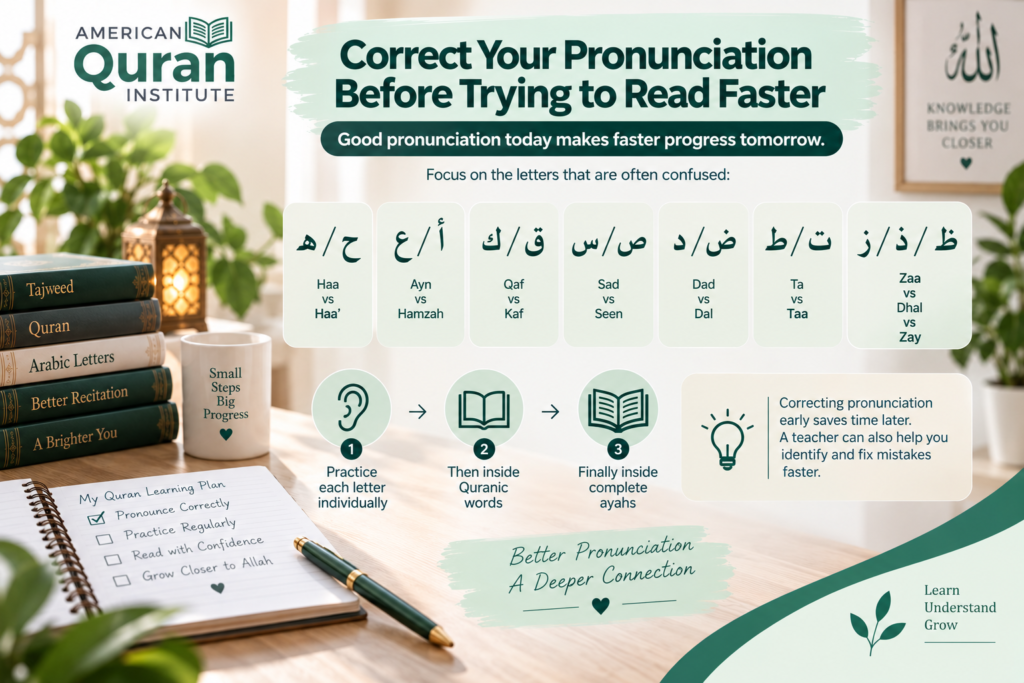
First, make sure you are pronouncing the Arabic letters correctly. Pay particular attention to letters that non-native Arabic speakers frequently confuse, such as:
ح / ه
ع / أ
ق / ك
ص / س
ض / د
ط / ت
ظ / ذ / ز
Practice each difficult letter individually, then inside Quranic words, and finally inside complete ayahs.
Correcting pronunciation early saves considerable time later. If you repeatedly memorize an ayah with an incorrect pronunciation, you may eventually have to unlearn the mistake before learning the correct form.
This is one reason studying with a teacher can accelerate progress. A teacher can hear errors that you may not recognize when practicing alone.
Step 4: Learn the Tajweed Rules You Need Most
You do not have to memorize an entire Tajweed textbook before you can begin reading the Quran.

Start with the rules you encounter frequently in your daily recitation, such as:
- Noon Sakinah and Tanween
- Meem Sakinah
- Ghunnah
- Qalqalah
- Madd
- Rules of Laam and Raa
- Basic stopping and starting rules
Then apply each rule directly while reading.
For example, after studying Qalqalah, open the Mushaf and identify examples instead of simply memorizing its definition. This transforms Tajweed from theory into an actual recitation skill.
If pronunciation and Tajweed are currently slowing your progress, online Tajweed classes can provide structured instruction and direct correction rather than leaving you to identify every mistake independently.

Step 5: Break Every Lesson Into Small Portions
Trying to learn an entire Quran page at once can make the lesson feel heavier than it needs to be. A better approach is to divide the material into small, manageable sections and master each part before moving on.
If you are improving your recitation, focus on one or two lines at a time. Read them slowly, correct any pronunciation mistakes, and repeat them until your reading becomes smoother.
If your goal is memorization, work with one ayah at a time—or even part of a long ayah if necessary. Once the first ayah is stable, move to the second, then connect both before adding more.
A simple sequence looks like this:
Ayah 1 → Repeat → Recite without looking
Ayah 2 → Repeat → Recite without looking
Ayahs 1 + 2 → Recite together
Ayah 3 → Repeat → Recite without looking
Ayahs 1–3 → Recite together
Continue the same pattern until you complete your daily portion This cumulative method helps strengthen the connection between ayahs and reduces the chance of reaching the end of a page only to discover that the beginning has already become weak.
Breaking memorization into smaller portions can also make mistakes easier to notice and correct before they become part of your recitation.
See Us in Action!
Take a look inside our virtual classrooms. Watch the clip below to see how our instructors engage with students, simplify complex rules, and create an inspiring environment for learning.
Start Your Quranic Education
Join our premier online institute for structured Quranic learning tailored for students in the USA.
Book Your Free TrialStep 6: Use Repetition Properly to Learn Quran Fast
Repetition is one of the most effective answers to how to learn Quran fast, but repeating an ayah many times without testing yourself can waste time. Effective repetition should move you gradually from reading the ayah to recalling it independently.

Read and Repeat the Ayah Until Your Recitation Becomes Stable
Start by reading one ayah slowly from the Mushaf several times, paying close attention to pronunciation and Tajweed. Then repeat it aloud without rushing.
If you keep making a mistake in one word or phrase, focus your repetition on that specific section instead of restarting the entire ayah every time. This helps you spend more time on the part that actually needs improvement.
Close the Mushaf and Test Whether You Can Recall the Ayah
After several correct repetitions, cover the ayah or close the Mushaf and try to recite it from memory.
If you hesitate or forget a word, check the exact place where the mistake occurred, repeat that phrase several times, and then test yourself again. Do not move forward simply because the ayah feels familiar while you are looking at it.
Focus Extra Repetition on Weak Parts Instead of Repeating Everything
Not every part of an ayah needs the same amount of repetition. If the beginning is already secure but you repeatedly forget the middle, concentrate your effort on the weak section.
Once that part becomes stable, reconnect it to the complete ayah and recite everything together. This makes repetition active and targeted, helping you learn faster without sacrificing accuracy.
Step 7: Listen to One Skilled Qari and Repeat
Listening can make Quran learning considerably easier, particularly if Arabic is not your first language.
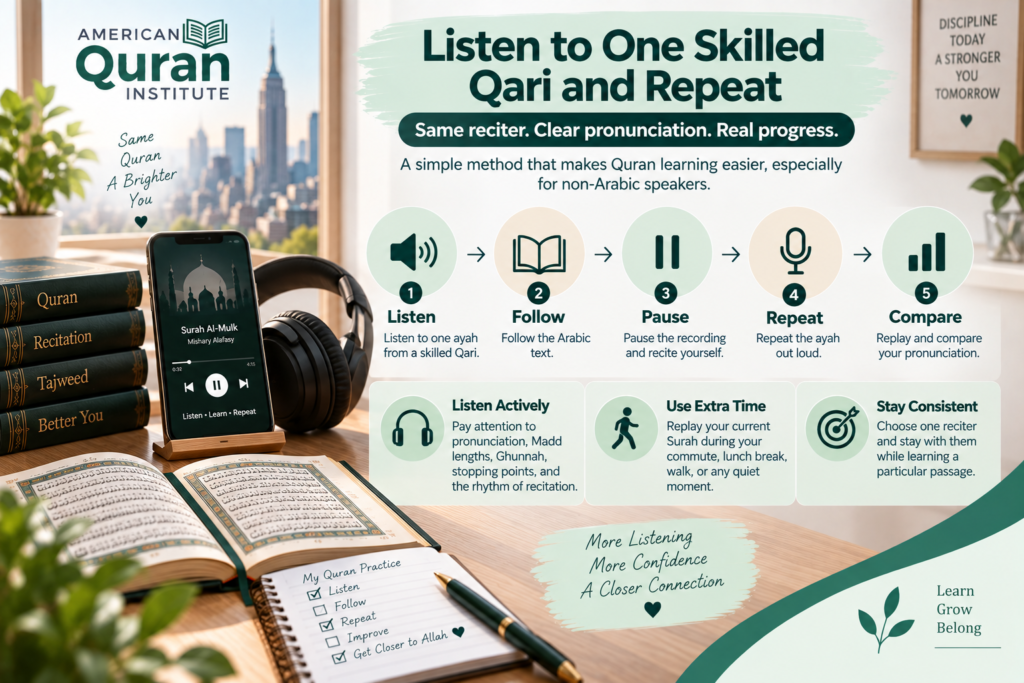
Choose a skilled Qari with slow, clear recitation and stay with the same reciter while learning a particular passage. Listen to one ayah while following the Arabic text. Pause the recording and imitate the recitation. Then replay it and compare your pronunciation.
Do not treat Quran audio as background sound during your main learning session. Listen actively to the pronunciation of letters, Madd lengths, Ghunnah, stopping points, and rhythm of the recitation.
You can then replay your current Surah during a commute, lunch break, walk, or another quiet period during your day.
For learners in the USA with limited study time, this is an easy way to create additional exposure without adding another formal lesson.
Step 8: Understand the Meaning of What You Are Learning
Understanding the meaning of an ayah gives your memory another strong connection. Before memorizing a passage, read a reliable English translation and make sure you understand its main message.
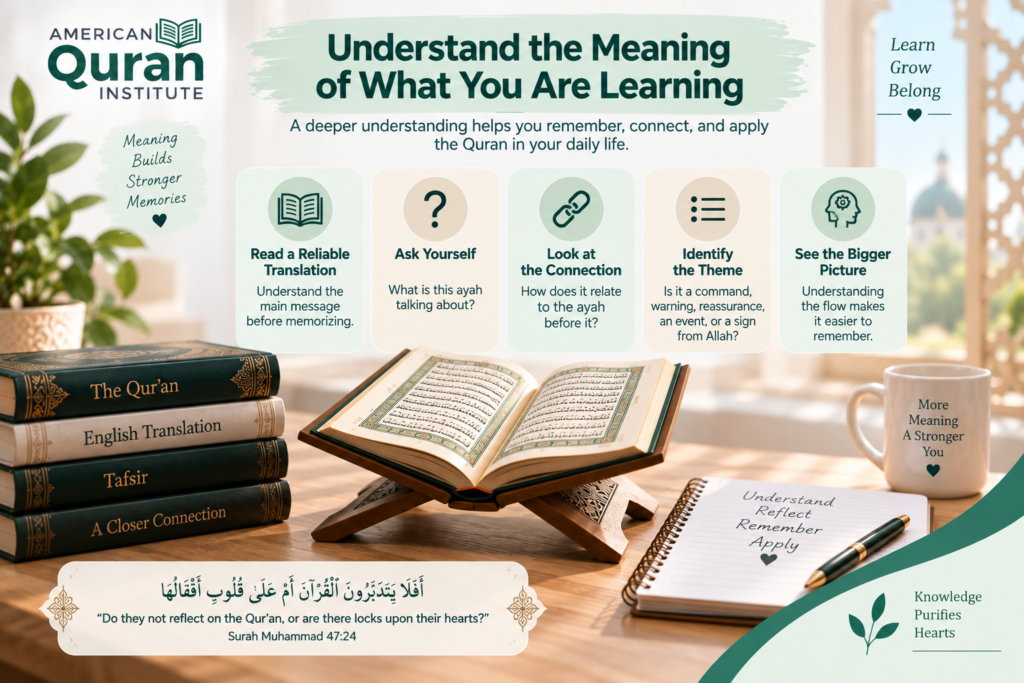
As you read, ask yourself: What is this ayah talking about? How does it connect to the ayah before it? Is it giving a command, describing an event, offering reassurance, giving a warning, or pointing to one of Allah’s signs? Once you understand how the ideas move from one ayah to the next, the Arabic sequence often becomes easier to remember.
This is especially useful for longer passages because you are no longer memorizing disconnected sounds—you are following a meaningful sequence from beginning to end.
Step 9: Use Your Daily Salah as an Extra Revision Session
Your Quran memorization should not end when you close the Mushaf. Daily Salah gives you a natural opportunity to revise newly memorized Surahs and ayahs while also strengthening your connection with what you are learning.
For example, if you memorize several short ayahs in the morning, try reciting them again during your prayers throughout the day whenever appropriate.
Each prayer becomes another opportunity to retrieve the passage from memory. By the evening, you may have recalled the same verses several times without needing to schedule a completely separate revision session.
This method is especially practical for busy Muslims in the United States who may struggle to find long, uninterrupted periods for Hifz between work, study, family responsibilities, and daily commitments. Instead of waiting for the perfect time to revise, you can make use of an act of worship that is already part of your daily schedule.
Reciting memorized passages in Salah can also reveal which parts still need more attention. If you hesitate at a particular ayah or confuse the order of verses, make a mental note to review that section afterward using the Mushaf.
In this way, Salah can support both revision and active recall, helping newly memorized Quran become more stable over time.
Step 10: Review Old Quran Before Adding Too Much New Material
Fast memorization is only useful when you can retain what you have already learned. Muraja’ah (regular revision) should therefore be part of your daily Hifz routine from the beginning.

Before adding new ayahs, test your previous lesson without looking at the Mushaf. If you can recite it confidently, continue with new material. If you hesitate frequently or need prompts, reduce the new portion and focus on strengthening what you already know.
A simple daily balance could be:
- 10 minutes: Review the previous lesson.
- 15–20 minutes: Memorize new material.
- 10 minutes: Revise older Surahs and ayahs.
Regular revision keeps earlier memorization active while you continue progressing. Without Muraja’ah, you may memorize quickly in the short term but struggle to retain the Quran consistently over time.
If Hifz is your main goal, structured Quran Memorization Classes can help you balance new memorization, revision, correction, and regular testing rather than trying to manage every part of the process alone.

Step 11: Learn With a Qualified Quran Teacher Online
Finding a suitable local Quran teacher can be difficult depending on where you live in the United States. Someone living close to a large Muslim community may have several mosques, Islamic centers, and Quran teachers nearby. A Muslim living farther from a major Islamic center may have far fewer options.
Online Quran learning removes much of this geographical limitation. Instead of choosing a teacher simply because they are nearby, you can study from home with a qualified instructor while arranging lessons around your work, college, or family schedule.
This is particularly useful across US time zones. Learners on Eastern, Central, Mountain, and Pacific Time can choose online lesson times that fit their individual routines rather than relying exclusively on a fixed local class.
One-to-one instruction can also accelerate learning because the lesson focuses on your specific errors. Your teacher can stop you immediately when a letter, Madd, Ghunnah, or stopping point needs correction That prevents small mistakes from becoming permanent habits.
Meet our Arabic and Quran teachers.

Step 12: Track Your Quran Progress Every Week
Do not measure progress only by asking, “How much Quran did I finish? Measure accuracy as well.
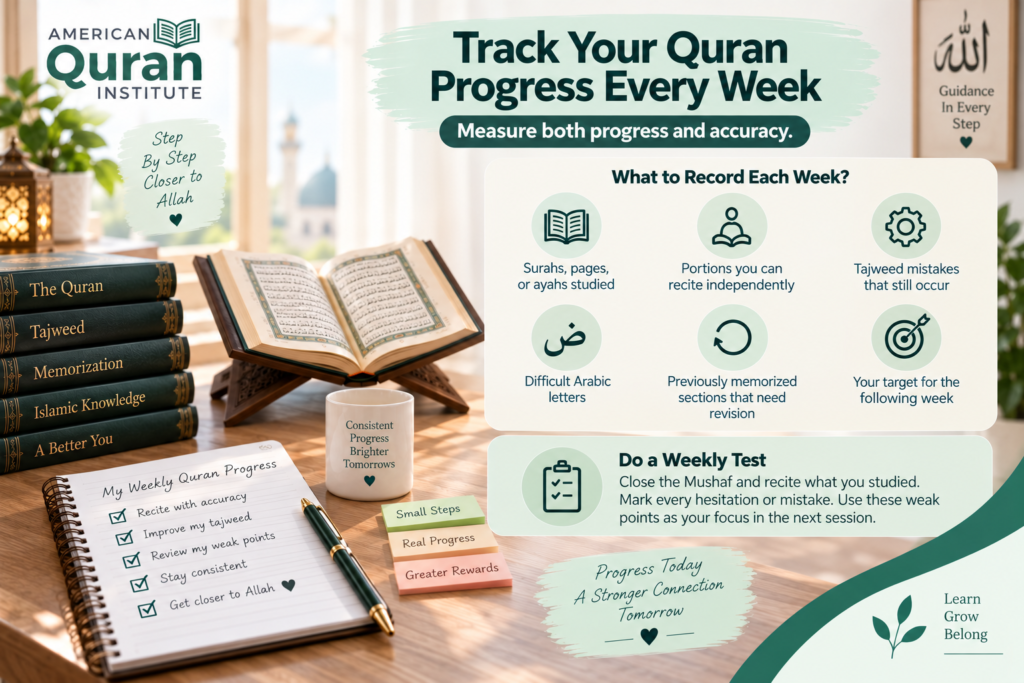
At the end of every week, record:
- Surahs, pages, or ayahs studied.
- Portions you can recite independently.
- Tajweed mistakes that still occur.
- Difficult Arabic letters.
- Previously memorized sections that need revision.
- Your target for the following week.
You can also perform a simple weekly test. Close the Mushaf and recite the material you studied that week. Mark every hesitation or mistake. Those weak points become the first material you review in your next session.
This prevents the common problem of constantly moving forward while leaving weaknesses behind.
A Simple Daily Routine to Learn Quran Quickly in the USA
You do not need hours of free time to make steady progress with the Quran. A simple routine built around the time you actually have can make daily learning easier to maintain.
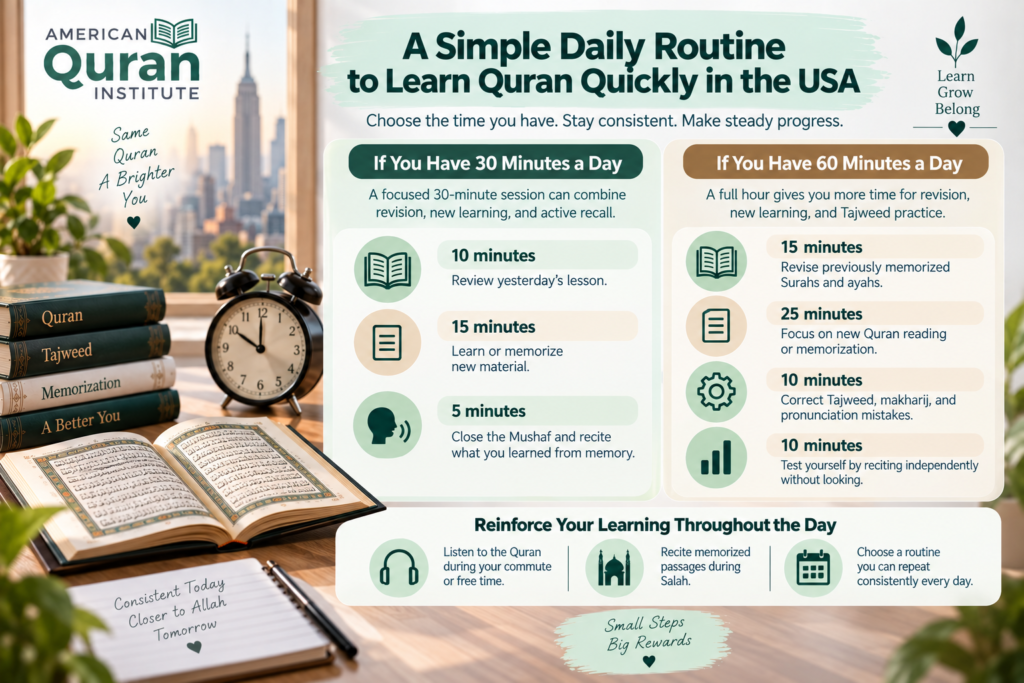
If You Have 30 Minutes a Day
A focused 30-minute session is enough to combine revision, new learning, and active recall without making your daily routine feel overwhelming.
- 10 minutes: Review yesterday’s lesson.
- 15 minutes: Learn or memorize new material.
- 5 minutes: Close the Mushaf and recite what you learned from memory.
If You Have 60 Minutes a Day
With a full hour, you can give more attention to older revision while also working on Tajweed, pronunciation, and independent recitation.
- 15 minutes: Revise previously memorized Surahs and ayahs.
- 25 minutes: Focus on new Quran reading or memorization.
- 10 minutes: Correct Tajweed, makharij, and pronunciation mistakes.
- 10 minutes: Test yourself by reciting independently without looking.
You can reinforce your lesson outside the main study session by listening during your commute or free time and reciting memorized passages during Salah. The exact schedule matters less than choosing a routine you can repeat consistently every day.
How to Learn the Quran Fast and Easy Without Sacrificing Accuracy?
Learning the Quran quickly should mean using your study time efficiently, not rushing through lessons at the expense of correct recitation and strong retention.
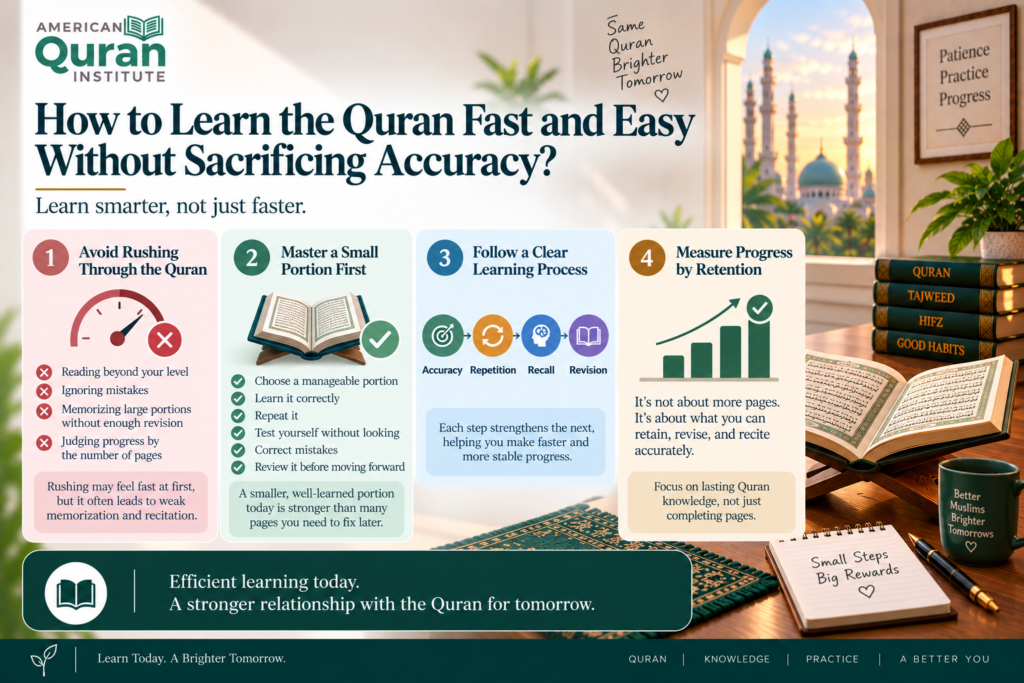
1. Rush Through the Quran Creates Weak Memorization and Recitation
Rushing means reading beyond your current ability, ignoring pronunciation mistakes, memorizing large portions without enough revision, and measuring success only by the number of pages completed.
This may create the feeling of fast progress at first, but weak memorization and repeated mistakes often require additional correction later.
2. Master a Small Portion Before Moving to New Ayahs
Efficient learning means choosing a manageable portion, learning it correctly, repeating it, testing yourself without looking, correcting mistakes, and reviewing it before moving forward.
This approach may initially seem slower than completing several pages at once, but over time it can reduce the need to return and repair weak memorization or incorrect pronunciation.
3. Follow Accuracy, Repetition, Recall, and Revision for Faster Progress
A strong Quran learning process follows a clear sequence:
Accuracy → Repetition → Recall → Revision → Progress
Each stage strengthens the next, helping you build new Quran learning on material that is already secure.
4. Measure Quran Progress by Retention, Not the Number of Pages
Completing more pages does not necessarily mean you are learning more effectively. Strong progress means being able to retain, revise, and recite what you have learned accurately.
Instead of focusing on:
More pages → More pages → More pages
Focus on building Quran knowledge that remains strong as you continue moving forward.
The American Quran Institute offers dedicated Qiraat Classes for learners ready to progress beyond foundational recitation and Tajweed into more advanced Quranic recitation study.

How Long Does It Take to Learn Quran?
There is no fixed number of weeks or months for learning the Quran. Your timeline depends on where you start, what you want to achieve, and how consistently you study and revise.

Your Starting Level Determines How Long Quran Learning Takes
A complete beginner who is still learning Arabic letters will naturally need a different amount of time from someone who can already read Arabic fluently. Your age, available study time, consistency, and access to teacher feedback can also influence your progress.
Your Quran Learning Goal Changes the Expected Timeline
Learning to recognize Arabic letters, developing basic Quran reading skills, mastering Tajweed, and memorizing the entire Quran are very different goals. Instead of comparing your timeline with other learners, measure your progress according to the specific skill you are working toward.
Consistent Improvement Is More Important Than Finishing Quickly
Rather than asking only, “How fast can I finish?”, use practical questions to evaluate your progress:
- Can I read today’s lesson more accurately than last week?
- Can I recite what I memorized without looking?
- Am I retaining what I learned one week ago?
If your accuracy, independent recall, and long-term retention are improving, you are making meaningful Quran progress—even if your learning takes longer than someone else’s.
Experience Our Classroom Environment
Don’t just take our word for it—experience a live session for yourself! Click on the videos below to watch real snippets from our classes and see our interactive teaching methods in real-time.
Start Your Quranic Education
Join our premier online institute for structured Quranic learning tailored for students in the USA.
Book Your Free TrialStart Your Quran Learning Journey Online With American Quran Institute
Learning the Quran quickly is not about finding a secret shortcut. Real progress comes from having a clear goal, studying consistently, correcting pronunciation early, practicing essential Tajweed, repeating manageable portions, and reviewing what you have already learned.
For Muslims across the United States, online Quran learning can make this process easier to maintain alongside work, school, university, and family responsibilities.
Having structured guidance also helps you know what to study next instead of moving between different resources without a clear learning path.
At American Quran Institute, students can learn the Quran online with structured guidance designed to support steady improvement in reading, recitation, Tajweed, and memorization according to their current level and goals.
If you have been searching for how to learn Quran quickly in the USA, start with one realistic daily session and build from there. A small amount learned correctly and consistently can become the foundation for lasting progress with the Quran.
Our Quran Courses
- Quran Tafsir Course
- Noorani Qaida Course
- Noorani Qaida Course for Kids
- Weekend Quran Classes
- Intensive Quran Course
- Al-Azhar Quran Course

Conclusion
Learning the Quran quickly is not about rushing through pages or trying to achieve everything in a few weeks. The most effective approach is to make each study session count by focusing on correct pronunciation, essential Tajweed, repetition, active recall, and regular revision.
Start from your current level, choose a realistic daily routine, and work with small portions that you can read or memorize accurately before moving forward. Even 20–30 focused minutes each day can become valuable when you remain consistent and continue reviewing what you have already learned.
Most importantly, measure your progress by the strength of your recitation and retention rather than by speed alone. If you can read more accurately, remember more without looking, recognize your mistakes, and retain previous lessons, you are moving in the right direction.
The best answer to how to learn Quran quickly in the USA is therefore simple: learn consistently, correct mistakes early, revise regularly, and build your Quran skills one strong lesson at a time.
FAQs About How to Learn Quran Quickly in the USA
How can I learn Quran fast as a beginner?
Start with the skill currently preventing you from progressing. If you cannot read Arabic comfortably, begin with letters, vowel marks, joining letters, and simple Quranic words. Once reading becomes easier, gradually introduce Tajweed, longer passages, and memorization.
Trying to learn everything simultaneously can slow you down.
How can I learn the Quran quickly while working full-time in the USA?
Use short, predictable sessions rather than waiting for large blocks of free time. A 20–30 minute session before work, after Fajr, after Isha, or at another consistent time can work well.
Use smaller periods during the rest of the day for listening and revision.
What is the fastest way to memorize Quran without forgetting?
Memorize small portions, repeat them aloud, connect each new ayah with the previous one, test yourself without looking, and revise previously memorized material every day.
Do not increase your new memorization target if your older portions are becoming weak.
Can I learn Quran online in the USA?
Yes. Online Quran study can be especially practical for US learners because it removes geographical restrictions and makes it easier to arrange lessons around different time zones, work schedules, school, and family responsibilities.
Should I learn Tajweed before memorizing Quran?
You do not need to master every advanced Tajweed topic before memorizing, but your basic pronunciation and frequently used Tajweed rules should be corrected early.
Otherwise, repeated pronunciation mistakes may become embedded in your memorization and require additional work to correct later.
Is 30 minutes a day enough to learn Quran?
Thirty focused minutes every day can produce meaningful progress, especially when the session combines revision, new learning, repetition, and self-testing.
Consistency matters more than occasionally studying for several hours and then stopping for days.







[…] Read also: How To Learn Quran Quickly In The Usa? – 12 Practical Steps […]