 Quran
Quran
Every year, thousands of Americans pick up the Quran — out of curiosity, academic interest, or a genuine desire to understand the beliefs of their neighbors, colleagues, or friends.
Reading the Quran as a non-Muslim is permissible in Islam. According to classical Islamic scholarship, a non-Muslim may read, listen to, and study the Quran for the purpose of learning, inquiry, or understanding. The Prophet Muhammad himself recited the Quran to non-Muslims who had not yet embraced the faith.
The one practical guideline that applies: avoid physically touching the Arabic-only printed Mushaf, as most Islamic scholars hold that this requires ritual purity. Reading on a phone, tablet, or computer — or from a bilingual translated edition — carries no such restriction.
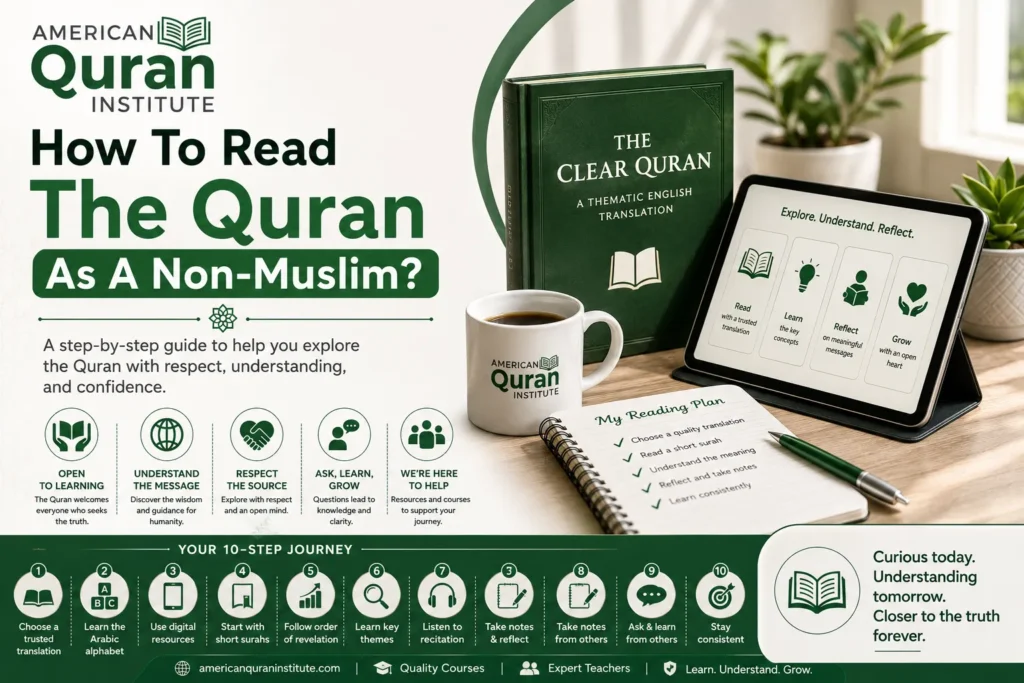
This guide breaks down ten concrete, sequenced steps for how to read the Quran as a non-Muslim — drawn from Islamic scholarly guidance, practical experience working with English-speaking American learners, and the gaps that most introductory resources don’t address. These steps are sequenced for someone beginning from zero.
Book your free trial class today
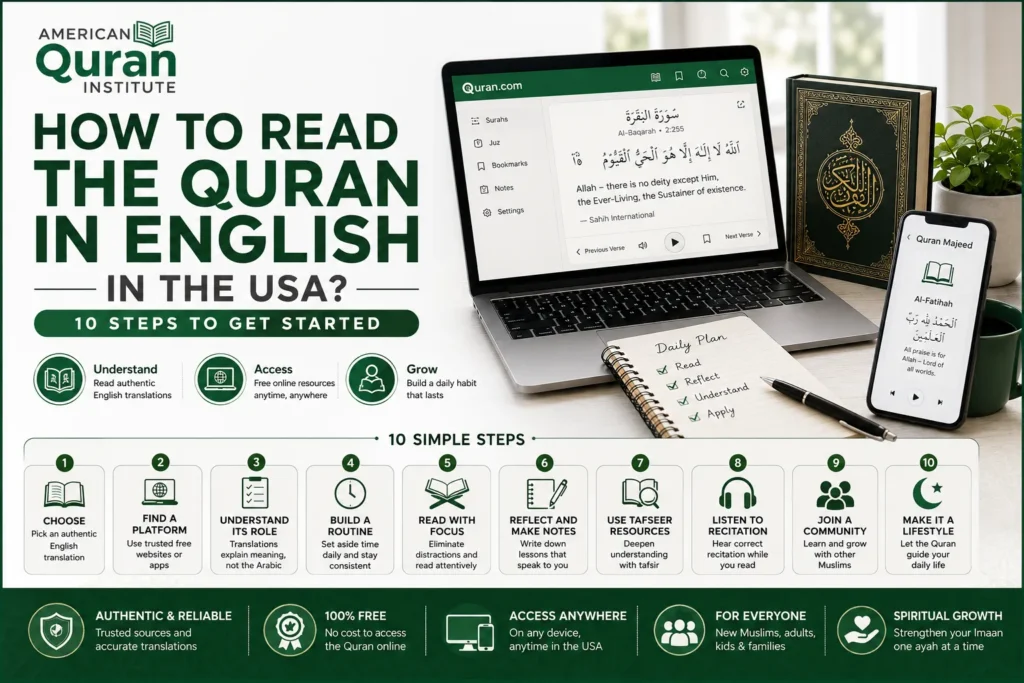
1. How To Read The Quran As A Non-Muslim Starts With A Trusted English Translation
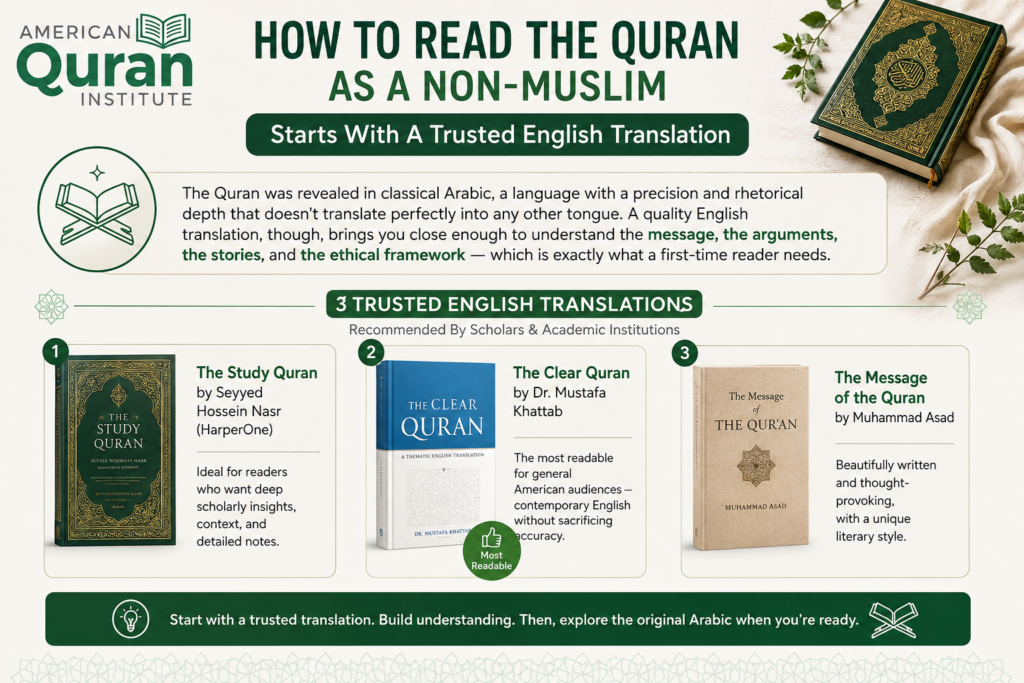
The Quran was revealed in classical Arabic, a language with a precision and rhetorical depth that doesn’t translate perfectly into any other tongue. A quality English translation, though, brings you close enough to understand the message, the arguments, the stories, and the ethical framework — which is exactly what a first-time reader needs.
For American readers, three translations are consistently recommended by scholars and academic institutions: The Study Quran by Seyyed Hossein Nasr (HarperOne), The Clear Quran by Dr. Mustafa Khattab, and The Message of the Quran by Muhammad Asad. The Clear Quran is the most readable for general American audiences — contemporary English without sacrificing accuracy.
The Study Quran includes extensive scholarly commentary per passage, making it the natural choice for academic readers. As a starting resource for how to read the Quran as an English speaker, any of these three will serve you well.
Read also: How To Make Reading Quran More Interesting In The USA?
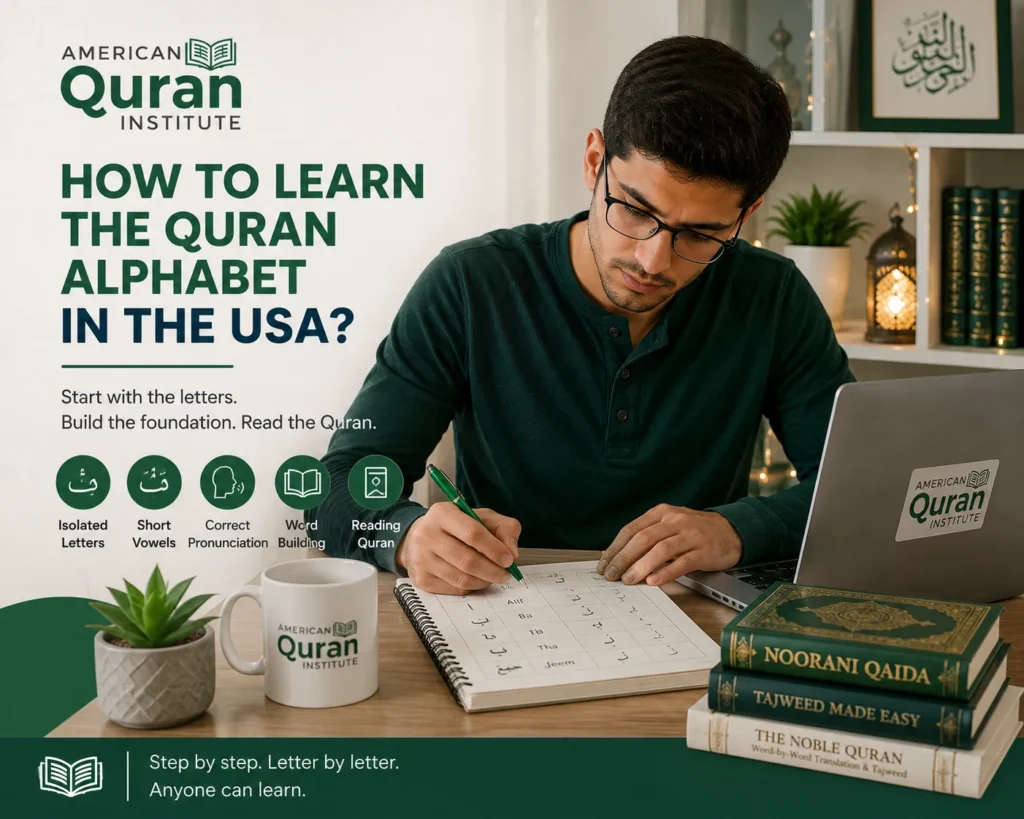
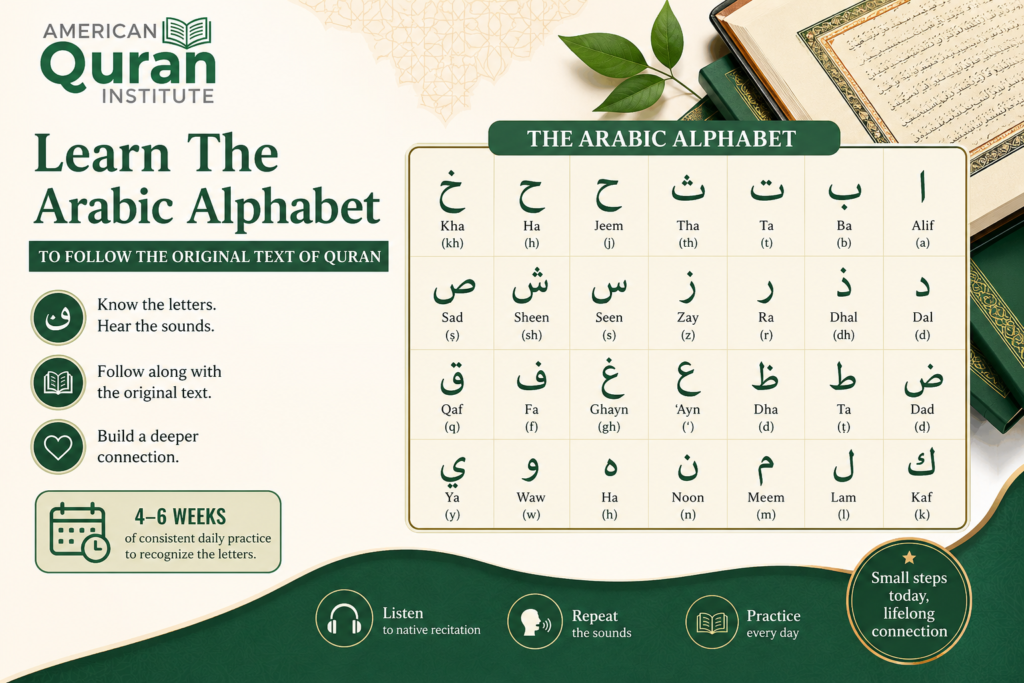
2. Learn The Arabic Alphabet To Follow The Original Text Of Quran
You don’t need to become fluent in Arabic to benefit from learning the alphabet. Even basic phonetic familiarity with Arabic letters, knowing how they sound and how they connect, gives a non-Muslim reader a layer of connection to the original text that no translation can fully replicate.
For Americans who want to take this step, how to learn the Quran alphabet is more manageable than it sounds. Most dedicated learners reach basic letter recognition within four to six weeks of consistent, daily practice. Once you can sound out Arabic letters, you can begin to follow along with audio recitation in the original, which deepens both comprehension and personal engagement considerably.
3. Read The Quran On A Digital Device And Not Through A Physical Mushaf
One of the most persistent misconceptions among non-Muslims in the U.S. is that reading the Quran requires obtaining a physical copy from a mosque or Islamic bookstore. In practice, digital tools have made access easier than ever and they carry none of the ritual restrictions that apply to the printed Arabic Mushaf.
Apps like Quran.com, iQuran, and Muslim Pro display the full text with parallel English translations, word-by-word breakdowns, and audio playback. You can search by topic, compare multiple translations of the same verse side by side, and bookmark passages for reflection.
For any American who wants to explore the Quran on their own schedule, a digital copy on a phone or tablet is the most accessible, practical, and unrestricted starting point available.

4. Begin With Shorter Surahs To Build Real Confidence
The Quran is not arranged chronologically, and chapter one is not an introduction in any Western sense. Al-Fatiha — the opening chapter — is a seven-verse prayer: powerful and significant, but not a narrative entry point. The longest chapters appear near the beginning of the standard arrangement, and many of the most accessible ones are near the end.
The last section of the Quran, known as Juz’ Amma (covering chapters 78 through 114), is the most practical entry point for a non-Muslim starting out.
These chapters are short, vivid, and rhythmically powerful, covering themes of gratitude, human accountability, judgment, and moral clarity in compressed, direct language. Starting here lets you complete a full chapter in a single sitting — which builds the kind of momentum that keeps a new reader coming back.
Read also: How To Read And Understand Quran?
Explore The American Quran Institute’s Al-Azhar Quran Course in the USA
See Us in Action!
Take a look inside our virtual classrooms. Watch the clip below to see how our instructors engage with students, simplify complex rules, and create an inspiring environment for learning.
Start Your Quranic Education
Join our premier online institute for structured Quranic learning tailored for students in the USA.
Book Your Free Trial5. Follow the Order of Revelation to Understand How the Message Unfolded
Reading the Quran in the order it was revealed offers a different way to understand its message and historical development. Instead of following the standard Mushaf arrangement, readers can trace how the Quranic message unfolded over approximately 23 years and how its themes developed through different stages.
A. Understand the Two Main Phases of Quranic Revelation
The Quran was revealed over approximately 23 years in two major phases. The Meccan period focused largely on theology, morality, faith, and the afterlife, while the Medinan period addressed community life, law, governance, and social ethics. The standard Mushaf arrangement brings revelations from both periods together.
B. See How the Quranic Message Developed Over Time
Reading the Quran chronologically allows non-Muslim readers to follow the historical progression of its message. It can make certain arguments easier to understand, provide clearer context, and reveal how theological themes developed from the earliest revelations to the later ones.
Start Reading the Quran Accurately with our USA Classes
6. Listen To Audio Recitation Before You Follow Along In Text
The Quran is, at its core, an oral scripture. Its very name means “the recitation.” For fourteen centuries, it has been transmitted primarily through sound — memorized and passed from teacher to student through the voice alone. Reading it silently on a page, while valuable, misses a significant dimension of the experience.
Before reading a chapter in text, listen to a professional recitation first. Sheikh Mishary Rashid Al-Afasy is widely available on YouTube and most Quran apps, and his recitation is clear enough for a first-time listener to follow along with a translation.
This approach — audio first, then text — mirrors how millions of learners begin, and it helps you absorb the rhythm and internal structure of the text before engaging it analytically.
Read also: How To Learn To Read Quran Word By Word In The USA?

7. Read Thematically Around Quran Topics That Genuinely Interest You
One of the most effective strategies for non-Muslim readers — one that most introductory guides skip over entirely — is thematic reading rather than sequential reading. The Quran addresses hundreds of themes: the nature of God, the lives of Biblical prophets, the ethics of wealth and charity, the treatment of neighbors and non-Muslims, justice, the human condition, and the nature of the afterlife.
If you’re a Christian or Jewish reader, you’ll find familiar figures — Abraham, Moses, Mary, Jesus — retold from a distinct theological perspective. If your interest is ethics or political philosophy, chapters on justice, consultation, and communal responsibility offer substantial material. Apps like Quran.com allow you to search by theme or keyword, making thematic reading genuinely practical even before you know your way around the text.
8. Explore Tafsir Of Quran Which Is The Commentary That Opens The Text Right Up
Every verse of the Quran carries context: a reason for its revelation, a linguistic precision in the original Arabic, and centuries of accumulated scholarly interpretation. Without access to some of that context, certain passages can seem abrupt, puzzling, or decontextualized — particularly when read in isolation.
Tafsir (exegetical commentary) addresses this directly. For English-speaking American readers, Ibn Kathir’s Tafsir Ibn Kathir (available in English and free online) and In the Shade of the Quran by Sayyid Qutb are two of the most accessible options.
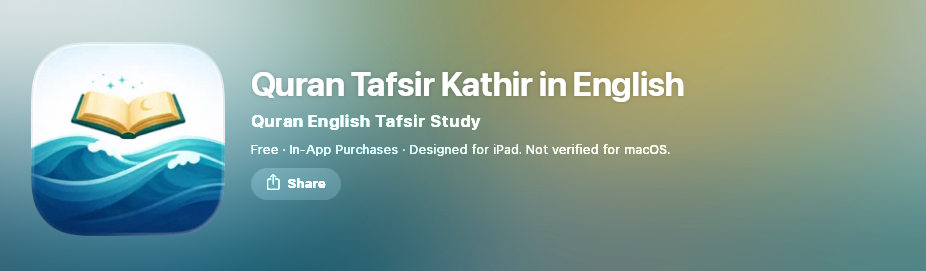
Reading even a condensed tafsir note alongside each chapter produces a richer, more honest reading experience. The difference is comparable to reading Shakespeare bare versus reading him with a modern-English companion — the choices make sense, the words clarify, and the meaning becomes whole.
Begin Quranic Interpretation Studies with The American Quran Institute

9. Work With A Qualified Teacher For Accurate, Guided Reading
Self-study takes you a meaningful distance. But at some point — particularly if your interest in the Quran is deepening, you’re considering Islam, or you want to read the Arabic text correctly — working with a qualified teacher is the step that changes the entire experience.
A good teacher doesn’t just correct pronunciation. They explain why certain passages are translated the way they are, what the scholarly debate around a verse has looked like historically, how the text connects to Islamic practice, and — for those approaching this as seekers — how to make sense of what they’re encountering spiritually.
For Americans who want to know how to learn the Quran in the USA without navigating language barriers or travel constraints, live online instruction has made expert access more practical than at any point in history.
American Quran Institute, based in the USA, connects American Muslims — children, adults, ladies, and new Muslims — with Ijazah-certified teachers who specialize in guiding English speakers from the Arabic alphabet through fluent recitation.
Read also: How To Read Quran If You Don’t Know Arabic?
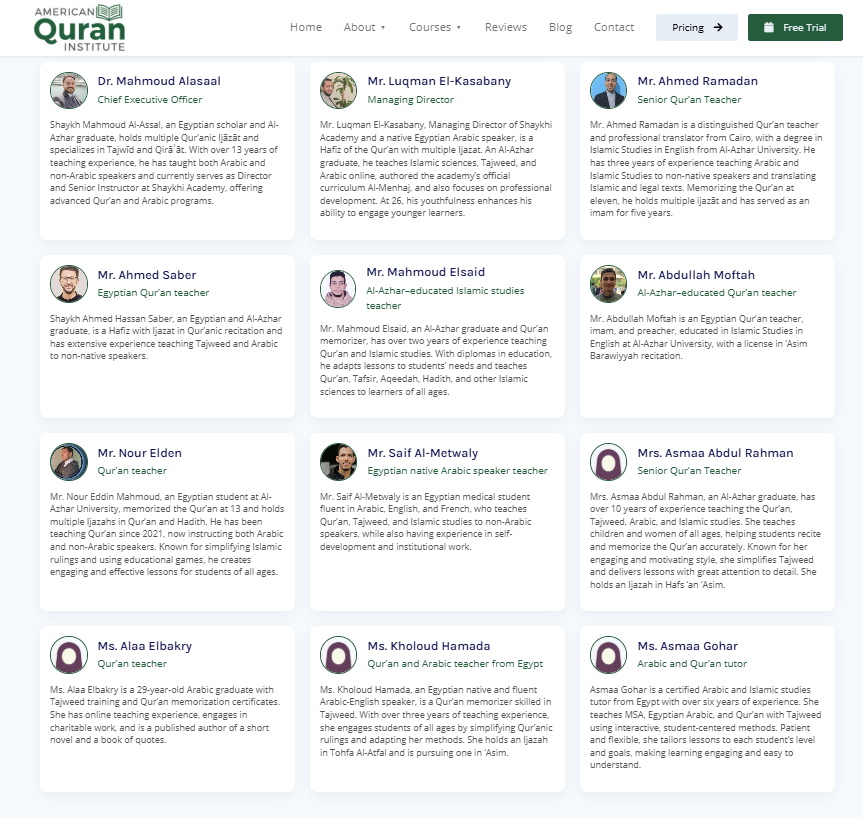
10. Approach The Text With Respect Because This Is Someone Else’s Sacred Ground
Reading the Quran respectfully doesn’t require a religious conversion or ritual preparation. It requires the same thoughtfulness you’d bring to any sacred text from any tradition — the kind of good-faith engagement that makes the reading genuinely rewarding rather than transactional.
A few practical guidelines for non-Muslim readers in the United States:
- Read with the intention to understand, not to refute or dismiss.
- Digital copies and translated editions may be handled freely by anyone.
- If someone lends you a physical Arabic Mushaf, treat it with care.
- Approach quoted passages in their full context before drawing conclusions from single verses.
- The Quran is an active, living scripture for 1.8 billion people worldwide — the intellectual seriousness that implies is well earned.
These aren’t external rules imposed on you. They’re the kind of good-faith baseline that opens the door to honest, substantive conversation — which, for most Americans who read the Quran seriously, is exactly what follows.
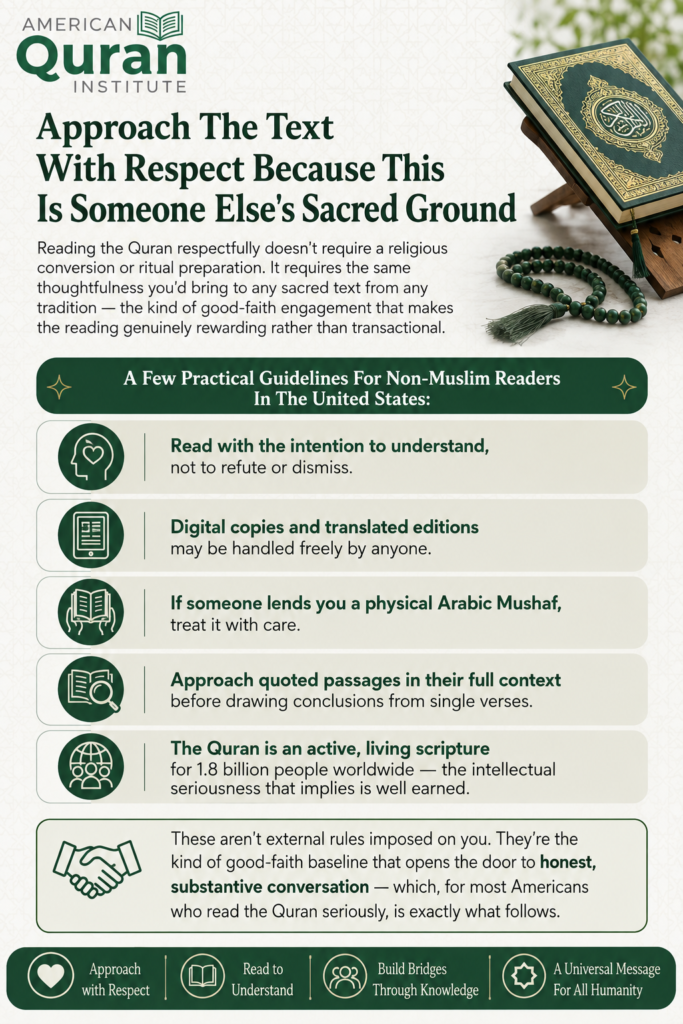
Building A Reading Practice That Stands The Test Of Time
A single read-through of the Quran gives you a foundation. What develops real understanding is the habit of return visits — the kind that come naturally from how to start reading the Quran daily, even in short ten-to-fifteen-minute sessions. Familiarity builds comprehension in ways that one-time exposure simply doesn’t produce.
For non-Muslim readers wondering about powerful motivations to read Quran beyond initial curiosity, the academic record speaks clearly: scholars of religion, literary critics, historians, and comparative theologians have cited the Quran as among the most consequential texts in human civilization.
For those who’ve moved from reading to active listening and want to explore recitation in the original Arabic, the benefits of reciting Quran in the original language go well beyond what any translation can deliver — the original phonetics carry a precision and resonance that has defined Islamic practice and study for fourteen centuries.
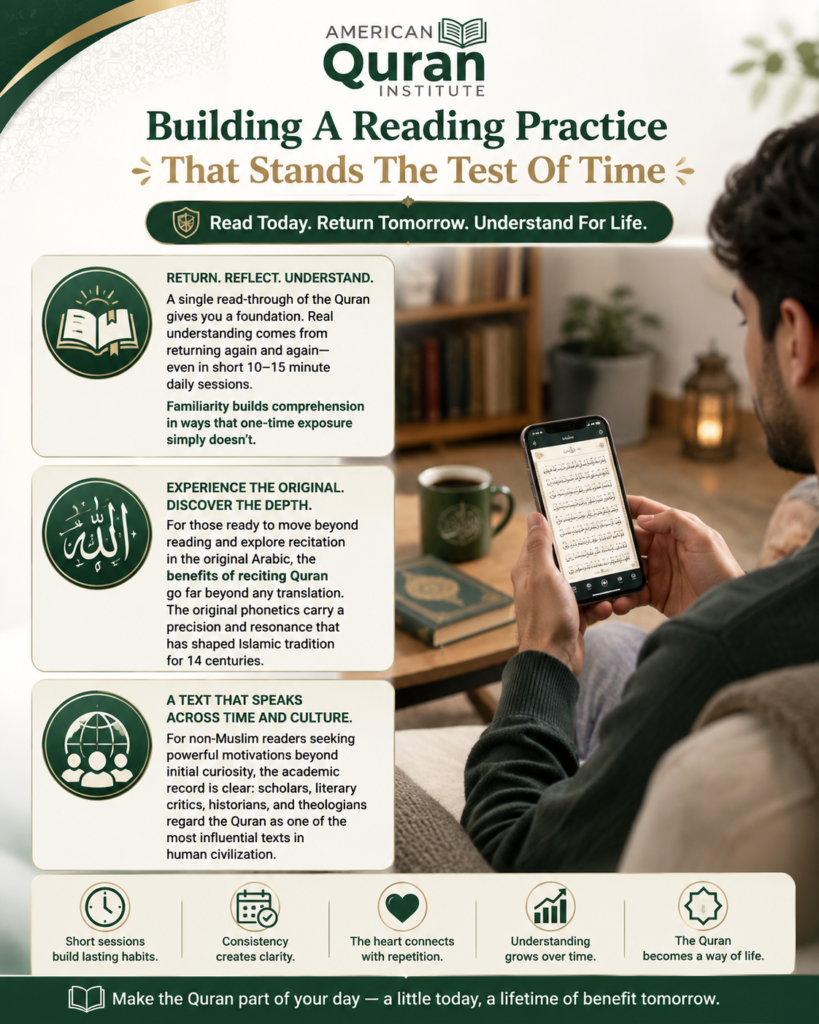
Experience Our Classroom Environment
Don’t just take our word for it—experience a live session for yourself! Click on the videos below to watch real snippets from our classes and see our interactive teaching methods in real-time.
Start Your Quranic Education
Join our premier online institute for structured Quranic learning tailored for students in the USA.
Book Your Free TrialDiscover How American Quran Institute Is Transforming Quran Learning
Many Americans who begin as curious non-Muslims find themselves wanting to go deeper — sometimes as seekers, sometimes as scholars, sometimes simply as neighbors trying to understand the faith of people they know and care about. At any stage of that journey, structured, expert-led instruction makes a measurable difference in how far and how accurately a learner progresses.
For those interested in going beyond reading to actual Quranic recitation, how to learn the Quran by yourself can take you a meaningful distance — especially with high-quality digital tools and a reliable translation. But sustained accuracy in pronunciation and Tajweed consistently requires a live teacher who can catch and correct errors in real time.
For families with children, learn Quran for kids in the USA is a search that reflects a real and growing need. Children who build a connection to Quranic recitation early carry that foundation through life in a way that adult learners genuinely envy. American Quran Institute‘s programs serve children and adults alike, with Ijazah-certified instructors and flexible scheduling built entirely around American routines and time zones.
Check Out Our Top Courses for Quran Learning
- Quran Classes in USA
- Noorani Qaida Course in the USA
- Online Quran Classes for Kids in the USA
- Online Tajweed Classes in the USA
- Quran Classes for Adults in the USA
- Quran Classes for Females in the USA
- Quran Ijazah Program in the USA
- Quran Memorization Course in the USA
- Tajweed Course for Kids in the USA
Book your free trial class today and find out what consistent, expert-guided Quran learning actually feels like.
Start Your Quranic Education
Join our premier online institute for structured Quranic learning tailored for students in the USA.
Book Your Free TrialConclusion
Reading the Quran as a non-Muslim is not the restricted, complicated undertaking that many Americans assume. Islamic scholarship has been consistent on this point for centuries: non-Muslims may read, listen to, and study the Quran for the purpose of understanding — and doing so with sincerity and intellectual honesty is considered entirely appropriate within Islamic tradition.
The ten steps in this guide give you a clear, actionable path. Start with a quality English translation. Use digital tools. Begin with shorter chapters. Listen before you read. Approach the text thematically. Follow the chronological order of revelation when historical context matters. Use tafsir as your companion guide.
Learn the Arabic alphabet when you’re ready to go deeper. Find a qualified teacher when self-study reaches its natural limit. And bring to the text the same respectful seriousness you’d bring to any great work from any civilization.
The Quran has been read and studied by non-Muslims for fourteen centuries — by critics, scholars, seekers, and admirers across every culture. It holds up under honest examination. For Americans engaging with it now, the access has never been easier, the tools never better, and the conversation around it never more worth joining.
Frequently Asked Questions
Can a non-Muslim touch and read the Quran?
Non-Muslims may read and listen to the Quran freely. The restriction most Islamic scholars apply concerns physically touching the printed Arabic-only Mushaf, which classical jurisprudence associates with ritual purity. Translations, bilingual editions, and all digital copies — on phones, tablets, or computers — carry no such restriction and are fully accessible to any reader.
Where should a non-Muslim start reading the Quran?
The most practical starting point is the last section — Juz’ Amma, covering chapters 78 through 114. These chapters are short, thematically coherent, and rhythmically vivid. Starting here lets you complete full chapters in a single sitting, building comprehension and confidence before moving to the longer, more complex chapters at the front of the standard text arrangement.
Is it disrespectful for a non-Muslim to read the Quran?
Approaching the Quran with genuine curiosity and intellectual honesty is not disrespectful — it’s exactly the kind of engagement Islamic tradition has welcomed from the beginning. The Prophet Muhammad himself recited the Quran to non-Muslims. The only context Islamic scholars consider inappropriate is deliberate mockery or misrepresentation. Sincere inquiry is not only permitted; it is encouraged.
Do I need to know Arabic to read the Quran?
A quality English translation gives you full access to the Quran’s content, arguments, and narratives. Basic familiarity with the Arabic script deepens the experience and allows you to follow along with recitation audio. For Americans looking to take that step, how to read the Quran in Arabic easy is genuinely achievable — most learners reach basic reading ability within four to six weeks of structured, consistent practice.
How long does it take to read the Quran in English?
The Quran in English translation contains approximately 77,000 words — roughly the length of a mid-sized novel. At a comfortable reading pace, a complete read-through takes around four to five hours. Most readers spread this across several weeks. Including tafsir and reflection time, a thorough first reading typically runs one to three months.
Are there Quran courses designed specifically for English speakers in the USA?
Yes. Several American institutions offer structured beginner courses for English-speaking learners — including non-Muslims exploring the faith, new converts, and American Muslims who never had formal Quranic instruction.
For those interested in reading accurately and progressing efficiently, including those wondering about how to read the Quran faster with correct Tajweed, American Quran Institute offers live online classes with Ijazah-certified instructors scheduled around US time zones.




Leave a Reply