 Quran
Quran

Reading the Quran is among the most rewarding acts a Muslim can perform but it’s also one where small errors can persist for years without the reader ever catching them.
Islamic scholars classify recitation errors into two types, and knowing which category an error falls into tells you how urgently it needs to be corrected.
Lahn Jali (clear mistakes) are errors that alter the meaning of a word substituting one letter for another or misreading a vowel mark in a way that produces a different word. Scholars consider correcting these errors obligatory.
Lahn Khafi (hidden mistakes) violate Tajweed rules without necessarily changing meaning, dropping the Ghunnah, shortening a Madd, or softening a letter that should carry heavy resonance.
This guide covers 10 of the most common mistakes when reading the Quran, the ones Tajweed-certified teachers correct most frequently, and gives you a clear path for addressing each one.
1. Mispronouncing Arabic Letters
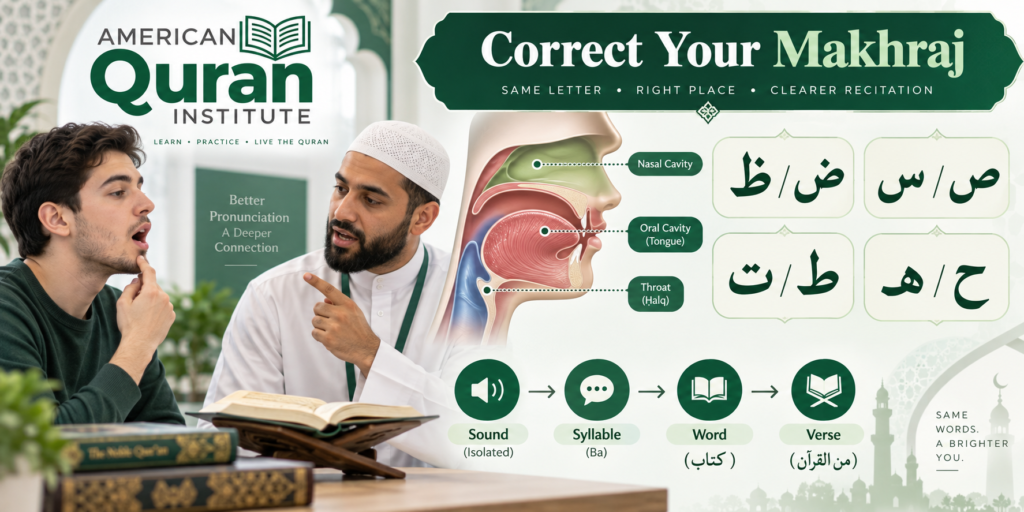
Every Arabic letter originates from a specific position in the mouth, throat, or nasal passage, its Makhraj (articulation point).
Pronouncing a letter from the wrong Makhraj is one of the most foundational Quran reading mistakes, and for English speakers, it’s nearly unavoidable without deliberate training.
English has no direct equivalent to letters like ض, ظ, ص, ح, or ع. Without a matching sound to anchor to, American readers unconsciously substitute the nearest English approximation ص becomes “s,” ط becomes “t,” and ع collapses into a vague glottal stop.
Read also: How To Concentrate While Reading Quran?
A. The Letter Pairs That Cause The Most Confusion For English Speakers
The most consistently confused pairs are ض/ظ, ص/س, ط/ت, and ح/هـ. Each pair involves letters that sound similar to an English ear but originate from entirely different positions in the Arabic vocal tract.
Getting these wrong tips a recitation from Lahn Khafi into Lahn Jali — because swapping ض for ظ or ص for س can produce a completely different Arabic word.
B. A Drill That Works Faster Than Full Verse Practice
Isolate the problem letter and repeat it alone, ten times, slowly, before moving to a syllable, then a word, then a verse.
Practicing full passages with unresolved articulation errors just reinforces the mistake. Build accuracy first, then fluency.
A strong foundation in letter recognition makes everything that follows faster. Understanding how to learn the Quran alphabet gives you the scaffolding that makes articulation drilling far more effective.
Read also: How To Get Better At Reading Quran In The USA?
Start Your Quranic Reading Journey with American Quran Institute

2. Misapplying The Rules Of Nun Sakin And Tanween
The Nun Sakin (silent Nun) and Tanween (double vowel) rules govern what happens when a Nun sound appears before specific letters, producing four distinct effects.
Izhar (clear pronunciation), Idgham (merging), Iqlab (conversion to Meem), and Ikhfa (partial hiding with nasalization). These four rules appear hundreds of times in the Quran.
Getting them wrong is one of the most systemic Quran reading mistakes precisely because of how frequently they recur throughout the text.
Read also: How To Improve Recitation Of The Quran In The USA?
Master Tajweed Recitation with The American Quran Institute’s Adult-Focused Training

A. Why Most Readers Default To Izhar For Everything
Izhar is the clearest and most intuitive outcome — just pronounce the Nun normally.
Many readers apply it everywhere, regardless of what letter follows, because it requires no additional technique. The result is a recitation that ignores the natural rhythm and sound the Quran is designed to carry.
B. The Ikhfa Rule Is The Most Consistently Missed
Ikhfa requires a nasalized, partially hidden sound held for approximately two vowel beats (Harakat). It’s the middle ground: not as clear as Izhar, not as merged as Idgham and most readers skip from one end to the other without touching it.
Identifying the 15 Ikhfa letters and practicing the nasalized hold in isolation is the fastest path to resolving this error.
Book your place in our Noorani Qaida classes

3. Missing The Mark On Madd
Madd (vowel elongation) is measured in Harakat (vowel beats), and each type has a fixed duration. The natural Madd (Madd Tabii) runs two beats.
The obligatory connected Madd (Madd Al-Muttasil) runs four to five beats. Deviating from these durations — in either direction — is a Tajweed error.
Two opposite mistakes appear regularly: shortening a Madd Al-Muttasil to match a natural Madd’s duration, and over-stretching the Madd Tabii to fill breath or add emotional texture. Both are violations, even when they sound pleasant to an untrained ear.
A practical self-check: if your elongation durations vary based on how you feel during a session rather than a consistent rule, this mistake is almost certainly present in your recitation.
See Us in Action!
Take a look inside our virtual classrooms. Watch the clip below to see how our instructors engage with students, simplify complex rules, and create an inspiring environment for learning.
Start Your Quranic Education
Join our premier online institute for structured Quranic learning tailored for students in the USA.
Book Your Free Trial4. Mixing Up Tafkhim And Tarqiq
Arabic letters carry either a “heavy” resonance (Tafkhim) or a “light” one (Tarqiq), and this distinction affects how the entire mouth cavity vibrates. The seven letters of Isti’la — ص, ض, ط, ظ, غ, خ, ق — are always heavy.
Most other letters are light, with the Raa and Laam carrying conditional rules.
For English speakers, this error almost always runs in one direction: applying light, English-influenced articulation to heavy Arabic letters. The ص ends up sounding like “s” and the ط like “t.”
Recording yourself and comparing against a recitation by Sheikh Mahmoud Khalil Al-Husary or Sheikh Abdul Basit surfaces this mistake immediately. The contrast is audible within seconds of comparison.
Begin Quran Memorization Training With Qualified Hifz Instructors

5. Dropping The Ball On Ghunnah, The Nasal Sound That Goes Missing
The Ghunnah is a nasal resonance held for two vowel beats at specific positions primarily with a doubled Meem or Nun, and during Idgham and Ikhfa situations.
It’s one of the most distinctive sounds in Quranic recitation and one of the most inconsistently applied.
Two opposite errors appear: some readers drop the Ghunnah in Idgham situations, where the Nun merges so completely that no nasal resonance survives.
Others overdo it, extending the sound well beyond two counts, which gives the recitation an artificial, exaggerated quality.
The fix is targeted: identify every position in a passage where Ghunnah applies, mark them, and practice only those positions until the duration and placement become automatic.
Book your free trial class today

6. Stopping In The Wrong Place, The Waqf And Ibtida Problem
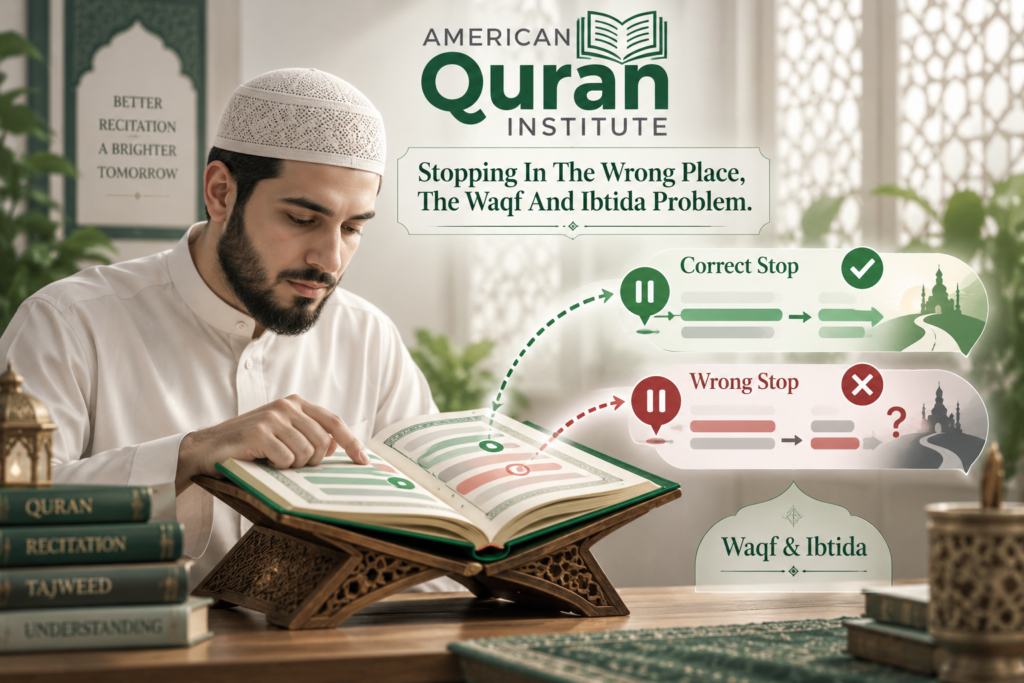
Waqf (stopping) and Ibtida (resuming) are not simply breath management; they’re Tajweed categories that determine which positions in a verse are permissible, preferred, or forbidden as stopping points.
The most frequently cited example is pausing after “لَا إِلَٰهَ” without completing “إِلَّا اللَّه.” The partial phrase, “there is no god”, stands in isolation at the point of pause, reversing the declaration of faith. Scholars are unanimous: pausing here is impermissible.
Color-coded Mushafs print Waqf symbols directly above the text. Learning to read those symbols, a one-time investment of an hour or two, eliminates most Waqf errors without requiring a full course in Tajweed theory.
7. Reading At Warp Speed Without Tarteel
Racing through Quranic verses is one of the most culturally normalized Quran reading mistakes, particularly in communities that treat completing a full reading (Khatmah) during Ramadan as the primary goal.
That finish-line mentality conflicts directly with Allah’s command in Surah Al-Muzzammil (73:4): “recite the Quran with measured recitation (Tarteel).”
Measured recitation isn’t slow recitation, it means every letter receives its right, every rule is applied, and no sound is swallowed. When speed causes letters to blur or rules to collapse, the recitation has crossed a line.
While there are useful resources on how to read the Quran faster, speed should always follow accuracy and never lead it. The practical test: if you can’t hear your own letters clearly at your current pace, you’re reading too fast.
8. Skipping The Tashdeed, The Doubled Letter That Gets Halved
The Tashdeed (شدة) marks a letter that should be held for twice the normal duration — with full muscular tension building and releasing.
This is among the quieter Quran reading mistakes, but it’s a genuine Tajweed error that appears consistently across all levels of readers.
The common failure is treating a Mushaddad letter as a single, normally weighted letter. Words like “وَكَفَّلَهَا” or “حَتَّىٰ” lose a phoneme in the process. The meaning may survive, but the letter hasn’t received its due.
A quick physical test: pause on any Mushaddad letter during practice. If no muscular pressure is building and releasing in your mouth, the Tashdeed hasn’t been properly applied.
Start Your Quran Qirat Learning Path With The American Quran Institute

9. Neglecting The Etiquette Of Recitation
Recitation etiquette (Adab Al-Tilawa) is part of correct reading practice, not a secondary concern. Scholars include it alongside Tajweed as a dimension of honoring the text itself.
The most common etiquette errors include beginning without seeking refuge (Isti’adha), allowing side conversations to interrupt a session, reading aloud in ways that disturb others in prayer, and treating the Quran as ambient sound during other activities.
Ibn Mas’ud’s narration, preserved in Sahih Muslim, warns against racing through the Quran “like poetry” without letting the meaning penetrate the heart.
The goal of recitation, he implied, is for the words to settle inward, not simply to exit the mouth.
Start Your Classes of Learning Quran for Beginners in the USA with a free session

10. Reciting Without Knowing What The Words Mean
Reading the Quran phonetically without any understanding of meaning disconnects the act of recitation from its deeper purpose.
For many American Muslims, this disconnect is the norm rather than the exception — they were taught the sounds, not the content.
Even partial understanding changes the experience significantly. You stop at the right places because you sense where meaning completes.
You apply appropriate emphasis because you feel what the verse is expressing. You catch your own Waqf errors without needing to reference symbols.
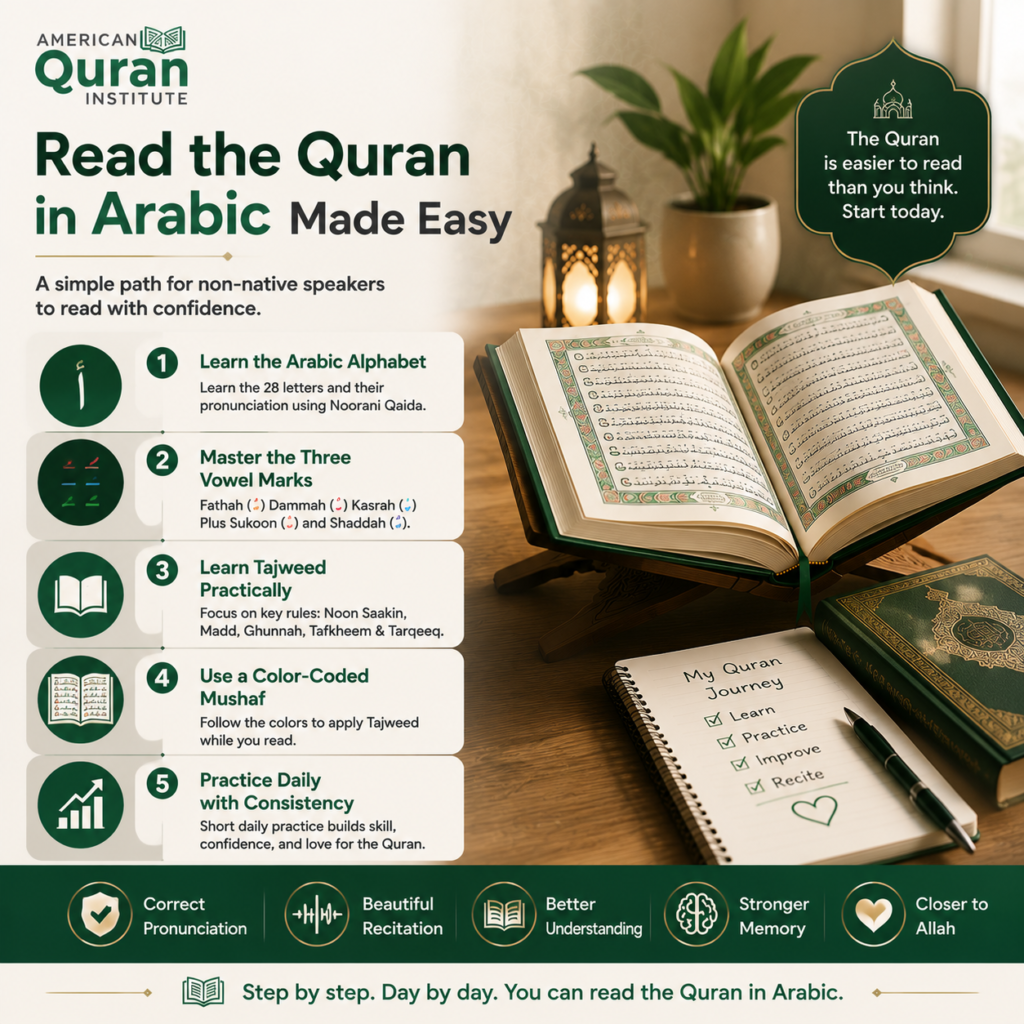
For anyone wanting to connect sound to meaning, how to read the Quran in Arabic easy offers a practical entry point especially for adult learners in the US who want comprehension alongside fluency.
Correction Framework For Fix These Quran Reading Mistakes
Knowing the mistakes is the beginning. Correcting them requires a deliberate, repeatable method.
A. Record Your Recitation
Play a verse from a certified reciter, read the same verse yourself, then compare. Your ear catches what your mouth misses. This single habit surfaces more errors than almost anything else.
B. Practice Isolation Drills
When you identify a specific error, a flattened ض, a dropped Ghunnah, isolate that element and practice it alone until it becomes natural.
Then reintegrate it into full verse reading. Full-passage practice with unresolved errors just reinforces the mistake.
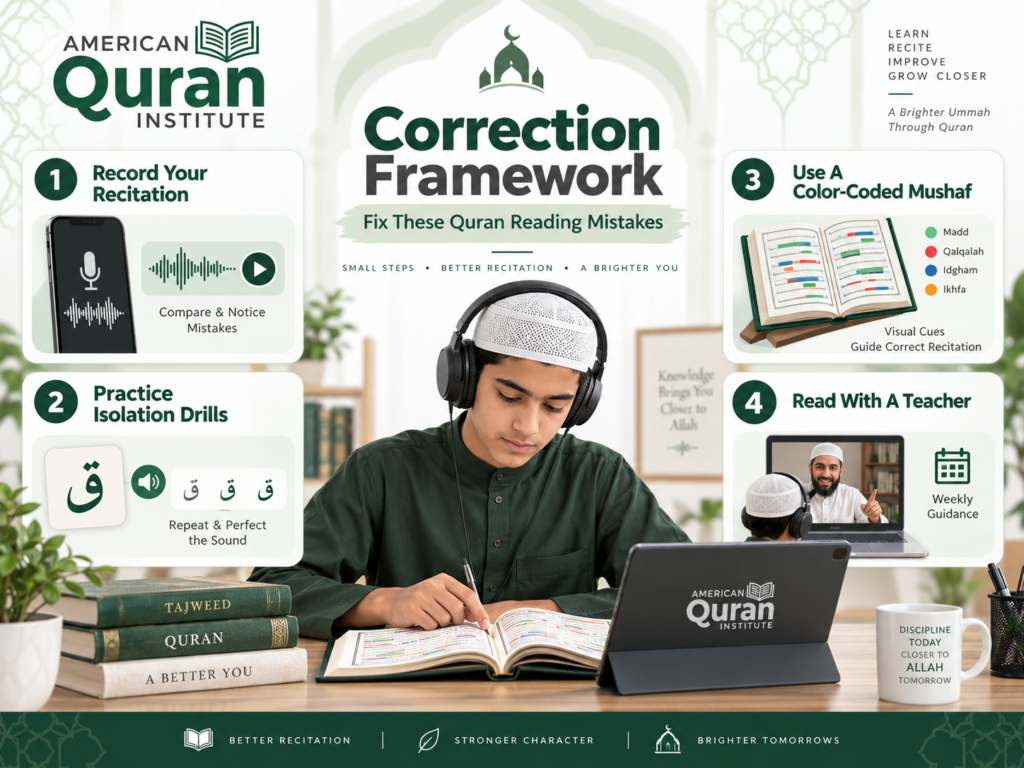
C. Use A Color-Coded Mushaf
These Mushafs mark Tajweed rules visually on the page — Ghunnah positions, Madd types, Ikhfa letters — removing the need to memorize rules before applying them.
They’re particularly useful when you’re building how to start reading the Quran daily as a consistent habit from scratch.
D. Read With A Teacher Periodically
Self-study surfaces some errors; a qualified teacher surfaces the rest. One session per week with a certified instructor is enough to maintain a solid correction trajectory.
Understanding the benefits of reciting Quran correctly reinforces why the investment in structured guidance is worthwhile.
Correct Your Recitation With American Quran Institute
American Quran Institute, based in the USA, connects American Muslims children, adults, ladies, and new Muslims with certified teachers who specialize in guiding English speakers from the Arabic alphabet through fluent recitation.
All classes are live and online, scheduled around US time zones so there’s no need to compromise your work, school, or family commitments.
For adults who’ve been putting this off, learning to read Quran for adults is more accessible than ever, with live online classes built around American schedules and real-time teacher correction.
For families who want their children to build correct habits early, learn to read Quran online for kids programs pair letter recognition with foundational Tajweed from day one.
If you’ve been carrying any of the mistakes above, or suspect there are errors you haven’t identified yet, a structured course with certified guidance turns months of unassisted trial into focused, measurable progress.
Experience Our Classroom Environment
Don’t just take our word for it—experience a live session for yourself! Click on the videos below to watch real snippets from our classes and see our interactive teaching methods in real-time.
Start Your Quranic Education
Join our premier online institute for structured Quranic learning tailored for students in the USA.
Book Your Free TrialStart Your Correction Journey Toda
Every mistake in your recitation is fixable, and the Quran deserves your best effort to fix them.
American Quran Institute offers live, one-on-one sessions with Ijazah-certified teachers, built around your schedule and your starting point.
Whether you’re correcting specific Tajweed errors or beginning from the alphabet, the path forward is structured, practical, and available wherever you are in the US.
Book your free trial class today

Start Your Quranic Education
Join our premier online institute for structured Quranic learning tailored for students in the USA.
Book Your Free TrialConclusion
The common mistakes when reading the Quran, from mispronounced letters to dropped Ghunnahs to wrong stopping points, rarely come from carelessness. They come from gaps in structured instruction.
Most American Muslims were taught to read phonetically without the framework of Tajweed rules, and those gaps compound quietly over time. Every mistake on this list is correctable, at any age, from anywhere in the US.
The process requires three things: identifying which errors are present in your recitation, committing to a deliberate correction practice, and ideally reading with a qualified teacher who can hear what you cannot.
Quran reading mistakes don’t define your relationship with the text. Taking the step to correct them does. Start with one error from this list, work it until it resolves, and move to the next.
That’s how accurate, confident recitation is built not in a single session, but one corrected mistake at a time.
Frequently Asked Questions
What Are The Most Common Mistakes When Reading The Quran?
The most common Quran reading mistakes include mispronouncing Arabic letters from incorrect articulation points, misapplying Nun Sakin and Tanween rules, getting Madd durations wrong.
Mixing up Tafkhim and Tarqiq, dropping the Ghunnah, stopping at impermissible Waqf positions, and reading too fast without Tarteel.
Does Making An Unintentional Recitation Mistake Carry Sin?
An unintentional mistake does not bring sin. The Prophet ﷺ stated that a person who reads the Quran with difficulty, struggling through it, receives two rewards.
The responsibility is to seek correction through continued learning rather than to stop reciting.
Can I Fix These Quran Reading Mistakes Through Self-Study Alone?
Self-study addresses some errors, particularly with the help of recording tools, color-coded Mushafs, and comparison to certified recitations.
However, many Tajweed errors, especially Makhraj mistakes, are very difficult to identify without an outside listener. A qualified teacher, even occasionally, is the most reliable tool for closing those gaps.
How Long Does It Take To Correct Quran Reading Mistakes?
A single isolated error can improve within a few weeks of focused practice. Systemic habits like consistent Ghunnah omission or habitually fast reading typically take two to three months of guided study to fully resolve.
Is It Ever Too Late For Adults To Correct Their Recitation?
It is never too late. Adult learners frequently progress faster than children because they can apply rules analytically rather than purely by imitation.
Many American Muslims have corrected decades-old habits through structured online classes in their forties, fifties, and beyond.
Should Children Learn Tajweed Rules Before Reading The Quran?
Children can begin reading and learning Tajweed simultaneously. Starting early means correct habits form before incorrect ones solidify.
Structured children’s programs pair letter recognition with foundational Tajweed rules from the very beginning, which is the most effective approach for long-term accuracy.






Leave a Reply