 Quran

Learning the Quran is not limited to the moments when you have wudu. You can learn Quran without wudu in many situations, including listening to recitation, studying Tajweed, practicing pronunciation, memorizing and reviewing from memory, and reading Quranic text from a digital device.
What matters is understanding the difference between reciting the Quran and touching a physical Mushaf. If you have simply lost your wudu, you can still recite from memory and continue many parts of your Quran study.
However, according to the majority of scholars and the four major madhhabs, wudu is required before directly touching a physical Mushaf.
There are also different rulings for situations such as janabah, reading from a phone, attending a Quran class, and memorizing or practicing Tajweed without wudu.
This guide explains these cases clearly, helping you know when you can continue learning, when wudu is required, and how to study the Quran with both consistency and proper Islamic etiquette.
Can You Recite Quran Without Wudu?
Yes, you can recite the Quran without wudu if you are only in a state of minor ritual impurity, as long as you do not touch the physical Mushaf. You may recite verses from memory even if your wudu was broken by using the bathroom, passing wind, sleeping, or another nullifier of wudu.

Imam al-Nawawi stated that Muslims agreed that a person in a state of minor impurity may recite the Quran, although performing wudu before recitation is preferable. Therefore, wudu is recommended for reciting the Quran from memory, but it is not required.
This is particularly important for students learning or memorizing the Quran. If your wudu breaks during revision, you do not have to stop reciting what you have memorized. You can continue your lesson, repetition, or Hifz review from memory without touching the printed Mushaf.
The key distinction is simple: reciting from memory without wudu is permissible, while directly touching a physical Mushaf without wudu is not permitted according to the majority of scholars. If you are in a state of major impurity (janabah), however, a different ruling applies and ghusl is required before Quran recitation.
Read also: Can We Learn Quran During Periods? – A Clear Guide For Muslim Women
Can You Touch the Quran Without Wudu?
According to the majority of Muslim scholars, including the four major madhhabs, you should not directly touch a physical Mushaf without wudu. This is different from reciting Quran from memory, which is permissible in a state of minor ritual impurity.

Scholars have also discussed the Quranic verse:
لَّا يَمَسُّهُ إِلَّا الْمُطَهَّرُونَ
“None touch it except the purified.”
There is a difference of interpretation concerning this verse. Many scholars understand it as referring to the purified angels and the preserved Book, while it has also been discussed in juristic arguments concerning purity and the Quran.
For this reason, the ruling on touching the Mushaf should not be presented as depending on this verse alone.
The practical distinction is therefore straightforward: you may recite Quran from memory without wudu when you are in minor ritual impurity, but according to the majority view, you should perform wudu before directly touching a physical Mushaf.
What Do the Four Madhhabs Say About Touching the Mushaf?
The four major Sunni madhhabs generally hold that wudu is required before directly touching a physical Mushaf. While they agree on this basic principle, some differences exist in the details, such as the use of barriers, carrying the Mushaf, and certain educational circumstances.
Read also: 10 Best Times To Learn Quran For Better Focus And Progress

1. Hanafi Madhhab
The Hanafi school generally holds that a person without wudu should not directly touch the Mushaf. Hanafi jurists also discuss specific details concerning barriers and indirect contact, but the basic ruling is to have wudu before touching the Quran directly.
2. Maliki Madhhab
The Maliki school also generally requires ritual purity for directly touching the Mushaf. However, Maliki jurists discuss certain exceptions and considerations, particularly in circumstances connected with teaching and learning the Quran.
3. Shafi‘i Madhhab
According to the Shafi‘i school, a person in a state of minor ritual impurity should not directly touch the Mushaf. Performing wudu is therefore required before handling the physical Quran directly.
4. Hanbali Madhhab
The Hanbali school likewise generally requires wudu for directly touching the Mushaf. A person who has lost wudu should renew it before directly handling the physical Quran.
For the ordinary Quran student, the practical majority ruling is straightforward: perform wudu before directly touching a physical Mushaf. The differences between the madhhabs mainly concern particular circumstances and details rather than this general rule.
Can I Read Quran Without Wudu If I Do Not Touch It?
Yes, you can read the Quran without wudu if you are in a state of minor ritual impurity and do not directly touch the physical Mushaf. Reciting the Quran and physically handling the Mushaf are treated as two separate issues.

If the Mushaf is placed in front of you and you can read from it without touching it, the reading itself is permissible according to scholars who distinguish between recitation and direct contact with the Mushaf.
The same principle can apply during a Quran lesson when a teacher holds the Mushaf while you follow and recite.
Therefore, losing your wudu does not mean that you must stop your Quran lesson completely. You can continue reading or reciting without directly handling the Mushaf, provided you are only in a state of minor ritual impurity.
Can I Learn Quran on My Phone Without Wudu?
Yes. This is one of the easiest solutions for modern Quran students. A phone, tablet, or computer displaying Quranic verses is generally not treated exactly like a physical Mushaf.
The Quranic letters appear electronically on the screen and disappear when the application or page is closed.
Therefore, if you are in a state of minor impurity, you can generally:
- read Quran from your phone;
- follow verses during an online class;
- memorize using a Quran app;
- review previously memorized passages;
- listen and repeat after a reciter;
- practice Tajweed with your teacher.
Wudu is still an excellent habit when studying Quran, but lack of wudu does not mean you have to abandon digital Quran study.
For adult learners balancing Quran study with work and family responsibilities, this flexibility can make maintaining a consistent routine much easier.
Structured Quran classes for adults can also help students build a realistic learning routine while receiving direct correction from a qualified teacher.

Can I Practice Tajweed Without Wudu?
Yes Many parts of Tajweed study do not require touching a Mushaf at all. You might spend a lesson learning:
- the makharij of Arabic letters;
- characteristics of letters;
- rules of Noon Sakinah and Tanween;
- rules of Meem Sakinah;
- Madd;
- Qalqalah;
- stopping and starting rules;
- correct articulation through listening and repetition.
None of these theoretical learning activities requires wudu in itself.
When Quranic verses are used for practice, a student without wudu can follow them digitally or recite memorized examples, provided the student is not in a state of major impurity that prevents Quran recitation.
This distinction is particularly helpful for beginners. Do not allow uncertainty about wudu to make your Tajweed practice unnecessarily inconsistent.
Experience Our Classroom Environment
Don’t just take our word for it—experience a live session for yourself! Click on the videos below to watch real snippets from our classes and see our interactive teaching methods in real-time.
Start Your Quranic Education
Join our premier online institute for structured Quranic learning tailored for students in the USA.
Book Your Free TrialCan I Memorize Quran Without Wudu?
Yes, Quran memorization without wudu is permissible when you are in minor ritual impurity, provided you are not directly touching the physical Mushaf.

You can memorize using:
- verses you already know;
- a Quran application;
- an online Quran platform;
- your teacher’s shared screen;
- audio recordings;
- repetition after your teacher.
For example, if you memorize three ayat in the morning while in wudu but later lose your wudu, you can still repeat those verses from memory during the day.
This can be extremely useful because successful Hifz depends heavily on frequent repetition. Restricting every repetition session to moments when you have wudu could unnecessarily reduce the amount of revision you complete. Whenever practical, maintaining wudu remains a beautiful etiquette of Quran study.
What If My Wudu Breaks During a Quran Class?
If your wudu breaks during a Quran class, you do not have to stop or leave the class. If you are only in a state of minor ritual impurity, you can continue listening to your teacher, studying Tajweed rules, practicing pronunciation, answering questions, and reciting verses from memory.

You can also continue following Quranic text on a phone, tablet, computer, or another digital device. However, according to the majority scholarly view, you should avoid directly touching a physical Mushaf until you perform wudu again.
If your lesson requires you to use a printed Mushaf, you can renew your wudu before handling it and then continue your lesson. Otherwise, you can keep learning through listening, recitation from memory, or digital Quranic text without interrupting the entire class.
The simple rule is: breaking your wudu does not end your Quran lesson; it only affects activities that require ritual purity, particularly directly touching the physical Mushaf.
What If I Am Learning Quran for an Ijazah?
The same wudu rulings apply when you are studying Quran for an Ijazah. Working toward an Ijazah does not mean that wudu becomes required for every part of your lesson.
If you are in a state of minor ritual impurity, you can still listen to your teacher’s corrections, review Tajweed rules, discuss recitation mistakes, and recite memorized passages without directly touching a physical Mushaf.
Students pursuing an Ijazah often spend long periods reciting to a qualified teacher and receiving detailed correction.
Through structured Quran Ijazah classes, learners can work on accurate pronunciation, Tajweed, and precise recitation while following the same basic rulings regarding wudu and the Mushaf.

At this advanced level, however, maintaining wudu whenever reasonably possible is a good practice and part of proper etiquette toward Quran study. Wudu is recommended for recitation, while directly touching a physical Mushaf requires wudu according to the majority scholarly view.
What Is the Difference Between Minor Impurity and Janabah?
The distinction between minor impurity and janabah is important because the answer to “Can I learn Quran without wudu?” is not the same in both situations. Losing wudu does not carry the same ruling as being in a state of major ritual impurity.
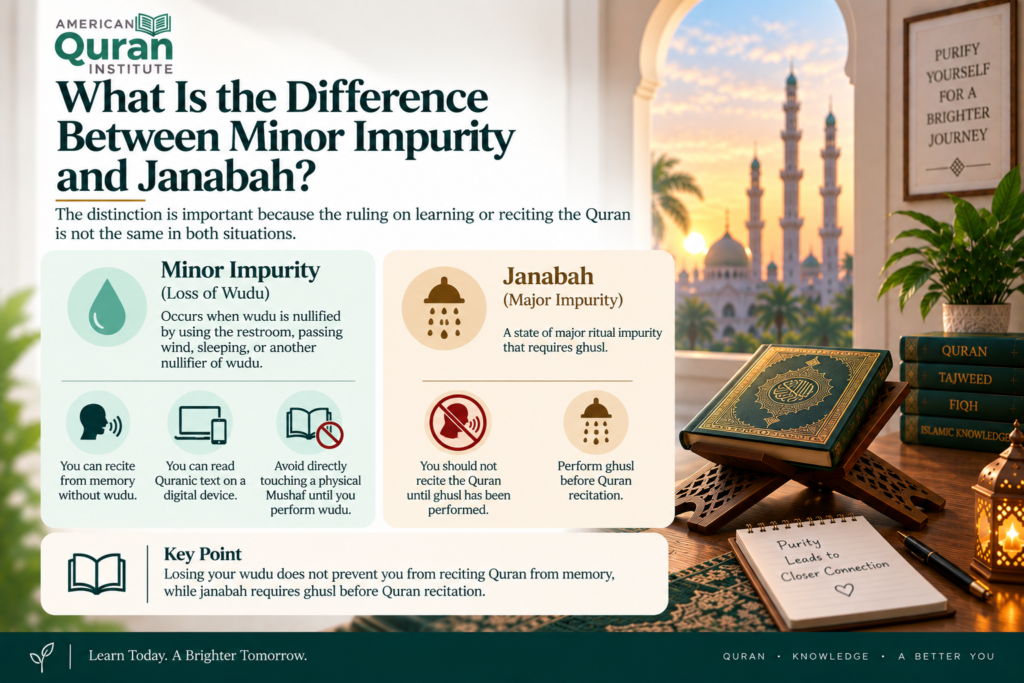
1. Minor Impurity Allows Quran Recitation Without Wudu
Minor ritual impurity occurs when wudu is nullified by using the restroom, passing wind, sleeping, or another nullifier of wudu. In this state, you can recite the Quran from memory and read Quranic text from a digital device without wudu. However, according to the majority of scholars, you should perform wudu before directly touching a physical Mushaf.
2. Janabah Requires Ghusl Before Quran Recitation
Janabah is a state of major ritual impurity that requires ghusl. Unlike ordinary loss of wudu, the commonly cited scholarly ruling is that a person in janabah should not recite the Quran until ghusl has been performed.
This distinction is based in part on reports from ‘Ali ibn Abi Talib (RA) concerning the Prophet ﷺ and Quran recitation, which scholars have used when distinguishing janabah from minor ritual impurity.
The difference is therefore important: losing your wudu does not prevent you from reciting Quran from memory, while janabah requires ghusl before Quran recitation.
Practical Ways to Continue Learning Quran Without Wudu
You do not have to stop learning the Quran simply because you do not have wudu. If you are in a state of minor ritual impurity, there are several ways to continue studying without directly touching a physical Mushaf.
- Recite and Review Quran From Memory: Continue repeating surahs and ayahs you have already memorized. This is especially useful for Hifz students who need regular revision throughout the day.
- Read Quran From a Digital Device: Use a Quran app on your phone, tablet, or computer to read and review verses. Digital devices are generally not treated according to the same rulings as a physical Mushaf.
- Listen to Quran and Repeat After the Reciter: Listen to a reliable reciter and repeat the verses aloud. This can help you work on pronunciation, rhythm, fluency, and accurate recitation without handling a printed Mushaf.
- Practice Tajweed and Arabic Pronunciation: Use your study time to review Tajweed rules, practice makharij, and work on difficult Arabic letters.
Students taking online Tajweed classes can also continue listening to their teacher, practicing pronunciation, and receiving corrections without wudu.

5. Continue Your Quran Lesson With Your Teacher
If your wudu breaks during a lesson, you can continue listening, answering questions, repeating after your teacher, and following digital Quranic text. You only need to avoid directly touching the physical Mushaf until you renew your wudu.
These options make it easier to maintain a consistent Quran learning routine without ignoring the rulings of purification. Rather than stopping your study completely, choose an appropriate method for your current state and continue learning.
Common Mistakes Students Make About Quran and Wudu
Many students become more restrictive than necessary because they do not distinguish between recitation, touching the Mushaf, digital reading, and different states of ritual impurity.

Avoiding these common mistakes makes it easier to follow the relevant rulings while maintaining a consistent Quran routine.
1. Assuming Every Form of Quran Learning Requires Wudu
Wudu is not required for every Quran learning activity. If you are in a state of minor ritual impurity, you can still listen to Quran, study Tajweed rules, practice pronunciation, recite from memory, and follow Quranic text on a digital device.
The requirement for wudu primarily becomes relevant when directly touching a physical Mushaf according to the majority view.
2. Treating a Phone or Tablet Like a Physical Mushaf
A Quran app on a phone or tablet is generally not treated in the same way as a printed Mushaf. This means that a student without wudu can continue reading Quranic text from a digital device when in a state of minor impurity, making digital Quran resources particularly useful for regular study and revision.
3. Treating Minor Impurity and Janabah as the Same State
Losing wudu is not the same as being in janabah. A person in a state of minor impurity may recite Quran from memory and use digital Quranic text, while the commonly cited ruling for janabah is that ghusl should be performed before Quran recitation.
Keeping these two states separate prevents unnecessary confusion about what you can and cannot do.
4. Stopping the Entire Quran Lesson When Wudu Breaks
Breaking your wudu does not mean your Quran lesson has to end. Instead of abandoning the lesson, you can switch to an activity that does not require directly touching the Mushaf.
Continue listening to your teacher, practicing Tajweed, reciting from memory, or following the lesson digitally until you are able to renew your wudu.
See Us in Action!
Take a look inside our virtual classrooms. Watch the clip below to see how our instructors engage with students, simplify complex rules, and create an inspiring environment for learning.
Start Your Quranic Education
Join our premier online institute for structured Quranic learning tailored for students in the USA.
Book Your Free TrialContinue Your Quran Learning With American Quran Institute
Knowing when you can learn Quran without wudu is only one part of building a correct and confident relationship with the Quran.
At American Quran Institute, students can learn with qualified teachers who provide structured guidance in Quran reading, pronunciation, Tajweed, memorization, and advanced recitation.
Whether you are beginning your Quran journey or working toward a higher level of accuracy, guided instruction can help you understand not only how to recite correctly, but also how to approach Quran study with the proper knowledge and etiquette.
Start your Quran learning journey with American Quran Institute and build a consistent study routine based on correct recitation, reliable guidance, and respect for the Quran.
Our Quran Courses
- Learn Quran Course for Beginners
- Quran Qirat Learning Course
- Quran Tafsir Course
- Noorani Qaida Course
- Noorani Qaida Course for Kids
- Weekend Quran Classes
- Intensive Quran Course
- Al-Azhar Quran Course

Conclusion
Learning the Quran without wudu is possible in many situations, and losing wudu does not mean that your Quran study has to stop.
If you are in a state of minor ritual impurity, you can still recite from memory, listen to the Quran, practice Tajweed, memorize and revise verses, attend Quran classes, and read from a digital device.
The main restriction, according to the majority of scholars, concerns directly touching a physical Mushaf without wudu, while janabah has a separate ruling that requires ghusl before recitation.
Understanding these distinctions helps you approach Quran learning with both proper Islamic etiquette and consistency.
Maintain wudu whenever possible, respect the rulings related to the Mushaf, and use the learning methods available to you so that a temporary loss of wudu does not unnecessarily interrupt your progress.
Frequently Asked Questions
Can I learn Quran without wudu?
Yes. You can learn Quran without wudu by listening to a teacher, studying Tajweed, practicing pronunciation, reciting from memory, or using a digital device if you are in a state of minor impurity. Wudu is required for directly touching a physical Mushaf according to the majority of scholars.
Can I memorize Quran without wudu?
Yes. You may memorize and revise Quran from memory or a digital device without wudu when you are in minor ritual impurity. Avoid directly touching the physical Mushaf until you perform wudu.
Can I attend an online Quran class without wudu?
Yes. Wudu is not a condition for attending an online Quran class. You can listen, learn Tajweed, repeat after your teacher, and read Quranic text displayed digitally.
Can I practice Tajweed without wudu?
Yes. Tajweed theory, makharij practice, listening exercises, and pronunciation practice do not require wudu. Quran recitation from memory or a screen is also permissible in minor impurity.
Can I touch the Quran without wudu while studying?
According to the majority of scholars and the four major madhhabs, you should not directly touch a physical Mushaf without wudu. Use a digital Quran or another permissible learning method until you renew your wudu.
Can I read Quran on my phone without wudu?
Yes. A smartphone or tablet is generally not treated as a physical Mushaf, so you can read Quran from its screen without wudu when you are in minor impurity.







[…] Read also: Can I Learn Quran Without Wudu? – A Clear Guide For Quran Students […]
[…] Read also: Can I Learn Quran Without Wudu? – A Clear Guide For Quran Students […]