 Quran
Quran
Death is one of the clearest realities the Quran asks us to remember. It is certain for every soul, its timing is known only to Allah, and it marks the end of our opportunity to act in this worldly life.
The Quran does not speak about death only to create fear. It speaks about death to create awareness, responsibility, and preparation.
Some verses emphasize that no one can escape it. Others explain that every lifespan has an appointed time. Some describe the moment of death itself, while others turn our attention toward what comes after it.
Studying Quran verses about death in Arabic helps us see these meanings directly in the language of revelation. The Arabic wording often carries a weight and precision that becomes clearer when we read the ayah alongside its transliteration, translation, and context.
Below are some of the most important Quran verses about death, with their Arabic text, transliteration, English meaning, direct Quran.com references, and simple explanations.
1. Quran Verse About Every Soul Tasting Death and True Success in the Hereafter
One of the most famous Quran verses about death in Arabic reminds us that death is universal while directing our attention toward the final measure of success in the Hereafter.
كُلُّ نَفْسٍ ذَائِقَةُ الْمَوْتِ ۗ وَإِنَّمَا تُوَفَّوْنَ أُجُورَكُمْ يَوْمَ الْقِيَامَةِ ۖ فَمَن زُحْزِحَ عَنِ النَّارِ وَأُدْخِلَ الْجَنَّةَ فَقَدْ فَازَ ۗ وَمَا الْحَيَاةُ الدُّنْيَا إِلَّا مَتَاعُ الْغُرُورِ
Kullu nafsin dhaa’iqatul mawt, wa innamaa tuwaffawna ujoorakum yawmal qiyaamah; faman zuhziha ‘anin naari wa udkhilal jannata faqad faaz; wa mal hayaatud dunyaa illaa mataa‘ul ghuroor.
“Every soul will taste death, and you will only be given your full compensation on the Day of Resurrection. So he who is drawn away from the Fire and admitted to Paradise has attained success. And what is the life of this world except the enjoyment of delusion.”
The opening phrase, كُلُّ نَفْسٍ ذَائِقَةُ الْمَوْتِ — “Every soul will taste death,” removes every exception.
The verse then immediately turns attention toward what truly counts: the Day of Resurrection, protection from the Fire, and entry into Paradise. It also warns believers not to become deceived by the temporary attractions of worldly life.
2. Quran Verse About Death and Life Being Created as a Test
The Quran does not describe death as a meaningless ending. Instead, Surah Al-Mulk places both death and life within a larger divine purpose.
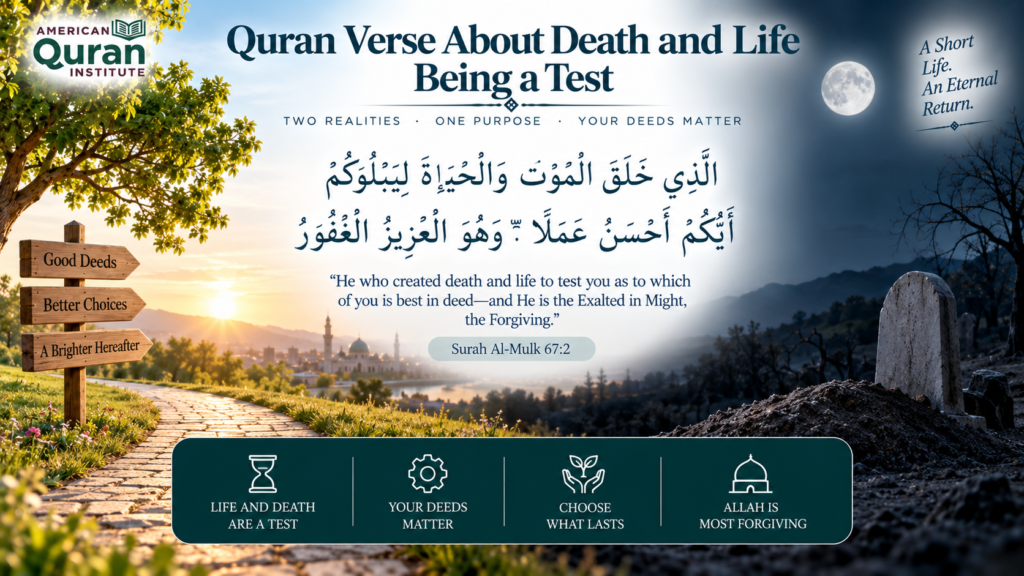
الَّذِي خَلَقَ الْمَوْتَ وَالْحَيَاةَ لِيَبْلُوَكُمْ أَيُّكُمْ أَحْسَنُ عَمَلًا ۚ وَهُوَ الْعَزِيزُ الْغَفُورُ
Allazee khalaqal mawta wal hayaata liyabluwakum ayyukum ahsanu ‘amalaa; wa huwal ‘Azeezul Ghafoor.
“He who created death and life to test you as to which of you is best in deed—and He is the Exalted in Might, the Forgiving.”
This verse changes the way we think about death. Death and life are both part of the test. The question is not simply how long a person lives, but whether their deeds are sincere, righteous, and pleasing to Allah.
The phrase أَيُّكُمْ أَحْسَنُ عَمَلًا — “which of you is best in deed” directs attention toward the quality of our actions.
3. Quran Verse About Death Reaching Everyone Wherever They Are
Human beings often seek security through wealth, health, strong buildings, or careful planning.
The Quran reminds us that none of these can prevent death when Allah has decreed it.
أَيْنَمَا تَكُونُوا يُدْرِككُّمُ الْمَوْتُ وَلَوْ كُنتُمْ فِي بُرُوجٍ مُّشَيَّدَةٍ
Aynamaa takoonoo yudrikkumul mawtu walaw kuntum fee buroojim mushayyadah.
“Wherever you may be, death will overtake you, even if you should be within towers of lofty construction.”
The image of fortified towers represents the strongest protection people can build for themselves. Yet the verse teaches that death does not depend on whether a person feels safe or vulnerable.
The believer is therefore encouraged to place trust in Allah while continuing to live responsibly and meaningfully.
4. Quran Verse About Every Soul Dying Only at Its Appointed Time by Allah’s Permission
The Quran makes the divine decree behind death explicit, teaching that no soul dies outside Allah’s permission or before its appointed time.
وَمَا كَانَ لِنَفْسٍ أَن تَمُوتَ إِلَّا بِإِذْنِ اللَّهِ كِتَابًا مُّؤَجَّلًا
Wa maa kaana linafsin an tamoota illaa bi iznil laahi kitaabam mu’ajjalan.
“And no soul can die except by Allah’s permission at a decree determined.”
This verse connects death directly to Allah’s permission and a fixed decree. Death is not outside His knowledge or control.
The expression كِتَابًا مُّؤَجَّلًا — kitaaban mu’ajjalan points to an appointed term that has already been determined. This gives the believer a deeper understanding of qadar: life and death remain completely within Allah’s authority.
Parents who want their children to build this understanding alongside their Quran skills can explore Quran Classes for Kids with structured, age-appropriate instruction.

5. Quran Verse About Every Appointed Time Being Impossible to Delay or Advance
The Quran emphasizes that every person and community has an appointed term that cannot be changed once it arrives.
فَإِذَا جَاءَ أَجَلُهُمْ لَا يَسْتَأْخِرُونَ سَاعَةً وَلَا يَسْتَقْدِمُونَ
Fa izaa jaaa’a ajaluhum laa yasta’khiruna saa‘atan wa laa yastaqdimoon.
“When their appointed time comes, they will not delay it by an hour, nor will they advance it.”
The key word here is أَجَل — ajal, meaning an appointed term. The verse makes it clear that once this appointed time arrives, it can neither be delayed nor brought forward.
This does not encourage carelessness. Rather, it reminds us that while we should take care of our health and responsibilities, the length of our lives ultimately remains under Allah’s decree.
Experience Our Classroom Environment
Don’t just take our word for it—experience a live session for yourself! Click on the videos below to watch real snippets from our classes and see our interactive teaching methods in real-time.
Start Your Quranic Education
Join our premier online institute for structured Quranic learning tailored for students in the USA.
Book Your Free Trial6. Quran Verse About No Soul Knowing Where It Will Die
The time of death is hidden from us, and so is its location. The Quran uses this uncertainty to remind us of the limits of human knowledge.
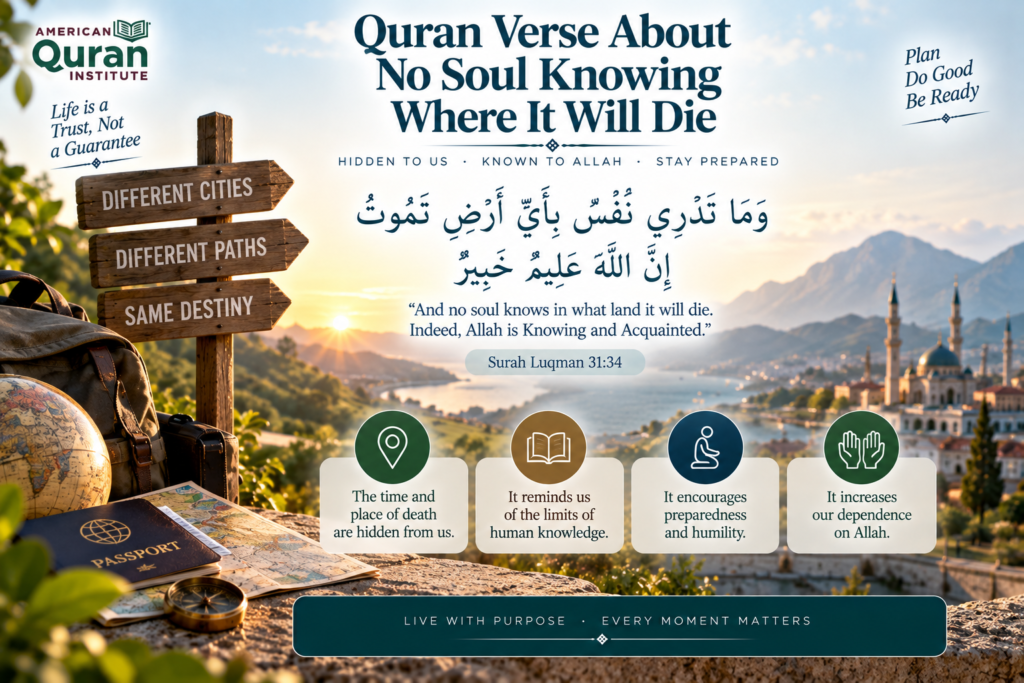
وَمَا تَدْرِي نَفْسٌ بِأَيِّ أَرْضٍ تَمُوتُ ۚ إِنَّ اللَّهَ عَلِيمٌ خَبِيرٌ
Wa maa tadree nafsum bi ayyi ardin tamoot; innal laaha ‘aleemun khabeer.
“And no soul knows in what land it will die. Indeed, Allah is Knowing and Acquainted.”
We may make detailed plans for tomorrow, next year, or even decades ahead, yet we do not know where our life will end.
That uncertainty is not meant to produce panic. It is meant to encourage preparedness, humility, and dependence on Allah.
7. Quran Verse About No One Escaping Death and Everyone Returning to Allah for Accountability
Another powerful Quran verse about death teaches that trying to escape death cannot prevent it and that every person will ultimately return to Allah for accountability.
قُلْ إِنَّ الْمَوْتَ الَّذِي تَفِرُّونَ مِنْهُ فَإِنَّهُ مُلَاقِيكُمْ ۖ ثُمَّ تُرَدُّونَ إِلَىٰ عَالِمِ الْغَيْبِ وَالشَّهَادَةِ فَيُنَبِّئُكُم بِمَا كُنتُمْ تَعْمَلُونَ
Qul innal mawtal lazee tafirroona minhu fa innahoo mulaaqeekum; thumma turaddoona ilaa ‘aalimil ghaibi wash shahaadati fa yunabbi’ukum bimaa kuntum ta‘maloon.
“Say, ‘Indeed, the death from which you flee—indeed, it will meet you. Then you will be returned to the Knower of the unseen and the witnessed, and He will inform you of what you used to do.’”
The wording is striking. It does not merely say that people eventually reach death. It says that death will meet them, making clear that no attempt to escape it can succeed.
The verse then connects death directly with accountability. After death comes the return to Allah, who knows both the unseen and the witnessed and will inform every person of what they did. Remembering this should encourage believers to correct their actions before that meeting takes place.
8. Quran Verse About the Stupor of Death Revealing the Reality No One Can Avoid
The Quran describes the intensity of the final moments of life, when death turns from a distant thought into an immediate and unavoidable reality.
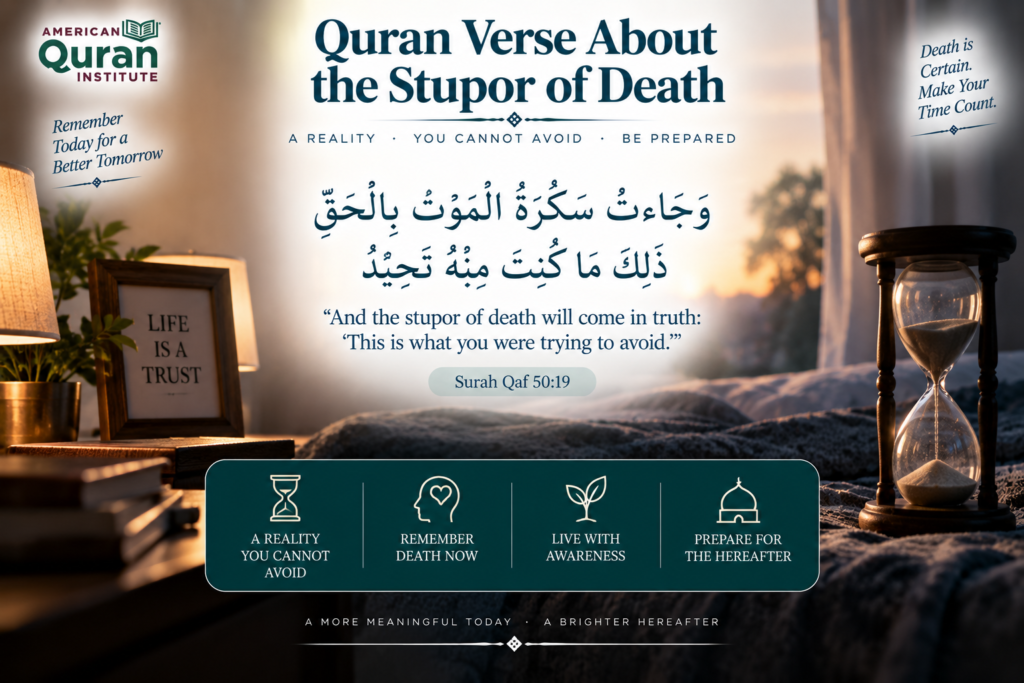
وَجَاءَتْ سَكْرَةُ الْمَوْتِ بِالْحَقِّ ۖ ذَٰلِكَ مَا كُنتَ مِنْهُ تَحِيدُ
Wa jaaa’at sakratul mawti bil haqq; zaalika maa kunta minhu taheed.
“And the stupor of death will come in truth: ‘This is what you were trying to avoid.’”
The phrase سَكْرَةُ الْمَوْتِ — sakratul mawt describes the overwhelming state associated with the arrival of death. At that moment, the reality a person may have ignored or tried to avoid can no longer be escaped.
The verse therefore serves as a powerful reminder not to wait until death becomes immediate before recognizing its certainty.
Remembering death now can encourage a person to live with greater awareness, prepare for the Hereafter, and make better use of the time Allah has given them.
9. Quran Verse About the Angel of Death Taking Souls by Allah’s Command
The Quran explains that the taking of the soul is carried out by an angel entrusted with this task by Allah.
قُلْ يَتَوَفَّاكُم مَّلَكُ الْمَوْتِ الَّذِي وُكِّلَ بِكُمْ ثُمَّ إِلَىٰ رَبِّكُمْ تُرْجَعُونَ
Qul yatawaffaakum malakul mawtil lazee wukkila bikum thumma ilaa Rabbikum turja‘oon.
“Say, ‘The angel of death will take you who has been entrusted with you. Then to your Lord you will be returned.’”
The Quran refers to this angel by the title مَلَكُ الْمَوْتِ — Malak al-Mawt, meaning “the Angel of Death.”
The verse also makes clear that his task is assigned by Allah. The final phrase—“Then to your Lord you will be returned”—again shifts attention away from death itself toward what comes after it.
10. Quran Verse About the Angels Greeting Righteous Souls With Peace
The Quran does not describe every death through fear and difficulty. It gives a comforting description of the angels receiving righteous believers with peace.
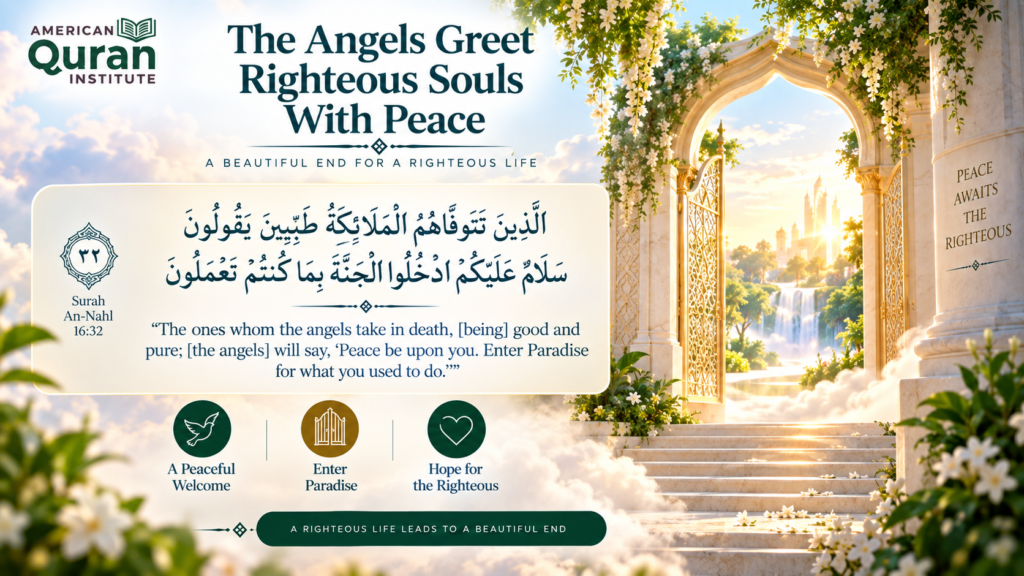
الَّذِينَ تَتَوَفَّاهُمُ الْمَلَائِكَةُ طَيِّبِينَ يَقُولُونَ سَلَامٌ عَلَيْكُمُ ادْخُلُوا الْجَنَّةَ بِمَا كُنتُمْ تَعْمَلُونَ
Allazeena tatawaffaahumul malaaa’ikatu taiyibeena yaqooloona salaamun ‘alaikumud khulul Jannata bimaa kuntum ta‘maloon.
“The ones whom the angels take in death, [being] good and pure; [the angels] will say, ‘Peace be upon you. Enter Paradise for what you used to do.’”
For the righteous, the angels greet them with salam, peace.
The passage shows that the Quran’s treatment of death is not entirely about warning. It also includes reassurance and hope for those who live in obedience to Allah.
11. Quran Verses About the Reassured Soul Returning to Allah and Entering Paradise
One of the most comforting Quranic passages connected with death and the Hereafter describes the reassured soul being welcomed back to Allah.
يَا أَيَّتُهَا النَّفْسُ الْمُطْمَئِنَّةُ ارْجِعِي إِلَىٰ رَبِّكِ رَاضِيَةً مَّرْضِيَّةً فَادْخُلِي فِي عِبَادِي وَادْخُلِي جَنَّتِي
Yaaa ayyatuhan nafsul mutma’innah. Irji‘eee ilaa Rabbiki raadiyatam mardiyyah. Fadkhulee fee ‘ibaadee. Wadkhulee jannatee.
“O reassured soul, return to your Lord, well-pleased and pleasing [to Him], and enter among My servants, and enter My Paradise.”
The phrase النَّفْسُ الْمُطْمَئِنَّةُ — an-nafs al-mutma’innah means the reassured or tranquil soul.
This passage presents return to Allah as a place of peace, acceptance, and honor for the righteous. The final invitation, “Enter My Paradise,” gives the believer hope that faithful living can lead to a beautiful return.
12. Quran Verses About Regretting Delayed Good Deeds When Death Arrives
One of the strongest Quranic warnings about delaying righteous actions describes a person asking for more time only after death approaches.
وَأَنفِقُوا مِن مَّا رَزَقْنَاكُم مِّن قَبْلِ أَن يَأْتِيَ أَحَدَكُمُ الْمَوْتُ فَيَقُولَ رَبِّ لَوْلَا أَخَّرْتَنِي إِلَىٰ أَجَلٍ قَرِيبٍ فَأَصَّدَّقَ وَأَكُن مِّنَ الصَّالِحِينَ وَلَن يُؤَخِّرَ اللَّهُ نَفْسًا إِذَا جَاءَ أَجَلُهَا ۚ وَاللَّهُ خَبِيرٌ بِمَا تَعْمَلُونَ
Wa anfiqoo mimmaa razaqnaakum min qabli ai yaatiya ahadakumul mawtu fa yaqoola Rabbi law laaa akhkhartaneee ilaa ajalin qareebin fa assaddaqa wa akum minas saaliheen. Wa lai yu’akhkhiral laahu nafsan izaa jaaa’a ajaluhaa; wallaahu khabeerum bimaa ta‘maloon.
“And spend from what We have provided you before death approaches one of you and he says, ‘My Lord, if only You would delay me for a brief term so I would give charity and be among the righteous.’ But never will Allah delay a soul when its time has come. And Allah is Acquainted with what you do.”
These verses show the regret that can come when opportunities for righteous action are finally over. The person asks only for a short delay, but the appointed time has already arrived.
The lesson is practical: do not postpone charity, repentance, worship, or other good deeds while assuming there will always be more time later.
13. Quran Verse About the Difficult Death of Persistent Wrongdoers
While some Quran verses describe the peaceful reception of righteous believers, others warn about the final moments of those who persisted in wrongdoing.
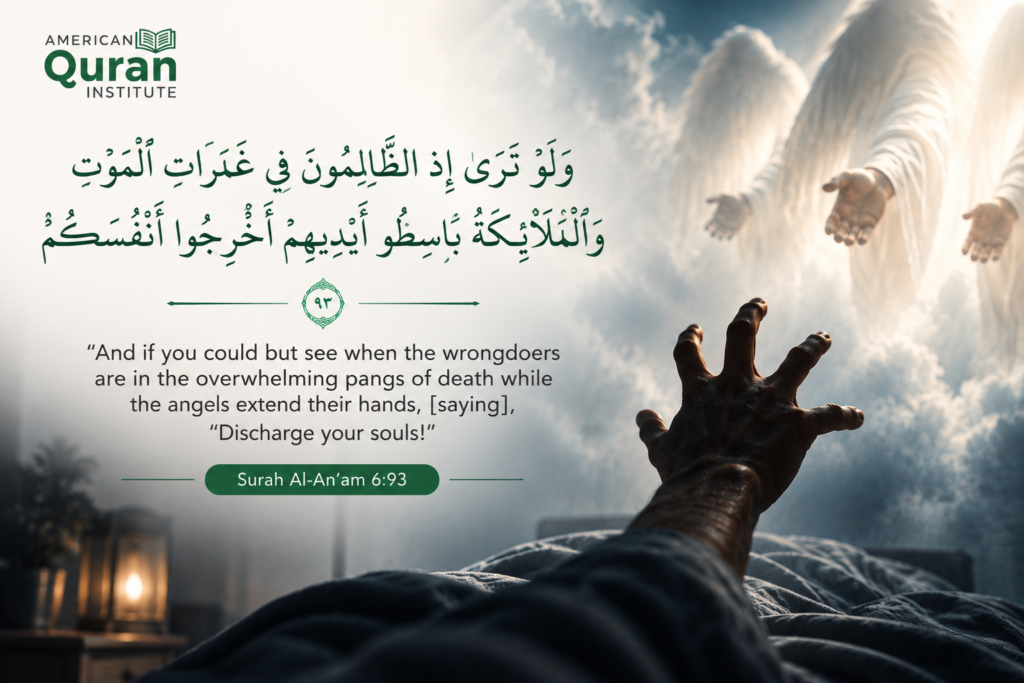
وَلَوْ تَرَىٰ إِذِ الظَّالِمُونَ فِي غَمَرَاتِ الْمَوْتِ وَالْمَلَائِكَةُ بَاسِطُو أَيْدِيهِمْ أَخْرِجُوا أَنفُسَكُمُ
Wa law taraaa iziz zaalimoona fee ghamaraatil mawti walmalaaa’ikatu baasitooo aideehim akhrijooo anfusakum.
“And if you could but see when the wrongdoers are in the overwhelming pangs of death while the angels extend their hands, [saying], ‘Discharge your souls!’”
This is a deliberate contrast with verses describing the peaceful reception of righteous believers. The phrase غَمَرَاتِ الْمَوْتِ — ghamaraat al-mawt conveys the sense of being overwhelmed by the difficulties of death. The contrast teaches that the Quran’s discussion of death is closely tied to how a person lived before that moment.
14. Quran Verse About Every Soul Tasting Death and Returning to Allah
The Quran repeats the phrase “every soul will taste death” in more than one place. Surah Al-‘Ankabut gives a concise version that connects death directly with return to Allah.
كُلُّ نَفْسٍ ذَائِقَةُ الْمَوْتِ ۖ ثُمَّ إِلَيْنَا تُرْجَعُونَ
Kullu nafsin zaaa’iqatul mawti thumma ilainaa turja‘oon.
“Every soul will taste death. Then to Us will you be returned.”
This short verse summarizes the Quranic view of death in two statements. First, death is universal. Second, death does not mean disappearance—the soul returns to Allah.
That second point is essential because the Quran consistently connects mortality with resurrection, judgment, and accountability.
15. Quran Verse About Allah Giving Life, Causing Death, and Bringing People Back to Life
The Quran places death within the complete cycle of human existence, reminding us that Allah is the One who gives life, causes death, and resurrects people again.
كَيْفَ تَكْفُرُونَ بِاللَّهِ وَكُنتُمْ أَمْوَاتًا فَأَحْيَاكُمْ ۖ ثُمَّ يُمِيتُكُمْ ثُمَّ يُحْيِيكُمْ ثُمَّ إِلَيْهِ تُرْجَعُونَ
Kaifa takfuroona billaahi wa kuntum amwaatan fa ahyaakum; thumma yumeetukum thumma yuhyeekum thumma ilaihi turja‘oon.
“How can you disbelieve in Allah when you were lifeless and He brought you to life; then He will cause you to die, then He will bring you back to life, and then to Him you will be returned.”
This verse places death between two forms of life. Allah brought human beings into existence, causes them to die, and will resurrect them again.
Death is therefore not presented as the final stage, but as one part of a larger journey that ends with return to Allah.
What Do Quran Verses About Death Teach Us?
The many Quran verses about death in Arabic repeatedly return to several important lessons about mortality, accountability, and preparation for the Hereafter.
- Every Person Will Face Death Regardless of Wealth, Strength, or Status: No person can escape death, regardless of wealth, status, strength, health, or security. Remembering this reality encourages humility and helps believers avoid becoming overly attached to worldly life.
- Every Person Has an Appointed Time of Death That Cannot Be Changed: The Quran teaches that every person has an appointed term. Once that appointed time arrives, it cannot be advanced or delayed.
- No One Knows Where Their Life Will End Except Allah: Human beings may make detailed plans for the future, but no soul knows the place where its life will end. This knowledge belongs to Allah alone.
- Death Is Followed by Return to Allah, Resurrection, and Accountability: Many Quran verses immediately connect death with return to Allah, resurrection, judgment, and the results of our deeds. Death is therefore not presented as the end of human existence.
- Righteous Believers Can Hope to Be Received With Peace and Enter Paradise: The Quran describes angels greeting righteous souls with peace and presents the reassured soul being welcomed back to Allah and invited into Paradise.
- Remembering Death Should Motivate Us to Prepare for the Hereafter: Reflecting on death is not meant to produce hopelessness. It should encourage repentance, sincere worship, good deeds, responsibility, and better use of the time Allah has given us.
Students who want to refine their recitation further and work toward formal Quranic authorization can explore the Ijazah Quran Classes at American Quran Institute.

What Do Quran Verses About Death Ultimately Teach Us?
The Quran verses about death in Arabic teach that death is certain, its appointed time is known to Allah, and no person can escape it or know exactly where their life will end. Yet the Quran does not present these realities simply to create fear.
It uses them to remind us that worldly life is temporary and that every soul will eventually return to Allah.
At the same time, the Quran gives believers hope. It describes the angels greeting righteous souls with peace, the reassured soul returning to its Lord, resurrection after death, and Paradise as the ultimate reward for those who believe and live righteously.
The central lesson is therefore not simply that life will end, but that life has a purpose before it ends.
Remembering death should encourage us to use our time wisely, strengthen our relationship with Allah, seek forgiveness, increase our good deeds, and prepare for the Hereafter while we still have the opportunity to act.
See Us in Action!
Take a look inside our virtual classrooms. Watch the clip below to see how our instructors engage with students, simplify complex rules, and create an inspiring environment for learning.
Start Your Quranic Education
Join our premier online institute for structured Quranic learning tailored for students in the USA.
Book Your Free TrialLearn to Read Quran Verses About Death With Confidence
Reading Quran verses about death in translation helps you understand their general message, but learning to read and recite them correctly in Arabic creates a more direct connection with the Quran.
At American Quran Institute, students can strengthen their Quran reading, pronunciation, Tajweed, and fluency through structured instruction.
Developing these skills can help learners approach verses about death with greater accuracy while understanding the Quranic words and meanings they contain.
Start your free trial today and experience Quran learning with American Quran Institute.
Our Arabic Courses
- Online Arabic Academy
- Online Arabic Course
- Classical Arabic Course
- Arabic Course for Beginners
- Advanced Arabic Course
- Quranic Arabic Course
- Arabic Grammar Course

Conclusion
The Quran verses about death in Arabic remind us that death is certain, its appointed time belongs to Allah, and every soul will ultimately return to Him. Yet these verses are not simply warnings about the end of life. They teach us how to understand the life we have now.
The Quran connects death with accountability, righteous deeds, repentance, resurrection, and hope in Allah’s mercy. It also gives comfort to believers through descriptions of the angels greeting righteous souls with peace and the reassured soul being welcomed into Paradise.
Remembering death should therefore lead to action rather than fear alone. It encourages us to value our time, strengthen our worship, seek forgiveness, do good while we have the opportunity, and prepare for the Hereafter with greater awareness of our return to Allah.
Frequently Asked Questions
What Is the Most Famous Quran Verse About Death in Arabic?
One of the most famous is Surah Aal ‘Imran 3:185: كُلُّ نَفْسٍ ذَائِقَةُ الْمَوْتِ, meaning “Every soul will taste death.”
What Does “Kullu Nafsin Dha’iqatul Mawt” Mean?
كُلُّ نَفْسٍ ذَائِقَةُ الْمَوْتِ — Kullu nafsin dhaa’iqatul mawt means “Every soul will taste death.” It emphasizes that death is universal.
Does the Quran Say When a Person Will Die?
The Quran teaches that every person has an appointed term. When it arrives, it cannot be delayed or advanced.
Does the Quran Say Where a Person Will Die?
Surah Luqman 31:34 says that no soul knows in what land it will die. This knowledge belongs to Allah.
What Does the Quran Say About the Death of a Righteous Believer?
The Quran describes angels greeting righteous souls with peace and the reassured soul being welcomed back to Allah.
Why Does Allah Mention Death So Often in the Quran?
Death reminds people of accountability, the temporary nature of worldly life, return to Allah, and the importance of righteous deeds.



Leave a Reply