 Quran
Quran
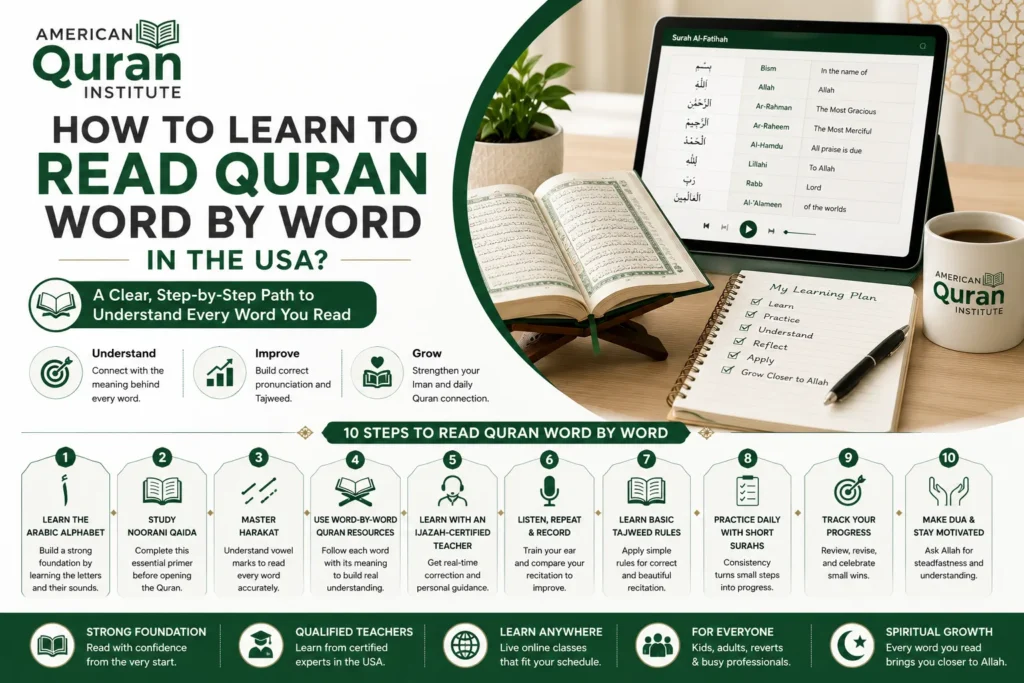
Millions of American Muslims recite the Quran daily in prayer — yet many describe the same quiet frustration: they move their lips through familiar words without knowing what they mean.
The path to Learn to read Quran word by word in the USA closes that gap. It builds a direct connection between the Arabic text and its meaning, word by word, ayah by ayah, until recitation becomes genuine comprehension rather than memorized sound.
For learners in the USA, this goal is fully achievable today. Structured online programs, certified English-speaking teachers, and purpose-built learning tools make word-by-word Quran reading accessible without leaving your city — or adjusting your time zone.
The ten methods below cover the complete learning path: from recognizing the first Arabic letter through fluent word-by-word recitation with understanding, at every level and age.
1. Master The Arabic Alphabet Using The Noorani Qaida To Learn To Read Quran Word By Word In The USA
The Arabic alphabet is the entry point to everything. Without it, reading the Quran word by word is not possible — and rushing past this stage is the single most common reason learners plateau early or develop uncorrectable pronunciation habits.
The Noorani Qaida is the most widely used beginner curriculum for non-Arabic speakers learning Quranic recitation. It teaches every Arabic letter in isolated and joined forms, the three vowel marks (fatha, kasra, damma), tanween, sukoon, and the foundational Tajweed concepts that apply from the very first word.
Most online Quran programs serving American students use it as their standard entry curriculum because it prevents the errors that plague self-taught learners. A clear overview of how to learn the quran alphabet explains exactly what the Noorani Qaida covers and why specialists treat it as non-negotiable before any Quranic text is introduced.
Enroll in our Noorani Qaida classes with a FREE session

2. Use A Word-By-Word Quran Mushaf Or App Every Day
Once you can read Arabic letters with vowel marks, a word-by-word Quran resource becomes your most important daily tool. These resources display each Arabic word with its English translation directly underneath — so you see what each individual word means as you move through an ayah, rather than working from a separate translation afterward.
Several apps are built specifically for this method. Quran.com lets you tap any word to hear its pronunciation from a professional reciter, see its grammatical function, and review its meaning in context.
Word-by-word printed mushafs published by Dar Al-Quran are widely available in Islamic bookstores and online, and popular for focused study sessions away from screens.
The combination that works best for most learners: use the printed mushaf during dedicated daily study, and the app for audio reinforcement at other points in the day.
Book your FREE trial session today
Read also: How To Read Quran For Beginners? A Complete Guide

3. Choose An Ijazah-Certified Quran Teacher
Apps and printed resources teach you a great deal, but they cannot do the one thing that determines whether your recitation is correct: they cannot hear your mistakes. Mispronounced letters, incorrect vowel lengths, skipped Tajweed rules — these are invisible when you learn alone. A certified teacher catches them in real time before they harden into habits.
American Quran Institute, based in the USA, connects American Muslims — children, adults, ladies, and new Muslims — with Ijazah-certified teachers who specialize in guiding English speakers from the Arabic alphabet through fluent recitation. All classes are live and online, scheduled around US time zones so there’s no need to compromise your work, school, or family commitments.
This real-time correction is the single greatest accelerator of word-by-word reading progress. You’re not just practicing — you’re practicing correctly.
Read also: How to Remember Quran Verse Numbers? – For American Memorizers
4. Apply The Listen-Repeat-Record Technique While Reading Quran
Among independent practice methods, listen-repeat-record is the most consistently effective — and the simplest to implement between teacher sessions.
Listen: Choose one word or a short phrase. Play it from a trusted reciter. Repeat: Say it aloud immediately, focusing on matching the sound as precisely as possible. Record: Use your phone to record yourself, then play it back and compare directly to the original.
The self-comparison step is the one most beginners skip, yet it’s the most valuable. Your ear processes your own voice differently when you hear a playback than when you’re speaking. Errors that were inaudible during recitation become obvious on recording.
Applied consistently to every new word you study, this technique trains your ear to self-correct — which is exactly what fluent reciters do naturally.
Read also: How To Read The Quran In English In The USA? 10 Steps To Get Started
See Us in Action!
Take a look inside our virtual classrooms. Watch the clip below to see how our instructors engage with students, simplify complex rules, and create an inspiring environment for learning.
Start Your Quranic Education
Join our premier online institute for structured Quranic learning tailored for students in the USA.
Book Your Free Trial5. Begin Your Quran Reading With Juz Amma — The Short Surahs At The End Of The Quran
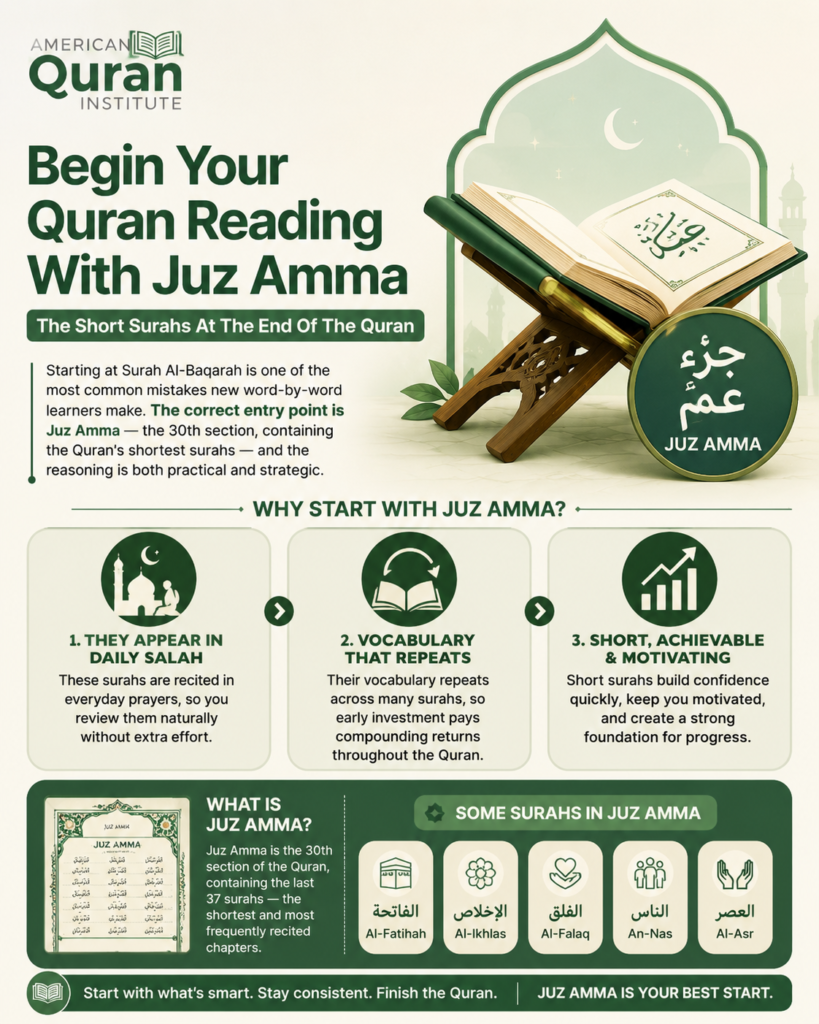
Starting at Surah Al-Baqarah is one of the most common mistakes new word-by-word learners make. The correct entry point is Juz Amma — the 30th section, containing the Quran’s shortest surahs — and the reasoning is both practical and strategic.
These surahs appear in daily salah, which means you review them naturally without extra effort. Their vocabulary repeats across many surahs, so early investment pays compounding returns throughout the Quran. And their length makes it genuinely possible to complete a surah word by word in a single focused session — producing the sense of progress that sustains long-term learning.
Start with Surah Al-Fatiha, then work through Juz Amma in order. Learn each surah word by word: read, listen, translate, repeat. Completing Juz Amma with correct Tajweed and translation is the recognized first milestone in structured Quranic learning programs.
6. Apply Tajweed Rules To Every Word You Read From The Very Beginning
Tajweed is not an advanced topic you revisit after learning to read. It applies to every Quranic word from the moment you begin reciting, and learners who treat it as separate from reading invariably develop recitation patterns that are difficult to correct later.
Rules such as ghunna (nasal sound in nun and meem with shaddah), madd (vowel elongation), qalqala (echoing resonance in certain letters), and idgham (merging of certain sounds) affect how individual words sound and are written directly into the Quranic text through specific symbols.
When you encounter a new word in word-by-word study, note which Tajweed rule applies to it. Ask your teacher to explain that rule in the context of that specific word. The word becomes a concrete anchor for the rule — far more memorable than rules studied in the abstract.
Learners who understand how to read the quran in Arabic Easy with Tajweed embedded from the beginning recite with measurably greater accuracy than those who attempt to layer pronunciation rules onto already-established reading habits.
Master Tajweed Recitation with The American Quran Institute’s Adult-Focused Training

7. Build Quranic Vocabulary Systematically
Roughly half of the Quran’s text is composed of just 100 unique root words. That statistic has a direct practical implication: a few months of targeted Quranic vocabulary work gives a disproportionately large reading return across the entire text.
A practical approach used in structured programs is to study five to ten new Quranic root words per week alongside your recitation practice. Spaced-repetition apps such as Anki work well for Arabic vocabulary — they surface roots at the right intervals to move them from short-term to long-term memory.
As you encounter each root during word-by-word reading, the meaning clicks rather than sitting as an unknown sound you’re skipping over. This is what distinguishes learners who recite with comprehension from those who recite phonetically. As vocabulary grows, word-by-word reading accelerates — because more of each ayah is already familiar before you even begin.
Read also: How to Read the Quran with a Beautiful Voice? Complete Guide for American Muslims
8. Build A Consistent Daily Quran Recitation Habit
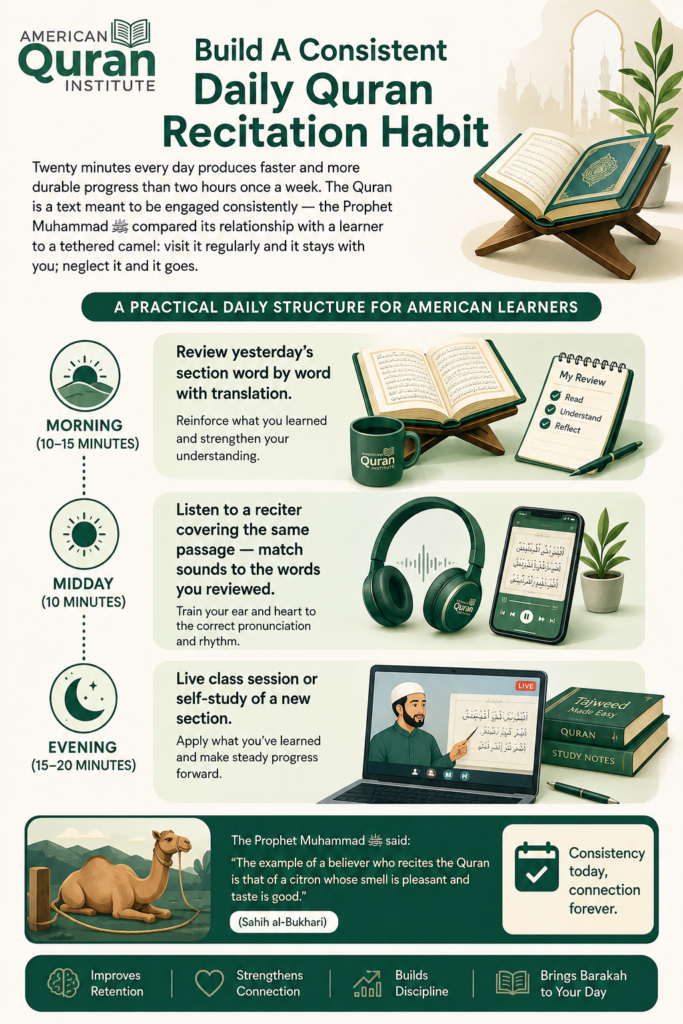
Twenty minutes every day produces faster and more durable progress than two hours once a week. The Quran is a text meant to be engaged consistently — the Prophet Muhammad ﷺ compared its relationship with a learner to a tethered camel: visit it regularly and it stays with you; neglect it and it goes. A practical daily structure for American learners:
- Morning (10–15 minutes): Review yesterday’s section word by word with translation.
- Midday (10 minutes): Listen to a reciter covering the same passage — match sounds to the words you reviewed.
- Evening (15–20 minutes): Live class session or self-study of a new section.
This structure works around common American schedules — the morning review fits before work or school, the midday listening on a lunch break or commute, and the evening session after dinner.
For anyone setting up this habit from scratch, a structured guide to how to start reading the quran daily covers practical scheduling strategies that account for US work, school, and family demands.
Read also: How To Read Quran Online For Free In The USA?
9. Use Quran Apps Built Specifically For Word-By-Word Learning
Several digital tools are purpose-built for the word-by-word approach, and they’re most valuable in the hours between teacher sessions.
A. Quran.com
Quran.com Displays word-by-word translations with audio from multiple reciters. You can loop any individual word or phrase until the pronunciation is solid — particularly useful for difficult sounds.

B. Tarteel AI
Uses voice recognition to flag mispronounced words in real time, one of the only tools that provides automated pronunciation feedback without a teacher present. Best used after a teacher has already established your baseline.
C. Quran Companion
Tracks recitation and memorization progress, sends daily reminders, and integrates naturally with a review-based daily schedule.
These tools don’t replace a certified teacher — but they fill practice hours productively. For learners who want to understand the full structure of the text before diving in, a broader guide on how to read the quran explains how the Quran is organized, which sections appear most in prayer, and how to navigate between chapters and juz during self-directed study.
Start learning Quran with a FREE trial class

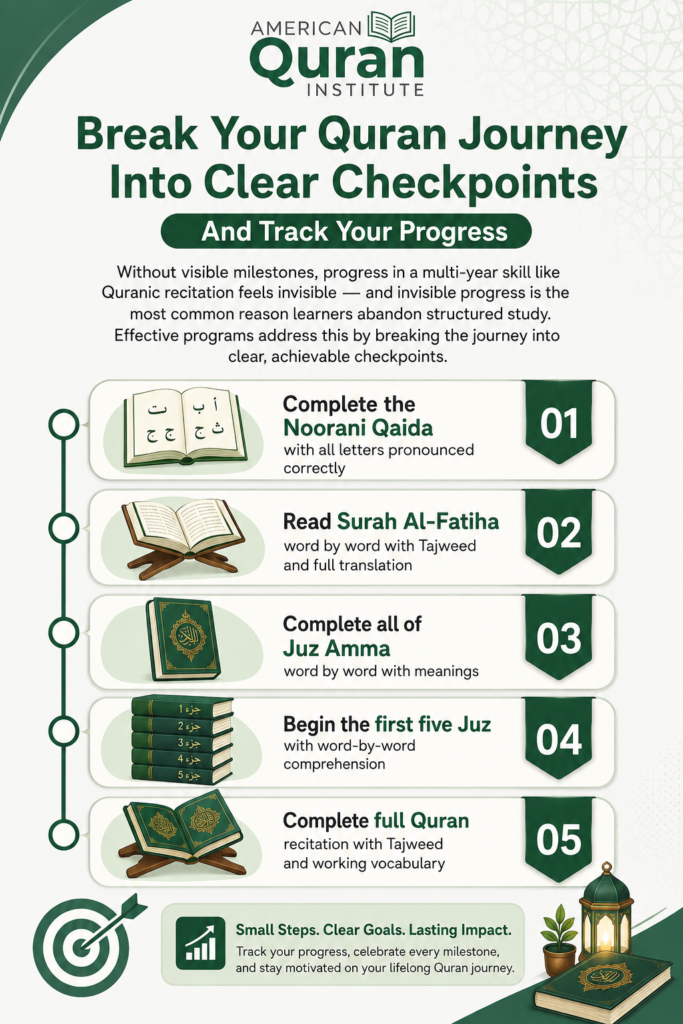
10. Break Your Quran Journey Into Clear Checkpoints And Track Your Progress
Without visible milestones, progress in a multi-year skill like Quranic recitation feels invisible — and invisible progress is the most common reason learners abandon structured study. Effective programs address this by breaking the journey into clear, achievable checkpoints. A practical milestone framework:
- Complete the Noorani Qaida with all letters pronounced correctly
- Read Surah Al-Fatiha word by word with Tajweed and full translation
- Complete all of Juz Amma word by word with meanings
- Begin the first five Juz with word-by-word comprehension
- Complete full Quran recitation with Tajweed and working vocabulary
Once foundational accuracy is established — once you can read consistently without pronunciation errors — the question naturally shifts from “how do I read correctly” to how to read the quran faster , meaning: how to build fluency and natural pace without sacrificing accuracy. That shift is itself a milestone worth recognizing.
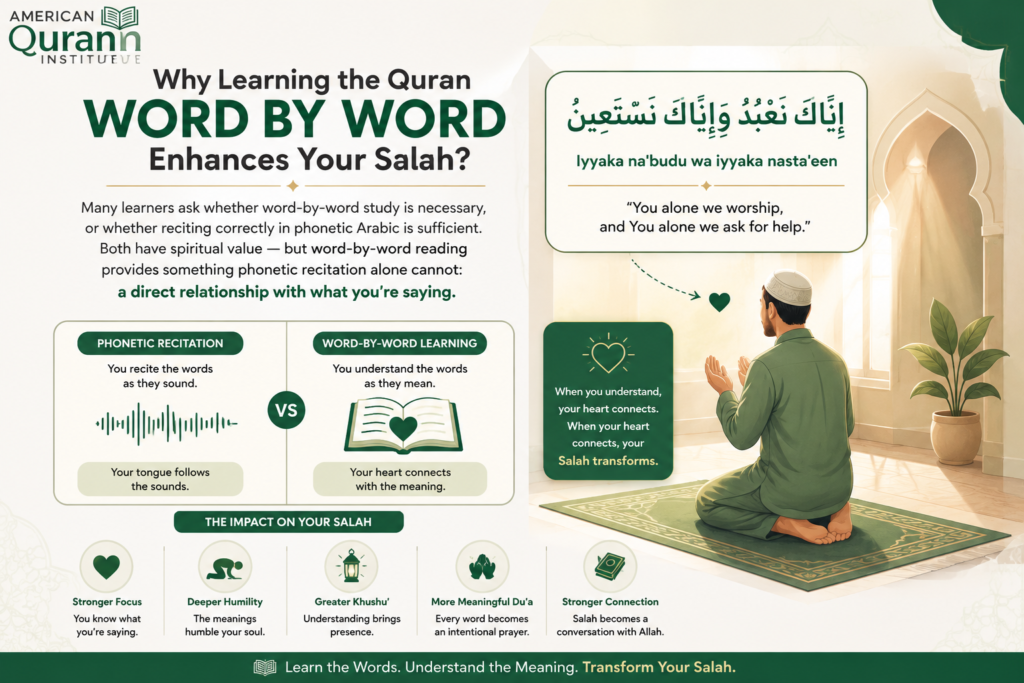
Why Learning the Quran Word by Word Enhances Your Salah?
Many learners ask whether word-by-word study is necessary, or whether reciting correctly in phonetic Arabic is sufficient. Both have spiritual value — but word-by-word reading provides something phonetic recitation alone cannot: a direct relationship with what you’re saying.
When you know that Iyyaka na’budu wa iyyaka nasta’een means “You alone we worship, and You alone we ask for help,” those words carry a different weight during Fajr than they do as sounds without meaning attached.
Scholars and educators who study Quranic learning consistently note that comprehension accelerates memorization — because you’re anchoring sounds to meaning, not just drilling sequences.
Understanding the benefits of reciting quran — from the spiritual rewards the Prophet ﷺ described to the documented effects on focus and attention — provides the “why” behind all of this investment. That matters deeply on days when progress feels slow.
A Step-By-Step Path For Complete Beginners
For anyone who doesn’t yet know the Arabic alphabet, word-by-word Quran reading is fully achievable. It simply requires beginning at the right starting point and maintaining regular practice over time.
The natural sequence: Arabic alphabet → Noorani Qaida → short surahs with Tajweed → word-by-word reading with growing vocabulary. Most students with three to four hours of instruction per week move from zero Arabic knowledge to correctly reading short surahs in three to six months.
Full word-by-word reading across the Quran typically develops over one to three years of structured study, depending on consistency and starting level. Some learners prefer to explore independently before committing to a formal program.
Start Your Classes of Learning Quran for Beginners in the USA with a free session

A guide on how to learn the quran by yourself offers a clear picture of what independent study looks like and which resources support it most effectively — useful context when deciding between self-directed and teacher-led learning.
Read also: How To Read Quran If You Don’t Know Arabic?
Word-by-Word Quran Learning For Children In The USA
Children bring natural advantages to Quranic learning: their ears are highly sensitive to unfamiliar sounds, their memory retention is stronger, and they haven’t accumulated the pronunciation habits that adults need to unlearn.
Children’s programs keep each lesson concrete — every session produces a visible, named result: these specific words, with these meanings, recited correctly. That tangibility sustains the motivation of young learners far better than abstract drilling.
For parents researching options, courses listed under learn quran for kids in the usa are structured specifically for children’s attention spans, learning styles, and age-appropriate engagement — quite different in format from adult programs even when covering identical foundational material.
Enroll your child in our Tajweed classes for kids with a FREE session

Experience Our Classroom Environment
Don’t just take our word for it—experience a live session for yourself! Click on the videos below to watch real snippets from our classes and see our interactive teaching methods in real-time.
Start Your Quranic Education
Join our premier online institute for structured Quranic learning tailored for students in the USA.
Book Your Free TrialStart Your Word-by-Word Quran Journey At The American Quran Institute
American Quran Institute connects learners across every US state with Ijazah-certified teachers who specialize in English-speaking students. Classes are live, one-on-one, and fit around Eastern, Central, Mountain, and Pacific time zones.
Every new student begins with a placement session — a direct assessment of exactly where you are right now and what the clearest path forward looks like for your specific level, schedule, and goals. No generic placement. No one-size curriculum.
Check Out Our Top Courses for Quran Learning
- Quran Classes in USA
- Online Quran Classes for Kids in the USA
- Online Tajweed Classes in the USA
- Quran Classes for Adults in the USA
- Quran Classes for Females in the USA
- Quran Ijazah Program in the USA
- Quran Memorization Course in the USA
- Quran Tafsir Course in the USA
Book your FREE trial session today

Start Your Quranic Education
Join our premier online institute for structured Quranic learning tailored for students in the USA.
Book Your Free TrialConclusion
Learning to read the Quran word by word in the USA is a structured, achievable goal — not a distant aspiration. The ten methods covered in this guide form a complete and sequenced roadmap: from the Arabic alphabet and Noorani Qaida, through the short surahs of Juz Amma with Tajweed, through systematic vocabulary building, and into fluent word-by-word recitation with genuine comprehension.
What separates learners who reach this goal from those who plateau is not talent or Arabic background — it’s structure. A consistent daily routine, a certified teacher who corrects errors before they become habits, clear milestones that make progress visible, and tools that support practice between sessions.
The Quran was revealed to be understood, reflected upon, and lived — not only recited. Word-by-word learning is the direct path from sound to meaning, and the investment, modest in daily time and significant in lifelong impact, pays itself back every time you stand in prayer knowing exactly what you’re saying.
Frequently Asked Questions
What does it mean to read the Quran word by word?
Reading the Quran word by word means reciting each Arabic word while knowing its individual meaning in English — rather than reading the full Arabic text and consulting a separate translation afterward. It builds a direct connection between pronunciation and understanding at the level of each individual word, which deepens both comprehension and memorization.
How long does it take to learn to read the Quran word by word in the USA?
Most learners with three to four hours of instruction per week can read short surahs correctly within three to six months. Full word-by-word recitation across the entire Quran typically develops over one to three years of consistent, structured study, depending on starting level and practice frequency.
Can I start without knowing any Arabic?
Yes — word-by-word Quran learning is specifically designed for non-Arabic speakers. The journey begins with the Arabic alphabet and the Noorani Qaida, then progresses into Quranic words with their translations. Formal Arabic grammar knowledge is not required to begin and improve.
Is a teacher necessary, or can I learn with apps alone?
A certified teacher is strongly recommended. Apps and resources are excellent supplements, but only a teacher can detect and correct mispronounced letters and Tajweed errors in real time. Uncorrected errors solidify into habits that become significantly harder to undo the longer they persist.
What is the Noorani Qaida, and why do most programs start there?
The Noorani Qaida is a structured beginner curriculum that teaches every Arabic letter, its vowel forms, and foundational Tajweed rules in sequence. It establishes correct pronunciation before a student encounters actual Quranic text — preventing the foundational errors that most self-taught learners accumulate and later struggle to correct.
Are certified Quran teachers available for US time zones?
Yes. Programs such as American Quran Institute specifically schedule live one-on-one classes around Eastern, Central, Mountain, and Pacific time zones, making consistent learning practical alongside a full work and school schedule. Scheduling around US time zones is a key criterion when selecting an online program.






Leave a Reply