 Quran
Quran
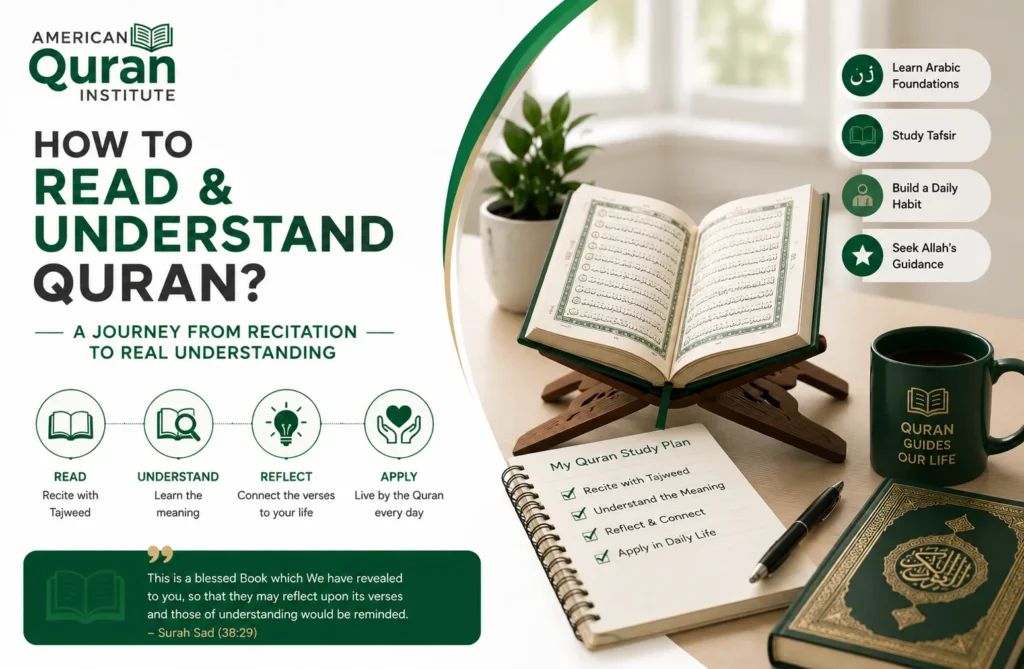
Every Muslim wants to connect with the Quran. Most find themselves in the same frustrating position: they can recite words they learned as children, but the meaning never quite lands. Understanding how to read and understand Quran is not one skill — it is a progression of layered practices, each building on the last.
Allah revealed this Book to be understood and acted upon, not only voiced. Surah Sad (38:29) is explicit: “This is a blessed Book which We have revealed to you, so that they may reflect upon its verses and those of understanding would be reminded.”
This guide is written for American Muslims specifically: people whose primary language is English, whose schedules are packed, and who want practical steps that fit real life rather than an idealized version of it.
Whether you are a new Muslim, a lifelong reciter who has never studied meaning, or a parent building this foundation for your children, the ten steps here will move you from mechanical recitation toward genuine comprehension.
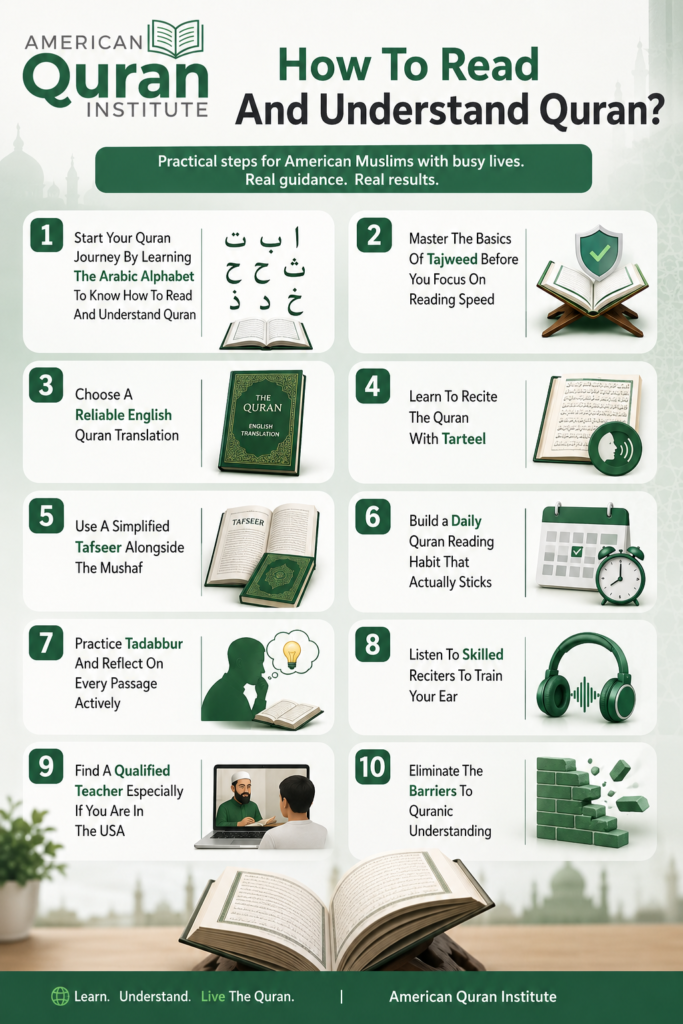
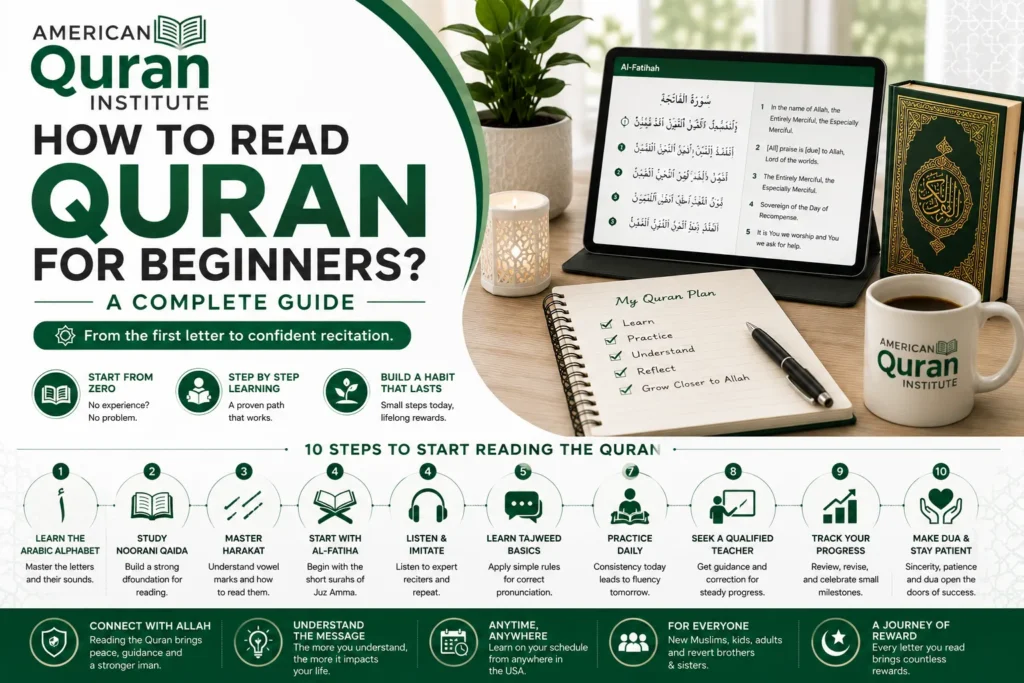
1. Start Your Quran Journey By Learning The Arabic Alphabet To Know How To Read And Understand Quran
Everything else in this list depends on this first step. Before you can recite a single verse correctly, before you can follow a translation verse-by-verse alongside the Arabic, you need to recognize the 28 Arabic letters and the short vowel marks (harakat) that determine how each word is pronounced.
Many English-speaking Muslims rely on transliteration — writing Arabic sounds in Roman letters — for years. Transliteration lets you memorize a handful of surahs by sound, but it cannot teach you to read independently, and it provides no foundation for Quranic study.
The solution is the Noorani Qaida, a beginner’s primer designed specifically for non-Arabic speakers that takes an adult learner from zero to independent reading within weeks of daily practice.
For a complete breakdown of where to start, how to learn the Quran alphabet covers the letter-by-letter approach, the vowel system, and the specific sequence that gets English speakers reading actual Quranic script as directly as possible.
Book a FREE trial class in our Noorani Qaida classes
Read also: How To Learn To Read Quran Word By Word In The USA?

2. Master The Basics Of Tajweed Before You Focus On Reading Speed
Tajweed governs correct Quranic pronunciation: how long to hold a vowel, when two sounds merge, where breath pauses are obligatory, and how to produce sounds that have no equivalent in English.
It is not a subject for specialists — it is the foundational layer of correct recitation, and skipping it produces habits that take far longer to unlearn than to build correctly in the first place.
The rules to prioritize first: articulation points of each letter (makhaarij al-huruf), the rules of noon sakinah and tanween, the rules of meem sakinah, and elongation rules (madd). Two to three months of consistent study at this level is a modest investment compared to years of reciting incorrectly.
Anyone working out how to read the Quran correctly from the beginning will recognize that tajweed is not slowing them down — it is ensuring that what they recite is recognizable as the Quran.
Explore our Tajweed Course for Ladies in the USA

3. Choose A Reliable English Quran Translation
A good translation is not a crutch. For a Muslim whose Arabic is still developing, it is the bridge between the sounds you produce and the meanings you need to absorb. The rule: keep it open beside the Arabic while you read, verse by verse, not in a separate session afterward.
Two translations stand out for American Muslims. Saheeh International is modern, precise, and close to the literal structure of Arabic — ideal for verse-by-verse study alongside the original text. The Clear Quran by Dr. Mustafa Khattab was written specifically for Western English-speaking audiences, with contemporary language and footnotes that address the questions American Muslim readers actually have.
The method: read one verse in Arabic, recite it, then read the same verse in translation before moving to the next. This parallel approach is far more effective than reading a full page in Arabic and then flipping back to check meaning.
For deeper meaning, the Quran Tafsir Course in the USA at American Quran Institute provides systematic tafseer instruction with a certified teacher who explains classical commentary in plain English — a natural next step once you have translation skills in place.
Enroll in our Quran Tafsir classes today
Read also: How To Read Quran For Beginners? A Complete Guide

4. Learn To Recite The Quran With Tarteel
Allah commanded the Prophet ﷺ directly in Surah Al-Muzzammil (73:4): “And recite the Quran with measured recitation (tarteel).” Tarteel does not mean exaggeratedly slow. It means deliberate and composed — a pace at which the mind receives meaning as the tongue produces sound.
Racing through pages is the single most counterproductive habit in Quran reading. A reader who completes a juz in 20 minutes without absorbing a single theme has produced sound, not worship. Ibn al-Qayyim wrote: “Reading one verse with reflection and understanding is better than reading a full khatm without tadabbur.”
Learning how to read the Quran faster is a legitimate goal — but only once comprehension is stable. Speed without understanding is just movement. A practical self-check: after finishing a page, ask yourself what the main theme was. If the answer does not come within a few seconds, you read too fast. Slow down until it does.
Read also: Benefits of Reciting Quran Without Understanding
See Us in Action!
Take a look inside our virtual classrooms. Watch the clip below to see how our instructors engage with students, simplify complex rules, and create an inspiring environment for learning.
Start Your Quranic Education
Join our premier online institute for structured Quranic learning tailored for students in the USA.
Book Your Free Trial5. Use A Simplified Tafseer Alongside The Mushaf
Tafseer is Quranic commentary — scholarly explanation of verse meanings, their context, the occasion of revelation, and the significance of specific word choices. You do not need to become a scholar to benefit from it. You need one accessible tafseer resource available during your study.
Three options work especially well for English-speaking Muslims in the USA. Tafseer Ibn Kathir (abridged) is available free through multiple apps and provides hadith-based context that clarifies historical background.
Tafseer as-Sa’di (translated into English) is concise enough to read in the same session as the verse itself, without derailing focus. In the Shade of the Quran by Sayyid Qutb is particularly powerful for connecting Quranic themes to the experience of living as a Muslim in the modern world.
The method: read the Arabic, then the translation, then check the tafseer note only for verses where a question arose. Reading tafseer for every single verse collapses most study sessions within a week. Use it surgically, for what you genuinely do not understand.
Book your FREE trial session today

6. Build a Daily Quran Reading Habit That Actually Sticks
A Muslim who reads two pages every single day, with attention and reflection, builds more comprehension over a year than someone who reads twenty pages on Fridays and nothing in between. The Prophet ﷺ said: “The most beloved deeds to Allah are the most consistent, even if they are small.”
The key for Americans managing careers, school, and family responsibilities is attaching Quran reading to an existing anchor in your daily routine rather than scheduling it as a standalone task. After Fajr prayer is the classical recommendation — the mind is undistracted and the morning carries a specific spiritual weight.
If Fajr does not work, any consistent 15-minute window that genuinely belongs to you works. Connect it to something that already happens every day without exception, and it stops feeling like a commitment you can defer.
For anyone who has been wondering how to start reading the Quran daily and struggling to maintain it, the anchor habit method — linking the Quran session to prayer, morning coffee, or the commute — is what converts intention into routine.
Start Memorizing Quran Classes in USA with first free session

7. Practice Tadabbur And Reflect On Every Passage Actively
Tadabbur is not passive. It is not sitting quietly hoping a feeling will arrive. It is asking specific questions of the text and looking for specific answers. The scholars identified structured methods for this that are as applicable today as they were in the 7th century. Five tadabbur techniques that work in practice:
- Ask “What is Allah telling me right now?” after every passage — before turning the page, not after.
- Identify the divine names at the end of verses. Every verse closing with Al-Aziz (the Almighty) or Al-Hakeem (the All-Wise) was chosen deliberately. Asking why that specific name closes that specific verse is one of the most powerful entry points into deep reflection — and it is a method rarely covered in beginner guides.
- Connect to your current circumstances. If a verse addresses patience in difficulty and you are in difficulty, that passage is not ancient history. It is a direct communication.
- Repeat the verses that move you. The Prophet ﷺ spent an entire night repeating a single verse. One verse understood deeply changes a person more than a hundred verses recited without engagement.
- Keep a reflection notebook. Writing one sentence about what a passage meant to you that day forces active engagement and builds a personal record of growth that no app can replicate.
Read also: How To Read The Quran In English In The USA? 10 Steps To Get Started
8. Listen To Skilled Reciters To Train Your Ear
Listening is a separate and underused avenue for building both recitation skill and comprehension. When you regularly hear a master reciter, your ear internalizes the rhythms, elongations, pauses, and emotional weight of Quranic Arabic before your analytical mind can explain any of it.
This phonemic memory accelerates comprehension dramatically when you encounter those same phrases during study. For American Muslims, this is especially practical. Commutes, workouts, cooking, and household tasks can all become passive Quran exposure.
Apps like iQuran Pro, QuranCompanion, and Muslim Pro display the Arabic text and English translation in sync with the audio, allowing you to follow visually while listening.
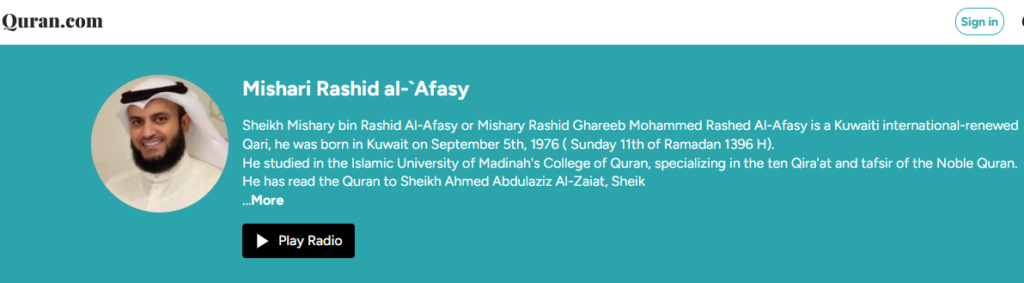
Three reciters with widely available, high-quality recordings: Sheikh Mishary Rashid Alafasy for an accessible, emotionally resonant style; Sheikh Mahmoud Khalil al-Husary, whose recordings are used as a worldwide tajweed teaching standard; and Sheikh Abdurrahman as-Sudais of Masjid al-Haram, whose recitation of longer surahs rewards repeated listening.
9. Find A Qualified Teacher Especially If You Are In The USA
Self-study takes you far. But there is a ceiling to what apps, guides, and solo effort can reach. The Quran was transmitted through an unbroken chain of teacher-to-student oral instruction from the Prophet ﷺ to the present day.
For those who have explored how to learn the Quran by yourself and reached the limits of independent study, or for those starting and wanting to do it right from the beginning, a qualified teacher changes everything.
The Companions of the Prophet ﷺ — native Arabic speakers — still sat with him and studied ten verses at a time until they understood both the knowledge and the required action. Independent ability was never the measure of completion.
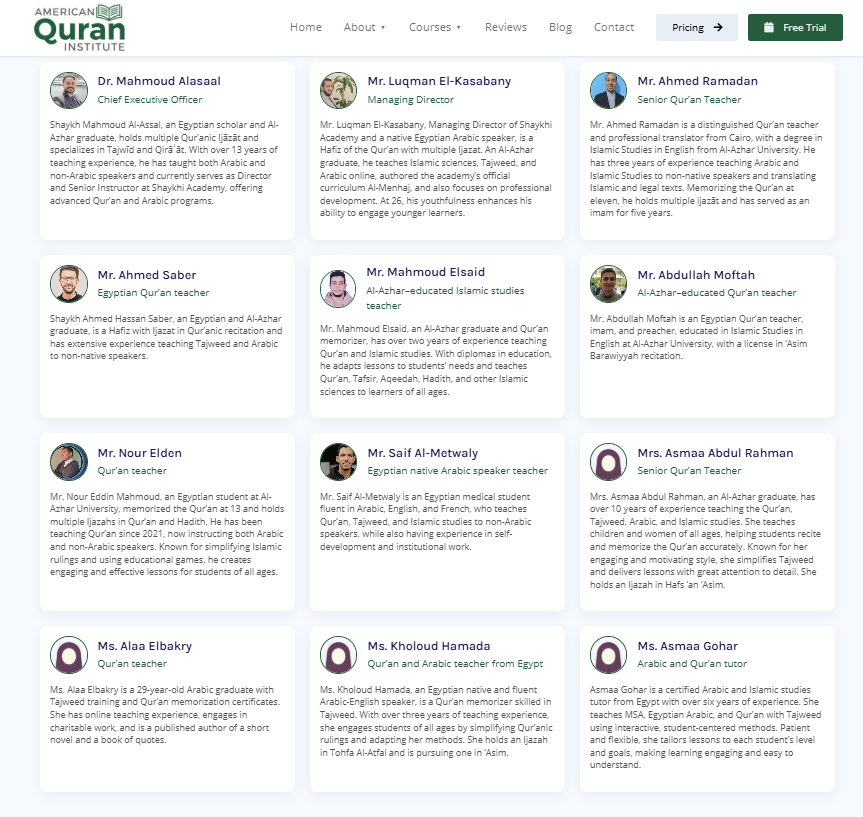
American Quran Institute, based in the USA, connects American Muslims — children, adults, ladies, and new Muslims — with Ijazah-certified teachers who specialize in guiding English speakers from the Arabic alphabet through fluent recitation. All classes are live and online, scheduled around US time zones so there’s no need to compromise your work, school, or family commitments.
Book a FREE session with one of our Ijazah-certified teachers
10. Eliminate The Barriers To Quranic Understanding
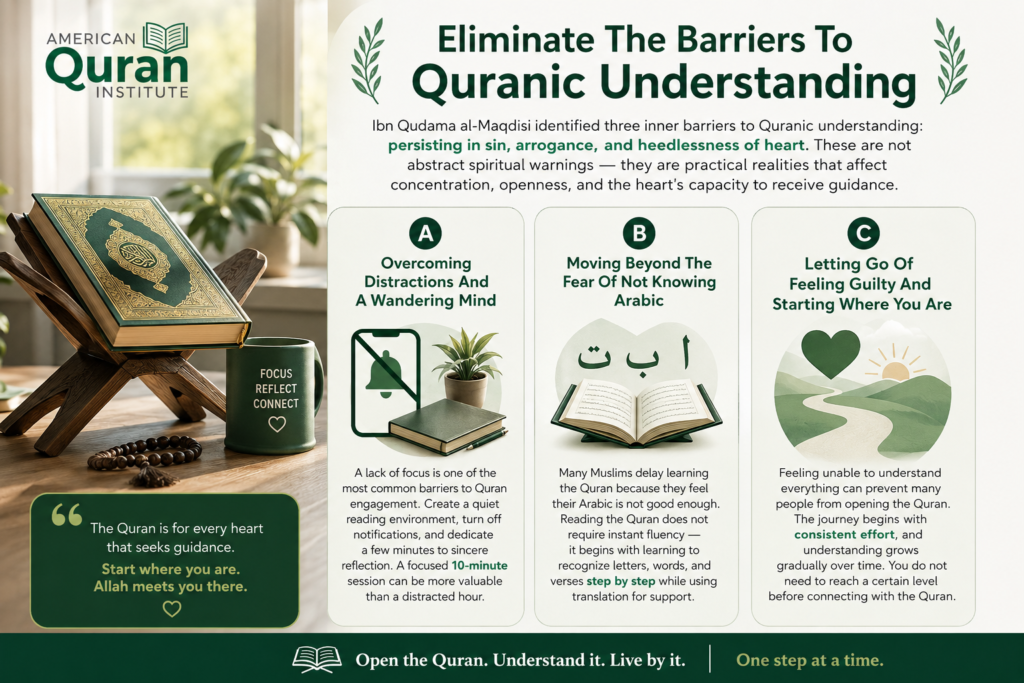
Ibn Qudama al-Maqdisi identified three inner barriers to Quranic understanding: persisting in sin, arrogance, and heedlessness of heart. These are not abstract spiritual warnings — they are practical realities that affect concentration, openness, and the heart’s capacity to receive guidance.
A. Overcoming Distractions And A Wandering Mind
A lack of focus is one of the most common barriers to Quran engagement. Create a quiet reading environment, turn off notifications, and dedicate a few minutes to sincere reflection. A focused 10-minute session can be more valuable than a distracted hour.
B. Moving Beyond The Fear Of Not Knowing Arabic
Many Muslims delay learning the Quran because they feel their Arabic is not good enough. Reading the Quran does not require instant fluency — it begins with learning to recognize letters, words, and verses step by step while using translation for support.
C. Letting Go Of Feeling Guilty And Starting Where You Are
Feeling unable to understand everything can prevent many people from opening the Quran. The journey begins with consistent effort, and understanding grows gradually over time. You do not need to reach a certain level before connecting with the Quran.
Experience Our Classroom Environment
Don’t just take our word for it—experience a live session for yourself! Click on the videos below to watch real snippets from our classes and see our interactive teaching methods in real-time.
Start Your Quranic Education
Join our premier online institute for structured Quranic learning tailored for students in the USA.
Book Your Free TrialStart Your Quran Reading Journey With The Right Guidance
If you have read this far and your main thought is “I know what I need — I need someone to actually help me do it,” you are right. Knowing the steps is the beginning. Consistent, guided practice is what produces lasting results.
American Quran Institute offers live online classes for every level, from absolute beginners learning their first Arabic letters to advanced students pursuing Ijazah certification. Every teacher is Ijazah-certified, experienced with English-speaking students, and available at times that work for US schedules.
Book your FREE trial session today

Explore Quran Programs in the USA:
- Quran Classes in USA
- Noorani Qaida Course in the USA
- Online Quran Classes for Kids in the USA
- Online Tajweed Classes in the USA
- Quran Classes for Adults in the USA
- Quran Classes for Females in the USA
- Quran Ijazah Program in the USA
- Tajweed Course for Kids in the USA
- Weekend Quran Classes
- Hifz Quran
Start Your Quranic Education
Join our premier online institute for structured Quranic learning tailored for students in the USA.
Book Your Free TrialConclusion
Learning how to read and understand the Quran is one of the most significant investments an American Muslim can make — not primarily in time or money, but in relationship.
A relationship with a Book that will intercede for its companion on the Day of Judgment; that records ten rewards for every letter recited; that, when read with genuine attention, changes how you see every problem, every decision, and every ordinary day.
The ten steps in this guide are not a checklist to complete and set aside. They are a living practice — each one worth returning to, deepening, and refining as your Arabic grows and your comprehension deepens.
Start with the alphabet. Add the translation. Build the daily habit. Find a teacher. Practice tadabbur until reflecting on the Quran feels as natural as any other form of thinking.
Frequently Asked Questions
Can I understand the Quran without learning Arabic?
You can begin to understand the Quran through a reliable English translation, and that is a completely valid starting point. A good translation gives you the meaning. Arabic gives you the original sound, rhythm, and precision of wording that no translation can fully carry. The recommended approach is to use both together from the start: recite the Arabic, then read the translation of the same verse before moving on.
How long does it take to learn to read the Quran?
Most adult beginners who study consistently — even 20 to 30 minutes a day — reach independent reading with correct tajweed in six months to a year. The Noorani Qaida phase (letter recognition and basic vowel reading) typically takes four to eight weeks with daily practice. Consistent teacher feedback shortens this timeline significantly.
Do I receive a reward for reciting the Quran if I do not understand it?
Yes. Scholars across generations are unanimous on this point: the reward of recitation — ten good deeds per letter — is given regardless of comprehension level. Understanding the meaning adds a separate and significant dimension of benefit, and it is something to pursue progressively. But comprehension is not a condition for the recitation itself to be valid or rewarded.
What is the best time to read the Quran for comprehension?
After Fajr prayer is the classical recommendation and is supported by practical experience: the mind is clear, distractions are minimal, and the day has not yet accumulated mental noise.
For Americans with early work schedules, any consistent 15-minute window before the household fully activates is effective. Consistency of time matters more than which specific hour you choose.
How do I stop my mind from wandering while reading the Quran?
The wandering mind is the most commonly reported barrier to Quranic comprehension. Three practical adjustments help: read in a dedicated, quiet space free of notifications; read aloud rather than silently, since the voice engages more of the brain; and use the verse-by-verse method — recite one verse, read the translation, pause for a single moment of reflection, then move to the next. This structured pacing gives the mind something specific to do at every moment, which prevents drift without requiring willpower.
Is it permissible to read the Quran from a screen without wudu?
Wudu (ablution) is required to physically touch the Mushaf — the printed Quran. It is not required to recite from memory or to read from a screen or app. For sessions involving the physical Mushaf, performing wudu beforehand is recommended both as a sign of respect and as a practical mental preparation that helps settle the mind for focused reading.






Leave a Reply