 Quran
Quran
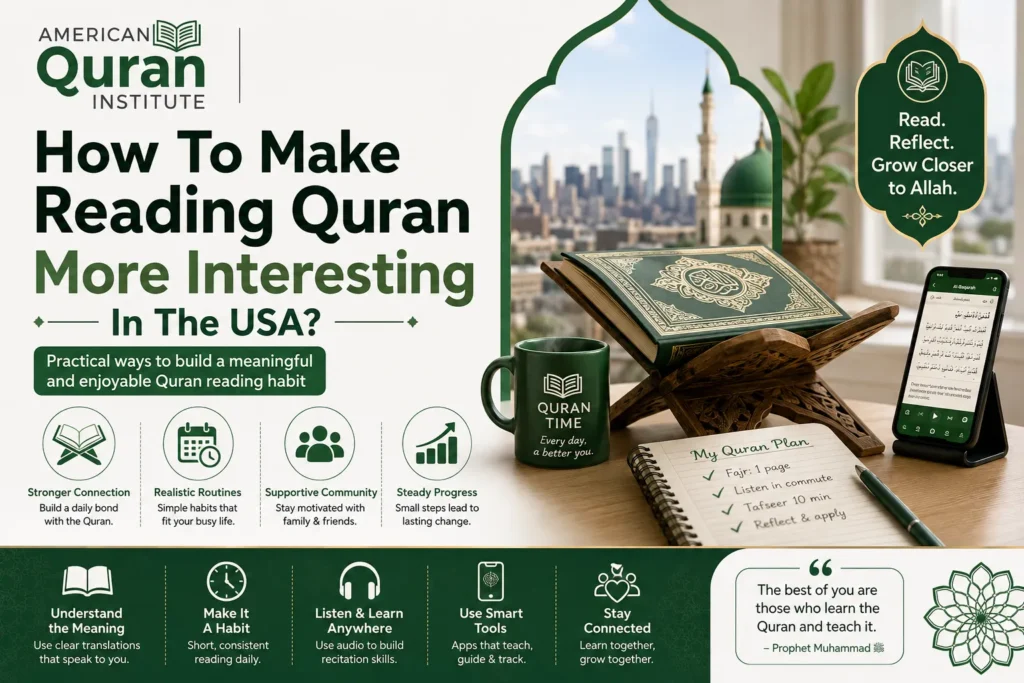
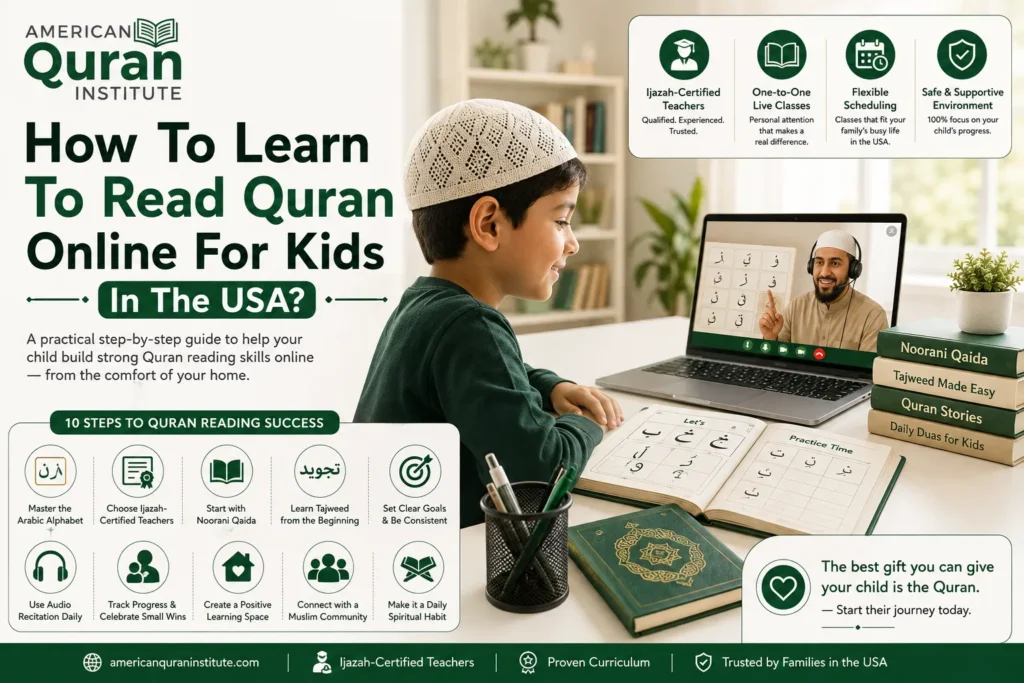
Reading the Quran should feel like a conversation with God — not another task on a packed to-do list. Yet for millions of Muslims living in the United States, that’s precisely what it becomes: something wedged between back-to-back meetings, school pickups, and the sheer velocity of daily American life until it quietly disappears from the schedule altogether.
Learning how to make reading Quran more interesting in the USA isn’t a willpower problem. It’s a design problem. Build the right conditions — the right tools, rituals, and community around the habit — and opening the Quran becomes something you return to willingly, even on your hardest days.
This guide walks through ten practical strategies built specifically for the American Muslim experience: English as a working language, a demanding schedule, and a cultural context that doesn’t automatically support daily recitation. Whether you’re reconnecting after years away or building your practice from scratch, every approach below is actionable today.
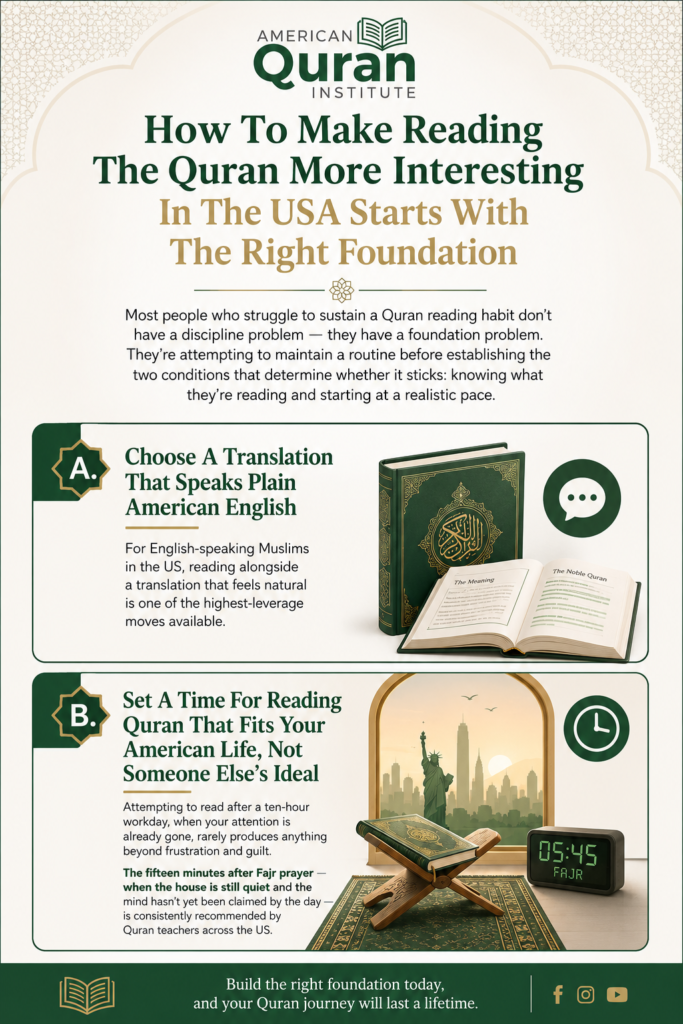
1. How To Make Reading The Quran More Interesting In The USA Starts With The Right Foundation
Most people who struggle to sustain a Quran reading habit don’t have a discipline problem — they have a foundation problem. They’re attempting to maintain a routine before establishing the two conditions that determine whether it sticks: knowing what they’re reading and starting at a realistic pace.
Before adding any strategy from this list, take ten minutes to clarify what you actually want from this practice. Spiritual grounding? Memorization? A closer relationship with your faith? That clarity determines everything downstream — the schedule, the format, the tools.
A. Choose A Translation That Speaks Plain American English
For English-speaking Muslims in the US, reading alongside a translation that feels natural is one of the highest-leverage moves available. The Clear Quran by Dr. Mustafa Khattab is widely recommended by American imams and educators for its contemporary, accessible English without sacrificing accuracy.
The Study Quran by Seyyed Hossein Nasr suits readers who want scholarly depth alongside the Arabic text. When the meaning of what you’re reading becomes clear, curiosity replaces obligation — and that shift alone changes the entire experience.
B. Set A Time For Reading Quran That Fits Your American Life, Not Someone Else’s Ideal
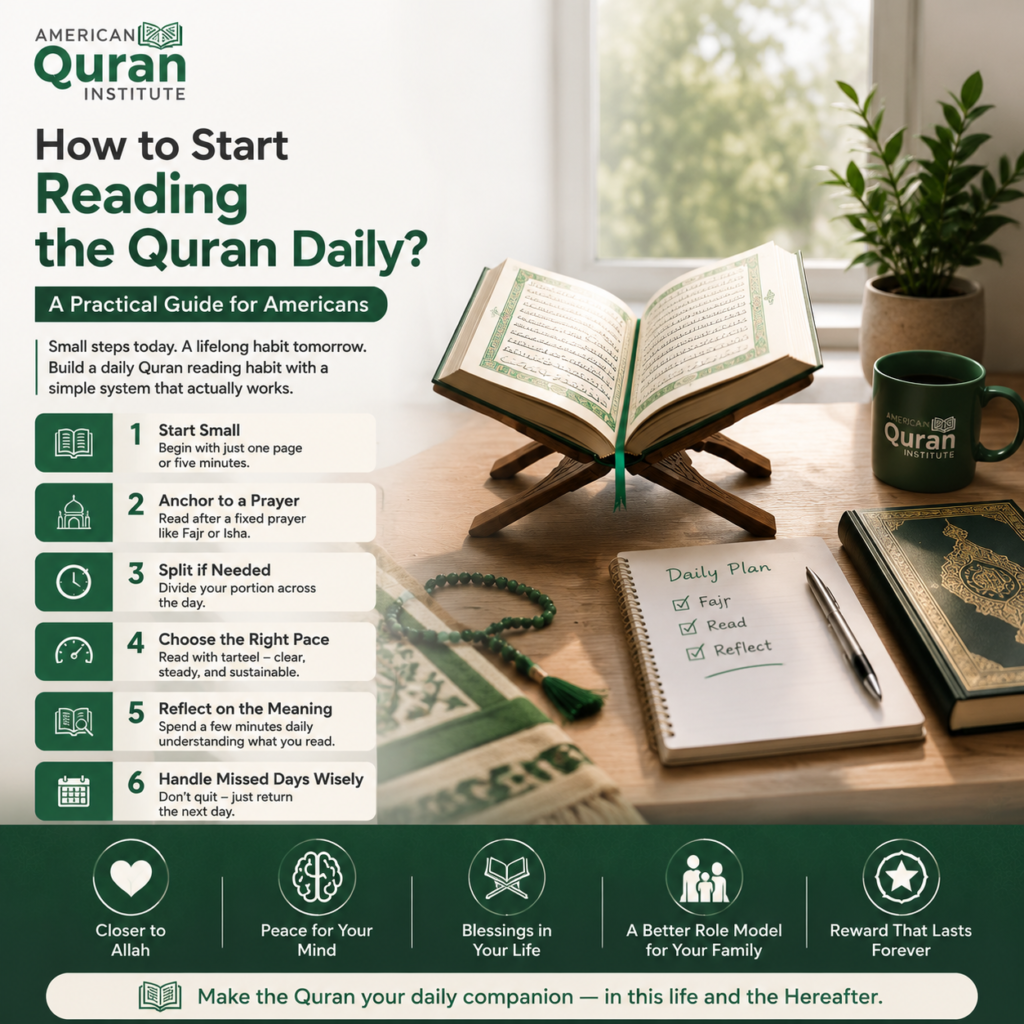
Attempting to read after a ten-hour workday, when your attention is already gone, rarely produces anything beyond frustration and guilt. The fifteen minutes after Fajr prayer — when the house is still quiet and the mind hasn’t yet been claimed by the day — is consistently recommended by Quran teachers across the US.
If mornings genuinely don’t work, the ten minutes before bed that would otherwise go to phone scrolling are a realistic and proven alternative. Understanding how to start reading the Quran daily comes down to one principle above all others: start smaller than feels meaningful. One page, read consistently, beats three chapters attempted and abandoned every time.
Read also: How To Read And Understand Quran?
2. Turn Your Daily Commute Into Quran Time
Americans spend an average of 54 minutes commuting each day — nearly six hours a week that most people spend half-consciously scrolling or listening to news that raises their blood pressure. Redirecting even a fraction of that time toward the Quran changes the math significantly.
Download a high-quality Quran audio app and queue up a reciter whose voice genuinely moves you. Sheikh Mishary Rashid Alafasy, Sheikh Abdul Rahman Al-Sudais, and Sheikh Saud Al-Shuraim are widely beloved among American listeners for their clarity and emotional depth. Follow the highlighted text in the app while you listen, and the combination of audio and visual reinforcement builds familiarity fast.
For those still developing their pronunciation, learning how to read the Quran in Arabic easy begins exactly here — with slow, audio-assisted repetition before attempting unaided reading. Ten minutes of commute listening each morning builds a recitation foundation that self-study drills alone rarely match.
See Us in Action!
Take a look inside our virtual classrooms. Watch the clip below to see how our instructors engage with students, simplify complex rules, and create an inspiring environment for learning.
Start Your Quranic Education
Join our premier online institute for structured Quranic learning tailored for students in the USA.
Book Your Free Trial3. Use Quran Apps Intentionally Not Just Conveniently
There’s a meaningful difference between having a Quran app on your phone and actually using it to grow. Most people download two or three, open them occasionally, and wonder why nothing changes. Used intentionally, the right tools become daily practice partners.
Read also: How To Learn To Read Quran Word By Word In The USA?
A. Apps That Turn Recitation Into An Active Skill
Tarteel uses AI to listen to your recitation in real time and flag errors in pronunciation or memorization — the closest thing to a private Tajweed tutor available on your phone. Quran Majeed offers translations in over 45 languages alongside color-coded Tajweed text, making it ideal for visual learners who want to see the rules displayed as they read.
Ayah and Muslim Pro both offer flexible reading trackers, daily verse notifications, and audio options that make maintaining a consistent habit straightforward without feeling mechanical.
B. Ai-Powered Tools For Long-Term Quran Reading Accuracy
One pattern common among American Muslims raised without Arabic at home is that pronunciation errors normalize over years — the ear adjusts to the mistake rather than catching it. AI recitation tools like Tarteel identify those patterns during practice rather than letting them compound quietly. Used alongside a teacher, they compress the correction timeline significantly.
Those exploring how to learn the Quran by yourself will find that the most effective independent approach combines structured app-based practice with periodic check-ins with a qualified teacher — not one or the other in isolation.
Begin Your Journey Toward Quran Ijazah Certification Today

4. Joining A Quran Circle Can Strengthen Your Motivation
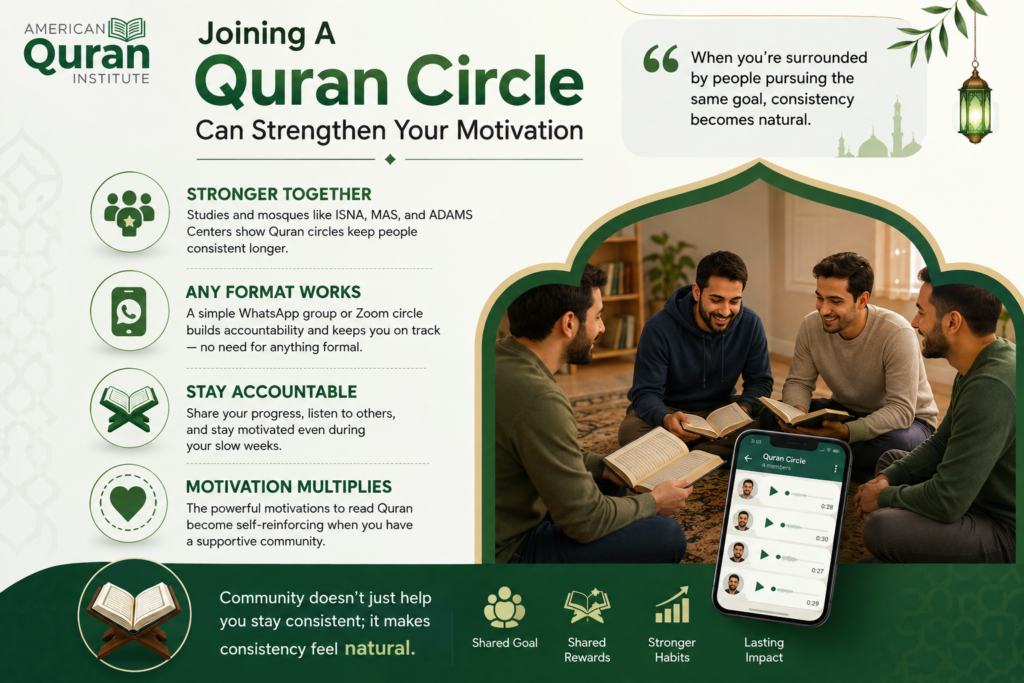
Social accountability is one of the strongest predictors of habit maintenance across virtually every domain of behavior. Quran reading is no different. Mosques affiliated with ISNA, MAS, and ADAMS Centers across the US report that group Quran circles retain participants significantly longer than solo commitments.
The format doesn’t need to be formal. A WhatsApp group of four friends, each sharing a thirty-second voice note of their daily reading, creates enough accountability to carry most people through their slow weeks. Virtual circles on Zoom work equally well — time zones aside, the experience of shared practice is what matters.
When you’re surrounded by people pursuing the same goal, the powerful motivations to read Quran that feel elusive in isolation become self-reinforcing. Community doesn’t just help you stay consistent; it makes consistency feel natural.
5. Read the Quran Stories — They Are the Heart of the Book
The Quran doesn’t read linearly in the way most English-language books do, and sequential reading from Al-Fatiha to An-Nas, while valuable for completeness, often isn’t the entry point that builds genuine engagement. Thematic reading — especially through the Quran’s stories — frequently is.
Spend a week with the prophets’ narratives. Surah Yusuf is a complete arc: betrayal, slavery, patience, and eventual redemption. Surah Maryam centers on three miraculous births and the dignity of faith under pressure.
Surah Al-Kahf contains some of the Quran’s most resonant parables about time, knowledge, and trust. These chapters read differently from legal verses or theological passages, and they’re often where readers fall genuinely in love with the text.
American Muslim scholar Omar Suleiman’s “Quran 30 for 30” series connects each juz to lived contemporary experience and has introduced this approach to millions of American viewers. The benefits of reciting Quran extend far beyond the accumulation of reward — understanding the narrative depth builds a relationship with the text that phonetic recitation alone rarely achieves.
Start Your Quranic Interpretation Training Today via our Quran Tafsir Course
Read also: Benefits of Reciting Quran Without Understanding

6. Keep A Reflection Journal Beside Your Mushaf
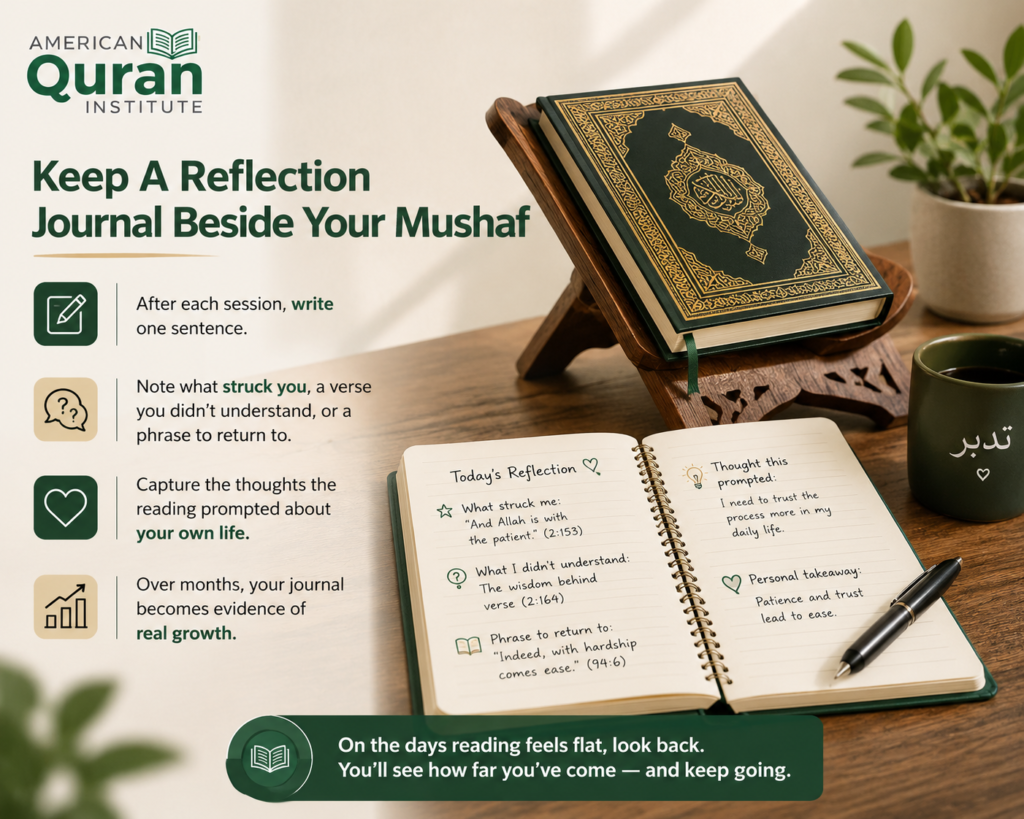
Reading without reflection rarely builds a living relationship with the text. The practice is simple: after each session, write one sentence — something that struck you, a verse you didn’t fully understand, a phrase you want to return to, or a thought the reading prompted about something in your own life.
Over months, that journal becomes evidence of real growth. On the days when reading feels flat or mechanical, flipping back through earlier entries shows you concretely how far you’ve come — and that perspective usually provides more momentum than any external encouragement could.
7. Create A Reading Place You Actually Want To Return To
Environment shapes behavior more reliably than motivation does. A designated reading corner — even a small one — signals to the brain that this space belongs to the Quran. The habit of going there starts to function as a cue, activating a reading mindset before the book is even open.
The specifics matter less than the intention behind them. Some American Muslim households set up a comfortable chair near a window with a side table for the Quran and a journal. Others keep a beautifully printed Quran with wide margins for notes on a dedicated shelf.
Good lighting, a small prayer rug, and even a subtle fragrance can make the space feel worth returning to each day. How to read the Quran in a way that truly sticks isn’t only about the mechanics of the text — it’s about designing a daily environment that supports the practice and makes the experience feel like the most grounding part of your day rather than one more obligation.
Begin Your Quran Recitation Journey with The American Quran Institute Today
8. Connect The Quran Verses To Your Life In America Right Now
One of the most common reasons Quran reading loses its pull is the creeping sense that it belongs to another time, another place, another language. That feeling is a bridge-building problem, not a problem with the text.
Short tafseer podcasts by American Muslim scholars address this directly. The Bayyinah Institute’s “Quran Cover to Cover” by Nouman Ali Khan draws explicit connections between Quranic themes and the contemporary American Muslim experience.
When a verse you recited in the morning reappears in a podcast discussion about something you’re navigating at work or at home, the Quran stops being an ancient document and starts being a living guide. That shift is fundamental to sustained engagement — and it’s available to any American Muslim with a commute and earbuds.
Book your free trial class today

Read also: BEST COUNTRY TO LEARN QURAN
9. Track Your Reading Progress And Build A Consistent Habit
American culture understands goals, streaks, and milestones, and there’s nothing wrong with applying that framework to your Quran practice. Apps like Quran.com and Muslim Pro let you track your daily reading streak, set page targets, and watch a year’s worth of consistency accumulate visually.
Physical tracking works just as well. A wall calendar where each completed day gets a checkmark is low-tech but psychologically effective for many readers. Completing Juz Amma, finishing your first full reading of the Quran, or memorizing your first ten surahs are genuine milestones worth acknowledging.
If efficiency is a goal, learning how to read the Quran faster is a distinct Tajweed skill built through consistent practice and expert correction — but raw speed should never come before accuracy or comprehension. Consistency at any pace, tracked and celebrated, is what builds a practice that lasts.
Read also: How To Read Quran If You Don’t Know Arabic?
Enroll Your Child in Our Noorani Qaida Course Today

10. Learn Quran Reading With A Qualified Teacher
Every approach on this list is more effective when a qualified teacher is in the picture. Teachers catch the pronunciation patterns you’ve normalized over years.
American Quran Institute, based in the USA, connects American Muslims — children, adults, ladies, and new Muslims — with Ijazah-certified teachers who specialize in guiding English speakers from the Arabic alphabet through fluent recitation. All classes are live and online, scheduled around US time zones so there’s no need to compromise your work, school, or family commitments.
Those starting from the very beginning will find clear, step-by-step guidance on how to learn the Quran alphabet before progressing to full recitation practice. Families will find that learn Quran for kids in the USA programs at AQI use age-appropriate methods that make learning feel engaging rather than formal, building a positive relationship with the text from an early age.
For independent learners and adults exploring how to learn Quran in the USA without a convenient local option, live instruction with an Ijazah-certified teacher is the most accountable and results-oriented path available.
Experience Our Classroom Environment
Don’t just take our word for it—experience a live session for yourself! Click on the videos below to watch real snippets from our classes and see our interactive teaching methods in real-time.
Start Your Quranic Education
Join our premier online institute for structured Quranic learning tailored for students in the USA.
Book Your Free TrialStart Your Quran Journey With The American Quran Institute Today
Consistency doesn’t happen by accident — it happens by design. American Quran Institute has guided thousands of American Muslims through the structured practice they’d been trying to build on their own for years. Ijazah-certified teachers, flexible scheduling across all US time zones, and programs tailored to every level and background mean there’s a real starting point for every learner.
Explore All Programs at American Quran Institute
- Quran Classes in USA
- Noorani Qaida Course in the USA
- Online Quran Classes for Kids in the USA
- Online Tajweed Classes in the USA
- Quran Classes for Adults in the USA
- Quran Classes for Females in the USA
- Quran Memorization Course in the USA
- Tajweed Course for Kids in the USA
Book your free trial class today and find out what consistent, expert-guided Quran learning actually feels like.

Start Your Quranic Education
Join our premier online institute for structured Quranic learning tailored for students in the USA.
Book Your Free TrialConclusion
Making the Quran a consistent part of daily American life doesn’t require extraordinary discipline — it requires thoughtful design. The ten strategies in this guide work because they account for the real constraints of life in the US: full schedules, English as a working language, and a cultural environment that doesn’t automatically reinforce daily recitation.
Start with one strategy this week. Let it settle into your routine before adding another. The American Muslims who have built lasting, meaningful Quran practices — teachers, scholars, and everyday believers — didn’t arrive there through sheer willpower.
They got there by designing their environments, finding their communities, and working with teachers who helped them past the obstacles they couldn’t see clearly on their own.
Frequently Asked Questions
How many pages should I read each day to stay consistent?
One page daily is a more sustainable starting point than most people expect. Quran teachers across the US consistently recommend consistency over volume — a five-minute session maintained every day over a year builds far more long-term engagement than ambitious goals abandoned after the first difficult week.
Can Quran reading be interesting without Arabic fluency?
Reading alongside a strong English translation makes an immediate difference. The Clear Quran uses plain, contemporary American English and is widely used by imams and educators throughout the US.
When you understand what you’re reading, the text shifts from a phonetic exercise into a living conversation. Arabic fluency deepens the experience over time, but comprehension through translation is a fully legitimate starting point.
What is the best time to read the Quran with a demanding American schedule?
The fifteen minutes after Fajr prayer — before the day starts claiming your attention — is the slot most consistently recommended by American Quran teachers. If that isn’t practical, the ten minutes before bed that would otherwise go to phone scrolling is the most realistic and effective alternative for working adults and parents.
Are online Quran classes as effective as in-person instruction?
For most learners, live online classes with a qualified teacher produce results equivalent to in-person instruction and are considerably more accessible for American Muslims with demanding daily schedules. The critical factor is “live” — real-time interaction with a certified teacher provides the personalized error correction and contextual guidance that recorded lessons and apps alone cannot replicate.
How do I stop losing focus when I read?
Reading aloud at a deliberate, unhurried pace — even quietly — is reliably more effective than silent reading for maintaining attention. Following the text with a finger or cursor adds a second sensory anchor that keeps the mind on the page. Short sessions of ten to fifteen minutes with full engagement consistently outperform longer sessions with wandering attention.
How do I help my children develop a genuine love for the Quran?
Framing the Quran’s stories as adventure narratives rather than religious lessons resonates with most children. Surah Yusuf, in particular, reads as a compelling story of betrayal, hardship, patience, and triumph that captivates young readers once they grasp the narrative.
Pairing storytelling with a consistent bedtime reading ritual — and enrolling children in a program where a patient teacher and peer learning create positive early associations — builds a relationship with the text that tends to last.






Leave a Reply