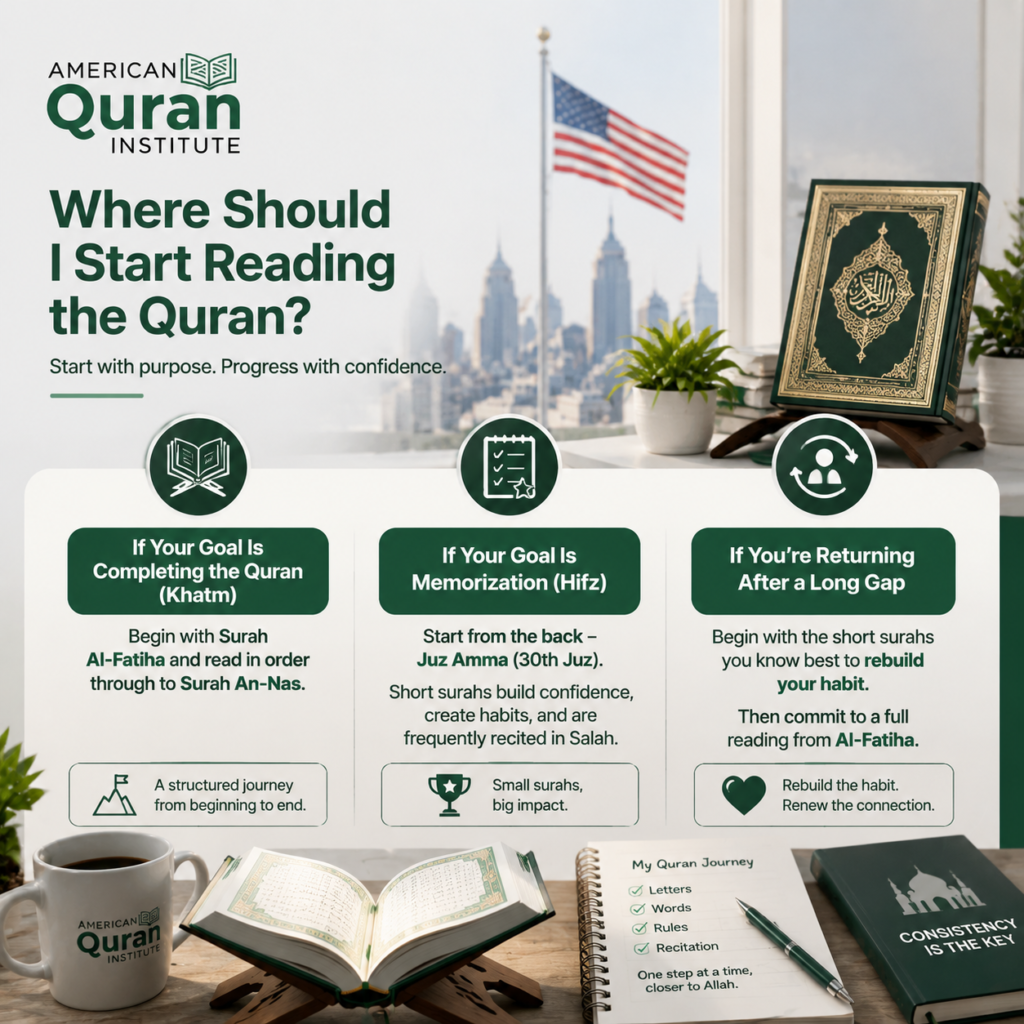
 Quran
Quran

Learning how to learn Quran recitation in the USA is one of the most meaningful commitments a Muslim can make, yet for many American Muslims, the path forward feels unclear.
Between demanding work schedules, school runs, and the absence of a traditional learning environment on every corner, finding a structured and genuinely effective approach can feel like a tall order.
The honest reality is that you don’t need to travel overseas or rearrange your life to build a strong, accurate recitation. With the right method, a qualified teacher, and steady effort, technique of how to get fluent in Quran recitation is entirely within reach; whether you’re in New York, Houston, Chicago, or a small town with no Islamic center nearby.
This guide walks through exactly how to approach Quran recitation from the ground up: from the Arabic alphabet to Tajweed application, online learning options, and the daily habits that separate learners who genuinely improve from those who plateau. Every section is written with the American Muslim’s actual life in mind, not a generalized Islamic curriculum from another country and another era.

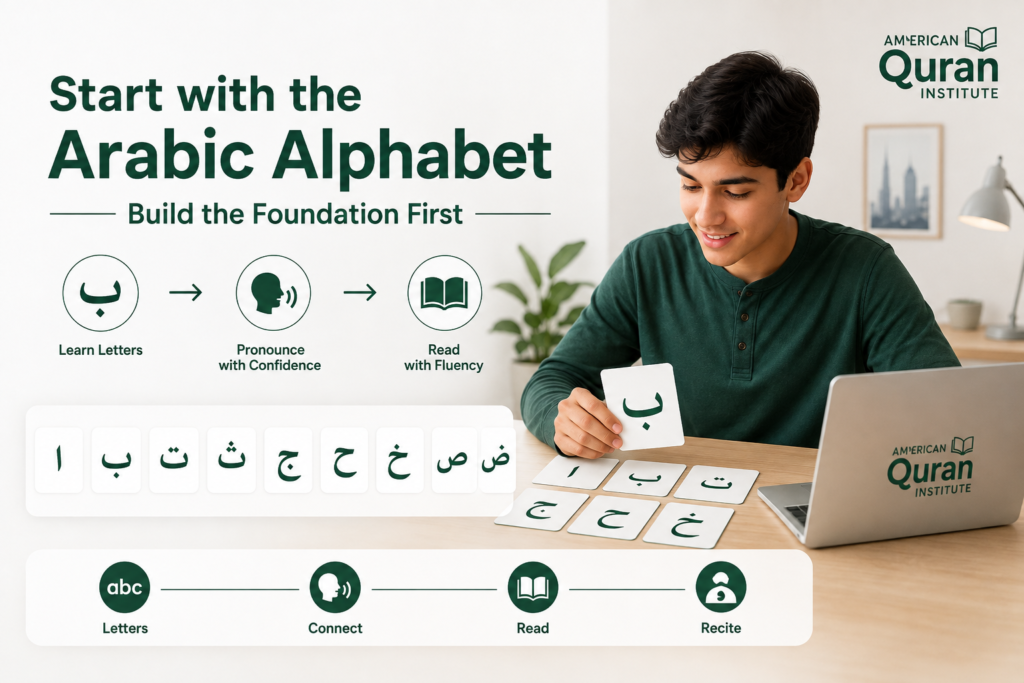
1. Start With The Arabic Alphabet If Want To Know How To Learn Quran Recitation In The USA
The most common mistake American learners make is attempting to recite Quran before mastering the Arabic script. The impulse is understandable — motivation is high and the surahs feel urgent — but the result is a shaky foundation that creates pronunciation errors that take years to undo.
A serious approach to how to learn the Quran alphabet before recitation begins is not a delay; it’s the fastest route to real fluency. Before touching a surah, a new learner needs to:
- Recognize all 28 Arabic letters in their isolated, initial, medial, and final written forms.
- Read short vowels — fathah, kasrah, dammah — and extended vowel sounds accurately.
- Understand sukoon, shadda, and tanween and how they change pronunciation.
- Distinguish letters that share visual similarity, such as ح and ج, or ص and ض.
- Read basic Arabic words from right to left with correct letter joining.
- Produce each letter from its correct articulation point, even at this early stage.
- Practice until letter recognition is automatic — no hesitation before a recitation session.
Once Arabic script feels natural, recitation accelerates quickly. Skipping this step is exactly as logical as trying to read aloud in English before learning the alphabet — and just as counterproductive.
Enroll in the Free Trial of The American Quran Institute’s classes Today
2. Choose A Teacher Who Holds An Ijazah, Not Just Good Intentions
The question that determines your outcome is not who teaches, it’s whether they are qualified to teach. The Prophet ﷺ said: “The best among you are those who learn the Quran and teach it.”
An Ijazah is an unbroken chain of recitation transmission from teacher to student, tracing directly back to the Prophet ﷺ.
A teacher with Ijazah doesn’t just know Tajweed rules from a textbook; they received the correct sound from a qualified teacher who received it from one before them.
That chain matters because Tajweed is fundamentally an oral science. Reading about the makhaarij al-huroof (articulation points) won’t teach your mouth how to produce the Arabic ع or ق — only hearing it correctly and being corrected in real time will.
A general overview of how to read the Quran can orient a beginning learner, but systematic recitation development requires live teacher feedback. Any credential short of a genuine Ijazah in Hafs ‘an ‘Asim should prompt you to ask more questions before committing.
3. Learn Tajweed To Pronounce Quran Correctly
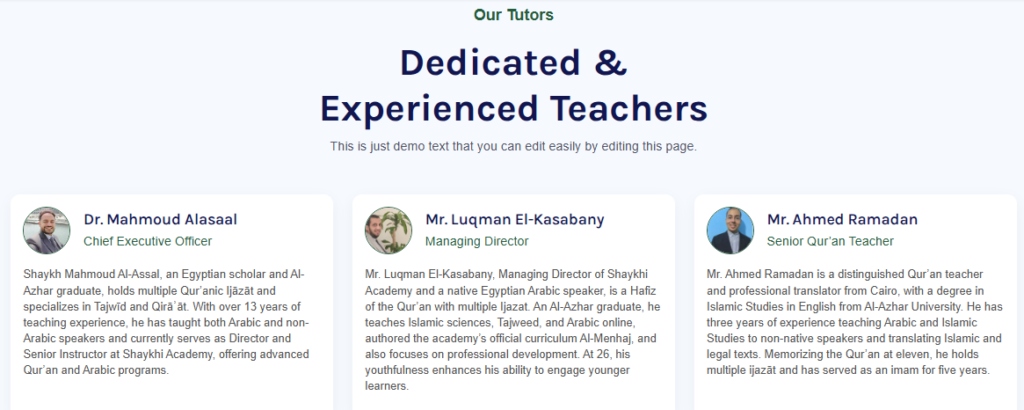
Tajweed — the science of reciting the Quran with correct pronunciation, accurate rule application, and proper rhythm — is not a natural gift. It is a skill built systematically, one layer at a time, through deliberate practice and consistent correction.
If you are wondering how to learn to read Quran with tajweed, the key is to follow a structured sequence rather than trying to master every rule at once.
Whether you are starting completely from scratch or correcting years of informal recitation, the sequence below represents an effective path for any English-speaking learner in the USA. Follow the order and resist the temptation to jump ahead. Each step assumes the previous one is solid and helps you learn to read Quran with tajweed accurately and confidently.
Establish correct articulation of every Arabic letter from its makhraj
Before any Tajweed rule makes sense in practice, you must be able to produce each Arabic letter from its correct point of articulation — the throat, the back of the tongue, the tip of the tongue, or the lips. Letters like ع, ح, ق, and ض have no English equivalents. Building correct muscle memory here is not optional.
Master the short vowels, long vowels, sukoon, shadda, and tanween
These diacritical marks govern the rhythm and meaning of every word in the Quran.
A dammah placed incorrectly does not just sound wrong — it can change the meaning of a word or sentence. Get these automatic before moving forward.
Begin Accurate Quranic Tajweed with Expert Female Tajweed Instructors

- Study the rules of Noon Saakinah and Tanween systematically These four rules — idh-haar, idghaam, iqlaab, and ikhfaa’ — appear thousands of times across the Quran. Mastering them early creates immediate, audible improvement in recitation quality. This is where most learners first notice a real difference.
- Learn the rules of Meem Saakinah Three rules govern a silent Meem: ikhfaa’ shafawi, idghaam shafawi, and idh-haar shafawi. Shorter to learn than the Noon rules but equally consistent in occurrence throughout the Quran.
- Understand the Madd (elongation) rules and their precise counts Natural Madd is two counts; other types extend to four or six. Getting these wrong creates choppy, unrecognizable recitation even when every letter is articulated correctly. Consistent length matters as much as correct sound.
Read also: how to start reading the Quran daily
See Us in Action!
Take a look inside our virtual classrooms. Watch the clip below to see how our instructors engage with students, simplify complex rules, and create an inspiring environment for learning.
Start Your Quranic Education
Join our premier online institute for structured Quranic learning tailored for students in the USA.
Book Your Free Trial4. Learn Levels Of Quran Recitation Speed
Not all recitation speeds serve the same purpose, and understanding where you are in this spectrum helps you set realistic expectations.
Islamic scholarship recognizes three accepted speeds:
- At-Tahqeeq: Deliberate, careful recitation used for learning and teaching. Every letter and rule is applied with full conscious attention. All beginners should spend the majority of their time here.
- At-Tadweer: A moderate pace that balances accuracy with natural flow. The realistic goal for intermediate students who have internalized the foundational rules.
- Al-Hadr: A faster recitation appropriate only for those who have already internalized all Tajweed rules fully. It is not a shortcut to fluency — it is a stage that follows mastery, not precedes it.
Most American learners learning how to learn Quran recitation with Tajweed should work primarily at at-tahqeeq for the first year, regardless of how advanced they feel. Speed without accuracy is not recitation. It is rushing.
Master Quran Recitation Through The American Quran Institute’s USA-Based Classes

5. Discover How To Learn Quran Recitation Online And Still Get Real Results
Online Quran recitation instruction has matured considerably. Today’s live programs can offer one-on-one sessions with Ijazah-certified teachers, real-time pronunciation correction, and schedules designed around American time zones. This flexibility makes online learning a practical option for people in the USA who are balancing work, family, and other responsibilities.
Knowing what to look for can help you avoid an expensive and disappointing experience. Before committing to any program that teaches how to learn Quran recitation online, make sure it provides live, one-on-one instruction.
Teachers should also have documented Ijazah credentials, and you should be able to ask whether the teacher holds a recitation Ijazah in Hafs ‘an ‘Asim and can provide documentation.
Scheduling and active speaking time also matter. A quality program should offer classes during US evenings and weekends across different time zones, since a convenient schedule is essential for consistent learning.
Individual sessions or small groups are generally better for receiving detailed pronunciation and Tajweed corrections.
Reputable academies should also provide separate learning tracks or suitable teachers for children, adults, sisters, and new Muslims.
Most importantly, the program should have clear progress milestones so you can understand exactly where you are in the Tajweed syllabus and measure your advancement over time.
Start Building Your Child’s Quranic Literacy Today

6. Follow The Quran Recitation Habits That Actually Move The Needle
Fluency in Quran recitation is not a switch that flips at a certain number of lessons. It is a quality that emerges gradually through accumulated correct practice.
Many learners make good progress in the early months and then stall, not because they’ve reached a limit, but because their habits aren’t structured for continued growth.
The learners who break through plateaus share a recognizable pattern. These are the habits that consistently make the difference:
A. Recite Out Loud Every Single Day, Even On Days Motivation Is Low
Silent reading does not develop recitation. Your tongue, lips, and throat need daily physical training.
Treat recitation like exercise — skip two consecutive days and you’ve already lost measurable ground.
Begin Learning Quran as a Beginner in the USA With Confidence

B. Use A Color-Coded Tajweed Mushaf Alongside Your Regular Practice
These specially printed copies of the Quran mark each Tajweed rule in a distinct color.
The visual reinforcement running parallel to your auditory practice accelerates awareness of rules in real text. Many learners report that switching to a Tajweed Mushaf immediately reduces careless errors — not because they’ve learned anything new, but because the visual cue makes invisible rules suddenly visible.
C. Slow Down Aggressively Whenever You Work On New Material
Speed is the primary enemy of early-stage accuracy. At-tahqeeq is not a crutch for beginners — even advanced students use it when approaching unfamiliar passages.
Deliberate slowness forces your mind to apply rules consciously before they become automatic. Once automatic, the speed takes care of itself.

D. Tie Your Recitation To Something That Already Happens Every Day
Recitation done “whenever I find time” rarely happens consistently. Anchor it to an existing daily habit — after Fajr, on your lunch break, before sleep. The anchor makes the new habit automatic.
Understanding how to make reading Quran more interesting can also transform a practice that feels like an obligation into one you look forward to.
E. Review The Previous Session’s Material Before Adding Anything New
Open every practice session with two to three minutes of material from the last session.
This spaced repetition approach dramatically reduces forgetting and builds long-term retention that accumulates into genuine fluency over time.
F. Keep A Recitation Journal With Teacher Feedback From Every Session
Write down the specific errors your teacher flagged, the surah and ayah range, and the rule involved. Review this list weekly.
Any error your teacher has corrected three or more times without resolution becomes your highest priority target in the next session.
G. Use Listening Time Strategically, Not Randomly
Don’t play Quran as background noise and count it as practice. Listen to a master reciter performing the same surah or passage you are currently working on.
Targeted listening — specific to your current material — calibrates your ear precisely and gives you the correct sound model before your next session.
H. Connect To The Meaning Of What You Are Reciting
Recitation driven purely by technical goals often loses momentum before fluency arrives. Learners who understand the meaning of what they recite stay consistent far longer.
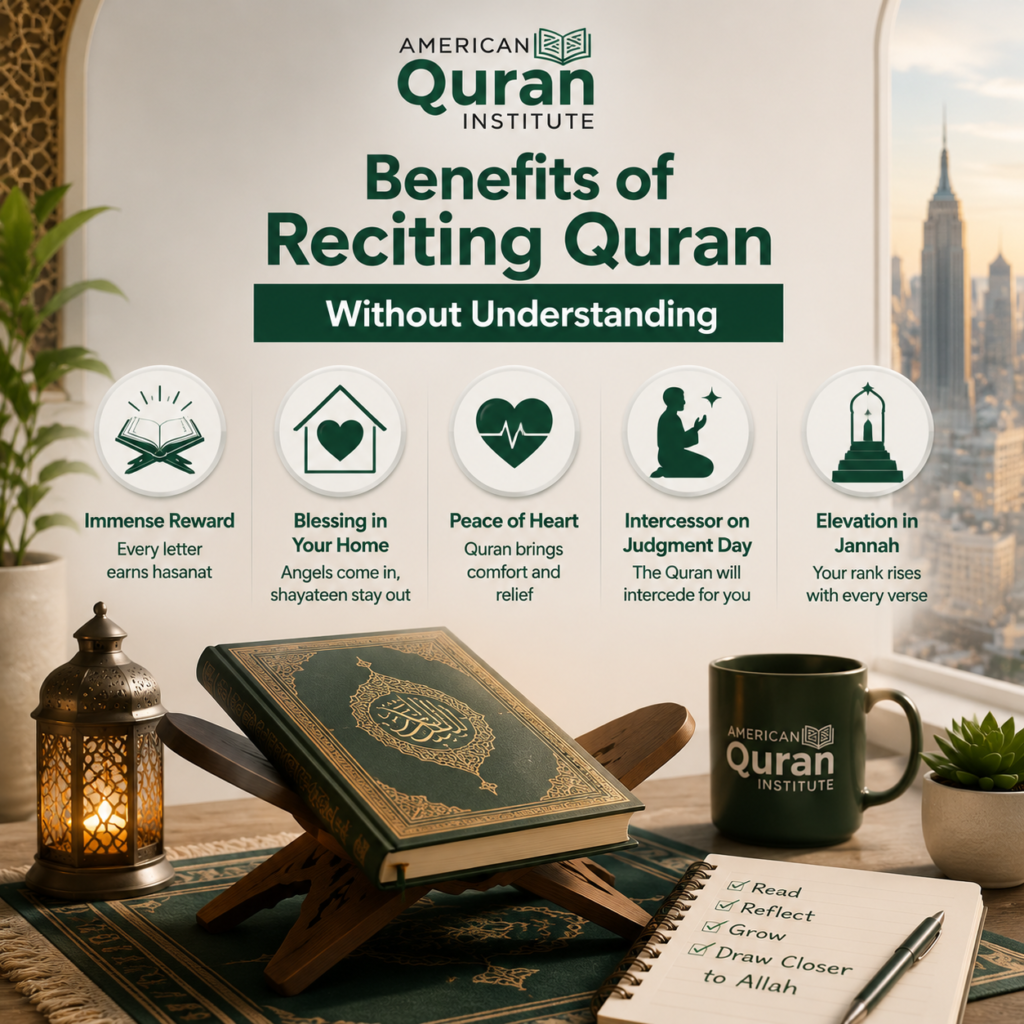
The benefits of reciting Quran extend well beyond the mechanics of pronunciation — and connecting with those benefits is, practically speaking, one of the most powerful tools for staying on track through the difficult middle stages of development.
Read also: how to read Quran as a non-Muslim
7. Staying The Course And Master What To Do When Progress Feels Like It Has Stalled
Every learner hits stretches where improvement seems to disappear — weeks where the same errors keep surfacing, sessions where familiar passages feel just as uncertain as they did months ago.
The learners who push through these periods consistently share one thing: a strong personal reason for reciting in the first place.
Reconnecting with that reason — whether it is prayer, understanding the Quran’s message, or the spiritual dimension of engaging with Allah’s words — is often more immediately useful than any technical adjustment.
Exploring powerful motivations to read Quran can restore the energy that technique alone can’t provide when the grind gets heavy.
For learners who have built a solid recitation foundation and want to increase how much they can cover in a single sitting, the question of how to read the Quran faster — without sacrificing accuracy — becomes the natural next goal.
Speed, properly developed, is a byproduct of deep accuracy, not a shortcut to it.
Explore our Tajweed Course for Kids in the USA

Experience Our Classroom Environment
Don’t just take our word for it—experience a live session for yourself! Click on the videos below to watch real snippets from our classes and see our interactive teaching methods in real-time.
Start Your Quranic Education
Join our premier online institute for structured Quranic learning tailored for students in the USA.
Book Your Free TrialBegin Your Recitation Journey With American Quran Institute
Your recitation doesn’t have to wait for the right city, the perfectly quiet house, or a schedule that finally opens up. It needs one thing: the right teacher and the decision to start.
American Quran Institute offers live, one-on-one Quran recitation classes with Ijazah-certified instructors, scheduled around US time zones, and designed specifically for English speakers at every level.
Whether you’re a complete beginner, a parent enrolling your child, a sister looking for a qualified female teacher, or a new Muslim taking your first steps with the Arabic alphabet, there is a structured program built around your starting point.
Book your free trial class today and find out what consistent, expert-guided Quran learning actually feels like.
Our Quran Courses
- Quran Online Academy
- Quran Recitation Classes
- Quran Reading Classes
- Online Quran Classes for Kids
- Quran Classes for Adults
- Quran Classes for Female/Sisters
- Learn Quran Course for Beginners
- Quran Qirat Learning Course
- Quran Tafsir Course
- Noorani Qaida Course
- Noorani Qaida Course for Kids
- Weekend Quran Classes
- Intensive Quran Course
- Al-Azhar Quran Course
Our Memorization Courses
- Quran Memorization (Hifz) Course
- Hifz Classes for Adults
- Quran Memorization and Hifz Course for Kids
- Quran Hifz Course for Ladies
- Quran Ijazah Program

Start Your Quranic Education
Join our premier online institute for structured Quranic learning tailored for students in the USA.
Book Your Free TrialConclusion
Learning how to learn Quran recitation in the USA is not a pipe dream held back by geography or schedule. It is achievable — by adults managing full careers, by parents committed to their children’s Islamic education, by new Muslims starting from the very beginning, and by anyone in between.
What the journey requires is the right sequence: Arabic letters before recitation, an Ijazah-certified teacher before independent practice, consistent daily engagement before fluency arrives on its own.
The results of learn Quran recitation with Tajweed are cumulative — each correct habit compounds over months into the kind of recitation that feels natural, sounds accurate, and carries genuine spiritual weight.
Start where you are. Show up consistently. And work with a teacher who can hear the difference between a letter articulated correctly and one nearly correct — because in Quran recitation, that distinction is everything.
Frequently Asked Questions
How long does it take to learn Quran recitation with Tajweed?
Most beginners studying with a qualified teacher two to three times per week achieve correct, fluent recitation of short surahs within six to twelve months.
Applying all Tajweed rules consistently across the full Quran typically takes two to four years of regular, corrected practice. The timeline depends far less on native ability than on session frequency and the quality of teacher feedback.
Can I learn Quran recitation online as an adult in the USA?
Yes — and for most American adults, online instruction is the most practical option available. Programs designed around US time zones offer live one-on-one sessions in the evenings and on weekends, making consistent attendance realistic alongside demanding schedules.
The key distinction is live sessions with corrective feedback versus pre-recorded video libraries. Only the former develops actual pronunciation.
What is the first step to learn Quran recitation for a complete beginner?
The first step is mastering the Arabic alphabet and its vowel marks — not reciting surahs. Every letter in its four written forms, every vowel mark, sukoon, and shadda needs to be automatic before recitation begins.
A structured guide on how to read Quran for beginners walks through this correctly. Attempting recitation before Arabic script is solid is the single most common mistake beginners make — and the hardest one to correct afterward.
How do I get fluent in Quran recitation without plateauing?
Fluency comes from three elements working together: daily out-loud practice, frequent and focused listening to master reciters, and regular real-time correction from a qualified teacher.
There are no shortcuts around the third element. Errors rehearsed without correction embed progressively deeper, and many mispronunciations are genuinely inaudible to an untrained ear.
Is it possible to learn to read the Quran with Tajweed without a teacher?
You can study the theory of Tajweed independently, and that theoretical knowledge has real value. However, the oral transmission element, a qualified teacher listening to your recitation in real time and correcting it, cannot be replicated through books, apps, or recordings.
This is not a bureaucratic formality; it is how the Quran has been transmitted since the Prophet ﷺ.
What does “learn Quran recitation with Tajweed” actually mean in practice?
Tajweed is the complete set of rules governing how the Quran is recited, covering correct letter articulation, proper elongation of vowels, treatment of silent letters, and the manner in which words connect across a passage.
Reciting with Tajweed means applying these rules consistently throughout recitation, as transmitted from the Prophet ﷺ through an unbroken oral chain.






Leave a Reply